REVIEW 1 major objections 3 minor 14 references
On the Planar Edge-Length Ratio of Planar Graphs
T0 review · 1 major / 3 minor · reviewed 2026-08-14 · deepseek-v4-flash
Pith's one-line read Some planar graphs force edge-length ratios that grow linearly with n, while treewidth-2 graphs always have sublinear ratio.
desk verdict Settles the planar edge-length ratio at Theta(n) and gives the first sublinear bound for treewidth-2 graphs, but the bipartite theorem's proof has a false augmentation step that needs a fix. read the letter →
The pith
A machine-rendered reading of the paper's core claim, the machinery that carries it, and where it could break.
The reading
What carries the argument
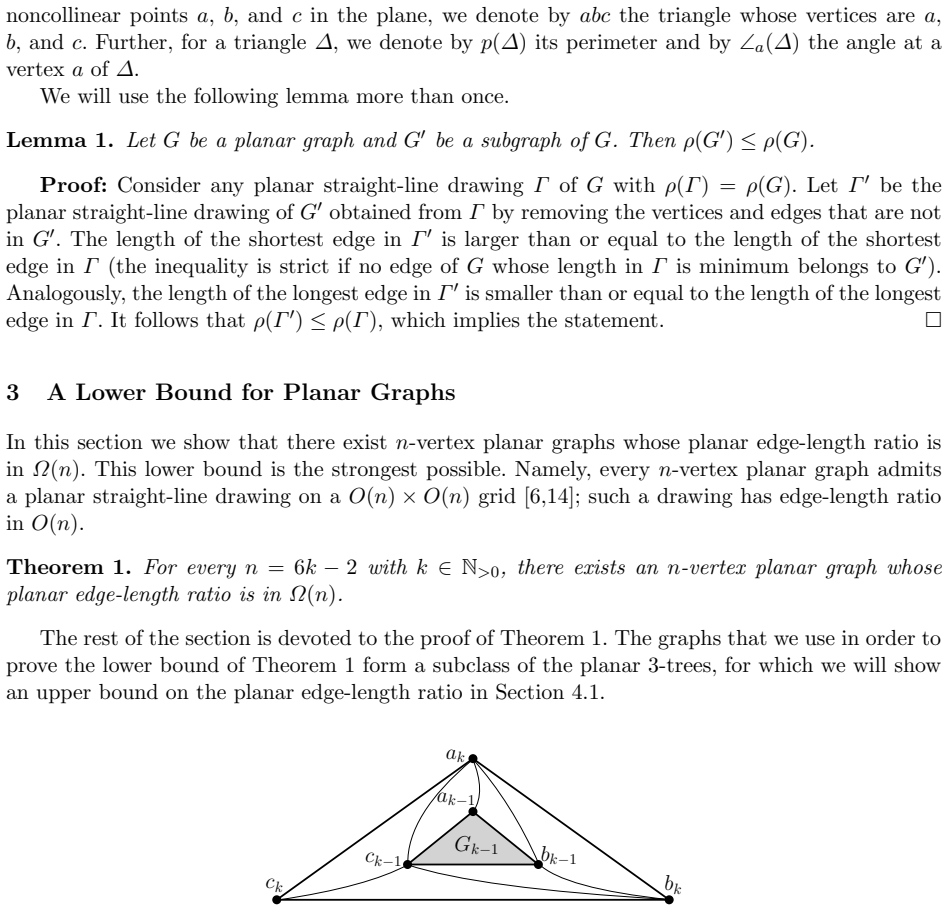
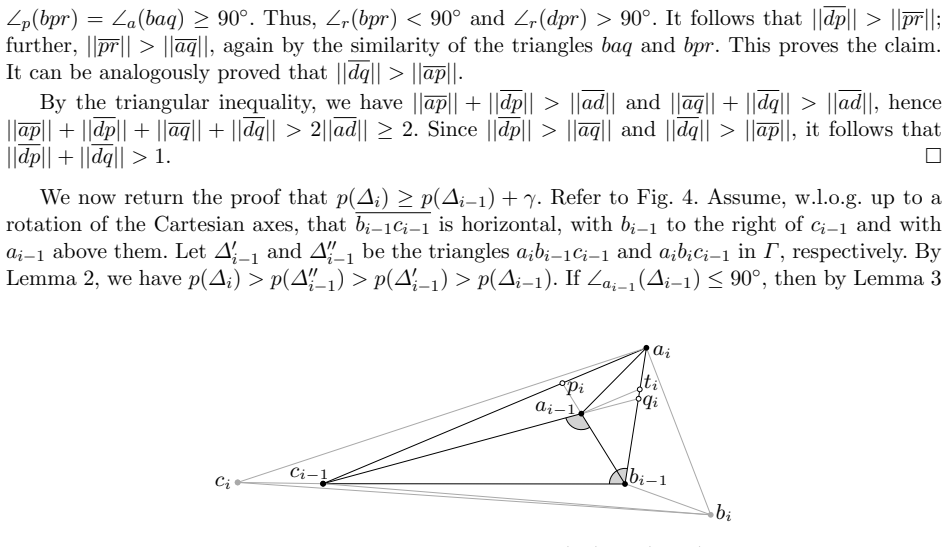
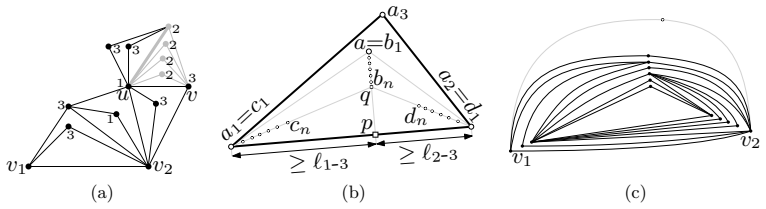
The load-bearing construction for the treewidth-2 bound is the linear 2-tree decomposition: every 2-tree contains a linear 2-tree subgraph $H$, drawn by the L2T-drawer algorithm, which assigns vertices three colour classes and guarantees that every edge of class 1-2, 1-3, or 2-3 has length at least a prescribed value. Removing $H$ splits the graph into $H$-components whose largest sizes $x,y,z$ satisfy $z\le n/2$ and either $x\le n/2$ with $y\le (n-x)/2$, or symmetrically. The recursion uses $f(n)=n^{\log_2\varphi}$, with the defining property that $f(n)\ge f(x)+f(y)$ holds under exactly these balance conditions; the golden ratio enters because $1/\varphi+1/\varphi^2=1$ makes the inequality tight at $x=n/2$, $y=n/4$. For the lower bound, the machinery is a family of nested triangles $G_k$, where a perimeter-growth lemma forces the outer triangle's perimeter to increase by a constant at each of $k$ layers.
What would settle it
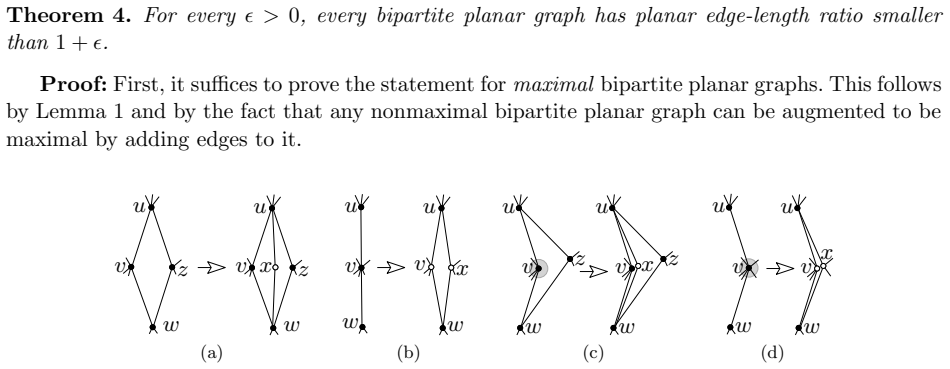
Test the first reduction of the bipartite theorem on the star $K_{1,3}$: no edge additions can turn it into a maximal bipartite planar graph without adding vertices or changing the bipartition, so the proof's reduction is invalid for this input and the argument must be repaired there.
Extended reading notes
Core claim
The paper's central claim is that the planar edge-length ratio—the smallest possible ratio between the longest and shortest edge in a planar straight-line drawing—is controlled sharply by treewidth. For $n=6k-2$ it constructs a planar graph by gluing two copies of a nested-triangle plane 3-tree to a complete graph on four vertices, and proves any planar drawing of it has ratio $\Omega(n)$; since an $O(n)\times O(n)$ grid drawing gives ratio $O(n)$ for every planar graph, this is tight. For graphs with treewidth at most two, it proves a sublinear upper bound $\rho(G)\in O(n^{\log_2\varphi})$ with $\varphi=(1+\sqrt{5})/2$, by decomposing any 2-tree into a linear 2-tree spine whose removal leaves small components, drawing the spine with prescribed edge-length classes, and recursing. It also proves that plane 3-trees of depth $k$ have ratio $O(k)$, and that every bipartite planar graph has ratio below $1+\varepsilon$ for any $\varepsilon>0$.
Load-bearing premise
Two borrowed assumptions carry the sharpest results: the 2-tree bound assumes the golden-ratio inequality $f(n)\ge f(x)+f(y)$ holds for every component-size pair produced by the decomposition, and the bipartite bound assumes every bipartite planar graph can be made maximal bipartite planar by adding only edges—a step that fails for a star with at least three leaves.
Editorial extensions
If this is right
- The planar edge-length ratio of planar graphs is $\Theta(n)$ in the worst case, so the standard $O(n)\times O(n)$ grid drawing cannot be improved asymptotically on ratio grounds.
- Every series-parallel graph, and more generally every treewidth-2 graph, admits a planar straight-line drawing with edge-length ratio $O(n^{0.695})$.
- Bipartite planar graphs have planar edge-length ratio approaching $1$, so their edges can be made nearly uniform in length.
- The lower-bound graphs have treewidth 3, so the transition from sublinear to linear planar edge-length ratio is sharp at treewidth 3 within these families.
- If crossings are allowed but vertex-edge overlaps are forbidden, planar graphs have edge-length ratio $O(1)$ by combining the paper's chromatic-number result with the four-colour theorem, in contrast to the linear lower bound for planar drawings.
Reading between the lines
- Beyond the paper's own claims: because the golden-ratio inequality is tight at component sizes $x=n/2$ and $y=n/4$, the exponent $\log_2\varphi\approx 0.695$ is likely the best this decomposition can deliver; improving the bound would require a stronger decomposition lemma or a different drawing primitive, neither of which the paper proposes.
- Also editorial: the bipartite proof's first reduction—augmenting to a maximal bipartite planar graph by adding edges—fails for stars such as $K_{1,3}$; since stars themselves have ratio $1$, the theorem may still be true, but the proof needs a repair such as allowing added vertices or a separate base case.
- A natural next test is whether the spine decomposition generalizes to graphs of bounded treewidth $k$, with the exponent governed by a generalized balance equation that would interpolate between $0.695$ and $1$; the paper does not attempt this generalization.
Signed reviews
Editorial analysis
A structured set of objections, weighed in public.
Referee Report
Summary. The paper studies the planar edge-length ratio of planar graphs, defined as the minimum over planar straight-line drawings of the ratio between the longest and shortest edge lengths. It proves an Omega(n) lower bound for infinitely many n-vertex planar graphs and notes that this is tight because every planar graph admits an O(n) by O(n) grid drawing. For upper bounds, the paper proves that plane 3-trees of depth k have planar edge-length ratio O(k), that every n-vertex 2-tree (and hence every n-vertex graph of treewidth at most 2) has planar edge-length ratio O(n^{log_2 phi}) with log_2 phi < 0.695, and that every bipartite planar graph has planar edge-length ratio below 1+epsilon. The lower-bound proof uses a concrete family of nested plane 3-trees and two perimeter-growth lemmas; the 2-tree result uses a decomposition into a linear 2-tree plus small components, following a technique of Chan; the bipartite result uses the inductive generation of maximal bipartite plane graphs by operations P0 and P1.
Significance. If the results are established, this is a substantial contribution to a recently active area. The linear lower bound answers the natural order-of-magnitude question for general planar graphs, and the sublinear upper bound for 2-trees provides a sharp counterpart to the Omega(log n) lower bound of Blazek et al. The plane 3-tree depth bound and the near-1 bound for bipartite planar graphs are also strong. The paper is careful in its explicit geometric arguments, particularly the perimeter lemmas and the concrete nested-triangle construction. However, the proof of Theorem 4 contains a false reduction at its first step, and this is load-bearing for one of the advertised results; the paper therefore cannot be accepted in its present form.
major comments (1)
- [Section 4.3, proof of Theorem 4, first paragraph] The reduction to maximal bipartite planar graphs is false. For G = K_{1,m} with m >= 3, the bipartition is unique: the center forms one part and all leaves form the other. No edge can be added between two leaves without placing two vertices in the same part, and every possible edge from the center is already present. Hence no edge-maximal bipartite planar supergraph on the same vertex set exists, and in particular G cannot be augmented to the plane quadrangulations used in the induction based on the operations P0 and P1 of Brinkmann et al. The remaining proof only handles maximal bipartite plane graphs that are quadrangulations, so Theorem 4 is not established for stars or, more generally, for non-quadrangulated bipartite planar graphs. The claim may be repairable, for instance by proving that every bipartite planar graph is a subgraph of a maximal bipartite planar graph on a superset of vertices (K_{1,m} is a subgraph of K_{2,m}) and then applying Lemma 1, but that argument is not present and must be supplied.
minor comments (3)
- [Section 4.2, proof of Theorem 3] The proof asserts that x, y, and z are all at least 1, but z can be 0 when H contains no class 1-2 edge other than the root; the 3-vertex 2-tree is an example. The argument is salvageable by defining f(0) = 0 and relaxing the input condition of L2T-drawer for edge classes that do not occur in H, but the text should be corrected.
- [Section 4.2, Theorem 3] The inequality f(n) >= f(x) + f(y) is quoted from Chan [5] without stating the result itself. Since the sublinear exponent depends on this inequality, it would improve the paper to state the lemma explicitly together with the exact hypotheses under which it applies.
- [Section 4.3, proof of Theorem 4] After the augmentation step is fixed, the phrase 'maximal bipartite planar graph' should be clarified, because the term is used differently in the edge-maximal sense and in the sense of plane quadrangulations used by Brinkmann et al.; the current transition between the two meanings is a source of the gap described in the major comment.
Circularity Check
No circular reasoning found; the proofs are self-contained constructions that rely on external, independently established results, with no fitted parameter disguised as a prediction.
full rationale
The paper's main claims are derived from explicit constructions and standard external theorems, not from assumptions equivalent to the conclusions. Theorem 1 constructs a family of plane graphs G_k and proves a geometric perimeter-increase lemma (Lemmata 2 and 3) to establish an Omega(n) lower bound; the constant gamma = 0.3 is an internal proof parameter chosen to satisfy the inequalities, not fitted to the target ratio. Theorem 2 gives an explicit recursive drawing invariant for plane 3-trees, with edge lengths bounded by the tree depth; the invariant is verified geometrically, not imported from the result itself. Theorem 3 uses a decomposition lemma (Lemma 4) whose proof is self-contained, and it invokes Chan [5] only for the inequality f(n) >= f(x)+f(y) with f(n)=n^{log2 phi}, which is an external, parameter-free mathematical fact; the recursive drawing then plugs in component sizes and the bound follows by induction. The golden-ratio exponent is not obtained by fitting a constant to the desired O(n^{0.695}) claim; it is the solution of the recurrence imported from Chan. Theorem 4 uses the structural characterization of maximal bipartite planar graphs by Brinkmann et al. [3] and a continuity/local expansion argument; no parameter is fitted to the epsilon target. Theorem 5 directly constructs drawings from colorings and colorings from drawings, which is a legitimate two-way derivation, not a circular equivalence. The only notable weakness is in Theorem 4's opening reduction: the assertion that every nonmaximal bipartite planar graph can be augmented to a maximal one by adding edges is false for stars such as K_{1,m}. That is a correctness gap in the proof, not a circularity: the theorem's statement is not assumed as an input, and the proof does not secretly presuppose the target ratio. Similarly, the reliance on Chan's inequality is a black-box external lemma, but it is not self-citation and does not smuggle in the conclusion. No step in the derivation chain equates a predicted quantity with a fitted input, and no load-bearing inference reduces to the authors' own prior work without independent verification. Therefore the circularity score is 0.
Assumptions & free parameters
free parameters (1)
- gamma =
0.3
assumptions (5)
- standard math Every n-vertex planar graph has a planar straight-line drawing on an O(n) by O(n) grid [6,14].
- standard math Chan's inequality: for f(n) = n^{log_2 phi}, f(n) >= f(x) + f(y) whenever x <= n/2 and y <= (n - x)/2, or symmetrically.
- standard math Fary's theorem on straight-line planar drawings and the continuity of vertex expansion.
- standard math Brinkmann et al. [3] generation theorem for maximal bipartite plane graphs by operations P0 and P1.
- standard math Four-color theorem.
Cite this review
Pith. "Pith review of On the Planar Edge-Length Ratio of Planar Graphs." pith.science (2026). https://pith.science/paper/IHU5TCCS
@misc{pith2026190803586,
  author       = {Pith},
  title        = {Pith review of: On the Planar Edge-Length Ratio of Planar Graphs},
  year         = {2026},
  howpublished = {\url{https://pith.science/paper/IHU5TCCS}},
  note         = {Machine review of arXiv:1908.03586}
}
abstract
The edge-length ratio of a straight-line drawing of a graph is the ratio between the lengths of the longest and of the shortest edge in the drawing. The planar edge-length ratio of a planar graph is the minimum edge-length ratio of any planar straight-line drawing of the graph. In this paper, we study the planar edge-length ratio of planar graphs. We prove that there exist $n$-vertex planar graphs whose planar edge-length ratio is in $\Omega(n)$; this bound is tight. We also prove upper bounds on the planar edge-length ratio of several families of planar graphs, including series-parallel graphs and bipartite planar graphs.
Figures


Figures from the paper (9 more)





Reference graph
Works this paper leans on
-
[1]
On the edge-length ratio of 2-trees
Blazej, V., Fiala, J., Liotta, G., Lomic, S.: On the edge-length ratio of 2-trees. CoRR abs/1909.11152 (2019)
work page Pith review arXiv 2019
-
[2]
In: Chaplick, S., Kindermann, P., Wolff, A
Blazej, V., Fiala, J., Liotta, G., Lomic, S.: On the edge-length ratio of 2-trees. In: Chaplick, S., Kindermann, P., Wolff, A. (eds.) 36th European Workshop on Computational Geometry (EuroCG ’20). pp. 35:1–35:6 (2020) 1 In this proof we actually only use the fact that the length of every edge in Γ is greater than 0. 16
work page 2020
-
[3]
Discrete Mathematics 305(1-3), 33–54 (2005)
Brinkmann, G., Greenberg, S., Greenhill, C.S., McKay, B.D., Thomas, R., Wollan, P.: Generation of simple quadrangulations of the sphere. Discrete Mathematics 305(1-3), 33–54 (2005)
work page 2005
-
[4]
Cabello, S., Demaine, E.D., Rote, G.: Planar embeddings of graphs with specified edge lengths. J. Graph Algo- rithms Appl. 11(1), 259–276 (2007)
work page 2007
-
[5]
Algorithmica 34(1), 1–13 (2002)
Chan, T.M.: A near-linear area bound for drawing binary trees. Algorithmica 34(1), 1–13 (2002)
work page 2002
-
[6]
Combinatorica 10(1), 41–51 (1990)
de Fraysseix, H., Pach, J., Pollack, R.: How to draw a planar graph on a grid. Combinatorica 10(1), 41–51 (1990)
1990
-
[7]
Prentice-Hall (1999)
Di Battista, G., Eades, P., Tamassia, R., Tollis, I.G.: Graph Drawing: Algorithms for the Visualization of Graphs. Prentice-Hall (1999)
1999
-
[8]
Discrete Applied Mathematics 28(2), 111–134 (1990)
Eades, P., Wormald, N.C.: Fixed edge-length graph drawing is NP-hard. Discrete Applied Mathematics 28(2), 111–134 (1990)
work page 1990
Show all 14 references
-
[9]
Acta Sci
F´ ary, I.: On straight line representions of planar graphs. Acta Sci. Math. (Szeged) 11, 229–233 (1948)
1948
-
[10]
Discrete Mathematics & Theoretical Computer Science 12(5), 139–174 (2010)
Frati, F.: Lower bounds on the area requirements of series-parallel graphs. Discrete Mathematics & Theoretical Computer Science 12(5), 139–174 (2010)
2010
-
[11]
In: Frati, F., Ma, K
Lazard, S., Lenhart, W., Liotta, G.: On the edge-length ratio of outerplanar graphs. In: Frati, F., Ma, K. (eds.) 25th International Symposium on Graph Drawing and Network Visualization (GD 2017). LNCS, vol. 10692, pp. 17–23. Springer (2017)
2017
-
[12]
Lazard, S., Lenhart, W.J., Liotta, G.: On the edge-length ratio of outerplanar graphs. Theor. Comput. Sci. 770, 88–94 (2019)
2019
-
[13]
Mondal, D., Nishat, R.I., Rahman, M.S., Alam, M.J.: Minimum-area drawings of plane 3-trees. J. Graph Algo- rithms Appl. 15(2), 177–204 (2011)
2011
-
[14]
In: Johnson, D.S
Schnyder, W.: Embedding planar graphs on the grid. In: Johnson, D.S. (ed.) ACM-SIAM Symposium on Discrete Algorithms (SODA ’90). pp. 138–148 (1990) 17
1990
Reviewed August 14, 2026 · model on record in the stance chip above.
Discussion (0). Continue with ORCID to comment.