REVIEW 4 major objections 6 minor 24 references
Correlation of high energy neutrinos and gamma rays on the direction of Fermi Bubbles
T0 review · 4 major / 6 minor · reviewed 2026-08-14 · deepseek-v4-flash
Pith's one-line read The paper argues that the ten IceCube neutrinos reconstructed inside the Northern Fermi Bubble cannot be connected to the bubble's gamma-ray emission through a single lepto-hadronic model, so they likely have a different origin, while the…
desk verdict An honest, clearly written conference paper, but the Northern Bubble non-association is not established by the background-free event count and hand-picked fits. read the letter →
The pith
A machine-rendered reading of the paper's core claim, the machinery that carries it, and where it could break.
The reading
What carries the argument
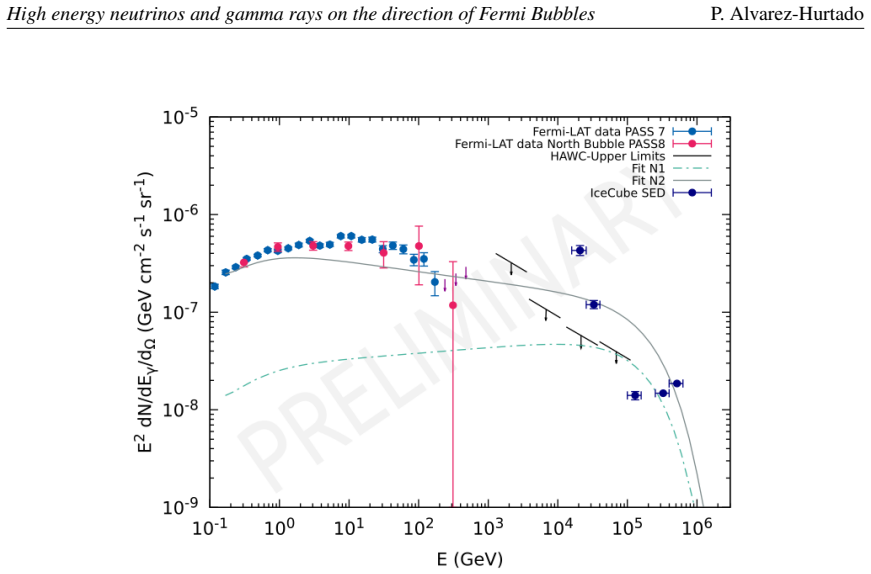
The load-bearing object is the hadronic proton spectrum $J_p(E_p) = A_{0\gamma} E_p^{-\alpha_\gamma} \exp[-(E_p/E_{0\gamma})^\beta]$ (Eq. 3.1), built on analytic proton-proton collision spectra, embedded in a hybrid model with a leptonic inverse-Compton component. The method works by fitting this spectrum to gamma-ray data to fix $A_{0\gamma}$, $\alpha_\gamma$, and $E_{0\gamma}$ for two parameter choices per bubble, then comparing the predicted neutrino flux with the IceCube-inferred flux $\phi_\nu E_\nu^2 = n E_\nu/(4\pi A t)$; the inconsistency in the Northern Bubble is the basis for the non-association claim.
What would settle it
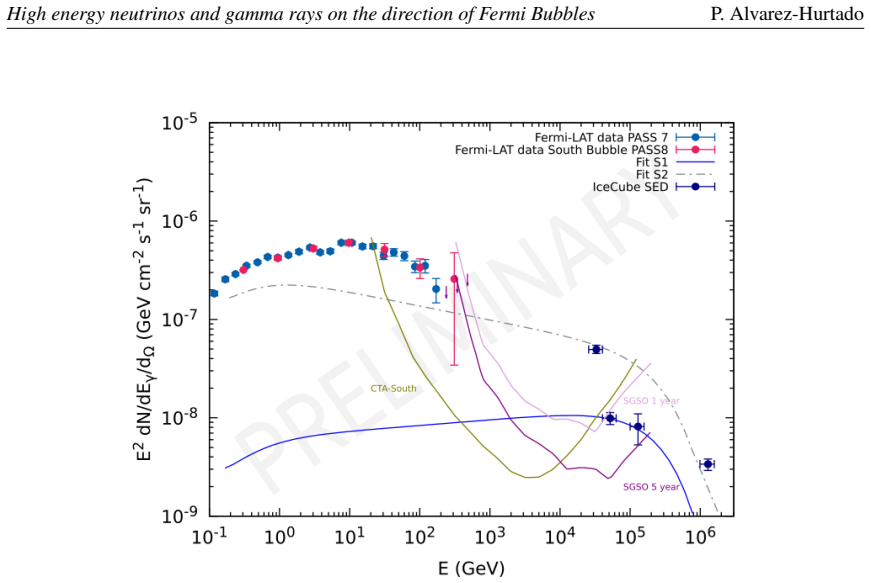
Compute a single-zone hadronic model with a different proton spectrum, such as a broken power law or log-parabola, and scan parameters against Fermi-LAT, HAWC upper limits, and IceCube fluxes for the Northern Bubble; if any parameter set fits all three within uncertainties, the non-association conclusion is falsified. Alternatively, a future CTA or SGSO detection of very-high-energy gamma rays from the Southern Bubble with a spectrum matching its neutrino flux would prove association there.
Extended reading notes
Core claim
The central claim is that the high-energy neutrino events (two tracks and eight showers, above 30 TeV) reconstructed inside the Northern Fermi Bubble's solid angle cannot be connected to the observed Fermi-LAT gamma-ray emission through a single lepto-hadronic model, and therefore those neutrinos likely originate elsewhere. For the Southern Bubble, one of the two model fits can accommodate both the gamma rays and the neutrinos, but without very-high-energy upper limits the association remains unproven rather than excluded.
Load-bearing premise
The conclusion rests on the assumption that the adopted proton spectrum with the two hand-picked parameter sets per bubble covers all plausible hadronic emission models; if some other spectral shape or a multi-component model fit both the gamma-ray and neutrino data simultaneously, the non-association would not follow.
Editorial extensions
If this is right
- If correct, IceCube's Northern Bubble neutrino events should be treated as background or as tracers of a different source class, not as evidence for hadronic acceleration in the bubble.
- The Southern Bubble remains a target for next-generation very-high-energy observatories; CTA and SGSO could confirm or reject hadronic emission there.
- The 1 PeV event IC14 near the Galactic center deserves separate scrutiny; its origin may be the central black hole rather than the bubble.
- A subdominant hadronic component can coexist with leptonic emission, so future multi-messenger fits should include both components rather than pure hadronic ones.
Reading between the lines
- The paper's two-fit-per-bubble scan is not exhaustive; a fuller parameter scan over $\alpha_\gamma$, $E_{0\gamma}$, and $\beta$ might find a region where a single model fits both gamma rays and neutrinos, which would overturn the 'cannot' conclusion.
- If the Northern Bubble non-association holds, the IceCube events likely come from unresolved point sources, such as Sgr A* flares or pulsars, within the bubble region; this could be tested by stacking analyses with improved angular resolution.
- The same hybrid-model test could be applied to other extended Galactic sources with both gamma-ray and neutrino data, offering a systematic way to identify which structures are truly hadronic emitters.
- The flux estimate in Eq. (3.2) uses a constant effective area; incorporating IceCube's energy-dependent exposure would yield a more robust neutrino flux and could change the comparison.
Signed reviews
Editorial analysis
A structured set of objections, weighed in public.
Referee Report
Summary. The paper investigates whether the high-energy neutrinos detected by IceCube in the direction of the Fermi Bubbles can be produced by the same hadronic mechanism that, together with a leptonic inverse-Compton component, accounts for the Fermi-LAT gamma-ray spectrum and the HAWC upper limits. Using 10 IceCube events (8 showers and 2 tracks) inside the bubble region, eight years of Fermi-LAT data, HAWC upper limits, and a proton spectrum with an exponential cutoff, the authors fit two parameter sets per bubble. They conclude that the Northern Bubble neutrinos are not associated with the gamma-ray emission through a single hadronic model, while a Southern Bubble association remains possible. The paper is an ICRC2019 proceedings contribution.
Significance. If firmly established, the non-association claim for the Northern Bubble would be a useful multimessenger constraint on the origin of both the Fermi Bubbles and the IceCube events in that sky region. The paper draws on public data from three observatories and attempts a lepto-hadronic description, which is a reasonable exercise for a proceedings paper. The authors are appropriately cautious about the Southern Bubble and point to CTA and SGSO as future decisive tests. However, the central claim currently rests on a very small event sample and on two ad hoc fits per bubble, and the analysis lacks background subtraction, significance testing, and parameter uncertainties; the result is suggestive rather than conclusive.
major comments (4)
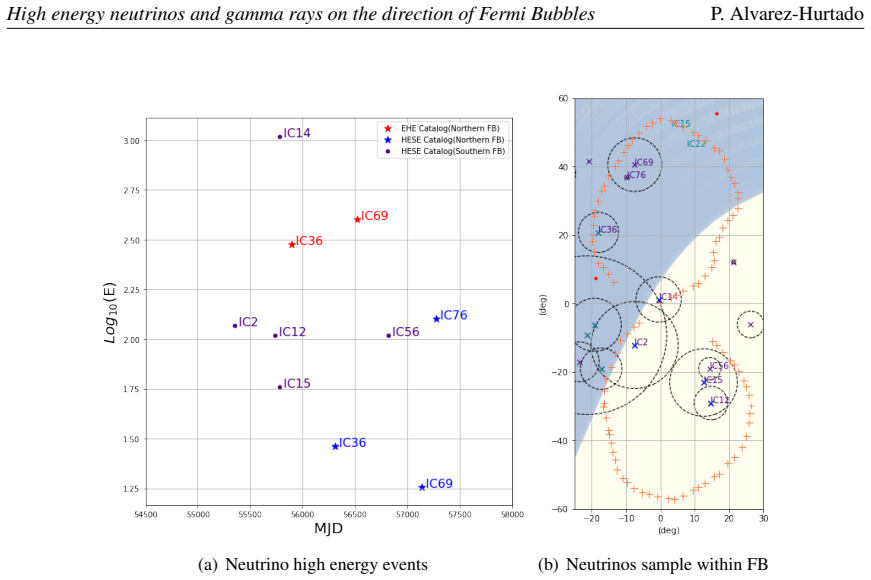
- [Section 3, Eq. (3.2)] The neutrino flux used in the comparison is obtained by converting all 10 events in the bubble region into a source flux, with n in Eq. (3.2) set to the total event count. No atmospheric-neutrino background expectation for the Fermi Bubble solid angle is computed, and no significance of the spatial excess is reported. Since the HESE shower events have angular resolutions of order 10-15 degrees and the bubbles cover a large solid angle, the expected number of background events over 2101 days is not negligible. If the observed count is compatible with background, the plotted neutrino flux is not a bubble flux, and the failure of fits N1/N2 to describe it does not support the conclusion of non-association. The authors should provide the background prediction and a Poisson or binomial significance for the excess.
- [Section 3, Table 2 and Figs. 2-3] The conclusion that the neutrino and gamma-ray emissions are "not associated through a single model" is based on only two manually chosen parameter sets per bubble. No fitting algorithm, goodness-of-fit measure, or uncertainties on A0γ, αγ, and E0γ are given, and the text describes the fits only qualitatively. Because the claim concerns the whole family of spectra of the form in Eq. (3.1), the authors should scan the parameter space or otherwise demonstrate that the two chosen sets bracket the hadronic models compatible with the gamma-ray data; ideally, they would perform a joint fit to gamma-ray and neutrino data and quote a test statistic. As it stands, the analysis only shows that two particular models do not simultaneously match both datasets.
- [Section 3, first paragraph] The timescale argument used to justify the hadronic scenario is internally inconsistent. For the 1 µG case the text quotes t_acc = 3.5 yr, t_pp = 3.5×10^9 yr, and t_esc = 3.2×10^9 yr, which violates the stated condition t_acc < t_pp ≲ t_esc because t_pp exceeds t_esc. This matters because the ordering is used to argue that pp interactions can produce neutrinos before escape. The authors should clarify the magnetic field and confinement assumptions and recompute the timescales, or state which of the quoted values is in error.
- [Section 3, Eq. (3.2)] The effective area A is not specified, although the sample combines 8 shower events and 2 track events from different catalogs (HESE and EHE) with different angular resolutions and effective areas. A single effective area cannot correctly convert the mixed event sample into a flux. The authors should provide the effective area as a function of energy and topology used for each event, or restrict the analysis to a homogeneous sample. Without this, the neutrino flux points in Figs. 2-3 are not reproducible and the comparison to the models is not quantitative.
minor comments (6)
- [Section 2, Table 1] The event list in the text includes "IC15" twice, matching both a shower (HESE) and a track (EHE) entry in Table 1. If these are distinct events, the notation should distinguish them; if they are the same event, one entry is erroneous.
- [Section 3, after Table 2] The text says "the cut-off energy varies from a minimum of 1.7 TeV to 3 PeV," which contradicts Table 2, where E0γ is listed in PeV and the minimum is 1.7 PeV.
- [Throughout] Typos include "Nothern" for "Northern," "Cerenkov" for "Cherenkov," and "a few Gauss∼ 2µG" in Section 3, which should presumably read "a few µG."
- [Section 3] The sentence "The maximum energy that protons can be accelerated is obtained through the timescales" is not supported by any calculation or equation; this statement should either be derived or removed.
- [Figures 2-3] The figures are not described in enough detail: the neutrino flux points do not appear to show error bars in the text version, and the legends are not visible in the manuscript text. The authors should add error bars and clarify the plotted curves.
- [References] Some references are incomplete, e.g., [15] lists only an arXiv identifier without authors or journal, and [24] is missing a DOI. Please complete the bibliography.
Circularity Check
No significant circularity: the model-comparison test uses independently fitted gamma-ray spectra and observed neutrino counts.
full rationale
The paper's central step is a model-comparison test rather than a derivation whose output is equivalent to its input. Equation (3.2) converts the 10 IceCube events into an observed neutrino-flux estimate from event counts, which is a data-reduction expression, not a fitted parameter or a prediction. The proton spectra in Table 2 are fitted to Fermi-LAT gamma-ray data (and HAWC upper limits for the Northern Bubble), and the corresponding neutrino fluxes are computed through pp interactions using standard gamma-ray/neutrino production machinery. The neutrino flux estimate is not used to adjust the hadronic model parameters, and no equation or parameter is defined in terms of the conclusion. The non-association claim follows from the failure of the fitted models to describe both gamma-ray and neutrino fluxes simultaneously, which is a legitimate falsification test. The self-citations to earlier Fraija et al. works for timescales and astrophysical inputs are not load-bearing for the central conclusion, and no uniqueness theorem or ansatz is smuggled in via citation. The paper is self-contained with respect to external Fermi-LAT, HAWC, and IceCube data, so no circularity is present.
Assumptions & free parameters
free parameters (5)
- Hadronic fit parameters for Northern fit N1 =
E0=2 PeV, alpha=2.15, A0=6.5e55 GeV
- Hadronic fit parameters for Northern fit N2 =
E0=1.7 PeV, alpha=2, A0=3.87e57 GeV
- Hadronic fit parameters for Southern fit S1 =
E0=2.5 PeV, alpha=2, A0=8.74e56 GeV
- Hadronic fit parameters for Southern fit S2 =
E0=3 PeV, alpha=2.2, A0=2e58 GeV
- Leptonic electron spectral index =
2.2
assumptions (5)
- domain assumption Hadronic proton-proton interactions produce gamma rays and neutrinos in a fixed ratio (Kelner et al. 2006).
- domain assumption The ordering t_acc < t_pp < t_esc is required for hadronic acceleration to be viable.
- domain assumption The 10 selected IceCube events are astrophysical neutrinos and are spatially inside the Fermi Bubbles.
- domain assumption The Fermi-LAT bubble gamma-ray emission and bubble geometry are correctly measured and assigned.
- domain assumption The proton spectrum is a power law with exponential cutoff of the form in eq. 3.1.
Cite this review
Pith. "Pith review of Correlation of high energy neutrinos and gamma rays on the direction of Fermi Bubbles." pith.science (2026). https://pith.science/paper/WDDOGKMF
@misc{pith2026190803613,
  author       = {Pith},
  title        = {Pith review of: Correlation of high energy neutrinos and gamma rays on the direction of Fermi Bubbles},
  year         = {2026},
  howpublished = {\url{https://pith.science/paper/WDDOGKMF}},
  note         = {Machine review of arXiv:1908.03613}
}
read the original abstract
We study the spatial correlation of astrophysical neutrinos detected by IceCube with the geometry of the two large globular structures located in the center of our Galaxy, known as Fermi Bubbles (FB). Using the Fermi-LAT data collected during 8 years and the upper limits derived by the High Altitude Water Cherenkov (HAWC) gamma-ray observatory, we use a hybrid (lepto-hadronic) model to investigate a possible correlation with the high-energy neutrinos in the direction of the Fermi Bubbles. We find that these events are possibly not associated with the Northern Bubble but do not dismiss a possible correlation with the Southern globular structure. We expect in the coming years to improve the gamma-ray observations through the Cerenkov Telescope Array (CTA) and the Southern Gamma-Ray Survey Observatory (SGSO) observatories to test a possible hadronic emission with the Southern Bubble.
Figures
Reference graph
Works this paper leans on
-
[1]
Dobler, G., Finkbeiner, P., Cholis, I., Slatyer, T. & Weiner, N., Astrophys. J. 717, 825–842 (2010)
work page 2010
-
[2]
Su, M., Slatyer, T. R. & Finkbeiner, D. P., Astrophys. J.724, 1044 (2010)
work page 2010
- [3]
-
[4]
Snowden, S., Egger, R., Freyberget, M. et al. Astrophys. J. 485, 125 (1997)
work page 1997
-
[5]
Carretti, E., Crocker, R., Staveley-Smith, L. et al. Nature 493, 66–69 (2013)
work page 2013
-
[6]
Mou, G., Yuan, F., Gan, Z. & Sun, M, Astrophys. J. 811, 37 (2015)
work page 2015
-
[7]
Crocker, R. M. & Aharonian, Phys. Rev. Lett. 106, 101102 (2011)
work page 2011
-
[8]
Lacki & Brian, C., MNRAS: Letters 444, L39–L43 (2014)
work page 2014
Show all 24 references
-
[9]
O., Dogiel, V
Cheng, K., Chernyshov, D. O., Dogiel, V . A., Ko, C. M. & Ip, W.,Astrophys. J. Letts. 731, L17 (2011)
2011
-
[10]
& Ko, C.,Astrophys
Cheng, K., Chernyshov, D., Dogiel, V . & Ko, C.,Astrophys. J. 790, 23 (2014)
2014
-
[11]
M., Perez, M
Fraija, N., González, M. M., Perez, M. & Marinelli, A., Astrophys. J. 753, 40 (2012)
2012
-
[12]
Fraija, N., MNRAS 437, 2187–2200 (2014)
2014
-
[13]
& Aguilar-Ruiz, E., Astroparticle Physics 89, 14–22 (2017)
Fraija, N., Marinelli, A., Galván-Gámez, A. & Aguilar-Ruiz, E., Astroparticle Physics 89, 14–22 (2017)
2017
-
[14]
& Marinelli, A., Astrophys
Fraija, N. & Marinelli, A., Astrophys. J. 830, 81 (2016)
2016
-
[15]
& Zweibel, E., [ arXiv:1802.05636]
Yang, K., Ruszkowski, M. & Zweibel, E., [ arXiv:1802.05636]
-
[16]
G., Ackermann, M., Adams, J., Aguilar, J
IceCube Collaboration, Aartsen, M. G., Ackermann, M., Adams, J., Aguilar, J. A., Ahlers, Ahrens, M. et. al. Phys. Rev. Lett. 113, 101101 (2014)
2014
-
[17]
& Razzaque, S., Phys
Lunardini, C. & Razzaque, S., Phys. Rev. Lett.108, 221102 (2012)
2012
-
[18]
Razzaque, S., Phys. Rev. D 88, 081302 (2013)
2013
-
[19]
& de Diego, J
Fraija, N., Araya, M., Galvan-Gamez, A. & de Diego, J. A., (2018), [ arXiv:1811.01108]
2018 arXiv
-
[20]
& de Diego, J
Fraija, N., Aguilar-Ruiz, E., Galván-Gámez, A., Marinelli, A. & de Diego, J. A. , Astrophys. J. 481, 4461–4471 (2018)
2018
-
[21]
Fraija, N., Astrophys. J. 783, 44 (2014)
2014
-
[22]
Shukurov, A., Rodrigues, L. F. , Bushby, P. J., Hollins, J. & Rachen, J. P., A&A623, A113 (2019).1809.03595
2019 arXiv
-
[24]
U., Albert, A., Alfaro, R., Alvarez, C., Alvarez, J
Abeysekara, A. U., Albert, A., Alfaro, R., Alvarez, C., Alvarez, J. D., Arceo, R. et. al. Astrophys. J. 842, 85 (2017)
2017
-
[25]
Guo, Y ., 32nd ICRC, 271 (2011), [arXiv:1101.5192]. 7
2011 arXiv
Reviewed August 14, 2026 · model on record in the stance chip above.
Discussion (0). Continue with ORCID to comment.