REVIEW 3 major objections 4 minor 1 cited by
The frequency-dependent behaviour of subpulse drifting: I. Carousel geometry and emission heights of PSR B0031-07
T0 review · 3 major / 4 minor · reviewed 2026-08-14 · deepseek-v4-flash
Pith's one-line read PSR B0031-07's three drift modes trace to one rotating carousel with 15, 14, or 13 sparks, and its frequency-dependent subpulse shifts give emission heights.
desk verdict A genuinely new AR-augmented carousel model with an honest but under-supported application to B0031-07; the height numbers are conditional on assumptions the authors themselves show to be shaky. read the letter →
The pith
A machine-rendered reading of the paper's core claim, the machinery that carries it, and where it could break.
The reading
What carries the argument
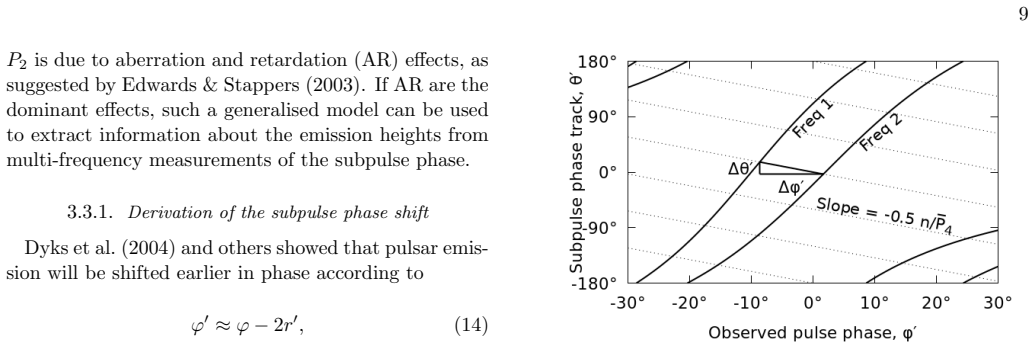
The load-bearing object is the carousel geometry relation between the subpulse modulation period $\overline{P}_3$, the number of sparks $n$, the carousel rotation period $\overline{P}_4$, and the aliasing order $k$: $1/\overline{P}_3 = |n/\overline{P}_4 - k|$, together with the condition that $n$ changes by an integer while $\overline{P}_4$ is constant. The AR extension adds the usual aberration-retardation phase shift $\phi' \approx \phi - 2r'$ (with $r' = r/r_{\rm LC}$) and the $r'$ delay of the spark-pattern information, which combine to give the constant slope $\Delta\theta'/\Delta\phi' = -n/(2\overline{P}_4)$ used to convert measured subpulse phase-track shifts between two frequencies into emission-height differences.
What would settle it
A single-telescope wide-band observation of B0031−07 spanning 185–610 MHz would remove the unknown clock offset; if the subpulse phase-track shift then yields negative height differences (low-frequency emission lower than high-frequency) or heights incompatible with independent estimates, the AR-dominance assumption is false.
Extended reading notes
Core claim
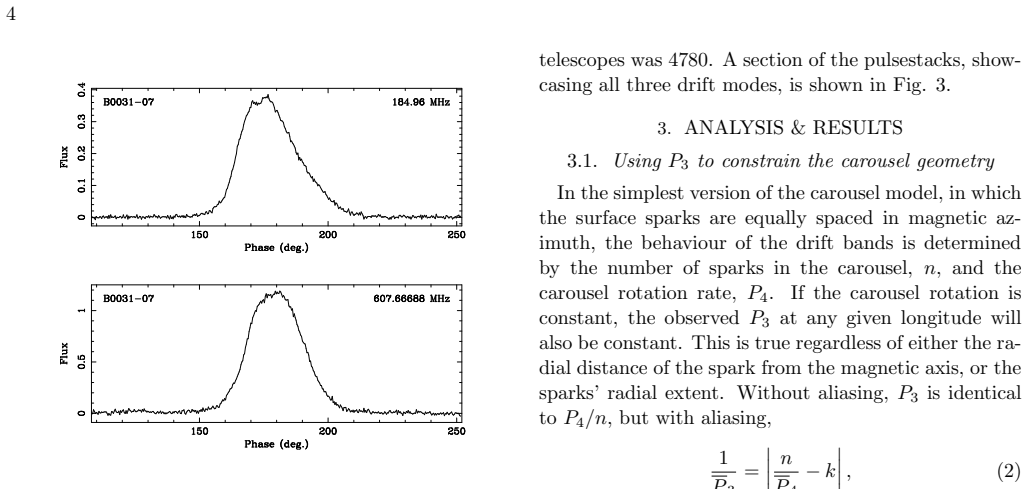
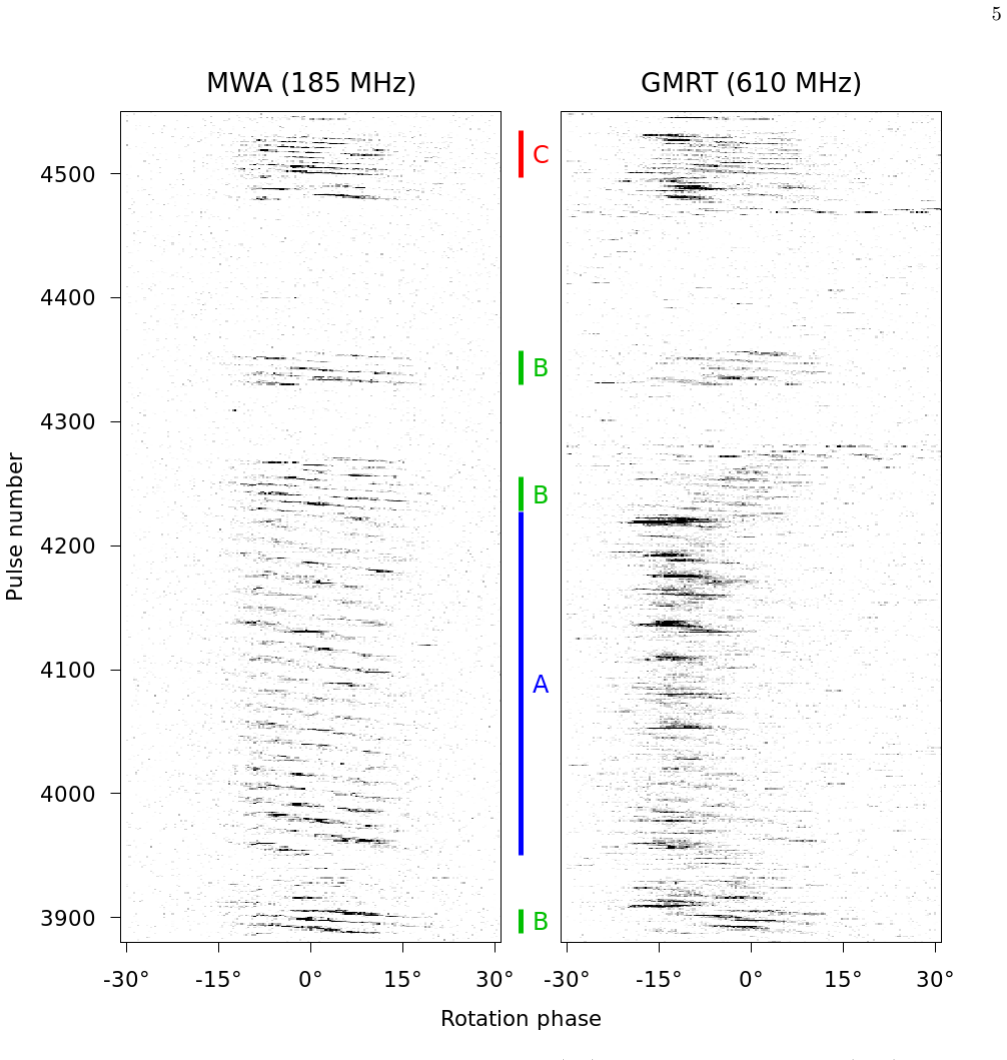
The central claim is that B0031−07's three drift modes are one physical carousel: the modulation is set by a fixed carousel rotation period $\overline{P}_4 = 16.4$ while the number of sparks takes the values $[n_A,n_B,n_C] = [15,14,13]$ in the three modes, and the different observed drift rates follow from first-order aliasing, $1/\overline{P}_3 = |n/\overline{P}_4 - k|$ with $k=1$. The paper further claims that once aberration and retardation are added, including the finite travel time of the spark-pattern information from the surface to the emission point, the frequency-dependent subpulse phase-track shift has a fixed slope $\Delta\theta'/\Delta\phi' = -n/(2\overline{P}_4)$, so that a measured phase shift between two frequencies directly gives the emission-height difference $\Delta r'$. Applied to simultaneous 185 MHz and 610 MHz observations, this yields conservative height differences of $\lesssim 2000$ km for mode A and $\lesssim 1000$ km for modes B and C.
Load-bearing premise
Aberration and retardation, together with the retarded travel of the spark-pattern information, dominate every other frequency-dependent shift of the subpulse phase at 185 and 610 MHz, so that observed phase shifts can be converted directly into emission-height differences.
Editorial extensions
If this is right
- B0031−07's three drift modes are the same carousel: only the number of sparks changes, so its carousel rotation period is fixed at about 16.4 pulse periods.
- The $\overline{P}_3$ values of modes A, B, and C should be harmonically related, as observed, and any multi-mode drifting pulsar with a constant $\overline{P}_4$ and integer-changing spark count should show the same arithmetic structure in $1/\overline{P}_3$.
- Subpulse phase-track shifts between two frequencies directly give emission-height differences, independent of average-profile or polarisation methods, for pulsars where AR effects dominate.
- The AR-augmented model implies that $P_2$ shrinks with frequency through Eq. (27), providing a quantitative, testable relation between pulse-longitude-dependent emission height and observing frequency.
- First-order aliasing brings the inferred carousel rotation period close to the theoretical Ruderman–Sutherland value, resolving part of the long-standing discrepancy between observed and predicted $\overline{P}_4$.
Reading between the lines
- Editorial inference: the constant-slope relation $\Delta\theta'/\Delta\phi' = -n/(2\overline{P}_4)$ means that any pulsar with known $n$ and $\overline{P}_4$ should show a predictable frequency-dependent tilt of its subpulse phase tracks; a clean null result would falsify the AR-augmented carousel picture as stated.
- Editorial inference: comparing heights from this AR method with heights from polarisation position-angle fits on the same pulsar would directly test whether AR effects dominate, as the paper itself notes this dominance is still open.
- Editorial inference: the positive fitted index $\eta$ (with $P_2$ varying as $\nu^{0.7}$) contradicts standard radius-to-frequency mapping; if that tension persists in larger samples, the dominant frequency-dependent effect is likely finite spark size or azimuth-dependent field curvature rather than AR.
Signed reviews
Editorial analysis
A structured set of objections, weighed in public.
Referee Report
Summary. The paper analyzes simultaneous MWA 185 MHz and GMRT 610 MHz observations of PSR B0031-07 within the carousel model. It first argues that the three drift modes can be explained by a single carousel rotation period P4 ≈ 16.4 P1 with [nA,nB,nC]=[15,14,13] sparks, attributing the different apparent drift rates to first-order aliasing, and it claims that the resulting harmonically related P3 values are confirmed. It then extends the carousel model to include aberration and retardation plus the travel time of spark information to the emission point, deriving equations that relate the frequency-dependent subpulse phase shift and P2 to emission-height differences. Under the assumption that AR effects dominate, it quotes conservative height differences of ≲2000 km for mode A and ≲1000 km for modes B and C between 185 and 610 MHz. The paper explicitly acknowledges that the inter-telescope clock offset is unknown and that the P2-frequency fit yields a positive index eta that contradicts standard RFM models and high-frequency observations.
Significance. The algebraic derivation of the AR-augmented carousel model, Eqs. (15)-(21) and (24)-(27), is transparent and internally consistent, and the paper is honest about many limitations. If AR dominance could be established independently, the method would provide a new way to estimate emission-height differences from subpulse drifting. However, the headline height estimates for B0031-07 are not measurements: they depend on an uncalibrated clock offset and on an AR-dominance assumption that the paper's own P2 analysis contradicts. The carousel geometry solution is plausible but degenerate and is not independently confirmed by the data. The model derivation is a useful contribution, but the observational application as currently presented overstates what the data support.
major comments (3)
- [Section 3.4, Fig. 6] The absolute subpulse phase shift is not actually measured because the MWA-GMRT clock offset is unknown, as the paper states explicitly. The height differences in Fig. 6 are therefore functions of an assumed clock offset, and the quoted upper limits (≲2000 km and ≲1000 km) correspond only to an offset window of roughly −0.5° to 5° that is not independently calibrated. The giant-pulse alignment at −4.2° is rejected solely because it yields negative height differences, so the positive-height requirement is effectively used to select the clock offset. This makes the height claim circular and conditional, and it should be presented as such in the abstract and conclusions.
- [Sections 3.3.1 and 4.2.2] The conversion of subpulse phase shifts into emission-height differences via Eqs. (16)-(21) assumes that aberration and retardation dominate every other frequency-dependent effect, an assumption stated explicitly in Section 3.3.1. The paper's own fit of Eq. (27) to historical P2 measurements returns η = 0.70 ± 0.34, and Section 4.2.2 notes that all known RFM models predict a negative index and that recent 1.4 GHz measurements contradict the model's prediction. Section 4.2.2 then concludes that either the AR theory is incomplete or AR effects are not typically dominant. Because the absolute phase shift and the P2-frequency relation are generated by the same AR machinery, this internal inconsistency directly undermines the reliability of the height estimates.
- [Section 3.1, Eqs. (2)-(6), Table 3] The derived carousel geometry is degenerate, and the harmonicity check is not independent of the measurements used to construct it. The same P3 values are used both to derive Eq. (6) and to select candidate k and n, and Table 3 lists six acceptable solutions with no goodness-of-fit criterion separating them. The representative solution [nA,nB,nC]=[15,14,13] with P4=16.4 is chosen by plausibility relative to the RS prediction, not determined by the data. The abstract's claim that harmonically related P3 values are 'confirmed' is therefore an overstatement; the analysis demonstrates consistency with the assumed model, not an independent confirmation.
minor comments (4)
- [Fig. 6 caption] The caption says 'The dash line at −4.2°'; this should read 'The dashed line at −4.2°'.
- [Section 4.2.2] There is a duplicated word in the sentence 'The overall shape of the curve is set by the signs of of dΦ/dϕ′ and η'; 'of of' should be 'of'.
- [Section 4.2.1] The phrase 'that would be observered in the absence of AR effects' contains a typo; 'observered' should be 'observed'.
- [Sections 2 and 3.4] The by-eye alignment of the average profiles and pulse-stack centres (Figs. 2 and 3) is a limitation that should be stated explicitly in the main text, not only in the figure captions, because it affects the absolute phase offsets on which the height estimates depend.
Circularity Check
No significant circularity: the carousel parameters are fit transparently from the measured periods, and the AR phase/height relation is an algebraic extension rather than a renamed input.
full rationale
The derivation chain is self-contained and algebraically transparent. Section 3.1 starts from the carousel alias relation Eq. (2), explicitly notes the degeneracy in k and P4, and solves for n/k using the previously published P3 measurements (McSweeney et al. 2017b); the harmonic-P3 relation Eq. (3) is a direct consequence of the constant-P4 and arithmetic-n ansatz, and checking it against the measured P3 values is a consistency test, not a fitted prediction, because Eq. (3) is derived before the n/P4 solution is selected. Section 3.2 likewise solves the viewing-geometry constraint from measured P2 without renaming an input as an output. The AR extension in Section 3.3 is a new algebraic model (Eqs. 14-27) whose parameters (k, P2, P3, n/P4) are supplied from measured quantities; the height differences in Fig. 6 are presented as a function of the unknown clock offset, and the P2 fit in Eq. (27) is explicitly a fit, not an independent prediction. The paper's own limitations (unknown MWA-GMRT clock offset in Sec. 3.4/4.2.1; admission that "either the AR-theory is incomplete or AR effects are not typically the dominant cause" in Sec. 4.2.2/5) weaken the evidential support for the height estimates, but they are correctness risks rather than circular reductions. Self-citations (McSweeney et al. 2017a,b; Wright & Fowler 1981; Rankin et al. 2013) provide observational data or historical attributions and do not carry the logical load of the derivation.
Assumptions & free parameters
free parameters (5)
- Aliasing order k =
±1 (preferred)
- Carousel spark counts n_A, n_B, n_C =
[15, 14, 13] representative
- Carousel rotation period P4 =
16.4 P1
- Inter-telescope clock offset =
unknown; scanned over roughly 0 to 5 degrees
- RFM and P2 fit parameters =
P2_0 = 23.6° ± 3.8°, dΦ/dϕ' = 0.3 ± 0.1, η = 0.70 ± 0.34
assumptions (6)
- domain assumption Discrete, equally spaced sparks rotate uniformly around the magnetic axis with period P4.
- domain assumption The carousel rotation period P4 stays constant across drift modes; only spark number n changes.
- domain assumption Aberration, retardation, and retarded spark-information propagation dominate frequency-dependent subpulse phase shifts.
- domain assumption Emission height scales as r' = Phi(phi) times nu^eta with no dependence on magnetic azimuth.
- domain assumption A dipole field with radius-to-frequency mapping places low-frequency emission on inner field lines at greater altitude.
- standard math Standard algebra, Taylor expansion, and nearest-integer rounding are valid in the derivations.
Cite this review
Pith. "Pith review of The frequency-dependent behaviour of subpulse drifting: I. Carousel geometry and emission heights of PSR B0031-07." pith.science (2026). https://pith.science/paper/G6LLEX4E
@misc{pith2026190803677,
  author       = {Pith},
  title        = {Pith review of: The frequency-dependent behaviour of subpulse drifting: I. Carousel geometry and emission heights of PSR B0031-07},
  year         = {2026},
  howpublished = {\url{https://pith.science/paper/G6LLEX4E}},
  note         = {Machine review of arXiv:1908.03677}
}
abstract
The carousel model of pulsar emission attributes the phenomenon of subpulse drifting to a set of discrete sparks located very near the stellar surface rotating around the magnetic axis. Here, we investigate the subpulse drifting behaviour of PSR B0031-07 in the context of the carousel model. We show that B0031-07's three drift modes (A, B, and C) can be understood in terms of a single carousel rotation rate if the number of sparks is allowed to change by an integral number, and where the different drift rates are due to (first-order) aliasing effects. This also results in harmonically-related values for P 3 (the time it takes a subpulse to reappear at the same pulse phase), which we confirm for B0031-07. A representative solution has [n_A, n_B, n_C] = [15, 14, 13] sparks and a carousel rotation period of P_4 = 16.4 P_1. We also investigate the frequency dependence of B0031-07's subpulse behaviour. We extend the carousel model to include the dual effects of aberration and retardation, including the time it takes the information about the surface spark configuration to travel from the surface up to the emission point. Assuming these effects dominate at B0031-07's emission heights, we derive conservative emission height differences of $\lesssim 2000$ km for mode A and $\lesssim 1000$ km for modes B and C as seen between 185 MHz and 610 MHz. This new method of measuring emission heights is independent of others that involve average profile components or the polarisation position angle curve, and thus provides a potentially strong test of the carousel model.
Figures

Figures from the paper (4 more)



Forward citations
Cited by 1 Pith paper
-
The Southern-sky MWA Rapid Two-metre (SMART) pulsar survey--IV. Survey update and an atlas of 205 non-recycled southern pulsars
Atlas of 205 non-recycled southern pulsars at 140–170 MHz from MWA SMART data, with profiles, DMs, RMs, fluxes and public data products for SKA-Low.
Reference graph
Works this paper leans on
-
[1]
Backer, D. 1970, Nature, 228, 42 —. 1971, PhD thesis, CORNELL UNIVERSITY
work page 1970
-
[2]
1980, Astronomy and Astrophysics, 90, 58
Bartel, N., Sieber, W., & Wolszczan, A. 1980, Astronomy and Astrophysics, 90, 58
work page 1980
-
[3]
2008, Monthly Notices of the Royal Astronomical Society, 383, 1538
Bhattacharyya, B., Gupta, Y., & Gil, J. 2008, Monthly Notices of the Royal Astronomical Society, 383, 1538
work page 2008
-
[4]
2007, Monthly Notices of the Royal Astronomical Society: Letters, 377, 10
Bhattacharyya, B., Gupta, Y., Gil, J., & Sendyk, M. 2007, Monthly Notices of the Royal Astronomical Society: Letters, 377, 10
work page 2007
-
[5]
2018, Astronomy & Astrophysics, 616, A119
Bilous, A. 2018, Astronomy & Astrophysics, 616, A119
work page 2018
-
[6]
1984, Monthly Notices of the Royal Astronomical Society, 211, 57
Davies, J., Lyne, A., Smith, F., et al. 1984, Monthly Notices of the Royal Astronomical Society, 211, 57
work page 1984
-
[7]
Deshpande, A. A., & Rankin, J. M. 2001, Monthly Notices of the Royal Astronomical Society, 322, 438
work page 2001
- [8]
Show all 57 references
-
[9]
K., & Rudak, B
Dyks, J., Harding, A. K., & Rudak, B. 2004, Astrophysical Journal, 606, 49
2004
-
[10]
2015, Monthly Notices of the Royal Astronomical Society, 446, 2505
Dyks, J., & Rudak, B. 2015, Monthly Notices of the Royal Astronomical Society, 446, 2505
2015
-
[11]
Edwards, R. T. 2006, Chinese Journal of Astronomy and Astrophysics Supplement, 6, 18
2006
-
[12]
T., & Stappers, B
Edwards, R. T., & Stappers, B. W. 2002, Astronomy and Astrophysics, 393, 733 —. 2003, Astronomy and Astrophysics, 410, 961
2002
-
[13]
G., Graham-Smith, F., et al
Esamdin, A., Lyne, A. G., Graham-Smith, F., et al. 2005, Monthly Notices of the Royal Astronomical Society, 356, 59
2005
-
[14]
Gangadhara, R. T. 2004, Astrophysical Journal, 609, 335
2004
-
[15]
T., & Gupta, Y
Gangadhara, R. T., & Gupta, Y. 2001, The Astrophysical Journal, 555, 31
2001
-
[16]
2000, Astrophysical Journal, 541, 351
Gil, J., & Sendyk, M. 2000, Astrophysical Journal, 541, 351
2000
-
[17]
M., & Lyne, a
Gould, D. M., & Lyne, a. G. 1998, Monthly Notices of the Royal Astronomical Society, 301, 235
1998
-
[18]
2004, Astronomy and Astrophysics, 426, 229
Gupta, Y., Gil, J., Kijak, J., & Sendyk, M. 2004, Astronomy and Astrophysics, 426, 229
2004
-
[19]
Collins, R. A. 1968, Nature, 217, 709 Hotan, a. W., Van Straten, W., & Manchester, R. N. 2004, Publications of the Astronomical Society of Australia, 21, 302
1968
-
[20]
R., Taylor, J
Huguenin, G. R., Taylor, J. H., & Troland, T. H. 1970, Astrophysical Journal, 162, 727
1970
-
[21]
A., Kuzmin, A
Izvekova, V. A., Kuzmin, A. D., Lyne, A. G., Shitov, Y. P., & Smith, F. G. 1993, Monthly Notices of the Royal Astronomical Society, 261, 865
1993
-
[22]
C., Naidu, A., Gajjar, V., & Wright, G
Joshi, B. C., Naidu, A., Gajjar, V., & Wright, G. A. 2018, in IAU Symposium, Vol. 337, Pulsar Astrophysics the Next Fifty Years, ed. P. Weltevrede, B. Perera, L. Preston, & S. Sanidas, 348–349
2018
-
[23]
W., & Serylak, M
Karuppusamy, R., Stappers, B. W., & Serylak, M. 2011, Astronomy and Astrophysics, 525, A55
2011
-
[24]
M., & Rankin, J
Kloumann, I. M., & Rankin, J. M. 2010, Monthly Notices of the Royal Astronomical Society, 408, 40
2010
-
[25]
D., & Ershov, A
Kuzmin, A. D., & Ershov, A. A. 2004, Astronomy and Astrophysics, 427, 575
2004
-
[26]
G., & Ashworth, M
Lyne, A. G., & Ashworth, M. 1983, Monthly Notices of the Royal Astronomical Society, 204, 519 17
1983
-
[27]
Maan, Y., & Deshpande, A. A. 2014, The Astrophysical Journal, 792, 130
2014
-
[28]
Melrose, D. B. 1992, Phil. Trans. R. Soc. Lond., 341, 105
1992
-
[29]
Mitra, D., & Rankin, J. M. 2008, Monthly Notices of the Royal Astronomical Society, 385, 606
2008
-
[30]
2011, Chinese Astronomy and Astrophysics, 35, 37
Nizamdin, B., Esamdin, A., Liu, Z.-Y., Wang, N., & Zhao, C.-S. 2011, Chinese Astronomy and Astrophysics, 35, 37
2011
-
[31]
2019, PASA, arXiv:1905.01826
Ord, S., Tremblay, S., McSweeney, S., et al. 2019, PASA, arXiv:1905.01826
2019 arXiv
-
[32]
J., Lee, K
Qiao, G. J., Lee, K. J., Zhang, B., Xu, R. X., & Wang, H. G. 2004, Astrophysical Journal, 616, L127
2004
-
[33]
Rankin, J. M. 1983, The Astrophysical Journal, 274, 333
1983
-
[34]
M., Ramachandran, R., & Suleymanova, S
Rankin, J. M., Ramachandran, R., & Suleymanova, S. A. 2005, Astronomy and Astrophysics, 429, 999
2005
-
[35]
M., Wright, G
Rankin, J. M., Wright, G. A. E., & Brown, A. M. 2013, Monthly Notices of the Royal Astronomical Society, 433, 445
2013
-
[36]
A., & Sutherland, P
Ruderman, M. A., & Sutherland, P. G. 1975, The Astrophysical Journal, 196, 51
1975
-
[37]
Savitzky, A., & Golay, M. J. E. 1964, Analytical Chemistry, 36, 1627
1964
-
[38]
M., Mitra, D., & Kuijpers, J
Smits, J. M., Mitra, D., & Kuijpers, J. 2005, Astronomy and Astrophysics, 440, 10
2005
-
[39]
M., Mitra, D., Stappers, B
Smits, J. M., Mitra, D., Stappers, B. W., et al. 2007, Astronomy and Astrophysics, 465, 15
2007
-
[40]
A., & Pugachev, V
Suleimanova, S. A., & Pugachev, V. D. 2002, Astronomy Reports, 46, 309
2002
-
[41]
1970, Astrophysical Journal Letters, 159, doi:10.1086/180484
Sutton, J., Staelin, D., Price, R., & Weimer, R. 1970, Astrophysical Journal Letters, 159, doi:10.1086/180484
1970 doi
-
[42]
1991, Current Science, 60, 95
Swarup, G., Ananthakrishnan, S., Kapahi, V., et al. 1991, Current Science, 60, 95
1991
-
[43]
H., Manchester, R
Taylor, J. H., Manchester, R. N., & Huguenin, G. R. 1975, The Astrophysical Journal, 195, 513
1975
-
[44]
Thomas, R. M. C., & Gangadhara, R. T. 2007, Astronomy and Astrophysics, 467, 911
2007
-
[45]
Thomas, R. M. C., Gupta, Y., & Gangadhara, R. T. 2010, Monthly Notices of the Royal Astronomical Society, 406, 1029
2010
-
[46]
Thorsett, S. E. 1992, in IAU Colloq. 128: Magnetospheric Structure and Emission Mechanics of Radio Pulsars, ed. T. H. Hankins, J. M. Rankin, & J. A. Gil, 143
1992
-
[47]
J., Goeke, R., Bowman, J
Tingay, S. J., Goeke, R., Bowman, J. D., et al. 2013, Publications of the Astronomical Society of Australia, 30, 7
2013
-
[48]
E., Ord, S
Tremblay, S. E., Ord, S. M., Bhat, N. D. R., et al. 2015, Publications of the Astronomical Society of Australia, 32, e005
2015
-
[49]
2011, Research in Astronomical Astrophysics, 11, 974 van Leeuwen, A
Tuoheti, A., Esamdin, A., Hu, H.-d., et al. 2011, Research in Astronomical Astrophysics, 11, 974 van Leeuwen, A. G. J., Stappers, B. W., Ramachandran, R., & Rankin, J. M. 2003, Astronomy and Astrophysics, 399, 223 van Straten, W., & Bailes, M. 2011, Publications of the Astrono...
2011
-
[50]
Vivekanand, M., & Joshi, B. C. 1996, The Astrophysical Journal, 477, 431
1996
-
[51]
T., & Stappers, B
Weltevrede, P., Edwards, R. T., & Stappers, B. W. 2006, Astronomy and Astrophysics, 445, 243
2006
-
[52]
W., & Edwards, R
Weltevrede, P., Stappers, B. W., & Edwards, R. T. 2007, Astronomy and Astrophysics, 469, 607
2007
-
[53]
1981, Astronomy and Astrophysics, 100, 91
Wolszczan, A., Bartel, N., & Sieber, W. 1981, Astronomy and Astrophysics, 100, 91
1981
-
[54]
2017, Monthly Notices of the Royal Astronomical Society, 464, 2597
Wright, G., & Weltevrede, P. 2017, Monthly Notices of the Royal Astronomical Society, 464, 2597
2017
-
[55]
Wright, G. A. E., & Fowler, L. A. 1981, in Pulsars : International Astronomical Union symposium no. 95 held in Bonn, 211
1981
-
[56]
2019, arXiv e-prints, arXiv:1905.00598
Xue, M., Ord, S., Tremblay, S., et al. 2019, arXiv e-prints, arXiv:1905.00598
2019 arXiv
-
[57]
Han, X. H. 2016, Monthly Notices of the Royal Astronomical Society, 459, 603
2016
Reviewed August 14, 2026 · model on record in the stance chip above.
Discussion (0). Continue with ORCID to comment.