REVIEW 4 major objections 5 minor 17 references
Adaptive RBF Interpolation for Estimating Missing Values in Geographical Data
T0 review · 4 major / 5 minor · reviewed 2026-08-14 · deepseek-v4-flash
Pith's one-line read An adaptive RBF interpolant with a density-tuned shape factor estimates missing elevation values more accurately than kNN or adaptive inverse distance weighting, at the cost of slower runs.
desk verdict The adaptive mechanism is inert on the near-uniform DEM grids, so the reported gains are really about fixed-shape-factor RBF, not adaptivity; the paper is honest but needs major revision. read the letter →
The pith
A machine-rendered reading of the paper's core claim, the machinery that carries it, and where it could break.
The reading
What carries the argument
The machinery is a local multi-quadric RBF interpolant whose shape factor is density-adaptive. The kernel is $\varphi(r)=\sqrt{r^2+c^2}$; the algorithm builds a local support set from the 20 nearest known points, computes expected density $D_{\mathrm{exp}}$ and local density $D_{\mathrm{loc}}$, forms the density ratio $D(s_0)=D_{\mathrm{loc}}/D_{\mathrm{exp}}$, normalizes it with the fuzzy membership $\mu_D$, and selects $c$ from one of five levels through a triangular membership function. That selected $c$ controls the flatness of the radial basis function and therefore the accuracy of the local solve. The local set keeps the computation practical on large grids, while the adaptive $c$ is what distinguishes the method from a fixed-shape RBF: in principle it lets the interpolant stiffen in sparse regions and soften in dense ones.
What would settle it
Run the same three DEM benchmarks with the shape factor fixed at each of the five levels $c_1$ through $c_5$. If the best fixed-$c$ RBF matches or beats the adaptive version on evenly distributed points, then the density adaptation is not the source of the reported accuracy; a second test on deliberately clustered points with a fixed-shape RBF as control would show whether the adaptive $c$ actually responds to density variation.
Extended reading notes
Core claim
On its own terms, the paper's central claim is that an RBF interpolant using the multi-quadric kernel $\varphi(r)=\sqrt{r^2+c^2}$, with the shape factor $c$ determined per interpolated point from local point density, estimates missing elevation values with lower RMSE than kNN interpolation and AIDW on regularly distributed DEM data. For each missing point, the method forms a local set of the 20 closest known points, computes the ratio of local density $D_{\mathrm{loc}}$ to expected density $D_{\mathrm{exp}}$, maps this ratio through a fuzzy membership function $\mu_D$, and then reads $c$ from a triangular membership function over five shape-factor levels. The reported comparisons show the adaptive RBF estimator as the most accurate and kNN as the least accurate, with accuracy of all three falling as known points are removed. The paper also reports that adaptive RBF is slower than both alternatives, and it acknowledges that because the DEM points are evenly distributed, the density-dependent shape factor is close to constant, so the advantage of the adaptive mechanism itself awaits tests on unevenly distributed data.
Load-bearing premise
The load-bearing premise is that the test digital elevation models have point distributions uneven enough to exercise the density-adaptive shape factor; the paper's own description says the points are evenly distributed, making the adaptively chosen shape factor nearly constant and leaving the adaptive mechanism untested.
Editorial extensions
If this is right
- If the accuracy comparison holds, gap-filling in regularly gridded terrain data should prefer the adaptive RBF estimator over kNN and AIDW when run time is not the constraint.
- The accuracy of all three estimators drops as the number of known values decreases, so the advantage of adaptive RBF is measured within a fixed missingness setting rather than across all data-completeness regimes.
- Because the test data are evenly distributed, the adaptive shape factor is nearly constant; a direct corollary is that the demonstrated accuracy gain is not yet evidence for the density-adaptation mechanism itself.
- The method's slower runtime means it is positioned for applications where imputation quality matters more than throughput, or where the local solves can be parallelized.
Reading between the lines
- A natural test the paper leaves implicit: on clustered or irregularly sampled geographic data, where $D_{\mathrm{loc}}$ varies strongly, the adaptive $c$ should diverge from a constant, and the accuracy gap over fixed-shape RBF should be measurable; the current DEM experiments cannot show this.
- The fuzzy membership plus triangular lookup could be replaced by a direct formula $c=f(D_{\mathrm{loc}}/D_{\mathrm{exp}})$, and a simpler mapping would make the method easier to reproduce and to compare across datasets.
- The missingness mechanism in the experiments is random removal of 10% of cells; real geographic data often have spatially structured gaps, and the method's behavior under clustered missingness remains untested.
- Since each missing point requires its own local RBF solve, the efficiency penalty is likely to shrink on GPU or parallel implementations, making the accuracy advantage more accessible at scale.
Signed reviews
Editorial analysis
A structured set of objections, weighed in public.
Referee Report
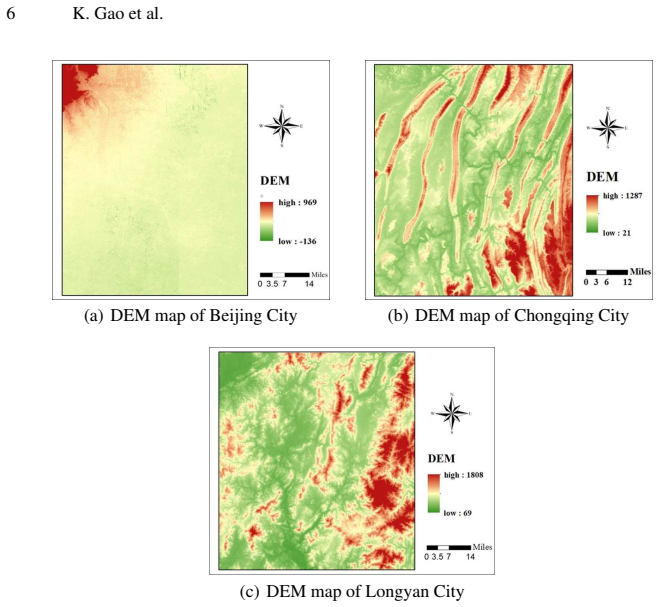
Summary. The paper proposes an adaptive Radial Basis Function (RBF) interpolation method for estimating missing values in geographical data. For each interpolated point, the method selects a local set of 20 nearest known points and adaptively sets the shape factor c of the MQ-RBF kernel from the local point density using Eqs. (4)-(8). The method is compared against kNN interpolation and Adaptive Inverse Distance Weighting (AIDW) on three large DEM datasets, with 10% of samples treated as missing. The authors report that the adaptive RBF estimator achieves the best accuracy but is the slowest. The paper concludes that the adaptive RBF method performs better than kNN and AIDW on regularly distributed datasets.
Significance. If validated, a density-adaptive shape-factor rule for local RBF interpolation would be a useful contribution to scattered-data interpolation and missing-value imputation. The manuscript gives a clear algorithmic description and benchmarks on large, realistic DEM datasets, which is a strength. However, the experimental design does not actually exercise the adaptive mechanism: the DEM data are nearly uniform grids, so the ratio Dloc/Dexp is approximately constant and the adaptive shape factor is essentially fixed. The paper itself concedes in Section 4 that 'the advantages of the adaptive RBF interpolation algorithm may not be realized' on evenly distributed data. The reported accuracy advantage, if real, therefore reflects a local MQ-RBF with a well-chosen constant shape factor rather than the adaptive mechanism. The lack of specified shape-factor levels c1-c5 further undermines reproducibility. The central claim thus remains unsupported by the present experiments.
major comments (4)
- [Section 4, Eqs. (4)-(8)] The experimental datasets are stated to be evenly distributed, which makes the local density Dloc and expected density Dexp nearly equal, forcing the density statistic D(s0) to be close to 1 and the shape factor c to remain at a nearly fixed value. Under this condition the adaptive component is inert, so the reported accuracy advantage cannot be attributed to the density-based adaptation. The paper itself acknowledges this: 'the advantages of the adaptive RBF interpolation algorithm may not be realized.' To support the central claim, the method should be tested on irregularly distributed or clustered point sets where the adaptive shape factor actually varies, and ideally compared against a non-adaptive RBF interpolant using the same constant shape-factor level.
- [Eq. (8)] The five shape-factor levels c1...c5 are introduced but their numerical values are never specified anywhere in the manuscript. Without those values the entire experiment is unreproducible, and the reader cannot judge whether the chosen levels are appropriate, how sensitive the results are to their settings, or whether the reported accuracy advantage is merely an artifact of tuning these five parameters.
- [Section 3, Section 4] The accuracy comparison appears to be based on a single random masking of 10% of the samples per dataset, with no repeated trials, standard deviations, confidence intervals, or significance tests reported. Given that the differences between the three estimators are visually described but not quantified beyond the RMSE figures, it is impossible to determine whether the observed advantage of the adaptive RBF method is statistically meaningful. Additionally, the baseline implementations (the value of k in the kNN method and the parameters of the AIDW method) are not specified, further limiting reproducibility.
- [Section 5, Conclusions] The conclusion states that the adaptive RBF method 'performs better than kNN interpolation and AIDW in regularly distributed datasets' — precisely the regime in which the adaptive mechanism is inactive, as the paper itself notes. Consequently, even if the reported accuracy advantage is real, it is a property of local MQ-RBF interpolation with a fixed shape factor, not of the proposed density-based adaptation. The paper therefore does not yet substantiate its central claim that adaptively determining the shape factor improves missing-value estimation accuracy.
minor comments (5)
- [Introduction] The sentence 'Some empirical formulas for optimum shape factor have been proposed by scholars' is not accompanied by any citations. Please add appropriate references or remove the sentence.
- [Section 2.1, Eq. (2)] The MQ-RBF kernel is introduced as phi(r) = sqrt(r^2 + c^2), but the dependence of the shape factor on the local density is described only later. A brief remark that the shape factor strongly affects both accuracy and conditioning of the interpolation matrix would help readers unfamiliar with RBF methods.
- [Section 2.1, Eq. (8)] The piecewise linear expressions in Eq. (8) could be simplified and written more uniformly, for example by defining c(mu) as a linear interpolation between the nearest levels. The current notation with repeated terms such as '5c2' and 'c2 [1-5(...)]' is unnecessarily hard to read, even though the endpoint values are consistent.
- [Section 4, Figures 3 and 4] The figure captions and axis labels appear garbled in the provided text (sequence of ASCII codes). The figures should be re-checked for readability, and the captions should describe what each panel or bar represents.
- [Section 3, Table 2] The table lists the number of known and missing values for each city, but the phrase in Section 4 'with the number of known data points in the datasets decreases' is ambiguous. Please clarify whether the comparison across cities is the intended interpretation, or whether additional experiments with varying amounts of known data were performed.
Circularity Check
No significant circularity: the adaptive shape factor is computed from point geometry (Eqs. 4–8), not from the missing values being estimated, and the accuracy comparison against kNN and AIDW is an independent benchmark.
full rationale
The paper's central claim—that the adaptive RBF interpolant estimates missing DEM elevations more accurately than kNN and AIDW—does not reduce to its inputs. The shape factor c is determined from data-point positions through Eq. (4) Dexp, Eq. (5) Dloc, Eq. (6) D(s0), Eq. (7) µD, and Eq. (8) c, with no use of the withheld elevation values; the withheld values are used only for final RMSE assessment in Section 4. The comparison baselines are externally defined (kNN and AIDW), and the test data are three independent DEM datasets. The only self-citation with methodological content is [12] (Mei, Xu, Xu, same research group), cited as the source of the density-adaptive scheme, but that prior work belongs to AIDW rather than RBF and is not invoked as a proof of the accuracy result. No uniqueness theorem or fitted parameter is used to force the outcome. The paper itself concedes a limitation: 'The data points selected from DEM are evenly distributed... the advantages of the adaptive RBF interpolation algorithm may not be realized.' This weakens the empirical evidence for the adaptation mechanism, and the five c-levels in Eq. (8) are never given values, harming reproducibility; but both are correctness or evidential concerns, not circularity. The derivation chain is self-contained: geometry -> shape factor -> RBF interpolation -> RMSE comparison.
Assumptions & free parameters
free parameters (2)
- Local neighborhood size Nloc =
20
- Shape-factor levels c1..c5 =
Not reported
assumptions (3)
- standard math The MQ-RBF interpolation system on 20 distinct local points is nonsingular and yields a unique coefficient set.
- ad hoc to paper The density-based shape factor formulas from AIDW (Eqs. 4-8) are valid for RBF interpolation.
- domain assumption Elevation values are smooth enough that local RBF interpolation of the missing points is well-approximated by nearby known points.
Cite this review
Pith. "Pith review of Adaptive RBF Interpolation for Estimating Missing Values in Geographical Data." pith.science (2026). https://pith.science/paper/YQN4CNZV
@misc{pith2026190803690,
  author       = {Pith},
  title        = {Pith review of: Adaptive RBF Interpolation for Estimating Missing Values in Geographical Data},
  year         = {2026},
  howpublished = {\url{https://pith.science/paper/YQN4CNZV}},
  note         = {Machine review of arXiv:1908.03690}
}
read the original abstract
The quality of datasets is a critical issue in big data mining. More interesting things could be mined from datasets with higher quality. The existence of missing values in geographical data would worsen the quality of big datasets. To improve the data quality, the missing values are generally needed to be estimated using various machine learning algorithms or mathematical methods such as approximations and interpolations. In this paper, we propose an adaptive Radial Basis Function (RBF) interpolation algorithm for estimating missing values in geographical data. In the proposed method, the samples with known values are considered as the data points, while the samples with missing values are considered as the interpolated points. For each interpolated point, first, a local set of data points are adaptively determined. Then, the missing value of the interpolated point is imputed via interpolating using the RBF interpolation based on the local set of data points. Moreover, the shape factors of the RBF are also adaptively determined by considering the distribution of the local set of data points. To evaluate the performance of the proposed method, we compare our method with the commonly used k Nearest Neighbors (kNN) interpolation and Adaptive Inverse Distance Weighted (AIDW) methods, and conduct three groups of benchmark experiments. Experimental results indicate that the proposed method outperforms the kNN interpolation and AIDW in terms of accuracy, but worse than the kNN interpolation and AIDW in terms of efficiency.
Figures


Figures from the paper (1 more)

Reference graph
Works this paper leans on
-
[1]
International Journal of Parallel Programming 45(5), 1–30 (2016)
Barone, G.B., Boccia, V ., Bottalico, D., Campagna, R., Carracciuolo, L., Laccetti, G., Lapegna, M.: An approach to forecast queue time in adaptive scheduling: How to medi- ate system efficiency and users satisfaction. International Journal of Parallel Programming 45(5), 1–30 (2016)
work page 2016
-
[2]
Applied Numerical Mathematics 116, 60–63 (2016)
Cuomo, S., Galletti, A., Giunta, G., Marcellino, L.: Reconstruction of implicit curves and surfaces via rbf interpolation. Applied Numerical Mathematics 116, 60–63 (2016)
work page 2016
-
[3]
Cuomo, S., Gallettiy, A., Giuntay, G., Staracey, A.: Surface reconstruction from scattered point via rbf interpolation on gpu (2013)
work page 2013
-
[4]
Concurrency Computation 30(24) (2018)
Ding, Z., Mei, G., Cuomo, S., Tian, H., Xu, N.: Accelerating multi-dimensional interpolation using moving least-squares on the gpu. Concurrency Computation 30(24) (2018)
work page 2018
-
[5]
International Journal of Parallel Programming pp
Ding, Z., Gang, M., Cuomo, S., Li, Y ., Xu, N.: Comparison of estimating missing values in iot time series data using different interpolation algorithms. International Journal of Parallel Programming pp. 1–15 (2018)
work page 2018
-
[6]
International Journal of Parallel Programming (157), 1–29 (2017)
Ding, Z., Gang, M., Cuomo, S., Xu, N., Hong, T.: Performance evaluation of gpu-accelerated spatial interpolation using radial basis functions for building explicit surfaces. International Journal of Parallel Programming (157), 1–29 (2017)
work page 2017
-
[7]
Acta Oceanologica Sinica37(3), 103–110 (2018)
Gao, D., Liu, Y ., Meng, J., Jia, Y ., Fan, C.: Estimating significant wave height from sar imagery based on an svm regression model. Acta Oceanologica Sinica37(3), 103–110 (2018)
work page 2018
-
[8]
Journal of Computational Physics 345, 732–751 (2017)
Kedward, L., Allen, C.B., Rendall, T.C.S.: Efficient and exact mesh deformation using mul- tiscale rbf interpolation. Journal of Computational Physics 345, 732–751 (2017)
work page 2017
Show all 17 references
-
[9]
Biometrics 74(4) (2018)
Keogh, R.H., Seaman, S.R., Bartlett, J.W., Wood, A.M.: Multiple imputation of missing data in nested case-control and case-cohort studies. Biometrics 74(4) (2018)
2018
-
[10]
Liang, Z., Na, Z., Wei, H., Feng, Z., Qiao, Q., Luo, M.: From big data to big analysis: a perspective of geographical conditions monitoring pp. 1–15
-
[11]
Computers & Geosciences 34(9), 1044–1055 (2008)
Lu, G.Y ., Wong, D.W.: An adaptive inverse-distance weighting spatial interpolation tech- nique. Computers & Geosciences 34(9), 1044–1055 (2008)
2008
-
[12]
Springerplus 5(1), 1389 (2016)
Mei, G., Xu, N., Xu, L.: Improving gpu-accelerated adaptive idw interpolation algorithm using fast knn search. Springerplus 5(1), 1389 (2016)
2016
-
[13]
Procedia Computer Science 108, 2433–2437 (2017)
Skala, V .: Rbf interpolation with csrbf of large data sets. Procedia Computer Science 108, 2433–2437 (2017)
2017
-
[14]
Neurocomputing 174(PA), 220–231 (2016)
Sovilj, D., Eirola, E., Miche, Y ., Bjrk, K.M., Rui, N., Akusok, A., Lendasse, A.: Extreme learning machine for missing data using multiple imputations. Neurocomputing 174(PA), 220–231 (2016)
2016
-
[15]
Soft Computing (1), 1–9 (2018)
Tang, T., Chen, S., Meng, Z., Wei, H., Luo, J.: Very large-scale data classification based on k-means clustering and multi-kernel svm. Soft Computing (1), 1–9 (2018)
2018
-
[16]
Thakuriah, P., Tilahun, N.Y ., Zellner, M.: Big data and urban informatics: Innovations and challenges to urban planning and knowledge discovery (2016)
2016
-
[17]
Statistics in Medicine 47(1), 1–16 (2018)
Tomita, H., Fujisawa, H., Henmi, M.: A bias-corrected estimator in multiple imputation for missing data. Statistics in Medicine 47(1), 1–16 (2018)
2018
Reviewed August 14, 2026 · model on record in the stance chip above.
Discussion (0). Continue with ORCID to comment.