REVIEW 4 major objections 6 minor 1 cited by
Deep Triplet Neural Networks with Cluster-CCA for Audio-Visual Cross-modal Retrieval
T0 review · 4 major / 6 minor · reviewed 2026-08-14 · deepseek-v4-flash
Pith's one-line read Audio-visual retrieval improves when a deep triplet network refines Cluster-CCA embeddings by pulling same-category cross-modal pairs together in cosine space.
desk verdict A plausible stacking of Cluster-CCA with a cosine triplet network for audio-visual retrieval, but the headline MAP gains are unreliable because hyperparameters were tuned on the test set and baseline tuning is undocumented. read the letter →
The pith
A machine-rendered reading of the paper's core claim, the machinery that carries it, and where it could break.
The reading
What carries the argument
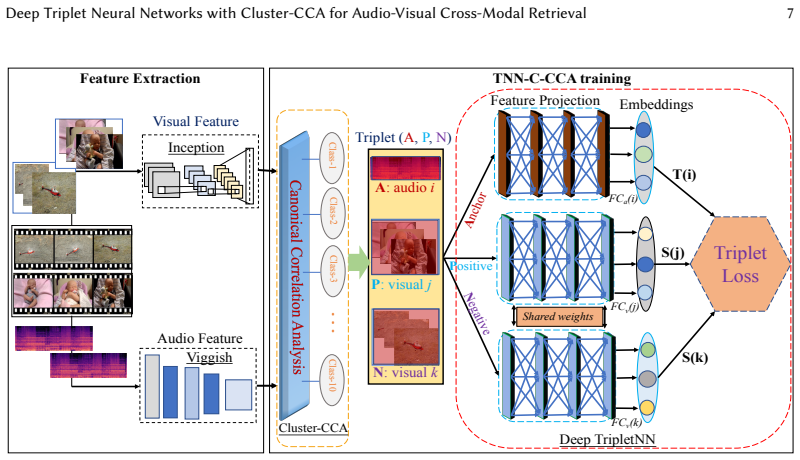
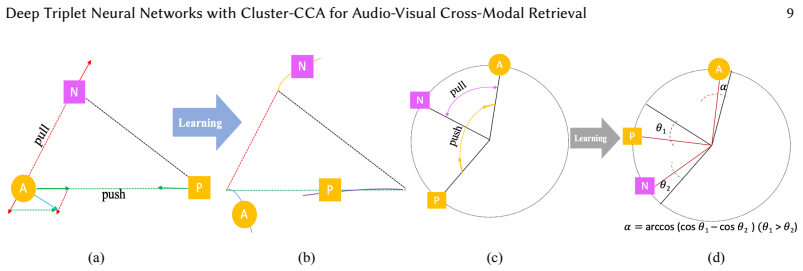
The architecture chains two stages. Cluster-CCA projects the two modalities into a shared subspace by treating every cross-modal pair inside a semantic category as a matching pair and applying canonical correlation analysis, which segregates categories while maximizing correlation. A deep triplet neural network then refines those embeddings with loss $d_{\cos}(T(i),S(j)) + \alpha < d_{\cos}(T(i),S(k))$, where $T(i)$ is the anchor audio embedding, $S(j)$ a same-category visual embedding, $S(k)$ a different-category visual embedding, $d_{\cos}$ is cosine distance, and $\alpha=0.5$; in-batch triplet selection (batch all, batch hard, batch semi-hard) controls which negatives are used. The triplet fine-tuning stage is what turns pairwise and category-level correlation into a space where same-category cross-modal pairs are closer than different-category pairs.
What would settle it
Retrain every baseline on the same VEGAS and MV-10K folds with per-method hyperparameter search, especially C-DCCA's beta and the regularization of the hashing and adversarial baselines, and check whether TNN-C-CCA's MAP margins survive; a modest grid search that closes the 4.28-point gap on VEGAS would falsify the outperformance claim.
Extended reading notes
Core claim
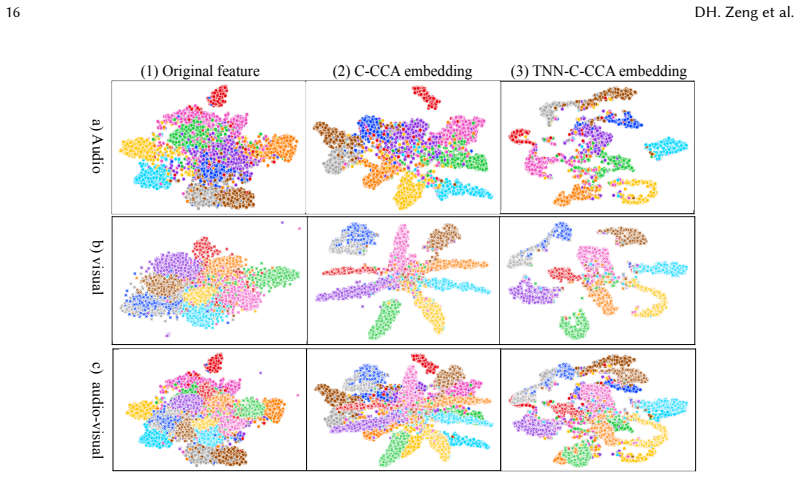
The paper claims that adding a deep triplet neural network on top of Cluster-CCA produces more discriminative audio-visual embeddings than either component alone or than existing CCA variants. The architecture maps audio and visual features to 10-dimensional embeddings via Cluster-CCA, then trains three fully connected branches (audio anchor, visual positive, visual negative, with the two visual branches sharing weights) using triplet loss with cosine distance and a margin of 0.5. In 5-fold cross-validation, TNN-C-CCA reaches MAP 74.66% and 73.77% for audio-to-visual and visual-to-audio retrieval on VEGAS, and 23.34% and 21.32% on MV-10K, surpassing the strongest CCA baseline C-DCCA by 4.28 and 4.5 percentage points on VEGAS. Ablation results show cosine distance beats Euclidean distance, batch-all triplet selection beats batch-hard and batch semi-hard, and the learned embedding clusters are more separated than Cluster-CCA's.
Load-bearing premise
The reported lead over baselines assumes that all comparison methods were implemented and tuned well enough that their hyperparameters are near-optimal, so the score gaps reflect method quality rather than undertuned competitors.
Editorial extensions
If this is right
- Audio-to-visual and visual-to-audio retrieval improve together, so the learned shared space is usable in both query directions.
- Explicitly training on negative cross-modal pairs, rather than only on positive/category pairs, is the component the paper credits for the margin over C-DCCA.
- The method's gains shrink on the noisily labeled MV-10K dataset, indicating that label quality is a binding constraint on the approach.
- The reported batch-size experiments imply a practical cost curve: reaching the top MAP requires enough negatives per batch, and the paper reports training times up to 32 hours for the best configuration.
Reading between the lines
- The two-stage recipe should transfer to other labeled modality pairs such as image-text or video-text, since the architecture does not depend on audio-specific machinery beyond the feature extractors.
- Because performance drops sharply on MV-10K's automatically assigned labels, a testable extension is to corrupt a known fraction of VEGAS labels and measure how quickly the MAP advantage over C-DCCA erodes.
- The paper's own batch-size table suggests that an external reader could check whether hard-negative mining at small batch sizes recovers most of the reported gain at a fraction of the 32-hour cost.
Signed reviews
Editorial analysis
A structured set of objections, weighed in public.
Referee Report
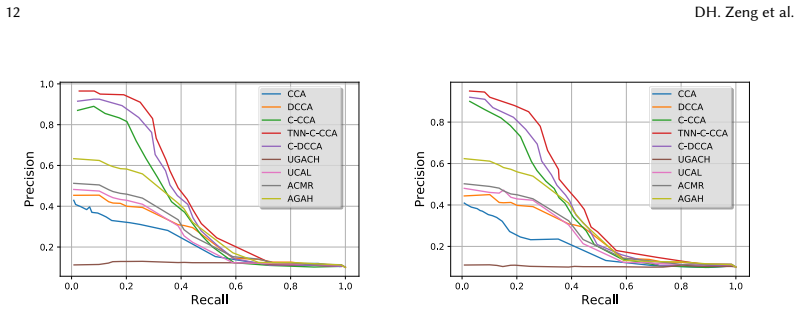
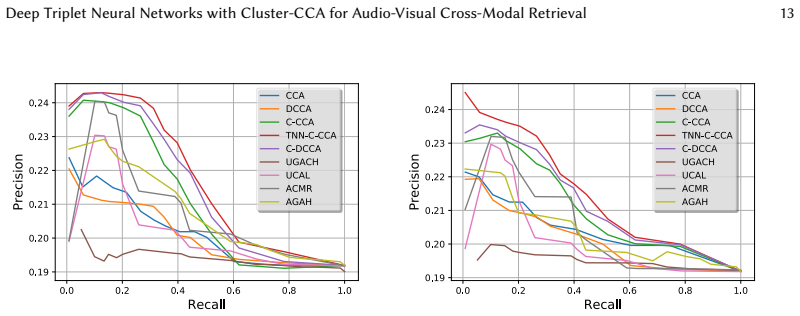
Summary. The manuscript presents TNN-C-CCA, an end-to-end two-branch architecture for audio-visual cross-modal retrieval. Audio clips are embedded with VGGish and visual frames with Inception-v3 plus PCA; Cluster-CCA projects the two views into a shared 10-dimensional space, and a triplet network with cosine distance and in-batch mining refines the embeddings using same-category positive pairs and different-category negative pairs. The method is evaluated on VEGAS and the authors' MV-10K dataset with MAP and PRC, and compared with six CCA-based methods and four state-of-the-art cross-modal retrieval methods. The paper claims consistent improvements, with the largest being 74.66% versus 70.34% audio-to-visual MAP over C-DCCA on VEGAS. Ablation studies cover triplet selection strategies, Euclidean versus cosine distance, and sensitivity to margin, batch size, and correlation components.
Significance. The audio-visual retrieval setting is underexplored, and the combination of cluster-level correlation learning with triplet ranking is a reasonable and clearly motivated idea. The paper's strengths include an end-to-end architecture, five-fold cross-validation, a broad comparison set, and an ablation study that probes several design choices. If the reported gains survive a statistically fair comparison, the method would be a useful contribution to multimedia retrieval. However, the quantitative claim is currently not supported by the evaluation protocol, because the proposed method's hyperparameters are selected on the test folds and the baselines are not shown to be comparably tuned. The contribution is incremental rather than conceptual, but it could be acceptable after a rigorous re-evaluation.
major comments (4)
- [Section 4.2(3) and Section 4.5.4] The margin (0.5), batch number (400), and correlation component count (10) are chosen by running the model on the VEGAS dataset and selecting the values with the highest MAP. Figure 10 plots MAP against the number of correlation components without any indicated validation split. Since the same folds are used for both selection and evaluation, the headline MAPs in Table 2 are optimistically biased. The authors should use a held-out validation split (or nested cross-validation) and report test MAP for the configuration selected without access to test labels.
- [Section 4.3] The baseline comparison is not sufficient to support the claimed improvement. The paper states that all baselines were implemented "with the same dimension of outputs and the same parameters," which does not address hyperparameter tuning. C-DCCA's beta is explicitly described as "very hard to set," yet no search is reported; the VEGAS advantage over C-DCCA is only 4.3 percentage points. To make the comparison interpretable, the authors should report validation-based hyperparameter selection for every baseline or use the numbers from the original publications.
- [Tables 5 and 6] The reported numbers are internally inconsistent. Table 5, which is presented as the margin study with "batch_num is 500," gives audio-visual MAP 75.31 and visual-audio MAP 73.26 at margin 0.5. Table 6, the batch-size study at margin 0.5, reports at 500 batches 74.51 and 72.98. The text states that the best configuration is 400 batches, yet the same MAP values appear in Table 5 for 500 batches. These inconsistencies must be corrected and explained.
- [Section 4.2(4) and Table 2] No measure of variability is reported. The MV-10K improvements over C-DCCA are 1.55 and 1.24 percentage points, which may be within fold-to-fold noise. The authors should report per-fold results with standard deviations and perform a paired significance test across the five folds.
minor comments (6)
- [Section 3.1, Eq. (1)] Equation (1) omits the squares in the denominator: the cosine distance should be 1 - sum(x_k y_k) / (sqrt(sum x_k^2) sqrt(sum y_k^2)).
- [Table 2] The MV-10K visual-to-audio value for LSTM_C_CCA is written as "18,89" with a comma; it should be 18.89.
- [Section 4.1] The list of VEGAS categories includes "rail transport" twice, although ten categories are claimed.
- [Section 4.3 and Table 2] The baseline LSTM_C_CCA appears in Table 2 and is mentioned in Section 4.3, but no reference, architecture description, or training procedure is given.
- [Section 4.5.4] There is an arithmetic slip: 6*63*70 is 26,460, not 264,640 as stated.
- [Section 3.4, Eqs. (7)-(8)] The indices j and k are not defined under the summation; the triplet condition should be written with explicit (i,j,k) triples.
Circularity Check
No circular derivation; only minor non-load-bearing self-citations in dataset and baseline choices.
full rationale
TNN-C-CCA is presented as an empirical architecture: Cluster-CCA produces 10-D embeddings that are then refined by a deep triplet network with cosine triplet loss (Eq. 8), and performance is measured by MAP/PRC under 5-fold cross-validation on VEGAS and MV-10K. The headline numbers in Table 2 come from held-out test folds, so the central claim is not equivalent to any fitted input by construction. The paper's only self-references are the MV-10K dataset ("MV-10K Dataset refers to our previous work [57]"), the C-DCCA comparator [55] by co-author Yi Yu, and the LSTM_C_CCA baseline appearing in Table 2; these are benchmarks or comparators, not load-bearing derivations, and no equation in Section 3 defines the proposed output in terms of the reported MAP. The Section 4.5.4 parameter sweeps over margin, batch number, and correlation components are reported directly on VEGAS and may inflate the proposed method's MAP relative to baselines that receive no comparable sweep, but that is an evaluation-protocol concern rather than an equation-level reduction of a prediction to its input; under the hard rules in the reviewing instructions it is not classified as circularity.
Assumptions & free parameters
free parameters (3)
- Correlation component (Cluster-CCA output dimension) =
10
- Triplet loss margin alpha =
0.5
- Number of batches (inverse batch size) =
400 (batch size about 55)
assumptions (4)
- domain assumption Pre-trained VGGish and Inception V3 features, averaged over frames, are sufficient semantic representations of audio and video.
- domain assumption The ten semantic categories in VEGAS and MV-10K are consistently aligned between audio and visual content.
- domain assumption Cluster-CCA's expansion to all within-category cross-modal pairs preserves the category structure needed for retrieval.
- domain assumption Triplet loss with cosine distance and a fixed margin produces a ranking that transfers to retrieval MAP.
Cite this review
Pith. "Pith review of Deep Triplet Neural Networks with Cluster-CCA for Audio-Visual Cross-modal Retrieval." pith.science (2026). https://pith.science/paper/EQI4KFJ4
@misc{pith2026190803737,
  author       = {Pith},
  title        = {Pith review of: Deep Triplet Neural Networks with Cluster-CCA for Audio-Visual Cross-modal Retrieval},
  year         = {2026},
  howpublished = {\url{https://pith.science/paper/EQI4KFJ4}},
  note         = {Machine review of arXiv:1908.03737}
}
read the original abstract
Cross-modal retrieval aims to retrieve data in one modality by a query in another modality, which has been a very interesting research issue in the field of multimedia, information retrieval, and computer vision, and database. Most existing works focus on cross-modal retrieval between text-image, text-video, and lyrics-audio.Little research addresses cross-modal retrieval between audio and video due to limited audio-video paired datasets and semantic information. The main challenge of audio-visual cross-modal retrieval task focuses on learning joint embeddings from a shared subspace for computing the similarity across different modalities, where generating new representations is to maximize the correlation between audio and visual modalities space. In this work, we propose a novel deep triplet neural network with cluster canonical correlation analysis(TNN-C-CCA), which is an end-to-end supervised learning architecture with audio branch and video branch.We not only consider the matching pairs in the common space but also compute the mismatching pairs when maximizing the correlation. In particular, two significant contributions are made: i) a better representation by constructing deep triplet neural network with triplet loss for optimal projections can be generated to maximize correlation in the shared subspace. ii) positive examples and negative examples are used in the learning stage to improve the capability of embedding learning between audio and video. Our experiment is run over 5-fold cross-validation, where average performance is applied to demonstrate the performance of audio-video cross-modal retrieval. The experimental results achieved on two different audio-visual datasets show the proposed learning architecture with two branches outperforms existing six CCA-based methods and four state-of-the-art based cross-modal retrieval methods.
Figures

Figures from the paper (7 more)



Forward citations
Cited by 1 Pith paper
-
Learning Joint Embedding for Cross-Modal Retrieval
Adding triplet neural networks to supervised deep CCA raises audio-visual retrieval mean average precision from 70.34% to 72.69% on VEGAS.
Reference graph
Works this paper leans on
-
[1]
Sami Abu-El-Haija, Nisarg Kothari, Joonseok Lee, Apostol (Paul) Natsev, George Toderici, Balakrishnan Varadara- jan, and Sudheendra Vijayanarasimhan. 2016. YouTube-8M: A Large-Scale Video Classification Benchmark. In arXiv:1609.08675. https://arxiv.org/pdf/1609.08675v1.pdf
arXiv 2016
-
[2]
Galen Andrew, Raman Arora, Jeff A. Bilmes, and Karen Livescu. 2013. Deep Canonical Correlation Analysis. In Proceedings of the 30th International Conference on Machine Learning, ICML 2013, Atlanta, GA, USA, 16-21 June 2013 . pp.1247–1255. https://doi.org/10.4324/9781315755649-3
-
[3]
Henriques, Andrea Vedaldi, and Philip H
Luca Bertinetto, Jack Valmadre, João F. Henriques, Andrea Vedaldi, and Philip H. S. Torr. 2016. Fully-Convolutional Siamese Networks for Object Tracking. In Computer Vision - ECCV 2016 Workshops - Amsterdam, The Netherlands, October 8-10 and 15-16, 2016, Proceedings, Part II . pp.850–865. https://doi.org/10.1007/978-3-319-48881-3_56
-
[4]
Corinna Cortes and Vladimir Vapnik. 1995. Support-Vector Networks.Machine Learning. Vol.20, no.3 (1995), pp.273–297. https://doi.org/10.1007/BF00994018
-
[5]
Jia Deng, Wei Dong, Richard Socher, Li-Jia Li, Kai Li, and Fei-Fei Li. 2009. ImageNet: A large-scale hierarchical image database. In 2009 IEEE Computer Society Conference on Computer Vision and Pattern Recognition (CVPR 2009), 20-25 June 2009, Miami, Florida, USA . pp.248–255. https://doi.org/10.1109/CVPRW.2009.5206848
arXiv 2009
-
[6]
Fangxiang Feng, Xiaojie Wang, Ruifan Li, and Ibrar Ahmad. 2015. Correspondence Autoencoders for Cross-Modal Retrieval. TOMCCAP Vol.12, no.1s (2015), pp.26:1–26:22. https://doi.org/10.1145/2808205
-
[7]
Wen Gu, Xiaoyan Gu, Jingzi Gu, Bo Li, Zhi Xiong, and Weiping Wang. 2019. Adversary Guided Asymmetric Hashing for Cross-Modal Retrieval. In Proceedings of the 2019 on International Conference on Multimedia Retrieval, ICMR 2019, Ottawa, ON, Canada, June 10-13, 2019. 159–167. https://doi.org/10.1145/3323873.3325045
arXiv 2019
-
[8]
Hardoon, Sándor Szedmák, and John Shawe-Taylor
David R. Hardoon, Sándor Szedmák, and John Shawe-Taylor. 2004. Canonical Correlation Analysis: An Overview with Application to Learning Methods. Neural Computation. Vol.16, no.12 (2004), pp.2639–2664. https://doi.org/10.1162/ 0899766042321814
work page 2004
Show all 62 references
-
[9]
Li He, Xing Xu, Huimin Lu, Yang Yang, Fumin Shen, and Heng Tao Shen. 2017. Unsupervised cross-modal retrieval through adversarial learning. In 2017 IEEE International Conference on Multimedia and Expo, ICME 2017, Hong Kong, China, July 10-14, 2017 . pp.1153–1158. https://doi.o...
2017
-
[10]
Alexander Hermans, Lucas Beyer, and Bastian Leibe. 2017. In Defense of the Triplet Loss for Person Re-Identification. CoRR abs/1703.07737 (2017). arXiv:1703.07737 http://arxiv.org/abs/1703.07737
2017 arXiv
-
[11]
Mengqiu Hu, Yang Yang, Fumin Shen, Ning Xie, Richang Hong, and Heng Tao Shen. 2019. Collective Reconstructive Embeddings for Cross-Modal Hashing. IEEE Trans. Image Processing Vol.28, 6 (2019), pp.2770–2784. https://doi.org/10. 1109/TIP.2018.2890144
2019
-
[12]
Sergey Ioffe and Christian Szegedy. 2015. Batch Normalization: Accelerating Deep Network Training by Reducing Internal Covariate Shift. In Proceedings of the 32nd International Conference on Machine Learning, ICML 2015, Lille, France, 6-11 July 2015 . pp.448–456
2015
-
[13]
Go Irie, Hiroyuki Arai, and Yukinobu Taniguchi. 2015. Alternating Co-Quantization for Cross-Modal Hashing. In 2015 IEEE International Conference on Computer Vision, ICCV 2015, Santiago, Chile, December 7-13, 2015 . pp.1886–1894. https://doi.org/10.1109/ICCV.2015.219
2015 doi
-
[14]
Yanli Ji, Yuhan Hu, Yang Yang, Fumin Shen, and Heng Tao Shen. 2019. Cross-domain facial expression recognition via an intra-category common feature and inter-category Distinction feature fusion network. Neurocomputing Vol.333 ACM Trans. Multimedia Comput. Commun. Appl., Vol. 1...
2019 doi
-
[15]
Andrej Karpathy, Armand Joulin, and Fei-Fei Li. 2014. Deep Fragment Embeddings for Bidirectional Image Sentence Mapping. In Advances in Neural Information Processing Systems 27: Annual Conference on Neural Information Processing Systems 2014, December 8-13 2014, Montreal, Queb...
2014
-
[16]
Gregory Koch, Richard Zemel, and Ruslan Salakhutdinov. 2015. Siamese Neural Networks for One-shot Image Recognition. In ICML Deep Learning Workshop, Vol. 7, no.11. pp.956–963. https://doi.org/10.1017/CBO9781107415324.004
2015 doi
-
[17]
Pei Ling Lai and Colin Fyfe. 2000. Kernel and Nonlinear Canonical Correlation Analysis. Int. J. Neural Syst. Vol.10, no.5 (2000), pp.365–377. https://doi.org/10.1142/S012906570000034X
2000 doi
-
[18]
Dongge Li, Nevenka Dimitrova, Mingkun Li, and Ishwar K. Sethi. 2003. Multimedia content processing through cross-modal association. In Proceedings of the Eleventh ACM International Conference on Multimedia, Berkeley, CA, USA, November 2-8, 2003. pp.604–611. https://doi.org/10....
2003
-
[19]
Manmatha, Chao-Yuan Wu, Alexander J
R. Manmatha, Chao-Yuan Wu, Alexander J. Smola, and Philipp Krähenbühl. 2017. Sampling Matters in Deep Embedding Learning. In IEEE International Conference on Computer Vision, ICCV 2017, Venice, Italy, October 22-29, 2017. pp.2859–2867. https://doi.org/10.1109/ICCV.2017.309
2017 doi
-
[20]
Jiquan Ngiam, Aditya Khosla, Mingyu Kim, Juhan Nam, Honglak Lee, and Andrew Y. Ng. 2011. Multimodal Deep Learning. In Proceedings of the 28th International Conference on Machine Learning, ICML 2011, Bellevue, Washington, USA, June 28 - July 2, 2011 . pp.689–696
2011
-
[21]
Yuxin Peng, Xin Huang, and Jinwei Qi. 2016. Cross-Media Shared Representation by Hierarchical Learning with Multiple Deep Networks. In Proceedings of the Twenty-Fifth International Joint Conference on Artificial Intelligence, IJCAI 2016, New York, NY, USA, 9-15 July 2016 . pp....
2016
-
[22]
Yuxin Peng and Jinwei Qi. 2019. CM-GANs: cross-modal generative adversarial networks for common representation learning. ACM Transactions on Multimedia Computing, Communications, and Applications (TOMM) Vol.15, 1 (2019), pp.22
2019
-
[23]
Yuxin Peng, Jinwei Qi, and Yuxin Yuan. 2018. Modality-specific cross-modal similarity measurement with recurrent attention network. IEEE Transactions on Image Processing Vol.27, 11 (2018), pp.5585–5599
2018
-
[24]
Viresh Ranjan, Nikhil Rasiwasia, and C. V. Jawahar. 2015. Multi-label Cross-Modal Retrieval. In 2015 IEEE International Conference on Computer Vision, ICCV 2015, Santiago, Chile, December 7-13, 2015 . pp.4094–4102. https://doi.org/10.1109/ ICCV.2015.466
2015
-
[25]
Nikhil Rasiwasia, Dhruv Mahajan, Vijay Mahadevan, and Gaurav Aggarwal. 2014. Cluster Canonical Correlation Analysis. In Proceedings of the Seventeenth International Conference on Artificial Intelligence and Statistics, AISTATS 2014, Reykjavik, Iceland, April 22-25, 2014 . pp.8...
2014 doi
-
[26]
Nikhil Rasiwasia, Jose Costa Pereira, Emanuele Coviello, Gabriel Doyle, Gert R. G. Lanckriet, Roger Levy, and Nuno Vasconcelos. 2010. A new approach to cross-modal multimedia retrieval. In Proceedings of the 18th International Conference on Multimedia 2010, Firenze, Italy, Oct...
2010
-
[27]
Mohammad Rastegari, Jonghyun Choi, Shobeir Fakhraei, Hal Daumé III, and Larry S. Davis. 2013. Predictable Dual- View Hashing. In Proceedings of the 30th International Conference on Machine Learning, ICML 2013, Atlanta, GA, USA, 16-21 June 2013. 1328–1336. http://proceedings.ml...
2013
-
[28]
Florian Schroff, Dmitry Kalenichenko, and James Philbin. 2015. FaceNet: A unified embedding for face recognition and clustering. In IEEE Conference on Computer Vision and Pattern Recognition, CVPR 2015, Boston, MA, USA, June 7-12,
2015
-
[29]
Rajiv Ratn Shah, Yi Yu, and Roger Zimmermann. 2014. ADVISOR: Personalized Video Soundtrack Recommendation by Late Fusion with Heuristic Rankings. In Proceedings of the ACM International Conference on Multimedia, MM ’14, Orlando, FL, USA, November 03-07, 2014 . pp.607–616. http...
2014
-
[30]
Abhishek Sharma, Abhishek Kumar, Hal Daume, and David W Jacobs. 2012. Generalized multiview analysis: A discriminative latent space. In 2012 IEEE Conference on Computer Vision and Pattern Recognition . IEEE, pp.2160–2167
2012
-
[31]
Abhishek Sharma, Abhishek Kumar, Hal Daumé III, and David W. Jacobs. 2012. Generalized Multiview Analysis: A discriminative latent space. In 2012 IEEE Conference on Computer Vision and Pattern Recognition, Providence, RI, USA, June 16-21, 2012. pp.2160–2167. https://doi.org/10...
2012
-
[32]
Blake Shaw, Bert Huang, and Tony Jebara. 2011. Learning a Distance Metric from a Network. In Advances in Neural Information Processing Systems 24: 25th Annual Conference on Neural Information Processing Systems 2011. Proceedings of a meeting held 12-14 December 2011, Granada, ...
2011
-
[33]
Chen Shen, Zhongming Jin, Wenqing Chu, Rongxin Jiang, Yaowu Chen, Guo-Jun Qi, and Xian-Sheng Hua. 2019. Multi-level Similarity Perception Network for Person Re-identification. TOMM 15, 2 (2019), 32:1–32:19. https: //doi.org/10.1145/3309881
2019 doi
-
[34]
Xiaoxiao Shi and Philip S. Yu. 2012. Dimensionality Reduction on Heterogeneous Feature Space. In 12th IEEE International Conference on Data Mining, ICDM 2012, Brussels, Belgium, December 10-13, 2012 . pp.635–644. https: //doi.org/10.1109/ICDM.2012.30 ACM Trans. Multimedia Comp...
2012 doi
-
[35]
Josef Sivic and Andrew Zisserman. 2003. Video Google: A Text Retrieval Approach to Object Matching in Videos. In 9th IEEE International Conference on Computer Vision (ICCV 2003), 14-17 October 2003, Nice, France . pp.1470–1477. https://doi.org/10.1109/ICCV.2003.1238663
2003 arXiv
-
[36]
Richard Socher and Fei-Fei Li. 2010. Connecting modalities: Semi-supervised segmentation and annotation of images using unaligned text corpora. In The Twenty-Third IEEE Conference on Computer Vision and Pattern Recognition, CVPR 2010, San Francisco, CA, USA, 13-18 June 2010 . ...
2010
-
[37]
Christian Szegedy, Sergey Ioffe, Vincent Vanhoucke, and Alexander A. Alemi. 2017. Inception-v4, Inception-ResNet and the Impact of Residual Connections on Learning. In Proceedings of the Thirty-First AAAI Conference on Artificial Intelligence, February 4-9, 2017, San Francisco...
2017
-
[38]
Christian Szegedy, Vincent Vanhoucke, Sergey Ioffe, Jonathon Shlens, and Zbigniew Wojna. 2016. Rethinking the Inception Architecture for Computer Vision. In 2016 IEEE Conference on Computer Vision and Pattern Recognition, CVPR 2016, Las Vegas, NV, USA, June 27-30, 2016 . pp.28...
2016 doi
-
[39]
Bokun Wang, Yang Yang, Xing Xu, Alan Hanjalic, and Heng Tao Shen. 2017. Adversarial Cross-Modal Retrieval. In Proceedings of the 2017 ACM on Multimedia Conference, MM 2017, Mountain View, CA, USA, October 23-27, 2017 . pp.154–162. https://doi.org/10.1145/3123266.3123326
2017
-
[40]
Cheng Wang, Haojin Yang, and Christoph Meinel. 2015. Deep Semantic Mapping for Cross-Modal Retrieval. In 27th IEEE International Conference on Tools with Artificial Intelligence, ICTAI 2015, Vietri sul Mare, Italy, November 9-11, 2015 . pp.234–241. https://doi.org/10.1109/ICTA...
2015 doi
-
[41]
Di Wang, Xinbo Gao, Xiumei Wang, Lihuo He, and Bo Yuan. 2016. Multimodal discriminative binary embedding for large-scale cross-modal retrieval. IEEE Transactions on Image Processing Vol.25, 10 (2016), pp.4540–4554
2016
-
[42]
Jian Wang, Yonghao He, Cuicui Kang, Shiming Xiang, and Chunhong Pan. 2015. Image-Text Cross-Modal Retrieval via Modality-Specific Feature Learning. In Proceedings of the 5th ACM on International Conference on Multimedia Retrieval, Shanghai, China, June 23-26, 2015 . pp.347–354...
2015
-
[43]
Kaiye Wang, Ran He, Wei Wang, Liang Wang, and Tieniu Tan. 2013. Learning Coupled Feature Spaces for Cross-Modal Matching. In IEEE International Conference on Computer Vision, ICCV 2013, Sydney, Australia, December 1-8, 2013 . pp.2088–2095. https://doi.org/10.1109/ICCV.2013.261
2013 doi
-
[44]
Liwei Wang, Yin Li, and Svetlana Lazebnik. 2016. Learning Deep Structure-Preserving Image-Text Embeddings. In 2016 IEEE Conference on Computer Vision and Pattern Recognition, CVPR 2016, Las Vegas, NV, USA, June 27-30, 2016 . pp.5005–5013. https://doi.org/10.1109/CVPR.2016.541
2016 doi
-
[45]
Zhangcheng Wang, Ya Li, Richang Hong, and Xinmei Tian. 2019. Eigenvector-Based Distance Metric Learning for Image Classification and Retrieval. TOMM 15, 3 (2019), 84:1–84:19. https://doi.org/10.1145/3340262
2019 doi
-
[46]
Chang Xu, Dacheng Tao, and Chao Xu. 2013. A survey on multi-view learning. Neural Comput. Appl. Vol.23 (2013), pp.2031–2038
2013
-
[47]
Xing Xu, Li He, Huimin Lu, Lianli Gao, and Yanli Ji. 2019. Deep adversarial metric learning for cross-modal retrieval. World Wide Web Vol.22, 2 (2019), pp.657–672
2019
-
[48]
Xing Xu, Li He, Atsushi Shimada, Rin-ichiro Taniguchi, and Huimin Lu. 2016. Learning unified binary codes for cross-modal retrieval via latent semantic hashing. Neurocomputing Vol.213 (2016), pp.191–203. https://doi.org/10.1016/ j.neucom.2015.11.133
2016
-
[49]
X. Xu, H. Lu, J. Song, Y. Yang, H. T. Shen, and X. Li. 2019. Ternary Adversarial Networks With Self-Supervision for Zero-Shot Cross-Modal Retrieval. IEEE Transactions on Cybernetics Vol.49, 7 (2019), pp.1–14. https://doi.org/10.1109/ TCYB.2019.2928180
2019
-
[50]
Xing Xu, Fumin Shen, Yang Yang, Heng Tao Shen, and Xuelong Li. 2017. Learning discriminative binary codes for large-scale cross-modal retrieval. IEEE Transactions on Image Processing Vol.26, 5 (2017), pp.2494–2507
2017
-
[51]
Fei Yan and Krystian Mikolajczyk. 2015. Deep correlation for matching images and text. InIEEE Conference on Computer Vision and Pattern Recognition, CVPR 2015, Boston, MA, USA, June 7-12, 2015 . pp.3441–3450. https://doi.org/10.1109/ CVPR.2015.7298966
2015
-
[52]
Yan Yan, Feiping Nie, Wen Li, Chenqiang Gao, Yi Yang, and Dong Xu. 2016. Image Classification by Cross-Media Active Learning With Privileged Information. IEEE Trans. Multimedia Vol.18, 12 (2016), pp.2494–2502. https://doi.org/ 10.1109/TMM.2016.2602938
2016
-
[53]
Yi Yang, Feiping Nie, Dong Xu, Jiebo Luo, Yueting Zhuang, and Yunhe Pan. 2012. A Multimedia Retrieval Framework Based on Semi-Supervised Ranking and Relevance Feedback. IEEE Trans. Pattern Anal. Mach. Intell. Vol.34, 4 (2012), pp.723–742. https://doi.org/10.1109/10.1109/TPAMI.2011.170
2012 doi
-
[54]
Ting Yao, Tao Mei, and Chong-Wah Ngo. 2015. Learning query and image similarities with ranking canonical correlation analysis. In Proceedings of the IEEE International Conference on Computer Vision . pp.28–36
2015
-
[55]
Yi Yu, Suhua Tang, Kiyoharu Aizawa, and Akiko Aizawa. 2018. Category-based deep CCA for fine-grained venue discovery from multimodal data. IEEE transactions on neural networks and learning systems. Vol.30, no.99 (2018), pp.1–9. ACM Trans. Multimedia Comput. Commun. Appl., Vol....
2018
-
[56]
Yi Yu, Suhua Tang, Francisco Raposo, and Lei Chen. 2019. Deep Cross-Modal Correlation Learning for Audio and Lyrics in Music Retrieval. TOMCCAP. Vol.15, no.1 (2019), pp.20:1–20:16. https://doi.org/10.1145/3281746
2019 doi
-
[57]
Donghuo Zeng, Yi Yu, and Keizo Oyama. 2018. Audio-Visual Embedding for Cross-Modal Music Video Retrieval through Supervised Deep CCA. In 2018 IEEE International Symposium on Multimedia, ISM 2018, Taichung, Taiwan, December 10-12, 2018. pp.143–150. https://doi.org/10.1109/ISM.2...
2018 doi
-
[58]
Jian Zhang, Yuxin Peng, and Mingkuan Yuan. 2018. Unsupervised Generative Adversarial Cross-Modal Hashing. In Proceedings of the Thirty-Second AAAI Conference on Artificial Intelligence, (AAAI-18), the 30th innovative Applications of Artificial Intelligence (IAAI-18), and the 8...
2018
-
[59]
Yin Zheng, Yu-Jin Zhang, and Hugo Larochelle. 2014. Topic Modeling of Multimodal Data: An Autoregressive Approach. In 2014 IEEE Conference on Computer Vision and Pattern Recognition, CVPR 2014, Columbus, OH, USA, June 23-28, 2014 . pp.1370–1377. https://doi.org/10.1109/CVPR.2014.178
2014 doi
-
[60]
Yipin Zhou, Zhaowen Wang, Chen Fang, Trung Bui, and Tamara L. Berg. 2018. Visual to Sound: Generating Natural Sound for Videos in the Wild. In 2018 IEEE Conference on Computer Vision and Pattern Recognition, CVPR 2018, Salt Lake City, UT, USA, June 18-22, 2018 . pp.3550–3558. ...
2018
-
[61]
Hauptmann
Linchao Zhu, Zhongwen Xu, Yi Yang, and Alexander G. Hauptmann. 2017. Uncovering the Temporal Context for Video Question Answering. International Journal of Computer Vision Vol.124, 3 (01 Sep 2017), pp.409–421. https: //doi.org/10.1007/s11263-017-1033-7 Received Oct 2019; revis...
2017 doi
-
[2015]
https://doi.org/10.1109/CVPR.2015.7298682
pp.815–823. https://doi.org/10.1109/CVPR.2015.7298682
2015
Reviewed August 14, 2026 · model on record in the stance chip above.
Discussion (0). Continue with ORCID to comment.