REVIEW 2 major objections 3 minor 47 references
Almost-rigidity of frameworks
T0 review · 2 major / 3 minor · reviewed 2026-08-14 · deepseek-v4-flash
Pith's one-line read This paper gives explicit, semidefinite-programming-checkable conditions under which a flexible framework cannot flex far, and guarantees a nearby rigid configuration.
desk verdict A valuable quantitative extension of prestress stability, with a real but fixable constant-error in Proposition III that needs correction before publication. read the letter →
The pith
A machine-rendered reading of the paper's core claim, the machinery that carries it, and where it could break.
The reading
What carries the argument
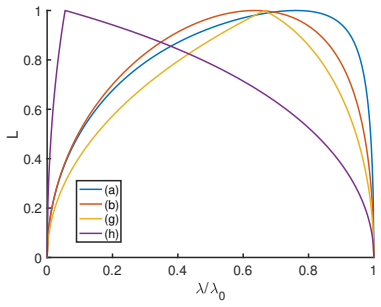
The load-bearing object is the artificial energy $H(q)=\sum_{(i,j)\in E}\bigl(\tfrac12\kappa(q_{ij}^2-p_{ij}^2)^2+\omega_{ij}q_{ij}^2\bigr)$, which models squared edge lengths as springs with stiffness $\kappa$ carrying tensions $\omega$. The proof controls three things on $C$: the gradient bound $|H'(p)|\le2|\omega^T R(p)|$, the Hessian lower bound $\tfrac12H''\ge\lambda$, and a third-derivative bound written as $\eta_0(r)=\tfrac{L}{2}\bigl(\bar\mu^{1/2}+r/L\bigr)^{-1}$, with $L=(\lambda/8z\kappa)^{1/2}$ and $\bar\mu=1-\mu_0/\lambda$. From those, a generalized second-derivative test for functions that are almost critical produces the discriminant conditions $D<1/2$, (3.12), and $D_{\rm pss}<1/2$, and the explicit formulas for $\eta_1,\eta_2,\eta_3,e^*_{\min}$.
What would settle it
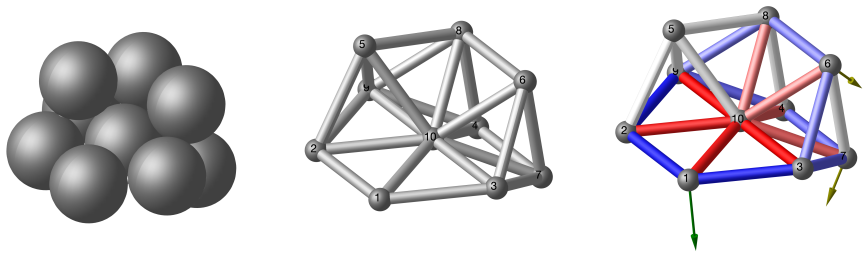
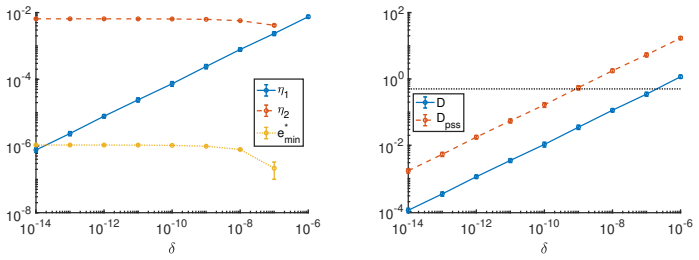
Run numerical path-following or algebraic solving on any framework satisfying Theorem I's inequalities to look for a same-edge-length configuration at distance in $(\eta_1,\eta_2)$ from $p$; a single example would refute the theorem. The natural test case is cluster 45601 from the 13-sphere survey, whose computed $D$ exceeds the threshold, or a slight perturbation of it, to see whether it actually flexes beyond $\eta_1$.
Extended reading notes
Core claim
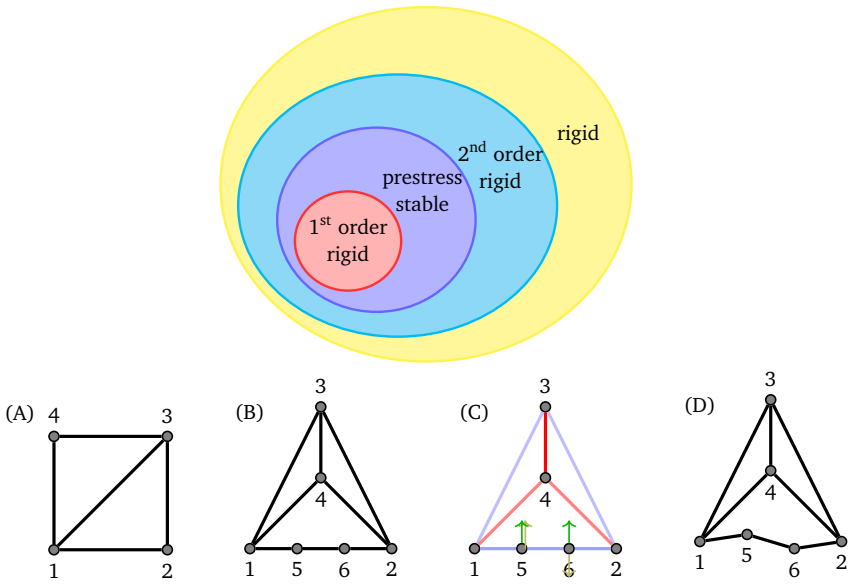
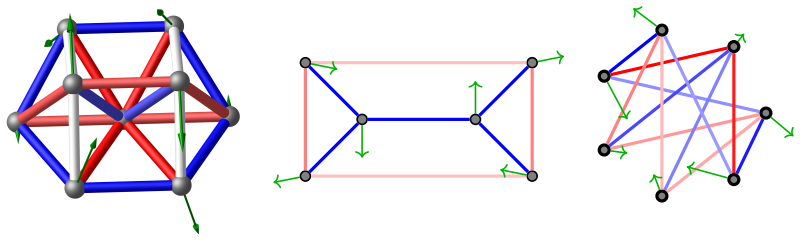
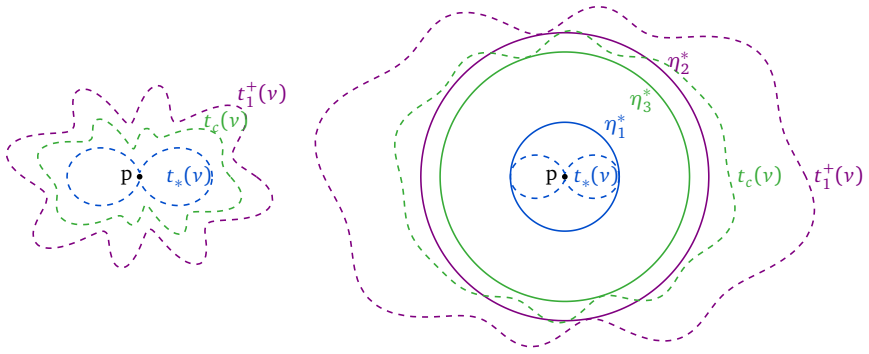
The paper's central discovery is that near-rigidity is certifiable. Starting from a configuration $p$, a subspace $C$ transverse to trivial motions, an almost-flex space $V$, an almost-stress $\omega$, and parameters $\lambda,\kappa$ chosen so that the energy $H(q)=\sum_{(i,j)\in E}\bigl(\tfrac12\kappa(q_{ij}^2-p_{ij}^2)^2+\omega_{ij}q_{ij}^2\bigr)$ has second derivative at least $2\lambda$ along unit vectors in $C$, Theorem I proves that if $D=(\eta_1/L)(\sqrt{\bar\mu}+\eta_1/L)<1/2$ with $\eta_1=4|\omega^T R(p)|/\lambda$, then every continuous path $q(t)\in p+C$ preserving edge lengths obeys $|q(t)-p|\le\eta_1$. Theorem II gives an outer radius $\eta_2>\eta_1$ separating nearby from distant same-edge-length configurations; Theorem III gives a minimum squared-edge-length change $e^*_{\min}$ along any path to a distant configuration; and Theorem IV, under a stronger $D_{\rm pss}<1/2$, guarantees a nearby prestress-stable configuration, which is therefore rigid. The paper computes these radii for sphere clusters, isostatic frameworks, Siamese dipyramids, and $K_{3,4}$ examples.
Load-bearing premise
The certificate rests on the computed quantity $D$ (or $D_{\rm pss}$ for Theorem IV) being below $1/2$ for the chosen stress, subspaces, and $\lambda$; one of the 98,529 surveyed clusters fails this, so the condition is not automatic.
Editorial extensions
If this is right
- A framework computed by finite-precision numerical solving can be certified to be nearly rigid: Theorem IV produces a nearby prestress-stable, hence rigid, configuration without assuming that small singular values of the rigidity matrix come from exact zeros.
- For first-order rigid frameworks, Corollary 3.4 gives explicit separation constants: any other same-edge-length configuration is at least roughly $0.618\,\sigma_0/(2\sqrt z)$ away, and any path to it must change squared edge lengths by at least roughly $0.528\,\sigma_0^2/(2\sqrt z)$.
- The asymptotics in Corollary 3.5 imply that when the exact framework is prestress stable but not first-order rigid, a numerical solution with squared-edge-length error $\epsilon$ can be only $\sqrt{\epsilon}$-close in configuration, so one expects roughly half as many digits of accuracy.
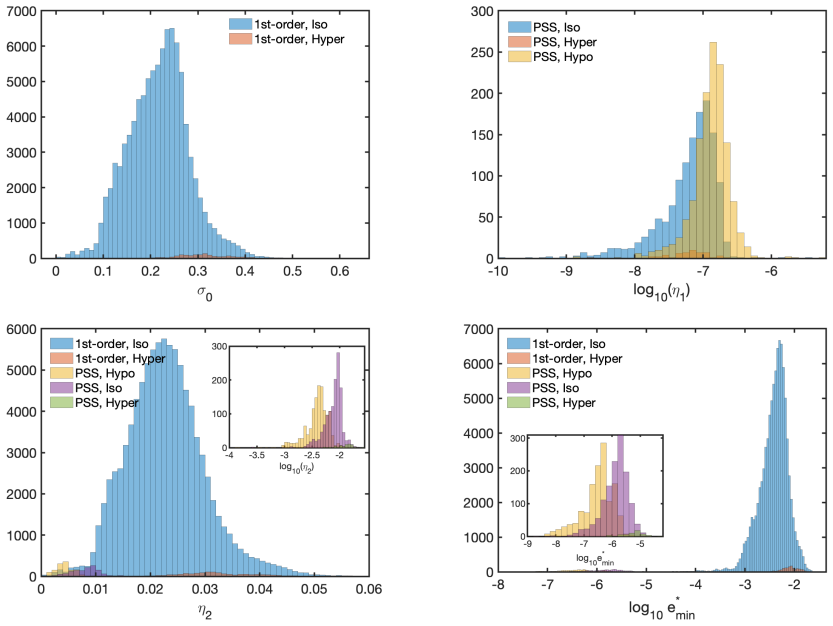
- In the survey of 98,529 rigid clusters of 13 unit spheres, all but one satisfy the numerical conditions of Theorems I–II and all but four satisfy the condition of Theorem IV, so the certificates are not empty in the applications that motivated the theory.
- With signs on the edges, the same radii extend to tensegrities under the added condition that no edge length changes by more than $2|\omega_{ij}|/\kappa$ on any cable or strut.
Reading between the lines
- Because the conditions are convex, one could optimize over choices of $V$, $W$, and $\lambda$ to make $\eta_2$ as large as possible; the paper fixes $\lambda$ in most examples and reports that $L(\lambda)$ varies by only about a factor of two, so such tuning could give noticeably larger outer radii.
- The edge-change barrier $e^*_{\min}$ could serve as a rigorous lower bound in molecular or colloidal settings where the question is whether a cluster can reach another geometry without breaking bonds; the paper's energy function already has the form of such interaction potentials, though it does not pursue this application.
- Because the certificate failed only for very floppy, high-$\bar\mu$ clusters in the 13-sphere survey, a practical screening rule could estimate $\bar\mu$ first and only run the full semidefinite test when it is moderate; this is a natural by-product of the paper's constants, not something it states.
- One could test how close the constants are to sharp by searching, via numerical continuation, for same-edge-length configurations inside the annulus $(\eta_1,\eta_2)$; the Siamese-dipyramid and $K_{3,4}$ examples suggest such close configurations are often absent, so the constants are likely conservative.
Signed reviews
Editorial analysis
A structured set of objections, weighed in public.
Referee Report
Summary. This paper introduces and proves a quantitative theory of "almost-rigidity" for bar frameworks. Given a framework (p,E), a subspace C complementary to the trivial motions, an almost-flex space V, an almost-stress ω whose stress matrix is positive definite on V, and derived quantities L, μ̄, η1, the authors state four theorems: (I) every continuous edge-length-preserving path in C_p starting at p remains within distance η1 of p; (II) any other configuration with the same edge lengths is either in the η1-ball or at distance at least η2>η1; (III) a deformation reaching distance η>(3/2)η1 forces a minimal squared-edge-length change e_min(η), hence any path to a distant equivalent configuration crosses a barrier e*_min; and (IV) under a stronger smallness condition there is a nearby prestress-stable framework. The proofs construct a spring energy H, prove general barrier propositions for functions that are almost critical (Section 5), specialize the derivative bounds to framework energies (Section 6), and then apply them (Section 7). The paper also reports SDP-based numerical tests on many examples and on 98,529 sphere clusters.
Significance. If the proof chain is repaired, this is a valuable contribution. It gives explicit, analytically defined radii and edge-length barriers that can be certified by linear algebra and semidefinite programming, without assuming that small singular values of the rigidity matrix are perturbed zeros. The framework is genuinely certificate-based: given V, W, ω satisfying (3.3), each theorem's conclusion follows from arithmetic verification of smallness conditions, and the examples and 98,529-cluster survey directly show how often the hypotheses hold and where they fail. The paper is also honest about limitations: the conditions are restrictive, one cluster fails in the survey, and Example 1 applies only for tiny perturbations. No parameter fitting or external ground truth is used in the estimates. However, the manuscript currently contains a load-bearing constant error in Proposition III and an overstatement in Theorem IV, so the central claims are defensible but need revision.
major comments (2)
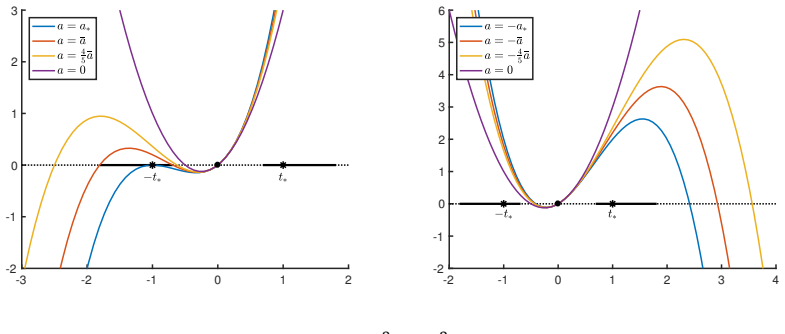
- [Section 5.3, Eq. (5.39)] The hypothesis labeled Strong(2/9, (3/2)η1*) is stated with the wrong threshold. From the definitions in (5.9) and (5.35), a=H'''/6, b=H''/2, c=H', so (max |a|/b)(max |c|/b) = (2/3)(max |H'|/H'')(max |H'''|/H''). Strong(2/9) therefore requires the displayed product to be < (3/2)(2/9) = 1/3, not <3/8; 3/8 is the threshold for Strong(1/4). As written, Proposition III is false: for H(t)=t³+t²+0.24t one has η1*=0.48 and η3*=2/3<0.72=(3/2)η1*, while the displayed product equals 0.36<3/8 (using |H'(0)|/H''(0)=0.12 and max|H'''|/H''(0)=3), so the asserted positivity interval is empty. Because Theorem III is proved through Proposition 7.4 and Corollary 5.12, which invokes Proposition III, the proof chain for Theorem III has a real gap. The intended theorem is recoverable by correcting the constant to 1/3 and re-verifying the chain; note that Corollary 5.12's condition η1/η0(3η1/2)<8/9 is the correct Strong(2/9) analogue.
- [Section 3 (Theorem IV) and Section 7 proof] Theorem IV as stated asserts existence of (ppss,E)∈C_p with the same edge lengths as p, but the proof only shows that the unconstrained energy H achieves an interior minimum ppss with ∇H(ppss)=0 and positive definite Hessian on C. A critical point of H is not forced to satisfy e(ppss)=e(p): for each edge energy h_i(x)=½κ(x-p_i²)²+ω_i x, the equation h_i(x)=h_i(p_i²) has a second root x=p_i²-2ω_i/κ, and the proof does not even show H(ppss)=H(p). Thus the "same edge lengths as p" clause is unsupported; it is also not used in the applications (Section 4.1.1 explicitly says "we don't know that ppss has the desired edge lengths"). The theorem should be restated with the weaker conclusion "there is a nearby prestress-stable framework" (matching the abstract and introduction), or an additional argument must be supplied. The phrase "since the energy function is quadratic" in the proof is also inaccurate: the energy in (6.2) is quartic in q.
minor comments (3)
- [Section 4.2.4] The sentence "the the K3,4 framework" contains a duplicated article.
- [Section 9] The phrase "using the spectral data associated associated with" contains a duplicated word.
- [Section 5.2, after Eq. (5.22)] The phrase "This is a slightly stronger than condition (5.14)" is grammatically incomplete, and the "constant of 2/8" should be written as 1/4 to avoid confusion with the adjacent 2/9 constant.
Circularity Check
No significant circularity: main theorems derive quantitative certificates from stated inputs, not from fitted outputs or self-citation chains.
full rationale
The paper's Theorem I-IV set up an energy H(q)=sum(1/2 kappa(q^2 - p^2)^2 + omega q^2), whose Hessian is controlled by the SDP condition (3.5), and then prove containment radii eta1, eta2, and e*_min as analytic consequences. The stress omega is obtained numerically via SDP (2.10), but it is an input certificate rather than a fit to the phenomenon being predicted; eta1 = 4|omega^T R(p)|/lambda is a computed bound from the residual of the almost-stress, not a parameter fitted to observed flex distances. In the examples, the radii are computed from the formulas and only afterwards compared with independently computed distances (e.g. Section 4.1.1), so the predictions are not statistically forced. No theorem is defined in terms of its own conclusion, no fitted quantity is renamed as a prediction, and no uniqueness or ansatz is imported from prior work of the same authors in a load-bearing way. The principal external reference [8] is cited for the standard definition of prestress stability and is not a self-citation of the present authors. Self-citations such as [23], [11], and [33] appear as sources of example clusters and datasets, not as premises of the proofs. A separate constant-mismatch concern in Proposition III (displayed assumption (5.39) is <3/8 while Strong(2/9) as defined in (5.35) would require the displayed product to be <1/3) is a correctness issue, not circularity: it does not make the conclusion equal to an input by construction. Overall, the derivation chain is self-contained and no circular step was found.
Assumptions & free parameters
free parameters (3)
- lambda (eigenvalue slack below lambda0) =
lambda0/2 or 0.8 lambda0 in examples
- singular value cutoff for almost-flex/stress spaces =
sigma0 or 1e-7 in examples
- kappa (spring constant) =
3.26 in example 2
assumptions (3)
- domain assumption A strict local minimum of the edge-energy function H with positive definite Hessian is prestress stable and therefore rigid (Connelly and Whiteley 1996).
- standard math Jordan-Brouwer separation theorem
- domain assumption The affine slice C_p is a valid local chart for the congruence quotient near p
invented entities (3)
-
almost-flex space V
-
almost-self-stress space W
-
almost-rigidity
Cite this review
Pith. "Pith review of Almost-rigidity of frameworks." pith.science (2026). https://pith.science/paper/GGMWNTZD
@misc{pith2026190803802,
  author       = {Pith},
  title        = {Pith review of: Almost-rigidity of frameworks},
  year         = {2026},
  howpublished = {\url{https://pith.science/paper/GGMWNTZD}},
  note         = {Machine review of arXiv:1908.03802}
}
abstract
We extend the mathematical theory of rigidity of frameworks (graphs embedded in $d$-dimensional space) to consider nonlocal rigidity and flexibility properties. We provide conditions on a framework under which (I) as the framework flexes continuously it must remain inside a small ball, a property we call "almost-rigidity"; (II) any other framework with the same edge lengths must lie outside a much larger ball; (III) if the framework deforms by some given amount, its edge lengths change by a minimum amount; (IV) there is a nearby framework that is prestress stable, and thus rigid. The conditions can be tested efficiently using semidefinite programming. The test is a slight extension of the test for prestress stability of a framework, and gives analytic expressions for the radii of the balls and the edge length changes. Examples illustrate how the theory may be applied in practice, and we provide an algorithm to test for rigidity or almost-rigidity. We briefly discuss how the theory may be applied to tensegrities.
Figures

Figures from the paper (6 more)
Reference graph
Works this paper leans on
-
[1]
http://www.arup.com/projects/kurilpa_bridge, 2009
Kurilpa bridge. http://www.arup.com/projects/kurilpa_bridge, 2009. URL http://www. arup.com/projects/kurilpa_bridge
work page 2009
-
[2]
Generalizations of Kempe’s universality theorem
T G Abbott. Generalizations of Kempe’s universality theorem. PhD thesis, Master’s Thesis, 2008
work page 2008
-
[3]
L Asimow and B Roth. The rigidity of graphs. Transactions of the American Mathematical Society, 245:279–289, 1978
work page 1978
-
[4]
Flexible mechan- ical metamaterials
Katia Bertoldi, Vincenzo Vitelli, Johan Christensen, and Martin van Hecke. Flexible mechan- ical metamaterials. Nature Reviews, 2:17066, 2017
work page 2017
-
[5]
New Principles for Auxetic Periodic Design
Ciprian S Borcea and Ileana Streinu. New Principles for Auxetic Periodic Design. SIAM Journal on Applied Algebra and Geometry, 1(1):442–458, January 2017
work page 2017
-
[6]
MIT Press, Cambridge, MA, 1988
John Canny .The complexity of robot motion planning, volume 1987 of ACM Doctoral Disser- tation Awards. MIT Press, Cambridge, MA, 1988. ISBN 0-262-03136-1
work page 1987
-
[7]
R Connelly and H Servatius. Higher-order rigidity–What is the proper definition? Discrete & Computational Geometry, 11(2):193–200, 1994
work page 1994
-
[8]
Second-order rigidity and prestress stability for tensegrity frameworks
R Connelly and W Whiteley . Second-order rigidity and prestress stability for tensegrity frameworks. SIAM Journal on Discrete Mathematics, 9(3):453–491, August 1996
work page 1996
Show all 47 references
-
[9]
The rigidity of certain cabled frameworks and the second-order rigidity of arbitrarily triangulated convex surfaces
Robert Connelly . The rigidity of certain cabled frameworks and the second-order rigidity of arbitrarily triangulated convex surfaces. Advances in Mathematics, 37(3):272–299, 1980
1980
-
[10]
strut-cable
Robert Connelly and Allen Back. Mathematics and tensegrity: Group and representation theory make it possible to form a complete catalogue of "strut-cable" constructions with pre- scribed symmetries. American Scientist, 86(2):142–151, 1998. URL http://www.jstor. org/stable/27856980
1998
-
[11]
Gortler, and Louis Theran
Robert Connelly , Steven J. Gortler, and Louis Theran. Rigidity for sticky discs.Proceedings of the Royal Society A: Mathematical, Physical and Engineering Sciences, 475(2222):20180773,
-
[12]
Guest, Andrea Micheletti, and Pete Winslow
Paola Daro, Don Gray , Simon D. Guest, Andrea Micheletti, and Pete Winslow. The Kent Tensegritree project. In Proceedings of the International Association for Shell and Spatial Structures Symposium 2015: Future Visions (IASS’15: Future Visions), August 2015
2015
-
[13]
Online course 4.491: Form-finding and structural optimization: Gaudi work- shop
Erik Demaine, John Ochsendorf, Martin Demaine, Simon Greenwold, Axel Kilian, and Bar- bara Cutler. Online course 4.491: Form-finding and structural optimization: Gaudi work- shop. Online course, 2004. URL https://ocw.mit.edu/courses/architecture/ 4-491-form-finding-and-structur...
2004
-
[14]
Geometric folding algorithms
Erik D Demaine and Joseph O’Rourke. Geometric folding algorithms . Linkages, Origami, Polyhedra. Cambridge University Press, Cambridge, Cambridge, 2007
2007
-
[15]
Separation bounds for polynomial systems
Ioannis Emiris, Bernard Mourrain, and Elias Tsigaridas. Separation bounds for polynomial systems. J. Symbolic Comput., 101:128–151, 2020. ISSN 0747-7171
2020
-
[16]
Epsilon local rigidity and numerical algebraic geometry , 2020
Andrew Frohmader and Alexander Heaton. Epsilon local rigidity and numerical algebraic geometry , 2020
2020
-
[17]
Unstable Polyhedral Structures
Michael Goldberg. Unstable Polyhedral Structures. Mathematics Magazine, 51(3):165–170, May 1978
1978
-
[18]
On the model flexibility of Siamese dipyramids
V Gorkavyy and I Fesenko. On the model flexibility of Siamese dipyramids. Journal of Geometry, 110(1):1–19, December 2018
2018
-
[19]
Graph implementations for nonsmooth convex programs
Michael Grant and Stephen Boyd. Graph implementations for nonsmooth convex programs. In V . Blondel, S. Boyd, and H. Kimura, editors, Recent Advances in Learning and Control , Lecture Notes in Control and Information Sciences, pages 95–110. Springer-Verlag Limited,
-
[20]
CVX: Matlab software for disciplined convex program- ming, version 2.1
Michael Grant and Stephen Boyd. CVX: Matlab software for disciplined convex program- ming, version 2.1. http://cvxr.com/cvx, March 2014
2014
-
[21]
Quint, Yaouen Fily , and J
Silke Henkes, David A. Quint, Yaouen Fily , and J. M. Schwarz. Rigid cluster decompo- sition reveals criticality in frictional jamming. Phys. Rev. Lett. , 116:028301, Jan 2016. doi: 10.1103 /PhysRevLett.116.028301. URL https://link.aps.org/doi/10.1103/ PhysRevLett.116.028301
2016
-
[22]
Sticky-Sphere Clusters.Annual Review of Condensed Matter Physics, 8(1):77–98, March 2017
Miranda Holmes-Cerfon. Sticky-Sphere Clusters.Annual Review of Condensed Matter Physics, 8(1):77–98, March 2017
2017
-
[23]
Enumerating Rigid Sphere Packings
Miranda C Holmes-Cerfon. Enumerating Rigid Sphere Packings. SIAM Review, 58(2):229– 244, May 2016
2016
-
[24]
Connected rigidity matroids and unique realizations of graphs
Bill Jackson and Tibor Jordán. Connected rigidity matroids and unique realizations of graphs. J. Combin. Theory Ser. B , 94(1):1–29, 2005. ISSN 0095-8956. doi: 10.1016 / j.jctb.2004.11.002. URL https://doi-org.ezproxy.st-andrews.ac.uk/10.1016/ j.jctb.2004.11.002
2005
-
[25]
Protein flexibility predictions using graph theory
D J Jacobs, A J Rader, L A Kuhn, and M F Thorpe. Protein flexibility predictions using graph theory. Proteins-Structure Function and Genetics, 44(2):150–165, 2001. 55
2001
-
[26]
W . Kabsch. A solution for the best rotation to relate two sets of vectors.Acta Crystallographica Section A, 32(5):922–923, Sep 1976. doi: 10.1107 /S0567739476001873. URL https: //doi.org/10.1107/S0567739476001873
1976 doi
-
[27]
Free energy of singular sticky-sphere clusters
Yoav Kallus and Miranda Holmes-Cerfon. Free energy of singular sticky-sphere clusters. Physical Review E, 95(2):2491–18, February 2017
2017
-
[28]
The Jamming Transition and the Marginally Jammed Solid
Andrea J Liu and Sidney R Nagel. The Jamming Transition and the Marginally Jammed Solid. Annual Review of Condensed Matter Physics, 1(1):347–369, 2010
2010
-
[29]
Colloidal matter: Packing, geometry , and entropy
V N Manoharan. Colloidal matter: Packing, geometry , and entropy. Science, 349(6251): 1253751–1253751, August 2015
2015
-
[30]
Direct obser- vation of a local structural mechanism for dynamic arrest
C Patrick Royall, Stephen R Williams, Takehiro Ohtsuka, and Hajime Tanaka. Direct obser- vation of a local structural mechanism for dynamic arrest. Nature Materials, 7(7):556–561, June 2008
2008
-
[31]
Selective buckling via states of self- stress in topological metamaterials
Jayson Paulose, Anne S Meeussen, and Vincenzo Vitelli. Selective buckling via states of self- stress in topological metamaterials. Proceedings of the National Academy of Sciences , 112 (25):7639–7644, June 2015
2015
-
[32]
Position- based tensegrity design
Nico Pietroni, Marco Tarini, Amir Vaxman, Daniele Panozzo, and Paolo Cignoni. Position- based tensegrity design. Acm Transactions on Graphics, 36(6):1–14, November 2017
2017
-
[33]
Daniel Rayneau-Kirkhope, Chengzhao Zhang, Louis Theran, and Marcelo A. Dias. Analytic analysis of auxetic metamaterials through analogy with rigid link systems. Proceedings of the Royal Society A: Mathematical, Physical and Engineering Sciences, 474(2210):20170753,
-
[34]
Morphometric Approach to Many-Body Correlations in Hard Spheres
Joshua F Robinson, Francesco Turci, Roland Roth, and C Patrick Royall. Morphometric Approach to Many-Body Correlations in Hard Spheres. Physical Review Letters , 122(6): 068004, February 2019
2019
-
[35]
Designing allostery-inspired response in mechanical networks
J W Rocks, N Pashine, I Bischofberger, C P Goodrich, A J Liu, and S R Nagel. Designing allostery-inspired response in mechanical networks. Proceedings of the National Academy of Sciences, 114:2520–2525, 2017
2017
-
[36]
The flexibility window in zeolites
Asel Sartbaeva, Stephen A Wells, M M J Treacy , and M F Thorpe. The flexibility window in zeolites. Nature Materials, 5(12):962–965, November 2006
2006
-
[37]
Sommese and Charles W
Andrew J. Sommese and Charles W . Wampler, II.The numerical solution of systems of poly- nomials. World Scientific Publishing Co. Pte. Ltd., Hackensack, NJ, 2005. Arising in engi- neering and science
2005
-
[38]
Louis Theran, Anthony Nixon, Elissa Ross, Mahdi Sadjadi, Brigitte Servatius, and M. F . Thorpe. Anchored boundary conditions for locally isostatic networks. Phys. Rev. E , 92: 053306, Nov 2015. doi: 10.1103 /PhysRevE.92.053306. URL https://link.aps.org/ doi/10.1103/PhysRevE.92...
2015 doi
-
[39]
Semidefinite programming.SIAM Rev., 38(1):49– 95, 1996
Lieven Vandenberghe and Stephen Boyd. Semidefinite programming.SIAM Rev., 38(1):49– 95, 1996. ISSN 0036-1445. doi: 10.1137 /1038003. URL https://doi-org.ezproxy. st-andrews.ac.uk/10.1137/1038003
1996 doi
-
[40]
Veenendaal and P
D. Veenendaal and P . Block. An overview and comparison of structural form finding methods for general networks. International Journal of Solids and Structures , 49(26):3741–3753,
-
[41]
White and Walter Whiteley
Neil L. White and Walter Whiteley . The algebraic geometry of stresses in frameworks. SIAM J. Algebraic Discrete Methods, 4(4):481–511, 1983. ISSN 0196-5212. doi: 10.1137 / 0604049. URL https://doi-org.ezproxy.st-andrews.ac.uk/10.1137/0604049
1983 doi
-
[42]
Counting out to the flexibility of molecules
Walter Whiteley . Counting out to the flexibility of molecules. Physical Biology, 2(4):S116– S126, December 2005
2005
-
[43]
Architecture and coevolution of allosteric materials
L Yan, R Ravasio, C Brito, and M Wyart. Architecture and coevolution of allosteric materials. Proceedings of the National Academy of Sciences, 114:2526–2531, 2017. 57
2017
-
[2008]
http://stanford.edu/~boyd/graph_dcp.html
-
[2012]
doi: 10.1016 /j.ijsolstr.2012.08.008
2012
-
[2018]
doi: 10.1098 /rspa.2017.0753
2017
-
[2019]
doi: 10.1098 /rspa.2018.0773. 54
2018
Reviewed August 14, 2026 · model on record in the stance chip above.
Discussion (0). Continue with ORCID to comment.