REVIEW 6 minor 78 references
Fixation probabilities in evolutionary dynamics under weak selection
T0 review · 0 major / 6 minor · reviewed 2026-08-14 · deepseek-v4-flash
Pith's one-line read For any population structure, weak-selection fixation probability reduces to a linear system of polynomial size.
desk verdict A rigorous, general weak-selection expansion for fixation probabilities that unifies and extends prior results; deserves serious refereeing and likely acceptance. read the letter →
The pith
A machine-rendered reading of the paper's core claim, the machinery that carries it, and where it could break.
The reading
What carries the argument
The argument is carried by three linked objects. An amended Markov chain that resets to the initial state $\xi$ with probability $u$ after absorption lets Proposition 1 identify neutral sojourn times with the $u$-derivative of the amended stationary distribution at $u=0$. The sojourn-time quantities $\eta^\xi_I$ are the unique solution of the linear system (35), and they measure, under neutral drift from $\xi$, the expected accumulation of $\hat{x}-x_I$ before absorption. The selection coefficient $c_{ji}^I$ comes from the pseudo-Boolean (multi-linear polynomial) representation of the first derivative of the transmission probabilities, and the degree $D$ is the largest $|I|$ that appears; only $\eta^\xi_I$ for $|I|\le D+1$ are needed. Uniqueness of $\eta^\xi$ follows from the set-valued coalescent chain, whose stationary distribution on singleton sets is exactly the reproductive-value vector $\pi$.
What would settle it
For a small smooth model (say a 4-cycle with death-Birth updating and the donation game), solve the exact $2^N$-state Markov chain for $\rho_A(\xi)$ at several small $\delta$, compute the right side of Eq. (34) by solving the $\eta$-system, and check that the difference is $O(\delta^2)$; a difference linear in $\delta$ would refute the expansion.
Extended reading notes
Core claim
The central claim is Theorem 2: for any fixed initial configuration $\xi$ in the paper's modeling framework, the fixation probability of type $A$ satisfies $$\rho_A(\xi) = \hat{\xi} + \delta \sum_{i=1}^N \pi_i \sum_{j=1}^N \sum_{\substack{I\subseteq\{1,\dots,N\}\\0\le |I|\le D_{ji}}} c_{ji}^I \left(\eta^\xi_{i\cup I} - \eta^\xi_{j\cup I}\right) + O(\$delta^{2}$),$$ where $\hat{\xi}$ is the reproductive-value-weighted frequency of $A$, $\pi_i$ are neutral reproductive values, $c_{ji}^I$ are the Fourier coefficients of the first derivative at $\delta=0$ of the marginal trait-transmission probabilities $e_{ji}$, and $\eta^\xi$ is the unique solution of the neutral sojourn-time system (35). The degree $D$ of the process is the largest set size appearing in those coefficients. If $D$ is fixed, computing the first-order effect requires solving only $O(N^{D+1})$ linear equations rather than the exponential number of states in the full Markov chain.
Load-bearing premise
The expansion rests on the assumption that every replacement-event probability is a smooth function of the selection intensity in a neighborhood of $\delta=0$; if a model has a kink or threshold at zero, the first-order coefficients $c_{ji}^I$ do not exist and the formula cannot be applied.
Editorial extensions
If this is right
- For fixed degree $D$, the first-order weak-selection expansion is computable in $O(N^{3(D+1)})$ time (or $O(N^{2.373(D+1)})$ with fast matrix multiplication), eliminating exponential state enumeration for this class of models.
- Proposition 4 gives the donation-game fixation probability from any initial configuration on any weighted connected graph, unifying previous regular-graph and uniform-initialization formulas from the literature.
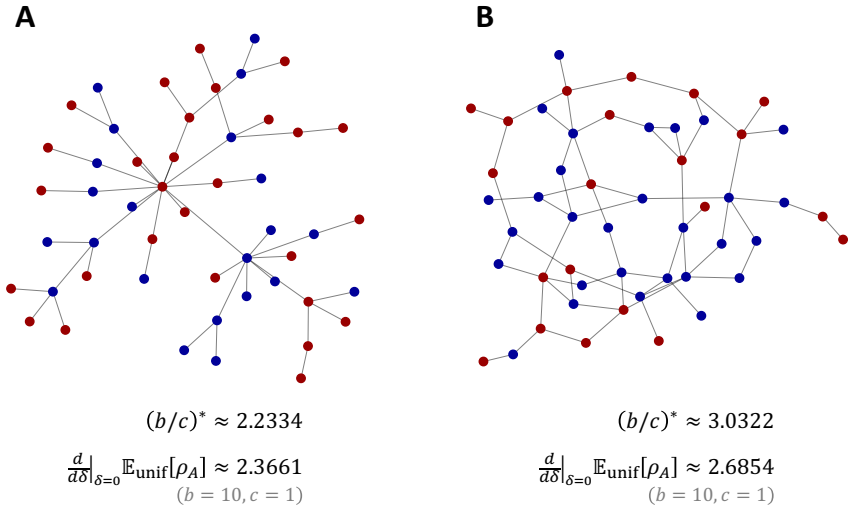
- Because the magnitude of the first-order coefficient is available, population structures can be compared by how much they boost cooperation at a given benefit-to-cost ratio, not only by the critical ratio; the paper shows these two rankings can disagree.
- For uniform mutant appearance, the quantities $\eta^{\mu_A}_I$ equal $1/N$ times the expected coalescence time of the set $I$, connecting the expansion to standard coalescent branch lengths.
- The framework also covers stochastic mutant-appearance distributions and relative fixation conditions for $A$ versus $B$, so the expansion applies beyond a fixed initial configuration.
Reading between the lines
- The polynomial-size formulation suggests a practical screening strategy for large structured populations: for any fixed-degree update rule, solve Eq. (35) once and rank structures by the size of the first-order effect; the paper demonstrates such a comparison but stops short of proposing it as a general search over structures.
- If the smoothness premise fails only mildly—say a kink at $\delta=0$ with one-sided derivatives—one could still obtain a formal expansion using one-sided coefficients, but the paper's uniqueness and $O(\delta^2)$ error bounds would need re-examination; this is an extension, not a claim of the paper.
- The paper notes that the $N\to\infty$ and $\delta\to0$ limits do not commute; an inference is that Eq. (34) is best suited to finite-$N$ analyses, and a large-population diffusion analogue would require either bounding $D$ as $N$ grows or a new averaging argument.
Editorial analysis
A structured set of objections, weighed in public.
Referee Report
Summary. This paper develops a first-order weak-selection expansion for fixation probabilities in a broad class of finite-population evolutionary models with arbitrary spatial structure and frequency-dependent selection. The main result, Theorem 2 (Eq. 34), expresses the first derivative of the fixation probability ρ_A(ξ) at δ=0 in terms of reproductive values π_i, Fourier coefficients c_{ji}^I of the first-order effects of selection on replacement probabilities, and neutral sojourn times η^ξ_I that solve an explicit linear system (Eq. 35) on subsets of size at most D+1, where D is the degree of the process. This reduces the computation from exponential to polynomial complexity in N for fixed D. The paper also derives extensions to stochastic mutant appearance (Section 5), compares fixation probabilities of two types (Section 6), and applies the framework to constant-fecundity models on graphs with death-Birth and Birth-death updating (Section 7) and to the donation game on weighted and regular graphs (Section 8), recovering and generalizing several known results. The proof strategy uses a sojourn-time/stationary-distribution identity for an amended Markov chain (Proposition 1), a coalescent representation, and prior results from the authors' modeling framework.
Significance. If the results hold, this is a significant contribution to the mathematical theory of evolutionary dynamics. The central formula is explicit and computable: for any fixed degree D, the first-order weak-selection coefficient is obtained by solving a linear system of size O(N^{D+1}), rather than by analyzing the exponentially large state space. The applications are also valuable: they provide new weak-selection expansions for arbitrary initial configurations on weighted graphs and unify results of Chen et al. (2016), Allen et al. (2017), and others. The proofs of the central theorem are coherent and the paper is careful to state its assumptions, particularly the smoothness of the replacement rule in δ (Section 2.1). The main limitations—the smoothness requirement and the fixed-degree condition for polynomial complexity—are explicitly acknowledged. The paper does not supply machine-checked proofs or code, but the derivations are standard and reproducible from the stated equations. Overall, this is a solid and useful mathematical contribution that deserves publication after minor revisions.
minor comments (6)
- [Section 5, Examples 1–3 (Eqs. 39–40, 54)] The definitions of the type-B mutant-appearance distribution use the same state notation as for type A, writing μ_B(1_i)=...; since μ_B is an initial distribution for B mutants in an all-A population, the paper's own subsequent identity E_{μ_B}[ξ_i]=1−μ_i shows that the intended support is the complementary state \bar{1_i}. Please correct the notation consistently, as the literal reading contradicts the equations that follow.
- [Section 7, Eqs. (57)–(60)] The duality ρ_A(r;ξ)=1−ρ_A(r^{−1};ξ) and the averaging identity in Eq. (58) appear to omit the complement of the initial configuration on the right-hand side; restoring \bar ξ makes Eq. (60) coherent, since ξ_I+\bar ξ_I is then 1 when all individuals in I have the same type. The missing overbars should be added throughout this subsection.
- [Section 7.1.1 and 7.1.2, Propositions 2 and 3] The derivations of Propositions 2 and 3 are summarized only as 'a series of simplifications' of Eq. (59). Because these are advertised as new results for arbitrary initial states on weighted graphs, the intermediate algebra should be supplied, at least in an appendix or supplement, so that readers can verify the reduction from the general linear system (35).
- [Section 8, proof of Proposition 4] The passage from Theorem 2's general η-system to the pair-level system (93) is compressed; in particular, the factors N/2 in Eq. (93a) and N in Eq. (93b) follow from the death-Birth coalescent recurrences but are not shown. A short derivation of (93a)–(93b) from Eq. (35) would make the application verifiable.
- [Section 2.1, third modeling assumption] The smoothness assumption on the replacement rule in δ is an explicit scope restriction: models with hard-threshold or sign-type selection rules, for which d/dδ e_{ij}(x) at δ=0 need not exist, are excluded. This is stated clearly and all applications use smooth fecundity maps, so I regard it as a limitation rather than a defect.
- [Section 8.3 and Figure 3] The caption states that Γ2 is 'unequivocally better' for cooperation, but this comparison is made for a specific parameter choice (b=10, c=1) and depends on the magnitude of the first-order effect; the caption should state this parameter dependence explicitly to avoid overgeneralization.
Circularity Check
No significant circularity: Theorem 2 follows from an explicit perturbation identity plus a self-contained linear-system reduction; self-citations are auxiliary and not equivalent to the target result.
full rationale
The derivation chain is self-contained in the sense required here. Theorem 1 is proved from the exact identity rho_A(xi) = xi_hat + <Delta_hat_sel>_xi (Eq. 31), which is obtained in the paper from the amended-chain construction, Proposition 1's sojourn-time identity (Eq. 18), and Corollary 1; no part of that chain assumes the first-order expansion being derived. Theorem 2 then expands Delta_hat_sel in the pseudo-Boolean basis of Eq. (6), defines eta^xi_I by Eq. (36), and shows that these quantities satisfy the linear system (35); the proof of uniqueness uses only the spectral structure of the neutral coalescent chain C. The cited results from Allen and Tarnita (2014), Allen and McAvoy (2019), and McAvoy et al. (2020) provide the general modeling framework, the neutral reproductive-value martingale, and a simplification in the game-theory application; these are auxiliary facts that do not presuppose the fixation expansion, and the martingale property is independently checkable from the linear system (12) stated in the paper. No fitted parameter is relabeled as a prediction, and the polynomial-complexity claim is explicitly qualified by fixed degree D (Remark 1). The weakest premise, smoothness of the replacement rule in delta, is stated as an explicit assumption and is a genuine scope restriction rather than a hidden circular step.
Assumptions & free parameters
assumptions (6)
- domain assumption Fixation Axiom: there exists an individual and a sequence of replacement events, each with positive probability in every state, such that the lineage of that individual can take over the whole population.
- domain assumption Neutral drift state-independence: at δ=0 the replacement rule is independent of the population state x.
- domain assumption Smoothness of the replacement rule in the selection intensity δ near δ=0.
- domain assumption Differentiability of mutant-appearance distributions at δ=0.
- standard math Fudenberg-Imhof low-mutation limit theorem (Fudenberg and Imhof, 2006, Theorem 2).
- domain assumption Deterministic state-to-fecundity mapping under weak selection (McAvoy et al., 2020).
Cite this review
Pith. "Pith review of Fixation probabilities in evolutionary dynamics under weak selection." pith.science (2026). https://pith.science/paper/UE6HBHW6
@misc{pith2026190803827,
  author       = {Pith},
  title        = {Pith review of: Fixation probabilities in evolutionary dynamics under weak selection},
  year         = {2026},
  howpublished = {\url{https://pith.science/paper/UE6HBHW6}},
  note         = {Machine review of arXiv:1908.03827}
}
read the original abstract
In evolutionary dynamics, a key measure of a mutant trait's success is the probability that it takes over the population given some initial mutant-appearance distribution. This "fixation probability" is difficult to compute in general, as it depends on the mutation's effect on the organism as well as the population's spatial structure, mating patterns, and other factors. In this study, we consider weak selection, which means that the mutation's effect on the organism is small. We obtain a weak-selection perturbation expansion of a mutant's fixation probability, from an arbitrary initial configuration of mutant and resident types. Our results apply to a broad class of stochastic evolutionary models, in which the size and spatial structure are arbitrary (but fixed). The problem of whether selection favors a given trait is thereby reduced from exponential to polynomial complexity in the population size, when selection is weak. We conclude by applying these methods to obtain new results for evolutionary dynamics on graphs.
Figures


Reference graph
Works this paper leans on
- [1]
-
[2]
B. Allen and A. McAvoy. A mathematical formalism for natural selection with arbitrary spatial and genetic structure. Journal of Mathematical Biology, 78 0 (4): 0 1147--1210, 2019. doi:10.1007/s00285-018-1305-z
-
[3]
B. Allen and M. A. Nowak. Games on graphs. EMS Surveys in Mathematical Sciences , 1 0 (1): 0 113--151, 2014. doi:10.4171/emss/3
-
[4]
B. Allen and C. E. Tarnita. Measures of success in a class of evolutionary models with fixed population size and structure. Journal of Mathematical Biology, 68 0 (1-2): 0 109--143, 2014. doi:10.1007/s00285-012-0622-x
-
[5]
B. Allen, C. Sample, Y. Dementieva, R. C. Medeiros, C. Paoletti, and M. A. Nowak. The Molecular Clock of Neutral Evolution Can Be Accelerated or Slowed by Asymmetric Spatial Structure . PLOS Computational Biology , 11 0 (2): 0 e1004108, 2015. doi:10.1371/journal.pcbi.1004108
-
[6]
B. Allen, G. Lippner, Y.-T. Chen, B. Fotouhi, N. Momeni, S.-T. Yau, and M. A. Nowak. Evolutionary dynamics on any population structure. Nature, 544 0 (7649): 0 227--230, 2017. doi:10.1038/nature21723
-
[7]
B. Allen, G. Lippner, and M. A. Nowak. Evolutionary games on isothermal graphs. Nature Communications, 10 0 (1): 0 5107, 2019. doi:10.1038/s41467-019-13006-7
-
[8]
B. Allen, C. Sample, R. Jencks, J. Withers, P. Steinhagen, L. Brizuela, J. Kolodny, D. Parke, G. Lippner, and Y. A. Dementieva. Transient amplifiers of selection and reducers of fixation for death-Birth updating on graphs . PLOS Computational Biology, 16 0 (1): 0 e1007529, 2020. doi:10.1371/journal.pcbi.1007529
Show all 78 references
-
[9]
Antal, S
T. Antal, S. Redner, and V. Sood. Evolutionary Dynamics on Degree-Heterogeneous Graphs . Physical Review Letters, 96 0 (18), 2006. doi:10.1103/physrevlett.96.188104
2006 doi
-
[10]
L. E. Blume. The Statistical Mechanics of Strategic Interaction . Games and Economic Behavior, 5 0 (3): 0 387--424, 1993. doi:10.1006/game.1993.1023
1993
-
[11]
Boros and P
E. Boros and P. L. Hammer. Pseudo-Boolean optimization . Discrete Applied Mathematics, 123 0 (1-3): 0 155--225, 2002. doi:10.1016/s0166-218x(01)00341-9
2002 doi
-
[12]
Broom and J
M. Broom and J. Rycht \' a r . An analysis of the fixation probability of a mutant on special classes of non-directed graphs. Proceedings of the Royal Society A: Mathematical, Physical and Engineering Sciences, 464 0 (2098): 0 2609--2627, 2008. doi:10.1098/rspa.2008.0058
2008
-
[13]
Broom, J
M. Broom, J. Rycht \' a r , and B. T. Stadler. Evolutionary Dynamics on Graphs - the Effect of Graph Structure and Initial Placement on Mutant Spread . Journal of Statistical Theory and Practice, 5 0 (3): 0 369--381, 2011. doi:10.1080/15598608.2011.10412035
2011
-
[14]
Y.-T. Chen. Sharp benefit-to-cost rules for the evolution of cooperation on regular graphs. The Annals of Applied Probability, 23 0 (2): 0 637--664, 2013. doi:10.1214/12-aap849
2013 doi
-
[15]
Y.-T. Chen. Wright-fisher diffusions in stochastic spatial evolutionary games with death--birth updating. The Annals of Applied Probability, 28 0 (6): 0 3418--3490, 2018. doi:10.1214/18-aap1390
2018 doi
-
[16]
Y.-T. Chen, A. McAvoy, and M. A. Nowak. Fixation Probabilities for Any Configuration of Two Strategies on Regular Graphs . Scientific Reports, 6 0 (1), 2016. doi:10.1038/srep39181
2016 doi
-
[17]
J. T. Cox. Coalescing random walks and voter model consensus times on the torus in Z^d . Annals of Probability, 17 0 (4): 0 1333--1366, 1989. doi:10.1214/aop/1176991158
1989
-
[18]
J. T. Cox and R. Durrett. Evolutionary games on the torus with weak selection. Stochastic Processes and their Applications, 126 0 (8): 0 2388--2409, 2016. doi:10.1016/j.spa.2016.02.004
2016 doi
-
[19]
F. A. Cuesta, P. G. Sequeiros, and \'A . L. Rojo. Suppressors of selection. PLOS One, 12 0 (7): 0 e0180549, 2017. doi:10.1371/journal.pone.0180549
2017 doi
-
[20]
F. A. Cuesta, P. G. Sequeiros, and \'A . L. Rojo. Evolutionary regime transitions in structured populations. PLOS One, 13 0 (11): 0 e0200670, 2018. doi:10.1371/journal.pone.0200670
2018 doi
-
[21]
D \' e barre, C
F. D \' e barre, C. Hauert, and M. Doebeli. Social evolution in structured populations. Nature Communications, 5, 2014. doi:10.1038/ncomms4409
2014 doi
-
[22]
R. Der, C. L. Epstein, and J. B. Plotkin. Generalized population models and the nature of genetic drift. Theoretical Population Biology, 80 0 (2): 0 80--99, 2011. doi:10.1016/j.tpb.2011.06.004
2011 doi
-
[23]
W. J. Ewens. Mathematical Population Genetics. Springer New York, 2004. doi:10.1007/978-0-387-21822-9
2004 doi
-
[24]
R. A. Fisher. The Genetical Theory of Natural Selection . Clarendon Press, 1930. doi:10.5962/bhl.title.27468
1930 doi
-
[25]
Fotouhi, N
B. Fotouhi, N. Momeni, B. Allen, and M. A. Nowak. Conjoining uncooperative societies facilitates evolution of cooperation. Nature Human Behaviour, 2 0 (7): 0 492--499, 2018. doi:10.1038/s41562-018-0368-6
2018 doi
-
[26]
Fudenberg and L
D. Fudenberg and L. A. Imhof. Imitation processes with small mutations. Journal of Economic Theory, 131 0 (1): 0 251--262, 2006. doi:10.1016/j.jet.2005.04.006
2006 doi
-
[27]
Grabisch, J.-L
M. Grabisch, J.-L. Marichal, and M. Roubens. Equivalent Representations of Set Functions . Mathematics of Operations Research, 25 0 (2): 0 157--178, 2000. doi:10.1287/moor.25.2.157.12225
-
[28]
J. B. S. Haldane. A mathematical theory of natural and artificial selection, part V: Selection and mutation . In Mathematical Proceedings of the Cambridge Philosophical Society, volume 23, pages 838--844. Cambridge University Press, 1927. doi:10.1017/S0305004100015644
1927 doi
-
[29]
P. L. Hammer and S. Rudeanu. Boolean Methods in Operations Research and Related Areas. Springer Berlin Heidelberg, 1968. doi:10.1007/978-3-642-85823-9
1968 doi
-
[30]
Hauert and M
C. Hauert and M. Doebeli. Spatial structure often inhibits the evolution of cooperation in the snowdrift game. Nature, 428 0 (6983): 0 643--646, 2004. doi:10.1038/nature02360
2004 doi
-
[31]
Hindersin and A
L. Hindersin and A. Traulsen. Counterintuitive properties of the fixation time in network-structured populations. Journal of The Royal Society Interface, 11 0 (99), 2014. doi:10.1098/rsif.2014.0606
2014
-
[32]
Hindersin and A
L. Hindersin and A. Traulsen. Most Undirected Random Graphs Are Amplifiers of Selection for Birth-Death Dynamics, but Suppressors of Selection for Death-Birth Dynamics . PLOS Computational Biology , 11 0 (11): 0 e1004437, 2015. doi:10.1371/journal.pcbi.1004437
2015 doi
-
[33]
Hindersin, M
L. Hindersin, M. M\" o ller, A. Traulsen, and B. Bauer. Exact numerical calculation of fixation probability and time on graphs. Biosystems, 150: 0 87--91, 2016. doi:10.1016/j.biosystems.2016.08.010
2016 doi
-
[34]
L. A. Imhof and M. A. Nowak. Evolutionary game dynamics in a Wright-Fisher process . Journal of Mathematical Biology, 52 0 (5): 0 667--681, 2006. doi:10.1007/s00285-005-0369-8
2006 doi
-
[35]
Kaveh, N
K. Kaveh, N. L. Komarova, and M. Kohandel. The duality of spatial death-birth and birth-death processes and limitations of the isothermal theorem. Royal Society Open Science, 2 0 (4): 0 140465--140465, 2015. doi:10.1098/rsos.140465
2015 doi
-
[36]
M. Kimura. On the Probability of Fixation of Mutant Genes in a Population . Genetics, 47 0 (6): 0 713--719, 1962
1962
-
[37]
J. F. C. Kingman. The coalescent. Stochastic Processes and their Applications, 13 0 (3): 0 235--248, 1982. doi:10.1016/0304-4149(82)90011-4
1982 doi
-
[38]
F. Le Gall. Faster Algorithms for Rectangular Matrix Multiplication . In 2012 IEEE 53rd Annual Symposium on Foundations of Computer Science . IEEE , 2012. doi:10.1109/focs.2012.80
2012 doi
-
[39]
Lessard and V
S. Lessard and V. Ladret. The probability of fixation of a single mutant in an exchangeable selection model. Journal of Mathematical Biology, 54 0 (5): 0 721--744, 2007. doi:10.1007/s00285-007-0069-7
2007 doi
-
[40]
Lieberman, C
E. Lieberman, C. Hauert, and M. A. Nowak. Evolutionary dynamics on graphs. Nature, 433 0 (7023): 0 312--316, 2005. doi:10.1038/nature03204
2005 doi
-
[41]
T. M. Liggett. Interacting Particle Systems. Springer New York, 1985. doi:10.1007/978-1-4613-8542-4
1985 doi
-
[42]
Maciejewski
W. Maciejewski. Reproductive value in graph-structured populations. Journal of Theoretical Biology, 340: 0 285--293, 2014. doi:10.1016/j.jtbi.2013.09.032
2014 doi
-
[43]
Maciejewski, F
W. Maciejewski, F. Fu, and C. Hauert. Evolutionary game dynamics in populations with heterogenous structures. PLoS Computational Biology, 10 0 (4): 0 e1003567, 2014. doi:10.1371/journal.pcbi.1003567
2014 doi
-
[44]
McAvoy and C
A. McAvoy and C. Hauert. Structure coefficients and strategy selection in multiplayer games. Journal of Mathematical Biology, 72 0 (1): 0 203--238, 2016. doi:10.1007/s00285-015-0882-3
2016 doi
-
[45]
McAvoy, B
A. McAvoy, B. Allen, and M. A. Nowak. Social goods dilemmas in heterogeneous societies. Nature Human Behaviour, 4 0 (8): 0 819--831, 2020. doi:10.1038/s41562-020-0881-2
2020 doi
-
[46]
D. M. McCandlish, C. L. Epstein, and J. B. Plotkin. Formal properties of the probability of fixation: Identities, inequalities and approximations . Theoretical Population Biology, 99: 0 98--113, 2015. doi:10.1016/j.tpb.2014.11.004
2015 doi
-
[47]
M \"o ller, L
M. M \"o ller, L. Hindersin, and A. Traulsen. Exploring and mapping the universe of evolutionary graphs identifies structural properties affecting fixation probability and time. Communications Biology, 2 0 (1): 0 137, 2019. doi:10.1038/s42003-019-0374-x
2019 doi
-
[48]
T. Monk, P. Green, and M. Paulin. Martingales and fixation probabilities of evolutionary graphs. Proceedings of the Royal Society A: Mathematical, Physical and Engineering Sciences, 470 0 (2165): 0 20130730--20130730, 2014. doi:10.1098/rspa.2013.0730
2014
-
[49]
P. A. P. Moran. Random processes in genetics. Mathematical Proceedings of the Cambridge Philosophical Society, 54 0 (01): 0 60, 1958. doi:10.1017/s0305004100033193
1958 doi
-
[50]
C. G. Nathanson, C. E. Tarnita, and M. A. Nowak. Calculating Evolutionary Dynamics in Structured Populations . PLoS Computational Biology , 5 0 (12): 0 e1000615, 2009. doi:10.1371/journal.pcbi.1000615
2009 doi
-
[51]
M. A. Nowak and R. M. May. Evolutionary games and spatial chaos. Nature, 359 0 (6398): 0 826--829, 1992. doi:10.1038/359826a0
1992 doi
-
[52]
M. A. Nowak, A. Sasaki, C. Taylor, and D. Fudenberg. Emergence of cooperation and evolutionary stability in finite populations. Nature, 428 0 (6983): 0 646--650, 2004. doi:10.1038/nature02414
2004 doi
-
[53]
M. A. Nowak, C. E. Tarnita, and T. Antal. Evolutionary dynamics in structured populations. Philosophical Transactions of the Royal Society B: Biological Sciences, 365 0 (1537): 0 19--30, 2009. doi:10.1098/rstb.2009.0215
2009
-
[54]
H. Ohtsuki. Evolutionary dynamics of n -player games played by relatives. Philosophical Transactions of the Royal Society B: Biological Sciences, 369 0 (1642): 0 20130359--20130359, 2014. doi:10.1098/rstb.2013.0359
2014
-
[55]
Ohtsuki, C
H. Ohtsuki, C. Hauert, E. Lieberman, and M. A. Nowak. A simple rule for the evolution of cooperation on graphs and social networks. Nature, 441 0 (7092): 0 502--505, 2006. doi:10.1038/nature04605
2006 doi
-
[56]
Patwa and L
Z. Patwa and L. M. Wahl. The fixation probability of beneficial mutations. Journal of The Royal Society Interface, 5 0 (28): 0 1279--1289, 2008. doi:10.1098/rsif.2008.0248
2008
-
[57]
Pavlogiannis, J
A. Pavlogiannis, J. Tkadlec, K. Chatterjee, and M. A. Nowak. Construction of arbitrarily strong amplifiers of natural selection using evolutionary graph theory. Communications Biology, 1 0 (1), 2018. doi:10.1038/s42003-018-0078-7
2018 doi
-
[58]
Pe \ n a, B
J. Pe \ n a, B. Wu, and A. Traulsen. Ordering structured populations in multiplayer cooperation games. Journal of The Royal Society Interface, 13 0 (114): 0 20150881, 2016. doi:10.1098/rsif.2015.0881
2016
-
[59]
F. Rousset. A Minimal Derivation of Convergence Stability Measures . Journal of Theoretical Biology, 221 0 (4): 0 665--668, 2003. doi:10.1006/jtbi.2003.3210
2003
-
[60]
Roze and F
D. Roze and F. Rousset. Selection and drift in subdivided populations: a straightforward method for deriving diffusion approximations and applications involving dominance, selfing and local extinctions. Genetics, 165 0 (4): 0 2153--2166, 2003
2003
-
[61]
Sample and B
C. Sample and B. Allen. The limits of weak selection and large population size in evolutionary game theory. Journal of Mathematical Biology, 75 0 (5): 0 1285--1317, 2017. doi:10.1007/s00285-017-1119-4
2017 doi
-
[62]
F. C. Santos and J. M. Pacheco. Scale-free networks provide a unifying framework for the emergence of cooperation. Physical Review Letters, 95 0 (9): 0 098104, 2005. doi:10.1103/physrevlett.95.098104
2005 doi
-
[63]
F. C. Santos, M. D. Santos, and J. M. Pacheco. Social diversity promotes the emergence of cooperation in public goods games. Nature, 454 0 (7201): 0 213--216, 2008. doi:10.1038/nature06940
2008 doi
-
[64]
K. Sigmund. The calculus of selfishness. Princeton University Press, 2010. doi:10.1515/9781400832255
2010 doi
-
[65]
Szab\' o and G
G. Szab\' o and G. F\' a th. Evolutionary games on graphs. Physics Reports, 446 0 (4-6): 0 97--216, 2007. doi:10.1016/j.physrep.2007.04.004
2007 doi
-
[66]
C. E. Tarnita and P. D. Taylor. Measures of Relative Fitness of Social Behaviors in Finite Structured Population Models . The American Naturalist, 184 0 (4): 0 477--488, 2014. doi:10.1086/677924
2014 doi
-
[67]
C. E. Tarnita, H. Ohtsuki, T. Antal, F. Fu, and M. A. Nowak. Strategy selection in structured populations. Journal of Theoretical Biology, 259 0 (3): 0 570--581, 2009. doi:10.1016/j.jtbi.2009.03.035
2009 doi
-
[68]
Taylor, D
C. Taylor, D. Fudenberg, A. Sasaki, and M. A. Nowak. Evolutionary game dynamics in finite populations. Bulletin of Mathematical Biology, 66 0 (6): 0 1621--1644, 2004. doi:10.1016/j.bulm.2004.03.004
2004 doi
-
[69]
P. D. Taylor. Allele-Frequency Change in a Class-Structured Population . The American Naturalist, 135 0 (1): 0 95--106, 1990. doi:10.1086/285034
1990 doi
-
[70]
P. D. Taylor, T. Day, and G. Wild. Evolution of cooperation in a finite homogeneous graph. Nature, 447 0 (7143): 0 469--472, 2007. doi:10.1038/nature05784
2007 doi
-
[71]
Tkadlec, A
J. Tkadlec, A. Pavlogiannis, K. Chatterjee, and M. A. Nowak. Population structure determines the tradeoff between fixation probability and fixation time. Communications Biology, 2, 2019. doi:10.1038/s42003-019-0373-y
2019 doi
-
[72]
Tkadlec, A
J. Tkadlec, A. Pavlogiannis, K. Chatterjee, and M. A. Nowak. Limits on amplifiers of natural selection under death-birth updating. PLOS Computational Biology, 16 0 (1): 0 e1007494, 2020. doi:10.1371/journal.pcbi.1007494
2020 doi
-
[73]
Traulsen and C
A. Traulsen and C. Hauert. Stochastic Evolutionary Game Dynamics . In Reviews of Nonlinear Dynamics and Complexity , pages 25--61. Wiley-Blackwell, 2010. doi:10.1002/9783527628001.ch2
2010 doi
-
[74]
Traulsen, J
A. Traulsen, J. M. Pacheco, and L. A. Imhof. Stochasticity and evolutionary stability. Physical Review E, 74 0 (2): 0 021905, 2006. doi:10.1103/physreve.74.021905
2006 doi
-
[75]
Van Cleve
J. Van Cleve. Social evolution and genetic interactions in the short and long term. Theoretical Population Biology, 103: 0 2--26, 2015. doi:10.1016/j.tpb.2015.05.002
2015 doi
-
[76]
Voorhees
B. Voorhees. Birth-death fixation probabilities for structured populations. Proceedings of the Royal Society A: Mathematical, Physical and Engineering Sciences, 469 0 (2153): 0 20120248, 2013. doi:10.1098/rspa.2012.0248
2013
-
[77]
J. Wakeley. Coalescent Theory: An Introduction. Macmillan Learning, 2016
2016
-
[78]
S. Wright. Evolution in M endelian populations. Genetics, 16: 0 97--159, 1931
1931
Reviewed August 14, 2026 · model on record in the stance chip above.
Discussion (0). Continue with ORCID to comment.