REVIEW 3 major objections 5 minor 95 references
Modeling Graphs with Vertex Replacement Grammars
T0 review · 3 major / 5 minor · reviewed 2026-08-14 · deepseek-v4-flash
Pith's one-line read The paper's central claim is that a vertex replacement grammar extracted from hierarchical clusterings compresses graphs better than state-of-the-art summarization models and generates graphs more faithfully than many state-of-the-art…
desk verdict A genuinely novel VRG extraction method with a subtle but load-bearing termination flaw in the generative model; worth serious review after the generator is fixed. read the letter →
The pith
A machine-rendered reading of the paper's core claim, the machinery that carries it, and where it could break.
The reading
What carries the argument
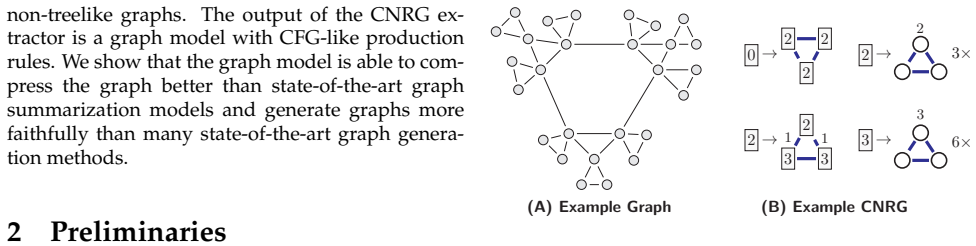
The central object is the Clustering-based Node Replacement Grammar (CNRG), whose rules are indexed by boundary degree. For a cluster of original nodes, $\omega$ counts the edges leaving the cluster; each terminal node in a rule's right-hand side is labeled by its own boundary degree, the number of edges connecting it to the outside. The extraction procedure is driven by the minimum-description-length principle: each candidate rule from the hierarchical clustering dendrogram is scored by the bits needed to store the rule plus the bits needed to store the graph given that rule, and the best-scoring subtree is contracted into a new nonterminal node, shrinking the graph until the dendrogram is empty. During generation, boundary degrees are the sole information used to reattach a rewritten subgraph, so the stochastic process reconstructs a large graph by matching local degrees of external connection.
What would settle it
Construct two graphs with identical cluster shapes and identical boundary-degree vectors, one in which each cluster attaches to a single central hub and another in which the same clusters attach diffusely to many different neighbors, extract a CNRG from each, generate graphs, and compare the generated graphs' graphlet counts or spectra to their originals; if the generated graphs cannot reproduce the hub-versus-diffuse distinction, the boundary-degree rewiring assumption is false.
Extended reading notes
Core claim
CNRG is a variant of a vertex replacement grammar. A production rule $X \to (R, f)$ rewrites a nonterminal node whose label is the integer $\omega$, the number of boundary edges of the cluster it stands for, into a right-hand-side labeled multigraph $R$; terminal nodes of $R$ are labeled by their boundary degrees, and $f$ is the number of times that rule occurred in the original graph. Extraction begins from any hierarchical clustering: every internal node of the dendrogram is a candidate rule, candidates are scored by a minimum-description-length objective that balances the size of the rule against the size of the graph it explains, and the best-scoring subtree is contracted into a new nonterminal node. Repeating this until the dendrogram is empty yields the grammar. Generation starts from a single nonterminal of size $0$ and repeatedly rewrites a nonterminal into a right-hand side, reconnecting the newly broken edges randomly but respecting each terminal node's boundary degree. The paper's claim is that the resulting model compresses the graph more than the compared summarization models and generates graphs that match the original on graphlet counts, graphlet correlation distance, spectral distance, and DeltaCon more faithfully than several widely used generators.
Load-bearing premise
The load-bearing assumption is that when a cluster of nodes is replaced by its rule, the only information needed to reattach it correctly is each node's boundary degree, so randomly rewiring edges to satisfy those counts preserves the graph's essential structure.
Editorial extensions
If this is right
- CNRG extraction scales to graphs with high treewidth because it relies on hierarchical clustering rather than a tree decomposition, so it avoids the computational barrier that limits hyperedge replacement grammars on the tested datasets.
- The description-length measurements imply the grammar is a genuine compression of the original graph: on the six larger datasets the reciprocal compression ratio $\mathrm{DL}(G)/\mathrm{DL}(H)$ ranges from 0.133 to 0.525, and in every case where a summarization baseline can run, CNRG has the smaller ratio.
- Because the grammar stores each distinct rule once along with its frequency, repeated substructures anywhere in the graph are encoded by a single production, which is the mechanism that lets one grammar summarize an entire network.
- In the reported generation experiments, CNRG matches the original graph on 2-, 3-, and 4-node graphlet counts and graphlet correlation distance more consistently than the other generators, while the degree-preserving Chung-Lu model remains better on spectral distance.
Reading between the lines
- If boundary-degree rewiring is a deliberate randomization rather than a bug, then CNRG-generated graphs are one sample from an ensemble of graphs that share the original's rule decomposition; quantifying the spread of this ensemble across many generations would show how much of the original's structure the grammar actually pins down.
- The rule multiset itself can serve as a network fingerprint: comparing CNRGs extracted from two graphs, or from successive snapshots of a temporal graph, could reveal shared growth mechanisms or structural drift; the paper lists these as future work, not as established results.
- Since CNRG preserves local graphlets well but trails the degree-based model on spectral distance, a natural testable extension is to rewire boundary edges with degree-corrected probabilities rather than uniformly, combining the grammar's local rules with the spectral fidelity of a configuration model.
Signed reviews
Editorial analysis
A structured set of objections, weighed in public.
Referee Report
Summary. The manuscript introduces CNRG, a variant of vertex replacement grammars, and gives an algorithm to extract a CNRG from any graph using hierarchical clustering. The grammar consists of production rules whose LHS labels are boundary degrees; extraction contracts subtrees, scores candidate rules using MDL-inspired criteria (size, level, local/global MDL), and iterates until the dendrogram is empty. The paper then defines a stochastic generation process that rewires boundary edges according to boundary degrees, and evaluates CNRG on seven datasets by comparing compression ratio against SUBDUE, SlashBurn, and VoG, and generation fidelity (graphlet counts, GCD, λ-distance, DELTACON) against ChungLu, HRG, DC-SBM, BTER, Kronecker, and a baseline labeled "VRG". The central claims are that CNRG compresses better than these summarization baselines and generates graphs more faithfully than many generation baselines.
Significance. If the technical issues are resolved, the paper would make a useful contribution: CNRG is an interpretable, automatically extractable graph model that avoids the tree-decomposition bottleneck of hyperedge replacement grammars, and the authors provide source code. The empirical study is broad, covering seven datasets and multiple compression and generation baselines, and the parameter study is repeated five times. Those strengths are real. However, the validity of the generation results depends on the well-definedness of the stochastic rewriting process, and the reported comparisons currently lack variance information and use a favorable model-selection protocol. I therefore view the central claims as defensible but not yet fully established.
major comments (3)
- [Section 4 (cf. Section 5.4)] The stochastic generation process is not well-defined because it can fail to terminate. A CNRG production's LHS label is only the boundary degree ω, and nothing in the formalism prevents a rule whose RHS contains a nonterminal with the same label as its LHS. For example, in the graph with edges a-b, a-c, c-d, b-e, after contracting {a,b} (boundary degree 2), the parent cluster {S,c} also has boundary degree 2, producing a rule with LHS 2 whose RHS contains a nonterminal labeled 2; the generator may then apply this rule to the nonterminal it just introduced, indefinitely. The instruction to "repeat this process until no more nonterminals exist" is therefore not a guaranteed terminating procedure. Please add an explicit tree-order or well-foundedness restriction to the generation algorithm in Section 4 (the remark in Section 5.4 about keeping a tree ordering is not part of the formal definition of the process) or prove that the extracted grammars always yield terminating derivations.
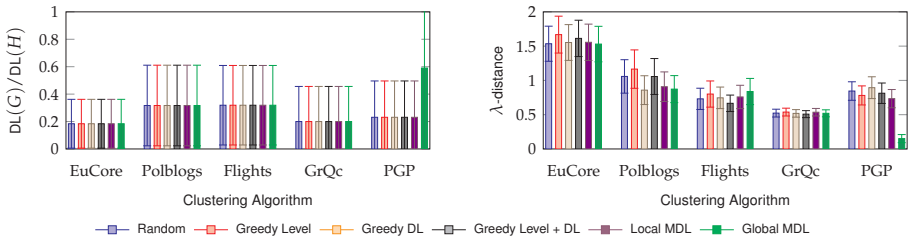
- [Section 5.4, Table 3] The generation evaluation reports only mean values, with no error bars or significance tests, even though the generator is stochastic and only five graphs are produced per condition; the standard error of these means is likely non-negligible. Moreover, the hyperparameter selection in Section 5.2 (choosing Leiden, Greedy Level + DL, and µ = 4) is performed on the same datasets as the final evaluation, so the reported favorable comparison may be optimistically biased. Please report standard deviations or confidence intervals and conduct model selection on held-out data or via nested validation.
- [Section 5.3, Table 2] The compression comparison is not on a common scale: SUBDUE, SlashBurn, and VoG each use their own description-length encoding, so the ratios DL(Model)/DL(H) are not directly commensurable. Because the paper's central claim is that CNRG compresses graphs better than these baselines, please provide a shared encoding or a robustness analysis showing the result is insensitive to the choice of encoding.
minor comments (5)
- [Table 3] The column label "VRG" presumably refers to the proposed method, which is named CNRG; please rename it to "CNRG" to avoid confusion with the general class of vertex replacement grammars.
- [Section 5.2, Figure 8] The text states that µ = 4 is selected because it "appears to generate reasonably small models with reasonable accuracy," but the figure only shows curves; please state the concrete quantitative criterion used to make this selection.
- [Section 2] The definition of the start symbol S is ambiguous: "S is the starting graph which is a non-terminal of size 0" should specify that S is a single nonterminal node labeled with ω = 0.
- [Section 3.3] The scoring function sη = |Vη| - µ can be negative for subtrees smaller than µ; please clarify whether such candidates are eligible for selection and how ties are resolved when several negative scores occur.
- [Figure 6] The text says that Spectral clustering gives "remarkably good graph generation, but bad compression," while the caption says that "Leiden performs the best consistently"; please align the caption with the results described in the text.
Circularity Check
No load-bearing circularity: CNRG is fitted to the training graph and evaluated in-sample, but the central comparisons are against external baselines; self-citations are not load-bearing.
full rationale
The paper's derivation chain is not circular in the sense of reducing a claimed prediction to its own inputs. The grammar rules are extracted from each graph H by contracting subtrees selected from a hierarchical clustering, and generation is then evaluated by comparing graphs sampled from the resulting CNRG back to H. This is an in-sample reconstruction task, which is standard for generative graph models; the paper claims fidelity rather than out-of-sample prediction. The key evaluation is comparative: CNRG is measured alongside independently fitted external models (ChungLu, BTER, Kronecker, HRG, DC-SBM) using common graphlet, spectral, and DELTACON metrics, so the central 'more faithful than many state-of-the-art generators' claim is not forced by construction. Rule frequencies and boundary-degree labels are fitted from H, but no separate quantity is renamed as a prediction; the frequencies are simply the model parameters. The invariant that the sum of RHS boundary degrees equals the LHS label omega is definitional and well-formedness-preserving, not a self-referential derivation. The paper cites prior HRG work by the same group (Aguiñaga et al., 2016, 2018) and Pennycuff et al. (2018), but those citations are contextual and provide baselines or analogy; the CNRG extraction and generation algorithm does not depend on an unverified result from those papers. No uniqueness theorem is imported from the authors' earlier work. One non-circular weakness is worth noting: Section 4's stochastic generator does not enforce a tree order, even though Section 5.4 remarks that 'Keeping a tree ordering over production rules in the CNRG will permit a generation close or isomorphic to the original graph.' Because LHS labels are only boundary degrees, a rule can introduce a nonterminal with the same label as its own LHS, risking non-termination. This is a correctness and well-definedness concern, not a circular reduction, so it does not raise the circularity score. Overall, the central claims have independent empirical content through external baselines, and the self-citations are not load-bearing.
Assumptions & free parameters
free parameters (2)
- μ (maximum RHS node count) =
4
- rule frequencies f =
per-rule counts of isomorphic occurrences in the graph
assumptions (3)
- domain assumption The graph H can be hierarchically clustered such that clusters correspond to meaningful building blocks.
- domain assumption Random rewiring of broken edges respecting boundary degrees yields graphs similar to the original.
- domain assumption The description length formulas in Section 2 are an appropriate measure of model complexity for comparing different graph formalisms.
Cite this review
Pith. "Pith review of Modeling Graphs with Vertex Replacement Grammars." pith.science (2026). https://pith.science/paper/MWAI5WMH
@misc{pith2026190803837,
  author       = {Pith},
  title        = {Pith review of: Modeling Graphs with Vertex Replacement Grammars},
  year         = {2026},
  howpublished = {\url{https://pith.science/paper/MWAI5WMH}},
  note         = {Machine review of arXiv:1908.03837}
}
read the original abstract
One of the principal goals of graph modeling is to capture the building blocks of network data in order to study various physical and natural phenomena. Recent work at the intersection of formal language theory and graph theory has explored the use of graph grammars for graph modeling. However, existing graph grammar formalisms, like Hyperedge Replacement Grammars, can only operate on small tree-like graphs. The present work relaxes this restriction by revising a different graph grammar formalism called Vertex Replacement Grammars (VRGs). We show that a variant of the VRG called Clustering-based Node Replacement Grammar (CNRG) can be efficiently extracted from many hierarchical clusterings of a graph. We show that CNRGs encode a succinct model of the graph, yet faithfully preserves the structure of the original graph. In experiments on large real-world datasets, we show that graphs generated from the CNRG model exhibit a diverse range of properties that are similar to those found in the original networks.
Figures


Figures from the paper (6 more)




Reference graph
Works this paper leans on
-
[1]
Agui \ n aga, R
S. Agui \ n aga, R. Palacios, D. Chiang, and T. Weninger. Growing graphs from hyperedge replacement graph grammars. In Proceedings of the 25th ACM International on Conference on Information and Knowledge Management, pages 469--478. ACM, 2016
2016
-
[3]
N. K. Ahmed, J. Neville, R. A. Rossi, and N. Duffield. Efficient graphlet counting for large networks. In Data Mining (ICDM), 2015 IEEE International Conference on, pages 1--10. IEEE, 2015
2015
-
[4]
Baldesi, C
L. Baldesi, C. T. Butts, and A. Markopoulou. Spectral graph forge: Graph generation targeting modularity. In IEEE INFOCOM 2018-IEEE Conference on Computer Communications, pages 1727--1735. IEEE, 2018
2018
-
[5]
V. D. Blondel, J.-L. Guillaume, R. Lambiotte, and E. Lefebvre. Fast unfolding of communities in large networks. Journal of statistical mechanics: theory and experiment, 2008 0 (10): 0 P10008, 2008
2008
-
[6]
A. Bojchevski, O. Shchur, D. Z \"u gner, and S. G \"u nnemann. Netgan: Generating graphs via random walks. arXiv preprint arXiv:1803.00816, 2018
arXiv 2018
-
[7]
Chakrabarti, Y
D. Chakrabarti, Y. Zhan, and C. Faloutsos. R-mat: A recursive model for graph mining. In Proceedings of the 2004 SIAM International Conference on Data Mining, pages 442--446. SIAM, 2004
2004
-
[8]
Chung and L
F. Chung and L. Lu. The average distances in random graphs with given expected degrees. Proceedings of the National Academy of Sciences, 99 0 (25): 0 15879--15882, 2002
2002
-
[9]
D. J. Cook and L. B. Holder. Substructure discovery using minimum description length and background knowledge. Journal of Artificial Intelligence Research, 1: 0 231--255, 1993
1993
Show all 95 references
-
[10]
P. Elias. Universal codeword sets and representations of the integers. IEEE transactions on information theory, 21 0 (2): 0 194--203, 1975
1975
-
[11]
Goyal and E
P. Goyal and E. Ferrara. Graph embedding techniques, applications, and performance: A survey. Knowledge-Based Systems, 151: 0 78--94, 2018
2018
-
[12]
Grahne and J
G. Grahne and J. Zhu. Fast algorithms for frequent itemset mining using fp-trees. IEEE transactions on knowledge and data engineering, 17 0 (10): 0 1347--1362, 2005
2005
-
[13]
Grover and J
A. Grover and J. Leskovec. node2vec: Scalable feature learning for networks. In Proceedings of the 22nd ACM SIGKDD international conference on Knowledge discovery and data mining, pages 855--864. ACM, 2016
2016
-
[14]
P. D. Gr \"u nwald. The minimum description length principle. MIT press, 2007
2007
-
[15]
Hagen and A
L. Hagen and A. B. Kahng. New spectral methods for ratio cut partitioning and clustering. IEEE transactions on computer-aided design of integrated circuits and systems, 11 0 (9): 0 1074--1085, 1992
1992
-
[16]
Ho c evar and J
T. Ho c evar and J. Dem s ar. A combinatorial approach to graphlet counting. Bioinformatics, 30 0 (4): 0 559--565, 2014
2014
-
[17]
Jiang, F
C. Jiang, F. Coenen, and M. Zito. A survey of frequent subgraph mining algorithms. The Knowledge Engineering Review, 28 0 (1): 0 75--105, 2013
2013
-
[18]
Karrer and M
B. Karrer and M. E. Newman. Stochastic blockmodels and community structure in networks. Physical review E, 83 0 (1): 0 016107, 2011
2011
-
[19]
N. S. Ketkar, L. B. Holder, and D. J. Cook. Subdue: Compression-based frequent pattern discovery in graph data. In Proceedings of the 1st international workshop on open source data mining: frequent pattern mining implementations, pages 71--76. ACM, 2005
2005
-
[20]
T. N. Kipf and M. Welling. Variational graph auto-encoders. arXiv preprint arXiv:1611.07308, 2016
2016 arXiv
-
[21]
T. G. Kolda, A. Pinar, T. Plantenga, and C. Seshadhri. A scalable generative graph model with community structure. SIAM Journal on Scientific Computing, 36 0 (5): 0 C424--C452, 2014
2014
-
[22]
Koutra, U
D. Koutra, U. Kang, J. Vreeken, and C. Faloutsos. Summarizing and understanding large graphs. Statistical Analysis and Data Mining: The ASA Data Science Journal, 8 0 (3): 0 183--202, 2015
2015
-
[23]
Koutra, N
D. Koutra, N. Shah, J. T. Vogelstein, B. Gallagher, and C. Faloutsos. Deltacon: principled massive-graph similarity function with attribution. ACM Transactions on Knowledge Discovery from Data (TKDD), 10 0 (3): 0 28, 2016
2016
-
[24]
J. Kunegis. Konect: the koblenz network collection. In Proceedings of the 22nd International Conference on World Wide Web, pages 1343--1350. ACM, 2013
2013
-
[25]
Leskovec and A
J. Leskovec and A. Krevl. SNAP Datasets : Stanford large network dataset collection. http://snap.stanford.edu/data, June 2014
2014
-
[26]
Leskovec, D
J. Leskovec, D. Chakrabarti, J. Kleinberg, C. Faloutsos, and Z. Ghahramani. Kronecker graphs: An approach to modeling networks. Journal of Machine Learning Research, 11 0 (Feb): 0 985--1042, 2010
2010
-
[27]
W. Lin, X. Xiao, and G. Ghinita. Large-scale frequent subgraph mining in mapreduce. In Data Engineering (ICDE), 2014 IEEE 30th International Conference on, pages 844--855. IEEE, 2014
2014
-
[28]
Y. Liu, N. Shah, and D. Koutra. An empirical comparison of the summarization power of graph clustering methods. arXiv preprint arXiv:1511.06820, 2015
2015 arXiv
-
[29]
Marcus and Y
D. Marcus and Y. Shavitt. Rage--a rapid graphlet enumerator for large networks. Computer Networks, 56 0 (2): 0 810--819, 2012
2012
-
[30]
Mussmann, J
S. Mussmann, J. Moore, J. J. Pfeiffer, and J. Neville III. Assortativity in chung lu random graph models. In Proceedings of the 8th Workshop on Social Network Mining and Analysis, page 3. ACM, 2014
2014
-
[31]
Mussmann, J
S. Mussmann, J. Moore, J. J. Pfeiffer III, and J. Neville. Incorporating assortativity and degree dependence into scalable network models. In AAAI, pages 238--246, 2015
2015
-
[32]
A. Y. Ng, M. I. Jordan, and Y. Weiss. On spectral clustering: Analysis and an algorithm. In Advances in neural information processing systems, pages 849--856, 2002
2002
-
[33]
Nijssen and J
S. Nijssen and J. N. Kok. The gaston tool for frequent subgraph mining. Electronic Notes in Theoretical Computer Science, 127 0 (1): 0 77--87, 2005
2005
-
[34]
Pennycuff, S
C. Pennycuff, S. Sikdar, C. Vajiac, D. Chiang, and T. Weninger. Synchronous hyperedge replacement graph grammars. In International Conference on Graph Transformation, pages 20--36. Springer, 2018
2018
-
[35]
J. J. Pfeiffer, T. La Fond, S. Moreno, and J. Neville. Fast generation of large scale social networks while incorporating transitive closures. In Privacy, Security, Risk and Trust (PASSAT), 2012 International Conference on and 2012 International Confernece on Social Computing ...
2012
-
[36]
Pr z ulj
N. Pr z ulj. Biological network comparison using graphlet degree distribution. Bioinformatics, 23 0 (2): 0 e177--e183, 2007
2007
-
[37]
J. R. Quinlan and R. L. Rivest. Inferring decision trees using the minimum description lenght principle. Information and computation, 80 0 (3): 0 227--248, 1989
1989
-
[38]
Ravasz and A.-L
E. Ravasz and A.-L. Barab \'a si. Hierarchical organization in complex networks. Physical review E, 67 0 (2): 0 026112, 2003
2003
-
[39]
Robins, P
G. Robins, P. Pattison, Y. Kalish, and D. Lusher. An introduction to exponential random graph (p*) models for social networks. Social networks, 29 0 (2): 0 173--191, 2007
2007
-
[40]
Rozenberg
G. Rozenberg. Handbook of Graph Grammars and Comp., volume 1. World scientific, 1997
1997
-
[41]
Simonovsky and N
M. Simonovsky and N. Komodakis. Graphvae: Towards generation of small graphs using variational autoencoders. In International Conference on Artificial Neural Networks, pages 412--422. Springer, 2018
2018
-
[42]
Z. Sun, H. Wang, H. Wang, B. Shao, and J. Li. Efficient subgraph matching on billion node graphs. Proceedings of the VLDB Endowment, 5 0 (9): 0 788--799, 2012
2012
-
[43]
J. Tang, M. Qu, M. Wang, M. Zhang, J. Yan, and Q. Mei. Line: Large-scale information network embedding. In Proceedings of the 24th international conference on world wide web, pages 1067--1077. International World Wide Web Conferences Steering Committee, 2015
2015
-
[44]
Thoma, H
M. Thoma, H. Cheng, A. Gretton, J. Han, H.-P. Kriegel, A. Smola, L. Song, P. S. Yu, X. Yan, and K. M. Borgwardt. Discriminative frequent subgraph mining with optimality guarantees. Statistical Analysis and Data Mining: The ASA Data Science Journal, 3 0 (5): 0 302--318, 2010
2010
-
[46]
R. C. Wilson and P. Zhu. A study of graph spectra for comparing graphs and trees. Pattern Recognition, 41 0 (9): 0 2833--2841, 2008
2008
-
[47]
Yan and J
X. Yan and J. Han. gspan: Graph-based substructure pattern mining. In Data Mining, 2002. ICDM 2003. Proceedings. 2002 IEEE International Conference on, pages 721--724. IEEE, 2002
2002
-
[48]
J. You, R. Ying, X. Ren, W. L. Hamilton, and J. Leskovec. Graphrnn: Generating realistic graphs with deep auto-regressive models. arXiv preprint arXiv:1802.08773, 2018
2018 arXiv
-
[49]
In: CIKM, ACM, pp 469--478
Agui \ n aga S, Palacios R, Chiang D, Weninger T (2016) Growing graphs from hyperedge replacement graph grammars. In: CIKM, ACM, pp 469--478
2016
-
[50]
IEEE Trans on Pattern Analysis and Machine Intelligence pp 1--1, doi:10.1109/TPAMI.2018.2810877
Agui \ n aga S, Chiang D, Weninger T (2018) Learning hyperedge replacement grammars for graph generation. IEEE Trans on Pattern Analysis and Machine Intelligence pp 1--1, doi:10.1109/TPAMI.2018.2810877
2018
-
[51]
In: ICDM, IEEE, pp 1--10
Ahmed NK, Neville J, Rossi RA, Duffield N (2015) Efficient graphlet counting for large networks. In: ICDM, IEEE, pp 1--10
2015
-
[52]
In: INFOCOM, IEEE, pp 1727--1735
Baldesi L, Butts CT, Markopoulou A (2018) Spectral graph forge: Graph generation targeting modularity. In: INFOCOM, IEEE, pp 1727--1735
2018
-
[53]
Journal of statistical mechanics: theory and experiment 2008(10):P10008
Blondel VD, Guillaume JL, Lambiotte R, Lefebvre E (2008) Fast unfolding of communities in large networks. Journal of statistical mechanics: theory and experiment 2008(10):P10008
2008
-
[54]
u gner D, G \
Bojchevski A, Shchur O, Z \"u gner D, G \"u nnemann S (2018) N et GAN : Generating graphs via random walks. In: Dy J, Krause A (eds) ICML, Stockholm Sweden, vol 80, pp 610--619
2018
-
[55]
In: SDM, SIAM, pp 442--446
Chakrabarti D, Zhan Y, Faloutsos C (2004) R-mat: A recursive model for graph mining. In: SDM, SIAM, pp 442--446
2004
-
[56]
Proceedings of the National Academy of Sciences 99(25):15879--15882
Chung F, Lu L (2002) The average distances in random graphs with given expected degrees. Proceedings of the National Academy of Sciences 99(25):15879--15882
2002
-
[57]
Journal of Artificial Intelligence Research 1:231--255
Cook DJ, Holder LB (1993) Substructure discovery using minimum description length and background knowledge. Journal of Artificial Intelligence Research 1:231--255
1993
-
[58]
IEEE Trans on Information Theory 21(2):194--203
Elias P (1975) Universal codeword sets and representations of the integers. IEEE Trans on Information Theory 21(2):194--203
1975
-
[59]
Knowledge-Based Systems 151:78--94
Goyal P, Ferrara E (2018) Graph embedding techniques, applications, and performance: A survey. Knowledge-Based Systems 151:78--94
2018
-
[60]
IEEE Trans on Knowledge and Data Engineering 17(10):1347--1362
Grahne G, Zhu J (2005) Fast algorithms for frequent itemset mining using fp-trees. IEEE Trans on Knowledge and Data Engineering 17(10):1347--1362
2005
-
[61]
In: SIGKDD, ACM, pp 855--864
Grover A, Leskovec J (2016) node2vec: Scalable feature learning for networks. In: SIGKDD, ACM, pp 855--864
2016
-
[62]
MIT press
Gr \"u nwald PD (2007) The minimum description length principle. MIT press
2007
-
[63]
IEEE Trans on Computer-Aided Design of Integrated Circuits and Systems 11(9):1074--1085
Hagen L, Kahng AB (1992) New spectral methods for ratio cut partitioning and clustering. IEEE Trans on Computer-Aided Design of Integrated Circuits and Systems 11(9):1074--1085
1992
-
[64]
Bioinformatics 30(4):559--565
Ho c evar T, Dem s ar J (2014) A combinatorial approach to graphlet counting. Bioinformatics 30(4):559--565
2014
-
[65]
The Knowledge Engineering Review 28(1):75--105
Jiang C, Coenen F, Zito M (2013) A survey of frequent subgraph mining algorithms. The Knowledge Engineering Review 28(1):75--105
2013
-
[66]
Phys Rev E 83(1):016107
Karrer B, Newman ME (2011) Stochastic blockmodels and community structure in networks. Phys Rev E 83(1):016107
2011
-
[67]
In: Workshop on open source data mining: frequent pattern mining implementations, ACM, pp 71--76
Ketkar NS, Holder LB, Cook DJ (2005) Subdue: Compression-based frequent pattern discovery in graph data. In: Workshop on open source data mining: frequent pattern mining implementations, ACM, pp 71--76
2005
-
[68]
arXiv preprint arXiv:161107308
Kipf TN, Welling M (2016) Variational graph auto-encoders. arXiv preprint arXiv:161107308
2016
-
[69]
SIAM Journal on Scientific Computing 36(5):C424--C452
Kolda TG, Pinar A, Plantenga T, Seshadhri C (2014) A scalable generative graph model with community structure. SIAM Journal on Scientific Computing 36(5):C424--C452
2014
-
[70]
Statistical Analysis and Data Mining: The ASA Data Science Journal 8(3):183--202
Koutra D, Kang U, Vreeken J, Faloutsos C (2015) Summarizing and understanding large graphs. Statistical Analysis and Data Mining: The ASA Data Science Journal 8(3):183--202
2015
-
[71]
ACM Trans on Knowledge Discovery from Data 10(3):28
Koutra D, Shah N, Vogelstein JT, Gallagher B, Faloutsos C (2016) Deltacon: principled massive-graph similarity function with attribution. ACM Trans on Knowledge Discovery from Data 10(3):28
2016
-
[72]
In: TheWebConf, ACM, pp 1343--1350
Kunegis J (2013) Konect: the koblenz network collection. In: TheWebConf, ACM, pp 1343--1350
2013
-
[73]
http://snap.stanford.edu/data
Leskovec J, Krevl A (2014) SNAP Datasets : Stanford large network dataset collection. http://snap.stanford.edu/data
2014
-
[74]
Journal of Machine Learning Research 11(Feb):985--1042
Leskovec J, Chakrabarti D, Kleinberg J, Faloutsos C, Ghahramani Z (2010) Kronecker graphs: An approach to modeling networks. Journal of Machine Learning Research 11(Feb):985--1042
2010
-
[75]
IEEE Trans on Knowledge and Data Engineering 26(12):3077--3089
Lim Y, Kang U, Faloutsos C (2014) Slashburn: Graph compression and mining beyond caveman communities. IEEE Trans on Knowledge and Data Engineering 26(12):3077--3089
2014
-
[76]
In: ICDE, IEEE, pp 844--855
Lin W, Xiao X, Ghinita G (2014) Large-scale frequent subgraph mining in mapreduce. In: ICDE, IEEE, pp 844--855
2014
-
[77]
arXiv preprint arXiv:151106820
Liu Y, Shah N, Koutra D (2015) An empirical comparison of the summarization power of graph clustering methods. arXiv preprint arXiv:151106820
2015
-
[78]
Computer Networks 56(2):810--819
Marcus D, Shavitt Y (2012) Rage--a rapid graphlet enumerator for large networks. Computer Networks 56(2):810--819
2012
-
[79]
In: Workshop on Social Network Mining and Analysis, ACM
Mussmann S, Moore J, Pfeiffer JJ, Neville III J (2014) Assortativity in chung lu random graph models. In: Workshop on Social Network Mining and Analysis, ACM
2014
-
[80]
In: AAAI, pp 238--246
Mussmann S, Moore J, Pfeiffer III JJ, Neville J (2015) Incorporating assortativity and degree dependence into scalable network models. In: AAAI, pp 238--246
2015
-
[81]
In: NeurIPS, pp 849--856
Ng AY, Jordan MI, Weiss Y (2002) On spectral clustering: Analysis and an algorithm. In: NeurIPS, pp 849--856
2002
-
[82]
Electronic Notes in Theoretical Computer Science 127(1):77--87
Nijssen S, Kok JN (2005) The gaston tool for frequent subgraph mining. Electronic Notes in Theoretical Computer Science 127(1):77--87
2005
-
[83]
In: ICGT, Springer, pp 20--36
Pennycuff C, Sikdar S, Vajiac C, Chiang D, Weninger T (2018) Synchronous hyperedge replacement graph grammars. In: ICGT, Springer, pp 20--36
2018
-
[84]
In: Workshop on Privacy, Security, Risk and Trust, IEEE, pp 154--165
Pfeiffer JJ, La Fond T, Moreno S, Neville J (2012) Fast generation of large scale social networks while incorporating transitive closures. In: Workshop on Privacy, Security, Risk and Trust, IEEE, pp 154--165
2012
-
[85]
Bioinformatics 23(2):e177--e183
Pr z ulj N (2007) Biological network comparison using graphlet degree distribution. Bioinformatics 23(2):e177--e183
2007
-
[86]
Information and computation 80(3):227--248
Quinlan JR, Rivest RL (1989) Inferring decision trees using the minimum description length principle. Information and computation 80(3):227--248
1989
-
[87]
Phys Rev E 67(2):026112
Ravasz E, Barab \'a si AL (2003) Hierarchical organization in complex networks. Phys Rev E 67(2):026112
2003
-
[88]
Social networks 29(2):173--191
Robins G, Pattison P, Kalish Y, Lusher D (2007) An introduction to exponential random graph (p*) models for social networks. Social networks 29(2):173--191
2007
-
[89]
World scientific
Rozenberg G (1997) Handbook of Graph Grammars and Comp., vol 1. World scientific
1997
-
[90]
In: International Conference on Artificial Neural Networks, Springer, pp 412--422
Simonovsky M, Komodakis N (2018) Graphvae: Towards generation of small graphs using variational autoencoders. In: International Conference on Artificial Neural Networks, Springer, pp 412--422
2018
-
[91]
Proceedings of the VLDB Endowment 5(9):788--799
Sun Z, Wang H, Wang H, Shao B, Li J (2012) Efficient subgraph matching on billion node graphs. Proceedings of the VLDB Endowment 5(9):788--799
2012
-
[92]
In: TheWebConf, International World Wide Web Conferences Steering Committee, pp 1067--1077
Tang J, Qu M, Wang M, Zhang M, Yan J, Mei Q (2015) Line: Large-scale information network embedding. In: TheWebConf, International World Wide Web Conferences Steering Committee, pp 1067--1077
2015
-
[93]
Statistical Analysis and Data Mining: The ASA Data Science Journal 3(5):302--318
Thoma M, Cheng H, Gretton A, Han J, Kriegel HP, Smola A, Song L, Yu PS, Yan X, Borgwardt KM (2010) Discriminative frequent subgraph mining with optimality guarantees. Statistical Analysis and Data Mining: The ASA Data Science Journal 3(5):302--318
2010
-
[94]
Scientific Reports 9(1):5233, doi:10.1038/s41598-019-41695-z, ://doi.org/10.1038/s41598-019-41695-z
Traag VA, Waltman L, van Eck NJ (2019) From Louvain to Leiden : guaranteeing well-connected communities. Scientific Reports 9(1):5233, doi:10.1038/s41598-019-41695-z, ://doi.org/10.1038/s41598-019-41695-z
2019 doi
-
[95]
Pattern Recognition 41(9):2833--2841
Wilson RC, Zhu P (2008) A study of graph spectra for comparing graphs and trees. Pattern Recognition 41(9):2833--2841
2008
-
[96]
In: ICDM, IEEE, pp 721--724
Yan X, Han J (2002) gspan: Graph-based substructure pattern mining. In: ICDM, IEEE, pp 721--724
2002
-
[97]
In: Dy J, Krause A (eds) ICML, Stockholm Sweden, vol 80, pp 5708--5717
You J, Ying R, Ren X, Hamilton W, Leskovec J (2018) G raph RNN : Generating realistic graphs with deep auto-regressive models. In: Dy J, Krause A (eds) ICML, Stockholm Sweden, vol 80, pp 5708--5717
2018
Reviewed August 14, 2026 · model on record in the stance chip above.
Discussion (0). Continue with ORCID to comment.