REVIEW 3 major objections 5 minor 64 references
An Asymptotically Compatible Approach For Neumann-Type Boundary Condition On Nonlocal Problems
T0 review · 3 major / 5 minor · reviewed 2026-08-14 · deepseek-v4-flash
Pith's one-line read The paper proves that a new nonlocal Neumann-type boundary condition makes the nonlocal diffusion problem converge to the classical Neumann problem at the optimal $O(\delta^2)$ rate in $L^\infty(\Omega)$.
desk verdict Genuinely new 2D nonlocal Neumann treatment with proven O(δ²) convergence, but the headline L∞ theorem is only proved under a geometric assumption absent from the statement and violated by natural geometries. read the letter →
The pith
A machine-rendered reading of the paper's core claim, the machinery that carries it, and where it could break.
The reading
What carries the argument
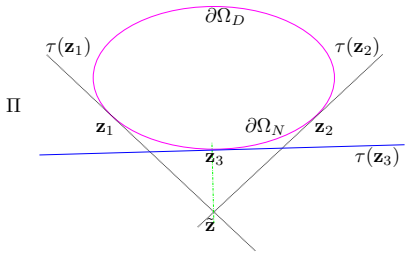
The mechanism is the nonlocal flux condition (2.2), which augments the usual nonlocal diffusion operator with two correction terms outside the domain: one involving the boundary data $g$ and one involving the second tangential derivative $[u_\delta(x)]_{pp}$, replaced in the final formulation by a one-dimensional nonlocal Laplace\,--\,Beltrami-type integral along the contour parallel to the boundary, with coefficient $M_\delta(x)$. The proof of the $O(\delta^2)$ rate rests on a maximum principle (Lemma 4.1), a truncation estimate for the consistency error $T_\delta$ (Lemma 4.2 and Lemma 4.4), and a specially constructed barrier function $\varphi(x)=|\mathrm{dist}(x,\tau(z_3))+1|^2$, where $\tau(z_3)$ is a tangent line chosen through the geometric assumption (4.14).
What would settle it
Construct a convex domain where the tangents at the two Dirichlet\,--\,Neumann interface points meet over the Dirichlet part, violating (4.14), solve the nonlocal boundary value problem (4.2) with a smooth manufactured solution, and measure $\sup_{x\in\Omega}|u_\delta(x)-u_0(x)|$ for a sequence of horizons $\delta\to0$; if the rate drops below $O(\delta^2)$ or the barrier estimate $-L_N^\delta\varphi$ changes sign in the collar, the geometric condition is necessary rather than cosmetic.
Extended reading notes
Core claim
The central claim, proven as Theorem 4.5, is that the solution $u_\delta$ of the nonlocal boundary value problem (2.5) with the proposed Neumann-type constraint converges uniformly on the domain to the solution $u_0$ of the local Neumann problem (2.1), with $\sup_{x\in\Omega}|u_\delta(x)-u_0(x)|\le C\delta^2$ for sufficiently small $\delta$. This rate is optimal because the nonlocal equation itself approximates the local one only to order $O(\delta^2)$ away from the boundary. The paper further establishes well-posedness of the nonlocal variational problem through a nonlocal Poincar\'e inequality and coercivity of the nonsymmetric bilinear form, and it verifies numerically that the convergence rate survives on domains with corners, where the analysis in the smooth case does not directly apply.
Load-bearing premise
The proof of the $O(\delta^2)$ bound depends on the geometric assumption (4.14) that the tangent lines at the two Dirichlet\,--\,Neumann interface points intersect at a point whose orthogonal projection lies on the Neumann part of the boundary; if that fails, the barrier function $\varphi$ no longer yields the required lower bounds, and the corner extension must fall back on a non-coercive formulation.
Editorial extensions
If this is right
- The nonlocal Neumann-type boundary value problem (2.5) recovers the local Neumann solution at the optimal $O(\delta^2)$ rate in the supremum norm, improving the previously known first-order rate for 2D nonlocal flux conditions.
- The variational problem is well-posed for convex $C^3$ domains with sufficiently small horizon, giving a firm foundation for using this boundary condition in simulations.
- The meshfree discretization is asymptotically compatible: as both the discretization length $h$ and the horizon $\delta$ go to zero with a fixed ratio, the numerical solution converges to the local solution at $O(h^2)$.
- Because the boundary condition is imposed on a collar layer inside the domain rather than by extrapolating outside it, the formulation can be applied to sharp interfaces without mesh extensions.
- Numerical experiments indicate that the second-order rate persists on Lipschitz domains with corners, although the corner formulation loses coercivity.
Reading between the lines
- The geometric assumption (4.14) is likely satisfied generically for convex domains but can fail for asymmetric Neumann arcs or reentrant corners; when it fails, the barrier-function argument would need a different barrier or an additional correction term to preserve the $O(\delta^2)$ rate.
- The same design principle, namely adding a boundary-layer second-derivative correction inside the nonlocal operator, could be carried to 3D problems, where the contour integral would become a surface Laplace\,--\,Beltrami operator and new curvature terms would likely appear.
- The approach suggests a general recipe for building asymptotically compatible Neumann closures for other compactly supported nonlocal models, such as peridynamic traction boundary conditions, where artificial surface effects are a known difficulty.
- The non-coercive corner formulation may be stabilizable; if coercivity were restored, the rigorous well-posedness and convergence theory could be extended from smooth domains to polygonal and more general Lipschitz domains.
Signed reviews
Editorial analysis
A structured set of objections, weighed in public.
Referee Report
Summary. The paper proposes a new nonlocal Neumann-type boundary condition for two-dimensional nonlocal diffusion models with finite horizon δ, aiming for an asymptotically compatible treatment of mixed Dirichlet/Neumann problems. The authors prove well-posedness of the associated nonlocal variational problem on C3 convex domains, establish L2 convergence to the local Neumann problem as δ→0, and derive an L∞ convergence rate O(δ²) under a geometric condition on the boundary. They also develop a meshfree generalized moving least squares discretization and present numerical tests on a square, a circle, an ellipse, and a square with a corner, reporting second-order convergence in all cases. The central advertised result is Theorem 4.5, which states sup_{x∈Ω}|uδ(x)-u0(x)| ≤ Cδ² for sufficiently small δ.
Significance. If the main theorem holds as stated, the paper would provide the first two-dimensional nonlocal Neumann-type flux treatment with second-order asymptotic compatibility, a genuinely useful contribution for nonlocal diffusion and peridynamics-type applications. The paper has notable strengths: the variational framework is developed in detail; the well-posedness and L2-convergence arguments are coherent; the numerical evidence on several geometries is consistent with the claimed rate; and the extension toward corners, while heuristic, addresses a practically important regime. However, the headline L∞ result is proved only under the 'crucial geometric assumption' (4.14), which is omitted from the theorem statement, and several numerical tests fall outside the theorem's hypotheses. These scoping issues are load-bearing and must be addressed before the central claim can be accepted in its advertised generality.
major comments (3)
- [Section 4, Theorem 4.5 and Eq. (4.14)] The O(δ²) L∞ convergence theorem is stated without the 'crucial geometric assumption' (4.14), and the abstract repeats the unconditional claim. In Step 3 of the proof of Lemma 4.3, the inclusion [B^-(x,δ)\Ω]^* ⊆ B^+(x,δ)\Ω is justified only by (4.14); without it, the lower bound -L_Nδ φ ≥ C(δ-s_x)^{3/2}δ^{-5/2}+C1 does not follow, so the subsequent monotonicity argument in Theorem 4.5 cannot control |Tδ|/(-L_Nδ φ). The assumption is not automatic: it fails for a square with one Neumann side, where the tangents at the two interface corners are parallel, and for a circular domain whose Neumann arc has angle at least π, where the endpoint tangents are parallel or project onto ∂Ω_D. The theorem and abstract should either incorporate (4.14) explicitly or supply a proof that removes it.
- [Section 4 and Sections 6.2-6.3] The theoretical result is proved only for homogeneous Neumann data g=0, as stated at the beginning of Section 4, yet the numerical tests in Sections 6.2 and 6.3 impose nonzero g and, more importantly, use a pure Neumann problem with a single pinned point uδ(0,-1)=u0(0,-1). This is not a one-dimensional Dirichlet boundary ∂Ω_D with a nonempty volume layer ∂Ω_{Dδ}, so Lemma 4.1's maximum principle and Lemma 4.3's boundary term do not apply. The observed second-order rates are therefore evidence of robustness beyond the theorem, but they do not verify Theorem 4.5 or the abstract's mixed-boundary claim as stated. Please separate the proven mixed-boundary statement from the numerically observed extensions, or extend the analysis to cover these cases.
- [Section 7, Eqs. (7.3)-(7.4)] The corner extension is derived by truncating a Taylor expansion, and the authors explicitly state that coercivity is lost in this formulation. Table 5 shows second-order behavior, but no well-posedness, stability, or consistency proof is supplied for Eqs. (7.3)-(7.4). Since the conclusion describes the regularity assumptions as 'relaxed in practice', the manuscript should clearly state that the corner treatment is a numerical heuristic not covered by the analysis, and should discuss the practical implications of the lost coercivity, for example by reporting condition numbers or iteration counts for the corner solver.
minor comments (5)
- [Table 5] In the h=2^{-6} row, the L∞ error 7.42×10^{-3} appears inconsistent with the preceding row 3.30×10^{-3} and with the reported order 2.15; this is likely a typo for 7.42×10^{-4} and should be corrected.
- [Section 4, Figure numbering] The text introducing z1,z2 and the geometric assumption refers to 'Figure 4', but the corresponding illustration is numbered Figure 3; please renumber the figures consistently.
- [Eq. (2.2) and nearby line integrals] The notation dx_l for the line integral along the contour Γ(x) is confusing because dx is used elsewhere for area integrals; use an arc-length differential such as dl or ds in the line integrals.
- [Lemma 4.1] The function space notation 'u∈C(Ω )\C(∂ΩDδ\∂ΩD)' is unclear; the intended restriction on the Dirichlet layer should be stated more precisely.
- [Lemma 3.4 and note after it] The note after Lemma 3.4 says ˜δ depends on both u and Ω, but the proof's bound (3.15) is independent of u; if the note is intended literally, the subsequent uniform bounds in Lemmas 3.5-3.6 do not follow. Please correct the note or clarify the uniformity.
Circularity Check
No significant circularity: the O(δ²) Neumann-condition claim is derived from Taylor-expansion consistency bounds and a barrier estimate, not from fitted data or self-citation.
full rationale
The paper's derivation chain is self-contained. The nonlocal flux condition (2.2)–(2.5) is constructed by Taylor-expanding the local solution u0 near ∂Ω and replacing the unknown [uδ]_pp with a 1D nonlocal Laplace–Beltrami term; no parameter is fitted to uδ or u0, and no target rate is imposed as an ansatz. The O(δ²) claim is then established by explicit estimates: Lemma 4.2 bounds the truncation Tδ, Lemma 4.3 supplies a maximum-principle barrier bound, Step 3 establishes lower bounds on −Lδφ and −LNδφ, Lemma 4.4 controls Tδ near the inner boundary, and Theorem 4.5 combines these via monotonicity of f(r). Self-citations—[58] for the meshfree quadrature framework and [57] for the asymptotic-compatibility framework—provide tools that are not load-bearing for the boundary-condition argument. The only caveat is a proof-hygiene issue, not circularity: the 'crucial geometric assumption' (4.14) is stated before Theorem 4.5 but omitted from the theorem statement; without it the barrier lower bound in Step 3 is unproved. This is a correctness gap, not a reduction of the conclusion to its inputs.
Assumptions & free parameters
assumptions (5)
- domain assumption Ω is bounded, convex, connected and C3 regular.
- domain assumption Kernels Jδ and Hδ satisfy rescaled integrability, positivity, nonincreasing and vanishing conditions, with ∫J|z|²=N and ∫H|z|²=1, ∫H<∞.
- domain assumption Boundary curvature estimates: |κ(z)|≤D, |κ'(z)|≤D and sup|κ'/κ|≤D a.e.
- ad hoc to paper Crucial geometric assumption: τ(z1)∩τ(z2) projects onto ∂ΩN.
- standard math Standard nonlocal Poincare inequality and compactness results from [45] and [50].
Cite this review
Pith. "Pith review of An Asymptotically Compatible Approach For Neumann-Type Boundary Condition On Nonlocal Problems." pith.science (2026). https://pith.science/paper/OO4CHYBJ
@misc{pith2026190803853,
  author       = {Pith},
  title        = {Pith review of: An Asymptotically Compatible Approach For Neumann-Type Boundary Condition On Nonlocal Problems},
  year         = {2026},
  howpublished = {\url{https://pith.science/paper/OO4CHYBJ}},
  note         = {Machine review of arXiv:1908.03853}
}
abstract
In this paper we consider 2D nonlocal diffusion models with a finite nonlocal horizon parameter $\delta$ characterizing the range of nonlocal interactions, and consider the treatment of Neumann-like boundary conditions that have proven challenging for discretizations of nonlocal models. While existing 2D nonlocal flux boundary conditions have been shown to exhibit at most first order convergence to the local counter part as $\delta\rightarrow 0$, we present a new generalization of classical local Neumann conditions that recovers the local case as $O(\delta^2)$ in the $L^{\infty}(\Omega)$ norm. This convergence rate is optimal considering the $O(\delta^2)$ convergence of the nonlocal equation to its local limit away from the boundary. We analyze the application of this new boundary treatment to the nonlocal diffusion problem, and present conditions under which the solution of the nonlocal boundary value problem converges to the solution of the corresponding local Neumann problem as the horizon is reduced. To demonstrate the applicability of this nonlocal flux boundary condition to more complicated scenarios, we extend the approach to less regular domains, numerically verifying that we preserve second-order convergence for domains with corners. Based on the new formulation for nonlocal boundary condition, we develop an asymptotically compatible meshfree discretization, obtaining a solution to the nonlocal diffusion equation with mixed boundary conditions that converges with $O(\delta^2)$ convergence.
Figures


Figures from the paper (3 more)


Reference graph
Works this paper leans on
-
[1]
Results on nonlocal boundary value problems
Burak Aksoylu and Tadele Mengesha. Results on nonlocal boundary value problems. Numerical Functional Analysis and Optimization, 31(12):1301–1317, 2010
work page 2010
-
[2]
Peridynamics and material interfaces.Journal of Elasticity, pages 1–24, 2015
Bacim Alali and Max Gunzburger. Peridynamics and material interfaces.Journal of Elasticity, pages 1–24, 2015. 35
work page 2015
-
[3]
Xavier Antoine and Hélène Barucq. Approximation by generalized impedance boundary conditions of a transmission problem in acoustic scattering.ESAIM: Mathematical Modelling and Numerical Analysis, 39(5):1041–1059, 2005
work page 2005
-
[4]
Peridynamic analysis of damage and failure in composites
Ebrahim Askari, Jifeng Xu, and Stewart Silling. Peridynamic analysis of damage and failure in composites. In 44th AIAA Aerospace Sciences Meeting and Exhibit, Reno, Nevada. Reston, VA: AIAA, 2006
work page 2006
-
[5]
M. Astorino, F. Chouly, and M. A. Fernández. Robin based semi-implicit coupling in fluid-structure interaction: Stability analysis and numerics.SIAM Journal on Scientific Computing, 31(6):4041–4065, 2009
work page 2009
- [6]
-
[7]
Guy Barles, Christine Georgelin, and Espen R Jakobsen. On neumann and oblique derivatives boundary conditions for nonlocal elliptic equations.Journal of Differential Equations, 256(4):1368–1394, 2014
work page 2014
-
[8]
Nonlocal integral formulations of plasticity and damage: survey of progress
Zdenek P Ba˘ zant and Milan Jirásek. Nonlocal integral formulations of plasticity and damage: survey of progress. Journal of Engineering Mechanics, 128(11):1119–1149, 2002
work page 2002
Show all 64 references
-
[9]
A meshfree unification: reproducing kernel peridynamics
MA Bessa, JT Foster, T Belytschko, and Wing Kam Liu. A meshfree unification: reproducing kernel peridynamics. Computational Mechanics, 53(6):1251–1264, 2014
2014
-
[10]
Adaptive refinement and multiscale modeling in 2D peridynamics
Florin Bobaru and Youn Doh Ha. Adaptive refinement and multiscale modeling in 2D peridynamics. International Journal for Multiscale Computational Engineering, 9(6), 2011
2011
-
[11]
Another look at sobolev spaces
Jean Bourgain, Haim Brezis, and Petru Mironescu. Another look at sobolev spaces. 2001
2001
-
[12]
Springer Science & Business Media, 2007
Susanne Brenner and Ridgway Scott.The mathematical theory of finite element methods, volume 15. Springer Science & Business Media, 2007
2007
-
[13]
Classical, nonlocal, and fractional diffusion equations on bounded domains
Nathanial Burch and Richard Lehoucq. Classical, nonlocal, and fractional diffusion equations on bounded domains. International Journal for Multiscale Computational Engineering, 9(6), 2011
2011
-
[14]
Global entropy weak solutions for general non-local traffic flow models with anisotropic kernel.ESAIM: Mathematical Modelling and Numerical Analysis, 52(1):163–180, 2018
Felisia Angela Chiarello and Paola Goatin. Global entropy weak solutions for general non-local traffic flow models with anisotropic kernel.ESAIM: Mathematical Modelling and Numerical Analysis, 52(1):163–180, 2018
2018
-
[15]
Boundary fluxes for nonlocal diffusion.Journal of Differential Equations, 234(2):360–390, 2007
Carmen Cortazar, Manuel Elgueta, Julio D Rossi, and Noemi Wolanski. Boundary fluxes for nonlocal diffusion.Journal of Differential Equations, 234(2):360–390, 2007
2007
-
[16]
How to approximate the heat equation with neumann boundary conditions by nonlocal diffusion problems.Archive for Rational Mechanics and Analysis, 187(1):137–156, 2008
Carmen Cortazar, Manuel Elgueta, Julio D Rossi, and Noemi Wolanski. How to approximate the heat equation with neumann boundary conditions by nonlocal diffusion problems.Archive for Rational Mechanics and Analysis, 187(1):137–156, 2008
2008
-
[17]
A real-space non-local phase-field model of ferroelectric domain patterns in complex geometries.Acta Materialia, 55(6):1907–1917, 2007
Kaushik Dayal and Kaushik Bhattacharya. A real-space non-local phase-field model of ferroelectric domain patterns in complex geometries.Acta Materialia, 55(6):1907–1917, 2007
1907
-
[18]
Fractional diffusion on bounded domains.Fractional Calculus and Applied Analysis, 18(2):342–360, 2015
Ozlem Defterli, Marta D’Elia, Qiang Du, Max Gunzburger, Rich Lehoucq, and Mark M Meerschaert. Fractional diffusion on bounded domains.Fractional Calculus and Applied Analysis, 18(2):342–360, 2015
2015
-
[19]
An approach to modeling extreme loading of structures using peridynamics
Paul Demmie and Stewart Silling. An approach to modeling extreme loading of structures using peridynamics. Journal of Mechanics of Materials and Structures, 2(10):1921–1945, 2007
1921
-
[20]
Nonlocal problems with neumann boundary conditions
Serena Dipierro, Xavier Ros-Oton, and Enrico Valdinoci. Nonlocal problems with neumann boundary conditions. arXiv preprint arXiv:1407.3313, 2014. 36
2014 arXiv
-
[21]
A nonlocal vector calculus, nonlocal volume-constrained problems, and nonlocal balance laws.Mathematical Models and Methods in Applied Sciences, 23(03):493–540, 2013
Qiang Du, Max Gunzburger, Richard B Lehoucq, and Kun Zhou. A nonlocal vector calculus, nonlocal volume-constrained problems, and nonlocal balance laws.Mathematical Models and Methods in Applied Sciences, 23(03):493–540, 2013
2013
-
[22]
Nonlocal convection-diffusion volume-constrained problems and jump processes.Discrete & Continuous Dynamical Systems-Series B, 19(4), 2014
Qiang Du, Zhan Huang, and Richard B Lehoucq. Nonlocal convection-diffusion volume-constrained problems and jump processes.Discrete & Continuous Dynamical Systems-Series B, 19(4), 2014
2014
-
[23]
Integral approximations to classical diffusionandsmoothedparticlehydrodynamics
Qiang Du, Richard B Lehoucq, and Alexandre M Tartakovsky. Integral approximations to classical diffusionandsmoothedparticlehydrodynamics. Computer Methods in Applied Mechanics and Engineering, 286:216–229, 2015
2015
-
[24]
Peridynamics, fracture, and nonlocal continuum models.SIAM News, 47(3), 2014
Qiang Du and Robert Lipton. Peridynamics, fracture, and nonlocal continuum models.SIAM News, 47(3), 2014
2014
-
[25]
Qiang Du, Robert Lipton, and Tadele Mengesha. Multiscale analysis of linear evolution equations with applications to nonlocal models for heterogeneous media.ESAIM: Mathematical Modelling and Numerical Analysis, 50(5):1425–1455, 2016
2016
-
[26]
A peridynamic model of fracture mechanics with bond- breaking
Qiang Du, Yunzhe Tao, and Xiaochuan Tian. A peridynamic model of fracture mechanics with bond- breaking. Journal of Elasticity, pages 1–22, 2017
2017
-
[27]
Mathematical analysis for the peridynamic nonlocal continuum theory.ESAIM: Mathematical Modelling and Numerical Analysis, 45(02):217–234, 2011
Qiang Du and Kun Zhou. Mathematical analysis for the peridynamic nonlocal continuum theory.ESAIM: Mathematical Modelling and Numerical Analysis, 45(02):217–234, 2011
2011
-
[28]
Survey of existence results in nonlinear peridynamics in comparison with local elastodynamics.Computational Methods in Applied Mathematics, 15(4):483–496, 2015
Etienne Emmrich and Dimitri Puhst. Survey of existence results in nonlinear peridynamics in comparison with local elastodynamics.Computational Methods in Applied Mathematics, 15(4):483–496, 2015
2015
-
[29]
Analysis and numerical approximation of an integro-differential equation modeling non-local effects in linear elasticity.Mathematics and Mechanics of Solids, 12(4):363– 384, 2007
Etienne Emmrich and Olaf Weckner. Analysis and numerical approximation of an integro-differential equation modeling non-local effects in linear elasticity.Mathematics and Mechanics of Solids, 12(4):363– 384, 2007
2007
-
[30]
Etienne Emmrich, Olaf Weckner, et al. On the well-posedness of the linear peridynamic model and its convergence towards the navier equation of linear elasticity.Communications in Mathematical Sciences, 5(4):851–864, 2007
2007
-
[31]
Convergence of a semi-discrete numerical method for a class of nonlocal nonlinear wave equations.ESAIM: Mathematical Modelling and Numerical Analysis, 52(3):803–826, 2018
Hüsnü A Erbay, Saadet Erbay, and Albert Erkip. Convergence of a semi-discrete numerical method for a class of nonlocal nonlinear wave equations.ESAIM: Mathematical Modelling and Numerical Analysis, 52(3):803–826, 2018
2018
-
[32]
PhD thesis, Purdue University, 2009
John T Foster.Dynamic crack initiation toughness: Experiments and peridynamic modeling. PhD thesis, Purdue University, 2009
2009
-
[33]
Peridynamic modeling of concrete structures.Nuclear Engineering and Design, 237(12):1250–1258, 2007
Walter Gerstle, Nicolas Sau, and Stewart Silling. Peridynamic modeling of concrete structures.Nuclear Engineering and Design, 237(12):1250–1258, 2007
2007
-
[34]
Local and nonlocal boundary conditions forµ-transmission and fractional elliptic pseudodifferential operators.Analysis & PDE, 7(7):1649–1682, 2014
Gerd Grubb et al. Local and nonlocal boundary conditions forµ-transmission and fractional elliptic pseudodifferential operators.Analysis & PDE, 7(7):1649–1682, 2014
2014
-
[35]
Characteristics of dynamic brittle fracture captured with peridynamics
Youn Doh Ha and Florin Bobaru. Characteristics of dynamic brittle fracture captured with peridynamics. Engineering Fracture Mechanics, 78(6):1156–1168, 2011
2011
-
[36]
Dynamic brittle fracture as a small horizon limit of peridynamics.Journal of Elasticity, 117(1):21–50, 2014
Robert Lipton. Dynamic brittle fracture as a small horizon limit of peridynamics.Journal of Elasticity, 117(1):21–50, 2014
2014
-
[37]
What is the fractional laplacian?arXiv preprint arXiv:1801.09767, 2018
Anna Lischke, Guofei Pang, Mamikon Gulian, Fangying Song, Christian Glusa, Xiaoning Zheng, Zhiping Mao, Wei Cai, Mark M Meerschaert, Mark Ainsworth, et al. What is the fractional laplacian?arXiv preprint arXiv:1801.09767, 2018. 37
2018 arXiv
-
[38]
Strong local-nonlocal coupling for integrated fracture modeling
David J Littlewood, Stewart A Silling, John A Mitchell, Pablo D Seleson, Stephen D Bond, Michael L Parks, Daniel Z Turner, Damon J Burnett, Jakob Ostien, and Max Gunzburger. Strong local-nonlocal coupling for integrated fracture modeling. Technical report, Sandia National Labo...
2015
-
[39]
Weak form of peridynamics for nonlocal essential and natural boundary conditions
Erdogan Madenci, Mehmet Dorduncu, Atila Barut, and Nam Phan. Weak form of peridynamics for nonlocal essential and natural boundary conditions. Computer Methods in Applied Mechanics and Engineering, 337:598–631, 2018
2018
-
[40]
Springer, 2016
Erdogan Madenci and Erkan Oterkus.Peridynamic theory and its applications. Springer, 2016
2016
-
[41]
Begell House Publishers Inc., Redding, CT, 2006
Richard L Magin.Fractional calculus in bioengineering. Begell House Publishers Inc., Redding, CT, 2006
2006
-
[42]
World Scientific, 2010
Francesco Mainardi.Fractional calculus and waves in linear viscoelasticity: an introduction to mathe- matical models. World Scientific, 2010
2010
-
[43]
Hamilton-jacobi equations and distance functions on riemannian manifolds
Carlo Mantegazza and Andrea Carlo Mennucci. Hamilton-jacobi equations and distance functions on riemannian manifolds. Applied Mathematics & Optimization, 47(1), 2003
2003
-
[44]
Analysis of a scalar peridynamic model with a sign changing kernel
Tadele Mengesha and Qiang Du. Analysis of a scalar peridynamic model with a sign changing kernel. Disc. Cont. Dyn. Sys. B, 18:1415–1437, 2013
2013
-
[45]
Nonlocal constrained value problems for a linear peridynamic navier equation
Tadele Mengesha and Qiang Du. Nonlocal constrained value problems for a linear peridynamic navier equation. Journal of Elasticity, 116(1):27–51, 2014
2014
-
[46]
Characterization of function spaces of vector fields and an application in nonlinear peridynamics.Nonlinear Analysis, 140:82–111, 2016
Tadele Mengesha and Qiang Du. Characterization of function spaces of vector fields and an application in nonlinear peridynamics.Nonlinear Analysis, 140:82–111, 2016
2016
-
[47]
Fractional diffusion with neumann boundary conditions: the logistic equation.arXiv preprint arXiv:1208.0470, 2012
Eugenio Montefusco, Benedetta Pellacci, and Gianmaria Verzini. Fractional diffusion with neumann boundary conditions: the logistic equation.arXiv preprint arXiv:1208.0470, 2012
2012 arXiv
-
[48]
M. L. Parks, P. Seleson, S. J. Plimpton, R. B. Lehoucq, and S. A. Silling. Peridynamics with lammps: A user guide v0.2 beta.Sandia National Laboraties, 2008
2008
-
[49]
Igor Podlubny. Fractional differential equations: an introduction to fractional derivatives, fractional differential equations, to methods of their solution and some of their applications, volume 198. Academic Press, 1998
1998
-
[50]
An estimate in the spirit of poincaré’s inequality.Journal of the European Mathematical Society, 6(1):1–15, 2004
Augusto C Ponce. An estimate in the spirit of poincaré’s inequality.Journal of the European Mathematical Society, 6(1):1–15, 2004
2004
-
[51]
Compact difference scheme for the fractional sub-diffusion equation with neumann boundary conditions.Journal of Computational Physics, 232(1):456–467, 2013
Jincheng Ren, Zhi-Zhong Sun, and Xuan Zhao. Compact difference scheme for the fractional sub-diffusion equation with neumann boundary conditions.Journal of Computational Physics, 232(1):456–467, 2013
2013
-
[52]
A priori error estimates for reduced order models in finance
Ekkehard W Sachs and Matthias Schu. A priori error estimates for reduced order models in finance. ESAIM: Mathematical Modelling and Numerical Analysis, 47(2):449–469, 2013
2013
-
[53]
Interface problems in nonlocal diffusion and sharp transitions between local and nonlocal domains.Computer Methods in Applied Mechanics and Engineering, 266:185–204, 2013
Pablo Seleson, Max Gunzburger, and Michael L Parks. Interface problems in nonlocal diffusion and sharp transitions between local and nonlocal domains.Computer Methods in Applied Mechanics and Engineering, 266:185–204, 2013
2013
-
[54]
Reformulation of elasticity theory for discontinuities and long-range forces.Journal of the Mechanics and Physics of Solids, 48(1):175–209, 2000
Stewart A Silling. Reformulation of elasticity theory for discontinuities and long-range forces.Journal of the Mechanics and Physics of Solids, 48(1):175–209, 2000
2000
-
[55]
Nonlocal diffusion and peridynamic models with neumann type constraints and their numerical approximations.Applied Mathematics and Computation, 305:282–298, 2017
Yunzhe Tao, Xiaochuan Tian, and Qiang Du. Nonlocal diffusion and peridynamic models with neumann type constraints and their numerical approximations.Applied Mathematics and Computation, 305:282–298, 2017. 38
2017
-
[56]
A two-dimensional peridynamic model for thin plates.Mathe- matics and Mechanics of Solids, 20(8):998–1010, 2015
Michael Taylor and David J Steigmann. A two-dimensional peridynamic model for thin plates.Mathe- matics and Mechanics of Solids, 20(8):998–1010, 2015
2015
-
[57]
Asymptotically compatible schemes and applications to robust dis- cretization of nonlocal models.SIAM Journal on Numerical Analysis, 52(4):1641–1665, 2014
Xiaochuan Tian and Qiang Du. Asymptotically compatible schemes and applications to robust dis- cretization of nonlocal models.SIAM Journal on Numerical Analysis, 52(4):1641–1665, 2014
2014
-
[58]
Trask, H
N. Trask, H. You, Y. Yu, and M. L. Parks. A meshfree quadrature rule for non-local mechanics.To appear, 2018
2018
-
[59]
Damage and failure analysis based on peridynamics—theory and applications
Olaf Weckner, Abe Askari, Jifeng Xu, Hamid Razi, and SA Silling. Damage and failure analysis based on peridynamics—theory and applications. In48th AIAA Structures, Structural Dynamics, and Materials Conf, 2007
2007
-
[60]
Cambridge university press, 2004
Holger Wendland.Scattered data approximation, volume 17. Cambridge university press, 2004
2004
-
[61]
Peridynamic analysis of impact damage in composite laminates
Jifeng Xu, Abe Askari, Olaf Weckner, and Stewart Silling. Peridynamic analysis of impact damage in composite laminates. Journal of Aerospace Engineering, 21(3):187–194, 2008
2008
-
[62]
Y. Yu, F. Bargos, H. You, M. L. Parks, M. L. Bittencourt, and G. E. Karniadakis. A partitioned coupling framework for peridynamics and classical theory: Analysis and simulations.To appear on Computer Methods in Applied Mechanics and Engineering, 2018
2018
-
[63]
Mathematical and numerical analysis of linear peridynamic models with nonlocal boundary conditions.SIAM Journal on Numerical Analysis, 48(5):1759–1780, 2010
Kun Zhou and Qiang Du. Mathematical and numerical analysis of linear peridynamic models with nonlocal boundary conditions.SIAM Journal on Numerical Analysis, 48(5):1759–1780, 2010
2010
-
[64]
A continuum theory with long-range forces for solids
Markus Zimmermann. A continuum theory with long-range forces for solids. PhD thesis, Massachusetts Institute of Technology, 2005. 39
2005
Reviewed August 14, 2026 · model on record in the stance chip above.
Discussion (0). Continue with ORCID to comment.