REVIEW 2 major objections 5 minor 45 references
Numerical computation of the capacity of generalized condensers
T0 review · 2 major / 5 minor · reviewed 2026-08-14 · deepseek-v4-flash
Pith's one-line read The paper establishes that conformal capacity of generalized condensers with piecewise-smooth or slit plates can be computed numerically by solving generalized Neumann kernel integral equations and one small linear system.
desk verdict A solid, genuinely useful computational paper—its theoretical scaffolding has a couple of soft spots that a referee should ask to be shored up, but the method and validation hold up. read the letter →
The pith
A machine-rendered reading of the paper's core claim, the machinery that carries it, and where it could break.
The reading
What carries the argument
The load-bearing object is the generalized Neumann kernel $N(s,t)=\frac1\pi\operatorname{Im}\left(\frac{A(s)}{A(t)}\frac{\dot\eta(t)}{\eta(t)-\eta(s)}\right)$ and its companion kernel $M$, built from the boundary parametrization $\eta$ and the Riemann-Hilbert coefficient $A$, which encodes Dirichlet levels on plate boundaries and the Neumann condition on outer boundaries. The key reduction is Theorem 4.3: for each data function $\gamma_k$ there is a unique $\mu_k$ solving $(I-N)\mu_k=-M\gamma_k$ and a unique piecewise constant $h_k$, so the desired constants $a_k$ satisfy the small linear systems (4.11) or (4.24). Once those constants are known, formula (2.12) converts them directly into the capacity, and the same basis representation of the auxiliary function $f$ gives the potential everywhere.
What would settle it
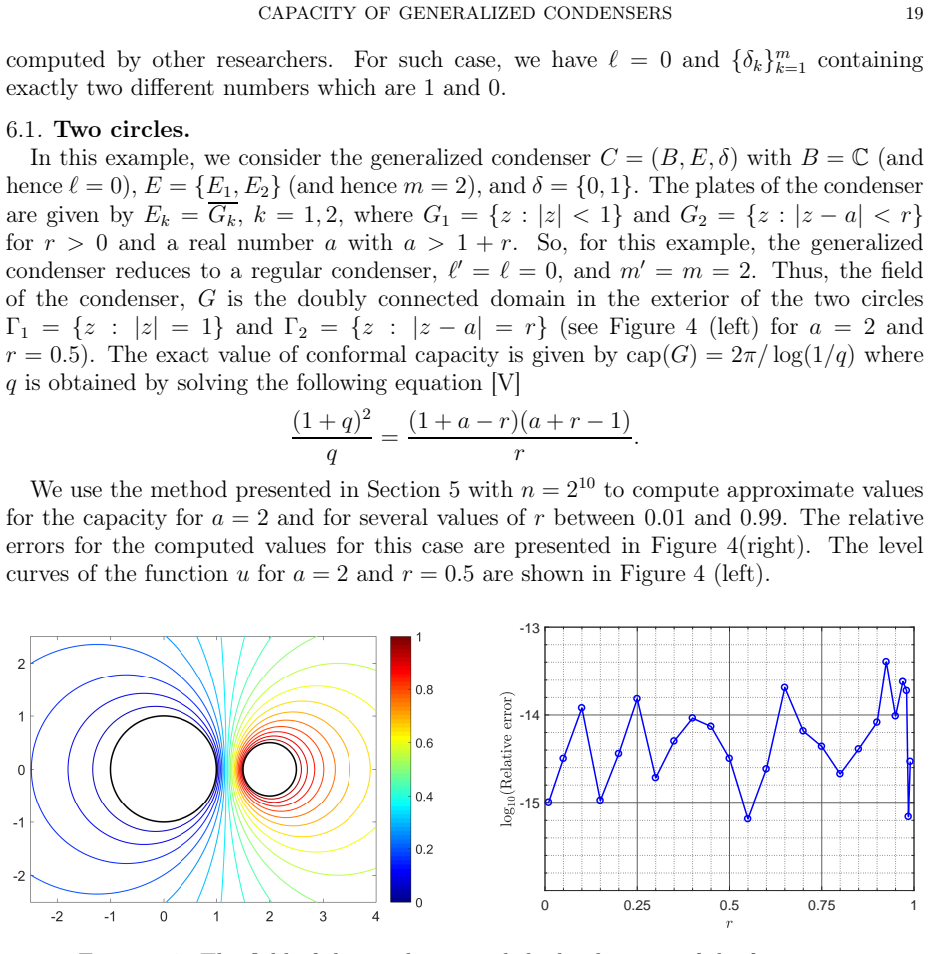
Compute the capacity of the two-circle condenser in Section 6.1 with increasing $n$ and compare it with the exact value $2\pi/\log(1/q)$: if the relative error does not converge toward machine precision, the derived equations are not producing the constants $a_k$. A sharper test targets the branch-cut settings of Lemma 3.9: move the auxiliary points across different branch choices and check whether the computed capacity changes.
Extended reading notes
Core claim
The central claim is that for a generalized condenser $C=(B,E,\delta)$ whose plates are bordered by piecewise smooth Jordan curves or rectilinear slits, the capacity $\operatorname{cap}(C)$ is obtained numerically from the formula $\operatorname{cap}(C)=2\pi\sum_{k=1}^m \delta_k a_k$, where the constants $a_k$ are found by solving the generalized Neumann kernel equations $(I-N)\mu_k=-M\gamma_k$ and then one linear system whose entries come from the piecewise-constant functions $h_k$. The argument reduces the mixed Dirichlet-Neumann problem for the potential to a Riemann-Hilbert problem for an auxiliary analytic function, uses the unique solvability of the generalized Neumann kernel equation to construct basis functions, and proves that the derived linear systems are non-singular. On this basis the same algorithm computes the potential $u$ in the field by Cauchy's integral formula and the harmonic measure for multiply connected domains.
Load-bearing premise
The method stands on the unique-solvability theory of the generalized Neumann kernel equations and of the derived linear systems: if those systems can fail to have exactly one solution for the piecewise-constant data used here, the constants $a_k$, and with them the capacity formula, would not be determined by the numerical solution.
Editorial extensions
If this is right
- Capacities of generalized condensers with thousands of boundary components, such as Cantor-dust and Sierpinski-carpet approximations, become computable in seconds to minutes.
- The same solver computes harmonic measure in multiply connected domains, including piecewise-smooth boundary components, by taking the level vector $\delta$ to be 1 on one boundary component and 0 on the others.
- Rectilinear-slit condensers are covered by first mapping the slit domain conformally to a smooth-bordered domain, since capacity is conformally invariant, so the scope extends beyond Jordan-curve boundaries.
- The cost estimate $O(m'(m+\ell)n\log n)$ for the integral-equation step, with only a small linear system afterwards, makes large many-plate problems feasible on a laptop.
Reading between the lines
- Because the capacity formula is linear in the potential levels $\delta_k$, one set of constants $a_k$ can be reused for many level assignments; the paper does not advertise this, but it follows directly from (2.12).
- The separation into an integral-equation stage and a tiny linear stage suggests the constants $a_k$, which are essentially boundary flux integrals, could serve as building blocks for other conformal invariants that are Dirichlet integrals over the same field.
- For slit plates the accuracy of the final capacity is inherited from the separately computed conformal map; a direct integral formulation on slit boundaries would remove that intermediate step, and the boundary conditions derived here give a starting point for such a formulation.
- The uniqueness lemma for piecewise-constant right-hand sides, if it extends to other coefficient functions $A$, could yield numerical methods for a wider class of mixed boundary-value problems than the constant-level case treated in this paper.
Signed reviews
Editorial analysis
A structured set of objections, weighed in public.
Referee Report
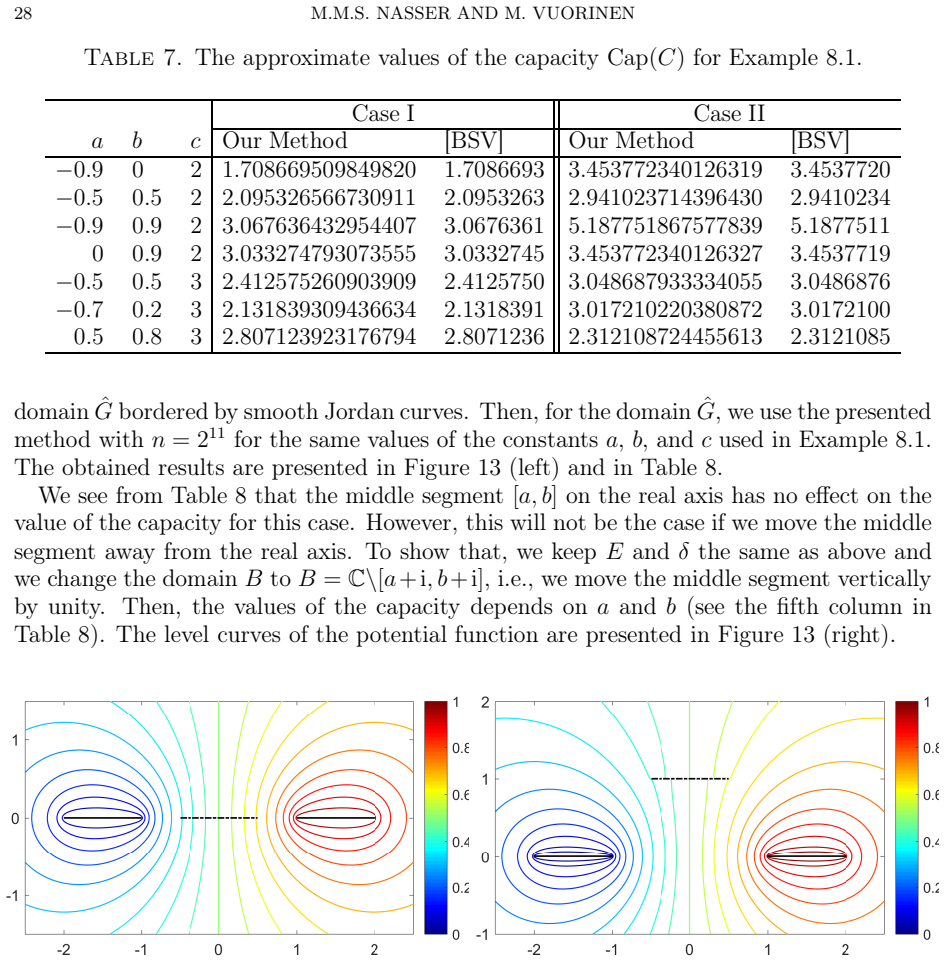
Summary. This paper presents a boundary integral method for computing the conformal capacity of generalized condensers (B, E, δ) in the complex plane. The plates E_k are closures of simply connected domains bounded by piecewise smooth Jordan curves; rectilinear-slit plates are handled via auxiliary conformal mappings. The mixed Dirichlet–Neumann problem for the potential u is reduced to a Riemann–Hilbert problem, and the generalized Neumann kernel is used to obtain a representation of the boundary values of the auxiliary analytic function in terms of flux constants a_k. The main theoretical results, Theorems 4.9 and 4.22, assert that the a_k satisfy a small dense linear system (4.11) or (4.24); the capacity is then cap(C) = 2π Σ δ_k a_k. The paper includes a MATLAB implementation, numerical validation against exact two-circle capacities and published [BSV] tables, and examples with Cantor dust, Sierpinski carpets, slit condensers, and harmonic measure computations.
Significance. If the theoretical framework is correct, this is the first numerical method for capacities of generalized condensers with piecewise smooth boundaries, and it also computes harmonic measure in multiply connected domains. The method has near-linear complexity in the discretization size, is validated to 6–12 digits against independent benchmarks, and is demonstrated on domains with thousands of boundary components. The full MATLAB code is provided, making the computational claims reproducible. The paper's practical contribution is substantial; the main caveat is the need for a more complete statement and proof of the uniqueness result on which the linear systems rely.
major comments (2)
- [Section 4, Lemma 4.7] The proof of Lemma 4.7 is load-bearing for Theorems 4.9 and 4.22, but as written it is not self-contained. It invokes 'a unique piecewise constant real-valued function h' making Re[A f] = γ + h uniquely solvable, whereas the only stated result of this type, Theorem 4.3, is proved or cited only for the particular functions γ_k defined in (3.10). Lemma 4.7 requires the external theorem from [N3,WN] to hold for every piecewise constant, indeed every Hölder continuous, right-hand side γ, together with uniqueness of the pair (f,h) under the normalization f(∞)=0 for unbounded G (and the corresponding normalization for bounded G). Please state the general theorem explicitly and verify that the branch-cut/winding-number hypotheses are satisfied under Lemma 3.9; this is what justifies the conclusion h = −γ and hence the invertibility of the linear systems (4.11) and (4.24).
- [Section 4, Theorem 4.22] The proof of Theorem 4.22 is omitted with the justification 'the theorem can be proved by the same argument as in the proof of Theorem 4.9.' This is not a routine omission because the Case II linear system (4.24) differs structurally from (4.11): there is no explicit Σ a_k = 0 row, a_m is recovered afterwards from (2.10), and the role of the exterior plate E_m changes the normalization argument in the bounded-G case. The nonsingularity of (4.24) and the derivation of the homogeneous solution are therefore not immediate corollaries of the proof of Theorem 4.9. Please provide a complete proof or a detailed set of modifications.
minor comments (5)
- [Section 4] The sentence 'The integral equation (4.5) been used for computing...' should read 'has been used for computing...'.
- [Table 4] The fifth row lists δ2 = 0.15; from the monotone sequence 0.15, 0.30, 0.45, 0.60, 0.90 this appears to be a typo, probably 0.75.
- [Algorithm 4.26, step 2] Step 2 ends with 'Γ_j for j = m + 1, m + 2, ..., m'; the upper limit should be m + ℓ.
- [Section 3, proof of Lemma 3.9] The proof contains an algebraic identity that is valid only because Σ a_k = 0; a remark at the point where Re[e^{-iθ} log(η−α)] Σ a_k is introduced would improve readability.
- [References] The reference [Ku1] is listed but not cited in the text; either cite it or remove it.
Circularity Check
No significant circularity: capacity is computed from BVP flux constants and checked against independent benchmarks.
full rationale
Section 4.3 obtains cap(C) from (2.12), a Green's-formula identity cap(C)=2πΣδ_k a_k with a_k the flux integrals (2.5)/(2.8). The a_k are not fitted to capacity; they are the solution of the linear systems (4.11)/(4.24) assembled from the µ_k, h_k computed by solving integral equation (4.5). The derivation of the linear systems (Theorem 4.9) uses Lemma 4.7 and the cited generalized Neumann kernel theory [N3, WN]; that theory is external mathematical tooling (solvability of Riemann-Hilbert problems), not the target capacity result, and its assumptions do not include the values being computed. Numerical checks are independent: exact two-circle capacity (Section 6.1), published [BSV] tables (Sections 6.2 and 8.1), and exact annulus harmonic measure (Section 9.2). Slit-plate examples use conformal mapping from [NG] to smooth domains, but capacity invariance under conformal maps is a standard theorem and the mapping is auxiliary. The terse proof of Lemma 4.7 extrapolates Theorem 4.3 from the specific γ_k to arbitrary piecewise-constant γ; this is a possible rigor gap in the cited solvability theory, not a circular definition or a fitted-input prediction. No equation here reduces to its own input by construction.
Assumptions & free parameters
free parameters (2)
- Auxiliary points alpha_k (k=1..m') and alpha =
Arbitrary; placed inside bounded complementary domains
- Discretization size n and iterative solver tolerances =
n between 2^8 and 2^11; GMRES tol 1e-14; FMM tol 0.5e-15
assumptions (5)
- standard math The mixed Dirichlet-Neumann boundary value problem (2.3) has a unique solution u.
- standard math The harmonic function u is the real part of an analytic F of the form F(z) = g(z) - sum a_k log(z-alpha_k) with single-valued g and real constants a_k.
- standard math For the functions gamma_k in (3.10), the integral equation (I-N)mu_k = -M gamma_k is uniquely solvable and a unique piecewise constant h_k exists such that Re[A f_k] = gamma_k + h_k.
- standard math The Dirichlet integral is conformally invariant, so a conformally equivalent smooth domain has the same capacity.
- domain assumption Trapezoidal rule with equidistant nodes converges exponentially for smooth boundaries, and Kress graded meshes restore convergence at corners.
Cite this review
Pith. "Pith review of Numerical computation of the capacity of generalized condensers." pith.science (2026). https://pith.science/paper/7GOJNMVO
@misc{pith2026190803866,
  author       = {Pith},
  title        = {Pith review of: Numerical computation of the capacity of generalized condensers},
  year         = {2026},
  howpublished = {\url{https://pith.science/paper/7GOJNMVO}},
  note         = {Machine review of arXiv:1908.03866}
}
read the original abstract
We present a boundary integral method for numerical computation of the capacity of generalized condensers. The presented method applies to a wide variety of generalized condenser geometry including the cases when the plates of the generalized condenser are bordered by piecewise smooth Jordan curves or are rectilinear slits. The presented method is used also to compute the harmonic measure in multiply connected domains.
Figures


Figures from the paper (13 more)




Reference graph
Works this paper leans on
-
[1]
L.V. Ahlfors, Conformal invariants. McGraw-Hill, New York, 1973
work page 1973
-
[2]
S.A.A. Al-Hatemi, A.H.M. Murid and M.M.S. Nasser , A boundary integral equation with the generalized Neumann kernel for a mixed boundary value problem in unbounded multiply connected regions. Bound. Value Probl. 2013 (2013), Article No. 54
work page 2013
-
[3]
G. D. Anderson, M. K. Vamanamurthy, and M. Vuorinen, Conformal invariants, inequalities and quasiconformal maps. John Wiley, 1997
work page 1997
- [4]
-
[5]
Atkinson , The Numerical Solution of Integral Equations of the Second Kind
K.E. Atkinson , The Numerical Solution of Integral Equations of the Second Kind. Cambridge University Press, 1997
work page 1997
-
[6]
S. Bezrodnykh, A. Bogatyrev, S. Goreinov, O. Grigoriev, H. Hakula, and M. Vuorinen : On capacity computation for symmetric polygonal condensers. J. Comput. Appl. Math. 361 (2019), 271--282
work page 2019
-
[7]
D. Betsakos, K. Samuelsson, and M. Vuorinen, The computation of capacity of planar condensers. Publ. Inst. Math. (Beograd) (N.S.) 75(89) (2004), 233--252
work page 2004
-
[8]
D. Crowdy and J. Marshall , Green's functions for Laplace equation in multiply connected domains. IMA J. Appl. Math. 72 (2007), 278--301
work page 2007
Show all 45 references
-
[9]
Driscoll and L.N
T.A. Driscoll and L.N. Trefethen, Schwarz-Christoffel mapping. Cambridge Monographs on Applied and Computational Mathematics, 8. Cambridge University Press, Cambridge, 2002. xvi+132 pp
2002
-
[10]
DeLillo, A.R
T.K. DeLillo, A.R. Elcrat and E.H. Kropf , Calculation of resistances for multiply connected domains using Schwarz-Christoffel transformations. Comput. Methods Funct. Theory 11 (2011), 725--745
2011
-
[11]
V. N. Dubinin, Condenser Capacities and Symmetrization in Geometric Function Theory, Birkh\"auser, 2014
2014
-
[12]
V. N. Dubinin , Capacities of condensers, generalizations of Gr\"otzsch lemmas, and symmetrization. Journal of Mathematical Sciences 143 (2007), 3053--3068
2007
-
[13]
V. N. Dubinin and N. V. Eyrikh , Applications of Generalized Condensers to Analytic Function Theory. Journal of Mathematical Sciences 133 (2006), 1634--1647
2006
-
[14]
V. N. Dubinin and D. B. Karp , Generalized condensers and distortion theorems for conformal mappings of planar domains. Contemporary Mathematics 424 (2007), 33--52
2007
-
[15]
V. N. Dubinin and D. Karp , Capacities of certain plane condensers and sets under simple geometric transformations. Complex Var. Elliptic Equ. 53(6) (2008), 607--622
2008
-
[16]
Gakhov, Boundary Value Problems, Pergamon Press, Oxford, 1966
F.D. Gakhov, Boundary Value Problems, Pergamon Press, Oxford, 1966
1966
-
[17]
J. B. Garnett and D. E. Marshall, Harmonic measure. Reprint of the 2005 original. New Mathematical Monographs, 2. Cambridge University Press, Cambridge, 2008. xvi+571 pp
2005
-
[18]
Greengard and Z
L. Greengard and Z. Gimbutas , FMMLIB2D: A MATLAB toolbox for fast multipole method in two dimensions. Version 1.2, http://www.cims.nyu.edu/cmcl/fmm2dlib/fmm2dlib.html. Accessed 1 Jan 2018
2018
-
[19]
Haas and H
R. Haas and H. Brauchli , Fast solver for plane potential problems with mixed boundary conditions. Comput. Methods Appl. Mech. Engrg. 89 (1991), 543--556
1991
-
[20]
Hakula, A
H. Hakula, A. Rasila and M. Vuorinen , On moduli of rings and quadrilaterals: algorithms and experiments. SIAM J. Sci. Comput. 33 (2011), 279--302
2011
-
[21]
Hakula, A
H. Hakula, A. Rasila and M. Vuorinen , Computation of exterior moduli of quadrilaterals. Electron. Trans. Numer. Anal. 40 (2013), 436--451
2013
-
[22]
P. N. Ivanshin and E. A. Shirokova , The solution of a mixed boundary value problem for the Laplace equation in a multiply connected domain. Probl. Anal. Issues Anal. 8 (26) (2019), 51--66
2019
-
[23]
Krantz , Geometric Function Theory: Explorations in Complex Analysis
S.G. Krantz , Geometric Function Theory: Explorations in Complex Analysis. Birkh\"auser, Boston, 2006
2006
-
[24]
Kress , A Nystr\"om method for boundary integral equations in domains with corners
R. Kress , A Nystr\"om method for boundary integral equations in domains with corners. Numer. Math. 58(2) (1990), 145--161
1990
-
[25]
K\"uhnau , Boundary Effects for an Electrostatic Condenser
R. K\"uhnau , Boundary Effects for an Electrostatic Condenser. Journal of Mathematical Sciences, 105 (2001), 2210--2219
2001
-
[26]
uhnau,\, The conformal module of quadrilaterals and of rings, In: Handbook of Complex Analysis: Geometric Function Theory , (ed. by R. K\
R. K\"uhnau,\, The conformal module of quadrilaterals and of rings, In: Handbook of Complex Analysis: Geometric Function Theory , (ed. by R. K\"uhnau) Vol. 2, North Holland/Elsevier, Amsterdam, 99--129, 2005
2005
-
[27]
Lehto and K.I
O. Lehto and K.I. Virtanen,\,
-
[28]
Liesen, O
J. Liesen, O. S\'ete and M.M.S. Nasser , Fast and accurate computation of the logarithmic capacity of compact sets. Comput. Methods Funct. Theory 17 (2017), 689--713
2017
-
[29]
Mikhlin, Integral Equations and Their Applications to Certain Problems in Mechanics, Mathematical Physics and Technology
S.G. Mikhlin, Integral Equations and Their Applications to Certain Problems in Mechanics, Mathematical Physics and Technology. 2nd rev ed. Pergamon Press, Oxford, 1964
1964
-
[30]
Muskhelishvili, Singular Integral Equations, Noordhoff, Groningen, 1953
N.I. Muskhelishvili, Singular Integral Equations, Noordhoff, Groningen, 1953
1953
-
[31]
Nasser , Numerical conformal mapping via a boundary integral equation with the generalized Neumann kernel
M.M.S. Nasser , Numerical conformal mapping via a boundary integral equation with the generalized Neumann kernel. SIAM J. Sci. Comput. 31 (2009), 1695--1715
2009
-
[32]
Nasser , Numerical conformal mapping of multiply connected regions onto the second, third and fourth categories of Koebe canonical slit domains
M.M.S. Nasser , Numerical conformal mapping of multiply connected regions onto the second, third and fourth categories of Koebe canonical slit domains. J. Math. Anal. Appl. 382 (2011), 47--56
2011
-
[33]
Nasser , Fast solution of boundary integral equations with the generalized Neumann kernel
M.M.S. Nasser , Fast solution of boundary integral equations with the generalized Neumann kernel. Electron. Trans. Numer. Anal. 44 (2015), 189--229
2015
-
[34]
Nasser, J
M.M.S. Nasser, J. Liesen and O. S\'ete , Numerical computation of the conformal map onto lemniscatic domains. Comput. Methods Funct. Theory 16 (2016), 609--635
2016
-
[35]
Nasser, A.H.M
M.M.S. Nasser, A.H.M. Murid and S.A.A. Al-Hatemi , A boundary integral equation with the generalized Neumann kernel for a certain class of mixed boundary value problem. J. Appl. Math. 2012 (2012), Article ID 254123, 17 pages
2012
-
[36]
Nasser and C.C
M.M.S. Nasser and C.C. Green , A fast numerical method for ideal fluid flow in domains with multiple stirrers. Nonlinearity 31 (2018), 815--837
2018
-
[37]
Papamichael and N
N. Papamichael and N. Stylianopoulos , Numerical conformal mapping: Domain decomposition and the mapping of quadrilaterals. World Scientific; 2010
2010
-
[38]
Ransford , Computation of logarithmic capacity
T. Ransford , Computation of logarithmic capacity. Comput. Methods Funct. Theory 10(2) (2010), 555–578
2010
-
[39]
Ransford and J
T. Ransford and J. Rostand , Computation of capacity. Math.Comput.76(259) (2007), 1499--1520
2007
-
[40]
Trefethen and J
L.N. Trefethen and J. A. C. Weideman , The exponentially convergent trapezoidal rule. SIAM Review 56 (2014), 385--458
2014
-
[41]
Tsuji , Potential Theory in Modern Function Theory
M. Tsuji , Potential Theory in Modern Function Theory. Chelsea Publ. Co., New York, 1975
1975
-
[42]
Vasil ' ev , Moduli of Families of Curves for Conformal and Quasiconformal Mappings
A. Vasil ' ev , Moduli of Families of Curves for Conformal and Quasiconformal Mappings. Springer-Verlag, Berlin, 2002
2002
-
[43]
Vuorinen , Conformal geometry and quasiregular mappings
M. Vuorinen , Conformal geometry and quasiregular mappings. Lecture Notes in Mathematics, 1319. Springer-Verlag, Berlin, 1988
1988
-
[44]
Vuorinen : Conformal invariants and quasiregular mappings
M. Vuorinen : Conformal invariants and quasiregular mappings. - J. Anal. Math. 45 (1985), 69--115
1985
-
[45]
Wegmann and M.M.S
R. Wegmann and M.M.S. Nasser , The Riemann-Hilbert problem and the generalized Neumann kernel on multiply connected regions. J. Comput. Appl. Math. 214 (2008), 36--57
2008
Reviewed August 14, 2026 · model on record in the stance chip above.
Discussion (0). Continue with ORCID to comment.