REVIEW 3 major objections 6 minor 9 references
Dielectric kernels for Maxwellian tokamak plasmas
T0 review · 3 major / 6 minor · reviewed 2026-08-14 · deepseek-v4-flash
Pith's one-line read The paper derives an integral-kernel form of the Maxwellian tokamak dielectric response whose kernel dispersion functions replace the poloidal Fourier mode expansion.
desk verdict The kernel idea is attractive, but the central series defining the Ξα functions does not converge as written; the paper's own convergence claim is wrong, leaving the representation unestablished. read the letter →
The pith
A machine-rendered reading of the paper's core claim, the machinery that carries it, and where it could break.
The reading
What carries the argument
The load-bearing object is the kernel dispersion function $\Xi_\alpha(\chi,\kappa,\xi)$ of equation (8), a series over an integer $M$ of the plasma dispersion function $I_\alpha$ evaluated at $\xi/|M+\kappa|$ and weighted by $\exp(iM\chi)/|M+\kappa|$. It collapses the infinite poloidal-mode couplings into a single function of the separation angle $2\chi$, the toroidal-mode parameter $\kappa$ (entering through the parallel wavenumber), and the resonance parameter $\xi_p$. Its quasi-periodicity $\Xi_\alpha(\chi,\kappa+1,\xi)=e^{-i\chi}\Xi_\alpha(\chi,\kappa,\xi)$, its $\theta$-function representation, and its exponential asymptotics are what make the kernel representation computationally practical and localize coupling near cyclotron resonance.
What would settle it
Evaluate the truncated series (8) for $\Xi_0$ on successively finer meshes in $\chi$ near 0 for fixed $\kappa$ and $\xi$ and check whether $\int |\Xi_0|\, d\chi$ stays finite; then use the kernel integral (6) on a simple axisymmetric test equilibrium and compare with the original mode-sum expression (3) — a persistent discrepancy as truncation grows would falsify the central claim.
Extended reading notes
Core claim
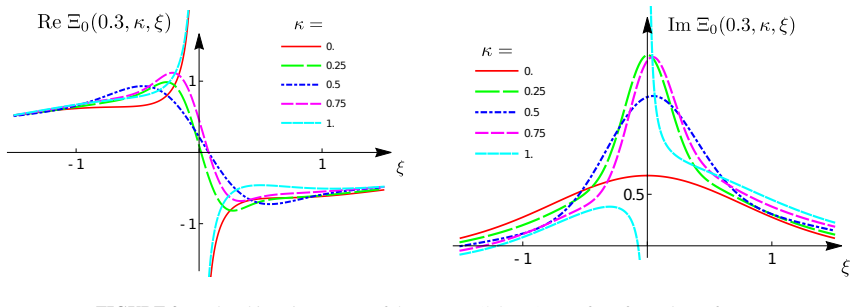
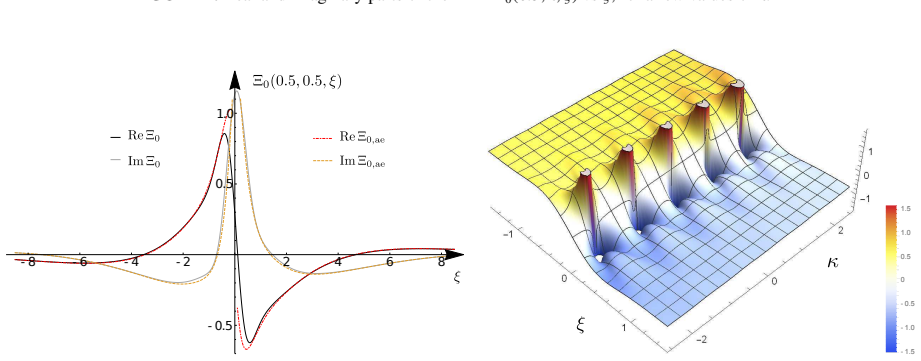
The central claim is the identity of equation (6): the dielectric response of particle species $\beta$ for toroidal mode $n$ can be written as $W^{FE}_\beta = \int d\rho \sum_{p,L} \int\!\int F^*_L(\rho,\theta+\chi) K^p_{LL}(\theta,\chi) E_L(\rho,\theta-\chi)\, d\chi\, d\theta$, where the field and test function enter at positions separated by the poloidal angle $2\chi$. The kernel is $K^p_{LL}(\theta,\chi) = -i\pi R_J \delta_{L,p} 2^{\alpha/2} \varepsilon_0 \omega_p^2/(|\kappa_\pi| v_T) \Xi_\alpha(\chi,\kappa,\xi_p)$, with $\alpha=2\delta_{L,0}$, and the new kernel dispersion functions are $\Xi_\alpha(\chi,\kappa,\xi) = (1/2\pi) \sum_M \exp(iM\chi) |M+\kappa|^{-1} I_\alpha(\xi/|M+\kappa|)$. The paper shows these functions are $2\pi$-periodic in $\chi$, quasi-periodic in $\kappa$, satisfy a conjugation relation under sign reversal of $\xi$, admit a Jacobi $\theta$-function integral representation, decay exponentially for large $|\chi\xi|$, and have an integrable logarithmic singularity at $\chi=0$ for $\alpha=0,1$. On this basis the paper argues that the poloidal Fourier mode expansion of the HF fields is no longer needed.
Load-bearing premise
The load-bearing assumption is that the infinite poloidal-mode sum can be legitimately exchanged for the poloidal-angle integral and that the divergent-at-zero kernel series still defines an integrable kernel; the proof is deferred to the companion paper, so if that interchange fails the central representation collapses.
Editorial extensions
If this is right
- A 2D finite-element discretization of the RF wave equation becomes possible without any poloidal harmonic grid: the dielectric term couples each test function and field at a common magnetic surface at points separated by a fixed poloidal angle.
- For a given poloidal geometry, all toroidal mode numbers can be served from one master table of $\Xi_\alpha$ over $\kappa$ in $[0,1[$, because of the quasi-periodicity relation (10).
- The exponentially narrow kernel for large $|\chi\xi_p|$ means the effective non-local coupling in poloidal angle shrinks as one moves away from cyclotron resonance, which gives a quantitative guide for mesh refinement.
- Singular behaviour is fully identified: integrable logarithmic singularities at $\chi=0$ for the cyclotron kernels, and poles wherever a resonance layer crosses an integer-$\kappa$ surface (rational-$q$ surfaces in constant-$k_\parallel$ coordinates), to be handled by the causality prescription $\mathrm{Im}\,\xi>0$.
- The same kernel dispersion functions extend to all orders in the Larmor radius, so the method can be carried beyond the lowest-order presentation without introducing a new set of functions.
Reading between the lines
- One practical consequence not spelled out in the paper: the integrable logarithmic singularity at $\chi=0$ could be subtracted and integrated analytically inside finite elements, giving a robust quadrature recipe for elements that straddle the resonance layer.
- The theta-function representation suggests the KDFs may be evaluable by fast special-function or asymptotically uniform algorithms, which would make the method competitive with existing spectral codes across the whole $(\chi,\kappa,\xi)$ parameter space.
- The paper's proposed two-dimensional poloidal-toroidal kernels, if built, would turn the dielectric response into a genuinely non-local operator on the full flux surface, potentially reusable for turbulence or gyrokinetic models that need kinetic non-locality, not only for RF heating.
Signed reviews
Editorial analysis
A structured set of objections, weighed in public.
Referee Report
Summary. The paper proposes a new integral-kernel formulation of the linear dielectric response of a Maxwellian tokamak plasma for radio-frequency waves. Starting from the established poloidal Fourier mode expression for the Galerkin dielectric response, Eq. (3), the author performs inverse poloidal Fourier transforms to obtain a representation, Eq. (6), in which the dielectric response is an integral over a poloidal position θ and a separation angle χ, involving the local field and test-function values at θ−χ and θ+χ. The kernel is written in terms of new special functions Ξα(χ,κ,ξ), called kernel dispersion functions, defined by the series in Eq. (8). The paper states several properties of these functions: conditional convergence and a logarithmic singularity in χ for α=0,1, absolute convergence for α=2, symmetries and a quasi-periodicity in κ, a theta-function representation for α=0,2, and large-|χξ| asymptotic decay. The presentation is restricted to lowest order in the Larmor radius, with higher orders deferred to a companion paper, reference [4], listed as "to be submitted".
Significance. If the central representation is rigorously valid, it offers a practically useful alternative to poloidal Fourier spectral methods for full-wave tokamak modeling, enabling local 2D finite-element refinement near cyclotron layers. The introduction of the kernel dispersion functions, with their symmetry, quasi-periodicity, and asymptotic properties, is a genuine theoretical contribution that could also be of interest in computational plasma physics. The paper is explicit in giving the key formulas (6)-(8) and identifies the mathematical subtleties of the kernels. However, the derivation of Eq. (6) from Eq. (3) is only sketched, and the convergence properties essential for the weak-form interpretation are asserted rather than proved, with the details relegated to an unpublished companion paper. The result is therefore conditional on a more self-contained justification.
major comments (3)
- [Section 2 (Integral kernel representation), Eq. (6)] The central transition from Eq. (3) to Eq. (6) is not actually shown. The sentence "Performing inverse poloidal Fourier transforms" hides the load-bearing steps: reindexing the double sum over m1,m2 in terms of a total index M and a difference index, evaluating the sum over the difference index as a periodic constraint on the poloidal angles, and interchanging the infinite sums with the integrals over dρ and dθ. Since Eq. (6) is the main result of the paper, this gap needs to be closed in the manuscript, either by a self-contained derivation or by a rigorous statement of the conditions under which the interchange is valid. Referring solely to the unpublished companion [4] is not sufficient for a standalone journal paper.
- [Section 3 (Properties of the KDFs), after Eq. (8)] The convergence and singularity claims for the KDFs are asserted but not demonstrated. The text states that the series for Ξ0 and Ξ1 are conditionally convergent for χ≠0 and diverge at χ=0 with an integrable logarithmic singularity. This property is load-bearing because the Galerkin integral in Eq. (6) must be well-defined when the kernel is integrated against finite-element basis functions. The manuscript gives no proof or asymptotic expansion establishing the logarithmic singularity, and it does not specify the summation order used to define the conditionally convergent series (e.g., symmetric partial sums over |M|). I note that the specific concern that the summands tend to a nonzero constant is based on the large-argument asymptotics of the plasma dispersion function; since the argument is ξ/|M+κ|→0 for large |M|, the small-argument expansion Z(z)∼i√π is the relevant one and the terms do tend to zero. The convergence claim is therefore plausible, but it remains unproved here. Please provide the proof or a citable published reference.
- [Section 3 (Properties of the KDFs), Eq. (11) and surrounding text] The theta-function representation in Eq. (11) is given only for Ξ0 and Ξ2. The paper defines Ξ1 and states that it appears in FLR generalizations, and the series for Ξ1 has the same conditional-convergence issue as Ξ0. If the present lowest-order paper only requires α=0 and 2, this is not a blocker, but the text presents the properties of the KDFs as a general toolkit. The authors should either provide a convergent representation or an evaluation strategy for Ξ1, or explicitly state that Ξ1 is outside the scope of the present communication.
minor comments (6)
- [Figure captions, Figs. 1 and 2] The figure captions do not list the specific values of ξ and κ used for the plotted curves. Please add these parameter values so that the figures are reproducible.
- [Section 3, Eq. (8)] For conditionally convergent series, the summation order must be specified. Please state that the sums in Eq. (8) are understood as symmetric partial sums over |M|≤N (or another explicit convention) when used for numerical evaluation.
- [Abstract and Introduction] The claim that the method is "free from the poloidal Fourier mode expansion of the HF fields" is slightly overstated, since Eq. (6) is obtained by inverse-transforming a poloidal-Fourier expression. The wording should be adjusted to say that the final representation does not require the poloidal Fourier representation, rather than implying the derivation avoids it.
- [Section 3, paragraph on Ξ2] The assertion that the Ξ2 series is absolutely convergent and finite at χ=0 is made without a supporting estimate. A one-line bound on the summands would settle this point.
- [References, [4]] Reference [4] is listed as "to be submitted". If the derivation and convergence proofs remain deferred, the reference should point to a published or in-press article; otherwise the necessary mathematical details should be included in the current paper.
- [Eq. (3)] In the extracted text, the factor 2^{α/2} is typeset as "2α/2"; please ensure that the published version has the correct exponent notation.
Circularity Check
No circular derivation: the kernel representation is an exact recasting of earlier published dielectric-response formulas, with no fitted parameter or definitional identification.
full rationale
The central claim (Eq. 6) is obtained by inverse poloidal Fourier transformation of the dielectric response (Eq. 3), which itself comes from the published guiding-centre/Galerkin formalism (Refs. [3], [5]). The KDFs (Eq. 8) are defined directly from the same plasma-dispersion functions I_alpha used in (3); no quantity is fitted to data and no output is defined in terms of the claim it supports. The paper is not self-contained: the convergence behaviour of the series (8) and the interchange of sums and integrals are deferred to the author's companion paper [4] ('to be submitted'), and the assertion that Xi_0 and Xi_1 have an integrable logarithmic singularity is quoted rather than proved. That is an omitted proof and a mathematical-correctness risk, not a circular reduction, because [4] is not assumed as an input and no equation reduces to an earlier fitted value or to the conclusion by construction. The self-citations to [3], [5], and [6] supply the starting formalism and coordinate choice, not the new kernel result itself. Therefore the circularity score is 0.
Assumptions & free parameters
assumptions (4)
- domain assumption Axisymmetry of the tokamak equilibrium and validity of the toroidal Fourier decomposition exp(inφ) in the Galerkin wave equation (1).
- domain assumption The standard assumptions of the poloidal Fourier expansion of the dielectric response, as discussed in reference [5], including the use of guiding-center expressions for k∥ and lowest-order Larmor radius, are valid.
- ad hoc to paper The inverse poloidal Fourier transform and the interchange of infinite sums and integrals leading from (3) to (6) are valid, with the singularities of the KDFs at χ=0 being integrable.
- standard math The causality prescription Im ξp > 0 is used to handle the poles at integer κ with ξp=0.
Cite this review
Pith. "Pith review of Dielectric kernels for Maxwellian tokamak plasmas." pith.science (2026). https://pith.science/paper/VXAPJNTU
@misc{pith2026190803896,
  author       = {Pith},
  title        = {Pith review of: Dielectric kernels for Maxwellian tokamak plasmas},
  year         = {2026},
  howpublished = {\url{https://pith.science/paper/VXAPJNTU}},
  note         = {Machine review of arXiv:1908.03896}
}
abstract
New integral kernels describing the full-wave dielectric response of Maxwellian tokamak plasmas are presented. They realistically account for the rotational transform and for wave dispersion in presence of equilibrium magnetic field parallel gradients. These kernels rely on special functions of three variables that generalize the standard plasma dispersion function; their main analytical properties are given, leading to efficient evaluation. This approach is free from the poloidal Fourier mode expansion of the HF fields which appears in earlier formulations and gives complete freedom for the numerical resolution of the wave equation: it will typically be applied to 2D finite element discretizations, allowing local mesh refinements as required near cyclotron resonance layers and in regions of rapid HF field variations. This first presentation is to lowest order in the Larmor radius for the sake of clarity but will readily generalize to all orders in ($\rho_{LT}/\lambda_\perp$).
Figures

Reference graph
Works this paper leans on
-
[3]
author author M. Brambilla \ and\ author T. Kruecken ,\ @noop journal journal Nucl. Fusion \ volume 28 ,\ p.\ pages 1813 ( year 1988 ) NoStop
work page 1988
-
[4]
author author P. U. \ Lamalle ,\ @noop journal journal Plasma Phys. Control. Fusion \ volume 39 ,\ \ pages 1409--1460 ( year 1997 ) NoStop
work page 1997
-
[1]
merlin.mbs aipnum4-1.bst 2010-07-25 4.21a (PWD, AO, DPC) hacked
FUNCTION id.bst "merlin.mbs aipnum4-1.bst 2010-07-25 4.21a (PWD, AO, DPC) hacked" ENTRY address archive archivePrefix author bookaddress booktitle chapter collaboration doi edition editor eid eprint howpublished institution isbn issn journal key language month note number organization pages primaryClass publisher school SLACcitation series title translati...
work page 2010
-
[2]
author author D. J. \ Gambier \ and\ author A. Samain ,\ @noop journal journal Nucl. Fusion \ volume 25 ,\ p.\ pages 283 ( year 1985 ) NoStop
work page 1985
-
[5]
author author P. U. \ Lamalle ,\ @noop journal journal Plasma Phys. Control. Fusion (to be submitted) \ ( year 2019 ) NoStop
work page 2019
-
[6]
author author P. U. \ Lamalle ,\ @noop journal journal Plasma Phys. Control. Fusion \ volume 40 ,\ \ pages 465--479 ( year 1998 ) NoStop
work page 1998
-
[7]
author author P. U. \ Lamalle ,\ @noop journal journal Plasma Phys. Control. Fusion \ volume 48 ,\ \ pages 433--477 ( year 2006 ) NoStop
work page 2006
-
[8]
author author T. H. \ Stix ,\ @noop title Waves in P lasmas \ ( publisher American Institute of Physics ,\ year 1992 ) NoStop
work page 1992
Show all 9 references
-
[9]
Erdélyi , author W
author author A. Erdélyi , author W. Magnus , author F. Oberhettinger , \ and\ author F. Tricomi ,\ @noop title Higher T ranscendental F unctions ,\ Vol. volume II \ ( publisher McGraw-Hill ,\ year 1953 ) NoStop
1953
Reviewed August 14, 2026 · model on record in the stance chip above.
Discussion (0). Continue with ORCID to comment.