REVIEW 1 major objections 4 minor 21 references
The shapes of Galois quartic fields
T0 review · 1 major / 4 minor · reviewed 2026-08-14 · deepseek-v4-flash
Pith's one-line read This paper classifies the shapes of all Galois quartic fields and proves that V4 shapes equidistribute in orthorhombic lattice spaces with explicit densities, while C4 shapes form discrete families with counted asymptotics.
desk verdict Completes the Galois quartic shape classification with a clean equidistribution proof; minor sieve terseness and a typo in the introduction don't affect the main results. read the letter →
The pith
A machine-rendered reading of the paper's core claim, the machinery that carries it, and where it could break.
The reading
What carries the argument
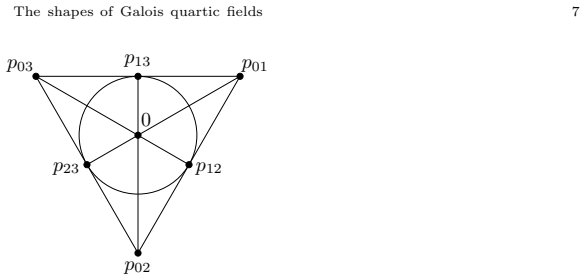
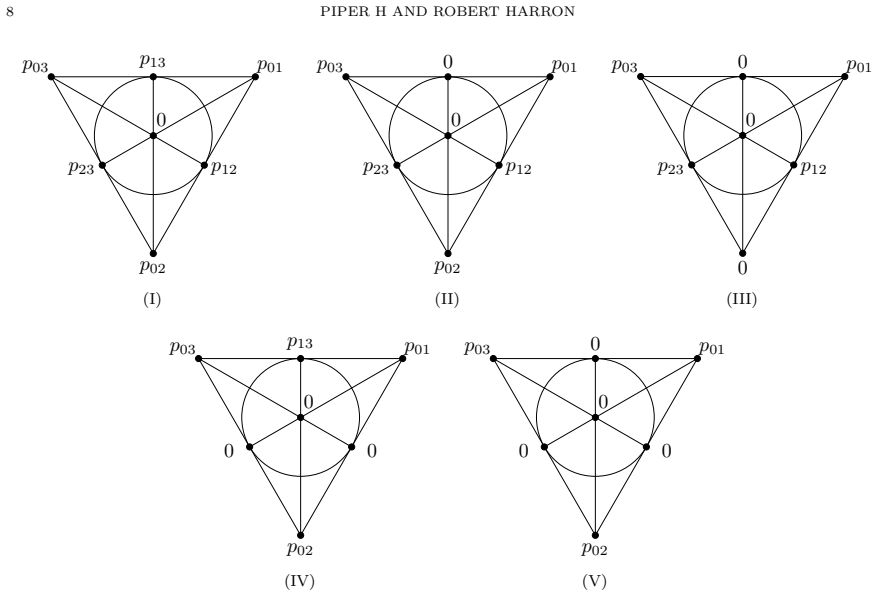
The argument is carried by the conorm diagram of [CS92], a labeling of the points of the Fano plane that encodes a rank-3 lattice up to isomorphism and exposes the combinatorial type of its Voronoi cell. Combined with the integral-basis data of [Wil70] for biquadratic fields, this identifies the $V_4$ shape as the appropriate orthorhombic lattice. The counting proof bijects $V_4$-quartic fields with $\ast$-strongly carefree triples, estimates the number of such triples in the relevant region with the lattice-point counting lemma of [Bha05], and passes from a finite sieve to all primes by the method of [DH71], producing the Euler product $\prod_{p\text{ odd}}(1-6p^{-2}+8p^{-3}-3p^{-4})$. For $C_4$ fields, the parametrization $K = Q(\sqrt{A(D+B\sqrt{D})})$ from [HHR+86], together with the integral-basis results of [HW90] and [SW06], reduces the fixed-shape count to sums-of-two-squares representations, handled by a Dirichlet-series factorization and a Tauberian theorem.
What would settle it
Enumerate all $V_4$-quartic fields with discriminant below a large $X$ (for instance $X = 10^{12}$), count those whose shape falls in a fixed box such as $1 \le x \le y \le 2$, and test whether $N_{\mathrm{wild}}(X,W)X^{-1/2}$ approaches $C_{\mathrm{wild}}\,\mu_{oC}(W)$; any systematic deviation beyond the claimed $o(1)$ would disprove Theorem C.
Extended reading notes
Core claim
The central claim is that the shape of a Galois quartic field falls into one of four infinite families and that, in the $V_4$ case, these shapes behave like random points in their natural two-dimensional spaces. Precisely, if $K$ is a $V_4$-quartic field with quadratic subfields $Q(\sqrt{\Delta_i})$, then its shape is a base-centered orthorhombic lattice with side ratios $\sqrt{|\Delta_1|}:\sqrt{|\Delta_2|}:\sqrt{|\Delta_3|}$ when the prime $2$ ramifies, and a body-centered orthorhombic lattice with the same ratios when $2$ is unramified. The main theorem states that for compact continuity sets $W$, the counts satisfy $N_{\mathrm{wild}}(X,W)/X^{1/2} \to C_{\mathrm{wild}}\,\mu_{oC}(W)$ and $N_{\mathrm{tame}}(X,W)/X^{1/2} \to C_{\mathrm{tame}}\,\mu_{oI}(W)$, with the constants given above. For $C_4$-quartic fields, the shape is a primitive tetragonal lattice with side ratio $\sqrt{2}\cdot r_{\mathrm{rat}}^{-1/4}$ if $2$ ramifies and a body-centered tetragonal lattice with side ratio $r_{\mathrm{rat}}^{-1/4}$ otherwise, where $r_{\mathrm{rat}} = N/|\Delta_2|$ is the ramification ratio; these shapes sit as discrete points, and the paper gives $X^{1/3}$-asymptotics for the number of fields with a specified shape.
Load-bearing premise
The load-bearing premise of the $V_4$ counting theorem is that imposing the squarefree and pairwise-coprime conditions at all primes simultaneously changes the count from the finite-sieve count by only $o(N)$; if this error were larger, the explicit constants in the equidistribution theorem would not be the true densities.
Editorial extensions
If this is right
- Within the totally real $V_4$-quartic fields, and within the tamely ramified $V_4$-quartic fields, the shape determines the field uniquely.
- For $V_4$ fields with shape in a compact set, the count grows like $X^{1/2}$ times the measure of the shape set; both logarithmic factors in the total count $X^{1/2}\log^2 X$ come from the unbounded shape parameters.
- For $C_4$ fields, the discriminant determines the shape, and the number of fields with a fixed shape and discriminant at most $X$ is asymptotic to a constant times $X^{1/3}$, where the constant depends on the shape through the ramification ratio and the set of primes dividing it.
- The proportion of $C_4$ fields with ramification ratio $r_{\mathrm{rat}}$ versus $p\, r_{\mathrm{rat}}$ depends on whether $p \equiv 1$ or $3 \pmod 4$, so the distribution of these shapes is not governed by a real Lie group action.
Reading between the lines
- The wild families of $C_3^2$-octic fields, mentioned in the paper only in the tame totally real case, should exhibit the same regularized equidistribution if the same conorm-diagram and sieve machinery is applied, with the density constants depending on the local behavior at the ramified prime.
- The ratio $C_{\mathrm{wild}}/C_{\mathrm{tame}} = 5/2$ suggests a purely local explanation at the prime $2$; interpreting this as the ratio of admissible congruence patterns at $2$ could predict similar constants for other Galois groups with a single wildly ramified prime.
- A numerical test of Theorem C at moderate $X$ is feasible because the field count is $X^{1/2}$ up to logs; computing the shape box count for $X \sim 10^{12}$ would separate the claimed Euler-product constant from nearby alternatives and provide a concrete check of the sieve step.
- The same shape-space viewpoint could resolve the general question of which $S_n$-fields have 'random' shapes versus rigid ones: Galois groups with large automorphism groups impose symmetries that shrink the shape space, and the dichotomy seen here between $V_4$ (equidistributed) and $C_4$ (discrete) should persist for other abelian Galois groups.
Signed reviews
Editorial analysis
A structured set of objections, weighed in public.
Referee Report
Summary. The paper determines the shapes of all Galois quartic number fields, splitting into four families according to Galois group C4 or V4 and tame versus wild ramification. In the V4 case, shapes are shown to form two-dimensional families of orthorhombic lattices, with explicit side ratios in terms of the three quadratic subfield discriminants, and the main Theorem C establishes a regularized equidistribution statement with explicit constants: the number of fields with shape in a compact continuity set is asymptotic to C_wild μ_oC(W) X^{1/2} or C_tame μ_oI(W) X^{1/2}, with C_wild = 5/48 and C_tame = 1/6 times the displayed Euler product over odd primes. In the C4 case, shapes are discrete tetragonal lattices determined by a ramification ratio, and Theorem E/Theorem 7.1 provides asymptotic counts for fields of a given shape. The proofs are built on Williams' integral bases, Conway-Sloane conorm diagrams, a bijection with strongly carefree triples, the Principle of Lipschitz, a sieve following Davenport-Heilbronn, and for the C4 case the Wirsing-Odoni and Wiener-Ikehara Tauberian methods.
Significance. If the results hold, this is a substantial contribution to the study of shape distributions of number fields, extending the cubic and S_n results of Terr and Bhargava-Harron to the Galois quartic setting. The paper contains no fitted parameters: all constants are derived from explicit integral bases, Gram matrices, and sieve densities, and the V4 result is tested against Baily's independent count of V4 fields. The regularized equidistribution result gives a concrete explanation for the appearance of log-squared terms in counting V4 fields, and Theorem A's complete-invariant statements are of independent interest. The analytic number theory is standard but carefully assembled, with the reduction to strongly carefree triples and the case-by-case integral-basis computations forming a solid and reproducible core.
major comments (1)
- [§1.2, Theorem E] The Euler product defining CΣ_A is printed as ∏_p (1 − f_A(p)/p)(1 − 1/p). For primes p ≡ 1 (mod 4) with p ∤ A this factor equals (1 − 2/p)(1 − 1/p), so the product over these primes diverges to 0; this contradicts the positive constants stated in Theorem 7.1 and equation (7.18), where the factor is (1 + f_A(p)/p)(1 − 1/p). Theorem E should be corrected to match (7.18).
minor comments (4)
- [§5.1] The line 'Let s(ii) = 2 and s(i) = s(ii) = 1' is internally inconsistent; it should read s(i) = s(iii) = 1 and s(ii) = 2, as used in Theorem 5.10 and in the subsequent substitutions for the counting regions.
- [§1.1, Remark 1.1(b)] The name 'Revera-Guaca' is a typo for 'Rivera-Guaca' as in the reference list; please correct it in the remark.
- [References, [Har19]] The arXiv identifier for [Har19] is printed as 'arXiv:11907.07209'; this should be 'arXiv:1907.07209'.
- [§3.1] The term 'subperbase' appears to be a typo for 'superbase': the sentence should say that a quadruple not necessarily satisfying the obtuse condition is called a superbase.
Circularity Check
No circularity found: the main constants and measures are derived from explicit counting, not fitted or imported as conclusions.
full rationale
I walked the derivation chain for both the V4 and C4 halves of the paper. In the V4 case, the shape classification in Theorem 4.2 is obtained directly from Williams' integral bases and explicit Gram-matrix computations; the side ratios sqrt(|Delta_1|):sqrt(|Delta_2|):sqrt(|Delta_3|) are computed, not assumed. The equidistribution result in Theorem C rests on counting strongly carefree triples with congruence conditions: Corollary 5.9 gives the finite-sieve main term with explicit densities, and the passage from the finite sieve to all primes is justified by a union-bound over p>Y with the stated O(N/p^2) bound. The constants 5/48 and 1/6 are then arithmetical products of the case constants 1/96 and 1/24 with the box-measure factor 1/2; they are not fitted to data or to the claimed limit. The measure mu_oC and mu_oI are defined naturally from the diagonal group action before any counting, and the box volumes are computed independently in Lemmas 3.11 and 3.13, so the equidistribution statement is not true by construction. In the C4 case, Theorem 7.1 is derived from the external Hardy-Hudson-Richman-Williams-Holtz parametrization plus Hudson-Williams and Spearman-Williams integral-basis data, and the asymptotics come from Wirsing-Odoni and Wiener-Ikehara applied to the sums-of-two-squares counting function; no parameter is adjusted to force the stated answer. The paper does cite the second author's earlier work [Har17, Har19] for the idea of regularized equidistribution and for context on log terms, but these citations are not load-bearing: the definitions, bijections, and analytic estimates that produce the theorems are all given in this paper. I found no step where a fitted parameter is renamed a prediction, no definition of an input in terms of the claimed output, and no self-citation used as the sole justification of a central premise. The only notable defect is a sign typo in the introduction's Theorem E, where the Euler product is printed with (1 - f_A(p)/p) instead of the positive (1 + f_A(p)/p) factor proved in Theorem 7.1; that is a correctness or typographical issue, not a circularity.
Assumptions & free parameters
assumptions (5)
- standard math Conway-Sloane conorm diagram classification of rank 3 lattices by non-negative labels on the Fano plane.
- domain assumption Williams' classification of integral bases of biquadratic (V4) fields into three cases, with the corresponding discriminants.
- domain assumption Parametrization of C4 fields as Q(sqrt(A(D+B sqrt(D)))) with A squarefree odd, D = B^2 + C^2 squarefree, gcd(A,D) = 1, together with the five-case discriminant and integral-basis data.
- domain assumption Davenport-Heilbronn sieve principle: the count of triples satisfying all infinitely many squarefree and coprimality conditions is the limit of finite-sieve counts with the stated constants and error o(N).
- standard math Wirsing-Odoni method and Wiener-Ikehara Tauberian theorem yield the stated main terms for the arithmetic sums F_Sigma and F_Sigma_U.
Cite this review
Pith. "Pith review of The shapes of Galois quartic fields." pith.science (2026). https://pith.science/paper/U37QK254
@misc{pith2026190803969,
  author       = {Pith},
  title        = {Pith review of: The shapes of Galois quartic fields},
  year         = {2026},
  howpublished = {\url{https://pith.science/paper/U37QK254}},
  note         = {Machine review of arXiv:1908.03969}
}
abstract
We determine the shapes of all degree $4$ number fields that are Galois. These lie in four infinite families depending on the Galois group and the tame versus wild ramification of the field. In the $V_4$ case, each family is a two-dimensional space of orthorhombic lattices and we show that the shapes are equidistributed, in a regularized sense, in these spaces as the discriminant goes to infinity (with respect to natural measures). We also show that the shape is a complete invariant in some natural families of $V_4$-quartic fields. For $C_4$-quartic fields, each family is a one-dimensional space of tetragonal lattices and the shapes make up a discrete subset of points in these spaces. We prove asymptotics for the number of fields with a given shape in this case.
Figures

Figures from the paper (3 more)


Reference graph
Works this paper leans on
-
[1]
Andrew Marc Baily, On the density of discriminants of quartic fields, J. Reine Angew. Math. 315 (1980), 190--210. 564533
work page 1980
-
[2]
Manjul Bhargava and Piper H, The equidistribution of lattice shapes of rings of integers in cubic, quartic, and quintic number fields, Compositio Mathematica 152 (2016), no. 6, 1111--1120. 3518306
work page 2016
-
[3]
Manjul Bhargava, The density of discriminants of quartic rings and fields, Ann. of Math. (2) 162 (2005), no. 2, 1031--1063. 2183288
work page 2005
-
[4]
Wilmar Bola \ n os and Guillermo Mantilla-Soler, The trace form over cyclic number fields, 2019, preprint, available at https://arxiv.org/abs/1904.10080v2 arXiv:1904.10080v2 [math.NT]
work page Pith review arXiv 2019
-
[5]
J. H. Conway and N. J. A. Sloane, Low-dimensional lattices. VI . V orono reduction of three-dimensional lattices , Proc. Roy. Soc. London Ser. A 436 (1992), no. 1896, 55--68. 1177121
work page 1992
-
[6]
H. Davenport and H. Heilbronn, On the density of discriminants of cubic fields. II , Proc. Roy. Soc. London Ser. A 322 (1971), no. 1551, 405--420. 0491593
work page 1971
-
[7]
E. S. Fedorov, The symmetry of regular systems of figures, Zapiski Mineralogi c eskih Ob s c estva (2) 28 (1891), 1--146, English translation in Symmetry of crystals, ACA Monograph no.\ 7, pp. 50--131, New York (1971)
work page 1971
-
[8]
, Na c ala u c eniya o figurah [ E lements of the study of figures] , Izdat. Akad. Nauk SSSR, Moscow, [1885] 1953, Orig.\ published in Zapiski Mineralogi c eskih Ob s c estva (2) 21 (1885), 1--279. 0062061
work page 1953
Show all 21 references
-
[9]
Steven Finch, Greg Martin, and Pascal Sebah, Roots of unity and nullity modulo n , Proc. Amer. Math. Soc. 138 (2010), no. 8, 2729--2743. 2644888
2010
-
[10]
thesis, Princeton University, 2016, p
Piper H, The equidistribution of lattice shapes of rings of integers of cubic, quartic, and quintic number fields: an artist's rendering, Ph.D. thesis, Princeton University, 2016, p. 130
2016
-
[11]
Robert Harron, The shapes of pure cubic fields, Proc. Amer. Math. Soc. 145 (2017), no. 2, 509--524. 3577857
2017
-
[12]
Robert Harron, Equidistribution of shapes of complex cubic fields of fixed quadratic resolvent, 2019, preprint, available at https://arxiv.org/abs/1907.07209 arXiv:11907.07209 [math.NT]
2019 arXiv
-
[13]
Kenneth Hardy, R. H. Hudson, D. Richman, Kenneth S. Williams, and N. M. Holtz, Calculation of the class numbers of imaginary cyclic quartic fields, Carleton--Ottawa Mathematical Lecture Note Series, vol. 7, 1986
1986
-
[14]
R. H. Hudson and K. S. Williams, The integers of a cyclic quartic field, Rocky Mountain J. Math. 20 (1990), no. 1, 145--150. 1057983
1990
-
[15]
53, American Mathematical Society, Providence, RI, 2004
Henryk Iwaniec and Emmanuel Kowalski, Analytic number theory, American Mathematical Society Colloquium Publications, vol. 53, American Mathematical Society, Providence, RI, 2004. 2061214
2004
-
[16]
Ram Murty, Problems in analytic number theory, second ed., Graduate Texts in Mathematics, vol
M. Ram Murty, Problems in analytic number theory, second ed., Graduate Texts in Mathematics, vol. 206, Springer, New York, 2008, Readings in Mathematics. 2376618
2008
-
[17]
322, Springer-Verlag, Berlin, 1999, Translated from the 1992 German original by Norbert Schappacher
J \"u rgen Neukirch, Algebraic number theory, Grundlehren der Mathematischen Wissenschaften, vol. 322, Springer-Verlag, Berlin, 1999, Translated from the 1992 German original by Norbert Schappacher. 1697859 (2000m:11104)
1999
-
[18]
Carlos Rivera-Guaca and Guillermo Mantilla-Soler, A proof of a conjecture on trace-zero forms and shapes of number fields, 2019, preprint, available at https://arxiv.org/abs/1907.09134v2 arXiv:1907.09134v2 [math.NT]
2019 arXiv
-
[19]
Spearman and Kenneth S
Blair K. Spearman and Kenneth S. Williams, Cyclic quartic fields with a unique normal integral basis, Far East J. Math. Sci. (FJMS) 21 (2006), no. 2, 235--240. 2247713
2006
-
[20]
Terr, The distribution of shapes of cubic orders, Ph.D
David C. Terr, The distribution of shapes of cubic orders, Ph.D. thesis, University of California, Berkeley, 1997, p. 137. 2697241
1997
-
[21]
Williams, Integers of biquadratic fields, Canad
Kenneth S. Williams, Integers of biquadratic fields, Canad. Math. Bull. 13 (1970), 519--526. 0279069
1970
Reviewed August 14, 2026 · model on record in the stance chip above.
Discussion (0). Continue with ORCID to comment.