REVIEW 5 major objections 4 minor 37 references
Bayesian Inference for Latent Chain Graphs
T0 review · 5 major / 4 minor · reviewed 2026-08-14 · deepseek-v4-flash
Pith's one-line read This paper shows that an adaptive sequential Monte Carlo sampler can recover the structure of a latent AMP chain graph while jointly inferring the graph's parameters from data.
desk verdict A genuine but under-verified SMC approach to Bayesian AMP chain graph inference: the missing MH acceptance ratio and the circular prior are load-bearing gaps that need fixing before the results can be trusted. read the letter →
The pith
A machine-rendered reading of the paper's core claim, the machinery that carries it, and where it could break.
The reading
What carries the argument
The load-bearing object is the AMP chain graph adjacency matrix $A\in\{0,1,2,3\}^{p\times p}$ paired with the covariance factorization $\Sigma=(\mathbf{I}-\mathbf{B})^{-1}\Omega^{-1}(\mathbf{I}-\mathbf{B}')^{-1}$, where the zero pattern of $\Omega$ encodes undirected edges and the zero pattern of $\mathbf{B}$ encodes directed edges. The sampler is an adaptive sequential Monte Carlo scheme: it builds a sequence of tempered posteriors from the prior at $\phi_0=0$ to the full posterior at $\phi_T=1$, initializes by rejection sampling from the prior, resamples particles according to effective sample size, and applies Metropolis-Hastings kernels that propose single-edge changes and elementwise random walks in $\Omega$ and $\mathbf{B}$. The AMP constraint, no semi-directed cycles, is enforced by rejecting any graph move that produces such a cycle, and $\Omega$ is given a G-Wishart prior conditional on the graph.
What would settle it
Generate data from a known AMP chain graph with, say, $p=20$ nodes and $m=200$ observations under the paper's own likelihood, then run the sampler with the stated hyperparameters; if the rejection-sampling initialization cannot produce the required number of particles in feasible time, or if the estimated posterior probabilities of the true edges do not exceed 0.5, the paper's central claim would be undercut.
Extended reading notes
Core claim
The authors claim that their adaptive SMC sampler enables full Bayesian inference for latent AMP chain graphs. The posterior target factorizes over chain components, each component following a Gaussian conditional on its parents, with the covariance constraint $\Sigma = (\mathbf{I}-\mathbf{B})^{-1}\Omega^{-1}(\mathbf{I}-\mathbf{B}')^{-1}$ enforcing the AMP Markov property. The sampler uses a tempering sequence from prior to posterior, exact rejection sampling from the initial distribution, and Metropolis-Hastings kernels that propose single-edge changes among the four adjacency states (no edge, undirected edge, and two directed orientations) while keeping the graph in the valid chain graph space. In simulation with an independent graph, the estimated posterior probabilities of no edge are mostly above 0.9, which the authors read as recovery of the generating structure. In the graduation-rates application, the chain graph selected under an informative Dirichlet prior has lower AIC and BIC than the comparison graphs, and in the tenofovir study the highest-posterior graph under a connection-favoring prior reproduces several clinically expected associations.
Load-bearing premise
The sampler starts by drawing exact samples from the initial distribution $\pi_0$ via rejection sampling, but the paper gives no algorithm for this step and notes that it becomes difficult as the number of nodes grows; if those initial draws effectively never occur for larger graphs, the entire method cannot get started.
Editorial extensions
If this is right
- Posterior probabilities for each edge type (absent, undirected, or directed in either direction) can be reported directly, so uncertainty about edge presence and orientation is quantified instead of hidden in a single fitted graph.
- The sampler can incorporate informative prior knowledge about edge frequencies through the Dirichlet parameters $\alpha$, and the graduation-rate case suggests that doing so yields lower AIC and BIC than the baseline graphs.
- Because SMC is naturally parallelizable, the algorithm can exploit multiple cores to reduce runtime in settings where the initialization step is feasible.
- The paper's own scaling limits imply that the method as presented is suited to small and moderate numbers of nodes; large-network applications require a cheaper initialization or a different first proposal.
Reading between the lines
- Because the graph prior is a product over edges truncated to valid AMP graphs, the effective prior mass per graph is not uniform; posterior edge probabilities should be read relative to this product prior, not as if the prior were uniform over chain graphs.
- A natural testable extension would be to replace the rejection-sampling initialization with a sequential construction of valid AMP graphs, for example by building chain components one at a time, which could push the approach to much larger $p$ while keeping the SMC tempering framework.
- In the pharmacokinetics case, the modification-index analysis points to adding an edge between TFVrectal and TFVplasma; refitting the model with that edge explicitly allowed would provide a direct posterior check of the clinical pathway discussed in the paper.
Signed reviews
Editorial analysis
A structured set of objections, weighed in public.
Referee Report
Summary. This paper proposes a Bayesian model for Gaussian AMP chain graphs with an unobserved graph structure. The graph is encoded by an adjacency matrix with four edge states; a Dirichlet-multinomial prior with a validity constraint is placed on the graph, a G-Wishart prior on the precision matrix Ω, and independent Gaussian priors on nonzero entries of the coefficient matrix B. Posterior inference is performed with an adaptive sequential Monte Carlo sampler (Algorithm 1) over a tempered sequence of targets. The method is illustrated on one simulated empty graph and two real case studies (university graduation rates and a tenofovir pharmacokinetics study), with comparisons to structural equation model fits.
Significance. The contribution is potentially useful: the AMP chain graph family is less studied than DAGs or undirected graphical models, and the paper addresses the harder inferential task of jointly learning graph and parameters. The SMC framework is a reasonable route for posterior sampling on a constrained graph space, and the incorporation of G-Wishart priors and covariate information is sensible. However, the manuscript as submitted does not yet establish the correctness of the central algorithm: the Metropolis-Hastings kernel is not fully specified, the simulation evidence is a single run, and the main case study uses an informative prior derived from the very graph used for comparison. If these points are addressed, the paper would provide a useful methodological contribution. The paper does not include code or reproducible numerical scripts, and no machine-checked proofs are provided.
major comments (5)
- [Appendix A] Appendix A: The joint (A,Ω,B) Metropolis-Hastings move is specified as a list of proposals, but the acceptance probability is never given; the text only states that it is 'easily calculated.' This is a load-bearing omission because the move changes the dimension of the parameter space: 0→1 introduces two new off-diagonal entries of Ω, 0→2/0→3 introduce a new entry of B, and the reverse moves delete entries deterministically. Correct reversible-jump acceptance requires a common reference measure, the ratio of target densities, and the forward/reverse proposal-density ratio, e.g., for 0→1 vs 1→0 a factor involving 1/φ(ω_ij;0,σ_2^2) enters. Without the formula, the claim that K_t admits π_t as invariant distribution is not verifiable, and the SMC weights are not justified because they rely on a correct mutation kernel. The authors should provide the full acceptance probability or a proof of invariance for all twelve move types.
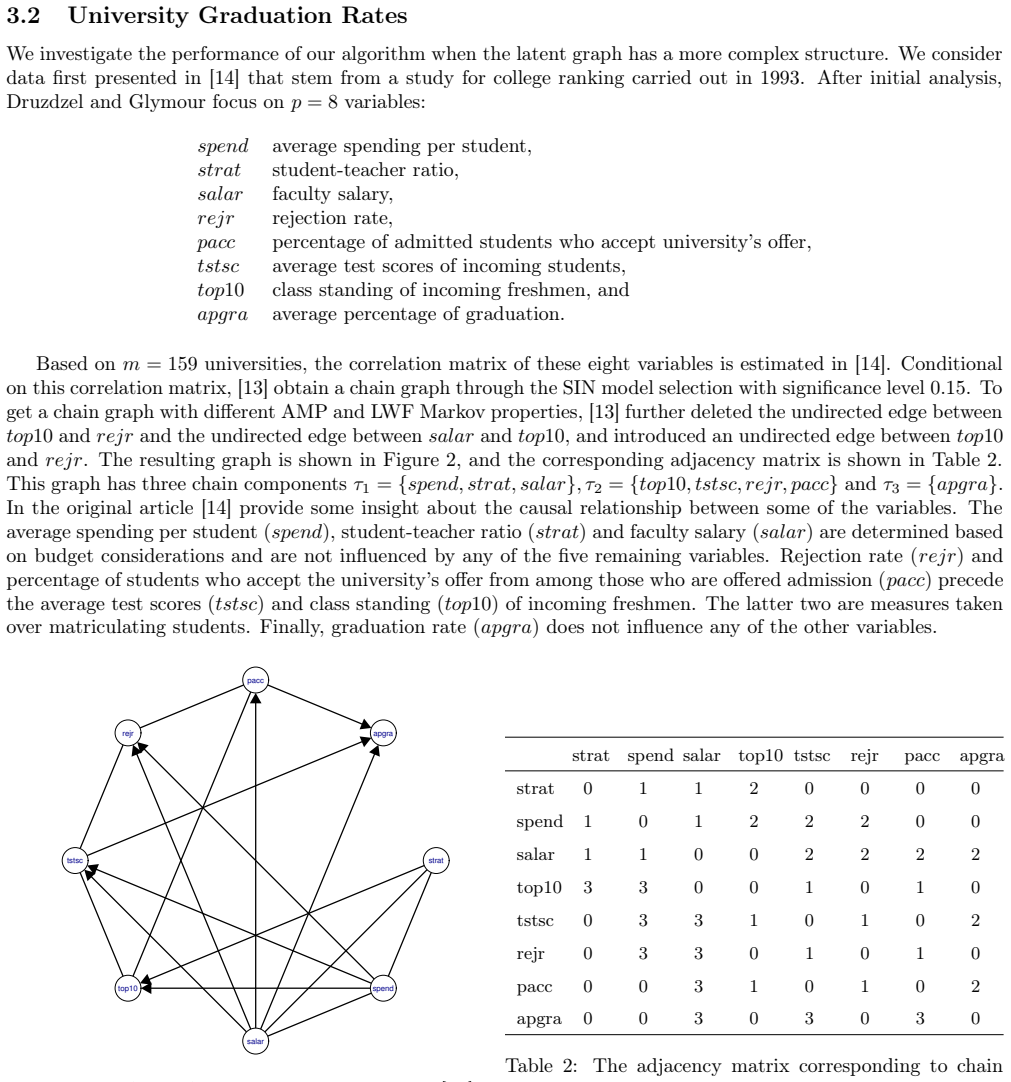
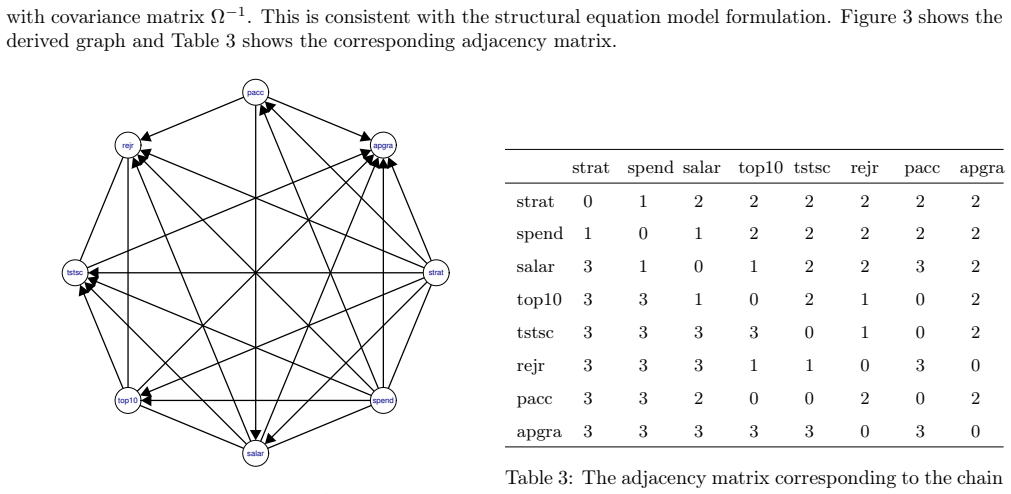
- [Section 3.2] Section 3.2: The informative prior α=(0.39,0.25,0.36,0.05) is constructed by matching the empirical edge-type frequencies in Figure 2 of [13], and the posterior graph obtained under this prior is then compared with Figure 2. As the authors acknowledge, this prior 'forces the posterior distribution of the edges to be similar to Figure 2.' The agreement with Figure 2 is therefore not independent evidence of the method's graph-recovery performance. The comparison is also used to argue that the algorithm can 'take advantage of available prior information and perform better'; this can only be evaluated with a prior that is not derived from the target graph. Please re-run the graduation case with a prior constructed independently of Figure 2, or explicitly frame the informative-prior result as a prior-predictive check rather than as validation.
- [Section 3.1] Section 3.1: The only simulation experiment is a single dataset generated from an empty graph with p=10, m=100. No repeated replicates, random seeds, standard errors, or alternative methods are reported, and the estimated posterior probabilities in Table 1 vary between 0.738 and 0.952 with no uncertainty quantification. The statement that the algorithm 'is able to recover the structure of the graph' is based on one run and, as reported, could be a favorable draw. The paper should report repeated simulation summaries (mean/range of posterior probabilities, graph recovery rates, Hamming distances) and, ideally, a nonempty graph with a known chain structure, before claiming that performance is 'stable and robust.'
- [Section 2.3] Section 2.3: The initialization step requires exact i.i.d. sampling from π0, but the only description is 'one simulates exactly from π0 using rejection sampling.' No proposal distribution, acceptance-rate calculation, or algorithm is given. The graph prior is proportional to a product over edges times an indicator of the AMP chain-graph constraint; for p=10 with α=(3,1,1,1) this may be feasible, but the authors themselves state in Section 4 that the sampler 'is not suitable when the number of nodes p is large, as the initializing step is difficult.' Because every particle is initialized this way, the method's feasibility and reproducibility depend on details that are currently missing. Please provide the rejection-sampling algorithm and report its acceptance rate in the experiments.
- [Sections 3.2-3.3] Sections 3.2 and 3.3: The graph estimate is formed by taking the elementwise posterior mode over each unordered pair, a_ij = arg max_k P(a_ij=k|y,α). Because the posterior support is the set of AMP chain graphs, an elementwise mode can in principle fall outside that support, for example by producing a semi-directed cycle. The paper does not verify that the reported point estimates in Figures 4 and 5 are valid chain graphs. The authors should either prove that elementwise modes preserve the chain-graph property, or compute a jointly coherent posterior mode under the validity constraint.
minor comments (4)
- [Section 2.1] There is a typo in Section 2.1: 'AMP Markox property' should be 'AMP Markov property.'
- [Section 3.3] Table cross-references in Section 3.3 are inconsistent: the SEM summary is called Table 7 but appears as Table 6, and the modification indices are called Table 5 but appear as Table 7. Please renumber the tables and update all references.
- [Algorithm 1] The adaptive tempering schedule is not described; the text only cites [37] for the choice of {φ_t} and [15] for the kernel parameters. A reader cannot reproduce the algorithm without consulting these references. Please state the schedule or give the adaptive rule explicitly.
- [General] No code, seeds, or running-time details are provided, so the numerical results in Sections 3.1-3.3 are not directly reproducible as reported.
Circularity Check
One circular validation: the informative prior is built from the target graph and then compared to that same graph; the central SMC methodology itself is independently tested.
-
fitted input called prediction
[Section 3.2, University Graduation Rates (Dirichlet prior specification and Figure 4 discussion)]
"we first consider a prior based on the analysis of [13], i.e., choosing α = (0.39, 0.25, 0.36, 0.05) by matching the probabilities of each type of edges in Figure 2 ... This is not surprising since the prior with α = (0.39, 0.25, 0.36, 0.05) is very informative and forces the posterior distribution of the edges to be similar to Figure 2."
The informative prior hyperparameter α is computed from the exact edge-type frequencies of the target graph in Figure 2, and then the posterior estimate obtained under that prior is compared with Figure 2 as evidence that the algorithm recovers the structure. Because the prior is concentrated on the very graph used in the comparison, agreement with Figure 2 is partly imposed by construction rather than independently confirmed. The paper explicitly concedes that this prior 'forces the posterior distribution of the edges to be similar to Figure 2.' This is a fitted-input-called-prediction pattern: the target graph is used to build the prior, and the same target is then quoted as the recovery result.
full rationale
The central contribution is an adaptive SMC sampler for Bayesian inference over latent AMP chain graphs, and the core algorithm is presented independently of the disputed validation: the likelihood is derived from the AMP chain graph factorization, the priors are specified on graphs, B, and Omega, and the simulation study generates data from an empty graph without using the target structure in the prior. The informative-prior comparison in Section 3.2 is the one genuinely circular step: α=(0.39,0.25,0.36,0.05) is calibrated to the edge counts of Figure 2, and the posterior under that prior is then compared to Figure 2 as if it were an external benchmark. The paper's own sentence that the prior 'forces the posterior distribution of the edges to be similar to Figure 2' makes the reduction explicit. Other self-citations, such as using [10], [15], and [5] for the SMC framework, are not load-bearing in a circular sense: they refer to established algorithmic results, and the model-specific kernel and target distributions are developed here. The appendix's omission of the explicit Metropolis-Hastings acceptance ratio for the dimension-changing graph moves is a serious verifiability/correctness concern, but it is not a circularity: it does not make the derivation equivalent to its inputs. Overall, the paper has one circular validation episode in the graduation-rates example, while the core method has independent empirical content, so a moderate score of 4 is appropriate.
Assumptions & free parameters
free parameters (5)
- Dirichlet prior alpha (simulation) =
(3, 1, 1, 1)
- Dirichlet prior alpha (graduation informative) =
(0.39, 0.25, 0.36, 0.05)
- Dirichlet prior alpha (connection favoring) =
(1, 3, 3, 3)
- G-Wishart prior parameters delta, D =
delta=3, D=I_p
- B prior parameters xi, kappa =
xi=0, kappa=1
assumptions (6)
- domain assumption The AMP chain graph likelihood factorizes as a product over chain components, with each component conditionally Gaussian given its parents.
- domain assumption Observations y1:m are i.i.d. given (B, Omega, A).
- standard math The prior p(Omega,B|A) can be used as an unnormalized density in the posterior; the normalizing constant does not affect SMC weight ratios.
- ad hoc to paper Exact sampling from pi0 by rejection sampling is feasible.
- standard math Convergence of the adaptive SMC sampler follows from Beskos, Jasra, Kantas and Thiery (2016).
- ad hoc to paper Each Metropolis-Hastings kernel Kt has pi_t as an invariant distribution.
Cite this review
Pith. "Pith review of Bayesian Inference for Latent Chain Graphs." pith.science (2026). https://pith.science/paper/JAYIXRH3
@misc{pith2026190804002,
  author       = {Pith},
  title        = {Pith review of: Bayesian Inference for Latent Chain Graphs},
  year         = {2026},
  howpublished = {\url{https://pith.science/paper/JAYIXRH3}},
  note         = {Machine review of arXiv:1908.04002}
}
read the original abstract
In this article we consider Bayesian inference for partially observed Andersson-Madigan-Perlman (AMP) Gaussian chain graph (CG) models. Such models are of particular interest in applications such as biological networks and financial time series. The model itself features a variety of constraints which make both prior modeling and computational inference challenging. We develop a framework for the aforementioned challenges, using a sequential Monte Carlo (SMC) method for statistical inference. Our approach is illustrated on both simulated data as well as real case studies from university graduation rates and a pharmacokinetics study.
Figures

Figures from the paper (2 more)


Reference graph
Works this paper leans on
-
[28]
Sil v a, R. (2013). A MCMC Approach for Learning the Structure of Gaussian Acyclic Directed Mixed Graphs. In Giudici,P., Ingrassia, S. & Vichi, M. (Eds)Statistical Models for Data Analysis, pp. 343–351, Springer: New York
work page 2013
-
[32]
W ang, H. (2015). Scaling It Up: Stochastic search structure learning in graphical models.Bayes. Anal., 10, 351-377
work page 2015
-
[13]
Drton, M. &Eichler, M. (2006). Maximum Likelihood Estimation in Gaussian Chain Graph Models under the Alternative Markov Property,Scand. J. Statist., 33, 247–257
work page 2006
-
[1]
Abdool, K. Q., Abdool, K. S. S.,Frohlich, J. A.,et al. (2010). Effectiveness and safety of tenofovir gel, an antiretroviral microbicide, for the prevention of HIV infection in women.Science, 329, 1168-1174
work page 2010
-
[2]
Andersson, S. A.,Madigan, D. &Perlman, M. D. (2001). Alternative Markov properties for chain graphs. Scand. J. Statist.28, 33-85
work page 2001
-
[3]
Anton, P. A.,Cranston, R. D.,Kashuba, A.,Hendrix, C. W.,Bumpus, N. N.,Harman, N. R.,Elliott, J., Janocko, L., Khanukhov a, E., Dennis, R., Cumberland, W. G., Ju, C., Dieguez, A. C., Mauck, C., & McGow an, I. (2012). RMP-02/MTN-006: A phase rectal safety, acceptability, pharmacokinetic, and pharmacodynamic study of tenofovir1% gel compared with oral tenofo...
work page 2012
-
[4]
M., Donnell, D., Ndase, P., et al
Baeten, J. M., Donnell, D., Ndase, P., et al. (2012). Antiretroviral prophylaxis for HIV prevention in heterosexual men and women.N Engl J Med, 367, 399-410
work page 2012
-
[5]
Beskos, A., Jasra, A., Kantas, N. &Thiery, A. (2016). On the convergence of adaptive sequential Monte Carlo. Ann. Appl. Probab., 26, 1111-1146
work page 2016
Show all 37 references
-
[6]
C.,Lombarts, K
Boerebach, B. C.,Lombarts, K. M.,keijzer, C., Heineman, M. J., &Arah. O. A. (2012). The teacher, the physician and the person: how faculty’s teaching performance influences their role modeling.PLoS One 7:e32089. doi:10.1371/journal.pone.0032089
2012 doi
-
[7]
(1989).Structural Equation Models with Latent Variables
Bollen, K. (1989).Structural Equation Models with Latent Variables. Wiley: New York
1989
-
[8]
Car v alho, C. M. &West, M. (2007). Dynamic Matrix-Variate Graphical Models.Bayesian Anal., 2, 69-98
2007
-
[9]
& Zhao, H
Chun, H., Zhang, X. & Zhao, H. (2015). Gene regulation network inference with joint sparse Gaussian graphical models.J. Comp. Graph. Statist., 24, 954-974
2015
-
[10]
&Jasra, A
Del Moral, P.,Doucet, A. &Jasra, A. (2006). Sequential Monte Carlo samplers.J. Roy. Statist. Soc. Ser. B, 68, 411-436
2006
-
[11]
R., Yao, G
Dobra, A., Hans, C., Jones, B., Nevins, J. R., Yao, G. & West, M. (2004). Sparse graphical models for exploring gene expression data.J. Mult. Anal., 90, 196-212
2004
-
[12]
& Perlman, M
Drton, M. & Perlman, M. D. (2004). A SINful approach to Gaussian graphical model selection. Technical Report 457, University of Washington
2004
-
[14]
J &Glymour, C
Druzdel, M. J &Glymour, C. (1999). Causal inferences from databases: why universities lose students. In Computation, causation, and discovery(eds C. Glymour & G. F. Cooper), Chapter 19, 521-539. AAAI Press, Menlo Park, CA
1999
-
[15]
A., Doucet, A
Jasra, A., Stephens, D. A., Doucet, A. & Tsagaris, T. (2011). Inference for Lévy driven stochastic volatility models via adaptive sequential Monte Carlo.Scand. J. Statist., 38, 1–22
2011
-
[16]
G., &Hudson, J
Kanayama, G., Pope, H. G., &Hudson, J. I. (2018). Associations of anabolic-androgenic steroid use with other behavioral disorders: an analysis using directed acyclic graphs.Psychol Med, 48, 2601-2608
2018
-
[17]
&Wermuth, N
Lauritzen, S.L. &Wermuth, N. (1984).Mixed interaction models.Institut for Elektroniske Systemer, Aal- borg Universitetscenter
1984
-
[18]
&Spiegelhalter, D
Lauritzen, S.L. &Spiegelhalter, D. J. (1988). Local computations with probabilities on graphical struc- tures and their applications to expert systems (with discussion).J. R. Statist. Soc. B, 50, 157-224
1988
-
[19]
Lauritzen, S. L. &Wermuth, N. (1989). Graphical models for association between variables, some of which are qualitative and some quantitative.Ann. Statist. 17, 31-57
1989
-
[20]
&Richardson, T.S
Lauritzen, S.L. &Richardson, T.S. (2002). Chain graph models and their causal interpretations.Journal of the Royal Statistical Society: Series B (Statistical Methodology), 64(3), 321–348. 14
2002
-
[21]
&Dobra, A
Lenkoski, A. &Dobra, A. (2011). Computational aspects related to inference in Gaussian graphical models with the G-Wishart prior.Journal of Computational and Graphical Statistics, 20(1), 140–157
2011
-
[22]
&Madigan, D
Levitz, M., Perlman, M.D. &Madigan, D. (2001). Separation and completeness properties for AMP chain graph Markov models.Annals of statistics, 1751–1784
2001
-
[23]
& Kim, S
McCarter, C. & Kim, S. (2014). On sparse Gaussian chain graph models.Advances in Neural Information Processing Systems (NIPS)
2014
-
[24]
Pearl, J. (1986). A constraint propagation approach to probabilistic reasoning.Kanal, L. M. &Lemmer, J., Eds.Uncertainty in Artificial Intelligence, North-Holland, Amsterdam, 357-370
1986
-
[25]
(2014).Probabilistic reasoning in intelligent systems: networks of plausible inference.Elsevier
Pearl, J. (2014).Probabilistic reasoning in intelligent systems: networks of plausible inference.Elsevier
2014
-
[26]
Pena, J.M. (2014). Learning marginal AMP chain graphs under faithfulness. InEuropean Workshop on Prob- abilistic Graphical Models(82–395). Springer, Cham
2014
-
[27]
W.,Bumpus, N
Richardson-Harman, N., Hendrix, C. W.,Bumpus, N. N.,Mauck, C., Cranston, R. D.,Yang, K., El- liott, J., Tanner, K., &McGow an, I. (2014). Correlation between compartmental tenofovir concentrations and an ex vivo rectal biopsy model of tissue infectibility in the RMP-02/MTN-006...
2014
-
[29]
& Ghahramani, Z
Sil v a, R. & Ghahramani, Z. (2009). The Hidden Life of Latent Variables: Bayesian learning with mixed graph models.J. Mach. Learn. Res., 10, 1187–1238
2009
-
[30]
&Pena, J.M
Sonntag, D. &Pena, J.M. (2016). On expressiveness of the chain graph interpretations.International Journal of Approximate Reasoning, 68, 91–107
2016
-
[31]
Jasra, A., De Iorio, M & Ebbels, T
Tan, L. Jasra, A., De Iorio, M & Ebbels, T. (2017). Bayesian Inference for multiple Gaussian graphical models. Ann. Appl. Stat., 11, 2222-2251
2017
-
[33]
&Car v alho, C
W ang, H., Reesony, C. &Car v alho, C. M. (2011). Dynamic financial index models: modeling conditional dependencies via graphs.Bayesian Anal., 6, 639-664
2011
-
[34]
Wermuth, N. (1980). Linear recursive equations, covariance selection and path analysis.J. Am. Statist. Assoc, 75, 963-972
1980
-
[35]
& Lauritzen, S
Wermuth, N. & Lauritzen, S. L. (1990). On substantive research hypotheses, conditional independence graphs and graphical chain models (with discussion).J. Roy. Statist. Soc. Ser. B52, 21-72
1990
-
[36]
H.,Hendrix, H.,Bumpus, N.,Elliott, J.,et
Yang, K. H.,Hendrix, H.,Bumpus, N.,Elliott, J.,et. al. (2014). A multi-compartment single and multiple dose pharmacokinetic comparison of rectally applied tenofovir1% gel and oral tenofovir disoproxil fumarate. PLOS One9, e106196
2014
-
[37]
Zhou, Y., Johansen, A. M. &Aston, J. A. (2016). Towards Automatic Model Comparison: An Adaptive Sequence Monte Carlo Approach.J. Comp. Graph. Statist., 25, 701-726. 15
2016
Reviewed August 14, 2026 · model on record in the stance chip above.
Discussion (0). Continue with ORCID to comment.