REVIEW 2 major objections 4 minor 18 references
Some Algebraic Properties of Sierpi\'nski-Type Graphs
T0 review · 2 major / 4 minor · reviewed 2026-08-14 · deepseek-v4-flash
Pith's one-line read The paper proves that the regular generalized Sierpiński graph $S^{++}(n,k)$ is a Cayley graph exactly when $n=1$, $k\le 2$, or $n=2$ with $k+1$ a prime power.
desk verdict A solid, self-contained contribution to Sierpiński-type graphs: clean spectrum recursion, a full Cayley classification, and new non-Cayley numbers; one unproved but fillable cut-vertex claim is the main soft spot. read the letter →
The pith
A machine-rendered reading of the paper's core claim, the machinery that carries it, and where it could break.
The reading
What carries the argument
The central object is the recursion $S^{++}(n+1,k)\cong L(S(S^{++}(n,k)))$, where $S(\Gamma)$ is the graph obtained by inserting a new vertex into every edge of $\Gamma$ and $L(\Gamma)$ is the line graph whose vertices are the edges of $\Gamma$. This identity converts the characteristic polynomial into a composition: $P_n(x)=(x(x+2))^{k^{n-2}(\binom{k}{2}-1)}P_{n-1}(f(x))$, with $f(x)=x^2+(2-k)x-k$, so every eigenvalue of $S^{++}(n,k)$ is a nested-radical expression built from iterates $f^j$. For the Cayley classification, the load-bearing tool is the notion of a strongly $\Delta$-partitioned graph: a graph whose vertices are partitioned by copies of $\Delta$ and which contains no further copies of $\Delta$. Applied to a Cayley graph, this forces the copies to be cosets of a subgroup; in the case $n=2$ the copies are complete graphs, and a Frobenius-group argument forces the order of each copy plus one, $k+1$, to be a prime power.
What would settle it
A computer search over all groups of order 30 for a connection set whose Cayley graph is isomorphic to $S^{++}(2,5)$ would settle the classification in this case; the theorem predicts no such Cayley presentation exists.
Extended reading notes
Core claim
The paper's main discovery is Theorem 14: $S^{++}(n,k)$ is a Cayley graph if and only if $n=1$, $k\le 2$, or $n=2$ and $k+1$ is a prime power. The 'if' direction is constructive: when $k+1=q$ is a prime power, $S^{++}(2,q-1)$ is shown to be the Cayley graph of the one-dimensional affine group $\mathbb{F}_q^*\ltimes\mathbb{F}_q$ with connection set $\{(x,0): x\neq 1\}\cup\{(-1,-1)\}$. The 'only if' direction combines two structural facts: for $n\ge 3, k\ge 3$ the graph is not even vertex-transitive, and for $n=2$ a strongly-partitioned Cayley graph argument forces $k+1$ to be a prime power. Along the way the paper proves that $S^{++}(n+1,k)$ is the line graph of the subdivision graph of $S^{++}(n,k)$, which yields the spectrum recursion $P_n(x)=(x(x+2))^{k^{n-2}(\binom{k}{2}-1)}P_{n-1}(f(x))$ with $f(x)=x^2+(2-k)x-k$. The paper also determines the Laplacian spectrum of $S(2,k)$ and conjectures an explicit formula for $S(n,k)$.
Load-bearing premise
The only-if direction of the classification for $n\ge 3$, $k\ge 3$ rests on the assertion, stated without full proof, that in the subgraph of vertices within three steps the vertex $(1,\dots,1,1)$ is a cut vertex while $(1,\dots,1,2)$ is not; if that distinction fails, these graphs might still be vertex-transitive and the non-Cayley conclusion for them loses its support.
Editorial extensions
If this is right
- For every $k\ge 3$ with $k+1$ not a prime power, $S^{++}(2,k)$ is a vertex-transitive graph that is not a Cayley graph; together with the $n\ge 3$, $k\ge 3$ cases, this gives a new infinite family of vertex-transitive non-Cayley graphs.
- Every integer $k(k+1)$ with $k(k+1)$ square-free and $k+1$ composite is a non-Cayley number, so the known list of non-Cayley numbers grows; the paper identifies eight new examples below $10^8$.
- The spectrum of $S^{++}(n,k)$ is fully determined by iterates of the single polynomial $f(x)=x^2+(2-k)x-k$, so all eigenvalues are obtained as nested radicals without diagonalizing large matrices.
- The Laplacian spectrum of $S(2,k)$ is explicitly known, and the conjecture that the same formula holds for all $S(n,k)$ gives a concrete prediction to test.
- The density calculation says the set of $k$ for which $k(k+1)$ is a new non-Cayley number has asymptotic density about $0.3226$, so these numbers are not rare.
Reading between the lines
- The same Frobenius-group obstruction may explain non-Cayley-ness in other recursively defined graph families built from complete graphs; comparing the paper's example of $SP_1(C_4)$ for order $20$ with the case where the number of copies plus one is composite could reveal whether the prime-power condition is a general structural principle.
- The iterated-polynomial form of the spectrum suggests that as $n$ grows, the spectral distribution of $S^{++}(n,k)$ may converge to the equilibrium measure of the Julia set of $f(x)=x^2+(2-k)x-k$; a numerical study of the empirical eigenvalue distribution for moderate $n$ could test this.
- If the Laplacian conjecture is correct, the heat-kernel and random-walk return probabilities on Sierpiński gasket graphs have a closed form in terms of iterates of $f$, which would give a concrete tool for diffusion models on these fractal networks.
Signed reviews
Editorial analysis
A structured set of objections, weighed in public.
Referee Report
Summary. The paper studies the Sierpiński graphs S(n,k) and the regularized family S++(n,k). In Section 2 the authors derive a recursive formula for the characteristic polynomial of S++(n,k) via the relation S++(n+1,k) ≅ L(S(S++(n,k))), and from it obtain the full spectrum of S++(n,k). Section 3 determines the Laplacian spectrum of S(2,k), verifies the resulting conjecture for k=2,3 and n=2, and states a general conjecture for the Laplacian spectrum of S(n,k). Section 4 characterizes the vertex-transitive graphs in the family (Proposition 9) and then classifies which S++(n,k) are Cayley graphs: they are Cayley exactly when n=1, k≤2, or n=2 and k+1 is a prime power (Theorem 14). As a by-product, the authors obtain new vertex-transitive non-Cayley graphs and a positive-density family of non-Cayley numbers.
Significance. If the main results are correct, Theorem 14 is a complete classification of the Cayley graphs in a substantial infinite family, and it supplies a new infinite family of vertex-transitive non-Cayley graphs and new square-free non-Cayley numbers. The proof strategy is attractive: the spectral recursion via incidence matrices and line graphs is elegant, and the Cayley characterization via Frobenius groups is a genuine structural use of group theory. The paper is largely self-contained and the arguments rely only on standard external results (McKay-Praeger, Ricci, Frobenius). The explicit Cayley construction for the prime-power case and the density computation for non-Cayley numbers are concrete and checkable. The main issues are two proof gaps, one in the load-bearing Proposition 9 and one in the proof of Theorem 4, both of which appear fixable without changing the stated results.
major comments (2)
- [Section 4, Proposition 9] The assertion that for n≥3, k≥3 the vertex u=(1,...,1,1) is a cut vertex of the induced subgraph on B(u,3) while v=(1,...,1,2) is not is stated only as "It can be seen" and is not proved. This claim is load-bearing: it is the only reason given for non-vertex-transitivity of S++(n,k) for n≥3, k≥3, and therefore for the only-if direction of Theorem 14 for those parameters. The assertion appears true, and a proof can likely be supplied by distance arguments (every path from a neighbor of u outside its copy to B(u,3) that avoids u must pass through vertices at distance at least 4 from u, while v admits an explicit alternate path inside B(v,3)), but as written the paper does not establish it. The authors should provide a complete proof or a precise reference.
- [Section 3, Theorem 4] In the proof of Theorem 4, after showing that (L^2-(k+2)L+kI)(QB-BQ)=0, the text states that every vector in the column space of QB-BQ is an eigenvector of L with eigenvalue satisfying λ^2-(k+2)λ+k=0. This does not follow: a nonzero vector w with p(L)w=0 for a quadratic polynomial p need not be an eigenvector. The intended conclusion can be obtained because the column space W is L-invariant and p is irreducible over Q, so the minimal polynomial of L restricted to W is p and W decomposes into the two eigenspaces, each of dimension k-1; this argument should be stated explicitly. As written, the multiplicity conclusion for the two roots is not fully justified.
minor comments (4)
- [Section 1] In the last paragraph of the introduction, "non-Calyley" should be "non-Cayley".
- [Section 4, Proposition 9] In the proof of Proposition 9, "vertices at distance at most 3 form u" should read "from u", and similarly for v.
- [Section 5] In the final paragraph, "leass than or equal to" should be "less than or equal to".
- [Theorem 19] The title of Theorem 19 says the density is "about 0.3226", while the proof actually obtains the exact value 2C_FT-1 ≈ 0.3226340989; it would be clearer to state the exact density in the theorem and reserve the approximation for the text.
Circularity Check
No circularity: spectral and Cayley classifications are derived in-paper from explicit isomorphisms, determinant identities, and external standard theorems; the one unproved cut-vertex assertion is a proof gap, not a circular reduction.
full rationale
The paper's main claims are self-contained derivations against external benchmarks. The spectrum of S++(n,k) (Theorem 2) follows from the explicitly proved isomorphism S++(n+1,k) ≅ L(S(S++(n,k))) (Lemma 1) together with standard incidence-matrix identities (1), (2), (3), (4); no parameter is fitted to the target spectrum. The Laplacian spectrum of S(2,k) (Theorem 4) is computed directly via the commutation matrix and eigenspace dimension counting; the general formula is explicitly labeled Conjecture 5, not asserted as a derived prediction. The Cayley classification (Theorem 14) is built from Proposition 9, Proposition 10, Lemma 11, and Theorem 13, each proved in the paper using standard group theory (Frobenius groups, Robinson [17]) and elementary graph arguments. The sufficiency direction is an explicit construction of Cay(G,C) for the one-dimensional affine group, and necessity reduces to Theorem 13, whose proof is internal and does not import the conclusion. Proposition 9's assertion that u=(1,...,1,1) is a cut vertex of its 3-ball while v=(1,...,1,2) is not, stated as 'It can be seen,' is indeed load-bearing but is an unproved local graph claim, not a reduction of the conclusion to the hypothesis; a gap in proof detail is a correctness concern, not circularity. External results are used only for background: McKay-Praeger for non-Cayley number classifications, Dobson-Spiga for Cayley numbers, and Ricci's density theorem for the square-free density; none supplies the paper's target conclusions by renaming. No self-citation chain appears, and no fitted input is called a prediction. Honest finding: no significant circularity.
Assumptions & free parameters
assumptions (8)
- standard math Incidence matrix identities X(Γ)^T X(Γ)=2I+A(L(Γ)) and X(Γ)X(Γ)^T=kI+A(Γ) for k-regular Γ.
- standard math Determinant identities for block matrices and for products M M^T versus M^T M.
- standard math Frobenius theorem: a Frobenius group with complement H has a normal kernel N = G \ union of conjugates of H\{1}.
- standard math The Frobenius kernel is nilpotent and its characteristic subgroups inherit normality.
- standard math Ricci's theorem on the asymptotic density of k-free values of polynomials.
- domain assumption Known classifications of Cayley numbers: McKay-Praeger for non-square-free numbers and Iranmanesh-Praeger plus Dobson-Spiga for products of primes.
- domain assumption The Grigorchuk-Šunić spectrum of the Hanoi Towers Schreier graph implies the Laplacian spectrum of S(n,3).
- domain assumption Every edge of S(n-1,k) for k≥3 lies on a cycle.
Cite this review
Pith. "Pith review of Some Algebraic Properties of Sierpi\'nski-Type Graphs." pith.science (2026). https://pith.science/paper/WJQPWZ6G
@misc{pith2026190804037,
  author       = {Pith},
  title        = {Pith review of: Some Algebraic Properties of Sierpi\'nski-Type Graphs},
  year         = {2026},
  howpublished = {\url{https://pith.science/paper/WJQPWZ6G}},
  note         = {Machine review of arXiv:1908.04037}
}
read the original abstract
This paper deals with some of the algebraic properties of Sierpi\'nski graphs and a family of regular generalized Sierpi\'nski graphs. For the family of regular generalized Sierpi\'nski graphs, we obtain their spectrum and characterize those graphs that are Cayley graphs. As a by-product, a new family of non-Cayley vertex-transitive graphs, and consequently, a new set of non-Cayley numbers are introduced. We also obtain the Laplacian spectrum of Sierpi\'nski graphs in some particular cases, and make a conjecture on the general case.
Figures

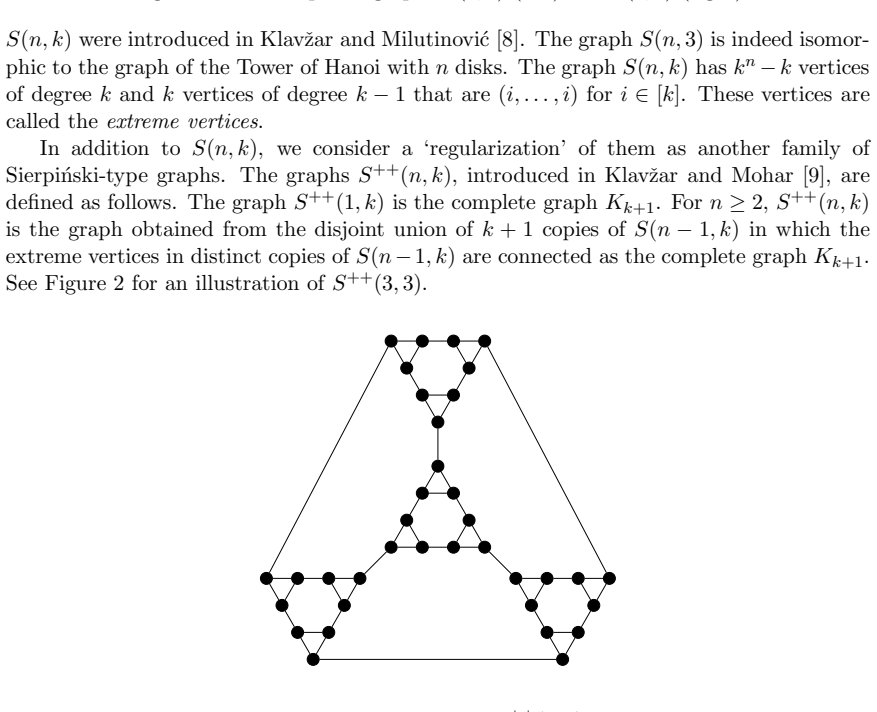
Reference graph
Works this paper leans on
-
[1]
L. Barri` ere, F. Comellas, and C. Dalf´ o, Fractality and the small-world effect in Sier- pinski graphs, J. Phys. A 39 (2006), 11739–11753
work page 2006
-
[2]
D. M. Cvetkovi´ c, M. Doob, and H. Sachs, Spectra of Graphs, Theory and Applications , Third Edition, Johann Ambrosius Barth, Heidelberg, 1995
work page 1995
-
[3]
T. Dobson and P. Spiga, Cayley numbers with arbitrarily m any distinct prime factors, J. Combin. Theory Ser. B 122 (2017), 301–310
work page 2017
-
[4]
S. R. Finch, Mathematical Constants , Encyclopedia of Mathematics and its Applica- tions, 94, Cambridge University Press, Cambridge, 2003
work page 2003
-
[5]
R. I. Grigorchuk and Z. ˇSuni´ c, Schreier spectrum of the Hanoi towers group on three pegs, Proc. Symp. Pure Math. 77 (2008), 183–198
work page 2008
-
[6]
A. M. Hinz, S. Klavˇ zar, and S. S. Zemljiˇ c, A survey and classification of Sierpi´ nski-type graphs, Discrete Appl. Math. 217 (2017), 565–600
work page 2017
-
[7]
M. A. Iranmanesh and C. E. Praeger, On non-Cayley vertex- transitive graphs of order a product of three prime, J. Combin. Theory Ser. B 81 (2001), 1–19
work page 2001
-
[8]
S. Klavˇ zar and U. Milutinovi´ c, Graphs S(n,k ) and a variant of the Tower of Hanoi problem, Czechoslovak Math. J. 47(122) (1997), 95–104
work page 1997
Show all 18 references
-
[9]
Klavˇ zar and B
S. Klavˇ zar and B. Mohar, Crossing numbers of Sierpi´ nski-like graphs, J. Graph Theory 50 (2005), 186–198
2005
-
[10]
J. R. Magnus and H. Neudecker, The commutation matrix: s ome properties and ap- plications, Ann. Statist. 7 (1979), 381–394
1979
-
[11]
Maruˇ siˇ c, Cayley properties of vertex symmetric graphs, Ars Combin
D. Maruˇ siˇ c, Cayley properties of vertex symmetric graphs, Ars Combin. 16B (1983), 297–302
1983
-
[12]
B. D. McKay and C. E. Praeger, Vertex-transitive graphs which are not Cayley graphs, I, J. Austral. Math. Soc. (A) 56 (1994), 53–63
1994
-
[13]
B. D. McKay and C. E. Praeger, Vertex-transitive graphs that are not Cayley graphs, II, J. Graph Theory 22(4) (1996), 321–334
1996
-
[14]
Pappalardi, A survey on k-freeness, Number Theory, Ramanujan Math
F. Pappalardi, A survey on k-freeness, Number Theory, Ramanujan Math. Soc. Lect. Notes Ser., vol. 1, Ramanujan Math. Soc. (2005), pp. 71–88. 15
2005
-
[15]
C. E. Praeger, C. H. Li, and A. C. Niemeyer, Finite transi tive permutation groups and finite vertex-transitive graphs, Graph Symmetry: Algebraic Methods and Applications, NATO Ser. C, 497, Kluwer Acad. Publ. (1997), pp. 277–318
1997
-
[16]
Ricci, Ricerche aritmetiche sui polinomi, Rend
G. Ricci, Ricerche aritmetiche sui polinomi, Rend. Circ. Mat. Palermo 57 (1933), 433– 475
1933
-
[17]
D. J. S. Robinson, A Course in the Theory of Groups , Second Edition, Spring-Verlag, New York, 1996
1996
-
[18]
M. A. Snyder, Chebyshev Methods in Numerical Approximation , Prentice-Hall, Inc., Englewood Cliffs, N. J. 1966. 16
1966
Reviewed August 14, 2026 · model on record in the stance chip above.
Discussion (0). Continue with ORCID to comment.