REVIEW 4 minor 1 cited by
Null-homologous twisting and the algebraic genus
T0 review · 0 major / 4 minor · reviewed 2026-08-14 · deepseek-v4-flash
Pith's one-line read This paper proves that null-homologous twisting changes algebraic genus by at most one in square cases, yielding new upper bounds on the topological slice genus of torus and satellite knots.
desk verdict The twisting technique and the main inequalities for Theorems 1 and 2 are solid and worth knowing, but the proof of the torus knot bound has a real off-by-one in Lemma 13 that leaves the headline 2/3 asymptotic unsupported as written. read the letter →
The pith
A machine-rendered reading of the paper's core claim, the machinery that carries it, and where it could break.
The reading
What carries the argument
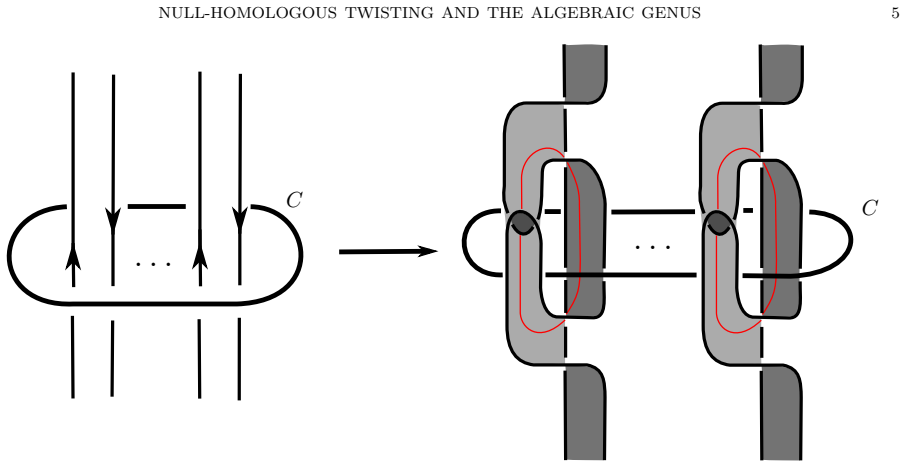
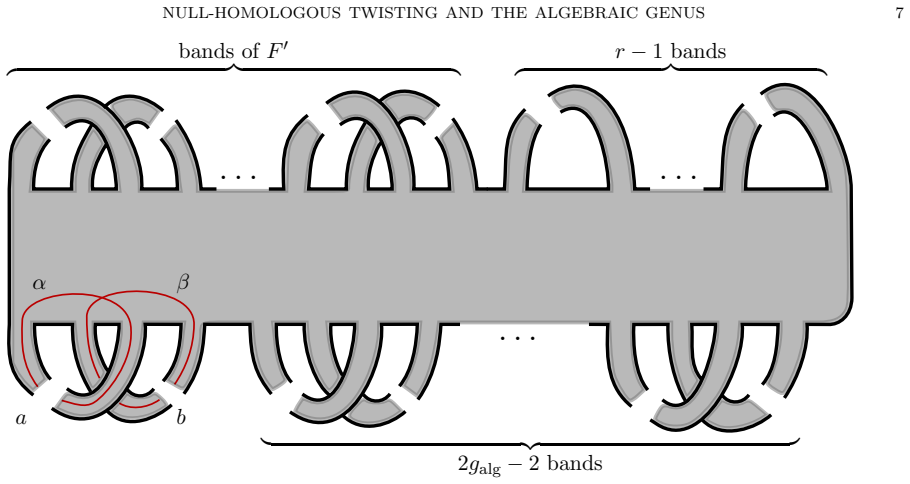
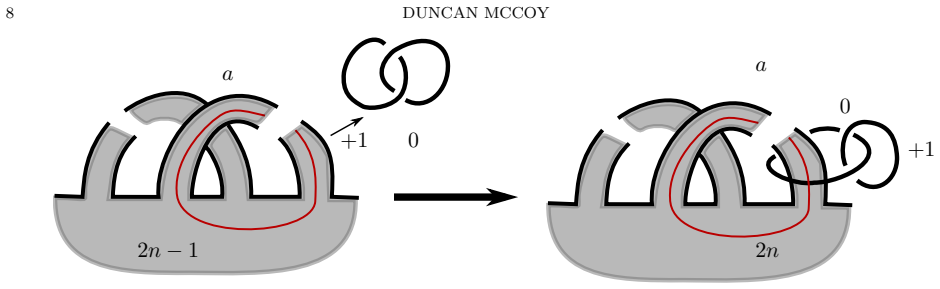
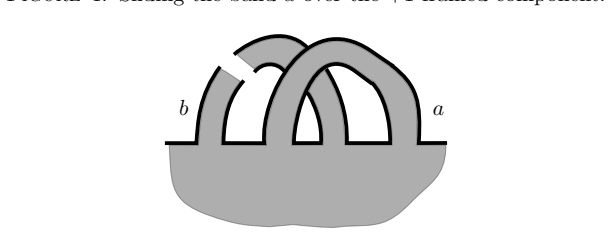
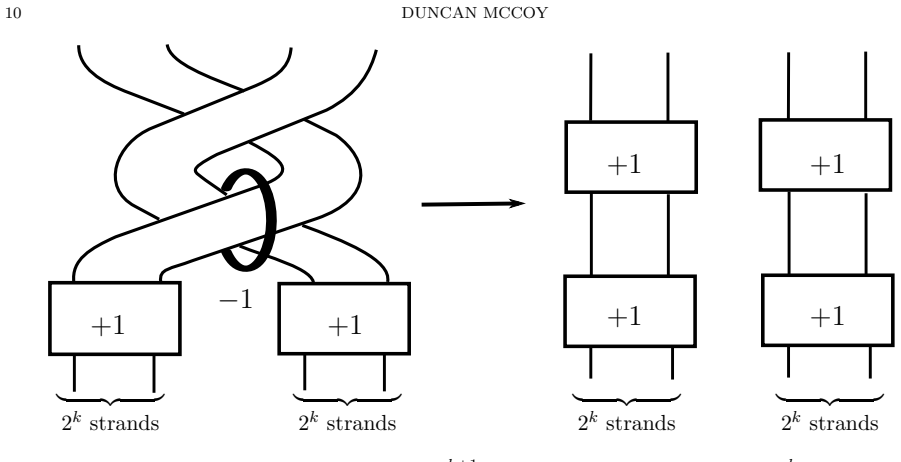
The load-bearing object is the null-homologous twist: an unknotted curve $C$ disjoint from the link with $\operatorname{lk}(C,L)=0$, on which a $1/n$-surgery is performed. The proof of Theorem 1 compares the Seifert matrices $M$ and $M'$ of the two links; when $-mn$ is a square, writing $m=-ax^2$ and $n=ay^2$ and stabilizing $M'$ by two extra basis vectors yields a matrix $M''$ such that an invertible integral matrix $P$ satisfies $P^T M'' P = M$ as an upper-left block, with two additional rows and columns. This shows the algebraic genus changes by at most one. For the torus-knot bound, the key recursion is that a full twist on $2k+1$ strands can be converted into four full twists on $2k$ strands using one null-homologous twist, giving $T_{k+1}\le 1+4T_k$, and the binary expansion of $p$ and $q$ decomposes $T_{p,q}$ into pieces $T_{2^a,2^b}$ whose algebraic genera are controlled by $2^{a+b}/3$.
What would settle it
Compute the algebraic genus of any torus knot, for example $T_{2^a,2^b}$, by exhaustive search over Seifert surfaces; if any value reaches or exceeds $pq/3 + p\log_2 q + q\log_2 p$, then Theorem 5 is false. Likewise, find two links that differ by a null-homologous $+1$-twist and a null-homologous $-1$-twist but whose algebraic genera differ by $2$; such a pair would refute Theorem 1.
Extended reading notes
Core claim
The central discovery is that null-homologous twisting pairs respect the algebraic genus up to a controlled error: if two links differ by a null-homologous $m$-twist and a null-homologous $n$-twist with $-mn$ a square, then their algebraic genera differ by at most one. From this, the paper derives a characterization of the algebraic genus as the minimum over ways of converting a link to an Alexander polynomial one link using $p$ null-homologous $+1$-twists and $n$ null-homologous $-1$-twists, namely $\min\max\{n,p\}$. Applying these operations to satellite knots gives $g_{\mathrm{alg}}(P(K)) \le g_{\mathrm{alg}}(P(U)) + g_{\mathrm{alg}}(K)$, independent of the pattern's winding number. For torus knots, a recursive untwisting argument yields $g_{\mathrm{alg}}(T_{p,q}) < pq/3 + p\log_2 q + q\log_2 p$, hence $g^{\mathrm{top}}_4(T_{p,q})$ satisfies the same bound, so the asymptotic ratio of topological to smooth slice genus for torus knots is at most $2/3$.
Load-bearing premise
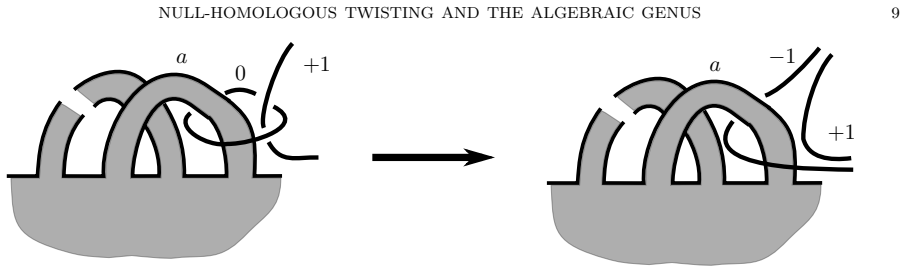
The proof of Theorem 1 requires that a Seifert surface realizing the algebraic genus can be stabilized and chosen so that it is disjoint from the two surgery curves, with the homology classes linking those curves represented by an unlink; this stabilization fact is quoted from earlier work.
Editorial extensions
If this is right
- For any integer $n$, a single null-homologous $n$-twist changes the algebraic genus by at most one, since $-n^2$ is a square.
- The algebraic genus equals the minimum over all ways of converting the link to an Alexander-polynomial-one link using $p$ null-homologous $+1$-twists and $n$ null-homologous $-1$-twists of $\max\{n,p\}$.
- For any satellite knot $P(K)$, the algebraic genus satisfies $g_{\mathrm{alg}}(P(K)) \le g_{\mathrm{alg}}(P(U)) + g_{\mathrm{alg}}(K)$, with no dependence on the winding number of the pattern.
- For any torus knot or link $T_{p,q}$ with $p,q>1$, both the algebraic genus and the topological slice genus are strictly less than $pq/3 + p\log_2 q + q\log_2 p$, giving an asymptotic ratio of topological to smooth slice genus at most $2/3$.
- If $-mn$ is not a square, the one-Lipschitz property can fail: there exist knots with algebraic genus and topological slice genus equal to $2$ that are unknotted by a null-homologous $m$-twist and a null-homologous $n$-twist.
Reading between the lines
- Editorial inference: Theorem 2 turns the algebraic genus into a search problem over ±1 null-homologous twists, so one could compute or bound it for small links by enumerating such twist sequences; the paper does not implement such a search.
- Editorial inference: If the algebraic genus also serves as a lower bound for topological slice genus in some families, the torus-knot bound would become an exact asymptotic statement; the paper only establishes upper bounds.
- Editorial inference: The winding-number independence of the satellite bound contrasts sharply with smooth slice genus behavior, suggesting a testable extension in which the topological slice genus of satellites might also satisfy a winding-number-independent subadditivity bound; the paper leaves this open.
Signed reviews
Editorial analysis
A structured set of objections, weighed in public.
Referee Report
Summary. The paper introduces null-homologous twisting operations as a tool for studying the algebraic genus $g_{alg}$. Theorem 1 states that performing an $m$-twist and an $n$-twist on null-homologous curves changes $g_{alg}$ by at most $1$ whenever $-mn$ is a square; the proof gives an explicit Seifert-matrix congruence. Theorem 2 characterizes $g_{alg}(L)$ as the minimal maximum number of $+1$- and $-1$-null-homologous twists needed to reach a link of algebraic genus zero. Theorem 4 gives the satellite bound $g_{alg}(P(K)) \le g_{alg}(P(U)) + g_{alg}(K)$, attributed to Feller-Miller-Pinzon-Caicedo. Theorem 5 proves $g_{top}^4(T_{p,q}) \le g_{alg}(T_{p,q}) < pq/3 + p\log_2 q + q\log_2 p$, improving the known asymptotic upper bound on $g_{top}^4/g_4$ for torus knots from below $3/4$ to at most $2/3$. Proposition 3 shows the square condition in Theorem 1 is sharp.
Significance. The main contribution is a new, explicit mechanism---null-homologous twisting---for bounding the algebraic genus. If correct, Theorem 5 improves the previously known asymptotic upper bound for torus knots, and the proof is largely parameter-free: Theorem 1 is a concrete matrix identity, Lemma 13 is a counting argument for full twists, and no fitted constants appear. The paper is also careful with attribution: the satellite upper bound is credited to FMPC19 rather than claimed as new. The main results have checkable, local proofs and should be of interest to knot theorists and 4-manifold topologists. I also checked the apparent off-by-one in Lemma 13 raised in the stress-test note; with the exponents read as $2^{k+1}$ and $2^k$, the recurrence is exactly what the geometry in Figure 7 supports, so I do not regard that concern as a real flaw.
minor comments (4)
- [§5 (proof of Theorem 5)] Inequality (3) has the two logarithms swapped: since $q$ is a sum of $k+1$ powers of two, one has $k\le \log_2 q$, and similarly $l\le \log_2 p$. With this correction, the final estimate $ql+pk\le q\log_2 p + p\log_2 q$ gives exactly the stated bound; as printed, the displayed inequalities would not yield the theorem's conclusion.
- [§5 (Lemma 13)] The argument is correct if the notations '2k+1 strands' and '2k strands' are typeset as $2^{k+1}$ and $2^k$ strands; then a full twist on $2^{k+1}$ strands is converted into four full twists on $2^k$ strands by one null-homologous twist, yielding $T_{k+1}\le 1+4T_k$. Please ensure the superscripts are not lost in the final version, since a reader seeing $2k+1$ could otherwise infer an off-by-one recurrence.
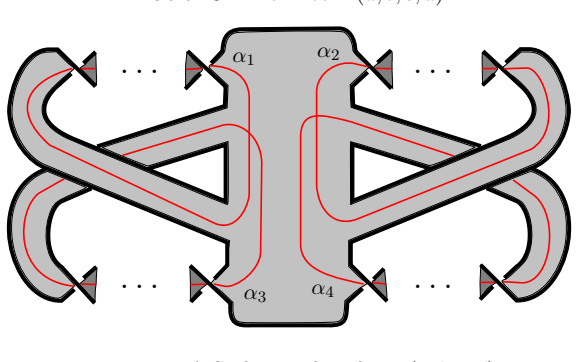
- [§6 (proof of Proposition 3)] In the displayed quadratic form (6), the coefficient of $x_4^2$ should be $d$, not $c$, to match the Seifert matrix (5) and the diagonalization (7).
- [§2 (proof of Theorem 1)] The assertion that one can choose a diagram so that Seifert's algorithm gives a surface disjoint from the surgery curves with the relevant homology classes forming an unlink is only justified by Figure 2; a short explanatory sentence describing the construction would make this load-bearing step easier to verify.
Circularity Check
No circularity: the derivation is self-contained and rests on independent prior results.
full rationale
The paper's central claims are proved from Seifert-form comparisons, band moves, and explicit twisting diagrams, not by fitting parameters or renaming inputs. Theorem 1 is proven directly by comparing Seifert matrices before and after null-homologous twists; Theorem 2 then combines this with Proposition 10, which constructs decreasing twist pairs. Theorem 4's satellite bound is explicitly credited to FMPC19 and proved independently via Lemma 11 and Lickorish's external Seifert-matrix construction. Theorem 5 is a deduction from Lemma 13 and Lemma 14; Lemma 13's recurrence counts null-homologous twists, an input independent of the algebraic-genus bound it yields. The one potentially load-bearing cited result, Lemma 8, comes from Feller-Lewark, an independent prior theorem about stabilization of Seifert surfaces; it is not a result of this paper and does not assume the target inequality. No fitted data are called predictions, no uniqueness theorem is imported from the authors, and no ansatz is smuggled in through citation. The skeptic's concern about a possible off-by-one in Lemma 13's recurrence is a mathematical correctness issue, not circularity: even if the recurrence were wrong, it would not make the argument equivalent to its own inputs. Accordingly the circularity score is 0.
Assumptions & free parameters
assumptions (6)
- domain assumption Freedman's theorem: knots with Alexander polynomial one are topologically slice.
- domain assumption Feller-Lewark characterization of the algebraic genus, including stabilization to a Seifert surface realizing it (Proposition 6 and Lemma 8).
- domain assumption S-equivalence invariance of the algebraic genus.
- domain assumption Taylor's invariant lower bound for the topological slice genus (Lemma 15).
- standard math Quadratic reciprocity and Dirichlet's theorem on primes in arithmetic progressions (Lemma 17).
- domain assumption Lickorish's satellite Seifert matrix theorem (Lemma 12 cites [Lic97]).
Cite this review
Pith. "Pith review of Null-homologous twisting and the algebraic genus." pith.science (2026). https://pith.science/paper/LNCPD4G2
@misc{pith2026190804043,
  author       = {Pith},
  title        = {Pith review of: Null-homologous twisting and the algebraic genus},
  year         = {2026},
  howpublished = {\url{https://pith.science/paper/LNCPD4G2}},
  note         = {Machine review of arXiv:1908.04043}
}
read the original abstract
The algebraic genus of a knot is an invariant that arises when one considers upper bounds for the topological slice genus coming from Freedman's theorem that Alexander polynomial one knots are topologically slice. This paper develops null-homologous twisting operations as a tool for studying the algebraic genus and, consequently, for bounding the topological slice genus above. As applications we give new upper bounds on the algebraic genera of torus knots and satellite knots.
Figures

Figures from the paper (6 more)

Forward citations
Cited by 1 Pith paper
-
Untwisting 3-strand torus knots
The topological 4-genus of every 3-strand torus knot equals half its maximal signature and its untwisting number.
Reference graph
Works this paper leans on
-
[1]
On the algebraic unknotting number
Maciej Borodzik and Stefan Friedl. On the algebraic unknotting number. Trans. London Math. Soc. , 1(1):57--84, 2014
2014
-
[2]
The unknotting number and classical invariants, I
Maciej Borodzik and Stefan Friedl. The unknotting number and classical invariants, I . Algebr. Geom. Topol. , 15(1):85--135, 2015
2015
- [3]
-
[4]
The stable 4-genus of alternating knots
Sebastian Baader and Lukas Lewark. The stable 4-genus of alternating knots. Asian J. Math. , 21(6):1183--1190, 2017
work page 2017
-
[5]
The degree of the A lexander polynomial is an upper bound for the topological slice genus
Peter Feller. The degree of the A lexander polynomial is an upper bound for the topological slice genus. Geom. Topol. , 20(3):1763--1771, 2016
work page 2016
-
[6]
On classical upper bounds for slice genera
Peter Feller and Lukas Lewark. On classical upper bounds for slice genera. Selecta Math. (N.S.) , 24(5):4885--4916, 2018
work page 2018
-
[7]
Balanced algebraic unknotting, linking forms, and surfaces in three- and four-space
Peter Feller and Lukas Lewark. Balanced algebraic unknotting, linking forms, and surfaces in three- and four-space. arXiv:1905.08305 , 2019
work page Pith review arXiv 1905
-
[8]
On 2-bridge knots with differing smooth and topological slice genera
Peter Feller and Duncan McCoy. On 2-bridge knots with differing smooth and topological slice genera. Proc. Amer. Math. Soc. , 144(12):5435--5442, 2016
work page 2016
Show all 16 references
-
[9]
Feller, A
P. Feller, A. N. Miller, and J. Pinzon-Caicedo. A note on the topological slice genus of satellite knots. In preparation , 2019
2019
-
[10]
The topology of four-dimensional manifolds
Michael Hartley Freedman. The topology of four-dimensional manifolds. J. Differential Geom. , 17(3):357--453, 1982
1982
-
[11]
Raymond Lickorish
W.B. Raymond Lickorish. An Introduction to Knot Theory . Springer, 1997
1997
-
[12]
Positive braid knots of maximal topological 4-genus
Livio Liechti. Positive braid knots of maximal topological 4-genus. Math. Proc. Cambridge Philos. Soc. , 161(3):559--568, 2016
2016
-
[13]
Null-homologous unknottings
Charles Livingston. Null-homologous unknottings. arXiv:1902.05405 , 2019
1902 arXiv
-
[14]
On calculating the slice genera of 11- and 12-crossing knots
Lukas Lewark and Duncan McCoy. On calculating the slice genera of 11- and 12-crossing knots. Exp. Math. , 28(1):81--94, 2019
2019
-
[15]
Some topologically locally-flat surfaces in the complex projective plane
Lee Rudolph. Some topologically locally-flat surfaces in the complex projective plane. Comment. Math. Helv. , 59(4):592--599, 1984
1984
-
[16]
L. R. Taylor. On the genera of knots. In Topology of low-dimensional manifolds ( P roc. S econd S ussex C onf., C helwood G ate, 1977) , volume 722 of Lecture Notes in Math. , pages 144--154. Springer, Berlin, 1979
1977
Reviewed August 14, 2026 · model on record in the stance chip above.
Discussion (0). Continue with ORCID to comment.