REVIEW 4 major objections 6 minor 1 references
Automatic Fashion Knowledge Extraction from Social Media
T0 review · 4 major / 6 minor · reviewed 2026-08-14 · deepseek-v4-flash
Pith's one-line read The paper presents a system that automatically extracts fashion knowledge from Instagram posts as structured triplets of occasion, person, and clothing.
desk verdict Two-page demo that puts all technical weight on the authors' prior paper and offers no validation of the working system — plausible, but evidence-free. read the letter →
The pith
A machine-rendered reading of the paper's core claim, the machinery that carries it, and where it could break.
The reading
What carries the argument
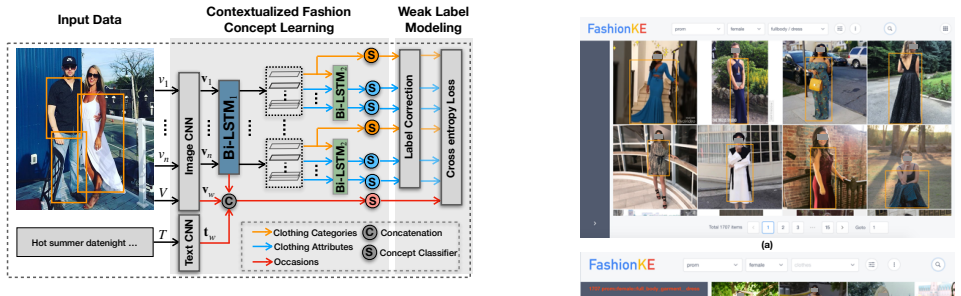
The core object is the contextualized fashion concept learning model: it treats multiple fashion concept predictions (occasion, clothing category, attributes) as a sequence and uses two bidirectional LSTMs to model their co-occurrence, improving prediction over independent classifiers. A weak label modeling module learns a label transition matrix to correct noise in machine-generated training labels. The pipeline's filters—a face-body ratio check and a binary poster/advertisement classifier—ensure that only clean, full-body fashion posts reach the detectors.
What would settle it
Take a random sample of Instagram posts from the same hashtags used by the crawler, manually annotate them for occasion, gender, and clothing, and compare with the system's extracted triplets; if occasion prediction accuracy on this sample is substantially below the level needed for credible trend analysis (for example, below 50% for the most common occasions), the central claim of useful automatic knowledge extraction fails.
Extended reading notes
Core claim
On its own terms, the paper claims that fashion knowledge can be automatically harvested from social media at scale. The central discovery is that a contextualized multi-task learning model—two bidirectional RNNs capturing dependencies among occasion, clothing category, and clothing attributes, plus a weak-label correction module—can learn fashion concepts from noisy, machine-labeled data gathered via hashtags. The extracted concepts are assembled into triplets and indexed for querying, and a demonstration website shows the resulting knowledge base in use.
Load-bearing premise
The whole system depends on the hashtag-crawled, filtered Instagram posts containing enough fashion-relevant content with reliable enough labels that the detectors can learn meaningful occasion and clothing concepts; if the collection or filtering is unrepresentative, the extracted knowledge base will be systematically biased.
Editorial extensions
If this is right
- Users can query the fashion knowledge base by occasion, gender, clothing category, or attribute to find relevant Instagram posts.
- The extracted triplets, combined with stored metadata such as time and location, support fashion trend analysis over time and geography.
- The system demonstrates a reusable architecture for multimodal knowledge extraction in domains where labels are noisy and hashtag-based collection is practical.
- The face-body ratio filter means the knowledge base is biased toward full-body fashion shots, not close-up product images or face-only portraits.
Reading between the lines
- If the extracted triplets are accurate, they form a fashion knowledge graph that could power outfit recommendation engines and virtual styling assistants, a step the paper does not take.
- The same contextualized weak-label approach could transfer to other attribute-rich domains, such as food photography or interior design, where hashtag-based labels are similarly noisy.
- The filtering choices, especially the face-body ratio threshold, may systematically exclude certain fashion styles (for example, modesty wear that does not show the face), so the resulting knowledge base reflects a particular visual norm that future users should audit.
Signed reviews
Editorial analysis
A structured set of objections, weighed in public.
Referee Report
Summary. This paper describes a system for automatic fashion knowledge extraction from social media. The system crawls Instagram posts via manually selected hashtags, filters images by face/body detection and heuristic thresholds, applies a contextualized fashion concept learning model with weak label modeling to predict occasion, clothing category/attributes, and gender, and organizes the resulting <occasion, person, clothing> triplets into a searchable knowledge base with a website. The manuscript is a system/demo description; it contains no quantitative evaluation of the detectors, filters, or extracted knowledge, and refers to the authors' prior work [1] for the underlying model details.
Significance. If the described system performs as claimed, it would provide a useful large-scale resource for fashion analysis and retrieval, integrating visual, textual, and metadata signals. The unified formulation of occasion, person, and clothing discovery from noisy social media is valuable. However, the paper offers no evidence within the text—no evaluation metrics, dataset statistics, or accessible demo—so the validity of the central claims cannot be assessed from the manuscript alone. The strengths are the clear architecture and the practical implementation choices, but the lack of reproducibility data limits the contribution.
major comments (4)
- [Section 2, Fig. 3] The abstract and Section 2 state that the contextualized model and weak label modeling 'improve' and 'boost' fashion concept learning performance, but no experimental result appears in this manuscript. The only support is a citation to [1]. Since the accuracy of the concept detectors is the load-bearing component that determines the quality of the extracted triplets, the paper must either report evaluation results (e.g., per-concept precision/recall, held-out accuracy, or human judgments) or explicitly reproduce the relevant numbers from [1].
- [Section 3, Detector] The detector description provides no dataset statistics, training details, or validation of the occasion/category/attribute/gender predictions. In particular, the weak label modeling module learns a label transition matrix from machine-labeled and clean data; without a clean held-out evaluation, the label-correction procedure can be circular and may yield confidently wrong triplets. Please add a small-scale evaluation of the full pipeline, such as manually evaluated triplets from the constructed knowledge base.
- [Section 3, Crawler and Filter] The hashtag selection and the face-body-height thresholds are heuristic, and the binary filter classifier is not validated. The paper does not report the scale of the crawl, the fraction of posts removed by each filter, or the precision of the filters. These choices determine the representativeness of the corpus and thus the knowledge base; some statistics or a manual audit are needed.
- [Section 2, Fig. 4] The website is presented as the demonstration of extracted knowledge quality, but no URL is provided and the screenshots only show interface layout, not correctness. For a system/demo paper, a publicly accessible link or a video demonstration should be included to allow verification.
minor comments (6)
- [Section 2] The text refers to 'Figure 2 shows our detection model,' but Figure 2 is the overall architecture; the detection model is Figure 3.
- [Section 3] The formulas in Section 3 contain garbled characters ('heiдght_of_face', 'heiдht_of_body'); the correct variable names should be used.
- [Section 2] The last paragraph repeats 'extracted by our system' twice in the same sentence; rephrase for clarity.
- [Figure 1 caption] The caption includes 'The first international !', which appears to be a fragment of the Instagram text and should be clarified or removed.
- [Reference [1]] The manuscript should state explicitly which components are new in this system beyond [1] (e.g., the integrated pipeline, the website, the triplet aggregation).
- [General] No discussion of privacy or ethical considerations for using Instagram images is included; while not central, a brief note would strengthen the system paper.
Circularity Check
No circular derivation in this systems/demo paper; missing evaluation is an evidentiary gap, not circularity.
full rationale
This is a two-page systems/demo paper, not a derivation or prediction paper. The pipeline (crawler, filters, detectors, index/search) is described descriptively, and the only reference to the authors' own prior work is a normal pointer: "For more details, please refer to [1]." That citation covers the architecture and weak-label modeling of the contextualized fashion concept learning model; it is not used to redefine an output as an input, to rename a fitted parameter as a prediction, or to import a uniqueness theorem. The paper contains no equations or quantitative results whose claimed derivation can be shown to reduce to its own assumptions. The lack of held-out evaluation or dataset statistics is a real evidentiary weakness, but that is a correctness/verification concern, not circularity. Nothing in the text exhibits the specific reduction required by the circularity rules: no fitted value is renamed as a predicted value, and no central claim is defined in terms of itself. The system's existence is independently evidenced by the described implementation and website screenshots; the accuracy of its detectors is unvalidated in this paper, but that omission does not make the derivation circular.
Assumptions & free parameters
free parameters (4)
- Occasion taxonomy =
10 occasions
- Clothing category taxonomy =
21 categories
- Attribute taxonomy =
8 attributes, 50 values
- Face-body ratio thresholds =
0.2 and 0.5
assumptions (3)
- domain assumption Instagram posts, collected via manually chosen hashtags, provide a representative and sufficient source of fashion knowledge including occasion, person, and clothing.
- domain assumption Pre-trained object detection and gender prediction models transfer reliably to Instagram fashion images.
- domain assumption Fashion knowledge can be adequately represented by discrete triplets of occasion, gender, and clothing category and attributes.
Cite this review
Pith. "Pith review of Automatic Fashion Knowledge Extraction from Social Media." pith.science (2026). https://pith.science/paper/E3RRO4BJ
@misc{pith2026190804045,
  author       = {Pith},
  title        = {Pith review of: Automatic Fashion Knowledge Extraction from Social Media},
  year         = {2026},
  howpublished = {\url{https://pith.science/paper/E3RRO4BJ}},
  note         = {Machine review of arXiv:1908.04045}
}
read the original abstract
Fashion knowledge plays a pivotal role in helping people in their dressing. In this paper, we present a novel system to automatically harvest fashion knowledge from social media. It unifies three tasks of occasion, person and clothing discovery from multiple modalities of images, texts and metadata. A contextualized fashion concept learning model is applied to leverage the rich contextual information for improving the fashion concept learning performance. At the same time, to counter the label noise within training data, we employ a weak label modeling method to further boost the performance. We build a website to demonstrate the quality of fashion knowledge extracted by our system.
Figures


Figures from the paper (1 more)

Reference graph
Works this paper leans on
-
[1]
[1] Yunshan Ma, Xun Yang, Lizi Liao, Yixin Cao, and Tat-Seng Chua. 2019. Who, Where, and What to Wear? Extracting Fashion Knowledge from Social Media. In 2019 ACM Multimedia Conference on Multimedia Conference . ACM
work page 2019
Reviewed August 14, 2026 · model on record in the stance chip above.
Discussion (0). Continue with ORCID to comment.