REVIEW 4 major objections 5 minor 1 cited by
The Bilinear Strategy for Calder\'on's Problem
T0 review · 4 major / 5 minor · reviewed 2026-08-14 · deepseek-v4-flash
Pith's one-line read This paper proves that for dimensions 5 and 6, boundary measurements determine an electrical conductivity with just over one derivative in $L^p$ ($p\ge d$), improving the previously known uniqueness threshold in Calderón's problem.
desk verdict The paper's advertised regularity improvement depends on a bilinear extension whose load-bearing transversality step is asserted, not proved. read the letter →
The pith
A machine-rendered reading of the paper's core claim, the machinery that carries it, and where it could break.
The reading
What carries the argument
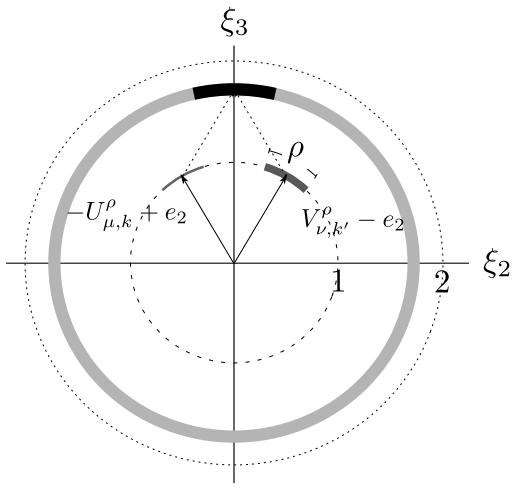
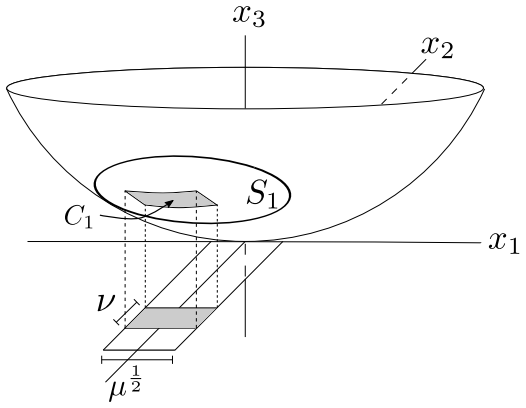
The load-bearing object is the family of Bourgain-type spaces $X^b_\zeta$, defined by weights built from the symbol $p_\zeta(\xi)=-|\xi|^2+2i\zeta\cdot\xi$, whose characteristic set $\Sigma_\zeta$ is a $(d-2)$-sphere; these spaces measure how concentrated a function's Fourier transform is near the surface where the complex geometrical optics equation degenerates. The proof's main new component is a bilinear restriction theorem for two separated surface patches of elliptic type or of the hemisphere: for functions $f_\mu$ and $g_\nu$ whose Fourier supports lie in $\mu$- and $\nu$-neighborhoods of such patches, it gives $\|f_\mu g_\nu\|_{p'}\le C_\varepsilon\mu^{n/(2p)-\varepsilon}\nu^{1/p-\varepsilon}\|f_\mu\|_2\|g_\nu\|_2$ for $1\le p'\le n/(n-1)$. A surface of elliptic type is, locally, the graph of a smooth function whose Hessian has all eigenvalues close to one. The estimate is proved through wave packet decompositions, an induction on scales, a decoupling step, and a Kakeya-type transversality estimate, following the bilinear-to-linear strategy.
What would settle it
Take the hemisphere case of Theorem 7 with two separated caps and compute explicitly the minimal angle between the cone over one cap and the tubes associated with the other: if any admissible pair of caps in the stated range yields angular separation tending to zero as $R\to\infty$, then estimate (69) is false and the theorem's proof chain breaks. More directly, the claimed bound $\|f_\mu g_\nu\|_{p'}\le C_\varepsilon\mu^{n/(2p)-\varepsilon}\nu^{1/p-\varepsilon}$ can be tested on explicit cap data; a violation for arbitrarily small $\varepsilon$ would disprove the bilinear theorem.
Extended reading notes
Core claim
The paper's central claim is Theorem 3: for a bounded Lipschitz domain $\Omega\subset\mathbb{R}^d$ with $d=5,6$, if $\gamma_1,\gamma_2\in W^{1+(d-5)/(2p)+,p}(\Omega)\cap L^\infty$ satisfy $\gamma_j\ge c>0$ and the Dirichlet-to-Neumann maps $\Lambda_{\gamma_1}$ and $\Lambda_{\gamma_2}$ agree on the boundary, then $\gamma_1=\gamma_2$ in $\Omega$. The proof shows that the expected value of the norm of the multiplication operator by $B_jf$, acting between the adapted Bourgain-type spaces $X^b_\zeta$, vanishes as $|\zeta|\to\infty$; from that vanishing, the author extracts complex geometrical optics solutions with negligible error terms, so the products $w_1w_2$ are dense and uniqueness follows. The same mechanism yields Theorem 4 for all $d\ge7$ once the two conductivities also have matching normal derivatives on the boundary.
Load-bearing premise
The proof of the bilinear restriction theorem for elliptic surfaces and the hemisphere relies on the assertion, sketched rather than proved in Section 4.5.1, that the cone of directions generated by one surface is uniformly transversal to all tubes coming from the other surface; if that 'intuitively clear' transversality failed, the Kakeya-type estimate (69) and hence the vanishing expectation would not follow.
Editorial extensions
If this is right
- If Theorem 3 is correct, uniqueness holds for conductivities in $W^{1+(d-5)/(2p)+,p}(\Omega)\cap L^\infty$, $d=5,6$, $d\le p<\infty$.
- Theorem 4 gives the same conclusion for all $d\ge7$ when the normal derivatives of the two conductivities agree on the boundary, confirming that the $d\le6$ restriction in Theorem 3 is a trace-extension issue rather than a failure of the bilinear estimate.
- The expected-value vanishing in Theorem 2 holds for every $d\ge3$, so the new bilinear restriction estimate is available for higher-dimensional inverse problems beyond the two dimensions where the paper states its main uniqueness theorem.
- The result narrows the gap to the conjectured $W^{1,d}$ threshold, with the remaining regularity excess measured by the small $(d-5)/(2p)+$ overload.
Reading between the lines
- If one pushes the argument further, the dimension restriction $d\le6$ should be removable by a more careful localization of the trace condition; in that case Theorem 4 would become unconditional for all $d$.
- The same wave-packet and induction-on-scales strategy could be adapted to other inverse boundary value problems whose complex geometrical optics characteristic sets are spheres, such as recovering a magnetic field or a potential.
- A numerical verification of the Kakeya-type estimate (69) on the hemisphere, using randomly sampled separated caps, would independently confirm the one step the text leaves as 'intuitively clear' before the full proof is formalized.
Signed reviews
Editorial analysis
A structured set of objections, weighed in public.
Referee Report
Summary. This paper addresses the Calderón problem of determining a conductivity from boundary measurements. The main result, Theorem 3, asserts uniqueness for d=5,6 when the conductivity lies in W^{1+(d-5)/(2p)+,p}(Ω) for d≤p<∞, improving on earlier results by Haberman and by Ham, Kwon and Lee. The strategy follows the Bourgain-space method: prove that the average of the multiplication-operator norm vanishes (Theorem 2), after reducing to an estimate (Theorem 8) that is obtained via bilinear restriction theory. The novel input is Theorem 7, an extension of Tao's bilinear restriction estimate to surfaces of elliptic type and to the hemisphere. The paper contains a full proof of the paraboloid case (Theorem 7') and only a sketch of the extension to the other surfaces.
Significance. If established, the improvement in regularity is a real advance: for d=5 it reaches W^{1,p}, matching the critical W^{1,d} conjecture when p=d, and for d=6 it improves the exponent by 1/(2p). The paraboloid case of the bilinear theorem is proved in considerable detail, and the reduction from the bilinear estimate to the vanishing theorem is clearly structured. No circularity is apparent: the proof depends on external results (Tao's bilinear theorem, Haberman's Lemma 5.1, Ham-Kwon-Lee's Lemma 4.3) and does not introduce fitted parameters. However, the central bilinear bound for the hemisphere and elliptic surfaces is not fully proved; the load-bearing transversality step is left as an 'intuitively clear' statement, and the summation estimates in Section 3.2 are asserted without details.
major comments (4)
- [§4.5.1, required for Theorem 7] The extension of Theorem 7' to the hemisphere is not proved. After reducing to the case where S1 and S2 are symmetric about e1, the paper states: 'It is intuitively clear that the portion of the cone generated by direction from S1 is uniformly transversal to tubes from S2.' This is exactly the statement needed to obtain the Kakeya-type estimate (69) via (71), which in turn closes the induction on scales in §4.2 and yields the ν^{1/n} factor in Theorem 18. Without a uniform lower bound on the angle between the cone P̃ and every T2 tube, the bilinear inequality (11) is not established for the sphere. Please provide a complete proof, with explicit estimates in terms of the separation parameters.
- [§4.5.1, elliptic-type surfaces] For surfaces of elliptic type, the transversality argument is also not rigorous: the sentence 'the inner product is basically equal to ⟨η1−η2, η1'−η2'⟩ for all the pairs ...' glosses over the dependence of the matrix A on the points. The paper needs to prove that A is uniformly close to the identity on the relevant compact ranges and that the lower bound |⟨η1−η2, η1'−η2'⟩| ≥ c > 0 holds uniformly, so that the constant Cδ in (71) does not degenerate.
- [§3.2, proof of Theorem 8] The bounds for the terms I and II after (42) are asserted rather than derived. The text says 'We fix λ ≳ M^{-1/2}, and sum first in ν and then in μ. Since p ≥ d ≥ 5, then we get I ≤ c M^{(d-5)/(2p)+ε} ...' but no summation details are given. This is load-bearing: the power M^{(d-5)/(2p)} is exactly the improvement over Haberman's exponent, and the dyadic sums must converge for the range μ ≤ ν < μ^{1/2}, λ ∈ [ν^{1/2},1], with the constraints appearing in the definition of Q. Please provide the complete computation.
- [§4.2, base case of induction] The base case of the induction on scales is not justified. After stopping at R^{(1-δ)^N} ≈ ν^{-1}, the paper states 'If r ≤ ν^{-1}, then we can average over translations of the paraboloid and apply Tao's bilinear to get Kν(r) ≤ Cε r^{1 - (n+2)/(2p) + ε} ν^{1/2}' without proof. This estimate is used to close the recurrence and should be derived explicitly, including the role of the translation averaging and the precise dependence on ν.
minor comments (5)
- [Notation] The symbol p is used both for the Sobolev index (Theorems 2, 3, 8, 12) and, in Theorem 9 and Lemma 10, for the Hölder dual of p1. This makes the exponents in (25), (30), and (31) ambiguous; please define p in each theorem or use a different letter.
- [Theorem 12] The statement reads 'For d ≤ p ≤ 8'; this should be 'd ≤ p < ∞'.
- [Throughout Section 3] The operator is denoted MB_i f in Theorem 2 and Theorem 8 but mB_i f in (42); please make the notation uniform.
- [§4.5.1] In the sentence 'By symmetry, we can assume that ξ2^2 = -a e1 and ξ1^2 = a e1', the variables ξ1^2 and ξ2^2 are not defined; they appear to be points on the two surfaces, but the notation conflicts with the second coordinate of ξ. Please clarify.
- [References] Reference [13] is cited as an arXiv preprint (v2, 2019). If the published version differs, the paper should cite the final version and state which lemmas are used.
Circularity Check
No circularity: the proof is self-contained in its new bilinear estimate and relies on external theorems for the remaining steps.
full rationale
The paper's derivation chain is not circular. The claimed new contribution is Theorem 7, an extension of Tao's bilinear restriction theorem to elliptic-type surfaces and the hemisphere. Theorem 7' proves the paraboloid case through an explicit wave-packet decomposition, induction on scales, a decoupling argument at scale R^{1/2}, and a Kakeya-type estimate, with constants tracked in the displayed inequalities. Section 4.5.1 then sketches the modifications needed for elliptic-type surfaces and the hemisphere, invoking the boundedness of the relevant seminorms and a transversality claim. The Calderón uniqueness theorem, Theorem 3, is reduced to the vanishing of the expected value, Theorem 2, via the same reduction used in Haberman and in Ham, Kwon and Lee; the paper does not fit any parameter to the target conclusion. Lemmas 13 and 14 are quoted from the external works of Haberman and Ham-Kwon-Lee, and they are used as stated bounds rather than as restatements of the desired theorem. The skeptical concern that the hemisphere extension in Section 4.5.1 rests on an unproved transversality assertion is a potential correctness gap in the proof, not a circularity: the claim is not equivalent by construction to an input, nor is any result renamed as a prediction. Therefore the appropriate circularity score is 0.
Assumptions & free parameters
assumptions (6)
- standard math Tomas-Stein restriction theorem (Theorem 5)
- standard math Tao's bilinear restriction theorem for paraboloids (cited [25])
- domain assumption Lemma 13 (Haberman Lemma 5.1)
- domain assumption Lemma 14 (Ham-Kwon-Lee Lemma 4.3)
- standard math Brown's boundary determination theorem (cited [5])
- standard math Sobolev extension and trace theorems for Lipschitz domains (Marschall [19])
Cite this review
Pith. "Pith review of The Bilinear Strategy for Calder\'on's Problem." pith.science (2026). https://pith.science/paper/PWS7KKAE
@misc{pith2026190804050,
  author       = {Pith},
  title        = {Pith review of: The Bilinear Strategy for Calder\'on's Problem},
  year         = {2026},
  howpublished = {\url{https://pith.science/paper/PWS7KKAE}},
  note         = {Machine review of arXiv:1908.04050}
}
abstract
Electrical Impedance Imaging would suffer a serious obstruction if for two different conductivities the potential and current measured at the boundary were the same. The Calder\'on's problem is to decide whether the conductivity is indeed uniquely determined by the data at the boundary. In $\mathbb{R}^d$, for $d=5,6$, we show that uniqueness holds when the conductivity is in $W^{1+\frac{d-5}{2p}+, p}(\Omega)$, for $d\le p <\infty$. This improves on recent results of Haberman, and of Ham, Kwon and Lee. The main novelty of the proof is an extension of Tao's bilinear Theorem.
Figures

Forward citations
Cited by 1 Pith paper
-
Recovery of the Derivative of the Conductivity at the Boundary
The paper gives quadratic-form reconstruction formulas for the boundary value and normal derivative of the conductivity from the Dirichlet-to-Neumann map, and deduces bulk uniqueness for conductivities in W^{1+(n-5)/(...
Reference graph
Works this paper leans on
-
[1]
K. Astala and L. Päivärinta. Calderón’s inverse conduct ivity problem in the plane. Ann. of Math. (2) , 163(1):265–299, 2006
work page 2006
- [2]
-
[3]
J. Bourgain, C. Demeter, and L. Guth. Proof of the main con jecture in Vinogradov’s mean value theorem for degrees higher than thr ee. Ann. of Math. (2) , 184(2):633–682, 2016
work page 2016
-
[4]
R. Brown. Global uniqueness in the impedance-imaging pr oblem for less regular conductivities. SIAM J. Math. Anal. , 27(4):1049–1056, 1996
work page 1996
-
[5]
R. Brown. Recovering the conductivity at the boundary fr om the Dirich- let to Neumann map: a pointwise result. J. Inverse Ill-Posed Probl. , 9(6):567–574, 2001. 40
work page 2001
-
[6]
Brown and R
R. Brown and R. Torres. Uniqueness in the inverse conduct ivity problem for conductivities with 3{2 derivatives in Lp, p ą 2n. J. Fourier Anal. Appl., 9(6):563–574, 2003
2003
-
[7]
Calderón
A. Calderón. On an inverse boundary value problem. In Seminar on Numerical Analysis and its Applications to Continuum Physi cs (Rio de Janeiro, 1980) , pages 65–73. Soc. Brasil. Mat., Rio de Janeiro, 1980
1980
-
[8]
P. Caro and K. Rogers. Global uniqueness for the Calderón problem with Lipschitz conductivities. Forum Math. Pi , 4:e2, 28, 2016
work page 2016
Show all 30 references
-
[9]
Dos Santos Ferreira, C
D. Dos Santos Ferreira, C. Kenig, M. Salo, and G. Uhlmann. Limit- ing Carleman weights and anisotropic inverse problems. Invent. Math. , 178(1):119–171, 2009
2009
-
[10]
Fefferman
C. Fefferman. A note on spherical summation multipliers . Israel J. Math., 15:44–52, 1973
1973
-
[11]
Haberman
B. Haberman. Uniqueness in Calderón’s problem for cond uctivities with unbounded gradient. Comm. Math. Phys. , 340(2):639–659, 2015
2015
-
[12]
Haberman and D
B. Haberman and D. Tataru. Uniqueness in Calderón’s pro blem with Lipschitz conductivities. Duke Math. J. , 162(3):496–516, 2013
2013
-
[13]
S. Ham, Y. Kwon, and S. Lee. Uniqueness in the calderón pr oblem and bilinear restriction estimates. arXiv:1903.09382v2 [mat h.AP], 2019
1903 arXiv
-
[14]
Kenig, A
C. Kenig, A. Ruiz, and C. Sogge. Uniform Sobolev inequal ities and unique continuation for second order constant coefficient di fferential op- erators. Duke Math. J. , 55(2):329–347, 1987
1987
-
[15]
Kenig, J
C. Kenig, J. Sjöstrand, and G. Uhlmann. The Calderón pro blem with partial data. Ann. of Math. (2) , 165(2):567–591, 2007
2007
-
[16]
Kohn and M
R. Kohn and M. Vogelius. Determining conductivity by bo undary mea- surements. Comm. Pure Appl. Math. , 37(3):289–298, 1984
1984
-
[17]
S. Lee. Improved bounds for Bochner-Riesz and maximal B ochner-Riesz operators. Duke Math. J. , 122(1):205–232, 2004
2004
-
[18]
S. Lee. Bilinear restriction estimates for surfaces wi th curvatures of different signs. Trans. Amer. Math. Soc. , 358(8):3511–3533, 2006. 41
2006
-
[19]
Marschall
J. Marschall. The trace of Sobolev-Slobodeckij spaces on Lipschitz do- mains. Manuscripta Math. , 58(1-2):47–65, 1987
1987
-
[20]
P. Mattila. Fourier analysis and Hausdorff dimension , volume 150 of Cambridge Studies in Advanced Mathematics . Cambridge University Press, Cambridge, 2015
2015
-
[21]
Nguyen and D
H. Nguyen and D. Spirn. Recovering a potential from cauc hy data via complex geometrical optics solutions. arXiv:1403.225 5v2 [math.AP], 2014
2014
-
[22]
Seagar, D
A. Seagar, D. Barber, and B. Brown. Electrical impedanc e imaging. IEE Proceedings, 134(2):201–210, 1987
1987
-
[23]
E. Stein. Harmonic analysis: real-variable methods, orthogonality , and oscillatory integrals , volume 43 of Princeton Mathematical Series . Princeton University Press, Princeton, NJ, 1993. With the a ssistance of Timothy S. Murphy, Monographs in Harmonic Analysis, III
1993
-
[24]
Sylvester and G
J. Sylvester and G. Uhlmann. A global uniqueness theore m for an inverse boundary value problem. Ann. of Math. (2) , 125(1):153–169, 1987
1987
-
[25]
T. Tao. A sharp bilinear restrictions estimate for para boloids. Geom. Funct. Anal., 13(6):1359–1384, 2003
2003
-
[26]
T. Tao, A. Vargas, and L. Vega. A bilinear approach to the restriction and Kakeya conjectures. J. Amer. Math. Soc. , 11(4):967–1000, 1998
1998
-
[27]
P. Tomas. A restriction theorem for the Fourier transfo rm. Bull. Amer. Math. Soc. , 81:477–478, 1975
1975
-
[28]
H. Triebel. Theory of function spaces , volume 78 of Monographs in Mathematics. Birkhäuser Verlag, Basel, 1983
1983
-
[29]
A. Vargas. Restriction theorems for a surface with nega tive curvature. Math. Z. , 249(1):97–111, 2005
2005
-
[30]
T. Wolff. A sharp bilinear cone restriction estimate. Ann. of Math. (2) , 153(3):661–698, 2001. 42
2001
Reviewed August 14, 2026 · model on record in the stance chip above.
Discussion (0). Continue with ORCID to comment.