REVIEW 1 major objections 6 minor 12 references
A Natural Quadratic Approach to the Generalized Graph Layering Problem
T0 review · 1 major / 6 minor · reviewed 2026-08-14 · deepseek-v4-flash
Pith's one-line read A quadratic assignment model matches the best exact solvers for layered graph drawing.
desk verdict A clean new QAP formulation for layered graph drawing, but the GLP-W experiments use a layer bound that is not an upper bound, so the empirical claims address a height-bounded variant. read the letter →
The pith
A machine-rendered reading of the paper's core claim, the machinery that carries it, and where it could break.
The reading
What carries the argument
The central object is the compact linearization of quadratic assignment constraints: for each arc $uv$ and layers $k,\ell$, a continuous variable $p_{u,k,v,\ell}$ is forced, by equations (2) and (3), to equal $x_{u,k} \cdot x_{v,\ell}$ whenever the $x$ variables are binary. Arc length, reversal, dummy-vertex counts, width, and inverse scaling factor are then expressed as sums of these $p$ variables, giving a model with only $2|A|Y + |V|$ constraints while avoiding artificial auxiliary variables for reversals and dummies.
What would settle it
On any small directed graph (e.g., three vertices forming a directed cycle) and a small layer bound $Y$, enumerate all binary assignments satisfying equations (1)-(4) and check whether every variable $p_{u,k,v,\ell}$ equals $x_{u,k} \cdot x_{v,\ell}$. If any feasible binary solution violates this equality, the objective can miscompute arc length or reversal counts, and the model would not solve the stated problem.
Extended reading notes
Core claim
The central claim is that the quadratic-assignment-based MIP models QLA-W and QLA-MS* are computationally competitive with the previously best exact ordering-based models CGL-W and CGL-MS* for the generalized graph layering problem. Using binary variables that assign each vertex to a layer, and continuous product variables defined for each arc and pair of layers, the model expresses arc length, reversal, dummy vertices, width, and target-area scaling as linear sums over those products. The compact linearization, taken from the author's earlier work, ensures each product variable equals the product of its two binary assignment variables at every feasible binary solution, so the objective faithfully represents the geometric quantities. The paper reports that solution times and timeout counts are comparable across instance families and objective settings, concluding that neither model family is clearly superior.
Load-bearing premise
The model is correct only if the cited compact linearization result indeed guarantees that each product variable equals the product of its two binary assignment variables at every feasible binary solution; the paper relies on that theorem from earlier work without proving it here.
Editorial extensions
If this is right
- QLA-W and QLA-MS* can serve as drop-in exact alternatives to CGL-W and CGL-MS* when solving layered drawing problems with a general-purpose MIP solver.
- The natural quadratic formulation makes it straightforward to add or adjust layout objectives, such as emphasizing width or fitting a specific drawing aspect ratio, without redesigning the model.
- Experiments indicate that width-emphasized and aspect-ratio-constrained layering remain hard beyond about 50 vertices for all tested models, pointing to a common bottleneck rather than a model-specific weakness.
- The 2:1 aspect-ratio case is consistently the hardest setting for both model families, suggesting that extreme aspect ratios impose particularly tight constraints on feasible layerings.
- Because the model is assignment-based, it may more easily accommodate additional assignment-dependent constraints in future generalizations of the layering problem.
Reading between the lines
- The competitive performance suggests that the difficulty of the QAP does not carry over to this special assignment structure; the compact constraint count may be more decisive than the quadratic nature.
- The model could be adapted to other optimization problems with assignment constraints and pairwise interaction costs, such as scheduling or facility layout, where the same compact linearization applies.
- Testing QLA-W on larger sparse graphs, or with different MIP solvers, would reveal whether the observed competitiveness is robust or tied to the specific solver and instance densities used.
- The natural expression of reversals and dummy vertices might also inspire new heuristic approaches, since the quadratic formulation exposes the pairwise decisions directly.
Signed reviews
Editorial analysis
A structured set of objections, weighed in public.
Referee Report
Summary. The paper proposes two mixed-integer programming formulations, QLA-W and QLA-MS*, for the generalized graph layering problem with width minimization (GLP-W) and with adaptation to a target drawing area (GLP-MS*). The models use binary assignment variables x_{v,k} for the layer of each vertex and continuous product variables p_{u,k,v,l} intended to equal x_{u,k} x_{v,l}; equations (1)-(4) enforce a feasible layering, and the objective terms for arc length, reversed arcs, dummy vertices, width, and scaling factor are expressed linearly through these products, following a compact linearization theorem from the author's earlier paper [5]. The paper reports computational experiments comparing QLA-W with CGL-W and QLA-MS* with CGL-MS* on AT&T and random graphs with up to 60 vertices, using Gurobi with a half-hour time limit, and concludes that the quadratic-assignment-based models are computationally competitive with the prior exact models.
Significance. If the computational claims are valid, the paper offers a conceptually natural exact modeling alternative to the ordering-based CGL formulations: the QAP-style model expresses conjunctive layout conditions directly and is compact in the number of constraints. The modeling core is largely correct: for binary x variables, equations (2)-(3) force p_{u,k,v,l} = x_{u,k} x_{v,l}, and the derivations of arc length, reversal indicators, and dummy-vertex counts in Section 4 are sound. The GLP-MS* experiments are not affected by the main concern below because they use the valid bound Y = |V|. However, the experimental evidence for GLP-W is compromised by the choice of Y in Section 5.1, and the paper does not provide code or data for independent reproduction. The approach remains promising, but the empirical support for the central competitiveness claim on GLP-W needs to be corrected before the claim can be accepted.
major comments (1)
- [§5.1, Experiment (1), and §4.1] The choice Y = ceil(1.6 sqrt(|V|)) is not an upper bound on the number of layers needed by an optimal GLP-W solution, so the model solved in Figure 3 is a height-bounded variant of GLP-W rather than the problem defined in Problem 4. Section 4.1 explicitly requires Y to be an upper bound on the number of layers, but Experiment (1) sets Y without any instance-specific justification. For example, a directed path on 60 vertices has an optimal layering under the weights of Experiment (1) that uses 60 layers, width 1, total length 59, and no reversals, giving objective value 60; forcing Y = 13 would require at least one reversal at cost omega_rev = 13 * 59 = 767, so the two optima are far apart. Thus the reported QLA-W and CGL-W runtimes do not establish that either model solves GLP-W as defined. Please either re-run the GLP-W experiments with a valid bound such as Y = |V|, or justify a valid instance-specific upper bound and state explicitly that the comparison is for a height-bounded variant.
minor comments (6)
- [§4.1] The stated total number of product variables is incorrect: after omitting the diagonal variables p_{u,k,v,k}, there are |A| * Y * (Y-1) such variables, not |A| * (Y-1)^2. Please correct or clarify the counting convention.
- [§5] The experiments report only solution times and timeout counts. Reporting optimal objective values, or final optimality gaps for timed-out instances, would let readers verify that QLA and CGL solve the same instance to the same optimum and would strengthen the equivalence claim.
- [§5.1] The sentence 'Gurobi 5 (release version 8)' is inconsistent; the solver should be identified as Gurobi 8 or as 'Gurobi (release version 8)'.
- [§2] The statement that width minimization can be obtained by setting r_W = 1 and r_H = infinity is informal, since the normalized ratios introduced in the paper are finite; a limiting or explicit degenerate-case statement would be more precise.
- [§5.1] In the description of the first instance set, 'The first set ATTar are the AT&T graphs' appears to contain a typo; 'ATTar' should likely be 'AT&T'.
- [§4.1] Since equations (2)-(3) rely on the compact linearization theorem from [5], a short statement of the lemma, or a precise pointer to the theorem in [5], would make the paper more self-contained.
Circularity Check
No significant circularity: the QLA models derive their objective from a cited, independent linearization theorem and are validated against external benchmark MIPs.
full rationale
The paper's derivation chain is self-contained with respect to its central claim. The quadratic model expresses arc length, reversals, and dummy-vertex counts through product variables p_{u,k,v,l}, and equations (2)-(3) force p = x_u,k * x_v,l for binary x. This relies on the author's earlier compact-linearization result [5], but that is a general, parameter-free theorem about assignment-constrained quadratic programs, not a restatement of the layering result; it does not assume the target objective or the GLP solution. The computational claim is an empirical comparison against the previously published CGL-W and CGL-MS* models on standard benchmark sets, with no fitted parameters relabeled as predictions. The reviewer-flagged issue that Y = ceil(1.6 sqrt(|V|)) may not be a valid height upper bound for unrestricted GLP-W is a modeling-validity concern about the experimental setup, not a circular derivation: the models themselves do not define their correctness in terms of the chosen Y. The paper's use of settings 'as in [4]' and 'as in [8]' is a reproducibility choice, not a load-bearing self-citation that forces the conclusion. Therefore no circular step is exhibited, and the appropriate score is 0.
Assumptions & free parameters
free parameters (2)
- Layer bound Y =
ceil(1.6 * sqrt(|V|)) for GLP-W; |V| for GLP-MS*
- Objective weights (omega_len, omega_rev, omega_wid, omega_scl) =
omega_len=1, omega_rev=Y*|A|, omega_wid=1 or omega_rev*|A|+|A|*Y+1, omega_scl=omega_rev*|A|+|A|*Y+1
assumptions (3)
- standard math Compact linearization theorem (Mallach 2018): for binary x satisfying assignment constraints, p variables satisfying equations (2)-(3) equal products x_{u,k} x_{v,l}.
- domain assumption The chosen layer bound Y is a valid upper bound for an optimal layering of the instances tested.
- domain assumption Width of a layering is the maximum number of original and dummy vertices on any layer; this is a proxy for final drawing width.
Cite this review
Pith. "Pith review of A Natural Quadratic Approach to the Generalized Graph Layering Problem." pith.science (2026). https://pith.science/paper/AOMZG3II
@misc{pith2026190804104,
  author       = {Pith},
  title        = {Pith review of: A Natural Quadratic Approach to the Generalized Graph Layering Problem},
  year         = {2026},
  howpublished = {\url{https://pith.science/paper/AOMZG3II}},
  note         = {Machine review of arXiv:1908.04104}
}
read the original abstract
We propose a new exact approach to the generalized graph layering problem that is based on a particular quadratic assignment formulation. It expresses, in a natural way, the associated layout restrictions and several possible objectives, such as a minimum total arc length, minimum number of reversed arcs, and minimum width, or the adaptation to a specific drawing area. Our computational experiments show a competitive performance compared to prior exact models.
Figures

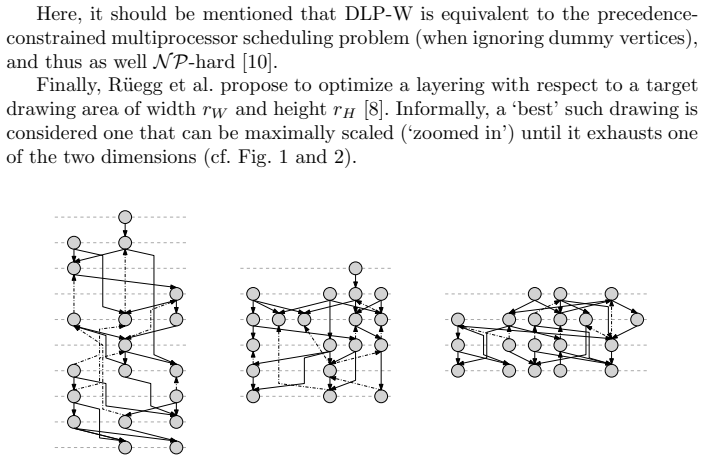

Figures from the paper (1 more)

Reference graph
Works this paper leans on
-
[5]
4OR 16(3), 295--309 (Sep 2018)
Mallach, S.: Compact linearization for binary quadratic problems subject to assignment constraints. 4OR 16(3), 295--309 (Sep 2018). doi:10.1007/s10288-017-0364-0
-
[4]
u egg, U., von Hanxleden, R.: Compact layered drawings of general directed graphs. In: Hu, Y., N \
Jabrayilov, A., Mallach, S., Mutzel, P., R \"u egg, U., von Hanxleden, R.: Compact layered drawings of general directed graphs. In: Hu, Y., N \"o llenburg, M. (eds.) Proceedings of the 24th International Symposium on Graph Drawing and Network Visualization (GD'16). pp. 209--221. Springer, Cham (2016)
work page 2016
-
[1]
In: Proceedings of the Symposium on Graph Drawing (GD'96), LNCS, vol
Di Battista , G., Garg, A., Liotta, G., Parise, A., Tamassia, R., Tassinari, E., Vargiu, F., Vismara, L.: Drawing directed acyclic graphs: An experimental study. In: Proceedings of the Symposium on Graph Drawing (GD'96), LNCS, vol. 1190, pp. 76--91. Springer (1997)
work page 1997
-
[2]
Software Engineering 19(3), 214--230 (1993)
Gansner, E.R., Koutsofios, E., North, S.C., Vo, K.P.: A technique for drawing directed graphs. Software Engineering 19(3), 214--230 (1993)
work page 1993
-
[3]
In: Goodrich, M.T., Kobourov, S.G
Healy, P., Nikolov, N.S.: A branch-and-cut approach to the directed acyclic graph layering problem. In: Goodrich, M.T., Kobourov, S.G. (eds.) Proceedings of the 10th International Symposium on Graph Drawing (GD'02), LNCS, vol. 2528, pp. 98--109. Springer (2002). doi:10.1007/3-540-36151-0
-
[6]
R \"u egg, U., Ehlers, T., Sp \"o nemann, M., von Hanxleden, R.: A generalization of the directed graph layering problem. Technical Report 1501, Kiel University, Department of Computer Science (Feb 2015), ISSN 2192-6247
work page 2015
-
[7]
R \"u egg, U., Ehlers, T., Sp \"o nemann, M., von Hanxleden, R.: A generalization of the directed graph layering problem. In: Hu, Y., N \"o llenburg, M. (eds.) Proceedings of the 24th International Symposium on Graph Drawing and Network Visualization (GD'16). pp. 196--208. Springer, Cham (2016)
work page 2016
-
[8]
R\"uegg , U., Ehlers , T., Sp\"onemann , M., von Hanxleden , R.: Generalized layerings for arbitrary and fixed drawing areas. Journal of Graph Algorithms and Applications 21(5), 823--856 (2017). doi:10.7155/jgaa.00441
Show all 12 references
-
[9]
IEEE Transactions on Systems, Man and Cybernetics 11(2), 109--125 (Feb 1981)
Sugiyama, K., Tagawa, S., Toda, M.: Methods for visual understanding of hierarchical system structures. IEEE Transactions on Systems, Man and Cybernetics 11(2), 109--125 (Feb 1981)
1981
-
[10]
Journal of Computer and System Sciences 10(3), 384--393 (1975)
Ullman, J.D.: NP -complete scheduling problems. Journal of Computer and System Sciences 10(3), 384--393 (1975). doi:https://doi.org/10.1016/S0022-0000(75)80008-0
1975 doi
-
[11]
, " * write output.state after.block = add.period write
ENTRY address author booktitle chapter doi edition editor eid howpublished institution journal key month note number organization pages publisher school series title type url volume year label INTEGERS output.state before.all mid.sentence after.sentence after.block FUNCTION in...
-
[12]
write newline
" write newline "" before.all 'output.state := FUNCTION n.dashify 't := "" t empty not t #1 #1 substring "-" = t #1 #2 substring "--" = not "--" * t #2 global.max substring 't := t #1 #1 substring "-" = "-" * t #2 global.max substring 't := while if t #1 #1 substring * t #2 gl...
Reviewed August 14, 2026 · model on record in the stance chip above.
Discussion (0). Continue with ORCID to comment.