REVIEW 2 major objections 4 minor 66 references
Frustrated Quantum Magnetism with Bose Gases in Triangular Optical Lattices at Negative Absolute Temperatures
T0 review · 2 major / 4 minor · reviewed 2026-08-14 · deepseek-v4-flash
Pith's one-line read A protocol using negative absolute temperatures realizes frustrated chiral superfluids in triangular optical lattices and predicts their quantum phase boundary.
desk verdict A credible proposal with a solid phase-boundary calculation and a protocol step that leans on Gutzwiller mean-field, where the paper's own numbers suggest caution is warranted. read the letter →
The pith
A machine-rendered reading of the paper's core claim, the machinery that carries it, and where it could break.
The reading
What carries the argument
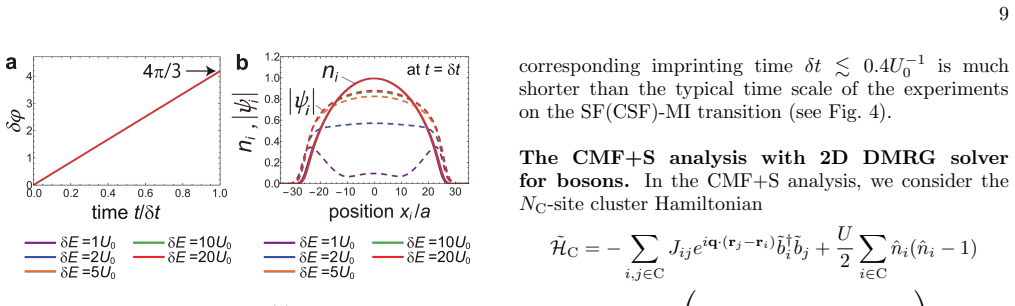
The central identity is the negative-temperature equivalence between equilibrium states of $H$ at $T<0$ and of $-H$ at $|T|>0$. The protocol's two operations are phase imprinting, which imposes the finite-momentum phase pattern $e^{i\mathbf{Q}\cdot\mathbf{r}}$ that maximizes the single-particle kinetic energy $\varepsilon_{\mathbf{q}}$, and sudden sign inversion of $U$ and $V$, which makes all energy terms maximal simultaneously. The ratio $|\varepsilon_{\mathbf{Q}}/\varepsilon_0|$, where $\varepsilon_0$ and $\varepsilon_{\mathbf{Q}}$ are the kinetic energies at zero and frustrated momentum, governs the rescaling of $U$ and $V$ and encodes the reduction of kinetic energy by frustration. The quantitative analysis uses the site-decoupling Gutzwiller approximation for the mean-field phase diagram, time-dependent Gutzwiller for the quench dynamics, and cluster mean-field plus scaling with a two-dimensional density matrix renormalization group cluster solver for the correlated critical points.
What would settle it
Load a Bose gas in a triangular lattice, imprint the three-color phase pattern, flip $U$ to $-U/2$ and $V$ to $-V/2$, and watch the central density fluctuation $\delta n^2$; if it grows or oscillates instead of staying essentially constant over hundreds of $U_0^{-1}$, the negative-temperature chiral superfluid is not dynamically stable. Alternatively, measure the critical point $|U_c/J_2|$ as $J_1/J_2$ is varied: the central claim would be falsified if no nonmonotonic dip near $J_1/J_2\approx 0.8$ appears, or if the critical point deviates from the cluster mean-field plus scaling curve by more than the quoted uncertainty.
Extended reading notes
Core claim
Negative-temperature statistics provide a route to frustrated quantum magnetism: a thermal state of Hamiltonian $H$ at $T<0$ is the equilibrium state of $-H$ at $|T|>0$. The authors exploit this by imprinting the chiral phase pattern $e^{i\mathbf{Q}\cdot\mathbf{r}}$ onto an ordinary superfluid, then suddenly flipping $U$ and $V$ to their opposite signs so that kinetic, interaction, and trap energies are all maximal, realizing a stable negative-temperature state equivalent to the ground state of a Bose-Hubbard model with sign-inverted hoppings. Because the kinetic energy of the frustrated condensate is reduced by the factor $|\varepsilon_{\mathbf{Q}}/\varepsilon_0|$, the interaction and trap must be rescaled accordingly, halved in the isotropic triangular case. Time-dependent Gutzwiller simulations show the created chiral superfluid remains stable for at least $200\,U_0^{-1}$, while a slow increase of $|U/J|$ drives it into a Mott insulator at $|U_c/J|\approx 17.5$ in the isotropic case. Cluster mean-field plus scaling calculations with a two-dimensional density matrix renormalization group solver predict the anisotropic phase boundary $U_c/|J_2|$, which is strongly reduced relative to the Gutzwiller value and shows a nonmonotonic dip near $J_1/J_2\approx 0.8$, a signature of frustration-enhanced quantum fluctuations.
Load-bearing premise
Everything rests on the assumption that after imprinting the chiral phase, the density and order-parameter magnitudes of the original unfrustrated ground state remain the correct ground-state magnitudes of the frustrated Hamiltonian once $U$ and $V$ are rescaled by $|\varepsilon_{\mathbf{Q}}/\varepsilon_0|$; this mapping is derived in the site-decoupling Gutzwiller approximation, and if intersite correlations change the optimal density profile the prepared state would not be the true frustrated ground state.
Editorial extensions
If this is right
- If the protocol works as simulated, a cold-atom experiment can reach the quantum regime of a frustrated bosonic magnet without the heating that plagues lattice-shaking methods.
- The dynamically stable negative-temperature chiral superfluid provides a direct realization of a bosonic system with sign-inverted hoppings, evidenced by a three-color phase pattern and a condensate at finite momentum.
- Slowly increasing $|U/J|$ should produce a chiral-superfluid-to-Mott-insulator transition whose critical point, at $|U_c/J|\approx 17.5$ for the isotropic triangular lattice, is about half the unfrustrated value and is detectable in time-of-flight images and density-fluctuation measurements.
- The predicted anisotropic phase boundary $U_c/|J_2|$ with its dip near $J_1/J_2\approx 0.8$ gives experiments a quantitative target that would confirm that intersite quantum correlations, enhanced by frustration, are captured by the simulator.
- Via the boson-to-spin mapping, the same transition is connected to pressure-driven quantum phase transitions in spin-1 triangular antiferromagnets, so the simulator can probe physics relevant to real frustrated magnets.
Reading between the lines
- The negative-temperature equivalence should generalize: the same phase-imprinting-plus-sign-inversion recipe could be applied to other non-bipartite lattices or to long-range interacting bosons, potentially realizing chiral Mott insulators or spin-liquid-like states that the paper only mentions as future directions.
- The rescaling factor $|\varepsilon_{\mathbf{Q}}/\varepsilon_0|$ is derived in the site-decoupling Gutzwiller approximation; a cleaner experimental check would be to compare the post-quench density profile against the ground-state profile of a directly simulated sign-inverted Hamiltonian, which would reveal any beyond-mean-field correction to the mapping.
- The predicted dip in $U_c/|J_2|$ near $J_1/J_2\approx 0.8$ is a sharp, quantitative signature; if experiments resolve it, it would also constrain the universality class of the chiral-superfluid-to-Mott-insulator transition, which the paper notes is not yet established.
- Extending the slow-sweep protocol to half-integer fillings, where quantum spin liquid behavior is expected for frustrated lattices, could make the simulator a probe of states that are not adjacent to the Mott insulator, though the required phase patterns would need different imprinting schemes.
Signed reviews
Editorial analysis
A structured set of objections, weighed in public.
Referee Report
Summary. The paper proposes an experimental protocol for realizing frustrated Bose-Hubbard physics in a triangular optical lattice at negative absolute temperature. Starting from a standard superfluid with positive hoppings, repulsive interactions, and a confining trap, the authors imprint the chiral phase pattern e^{iQ·r_i}, then suddenly invert the interaction and trap potential with strengths rescaled by |ε_Q/ε_0|. They argue that the resulting maximum-energy state is equivalent to the ground state of a frustrated Hamiltonian with sign-inverted hoppings. Using time-dependent Gutzwiller (TDGA) simulations they show that the chiral superfluid state is dynamically stable and that a slow ramp of |U/J| drives a transition to a Mott insulator. They then compute the frustrated superfluid–Mott insulator phase boundary as a function of hopping anisotropy using cluster mean-field plus scaling (CMF+S) with a 2D DMRG cluster solver, finding that quantum correlations reduce U_c by 40–50% relative to the Gutzwiller value.
Significance. The proposal is original and timely, offering a possible route around the heating problems of lattice shaking. The CMF+S calculation is systematic, with cluster-size scaling and explicit error estimates, and it produces falsifiable predictions for the phase boundary. The negative-temperature equivalence is correctly derived at the Gutzwiller level, and the paper gives concrete experimental steps including phase-imprinting methods and detection schemes. However, the central mapping from the phase-imprinted state to the frustrated ground state is established only within mean-field theory, and the paper's own CMF+S results show that beyond-mean-field corrections are large and frustration-enhanced. This gap must be addressed before the protocol can be considered quantitatively reliable.
major comments (2)
- [Negative absolute temperature; Methods: The GA analysis for finite-momentum BEC states] The rescaling U→−|ε_Q/ε_0|U and V→−|ε_Q/ε_0|V rests on an equivalence that is exact only within the site-decoupling Gutzwiller approximation. In the exact Hamiltonian (1), the transformation b_i→e^{iQ·r_i}b_i maps the hopping term to −∑J_ij e^{iQ·(r_j−r_i)}b†_i b_j, which for generic Q (e.g., Q_K) has bond-dependent phases that are not equivalent to a global sign, while the interaction and trap terms are unchanged. Hence the exact H(J>0,U,V) is not proportional to H(J<0, |ε_Q/ε_0|U, |ε_Q/ε_0|V). The statement that the phase-imprinted state 'is expected to correspond to the ground state of the frustrated Hamiltonian' is therefore an assumption, not a consequence. The CMF+S data in Fig. 5b show 40–50% corrections to U_c in the frustrated case, indicating that the assumption is quantitatively significant. Please provide a beyond-mean-field check (e.g., a DMRG or CMF+S computation of the overlap between the phase-imprinted unfrustrated ground state and the true frustrated ground state for the same trap parameters) or explicitly downgrade the claim to a mean-field-motivated ansatz.
- [TDGA simulation; Fig. 3] The dynamical stability demonstration in Fig. 3 is performed entirely within TDGA, which is the same site-decoupling approximation that underlies the mapping. Therefore it does not provide independent evidence that the negative-temperature chiral superfluid state is stable against nonlocal quantum fluctuations. This is particularly relevant because the initial |U/J| ≈ 6.25 is not deep in the superfluid regime (the GA critical value is 17.5) and because the CMF+S analysis shows that frustration enhances quantum corrections. I request that the stability claim be either supported by a beyond-mean-field dynamical calculation (e.g., time-dependent cluster mean-field or small-system exact dynamics) or explicitly qualified as a mean-field prediction in the abstract and conclusions.
minor comments (4)
- [Fig. 3 caption] The figure caption states that 'The case without the phase imprinting operation (d) is shown in (e)', but panel (d) is not otherwise described; please clarify what is plotted in each panel.
- [Fig. 4d,e] In panels (d) and (e), the quantity |U/J| uses different definitions of |U|: for the frustrated case |U| = U0/2 (the post-quench interaction), while for the unfrustrated case |U| = U0. Please state this explicitly in the caption or text, because the comparison of the transition values relies on this distinction.
- [Results, after Eq. (2)] The sentence 'The slight variance of Qx from 4π/3 at J2/J1 = 1' should read 'at J1/J2 = 1' (the equilateral point), as correctly stated in the Methods.
- [Methods: CMF+S analysis] The error bars in Fig. 5a are estimated from linear fits using different pairs of the three cluster sizes; since there are only three data points, this does not account for possible systematic curvature in the scaling. Please state this limitation explicitly.
Circularity Check
No significant circularity: the quantitative phase boundary is computed from the Bose-Hubbard model by cluster mean-field plus scaling, and the negative-temperature mapping is a standard statistical identity.
full rationale
The paper's derivation chain is self-contained. The negative-temperature protocol rests on the exact identity that a state at T < 0 for a Hamiltonian H is the equilibrium state of -H at |T| > 0, a standard statistical-mechanics fact that is not fitted to the target result. The GA scaling factor |ε_Q/ε_0| is derived in the Methods from Eqs. (8)-(9): the local GA Hamiltonians for the unfrustrated and frustrated cases differ only in ε_q, so rescaling U and V by |ε_Q/ε_0| makes the local problems identical. This is an approximate mean-field identity used to choose the post-quench parameters; it is not obtained by fitting the simulated transition point. The TDGA simulations of dynamical stability and of the CSF-MI transition are consistency checks within the same Gutzwiller approximation, and the paper explicitly labels the observed transition as the GA prediction (|U_c^(GA)/J| = 17.5). The quantitative prediction that serves as an experimental benchmark is the CMF+S result of Fig. 5, which is obtained independently from the cluster Hamiltonian (14) with a 2D DMRG solver and finite-size scaling (Fig. 9) over cluster sizes 10, 15, and 21; no experimental or GA output is used as a fit. Self-citations (Refs. 14, 36-38) introduce the CMF+S method, but the present paper displays the cluster-size data and the extrapolation, so the central claim does not reduce to those citations. The paper's own caveat that the site-decoupling treatment may fail near the CSF-MI transition is a limitation on the GA/TDGA part, not a circularity.
Assumptions & free parameters
assumptions (5)
- standard math A negative-temperature equilibrium state of H is equivalent to a positive-temperature state of -H.
- domain assumption The Bose-Hubbard model with finite local Hilbert space accurately describes ultracold bosons in a deep optical lattice.
- domain assumption The Gutzwiller site-decoupling approximation is valid for describing the ground state and dynamics in the deep superfluid regime.
- domain assumption Cluster mean-field plus scaling extrapolation from NC=10,15,21 clusters gives the infinite-size critical point.
- ad hoc to paper The phase-imprinted state with the unfrustrated density profile is the ground state of the frustrated Hamiltonian after rescaling U and V by |ε_Q/ε_0|.
Cite this review
Pith. "Pith review of Frustrated Quantum Magnetism with Bose Gases in Triangular Optical Lattices at Negative Absolute Temperatures." pith.science (2026). https://pith.science/paper/KYPZWEGN
@misc{pith2026190804134,
  author       = {Pith},
  title        = {Pith review of: Frustrated Quantum Magnetism with Bose Gases in Triangular Optical Lattices at Negative Absolute Temperatures},
  year         = {2026},
  howpublished = {\url{https://pith.science/paper/KYPZWEGN}},
  note         = {Machine review of arXiv:1908.04134}
}
read the original abstract
Quantum antiferromagnets with geometrical frustration exhibit rich many-body physics but are hard to simulate by means of classical computers. Although quantum-simulation studies for analyzing such systems are thus desirable, they are still limited to high temperature regions, where interesting quantum effects are smeared out. Here, we propose a feasible protocol to perform analog quantum simulation of frustrated antiferromagnetism with strong quantum fluctuations by using ultracold Bose gases in optical lattices at negative absolute temperatures. Specifically, we show from numerical simulations that the time evolution of a negative-temperature state subjected to a slow sweep of the hopping energy simulates quantum phase transitions of a frustrated Bose-Hubbard model with sign-inverted hoppings. Moreover, we quantitatively predict the phase boundary between the frustrated superfluid and Mott-insulator phases for triangular lattices with hopping anisotropy, which serves as a benchmark for quantum simulation.
Figures


Figures from the paper (6 more)




Reference graph
Works this paper leans on
-
[1]
Frustrated Spin Systems (World Scientific, Singapore, 2004)
Diep, H. Frustrated Spin Systems (World Scientific, Singapore, 2004)
work page 2004
-
[2]
Moessner R. & Ramirez, A. P. Geometrical frustration. Physics Today 59 , 24 (2006)
work page 2006
-
[3]
Spin liquids in frustrated magnets
Balents, L. Spin liquids in frustrated magnets. Nature 464 , 199-208 (2010)
work page 2010
- [4]
-
[5]
Kulagin, S. A., Prokof'ev, N., Starykh, O. A., Svistunov, B. & Varney, C. N. Bold Diagrammatic Monte Carlo Method Applied to Fermionized Frustrated Spins. Phys. Rev. Lett. 110 , 070601 (2013)
work page 2013
- [6]
-
[7]
Bloch, I., Dalibard, J. & Nascimbene, S. Quantum simulations with ultracold quantum gases. Nat. Phys. 8 , 267-276 (2012)
work page 2012
-
[8]
Gross C. & Bloch, I. Quantum simulations with ultracold atoms in optical lattices. Science 357 , 995-1001 (2017)
work page 2017
Show all 66 references
-
[9]
A., Cirac, J
Santos, L., Baranov, M. A., Cirac, J. I., Everts, H.-U., Fehrmann, H. & Lewenstein, M. Atomic Quantum Gases in Kagom\'e Lattices. Phys. Rev. Lett. 93 , 030601 (2004)
2004
-
[10]
Optical Kagome Lattice for Ultracold Atoms with Nearest Neighbor Interactions
Ruostekoski, J. Optical Kagome Lattice for Ultracold Atoms with Nearest Neighbor Interactions. Phys. Rev. Lett. 103 , 080406 (2009)
2009
-
[11]
& Lewenstein, M
Eckardt, A., Hauke, P., Soltan-Panahi, P., Becker, C., Sengstock, K. & Lewenstein, M. Frustrated quantum antiferromagnetism with ultracold bosons in a triangular lattice. Europhys. Lett. 89 , 10010 (2010)
2010
-
[12]
Huber S. D. & Altman, E. Bose condensation in flat bands. Phys. Rev. B 82 , 184502 (2010)
2010
-
[13]
& Liu, W.-M
Chen, Y.-H., Wu, W., Tao, H.-S. & Liu, W.-M. Cold atoms in a two-dimensional triangular optical lattice as an artificial frustrated system. Phys. Rev. A 82 , 043625 (2010)
2010
-
[14]
& Danshita, I
Yamamoto, D., Marmorini, G., Tabata, M., Sakakura, K. & Danshita, I. Magnetism driven by the interplay of fluctuations and frustration in the easy-axis triangular XXZ model with transverse fields. Phys. Rev. B 100 , 140410(R) (2019)
2019
-
[15]
& Esslinger, T
Greif, D., Uehlinger, T., Jotzu, G., Tarruell, L. & Esslinger, T. Short-Range Quantum Magnetism of Ultracold Fermions in an Optical Lattice. Science 340 , 1307-1310 (2013)
2013
-
[16]
A., Duarte, P
Hart, R. A., Duarte, P. M., Yang, T.-L., Liu, X., Paiva, T., Khatami, E., Scalettar, R. T., Trivedi, N., Huse, D. A. & Hulet, R. G. Observation of antiferromagnetic correlations in the Hubbard model with ultracold atoms. Nature 519 , 211-214 (2015)
2015
-
[17]
& Esslinger, T
Greif, D., Jotzu, G., Messer, M., Desbuquois, R. & Esslinger, T. Formation and Dynamics of Antiferromagnetic Correlations in Tunable Optical Lattices. Phys. Rev. Lett. 115 , 260401 (2015)
2015
-
[18]
F., Mazurenko, A., Chiu, C
Parsons, M. F., Mazurenko, A., Chiu, C. S., Ji, G., Greif, D. & Greiner, M. Site-resolved measurement of the spin-correlation function in the Fermi-Hubbard model. Science 353 , 1253-1256 (2016)
2016
-
[19]
A., Salomon, G., Omran, A., Nespolo, J., Pollet, L., Bloch, I
Boll, M., Hilker, T. A., Salomon, G., Omran, A., Nespolo, J., Pollet, L., Bloch, I. & Gross, C. Spin- and density-resolved microscopy of antiferromagnetic correlations in Fermi-Hubbard chains. Science 353 , 1257-1260 (2016)
2016
-
[20]
W., Nichols, M
Cheuk, L. W., Nichols, M. A., Lawrence, K. R., Okan, M., Zhang, H., Khatami, E., Trivedi, N., Paiva, T., Rigol, M. & Zwierlein, M. W. Observation of spatial charge and spin correlations in the 2D Fermi-Hubbard model. Science 353 , 1260-1264 (2016)
2016
-
[21]
S., Ji, G., Parsons, M
Mazurenko, A., Chiu, C. S., Ji, G., Parsons, M. F., Kan\'asz-Nagy, M., Schmidt, R., Grusdt, F., Demler, E., Greif, D. & Greiner, M. A cold-atom Fermi-Hubbard antiferromagnet. Nature 545 , 462-466 (2017)
2017
-
[22]
A., Salomon, G., Grusdt, F., Omran, A., Boll, M., Demler, E., Bloch, I
Hilker, T. A., Salomon, G., Grusdt, F., Omran, A., Boll, M., Demler, E., Bloch, I. & Gross, C. Revealing hidden antiferromagnetic correlations in doped Hubbard chains via string correlators. Science 357 , 484-487 (2017)
2017
-
[23]
T., Mitra, D., Guardado-Sanchez, E., Schau , P., Kondov, S
Brown, P. T., Mitra, D., Guardado-Sanchez, E., Schau , P., Kondov, S. S., Khatami, E., Paiva, T., Trivedi, N., Huse, D. A. & Bakr, W. S. Spin-imbalance in a 2D Fermi-Hubbard system. Science 357 , 1385-1388 (2017)
2017
-
[24]
ager, J., D\
Becker, C., Soltan-Panahi, P., Kronj\"ager, J., D\"orscher, S., Bongs, K. & Sengstock, K. Ultracold quantum gases in triangular optical lattices. New J. Phys. 12 , 065025 (2010)
2010
-
[25]
K., Hosur, P., Vishwanath, A
Jo, G.-B., Guzman, J., Thomas, C. K., Hosur, P., Vishwanath, A. & Stamper-Kurn, D. M. Ultracold Atoms in a Tunable Optical Kagome Lattice. Phys. Rev. Lett. 108 , 045305 (2012)
2012
-
[26]
Kuklov A. B. & Svistunov, B. V. Counterflow Superfluidity of Two-Species Ultracold Atoms in a Commensurate Optical Lattice. Phys. Rev. Lett. 90 , 100401 (2003)
2003
-
[27]
& Lukin, M
Duan, L.-M., Demler, E. & Lukin, M. D. Controlling Spin Exchange Interactions of Ultracold Atoms in Optical Lattices. Phys. Rev. Lett. 91 , 090402 (2003)
2003
-
[28]
& Holthaus, M
Eckardt, A., Weiss, C. & Holthaus, M. Superfluid-Insulator Transition in a Periodically Driven Optical Lattice. Phys. Rev. Lett. 95 , 260404 (2005)
2005
-
[29]
& Arimondo, E
Lignier, H., Sias, C., Ciampini, D., Singh, Y., Zenesini, A., Morsch, O. & Arimondo, E. Dynamical Control of Matter-Wave Tunneling in Periodic Potentials. Phys. Rev. Lett. 99 , 220403 (2007)
2007
-
[30]
& Sengstock, K
Struck, J., \"Olschl\"ager, C., Le Targat, R., Soltan-Panahi, P., Eckardt, A., Lewenstein, M., Windpassinger, P. & Sengstock, K. Quantum Simulation of Frustrated Classical Magnetism in Triangular Optical Lattices. Science 333 996-999 (2011)
2011
-
[31]
& Ertmer, W
Dobrek, ., Gajda, M., Lewenstein, M., Sengstock, K., Birkl, G. & Ertmer, W. Optical generation of vortices in trapped Bose-Einstein condensates. Phys. Rev. A 60 , R3381(R) (1999)
1999
-
[32]
Burger, S., Bongs, K., Dettmer, S., Ertmer, W., Sengstock, K., Sanpera, A., Shlyapnikov, G. V. & Lewenstein, M. Dark Solitons in Bose-Einstein Condensates. Phys. Rev. Lett. 83 , 5198 (1999)
1999
-
[33]
& Takahashi, Y
Taie, S., Ozawa, H., Ichinose, T., Nishio, T., Nakajima, S. & Takahashi, Y. Coherent driving and freezing of bosonic matter wave in an optical Lieb lattice. Sci. Adv. 1 , e1500854 (2015)
2015
-
[34]
Ramsey, N. F. Thermodynamics and Statistical Mechanics at Negative Absolute Temperatures. Phys. Rev. 103 , 20 (1956)
1956
-
[35]
P., Schreiber, M., Hodgman, S
Braun, S., Ronzheimer, J. P., Schreiber, M., Hodgman, S. S., Rom, T., Bloch, I. & Schneider, U. Negative Absolute Temperature for Motional Degrees of Freedom. Science 339 , 52-55 (2013)
2013
-
[36]
& Danshita, I
Yamamoto, D., Masaki, A. & Danshita, I. Quantum phases of hardcore bosons with long-range interactions on a square lattice. Phys. Rev. B 86 , 054516 (2012)
2012
-
[37]
& Danshita, I
Yamamoto, D., Marmorini, G. & Danshita, I. Quantum Phase Diagram of the Triangular-Lattice XXZ Model in a Magnetic Field. Phys. Rev. Lett. 112 , 127203 (2014); ibid , 112 , 259901 (2014)
2014
-
[38]
& Shimokawa, T
Yamamoto, D., Ueda, H., Danshita, I., Marmorini, G., Momoi, T. & Shimokawa, T. Exact diagonalization and cluster mean-field study of triangular-lattice XXZ antiferromagnets near saturation. Phys. Rev. B 96 , 014431 (2017)
2017
-
[39]
& Bouchaud, J.-P
Krauth, W., Caffarel, M. & Bouchaud, J.-P. Gutzwiller wave function for a model of strongly interacting bosons. Phys. Rev. B 45 , 3137 (1992)
1992
-
[40]
R., Pandit, R
Sheshadri, K., Krishnamurthy, H. R., Pandit, R. & Ramakrishnan, T. V. Superfluid and Insulating Phases in an Interacting-Boson Model: Mean-Field Theory and the RPA. Europhys. Lett. 22 , 257-263 (1992)
1992
-
[41]
& Vezzani, A
Buonsante, P., Massel, F., Penna, V. & Vezzani, A. Gutzwiller approach to the Bose-Hubbard model with random local impurities. Phys. Rev. A 79 , 013623 (2009)
2009
-
[42]
Trumper, A. E. Spin-wave analysis to the spatially anisotropic Heisenberg antiferromagnet on a triangular lattice. Phys. Rev. B 60 , 2987 (1999)
1999
-
[43]
H., Marston, J
Merino, J., McKenzie, R. H., Marston, J. B. & Chung, C. H. The Heisenberg antiferromagnet on an anisotropic triangular lattice: linear spin-wave theory. J. Phys.: Condens. Matter 11 , 2965 (1999)
1999
-
[44]
A., Tsvelik, A
Coldea, R., Tennant, D. A., Tsvelik, A. M. & Tylczynski, Z. Experimental Realization of a 2D Fractional Quantum Spin Liquid. Phys. Rev. Lett. 86 , 1335 (2001)
2001
-
[45]
A., Graf, D., Sakurai, T., Kimura, S., Nojiri, H., Wosnitza, J., Ohta, H., Ono, T
Zvyagin, S. A., Graf, D., Sakurai, T., Kimura, S., Nojiri, H., Wosnitza, J., Ohta, H., Ono, T. & Tanaka H. Pressure-tuning the quantum spin Hamiltonian of the triangular lattice antiferromagnet Cs _2 CuCl _4 . Nat. Commun. 10 , 1064 (2019)
2019
-
[46]
Greiner, M., Mandel, O., Esslinger, T., H\"ansch, T. W. & Bloch, I. Quantum phase transition from a superfluid to a Mott insulator in a gas of ultracold atoms. Nature 415 , 39-44 (2002)
2002
-
[47]
Altman, E., Polkovnikov, A., Demler, E., Halperin, B. I. & Lukin, M. D. Superfluid-Insulator Transition in a Moving System of Interacting Bosons. Phys. Rev. Lett. 95 , 020402 (2005)
2005
-
[48]
& Hofstetter, W
Snoek M. & Hofstetter, W. Two-dimensional dynamics of ultracold atoms in optical lattices. Phys. Rev. A 76 , 051603(R) (2007)
2007
-
[49]
Collective modes of a strongly interacting Bose gas: Probing the Mott transition
Snoek M. Collective modes of a strongly interacting Bose gas: Probing the Mott transition. Phys. Rev. A 85 , 013635 (2012)
2012
-
[50]
& Nikuni, T
Saito, T., Danshita, I., Ozaki, T. & Nikuni, T. Detecting the superfluid critical momentum of Bose gases in optical lattices through dipole oscillations. Phys. Rev. A 86 , 023623 (2012)
2012
-
[51]
K., Marcassa, L
Mun, J., Medley, P., Campbell, G. K., Marcassa, L. G., Pritchard, D. E. & Ketterle, W. Phase Diagram for a Bose-Einstein Condensate Moving in an Optical Lattice. Phys. Rev. Lett. 99 , 150604 (2007)
2007
-
[52]
& Tiesinga, E
Chin, C., Grimm, R., Julienne, P. & Tiesinga, E. Feshbach resonances in ultracold gases. Rev. Mod. Phys. 82 , 1225-1286 (2010)
2010
-
[53]
& Lewenstein, M
Damski, B., Zakrzewski, J., Santos, L., Zoller, P. & Lewenstein, M. Atomic Bose and Anderson Glasses in Optical Lattices. Phys. Rev. Lett. 91 , 080403 (2003)
2003
-
[54]
Mean-field dynamics of the superfluid-insulator phase transition in a gas of ultracold atoms
Zakrzewski, J. Mean-field dynamics of the superfluid-insulator phase transition in a gas of ultracold atoms. Phys. Rev. A 71 , 043601 (2005)
2005
-
[55]
L., Schmidutz, T
Gaunt, A. L., Schmidutz, T. F., Gotlibovych, I., Smith, R. P. & Hadzibabic, Z. Bose-Einstein Condensation of Atoms in a Uniform Potential. Phys. Rev. Lett. 110 , 200406 (2013)
2013
-
[56]
& Dalibard, J
Chomaz, L., Corman, L., Bienaim\'e, T., Desbuquois, R., Weitenberg, C., Nascimb\`ene, S., Beugnon, J. & Dalibard, J. Emergence of coherence via transverse condensation in a uniform quasi-two-dimensional Bose gas. Nat. Commun. 6 , 6162 (2015)
2015
-
[57]
Mott-Hubbard transition of cold atoms in optical lattices
Zwerger, W. Mott-Hubbard transition of cold atoms in optical lattices. J. Opt. B 5 , S9 (2003)
2003
-
[58]
G., Prokof'ev, N
Capogrosso-Sansone, B., S\"oyler, S . G., Prokof'ev, N. & Svistunov, B. Monte Carlo study of the two-dimensional Bose-Hubbard model. Phys. Rev. A 77 , 015602 (2008)
2008
-
[59]
B., Phillips, W
Spielman, I. B., Phillips, W. D. & Porto, J. V. Condensate Fraction in a 2D Bose Gas Measured across the Mott-Insulator Transition. Phys. Rev. Lett. 100 , 120402 (2008)
2008
-
[60]
P., Parameswaran, S
Zaletel, M. P., Parameswaran, S. A., R\"uegg, A. & Altman, E. Chiral bosonic Mott insulator on the frustrated triangular lattice. Phys. Rev. B 89 , 155142 (2014)
2014
-
[61]
E., Zhu, W., Starykh, O
Wang, Z., Feiguin, A. E., Zhu, W., Starykh, O. A., Chubukov, A. V. & Batista, C. D. Chiral liquid phase of simple quantum magnets. Phys. Rev. B 96 , 184409 (2017)
2017
-
[62]
& Ivanov, M
Javanainen J. & Ivanov, M. Y. Splitting a trap containing a Bose-Einstein condensate: Atom number fluctuations. Phys. Rev. A 60 , 2351 (1999)
1999
-
[63]
& Auerbach, A
Altman E. & Auerbach, A. Oscillating Superfluidity of Bosons in Optical Lattices. Phys. Rev. Lett. 89 , 250404 (2002)
2002
-
[64]
& Tanaka, H
Kurita N. & Tanaka, H. Magnetic-field- and pressure-induced quantum phase transition in CsFeCl _3 proved via magnetization measurements. Phys. Rev. B 94 , 104409 (2016)
2016
-
[65]
& Masuda, T
Hayashida, S., Zaharko, O., Kurita, N., Tanaka, H., Hagihala, M., Soda, M., Itoh, S., Uwatoko, Y. & Masuda, T. Pressure-induced quantum phase transition in the quantum antiferromagnet CsFeCl _3 . Phys. Rev. B 97 , 140405 (2018)
2018
-
[66]
& Masuda, T
Hayashida, S., Matsumoto, M., Hagihala, M., Kurita, N., Tanaka, H., Itoh, S., Hong, T., Soda, M., Uwatoko, Y. & Masuda, T. Novel excitations near quantum criticality in geometrically frustrated antiferromagnet CsFeCl _3 . Sci. Adv. 5 , eaaw5639 (2019). \\ \\
2019
Reviewed August 14, 2026 · model on record in the stance chip above.
Discussion (0). Continue with ORCID to comment.