REVIEW 3 major objections 4 minor 32 references
A novel approach for deducing the mass composition of cosmic rays from lateral densities of EAS particles
T0 review · 3 major / 4 minor · reviewed 2026-08-14 · deepseek-v4-flash
Pith's one-line read The paper claims that two pointwise shape parameters of electron and muon lateral density profiles—local age and segmented slope—show cosmic-ray composition changing gradually from proton- to iron-dominated across the knee.
desk verdict A useful extension of local-age methods to muon LDFs, but the exponent swap in Eq. (1) biases the central observable and must be fixed before the results can be trusted. read the letter →
The pith
A machine-rendered reading of the paper's core claim, the machinery that carries it, and where it could break.
The reading
What carries the argument
The central objects are the local age parameter (LAP) and segmented slope parameter (SSP), pointwise shape estimators computed from density ratios at two core distances. For any lateral distribution $f(r)$, equation (1) defines $$a_{\rm local}=\frac{\ln(F_{ij}X_{ij}^{\alpha_1}Y_{ij}^{\alpha_2})}{\ln(X_{ij}Y_{ij})}$$ with $F_{ij}=\rho(r_i)/\rho(r_j)$, $X_{ij}=r_i/r_j$, and $Y_{ij}=(r_i/R+1)/(r_j/R+1)$. For the NKG electron form $f(r)=C(r/R)^{s-2}(1+r/R)^{s-4.5}$ the authors take $\alpha_1=4.5$, $\alpha_2=2$ and call the result the LAP; for the Greisen-type muon form $f_\mu(r)=A(r/R_G)^{-\beta}(1+r/R_G)^{-2.5}$ they take $\alpha_1=0$, $\alpha_2=2.5$ and call it the SSP. These estimators are meant to convert local density shapes into the age or slope of the cascade at a given radius, and the analysis uses their extrema, the minimum LAP near 44 m and the maximum SSP near 71 m, as mass-sensitive observables.
What would settle it
Simulate showers with a known single primary mass and a known NKG age, then apply the paper's exact equations (1) and (3) to the simulated densities; if the output local age differs from the input age by the radius-dependent term $2.5/(1+2x)$, the KASCADE trends in figures 4–6 cannot be interpreted as measuring true shower age, and the composition conclusion would need to be re-derived with the corrected formula.
Extended reading notes
Core claim
The central claim is that the local age parameter and the segmented slope parameter, estimated directly from density ratios at neighboring core distances, are mass-sensitive observables and that their averages over the KASCADE data track a composition transition around the knee. The paper's Figure 4 shows that the mean minimum local ages of electrons and muons from observed events fall between the proton and iron simulation bands and move from the proton side toward the iron side with increasing shower size and muon size; Figures 5 and 6 make the same point for muon local age and for the maximum segmented slope. The authors interpret this as evidence that the cosmic-ray composition gradually shifts from lighter (proton-dominated) to heavier (iron-dominated) nuclei as primary energy increases through the knee, consistent with the earlier KASCADE result based on the electron-size versus muon-size correlation. They also report that the radial variation of the local age and segmented slope is approximately independent of shower size, which they call scaling behavior.
Load-bearing premise
The load-bearing step is equation (1)'s claim that $s_{\rm local}$ recovered from a two-point density ratio equals the true shower age for the standard electron profile; direct algebra with the paper's chosen exponents gives $s_{\rm local}=s+2.5/(1+2x)$ instead, so the reported 'minimum at 44 m' and the composition trend built on it may be measuring this offset.
Editorial extensions
If this is right
- The mean minimum local age near 44 m and the mean maximum segmented slope near 71 m can serve as mass discriminators for experiments that measure lateral densities but not the depth of shower maximum.
- Because the radial LAP and SSP curves are nearly size-independent, composition might be inferred from a single shape extremum per event, reducing the need for precise primary-energy reconstruction.
- Extending the local-age analysis from electrons to muons gives a second, independent composition probe that is less affected by atmospheric attenuation.
- If the reported composition trend is correct, the knee of the cosmic-ray spectrum is not a sudden switch but a gradual light-to-heavy transition, in line with rigidity-dependent cutoffs of galactic sources.
Reading between the lines
- A direct algebra test of equation (1) with the paper's own NKG exponents gives $s_{\rm local}=s+2.5/(1+2x)$ for a pure NKG profile rather than the true age $s$, so the 'minimum at 44 m' may partly reflect this offset; a corrected estimator would need to be tested before the composition conclusion is taken quantitatively.
- A stronger test would apply the same LAP and SSP recipe to Monte Carlo showers with known mixed compositions (helium, CNO, and silicon as well as proton and iron) and check whether the mean extrema still separate mass groups with the same ranking.
- The 44 m and 71 m feature locations may depend on detector spacing and on the chosen Moliere and Greisen radii; repeating the analysis at a denser array would show whether the features are a property of the shower or of the sampling geometry.
Signed reviews
Editorial analysis
A structured set of objections, weighed in public.
Referee Report
Summary. The paper introduces two local shape observables for extensive air showers: the local age parameter (LAP), computed from the NKG lateral density function, and the segmented slope parameter (SSP), computed from a Greisen-like muon lateral density function. Using CORSIKA proton and iron simulations at KASCADE energies, the authors study radial profiles of these parameters and define the mean minimum LAP and the mean maximum SSP as functions of electron shower size or truncated muon size. They then compute the same observables from public KASCADE (KCDC) data and interpret the comparison as evidence for a gradual light-to-heavy change of cosmic-ray mass composition across the knee. The paper also reports a first study of radial LAP/SSP profiles for muon lateral densities.
Significance. If the proposed shape parameters were cleanly defined, the approach could offer a useful composition-sensitive observable that uses only lateral density data, and the comparison with public KASCADE data would be a valuable external benchmark. The paper has concrete strengths: it uses a dedicated CORSIKA simulation sample, checks two high-energy hadronic interaction models, and is the first to report radial LAP/SSP profiles for muon densities. However, the central algebraic definition of the LAP is inconsistent with the NKG form as stated, so the method as written does not return the lateral shower age. Because the LAP is the main observable behind Figures 1, 3, 4, and 5 and the primary composition conclusion, this is a load-bearing technical error that must be corrected and the analysis redone before the claims can be evaluated.
major comments (3)
- [II, Eqs. (1)-(2)] The stated exponents α1=4.5 and α2=2 are inconsistent with the NKG lateral distribution in Eq. (3). Substituting f(r)=C x^(s-2)(1+x)^(s-4.5) into Eq. (1) gives ln(Fij Xij^{α1} Yij^{α2}) = (s-2+α1) ln Xij + (s-4.5+α2) ln Yij. For this to equal s (ln Xij + ln Yij), one needs α1=2 and α2=4.5, not the values printed in the text. With the printed values, the continuous limit in Eq. (2) yields slocal(r)=s+2.5/(1+2r/Rm), a radial-dependent offset. Quantitatively, at r=44 m with Rm=89 m the offset is about 1.26, and with Rm=320 or 420 m it is about 2.0. Thus every reported LAP value, the radial position and depth of the minimum, the Rm dependence shown in Figure 3, and the quantitative age scales in Figures 4 and 5 are biased. If the implementation actually used the swapped exponents, the text misstates the method; if it followed the text, the reported observables are not lateral shower ages. The paper must correct the definition, recompute all LAP-based quantities, and re-examine the composition conclusions.
- [V.A and VI.4] Section V.A first states that the KASCADE muon data 'also indicates a heavier domination with increasing muon size/energy across the knee,' but the immediately following sentence says that the idea of a gradual transition from lighter to heavier composition is 'somewhat at least not obvious in experimental results.' These statements are mutually contradictory. Given that the muon-LAP trend is acknowledged not to be obvious, the strong conclusion in Section VI.4 that Figures 4, 5, and 6 indicate a gradual light-to-heavy change is an overstatement, independent of the algebraic issue in Eq. (2). The authors should either provide a quantitative measure of the trend or temper the conclusion.
- [V, Figs. 4-6] The composition inference is only a qualitative bracketing of the KASCADE data between proton and iron simulation curves. No mixture fraction, goodness-of-fit statistic, or compatibility test between the data and the p/Fe templates is presented. Since the central claim is a 'gradual change' in composition, the paper should quantify how well the data points are described by mixtures of the two templates, with uncertainties, rather than relying on visual interpolation.
minor comments (4)
- [IV] The text contains the typo 'fist time' in the sentence introducing the first muon LAP/SSP study; it should be 'first time.'
- [Fig. 1 caption] The caption refers to 'Fig. c and Fig. d'; these should be labeled '(c)' and '(d)' consistently with the other panels.
- [Fig. 5 caption] The caption contains the typo 'QGSJeT'; it should be 'QGSJet' for consistency with the text.
- [II] The phrase 'each point' and the notation alocal(i,j) for distinct radii is a little confusing; the paper would benefit from an explicit statement that Eq. (2) is obtained in the limit ri -> rj and how the discrete experimental estimates are assigned to radial positions.
Circularity Check
No circularity: the composition claim rests on independent CORSIKA p/Fe templates compared against external KASCADE/KCDC data, not on self-referential fitting.
full rationale
The paper's central inference is a template comparison, not a circular reduction. The observables (LAP and SSP) are defined a priori by Eqs. (1), (3), and (6) from the NKG/Greisen LDFs, with KASCADE's external choices for Rm (89 m, 320/420 m), muon-size truncation, and LECFs. The same definition is applied to simulated CORSIKA proton/iron showers and to KASCADE/KCDC densities, and the mass-composition statement is obtained by comparing the KASCADE points to p/Fe curves in Figs. 4-6. No parameter is fitted to KASCADE data and then renamed a prediction, and no uniqueness theorem or forced ansatz is imported from the authors' prior work. Self-citations to Dey et al. [2,11] introduce the LAP concept and the scaling idea, but the scaling behavior is re-derived from the present simulations, and the composition claim is benchmarked against an independent experiment, so these self-citations are not load-bearing. Two non-circular concerns should be flagged. First, the algebra in Eqs. (1)-(3) as printed is suspect: substituting the NKG f(r) into Eq. (1) with alpha1=4.5, alpha2=2 gives alocal = s + 2.5/(1+2x), not s, so the 'local age' may be a distance-dependent transformation of the shower age rather than the age itself; this is a correctness/calibration issue, not a self-referential reduction. Second, the paper itself concedes in Sec. V.A that the muon-LAP trend 'is somewhat at least not obvious in experimental results', which weakens the strongest claim but is an evidentiary limitation, not circularity.
Assumptions & free parameters
free parameters (3)
- Moliere radius for muon LDF =
320 m and 420 m
- Observable positions =
44 m for mean minimum LAP, 71 m for mean maximum SSP
- Spectral index for MC generation =
2.7 below 3e15 eV, 3.1 above
assumptions (5)
- domain assumption NKG and Greisen LDFs describe the lateral distributions of EAS electrons and muons
- ad hoc to paper The local age formula (Eq. 1) with alpha1=4.5 and alpha2=2 returns the NKG age
- domain assumption Hadronic interaction models EPOS, QGSJet, and EPOS-LHC bracket real hadronic interactions
- domain assumption KASCADE muon data are reliable in the 10-120 m radial range after LECF conversion
- domain assumption Only proton and iron primaries bracket the full composition
Cite this review
Pith. "Pith review of A novel approach for deducing the mass composition of cosmic rays from lateral densities of EAS particles." pith.science (2026). https://pith.science/paper/UPOSDHH6
@misc{pith2026190804150,
  author       = {Pith},
  title        = {Pith review of: A novel approach for deducing the mass composition of cosmic rays from lateral densities of EAS particles},
  year         = {2026},
  howpublished = {\url{https://pith.science/paper/UPOSDHH6}},
  note         = {Machine review of arXiv:1908.04150}
}
read the original abstract
A Monte Carlo (MC) simulation study of cosmic ray (CR) extensive air showers (EAS) has been carried out in the energy regime of the KASCADE experiment. From the characteristics of lateral distributions of electrons and muons of simulated EAS, some important EAS observables are extracted by a novel approach, and their CR mass-sensitivity is demonstrated. The study takes into account the issue of the experimental lateral density profiles of EAS electrons and muons after introducing the notion of the local age and segmented slope parameters, aimed to extract information on CR mass composition from observed data. The estimated lateral shower age and slope from the analysis of the KASCADE data (KCDC) agrees with the idea of a gradual change of CR mass composition from light to heavy around the knee.
Figures
Figures from the paper (2 more)


Reference graph
Works this paper leans on
-
[1]
This feature of the LAP still persists when the parameter has been estimated from the LDD of muons
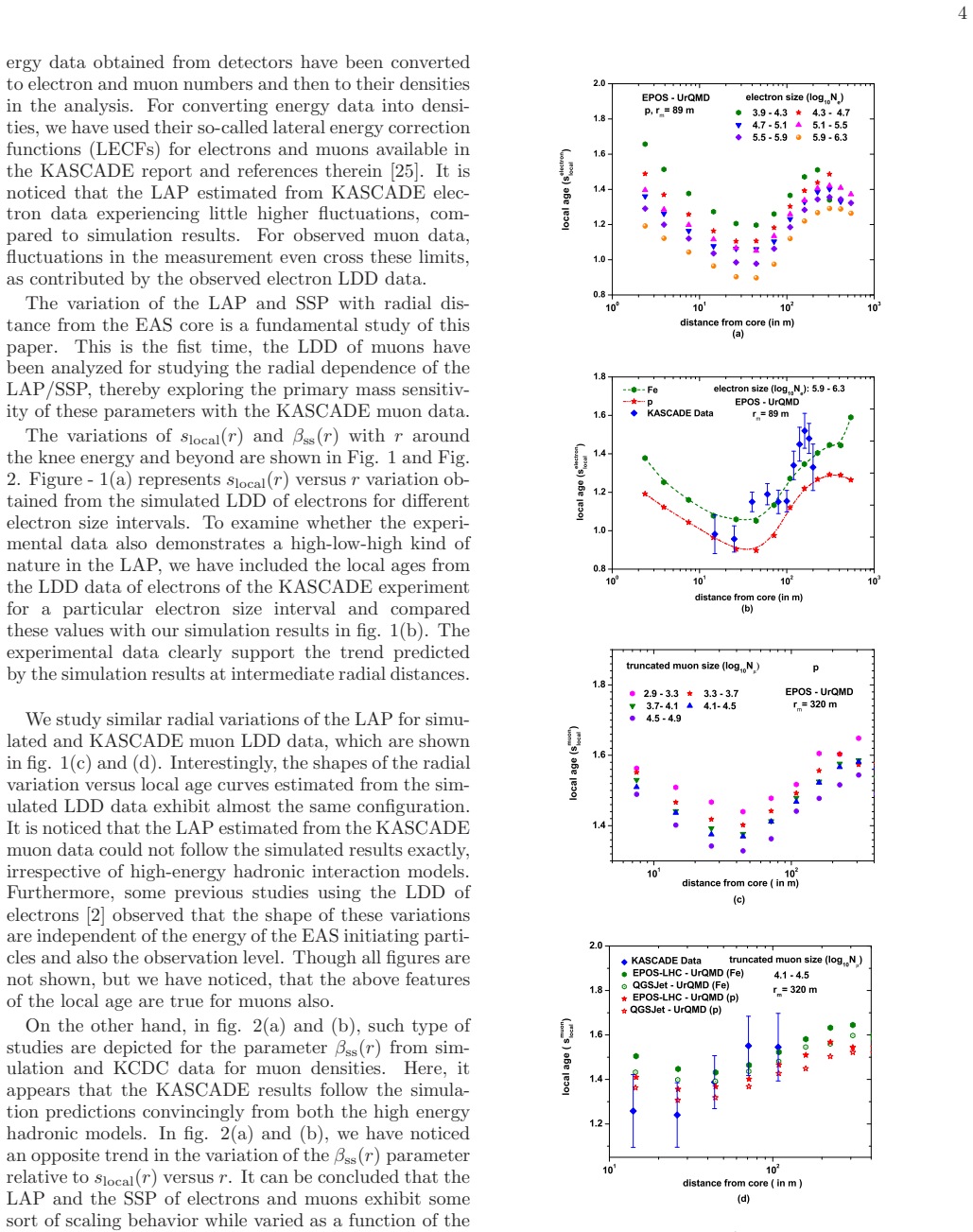
The LDD of electrons in a shower manifests some sort of scaling (shower size independent) nature in terms of the LAP. This feature of the LAP still persists when the parameter has been estimated from the LDD of muons. The radial variation of the LAP follows a config- uration where with an increasing of the core distance, the parameter decreases initially a...
-
[2]
Figure - 1(a) represents slocal(r) versus r variation ob- tained from the simulated LDD of electrons for different electron size intervals. To examine whether the experi- mental data also demonstrates a high-low-high kind of nature in the LAP, we have included the local ages from the LDD data of electrons of the KASCADE experiment for a particular electron...
-
[3]
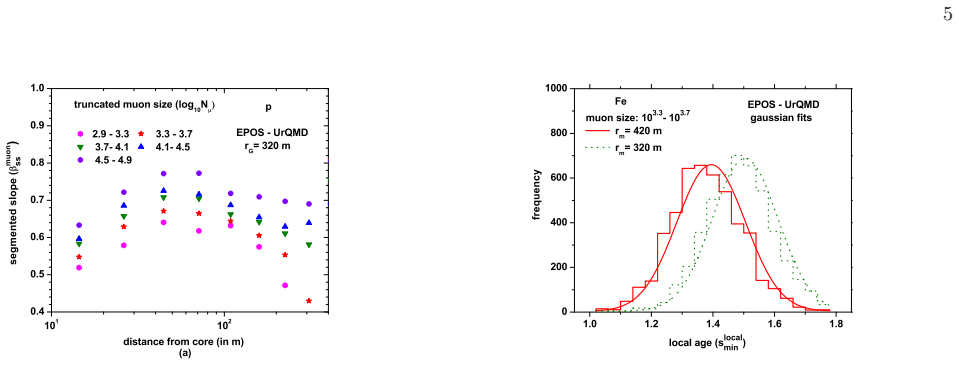
The scale distance such as the Moli´ ere/Greisen ra- dius used in the LDF functions may lead to determine the shape of the slocal(r) or βss(r) versus r curves. The frequency distributions of the minimum values of slocal(r) for two different Moli´ ere radii possess different mean val- ues. This suggests that the scale distance regulates the shape of the sloc...
-
[4]
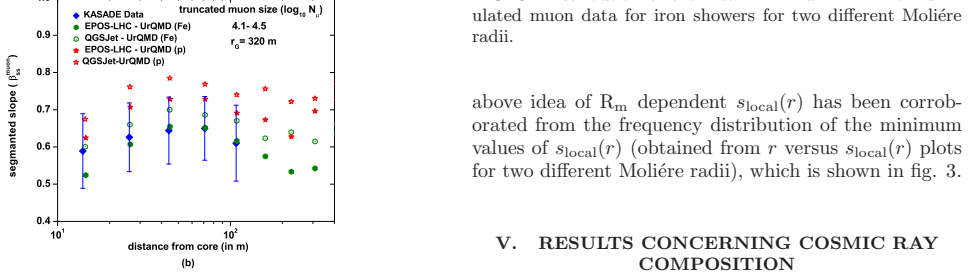
The LDD of muons in a shower also exhibits scaling nature in terms of the SSP. The characteristic feature of SSP versus the core distance curves satisfy a complete opposite configuration compared to the radial variation of the LAP. The SSP estimated from the LDD of muons follows a low-high-low kind of radial variation at least within the range 10 − 300 m. ...
- [5]
-
[6]
The KASCADE experimental data in figures 4, 5 and 6 in terms of the important measured parameters (mean minimum LAP and mean maximum SSP) indicate that the CR mass composition follows a gradual change from predominantly lighter (proton-dominated) to heav- ier (iron-dominated) nuclei with the increase of shower size and muon size or energy. This above featu...
work page 2015
-
[7]
J. N. Capdevielle and J. Procureur, Proc. 18th ICRC, Bangalore, 11 307 (1983)
work page 1983
-
[8]
R. K. Dey, A. Bhadra and J. N. Capdevielle, J. Phys. G:Nucl. Part. Phys. 39 085201 (2012)
work page 2012
Show all 32 references
-
[9]
J. N. Capdevielle and J. Gawin, J. of Physics G, 8, 1317 (1982)
1982
-
[10]
D. Heck, J. Knapp, J. N. Capdevielle, G. Schatz and T. Thouw, FZKA report-6019 ed. FZK The CORSIKA Air Shower Simulation Program , Karlsruhe (1998)
1998
-
[11]
R. K. Dey and S. Dam, Eur. Phys.J. Plus 131: 402 (2016)
2016
-
[12]
Moli‘ere,: Cosmic Radiation, W
G. Moli‘ere,: Cosmic Radiation, W. Heisenberg, ed., Dover Publications, New York, 1st ed., (1946)
1946
-
[13]
Rossi and K Greisen, Rev
B. Rossi and K Greisen, Rev. Mod. Phys. 13, 240 (1941)
1941
-
[14]
Nishimura, and K
J. Nishimura, and K. Kamata: Progr. Theor. Phys., 5, 899 (1950)
1950
-
[15]
Kamata and J
K. Kamata and J. Nishimura, Prog. Theor. Phys. Suppl. 6, 93 (1958)
1958
-
[16]
Lipari, Phys
P. Lipari, Phys. Rev. D 79 063001 (2009)
2009
-
[18]
J. N. Capdevielle, J. Cohen, J. Phys. G: Nucl. Part. Phys . 31 507 (2005)
2005
-
[19]
Bourdeau, J.N
M.F. Bourdeau, J.N. Capdevielle and J. Procureur, J. Phys.G, 6, 901, (1980)
1980
-
[20]
Two smaller samples of the MC events have also been generated with combinations, QGSJet01.c [22] - UrQMD and EPOS- LHC [23]-UrQMD
interaction model for the high-energy hadronic in- teractions, in combination with the UrQMD model [21] for the low-energy hadronic interactions. Two smaller samples of the MC events have also been generated with combinations, QGSJet01.c [22] - UrQMD and EPOS- LHC [23]-UrQMD. ...
-
[21]
Greisen, Prog
K. Greisen, Prog. in Cosmic Ray Physics, North Holland, Co., Amsterdam, 3 1 (1956)
1956
-
[22]
Capdevielle et al., J
J.N. Capdevielle et al., J. Phys. G: Nucl. Part. Phys. 31 507 (2005)
2005
-
[23]
Nagano et al., J
M. Nagano et al., J. Phys. Soc. Japan 53 (1984) 1667
1984
-
[24]
J. N. Capdevielle and P. Gabinski, J. Phys. G.:Nucl. Par t. Phys. 16, 769 (1990)
1990
-
[25]
S. K. Gupta et al., Nucl. Instr. Meth. A, 540, 311 (2005)
2005
-
[26]
Werner, et al., Phys
K. Werner, et al., Phys. Rev. C 74, 044902 (2006)
2006
-
[27]
Bleicher, et al., J
M. Bleicher, et al., J. Phys. G: Nucl. Part. Phys. 25, 185 9 (1999)
1999
-
[28]
N. N. Kalmykov, S. S. Ostapchenko and A. I. Pavlov Nucl. Phys. B (Proc. Suppl.) 52 17 (1997)
1997
-
[29]
L. G. Dedenko et al., J. Phys. Conf. Series, 934 012017 (2017)
2017
-
[30]
W. R. Nelson, H. Hiramaya, D. W. O. Rogers, Report 8 SLAC 265, (1985)
1985
-
[31]
Apel et al., Nucl
W.D. Apel et al., Nucl. Instrum. Methods, A 620 (23):202, (2010)
2010
-
[32]
Sanyal et al., Aust
S. Sanyal et al., Aust. J. Phys. 46 589 (1993)
1993
-
[33]
Antoni et al., Astropart
T. Antoni et al., Astropart. Phys. 14 245 (2001)
2001
Reviewed August 14, 2026 · model on record in the stance chip above.
Discussion (0). Continue with ORCID to comment.