REVIEW 2 major objections 5 minor 23 references
Hecke algebra trace algorithm and some conjectures on weaving knots
T0 review · 2 major / 5 minor · reviewed 2026-08-14 · deepseek-v4-flash
Pith's one-line read The trace of the Hecke algebra representation of any braid can be computed by an explicit recursive algorithm, giving the Alexander, Jones, HOMFLY-PT polynomials and Khovanov homology for weaving knots.
desk verdict The trace algorithm is a solid, reproducible computational contribution; the claimed volume-bound improvements in Section 5 are conditional on unproven strictness and should be reframed as conjectural. read the letter →
The pith
A machine-rendered reading of the paper's core claim, the machinery that carries it, and where it could break.
The reading
What carries the argument
The central object is the Hecke algebra $H_{n+1}(q)$: the algebra with generators $T_1,\dots,T_n$ and relations $T_iT_j=T_jT_i$ for $|i-j|\ge 2$, $T_iT_{i+1}T_i=T_{i+1}T_iT_{i+1}$, and $T_i^2=(q-1)T_i+q$. Its trace $\operatorname{Tr}$ is the unique linear functional with $\operatorname{Tr}(1)=1$, $\operatorname{Tr}(ab)=\operatorname{Tr}(ba)$, and $\operatorname{Tr}(aT_ib)=z\operatorname{Tr}(ab)$. The algorithm's moving parts are: a basis $\mathcal{B}_n$ of words $\beta^l_n$ built from products $u^j_i = T_iT_{i-1}\cdots T_{i-j+1}$; rewriting rules that express products of basis elements back in the basis; a recursion for $\operatorname{Tr}(\beta^l_n)$; and, for weaving braids, a recursion for the coefficient polynomials $f^m_l(q)$. The trace function converts the final linear combination into a Laurent polynomial in $q$ and $z$.
What would settle it
Compute the $k$-th twist numbers $T_k(W(n+1,m))$ for $m$ much larger than in the tables (for example, $m\approx 10^4$) and test whether $f_k(m)=T_k(m)\big/\big(((r+d)^k+r^k)m^k/k!\big)$ is within numerical error of 1; for the volume claim, compute relative volume with a hyperbolic-volume program for several large $m$ and check whether the proposed $L^3_k(m)$ stays below $v_n(m)$ and $U^3_k(m)$ stays above it. A counterexample to either would refute Conjecture 5.2 or the strictness premise.
Extended reading notes
Core claim
The paper's central assertion is that there is an algorithm which, given any braid word, expresses the image of the braid in the Hecke algebra $H_{n+1}(q)$ as a linear combination of basis elements and then evaluates the trace using the trace axioms; specialized to weaving braids $\sigma_{n+1,m}$, this becomes a recursion (Theorem 3.6) and yields a concrete computer program. From the trace, the paper derives the universal skein invariant and hence the Alexander, Jones, and HOMFLY-PT polynomials. For alternating weaving knots with $\gcd(n+1,m)=1$, it combines the Jones polynomial with the signature to produce Khovanov homology via the two-line support theorem. In addition, the paper states Conjecture 5.2, that the $k$-th twist number $T_k(m)$ of $W(n+1,m)$ is asymptotic to $\big((r+d)^k + r^k\big) m^k / k!$ for fixed $n$, and Conjecture 6.4, that normalized Khovanov ranks along the support lines approach a normal distribution for even $n$.
Load-bearing premise
The load-bearing premise is that the finite-table observation $f_k(m)\to 1$ as $m$ grows (Equation 5.5 and Conjecture 5.2) really holds for all large $m$, and that the known volume inequalities in (5.4) are strict; if either fails, the proposed improved volume bounds may not be bounds at all.
Editorial extensions
If this is right
- For any braid, the trace of its Hecke algebra representation can be computed by a uniform series of recursions, so the polynomial invariants of its closure no longer require an ad hoc basis expansion by hand.
- For weaving knots $W(n,m)$, the same routine outputs the Alexander, Jones, and HOMFLY-PT polynomials for arbitrary $n$ and $m$ up to computational limits.
- For alternating weaving knots with $\gcd(n+1,m)=1$, the Jones polynomial and signature determine the Khovanov ranks, so the trace routine also yields Khovanov homology.
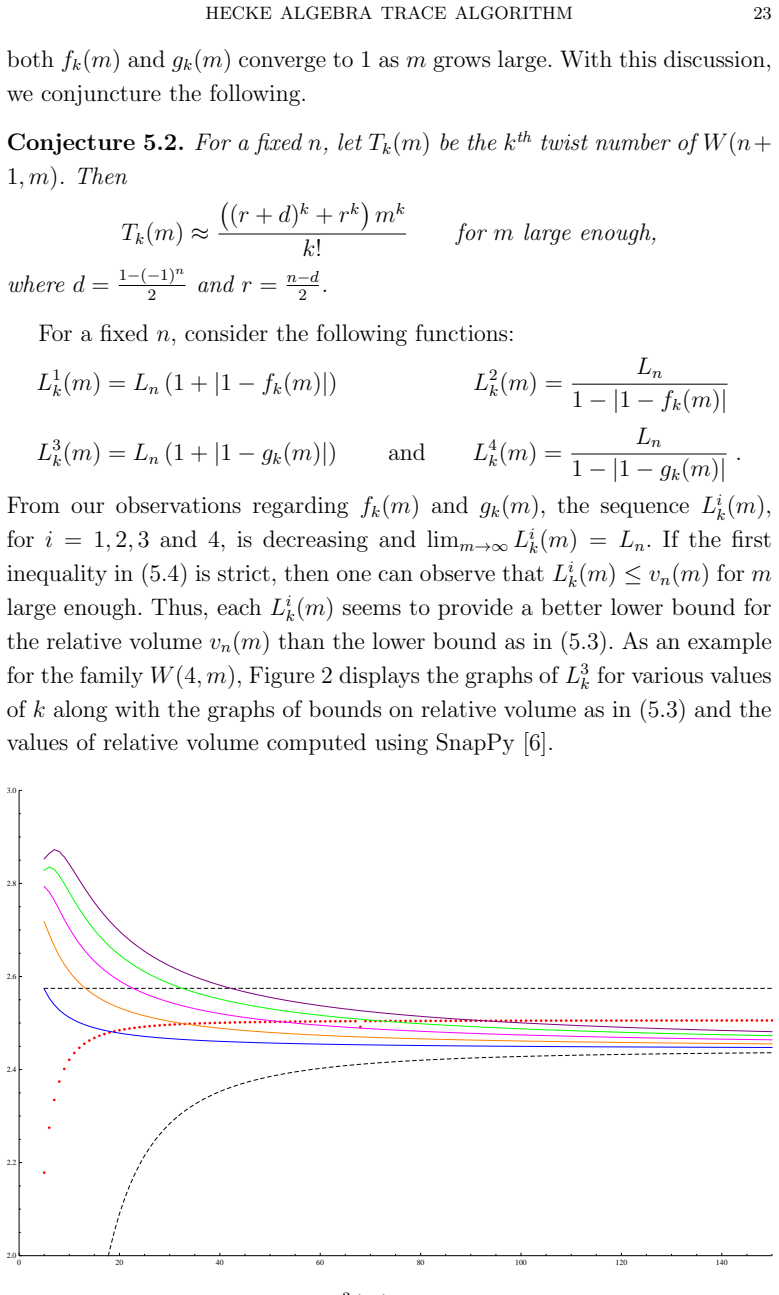
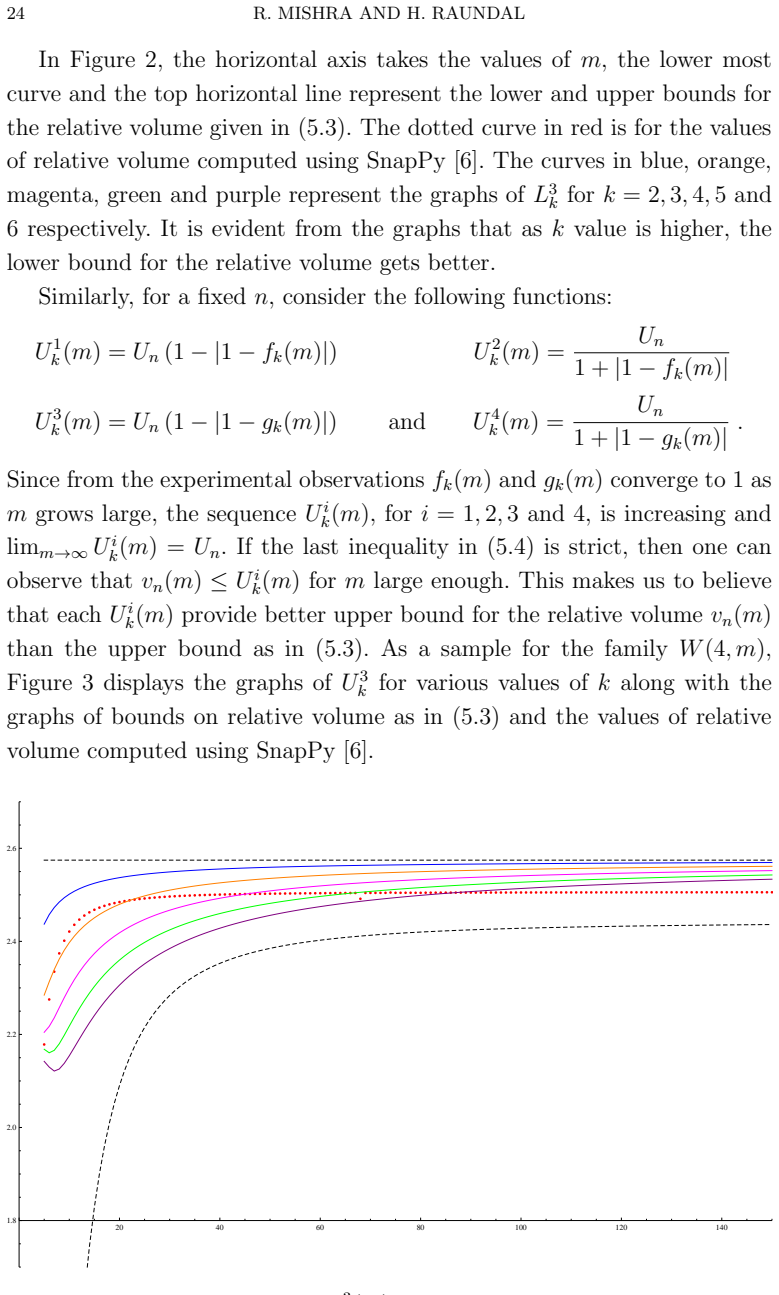
- If Conjecture 5.2 holds, the higher twist numbers $T_k(W(n+1,m))$ grow like $\big((r+d)^k+r^k\big)m^k/k!$ for fixed $n$, and the derived functions $L^i_k(m)$ and $U^i_k(m)$ give volume bounds claimed to improve on existing bounds.
Reading between the lines
- The same recursion could be applied to other infinite braid families with periodic or structured words, replacing hand-computed cases like $W(3,m)$ with a general routine; the paper only demonstrates weaving braids.
- If the twist-number asymptotics hold, they give an explicit asymptotic formula for the Jones polynomial coefficients of weaving knots, which might be probed independently through the colored Jones polynomial or the volume conjecture; this connection is not made in the paper.
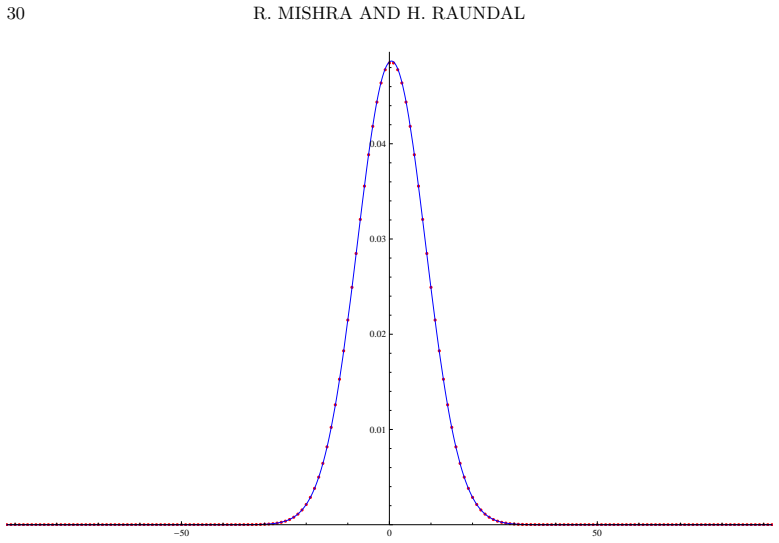
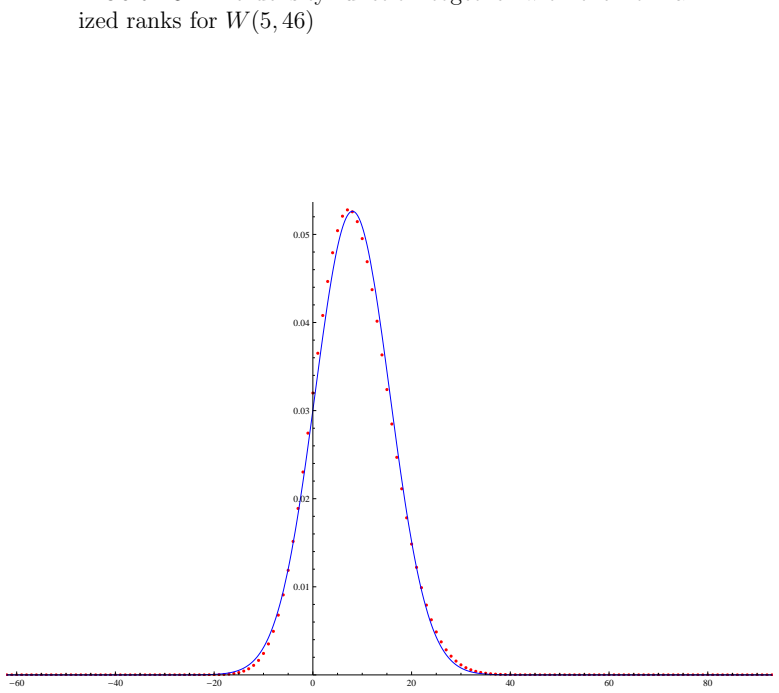
- The normal-distribution conjecture for even $n$, if true, would make weaving knots a natural family of homologically thin knots with Gaussian-distributed Khovanov ranks, suggesting a possible link to random-walk models of knot homology; this is an interpretive parallel, not a paper claim.
Signed reviews
Editorial analysis
A structured set of objections, weighed in public.
Referee Report
Summary. The paper develops a recursive algorithm for computing the trace of the Hecke algebra representation of an arbitrary braid, using the standard trace axioms together with a basis of the Hecke algebra. It specializes the algorithm to weaving braids and provides a Mathematica implementation. From the computed traces the authors derive Alexander, Jones, and HOMFLY-PT polynomials for weaving knots W(n,m) and use known results for alternating knots to compute Khovanov ranks. The paper also studies higher twist numbers of weaving knots, proposes conjectural improved volume bounds based on numerical data, and conjectures asymptotic normality of normalized Khovanov ranks.
Significance. If the central algorithm is correct, it gives an explicit automatable route from a braid word to the trace of its Hecke algebra element and hence to several link invariants. This is a genuinely useful computational contribution. The paper's spot checks against known knots and links--for example W(3,2) as the figure-eight knot, W(5,2) as 8_12, and W(4,3) as the mirror of 9_40--provide independent evidence that the trace algorithm and its implementation are producing the correct invariants. The volume-bound and Khovanov-normality parts of the paper are clearly experimental: they are formulated as conjectures or as conditional statements, and the authors are transparent about the main caveat in Remark 5.3. For these reasons, the trace algorithm deserves publication after the identified issues are fixed.
major comments (2)
- [Section 3, Lemma 3.7] Lemma 3.7 is false as stated if the word is allowed to contain inverses of the generators T_k. For example, Tr(T_1^{-1}) = q^{-1}(z + 1 - q), whose degree in q,z is not the word length of T_1^{-1}. If the lemma is intended only for positive words in T_1,...,T_n, that restriction must be stated explicitly, and Proposition 3.8, which invokes Lemma 3.7, must be justified under that restriction. The present proof is also heuristic: it assumes that the leading contributions from different words do not cancel and that no other operation affects the relevant degree, which is not established. These degree claims do not appear to be used in the trace algorithm itself, but they are stated results and need correction.
- [Section 5, Equations (5.2)-(5.4) and Remark 5.3] The proposed 'improved' volume bounds L_i^k(m) and U_i^k(m) are only valid if the corresponding inequalities in (5.4) are strict, and the paper does not prove strictness. Moreover, since the numerical functions f_k(m) and g_k(m) appear to converge to 1, the quantities L_i^k(m) converge to L_n from the same side that would make them fail as bounds if liminf_m v_n(m) equals L_n. The authors acknowledge this in Remark 5.3, but that acknowledgment means the headline claim of better volume bounds is conditional on an unproved hypothesis. The section should be reframed as a conjectural comparison, or a proof of the needed strict inequalities must be supplied.
minor comments (5)
- [Section 3 / Section 4] The notation for weaving knots is confusing: the introduction defines W(n,m) using the braid on n strands, while Theorem 3.6 and the program use W(n+1,m) with generators up to T_n. The indexing should be unified and stated once in one place.
- [Section 3] The Mathematica code is typeset with many symbol artifacts that make it hard to reproduce; a clean notebook or a machine-readable listing should be provided as supplementary material.
- [Tables 3-6] The notes below Tables 3-6 say the values are shown for 1 <= k <= 8, but the tables only display columns for k = 2 through k = 7 (or k = 8 for W(5,m)); the notes should match the displayed range.
- [Section 6] In the sentence introducing formula (6.1), 'we can obtain the for the Khovanov polynomial' has a missing word; it should read 'we can obtain the formula for the Khovanov polynomial'.
- [Throughout] There are several typos, including 'conjuncture' instead of 'conjecture' in Section 5; a careful proofreading pass is recommended.
Circularity Check
No significant circularity: the Hecke trace algorithm is an inductive derivation from the defining algebra relations, and the Section 5 volume-bound improvement is explicitly conditional rather than a fitted prediction.
full rationale
The central trace algorithm is self-contained in the relevant sense: Propositions 3.2 through 3.5 and Theorem 3.6 reduce products and traces to the Hecke algebra relations and the trace axioms stated in Theorem 2.3, which is quoted from the external reference [9]. The trace of a basis element is computed by induction via Lemma 3.3 and Proposition 3.4, and the trace of a general braid representation is then assembled by expressing the braid word in the Hecke basis. No invariant being computed is fed back into the algorithm; in particular, the Jones, Alexander, HOMFLY-PT, and Khovanov outputs are not used as inputs to the trace computation. The polynomial invariants are obtained by standard substitutions into the universal skein formula (4.1) from [9, 12], and the paper provides external spot checks such as W(3,2) matching the figure-eight knot, W(5,2) matching 8_12, and Rolfsen/Thistlethwaite table comparisons. The Khovanov section uses a self-citation for the signature formula, Proposition 6.2 from [18], but that is a standalone theorem from the authors' earlier work and is not identical to the Khovanov ranks being reported; it is externally checkable and is not a fitted or constructed input. The most delicate part is Section 5, where the proposed improved volume bounds L_i^k(m) and U_i^k(m) depend on the empirical quantities f_k(m) and g_k(m). The paper explicitly concedes in Remark 5.3 that these functions are guaranteed bounds only if the inequalities in (5.4) are strict, which is not established. That is a genuine limitation and a correctness risk for the conjectural volume claims, but it is not circularity: the functions are not fitted to volume data, and the conjectural convergence in Conjecture 5.2 is presented as an empirical observation from the authors' computed tables rather than as a derived prediction. Similarly, Conjecture 6.4 about normalized Khovanov ranks approaching a normal distribution is an empirical summary, not a consequence imposed by the algorithm. Overall, no step in the derivation reduces by construction to its own inputs, and the central trace algorithm is supported by independent algebraic derivation and external benchmark checks.
Assumptions & free parameters
assumptions (5)
- standard math The Hecke algebra trace is uniquely determined by the axioms Tr(1)=1, Tr(ab)=Tr(ba), and Tr(aT_i b)=z Tr(ab) (Theorem 2.3).
- standard math The sets B_i form a basis of H_{i+1}(q) (Section 2).
- standard math The braid group representation ρ(σ_i)=T_i sends braids to the monoid of H_{n+1}(q) (Section 3).
- domain assumption Alternating knots have Khovanov homology supported on two lines, and Lee's theorem determines these lines from the signature and Jones polynomial (Theorem 6.1).
- domain assumption Weaving knots W(n+1,m) are alternating and hyperbolic for the relevant parameters (Sections 5 and 6).
Cite this review
Pith. "Pith review of Hecke algebra trace algorithm and some conjectures on weaving knots." pith.science (2026). https://pith.science/paper/SKC2LGDD
@misc{pith2026190804152,
  author       = {Pith},
  title        = {Pith review of: Hecke algebra trace algorithm and some conjectures on weaving knots},
  year         = {2026},
  howpublished = {\url{https://pith.science/paper/SKC2LGDD}},
  note         = {Machine review of arXiv:1908.04152}
}
abstract
Computing polynomial invariants for knots and links using braid representations relies heavily on finding the trace of Hecke algebra elements. There is no easy method known for computing the trace and hence it becomes difficult to compute the known polynomial invariants of knots using their braid representations. In this paper, we provide an algorithm to compute the trace of the Hecke algebra representation of any braid. We simplify this algorithm and write a Mathematica program to compute the invariants such as Alexander polynomial, Jones polynomial, HOMFLY-PT polynomial and Khovanov homology of a very special family of knots and links $W(n,m)$ known as weaving knots by expressing them as closure of weaving braids. We also explore on the relationship between the topological and geometric invariants of this family of alternating and hyperbolic knots (links) by generating data for the subfamilies $W(3,m)$, $W(4,m)$, $W(5,m)$ and $W(6,m)$ of weaving knots.
Figures

Figures from the paper (4 more)


Reference graph
Works this paper leans on
-
[1]
J. W. Alexander, Topological invariants of knots and links , Trans. Amer. Math. Soc. 30 (1928), 275–306
work page 1928
-
[2]
S. J. Bigelow, Braid groups and Iwahori-Hecke algebras , in: Prob- lems on mapping class groups and related topics, Proc. Sympos. Pure Math. 74, Amer. Math. Soc., Providence, RI, 2006, 285–299
work page 2006
-
[3]
G. Burde and H. Zieschang, Knots, 2nd ed., de Gruyter Studies in Mathematics 5, Walter de Gruyter, Berlin, 2003
work page 2003
-
[4]
A. Champanerkar, I. Kofman and J. S. Purcell, Geometrically and diagrammatically maximal knots , J. Lond. Math. Soc. 94 (2016) 883–908
work page 2016
-
[5]
A. Champanerkar, I. Kofman and J. S. Purcell, Volume bounds for weaving knots, Algebr. Geom. Topol. 16 (2016) 3301–3323
work page 2016
- [6]
-
[7]
O. T. Dasbach and X.-S. Lin, A volumish theorem for the Jones polynomial of alternating knots , Pacific J. Math. 231 (2007) 279– 291. 32 R. MISHRA AND H. RAUNDAL
work page 2007
- [8]
Show all 23 references
-
[9]
P. D. L. Harpe, M. Kervaire and C. Weber,On the Jones polynomial, Enseign. Math. 32 (1986) 271–335
1986
-
[10]
W. W. Hines, D. C. Montgometry, D. M. Goldsman and C. M. Borror, Probability and statistics in engineering, 4th ed., John Wiley & Sons, 2003
2003
-
[11]
V. F. R. Jones, A polynomial invariant for knots via von Neumann algebras, Bull. Amer. Math. Soc. (N. S.) 12 (1985), 103–111
1985
-
[12]
V. F. R. Jones, Hecke algebra representations of braid groups and link polynomials, Ann. of Math. 126 (1987) 335–388
1987
-
[13]
Khovanov, A categorification of the Jones polynomial , Duke Math
M. Khovanov, A categorification of the Jones polynomial , Duke Math. J. 101 (2000) 359–426
2000
-
[14]
E. S. Lee, An endomorphism of the Khovanov invariant, Adv. Math. 197 (2005) 554–586
2005
-
[15]
E. S. Lee, The support of the Khovanov’s invariants for alternating knots, arXiv:math/0201105v1 (2002)
2002 arXiv
-
[16]
W. B. R. Lickorish and K. C. Millett, A polynomial invariant of oriented links, Topology 26 (1987) 107–141
1987
-
[17]
Mishra and H
R. Mishra and H. Raundal, Hecke algebra trace algorithm and some conjectures on weaving knots , Notebook Archive, https://notebookarchive.org/2020-01-7fugqlj, 2020
2020
-
[18]
Mishra and R
R. Mishra and R. Staffeldt, Polynomial invariants, knot ho- mologies, and higher twist numbers of weaving knots W (3,n ), arXiv:1902.01819v2 (2019)
2019 arXiv
-
[19]
Murakami, An introduction to the volume conjecture and its gen- eralizations, Acta Math
H. Murakami, An introduction to the volume conjecture and its gen- eralizations, Acta Math. Vietnam. 33 (2008) 219–253
2008
-
[20]
J. H. Przytycki and P. Traczyk, Conway algebras and skein equiva- lence of links , Proc. Amer. Math. Soc. 100 (1987), 744–748
1987
-
[21]
A. N. Shumakovitch, Torsion in Khovanov homology of homologi- cally thin knots , arXiv:1806.05168v1 (2018)
2018 arXiv
-
[22]
A. N. Shumakovitch, Torsion of Khovanov homology , Fund. Math. 225 (2014) 343–364
2014
-
[23]
W. P. Thurston, Three dimensional manifolds, Kleinian groups and hyperbolic geometry, Bull. Amer. Math. Soc. (N. S.) 6 (1982) 357– 381. HECKE ALGEBRA TRACE ALGORITHM 33 Table 3. Values offk(m) for W (3,m ) k 2 3 4 5 6 7 m 35 0 .971429 0 .920816 0 .855883 0 .784009 0 .711201 0 ...
1982
Reviewed August 14, 2026 · model on record in the stance chip above.
Discussion (0). Continue with ORCID to comment.