REVIEW 4 major objections 4 minor 27 references
Configuration spaces of disks in an infinite strip
T0 review · 4 major / 4 minor · reviewed 2026-08-14 · deepseek-v4-flash
Pith's one-line read Hard-disk configuration spaces in a strip have Betti numbers that grow exponentially in the liquid regime, at rate $(q+1)^n n^{qw+2r}$.
desk verdict New asymptotic growth rates for Betti numbers of disk configuration spaces in a strip, with a real but likely repairable gap in the deformation-retraction lemma. read the letter →
The pith
A machine-rendered reading of the paper's core claim, the machinery that carries it, and where it could break.
The reading
What carries the argument
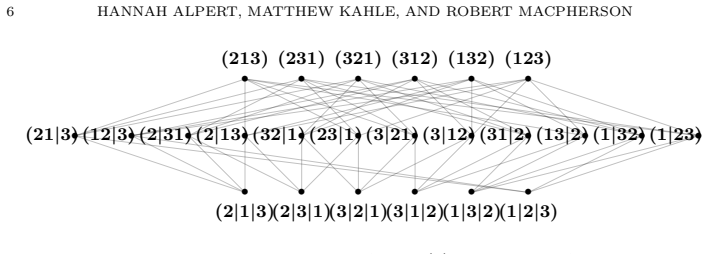
The central objects are $\mathrm{cell}(n,w)$, a subcomplex of the Salvetti complex whose cells are permutations with bars and with no block of more than $w$ entries, and a good cover $U_\alpha$ used to prove the homotopy equivalence $C(n,w) \simeq \mathrm{cell}(n,w)$ through the nerve theorem. The deformation retraction from $U(n,w)$ to the disk configuration space is driven by a vector field that raises the tautological function $\tau$ at a controlled rate. For lower bounds, the paper constructs embedded tori $Z_\alpha$ labeled by special symbols and closed dual submanifolds $Z^*_\alpha$, then uses the intersection pairing between homology and homology with closed supports to show these cycles are linearly independent, yielding the exponential lower bound. For upper bounds, a discrete gradient vector field collapses $\mathrm{cell}(n,w)$ to a complex whose critical cells are coded by skylines; counting those cells gives the matching exponential upper bound.
What would settle it
A direct persistent-homology computation of $\beta_1[C(9,3)]$ must give 36, since the gas-regime isomorphism identifies it with $\beta_1[C(9,\mathbb{R}^2)]$; a simultaneous computation of $\beta_6[C(9,4)]$ must give a nonzero value, as the liquid regime requires. A violation at either value would pinpoint a failure in the homotopy-equivalence chain behind the asymptotic claims.
Extended reading notes
Core claim
The paper's central claim is that the homology of hard-disk configuration spaces in a strip changes character at a sharp threshold: once $j \ge w-1$, the Betti number $\beta_j[C(n,w)]$ stops being polynomial and grows exponentially in $n$, at the rate $(q+1)^n n^{qw+2r}$, where $j = q(w-1) + r$ and $0 \le r < w-1$. In the complementary range $0 \le j \le w-2$, the inclusion of $C(n,w)$ into the point configuration space $C(n,\mathbb{R}^2)$ induces an isomorphism on $H_j$, so $\beta_j[C(n,w)]$ is the unsigned Stirling number $\left[{n \atop n-j}\right]$ and grows as a polynomial in $n$ of degree $2j$. For $w=0$, or $w=1$ with $j \ge 1$, the homology vanishes; for $w=1$ and $j=0$, $\beta_0 = n!$. The paper also proves a complete finite-$n$ phase portrait in the $(w,j)$-plane, dividing degrees into homological solid, liquid, and gas regimes.
Load-bearing premise
The proof rests on a geometric flow that moves any configuration with no vertical stack of $w+1$ points so that its minimal disk diameter grows at a guaranteed speed; if that flow cannot be constructed as claimed, the homotopy equivalence and the bounds built on it would need to be reworked.
Editorial extensions
If this is right
- In the gas regime, hard disks are indistinguishable from point particles for homology in degrees $j \le w-2$: the inclusion induces $H_j[C(n,w)] \cong H_j[C(n,\mathbb{R}^2)]$ for every $n$.
- In the liquid regime, the exponential base is $q+1$, so for a fixed strip width, larger homology degree comes with a faster exponential growth rate, and the polynomial correction is $n^{qw+2r}$.
- For every finite $n$, the phase portrait gives exact boundaries: $H_j[C(n,w)] = 0$ for $j \ge n - \lceil n/w \rceil + 1$, and $H_j[C(n,w)] \ne 0$ but not isomorphic to point-particle homology for $w-1 \le j \le n - \lceil n/w \rceil$.
- The space $C(n,2)$ is aspherical: it admits a locally CAT(0) cube complex structure, so its higher homotopy groups vanish.
Reading between the lines
- The formula has a statistical-mechanics flavor: the factor $(q+1)^n$ counts placements of the leftover disks in the gaps between maximal vertical blocks, so the exponential growth rate may be interpreted as a free-energy-like quantity for which a generating function could exist.
- The numerical coincidence the paper observes between $H_1(C(n,2))$ and the first homology of the $(n+1)$-point k-equal manifold suggests there may be a natural map between those spaces; finding it would connect disk configuration spaces to the well-developed homology theory of k-equal arrangements.
- The skyline coding that makes the upper bound efficient may extend to related hard-particle configuration spaces, such as mixtures of disk sizes or disks in higher-dimensional slabs, giving analogous exponential Betti bounds.
Signed reviews
Editorial analysis
A structured set of objections, weighed in public.
Referee Report
Summary. The paper studies the configuration space C(n,w) of n unit-diameter hard disks in an infinite strip of width w. It proves an asymptotic description of the Betti numbers beta_j[C(n,w)] for fixed j and w as n tends to infinity: in the 'gas' regime w >= j+2 the Betti numbers are those of the plane configuration space and grow polynomially, in the 'liquid' regime j >= w-1 they grow exponentially with an explicit base and polynomial correction, and in the 'solid' regime the homology is trivial. The paper also proves a finite-n phase portrait. The proof strategy is to identify C(n,w) with a subcomplex of the Salvetti complex via a nerve cover and a deformation retraction, obtain lower bounds by explicit intersecting torus cycles, and obtain upper bounds by a discrete Morse matching; an appendix computes Betti numbers for n <= 8.
Significance. If the main theorems are correct, this is a significant contribution to the topology of configuration spaces of hard disks, giving the first systematic asymptotic picture and a finite-n phase portrait that are both conceptually clean and quantitatively explicit. The methods are largely self-contained, the arguments contain no fitted parameters, and the computational appendix with PHAT provides useful independent evidence for small n. The strengths are real: the nerve-theoretic comparison to the Salvetti complex, the explicit torus cycles, and the skyline-counting upper bounds are elegant ideas. However, several load-bearing steps in the written proofs are sketched rather than completed, especially the construction of the deformation retraction in Section 3.2 and the transversality check in Section 4. These gaps do not appear to point to a counterexample, but they need to be filled before the central claims are fully established.
major comments (4)
- [Section 3.2, Lemma 3.5] The construction of x(p) is described only for pairs of consecutive blocks, and the proof verifies the required increase rate only for short measurements realized by points in those consecutive blocks. A short measurement can be realized by points in two non-consecutive blocks, and the increase in their horizontal separation is only an indirect sum of the chosen increases in the intervening consecutive gaps. The text does not prove that this sum achieves the required rate 2*sqrt(1/w(alpha) - m(p)) for every active short measurement, especially when some intermediate consecutive gap is left unchanged. Since Lemma 3.5 is the core of Theorem 3.3, this is a load-bearing gap.
- [Section 3.2, proof that Lemma 3.5 implies Theorem 3.3] The proof defines v(p) as a partition-of-unity combination of the local vector fields v_alpha(p) and then uses an ODE argument to conclude that the flow reaches C_{1/w}(n,1) in time at most 1. This requires continuity of lambda(p), x(p), and hence v_alpha(p); lambda(p) is defined as a minimum over a set of short measurements that changes as p varies, and the text does not prove that this minimum varies continuously. The assertion that the directional derivative of tau is always well-defined is also stated without proof. Without these facts, the existence of the flow and the claim that it stays inside U(n,w) until reaching the target are not fully justified.
- [Section 4, Theorem 4.4] The lower-bound argument relies on Lemma 4.1, whose condition (4) requires that Z_alpha intersects Z*_alpha transversely in a point. The proof of Theorem 4.4 asserts the single-point intersection and then says 'We omit the details' for the tangent-space direct-sum check. This transversality check is essential for linear independence of the cycles and therefore for the lower-bound half of Theorem 1.1(2); it should either be supplied or replaced by a precise reference.
- [Section 3.2, Theorem 3.4, Step 2] The algorithm producing A_p imposes the condition y_{sigma_l} > y_{sigma_l'} + 1, which is incompatible with the ambient condition 0 < y_k < 1 and with Definition 2.3, where the same-block condition is simply y_{sigma_l} > y_{sigma_l'}. The same impossible '+1' appears later in the chain-to-point construction. This is probably a typographical error, but because the algorithm is load-bearing for the identification of the nerve with the barycentric subdivision of cell(n,w), the correct strict inequality should be stated and the surrounding argument checked.
minor comments (4)
- [Throughout, Theorem 3.1 and Section 3.3] Several inclusions are printed with a missing arrow, for example 'C(n,w) contained in C(n,w+1)' in Theorem 3.1 and 'C(n,w) contained in C(n,R^2)' in the proof of Theorem 1.1(1); these should be typeset with the inclusion arrow.
- [Section 4, proof of Theorem 1.1(2)] The lower-bound formula contains malformed brace markup in the multinomial coefficient and is hard to read; please typeset the multinomial coefficient properly.
- [Section 5, proof of Theorem 1.2(2)] The first sentence of the proof says '0 <= j <= n - ceil(n/w)', while the theorem statement requires 'w-1 <= j <= n - ceil(n/w)'; the proof later uses j >= w-1, so the displayed range should be corrected.
- [References] Reference [12] appears to cite Davis's book as a chapter in 'Introduction to modern mathematics' with volume 33; please verify the bibliographic data.
Circularity Check
No significant circularity: the derivation is self-contained and relies only on standard theorems and independent prior results.
full rationale
The paper's central claims (Theorem 1.1 and Theorem 1.2) are proved from an internal chain of constructions: the homotopy equivalence C(n,w) ≃ cell(n,w) via the nerve theorem and a deformation retraction, lower bounds from explicitly constructed torus cycles and intersection duality, and upper bounds from a discrete Morse vector field with counted critical cells. No parameter is fitted to data and no Betti number is used as an input to produce another Betti number. The gas-regime comparison uses Arnold's independent computation of Betti numbers of C(n,R^2), which is external and not derived from the present paper's assumptions. The citation of the 'tautological function' to [3], with overlapping authorship, is not load-bearing: the function is explicitly defined in this paper and its properties are proved here, and the cited paper is used for terminology rather than as the sole justification of the deformation retraction. The main genuinely questionable point is the proof completeness of Lemma 3.5's vector-field construction, as noted by a skeptical reading: the argument is sketched and may not fully handle all cases, but incompleteness or a gap is a correctness risk, not circularity. There is no step in which an output equals an input by construction, no renamed fitted parameter, and no uniqueness theorem imported from the authors' prior work to forbid alternatives. Therefore the appropriate circularity score is 0.
Assumptions & free parameters
assumptions (6)
- standard math Salvetti complex cell(n) is homotopy equivalent to the configuration space of n points in the plane C(n,R^2).
- standard math Arnold's computation of the Poincaré polynomial of C(n,R^2).
- standard math Nerve theorem: a good open cover of a space has a nerve homotopy equivalent to the space.
- standard math Discrete Morse theory: a discrete gradient vector field gives a homotopy equivalent complex with one cell per critical cell, so Betti numbers are bounded by numbers of critical cells.
- standard math Borel-Moore homology and the intersection pairing on an open manifold.
- standard math Gromov's flag condition criterion for a cube complex to be locally CAT(0).
Cite this review
Pith. "Pith review of Configuration spaces of disks in an infinite strip." pith.science (2026). https://pith.science/paper/ISF4T4EC
@misc{pith2026190804241,
  author       = {Pith},
  title        = {Pith review of: Configuration spaces of disks in an infinite strip},
  year         = {2026},
  howpublished = {\url{https://pith.science/paper/ISF4T4EC}},
  note         = {Machine review of arXiv:1908.04241}
}
abstract
We study the topology of the configuration spaces $C(n,w)$ of $n$ hard disks of unit diameter in an infinite strip of width $w$. We describe ranges of parameter or "regimes", where homology $H_j [C(n,w)]$ behaves in qualitatively different ways. We show that if $w \ge j+2$, then the homology $H_j[C(n, w)]$ is isomorphic to the homology of the configuration space of points in the plane, $H_j[C(n, \mathbb{R}^2)]$. The Betti numbers of $C(n, \mathbb{R}^2) $ were computed by Arnold, and so as a corollary of the isomorphism, $\beta_j[C(n,w)]$ is a polynomial in $n$ of degree $2j$. On the other hand, we show that if $2 \le w \le j+1$, then $\beta_j [ C(n,w) ]$ grows exponentially with $n$. Most of our work is in carefully estimating $\beta_j [ C(n,w) ]$ in this regime. We also illustrate, for every $n$, the homological "phase portrait" in the $(w,j)$-plane--- the parameter values where homology $H_j [C(n,w)]$ is trivial, nontrivial, and isomorphic with $H_j [C(n, \mathbb{R}^2)]$. Motivated by the notion of phase transitions for hard-spheres systems, we discuss these as the "homological solid, liquid, and gas" regimes.
Figures


Figures from the paper (2 more)


Reference graph
Works this paper leans on
-
[1]
Restricting cohomology classes to disk a nd segment configuration spaces
Hannah Alpert. Restricting cohomology classes to disk a nd segment configuration spaces. Topology Appl., 230:51–76, 2017
work page 2017
-
[2]
Vladimir I. Arnold. The cohomology ring of the colored braid group , pages 183–186. Springer Berlin Heidelberg, Berlin, Heidelberg, 2014
work page 2014
-
[3]
Mi n-type Morse theory for configu- ration spaces of hard spheres
Yuliy Baryshnikov, Peter Bubenik, and Matthew Kahle. Mi n-type Morse theory for configu- ration spaces of hard spheres. Int. Math. Res. Not. IMRN , 9:2577–2592, 2014
work page 2014
-
[4]
Ulrich Bauer, Herbert Edelsbrunner, Grzegorz Jablonsk i, and Marian Mrozek. Čech– Delaunay gradient flow and homology inference for self-maps . arXiv:1709.04068, 2017. 28 HANNAH ALPERT, MATTHEW KAHLE, AND ROBERT MACPHERSON Table 1. Betti numbers of C(n, w) for small n and w. Bold font indicates that homology is in the “liquid regime”. n w β0 β1 β2 β3 β4 β5...
arXiv 2017
-
[5]
PHAT – Persistent Homology Algorithms Toolbox
Ulrich Bauer, Michael Kerber, Jan Reininghaus, and Hube rt W agner. PHAT – Persistent Homology Algorithms Toolbox. Journal of Symbolic Computation , 78:76–90, January 2017. Software available at https://bitbucket.org/phat-code/phat
work page 2017
-
[6]
Anders Björner. Subspace arrangements. In First European Congress of Mathematics, Vol. I (Paris, 1992) , volume 119 of Progr. Math., pages 321–370. Birkhäuser, Basel, 1994
work page 1992
-
[7]
Linear decision trees , subspace arrangements and Möbius functions
Anders Björner and László Lovász. Linear decision trees , subspace arrangements and Möbius functions. J. Amer. Math. Soc. , 7(3):677–706, 1994. CONFIGURATION SPACES OF DISKS IN AN INFINITE STRIP 29
work page 1994
-
[8]
Linear decisio n trees: volume estimates and topological bounds
Anders Björner, László Lovász, and A Yao. Linear decisio n trees: volume estimates and topological bounds. In Proc. 24th ACM Symp. on Theory of Computing , volume 170, page
Show all 27 references
-
[9]
k-equal
Anders Björner and Volkmar W elker. The homology of “ k-equal” manifolds and related par- tition lattices. Adv. Math. , 110(2):277–313, 1995
1995
-
[10]
Pavle V. M. Blagojević and Günter M. Ziegler. Convex equ ipartitions via equivariant ob- struction theory. Israel J. Math. , 200(1):49–77, 2014
2014
-
[11]
Computational topology for configuration spaces of hard disks
Gunnar Carlsson, Jackson Gorham, Matthew Kahle, and Je remy Mason. Computational topology for configuration spaces of hard disks. Phys. Rev. E , 85:011303, Jan 2012
2012
-
[12]
Michael W. Davis. The geometry and topology of Coxeter g roups. In Introduction to modern mathematics, volume 33 of Adv. Lect. Math. (ALM) , pages 129–142. Int. Press, Somerville, MA, 2015
2015
-
[13]
Configuration spaces of thick particle s on a metric graph
Kenneth Deeley. Configuration spaces of thick particle s on a metric graph. Algebr. Geom. Topol., 11(4):1861–1892, 2011
2011
-
[14]
The Markov chain Monte Carlo revolutio n
Persi Diaconis. The Markov chain Monte Carlo revolutio n. Bull. Amer. Math. Soc. (N.S.) , 46(2):179–205, 2009
2009
-
[15]
R econstructing functions from random samples
Steve Ferry, Konstantin Mischaikow, and Vidit Nanda. R econstructing functions from random samples. J. Comput. Dyn. , 1(2):233–248, 2014
2014
-
[16]
A user’s guide to discrete Morse theory
Robin Forman. A user’s guide to discrete Morse theory. Sém. Lothar. Combin. , 48:Art. B48c, 35, 2002
2002
-
[17]
Stratified Morse theory , volume 14 of Ergebnisse der Mathematik und ihrer Grenzgebiete (3) [Results in Mathe matics and Related Areas (3)]
Mark Goresky and Robert MacPherson. Stratified Morse theory , volume 14 of Ergebnisse der Mathematik und ihrer Grenzgebiete (3) [Results in Mathe matics and Related Areas (3)] . Springer-Verlag, Berlin, 1988
1988
-
[18]
M. Gromov. Hyperbolic groups. In Essays in group theory , volume 8 of Math. Sci. Res. Inst. Publ., pages 75–263. Springer, New York, 1987
1987
-
[19]
Sparse locally-jammed disk packings
Matthew Kahle. Sparse locally-jammed disk packings. Ann. Comb. , 16(4):773–780, 2012
2012
-
[20]
Real K(π, 1) arrangements from finite root systems
Mikhail Khovanov. Real K(π, 1) arrangements from finite root systems. Math. Res. Lett. , 3(2):261–274, 1996
1996
-
[21]
Lagarias, and Senya Shlosman
Rob Kusner, Wöden Kusner, Jeffrey C. Lagarias, and Senya Shlosman. Configuration spaces of equal spheres touching a given sphere: The twelve spheres problem. In New Trends in Intuitive Geometry, Bolyai Society Mathematical Studies , pages 219–277. Springer-Verlag GMBH, Germany, 2018
2018
-
[22]
Euclidean matchin gs and minimality of hyperplane arrangements
Davide Lofano and Giovanni Paolini. Euclidean matchin gs and minimality of hyperplane arrangements. arXiv:1809.02476, 2018
2018 arXiv
-
[23]
(Discrete) Morse th eory on configuration spaces
Francesca Mori and Mario Salvetti. (Discrete) Morse th eory on configuration spaces. Math. Res. Lett., 18(1):39–57, 2011
2011
-
[24]
Salvetti
M. Salvetti. Topology of the complement of real hyperpl anes in CN . Invent. Math., 88(3):603– 618, 1987
1987
-
[25]
Combinatoria l Morse theory and minimality of hy- perplane arrangements
Mario Salvetti and Simona Settepanella. Combinatoria l Morse theory and minimality of hy- perplane arrangements. Geom. Topol., 11:1733–1766, 2007
2007
-
[26]
Dev P. Sinha. The (non-equivariant) homology of the lit tle disks operad. In OPERADS 2009, volume 26 of Sémin. Congr. , pages 253–279. Soc. Math. France, Paris, 2013
2009
-
[27]
Richard P. Stanley. Enumerative combinatorics. Volume 1 , volume 49 of Cambridge Studies in Advanced Mathematics . Cambridge University Press, Cambridge, second edition, 2 012
Reviewed August 14, 2026 · model on record in the stance chip above.
Discussion (0). Continue with ORCID to comment.