REVIEW 2 major objections 4 minor 12 references
Free surface of a liquid in a rotating frame with time-depend velocity
T0 review · 2 major / 4 minor · reviewed 2026-08-14 · deepseek-v4-flash
Pith's one-line read The free surface of a rotating rectangular liquid is a parabola whose concavity equals ω²/(2g) and whose vertex drops as ω²L²/(24g), and a smartphone-based experiment matches this.
desk verdict A neat smartphone-lab variant on a textbook problem; the results support the model, but the paper needs to justify a post-hoc data exclusion and discuss its uncertainty budget. read the letter →
The pith
A machine-rendered reading of the paper's core claim, the machinery that carries it, and where it could break.
The reading
What carries the argument
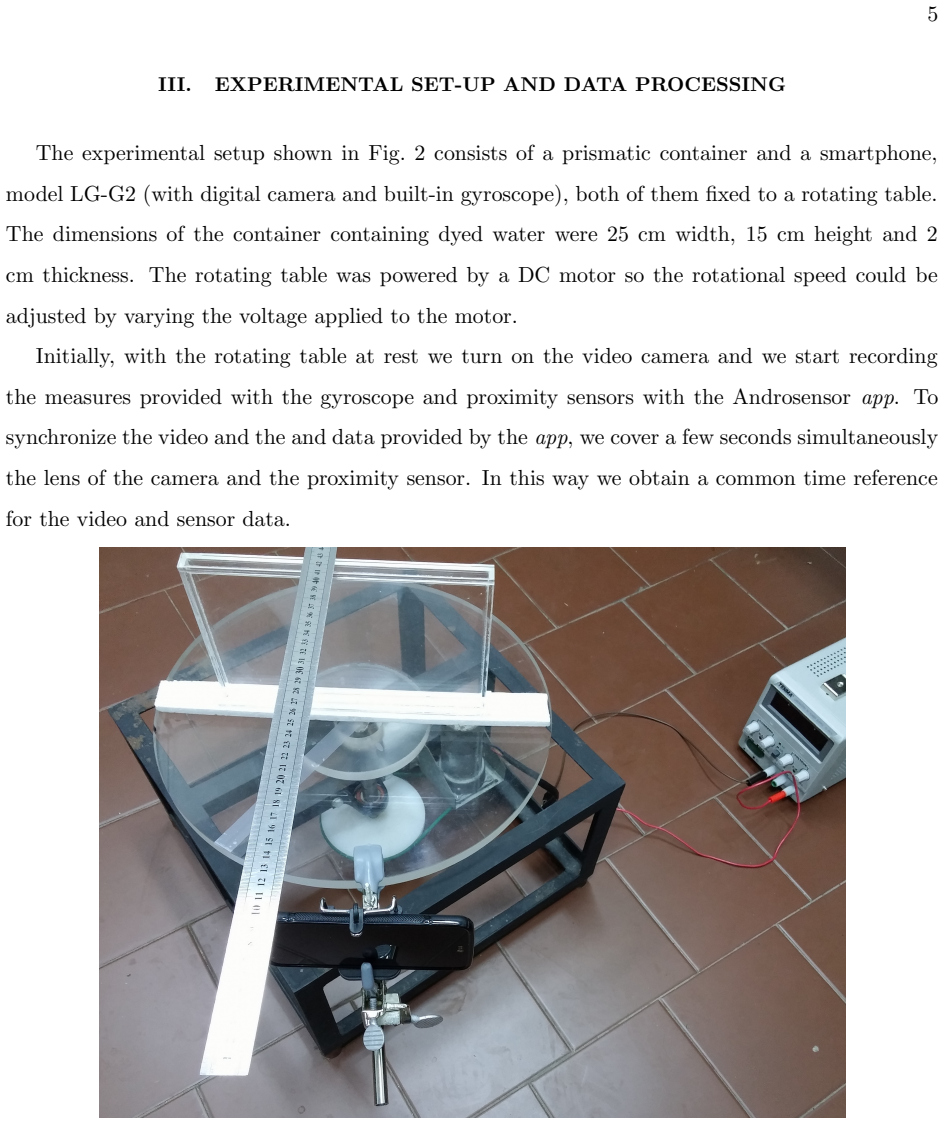
The central object is the parabolic free-surface equation $z'(r) = H - (\omega^2/2g)(L^2/12 - r^2)$, obtained by integrating the hydrostatic pressure balance $\nabla p = \rho(\vec{g} - \vec{a})$ under rigid-body rotation ($\vec{a} = -\omega^2 r \,\hat{r}$) and fixing the integration constant with volume conservation. The experiment's other key element is the simultaneous measurement: a smartphone fixed to the rotating frame records the surface with its camera and the angular velocity with its gyroscope, and the frames are matched to the sensor data by a synchronization mark; the surface points are then fitted to a parabola in the Tracker video-analysis software.
What would settle it
Monitor the free surface continuously while the angular velocity is increased in one large step rather than many small ones; if the fitted concavity during the spin-up transient differs measurably from $\omega^2/(2g)$ and converges only after a settling time, the quasi-static assumption that the analysis relies on is violated.
Extended reading notes
Core claim
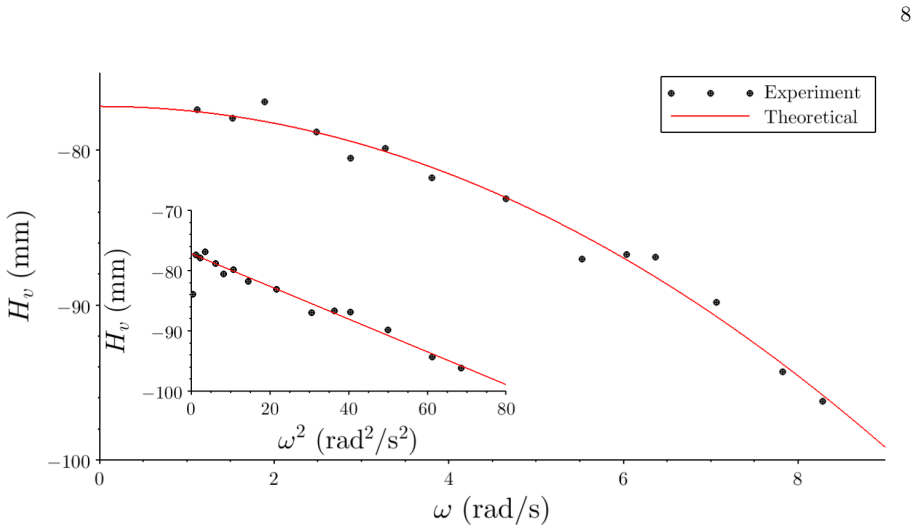
Under the assumptions that the fluid rotates as a rigid body with velocity $\vec{u} = \omega r \,\hat{\theta}$ and that transients are negligible because the angular velocity is increased slowly, the pressure field integrates to $p(r,z) = p_{\rm atm} + \rho g(H-z) + \rho\omega^2(r^2 - L^2/24)/2$, and the free surface is the parabola $z'(r) = H - (\omega^2/2g)(L^2/12 - r^2)$. The vertex is at $r=0$ with height $H - \omega^2L^2/(24g)$, and two fixed nodal points at $r = \pm L/\sqrt{12}$ remain at height $H$ regardless of $\omega$. The experiment confirms these predictions: the linear fit of concavity versus $\omega^2$ has slope 20.16(4) m·$rad^{2}$/$s^{2}$, matching $2g$, and the vertex-height slope is -0.27(1) mm·$s^{2}$/$rad^{2}$, matching $-L^2/(24g)$. The intercept of the vertex-height fit gives the rest water level, 7.72(3) cm, consistent with the 7.6(2) cm measured directly.
Load-bearing premise
The fluid has reached steady solid-body rotation by the time each frame is recorded, so the slowly stepped angular velocity can be treated as quasi-static and transient effects neglected.
Editorial extensions
If this is right
- The same setup yields a measurement of $g$: the concavity-versus-$\omega^2$ slope is $2g$, so a student can extract the gravitational acceleration from a linear fit, with precision comparable to the given 20.16(4) value.
- The two nodal points at $\pm L/\sqrt{12}$ provide a built-in check: they stay at the rest height $H$ for any angular velocity, so a misaligned fit can be spotted.
- The model sets an upper limit: for $\omega \ge \sqrt{24gH/L}$ the vertex reaches the container bottom, so beyond that the parabolic formula no longer applies; the experiment stops before that.
- Because the angular velocity is time-dependent and slowly stepped, the same video contains many quasi-static states, so one run produces a full calibration curve rather than a single point.
Reading between the lines
- The method could be extended to measure transient relaxation: by analyzing frames immediately after each voltage jump, one could extract the spin-up time of the fluid and test whether the quasi-static assumption holds for large jumps.
- The same smartphone-sensor pairing (camera plus gyroscope) could be applied to other non-inertial-frame phenomena, such as the effective gravity in an accelerating or oscillating frame, without additional hardware.
- Automated edge detection could replace manual labeling of the eight points, making the measurement faster and possibly more precise, and would allow tracking the surface continuously rather than at discrete frames.
- For containers with larger width $d$, the assumption $L \gg d$ and the two-dimensional prismatic flow may break down; testing the predicted nodal points with wider tanks would delimit the model's range of validity.
Signed reviews
Editorial analysis
A structured set of objections, weighed in public.
Referee Report
Summary. The paper proposes a simple experiment for an undergraduate fluid mechanics lab: a narrow rectangular container with dyed water is placed on a rotating table, and a smartphone fixed to the table records the free surface on video while its gyroscope measures the angular velocity. Assuming quasi-static rigid-body rotation, the authors derive the parabolic free surface z'(r) = H - (ω²/2g)(L²/12 - r²), with concavity ω²/(2g) and vertex height H - ω²L²/(24g). Fifteen video frames at different angular velocities are analyzed with Tracker; the fitted concavity and vertex height are plotted against ω², and linear fits give slopes 20.16(4) m·rad²/s² (compared with 2g) and -0.27(1) mm·s²/rad² (compared with -L²/(24g) = -0.2655(5) mm·s²/rad²), which the authors regard as good agreement.
Significance. If the two confirmations are robust, the paper provides a clean, low-cost demonstration of solid-body rotation and the parabolic free surface, with the pedagogical advantage of simultaneous smartphone camera and gyroscope measurements. The derivation is standard and free of fitted parameters (the constants g, L, H are external or measured), which is a strength. The use of a smartphone in a rotating frame to measure both the shape and angular velocity is a nice contribution to the physics-education literature.
major comments (2)
- [Section IV, Figure 6 caption and results] The reported vertex-height slope -0.27(1) mm·s²/rad² is based on a linear fit that excludes the leftmost (smallest-ω²) point, justified only by the qualitative statement that this point has 'great uncertainty.' No per-point uncertainties, error bars, or quantitative exclusion criterion are provided. Because the vertex-height comparison is one of the two central quantitative confirmations of the model, an unjustified exclusion could materially bias the agreement. Please report the coordinates and an uncertainty estimate for the excluded point, show the fit with all data points (or a weighted fit), and justify the exclusion statistically. If the all-point slope remains consistent with -L²/(24g), state that explicitly; if not, the claim of agreement needs to be qualified.
- [Section II and Section III] The theoretical derivation assumes steady, rigid-body rotation with negligible transients, while the experiment increases the angular velocity in 'small jumps.' The manuscript does not demonstrate that the fluid has reached a quasi-static state at the times the 15 frames were extracted. A non-zero Euler acceleration (dω/dt) during a jump produces an azimuthal pressure gradient and a surface that is not the simple parabola of Eq. (9); the gyroscope records the instantaneous ω, but the surface shape may lag. Please provide evidence that the fitted concavity and vertex height are stable within each constant-ω plateau, for example by analyzing consecutive frames at the same nominal ω or by estimating the spin-up time of the fluid (e.g., from the container width and water viscosity). This is needed to validate the comparison of the fitted parabolas with Eq. (9).
minor comments (4)
- [Section II, near Eq. (10)] The condition for the vertex to reach the bottom, ω ≥ √(24gH/L), is dimensionally inconsistent (the right-hand side has units of √(m/s²), not s⁻¹). From Eq. (10) with z_v = 0, the correct condition is ω ≥ (1/L)√(24gH).
- [Section IV and Figure 5] Please clarify the quantity plotted and the units of the slope 20.16(4) m·rad²/s². A direct fit of the concavity coefficient A to ω² should yield a slope 1/(2g) ≈ 0.051 s²/m; the stated value appears to be 2g, so the text, axes, and units need to be reconciled. Additionally, the difference between 20.16(4) and 19.62 is about 13 times the reported fit uncertainty; some discussion of systematic uncertainties is needed to support the statement of 'good agreement.'
- [Throughout] There are several typos and style issues: 'neglectd' (Section II) should be 'neglected'; 'parabole' should be 'parabola'; 'tipically' should be 'typically'; 'and data provided by theapp' in Section III has a doubled 'and'; the title word 'time-depend' should be 'time-dependent.'
- [Section IV, intercept comparison] The intercept of the vertex-height fit (-7.72(3) cm) is compared with a direct image measurement (-7.6(2) cm); please state how the uncertainty of the direct measurement was obtained, since it is given with only one significant digit.
Circularity Check
No significant circularity: the parabolic-surface prediction is derived from textbook fluid mechanics with externally measured g, L, H, and the experimental slopes are compared against, not fitted into, the model.
full rationale
The derivation chain is self-contained. Section II derives z'(r)=H-(omega^2/2g)(L^2/12-r^2) from the Euler equation under the explicit rigid-body/negligible-transients assumption, with g, L, and H entering as external constants (gravitational acceleration and measured container dimensions/initial height). Equations (6)-(7) use only mass conservation and incompressibility to fix the integration constant; no experimental fit parameter enters the model. The experiment independently fits a parabola y=Ax^2+Bx+C to video frames and compares the fitted concavity A and vertex height -B^2/(4A) with the closed-form slopes 2g and -L^2/24g. The reported slopes (20.16(4) m*rad^2/s^2 vs 2g, and -0.27(1) mm*s^2/rad^2 vs -0.2655(5) mm*s^2/rad^2) are agreements, not normalizations. The intercept is compared to a direct image measurement. The authors' self-citations (Refs. 6-11) support only the smartphone multi-sensor methodology and are not load-bearing for the fluid-physics result, so they do not constitute circularity. The Figure 6 exclusion of the lowest-omega point without per-point uncertainties is a legitimate statistical-robustness concern, but it is a question of data presentation, not a reduction of the prediction to its inputs. Consequently no 'prediction' is equivalent by construction to a fitted input, and no self-citation chain forces the central claim.
Assumptions & free parameters
assumptions (4)
- domain assumption The fluid rotates as a rigid body once transients decay, so the velocity field is u = ωr θ̂.
- domain assumption The fluid is incompressible and its volume is conserved during rotation.
- domain assumption The angular velocity changes slowly enough that transient effects can be neglected.
- domain assumption The container is narrow in one dimension (L >> d), so the pressure field can be treated as depending only on the radial coordinate r across the width.
Cite this review
Pith. "Pith review of Free surface of a liquid in a rotating frame with time-depend velocity." pith.science (2026). https://pith.science/paper/ZR5326PJ
@misc{pith2026190804256,
  author       = {Pith},
  title        = {Pith review of: Free surface of a liquid in a rotating frame with time-depend velocity},
  year         = {2026},
  howpublished = {\url{https://pith.science/paper/ZR5326PJ}},
  note         = {Machine review of arXiv:1908.04256}
}
read the original abstract
The shape of liquid surface in a rotating frame depends on the angular velocity. In this experiment, a fluid in a rectangular container with a small width is placed on a rotating table. A smartphone fixed to the rotating frame simultaneously records the fluid surface with the camera and also, thanks to the built-in gyroscope, the angular velocity. When the table starts rotating the surface evolves and develops a parabolic shape. Using video analysis we obtain the surface's shape: concavity of the parabole and height of the vertex. Experimental results are compared with theoretical predictions. This problem contributes to improve the understanding of relevant concepts in fluid dynamics.
Figures


Figures from the paper (3 more)


Reference graph
Works this paper leans on
- [1]
-
[2]
Apparatus for the study of uniform circular motion in a liquid
Erlend H Graf. Apparatus for the study of uniform circular motion in a liquid. The Physics Teacher, 35(7):427–430, 1997
work page 1997
-
[3]
Measuring g using a rotating liquid mirror: enhancing laboratory learning
Andr´ eas Sundstr¨ om and Tom Adawi. Measuring g using a rotating liquid mirror: enhancing laboratory learning. Physics Education, 51(5):053004, 2016
work page 2016
-
[4]
Rotating the haven of fixed stars: a simulation of mach’s principle
Alexsandro Pereira de Pereira and Lara Elena Sobreira Gomes. Rotating the haven of fixed stars: a simulation of mach’s principle. Physics Education, 51(5):055016, 2016
work page 2016
-
[5]
Carl-Olof F¨ agerlind and Ann-Marie Pendrill. Liquid in accelerated motion. Physics Education , 50(6):648, 2015
work page 2015
-
[6]
Understanding coffee spills using a smart- phone
Fernando Tornar´ ıa, Mart´ ın Monteiro, and Arturo C Marti. Understanding coffee spills using a smart- phone. The Physics Teacher, 52(8):502–503, 2014
work page 2014
-
[7]
Angular velocity and centripetal acceleration relationship
Mart´ ın Monteiro, Cecilia Cabeza, Arturo C Marti, Patrik Vogt, and Jochen Kuhn. Angular velocity and centripetal acceleration relationship. The Physics Teacher, 52(5):312–313, 2014
work page 2014
-
[8]
Exploring phase space using smartphone acceleration and rotation sensors simultaneously
Mart´ ın Monteiro, Cecilia Cabeza, and Arturo C Mart´ ı. Exploring phase space using smartphone acceleration and rotation sensors simultaneously. European Journal of Physics , 35(4):045013, 2014
work page 2014
Show all 12 references
-
[9]
Mart´ ın Monteiro, Patrik Vogt, Cecilia Stari, Cecilia Cabeza, and Arturo C. Marti. Exploring the atmosphere using smartphones. The Physics Teacher, 54(5):308–309, 2016
2016
-
[10]
The polarization of light and malus’ law using smartphones
Mart´ ın Monteiro, Cecilia Stari, Cecilia Cabeza, and Arturo C Mart´ ı. The polarization of light and malus’ law using smartphones. The Physics Teacher, 55(5):264–266, 2017
2017
-
[11]
Magnetic field ‘flyby’ measurement using a smartphone’s magnetometer and accelerometer simultaneously.The Physics Teacher, 55(9):580– 581, 2017
Mart´ ın Monteiro, Cecilia Stari, Cecilia Cabeza, and Arturo C Marti. Magnetic field ‘flyby’ measurement using a smartphone’s magnetometer and accelerometer simultaneously.The Physics Teacher, 55(9):580– 581, 2017
2017
-
[12]
Tracker: Free video analysis and modeling tool for physics education, June 2014
D Brown. Tracker: Free video analysis and modeling tool for physics education, June 2014
2014
Reviewed August 14, 2026 · model on record in the stance chip above.
Discussion (0). Continue with ORCID to comment.