REVIEW 4 major objections 7 minor 2 references
Convolutional Humanoid Animation via Deformation
T0 review · 4 major / 7 minor · reviewed 2026-08-14 · deepseek-v4-flash
Pith's one-line read A single unlabeled video can train a rig-free animation system that synthesizes new humanoid motion by interpolating between sparsely placed keyframes on a learned pose manifold.
desk verdict Plausible, reimplementable single-video keyframe animation method; the evaluation never isolates what the learned manifold and GAN contribute, because the final output is a retrieval-and-warp composite from the training video. read the letter →
The pith
A machine-rendered reading of the paper's core claim, the machinery that carries it, and where it could break.
The reading
What carries the argument
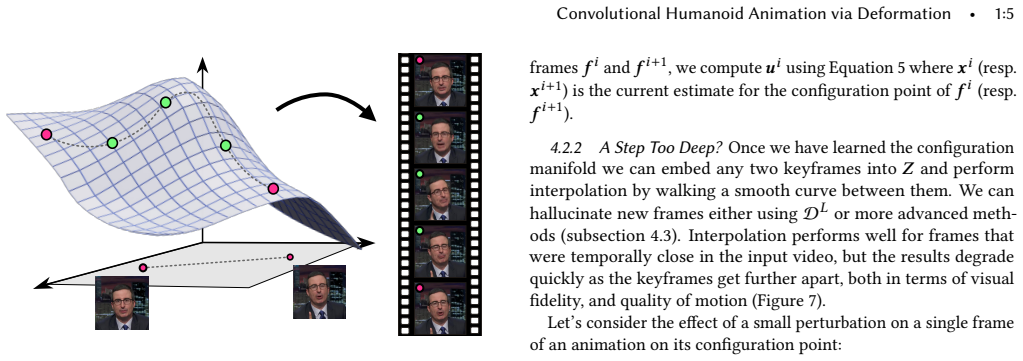
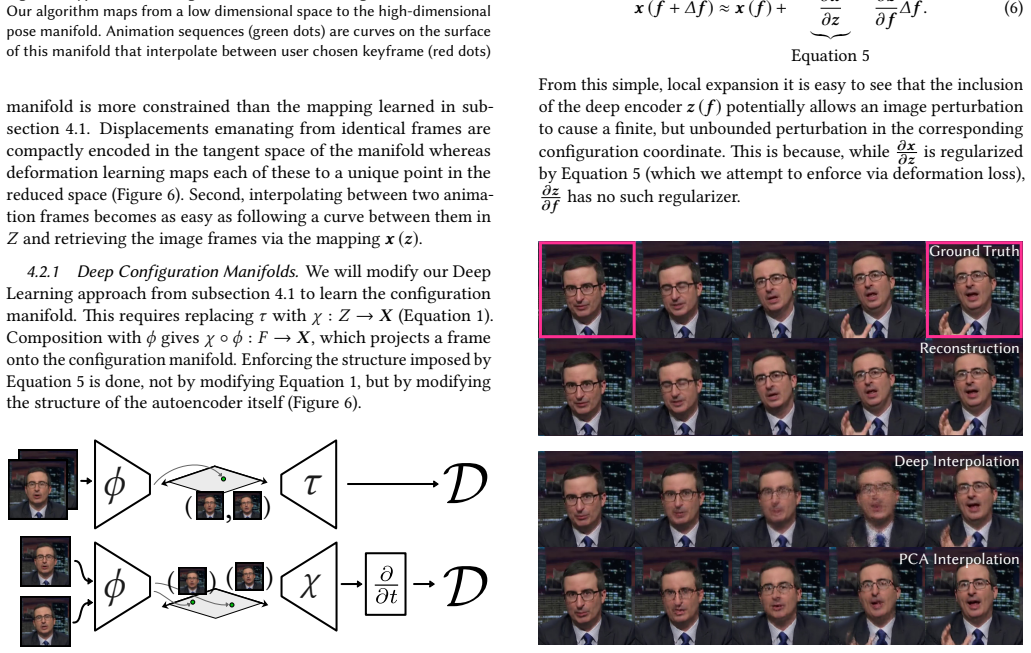
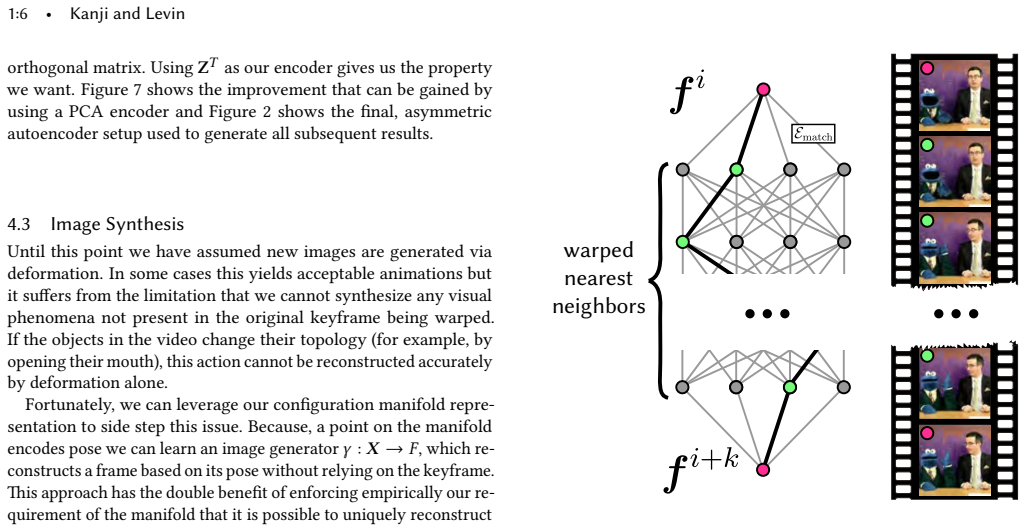
The configuration manifold is a low-dimensional space in which each point encodes the pose of the character, with curves on the manifold corresponding to natural motions. CHAD approximates it with an asymmetric autoencoder where the encoder is the transpose of the PCA basis, which gives bounded sensitivity, and the decoder is a deep CNN that maps pose codes to images. Deformation along the manifold's tangent is enforced by a training loss that warps frames forward using the code differences, and a GAN plus nearest-neighbor detail transfer converts manifold points into clean output frames.
What would settle it
Take a video with at least two poses that are visually very different and never appear close together in time; train CHAD on half of it and pick keyframes from those extreme poses. If the interpolated middle frames are blurry, ghosted, or anatomically implausible, the straight-line interpolation claim fails.
Extended reading notes
Core claim
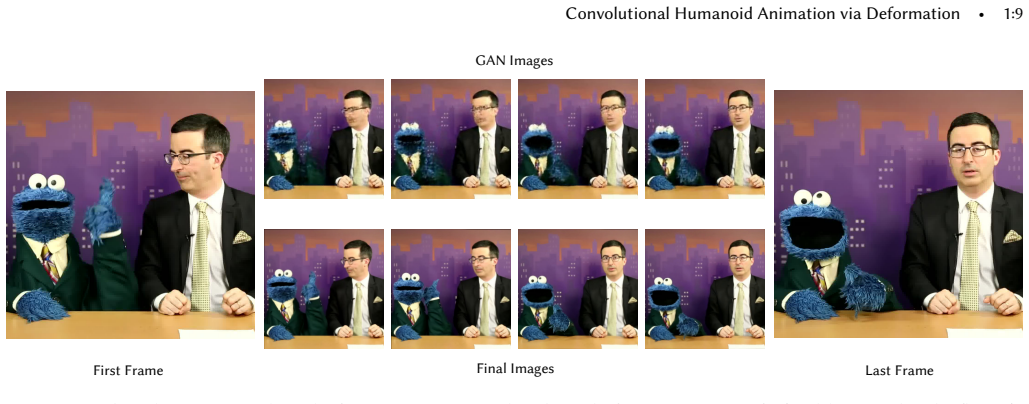
CHAD's central claim is that an implicit rig can be learned from raw video by projecting frames with a PCA encoder into a low-dimensional pose space and decoding points in that space with a deep convolutional decoder. Because the PCA basis is orthogonal, perturbations in image space produce bounded perturbations in the pose code, and straight-line interpolation between keyframe codes yields natural intermediate motion. A GAN then inverts pose codes into sharp images, and a Poisson-blending detail transfer step removes GAN noise by borrowing texture from nearest-neighbor source frames. The authors demonstrate the same untuned architecture interpolating facial expressions, whole-body zebra motion, and a two-character scene, all trained from single YouTube clips.
Load-bearing premise
Straight lines through the PCA-projected pose space must stay on the natural-motion manifold, and the trained GAN must be able to turn every point on that line into a sharp, pose-correct image.
Editorial extensions
If this is right
- Users can produce novel animation sequences from as few as two keyframes, without touching a rig or specifying a skeleton.
- Because no motion prior is used, the same pipeline transfers to new subject types, such as faces, animals, and multi-character scenes, without architecture changes.
- The PCA encoder makes the pose code robust to image perturbations and keeps interpolation within a bounded region of pose space.
- The GAN-plus-detail-transfer pipeline can handle topology-changing motion, such as a mouth opening or a hand entering the frame, that pure image warping cannot reproduce.
- The learned configuration space itself becomes a reusable representation for related tasks like selecting representative frames or retiming a video.
Reading between the lines
- Beyond the paper: because interpolation is linear in PCA space, poses outside the convex hull of the training distribution are likely to interpolate poorly, so sampling keyframes far outside the observed pose range would stress-test the method.
- Beyond the paper: the bounded-sensitivity argument that justifies the PCA encoder suggests a quantitative check for any encoder, namely measuring the spectral norm of the Jacobian on held-out frames, which the paper does not report.
- Beyond the paper: CHAD's detail-transfer step implies that output sharpness is limited by the density of pose coverage in the source video, so slow, pose-rich videos may yield crisper interpolations than fast-moving ones.
Signed reviews
Editorial analysis
A structured set of objections, weighed in public.
Referee Report
Summary. The paper presents CHAD, a deep-learning method for image-based humanoid animation from sparse user-specified keyframes. The method learns a configuration manifold from a single unlabeled video using an asymmetric autoencoder: a PCA-based encoder maps frames into a low-dimensional latent space, and a deep convolutional decoder maps latent codes back to images. A GAN is then trained to synthesize frames directly from a configuration point, avoiding the error accumulation of sequential warping. Finally, a detail-transfer stage retrieves nearest-neighbor frames from the source video, warps them, and blends them with the GAN output via a screened Poisson equation. The authors claim that CHAD requires no motion priors, works with sparse temporal input, and generalizes to facial, whole-body, and multi-character motion. The evaluation consists of qualitative still images from four YouTube clips, with interpolation performed between keyframes randomly chosen from the training video itself.
Significance. If substantiated, the paper's central idea is valuable: learning a configuration manifold directly from raw video, without rigs, blendshapes, or dense temporal input, could lower the barrier for image-based character animation. The asymmetric PCA-encoder/deep-decoder architecture is a simple and potentially effective way to obtain a latent pose space with bounded sensitivity, and the detail-transfer post-process is a practical engineering solution to the GAN's lack of sharpness. However, the current manuscript does not provide the evidence needed to support its broad claims. The evaluation is purely qualitative, the test conditions are inside the training distribution, and the final output is a composite of retrieved and warped training frames, making it impossible to attribute the reported motion quality to the learned manifold and GAN rather than to the retrieval stage. The significance of the contribution depends on resolving these evaluation gaps.
major comments (4)
- [§5.2–5.5] The evaluation consists entirely of qualitative still frames from four YouTube clips. There is no quantitative measurement of motion naturalness, pose accuracy, temporal smoothness, image sharpness, or user preference, and no comparison to any prior image-based animation method (e.g., Chan et al. 2018, Geng et al. 2018, Averbuch-Elor et al. 2017). Without such evidence, the abstract's claims of 'natural motion' and 'broadly applicable' are unsupported.
- [§4.3.1, Eq. (7)–(8)] The final output of CHAD is a blend of the GAN image with warped nearest-neighbor frames retrieved from the same training video, combined through the screened Poisson equation. Because the keyframes used in Section 5.2 are randomly chosen from that same training video, the evaluation cannot separate the contribution of the learned configuration manifold and GAN from that of the k-NN retrieval and warping. An ablation that removes or varies the detail-transfer stage, or a test with keyframes from a held-out video or synthetic poses, is needed to support the claim that CHAD generates new animations rather than recombining existing frames.
- [§4.2.2, Eq. (6)] The theoretical justification for the PCA encoder is heuristic. The local expansion in Eq. (6) and the statement that PCA 'gives us the property we want' do not constitute a proof that straight-line interpolation in PCA latent space stays on the natural motion manifold. The authors themselves acknowledge that interpolation degrades quickly for temporally distant keyframes, but they do not quantify this degradation or provide a mechanism that guarantees valid interpolated paths. This is a load-bearing issue because the central claim is that CHAD can interpolate between sparse keyframes.
- [§5.3] The claim that 'CHAD is the first algorithm to be able to perform synthesis of this detail by purely relying on input data' is not supported by a literature comparison. The related work section reviews prior methods, but no baseline is implemented or cited to substantiate this priority claim.
minor comments (7)
- [Figure 2 caption] The caption uses the informal phrase 'learning cool animations'; the language should be professional throughout the paper.
- [§5.5] The phrase 'googliness' is colloquial and should be replaced with a precise description of the observed artifact.
- [Conclusions] The paper states 'we intend to release the CHAD source code and pre-trained networks', but no code repository or link is provided. If the contribution is to be reproducible, the release should be part of the submission.
- [§5.1.1] The claim that clips are 'unprocessed aside from uniform cropping' is contradicted by the description of the John Oliver clip, where a minimal square bounding box is computed over all frames and then expanded by 15 pixels.
- [References] The reference 'Spotify 2018' is informal; the Annoy library should be cited by its name and version rather than as a company citation.
- [Figure 2] The label 'kNN+ PIE' is undefined; the acronym PIE is not introduced in the text or figure caption.
- [§4.1–4.2.2] The notation Δt is used both as the frame time and as the finite-difference interval, which makes the relationship between Eq. (4) and Eq. (5) unnecessarily confusing; please clarify.
Circularity Check
No significant circularity: CHAD's pipeline is described self-containedly, with no self-citation chain and no prediction that reduces by construction to its fitted inputs.
full rationale
The claimed derivation is a feed-forward pipeline: PCA projection of training frames defines Z (Sec. 4.2.2), a deep decoder and GAN are trained with explicit losses (Eqs. 1-5, Sec. 4.3), and detail transfer retrieves nearest-neighbor frames and solves Eq. (8). Each stage is independently specified, and none is defined in terms of the final animation. The paper uses no self-citations for load-bearing claims; references such as Lanczos, Goodfellow, Darabi, and Weinzaepfel are external, and the PCA encoder is standard linear algebra, not an author-specific uniqueness theorem. The central capability - keyframe interpolation in a learned latent configuration space - is a real algorithmic proposal rather than a renamed known result. The evaluation is entirely within the training video (Sec. 5.2), and the final images blend warped source frames (Eq. 8), so the relative contribution of the learned manifold versus retrieval is not ablated; this is an evaluation and reproducibility limitation, not a circular derivation. The paper itself flags in Sec. 6 that 'our current image denoising approach is less than perfect,' but that admission concerns temporal smoothness and ghosting, not a circular dependency. There is no equation in which the output equals the input by construction, and no fitted parameter is relabeled as a prediction. Therefore the circularity score is 0.
Assumptions & free parameters
free parameters (4)
- Latent dimension |Z| per clip =
200, 400, 250, 200 for the four clips (Table 1)
- Detail transfer parameters alpha and beta in Eq. 7 =
not specified numerically
- Blending weight lambda in Eq. 8 =
0.1, 0.5, 1.0 shown in Figure 9
- Number of nearest neighbors k =
not specified
assumptions (4)
- domain assumption Smooth motion in the video corresponds to a smooth path on the learned configuration manifold.
- domain assumption PCA coordinates of raw frames form a configuration space whose linear interpolation yields natural humanoid motion.
- domain assumption Every pose code can be decoded into a sharp, pose-correct image, including topology changes.
- domain assumption Warping and blending nearest-neighbor source frames preserves the interpolated motion.
Cite this review
Pith. "Pith review of Convolutional Humanoid Animation via Deformation." pith.science (2026). https://pith.science/paper/EEJLB5TC
@misc{pith2026190804338,
  author       = {Pith},
  title        = {Pith review of: Convolutional Humanoid Animation via Deformation},
  year         = {2026},
  howpublished = {\url{https://pith.science/paper/EEJLB5TC}},
  note         = {Machine review of arXiv:1908.04338}
}
read the original abstract
In this paper we present a new deep learning-driven approach to image-based synthesis of animations involving humanoid characters. Unlike previous deep approaches to image-based animation our method makes no assumptions on the type of motion to be animated nor does it require dense temporal input to produce motion. Instead we generate new animations by interpolating between user chosen keyframes, arranged sparsely in time. Utilizing a novel configuration manifold learning approach we interpolate suitable motions between these keyframes. In contrast to previous methods, ours requires less data (animations can be generated from a single youtube video) and is broadly applicable to a wide range of motions including facial motion, whole body motion and even scenes with multiple characters. These improvements serve to significantly reduce the difficulty in producing image-based animations of humanoid characters, allowing even broader audiences to express their creativity.
Figures


Figures from the paper (12 more)





Reference graph
Works this paper leans on
-
[2012]
Image Melding: Combining Inconsistent Images Using Patch-based Synthesis. ACM Trans. Graph. 31, 4, Article 82 (July 2012), 10 pages. h/t_tps://doi.org/10.1145/ 2185520.2185578 Abe Davis and Maneesh Agrawala. 2018. Visual Rhythm and Beat. ACM Trans. Graph. 37, 4, Article 122 (July 2018), 11 pages. h/t_tps://doi.org/10.1145/3197517.3201371 Pif Edwards, Chri...
arXiv 2016
-
[2018]
Synthesizing Images of Humans in Unseen Poses. In CVPR. /T_habo Beeler, Bernd Bickel, Paul Beardsley, Bob Sumner, and Markus Gross. 2010. High-quality single-shot capture of facial geometry. In ACM SIGGRAPH 2010 papers on - SIGGRAPH ’10. ACM Press, New York, New York, USA, 1. h/t_tps://doi.org/10. 1145/1833349.1778777 /T_habo Beeler, Fabian Hahn, Derek Br...
arXiv 2014
Reviewed August 14, 2026 · model on record in the stance chip above.
Discussion (0). Continue with ORCID to comment.