REVIEW 4 major objections 5 minor 50 references
Electrified Cone Formation in Perfectly Conducting Viscous Liquids: Self-Similar Growth Irrespective of Reynolds Number
T0 review · 4 major / 5 minor · reviewed 2026-08-14 · deepseek-v4-flash
Pith's one-line read This paper claims that the accelerating conical tip of an electrified perfectly conducting viscous liquid always grows self-similarly, at any Reynolds number, with blow-up exponents interpolating between the Stokes and inviscid limits.
desk verdict A solid finite-Re numerical fill-in of a known self-similar blow-up regime, held back only by fitted collapse times and an overbroad 'always' claim. read the letter →
The pith
A machine-rendered reading of the paper's core claim, the machinery that carries it, and where it could break.
The reading
What carries the argument
The mechanism is local electric-field self-enhancement at the sharpening apex, which drives divergent power-law growth as the collapse time $T_C$ is approached. The analysis is carried by a self-similar ansatz in the time interval $\tau = T_C - T$: lengths scale as $\tau^{\beta_C}$, and the stress terms scale as $\tau^{-\beta_j}$. The exponents are not derived from a single similarity solution but extracted numerically from the final 2.5 decades of each simulation by choosing $T_C$ to give the best linear log-log fit of the Maxwell pressure, and the tip shapes are rescaled by the capillary exponent to exhibit collapse. The finite-element model couples Laplace's equation in the vacuum gap to the Navier-Stokes equations in the liquid through the moving interface, with the normal stress boundary condition balancing capillary, Maxwell, and viscous stresses.
What would settle it
Run the same axisymmetric setup to a much smaller final tip radius of curvature, say $10^{-5}$ or smaller, or for several additional decades in $\tau$, and check whether the extracted exponents and the shape collapse remain fixed; a second check is to vary the fitting window (for instance, fit over the final 3.5 decades rather than 2.5) and see whether $\beta_M$, $\beta_C$, and $\beta_V$ shift beyond the reported uncertainties of about $10^{-3}$.
Extended reading notes
Core claim
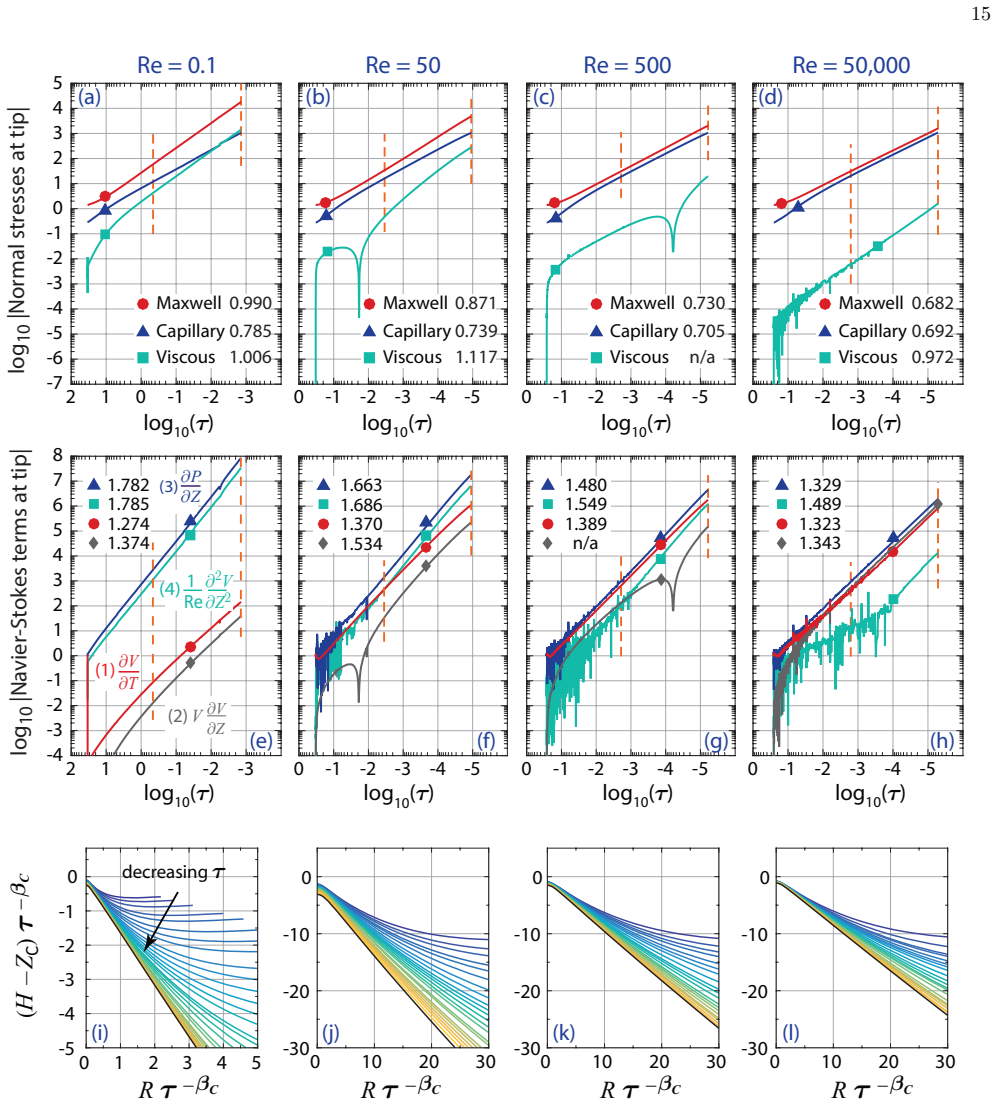
The central claim is that the conical tip of an electrified, perfectly conducting Newtonian liquid always undergoes self-similar growth in time, irrespective of Reynolds number. As the interval $\tau = T_C - T$ before the collapse time $T_C$ shrinks to zero, the Maxwell, capillary, and viscous normal stresses at the apex diverge as $\tau^{-\beta_j}$ with $j = M, C, V$, and the four terms of the Navier-Stokes equation at the apex diverge with their own exponents. The computed exponents vary smoothly with $\mathrm{Re}$: at low Reynolds number they approach the Stokes-limit values (Maxwell exponent near 1, capillary exponent set by the cone half-angle), and at high Reynolds number they approach the inviscid-limit values $2/3$, $2/3$, and $1$ for Maxwell, capillary, and viscous stresses respectively. Rescaling the interface shape by $\tau^{-\beta_C}$ collapses the tip profiles onto a universal conic shape whose interior half-angle increases with $\mathrm{Re}$ and can exceed the static Taylor angle of $49.3^\circ$. The simulations also reveal a thin surface boundary layer of very high strain rate beneath the accelerating tip, and show that viscous forces per unit volume remain significant up to $\mathrm{Re} \approx 3 \times 10^4$ even where the viscous normal stress at the interface has become small.
Load-bearing premise
The extracted exponents and the claimed universality rest on the numerical fit that chooses the collapse time $T_C$ for each run as the value giving the best linear fit of the Maxwell pressure over the final 2.5 decades, together with the rule that every simulation stops once the dimensionless tip radius of curvature reaches $2.722 \times 10^{-4}$; if that final window is not truly asymptotic, the reported self-similar exponents could be artifacts of the fitting procedure.
Editorial extensions
If this is right
- Dynamic cone formation in perfectly conducting liquids becomes a single continuous phenomenon: the same self-similar mechanism operates from the Stokes regime to the inviscid limit, so exponents and shapes from one Reynolds number can be extrapolated to another.
- The dominant balance at the apex switches from Maxwell-viscous competition at low $\mathrm{Re}$ to Maxwell-capillary competition at high $\mathrm{Re}$, with the crossover visible in the extracted exponents; viscous forces per unit volume remain comparable to inertial forces up to roughly $\mathrm{Re} = 3 \times 10^4$.
- The interior half-angle of the dynamic cone is not a fixed constant: at fixed capillary number it grows with $\mathrm{Re}$ and can exceed the static Taylor angle of $49.3^\circ$, so dynamic cones should not be identified with stationary Taylor cones.
- Rescaling interface shapes by the capillary-stress exponent provides a predictive collapse for tip curvature and local field enhancement, which is directly relevant to estimating the emission region in liquid metal ion sources.
Reading between the lines
- The smooth, monotone dependence of the exponents on $\mathrm{Re}$ suggests that a one-parameter family of self-similar solutions, parameterized by the interior half-angle, may exist for all Reynolds numbers; a test would be to solve for the full self-similar profiles and see whether their far field matches the static cone solution at every $\mathrm{Re}$.
- Because the capillary number is held fixed at 7.0834 throughout, an untested extension is whether the claimed universality and the exponent curves persist at other $\mathrm{Ca}$ values or whether the collapse time and stopping criterion introduce an effective $\mathrm{Ca}$ dependence.
- The thin, high-strain-rate boundary layer just below the tip may control the size of the ion-emission region in liquid metal ion sources; if its thickness follows a power law in $\mathrm{Re}$, simulations at higher $\mathrm{Re}$ could predict how the emission site shrinks as inertia grows.
- The same self-similar framework might extend to partially conducting or leaky dielectric liquids once tangential interfacial stresses are included, since the paper notes that such stresses are what enable the cone-jet transition; this is a natural but unproven extension.
Signed reviews
Editorial analysis
A structured set of objections, weighed in public.
Referee Report
Summary. The paper presents finite-element simulations of an axisymmetric, perfectly conducting, Newtonian liquid layer in vacuum with an initially tiny Gaussian protrusion, held at fixed capillary number Ca = 7.0834, for Reynolds numbers in the range 0.1 ≤ Re ≤ 5×10^4. The central claim is that the accelerating liquid tip always undergoes self-similar conic growth irrespective of Reynolds number, with blow-up exponents for the Maxwell, capillary, and viscous normal stresses, and for the four terms in the Navier-Stokes equation, interpolating between the Stokes limit and the inviscid limit. The paper further reports collapse of interface profiles onto a universal conic shape, a thin surface boundary layer with high strain rate, and compares the extracted exponents with analytic predictions by Zubarev (2001) and Fontelos et al. (2008).
Significance. If the central claim is correct, the paper provides the first systematic numerical bridge between the previously analyzed Stokes and inviscid self-similar regimes, and it offers quantitative exponent curves that can guide theoretical work and liquid-metal-ion-source modeling. The study is genuinely comparative rather than circular: it benchmarks extracted exponents against independent analytic predictions in both limits, and it includes a fairly complete table of exponents over a wide Reynolds-number range plus a cross-check between two mesh schemes for selected runs. However, the broad 'always' claim is stronger than the finite set of simulations and the fitting procedure can support, so the paper is best read as a valuable numerical conjecture that needs uncertainty quantification before the universality claim is fully established.
major comments (4)
- [IV.C.1 and Table II] The collapse time TC is not measured independently but is chosen for each run as the value that makes log PM versus log(TC−T) most linear over the final 2.5 decades; all other exponents and the shape collapse are then computed with that same TC. The uncertainties quoted in Table II are linear-regression standard errors only and do not propagate the TC selection, mesh dependence, or the fixed stopping curvature 2.722×10⁻⁴. A mis-specified TC can produce apparent power laws over a limited window and can make the interface profiles in Fig. 7(i-l) look collapsed even if the true asymptote has not been reached. The authors should quantify the sensitivity of βM, βC, βV, and β1-β4 to TC, for example by varying TC within the range consistent with the data, by determining TC independently from shape data, or by computing local log-log slopes, and they should report total uncertainties that include the TC identification step.
- [IV.H, Fig. 8, and Table II] The comparison with the Stokes limit is an extrapolation rather than a demonstrated approach: the lowest Reynolds number simulated is Re = 0.1, and at that run βC = 0.7849 ± 0.0017, about 7% below the Fontelos et al. value 0.8465 quoted for the Re → 0 limit. No run below Re = 0.1 is included. The statement in Sec. IV.G and the abstract that the conic tip 'always' undergoes self-similar growth irrespective of Reynolds number is therefore stronger than the tested range. Additional runs at Re of order 0.01-0.05, or a quantitative extrapolation of βC(Re) with estimated uncertainty, are needed to substantiate the Stokes-limit trend. The intermediate range is also partially undocumented because βV is not reported for 100 ≤ Re ≤ 1000 (Sec. IV.D) and β4 is noisy in that range.
- [IV.F and Fig. 7(i-l)] The shape collapse is not an independent test of self-similarity: the rescaling uses the capillary-stress exponent βC extracted from the same simulations, and the virtual cone height ZC and collapse height HC are fitted to minimize residuals of auxiliary linear fits. The collapse should be re-examined using fixed benchmark exponents, namely 2/3 for the inviscid limit and α(θ1/2) from Fontelos et al. for the Stokes limit, or by perturbing TC and βC within their uncertainties, to show that the collapse is not an artifact of the fitting procedure.
- [III.C and IV.C.1] The simulations are terminated when the dimensionless tip radius of curvature reaches 2.722 × 10⁻⁴, and the power-law fits are based on the final 2.5 decades in τ. The manuscript does not demonstrate that this window is asymptotic: no convergence study is shown for the extracted exponents versus the fitting window (for example, last decade versus last 2.5 decades), versus the termination curvature, or versus mesh resolution at the tip. Without such diagnostics, the claimed universality may reflect a pre-asymptotic property of the truncation. The authors should add these convergence checks or explicitly restrict the claim to the resolved window.
minor comments (5)
- [III.C, Eqs. (41)-(43)] The word 'inpenetrability' appears in Eqs. (41)-(43) and should be 'impenetrability' or 'no-penetration'; please also check the manuscript for other typographical errors, such as 'regios' in Sec. IV.B and 'the since' in Sec. V.A.
- [Fig. 7 caption] The axis labels for panels (i-l) are opaque: the expression 'R τ−βC (H−ZC)' does not clearly state which coordinate is plotted on each axis, and the definition of ZC and HC appears only in the caption. Please define the plotted quantities explicitly in the figure itself or in a dedicated equation.
- [IV.C.1 and Fig. 7] The text refers interchangeably to 'two and one half decades' and '2.5 decades', and the dashed vertical lines in Fig. 7 do not appear to be at identical positions across panels. Please state the exact fitting interval used for each run and each quantity, including the different final-decade convention used for Term 4 at high Re.
- [Table III and Sec. V.C] For Re = 5000 and Re = 50,000, the Bond numbers in Table III are of order 1 to 10^4, so the condition Bo << 1 used in the model would not hold for the physical systems listed. The authors should clearly state that the high-Re rows are not directly realizable in the geometry of Fig. 2 with the tabulated materials, or should discuss what experimental configuration would satisfy Bo << 1.
- [General] The paper does not provide a data-availability statement or a description of how to obtain the COMSOL model files. Given that the central claim rests on a fitting procedure, making the simulation data and fit scripts available would substantially strengthen reproducibility.
Circularity Check
Collapse time is fitted to make the Maxwell pressure log-log plot linear, and the same fitted time and capillary exponent are reused in the exponent table and shape collapse; the central claim still has independent content through the Zubarev and Fontelos limit comparisons.
-
fitted input called prediction
[Section IV.C.1 (Determination of collapse time TC); used throughout Section IV.D and Table II]
"For each run corresponding to a given value Re, this collapse time was determined by examining the growth in the Maxwell pressure at the conic apex as a function of the interval τ = TC −T → 0 plotted on double logarithmic axes and then choosing that value TC which produced the best linear fit over the final two and one half decades in time."
The Maxwell-pressure power law is not an independent output of the simulation: TC is chosen specifically to make log PM versus log(TC−T) linear over the fitting window. The same TC is then used to extract every other exponent in Table II and to construct the self-similar collapse in Fig. 7. The reported uncertainties are linear-regression standard errors only and do not propagate the TC selection, mesh dependence, or the fixed stopping curvature 2.722e-4. Thus part of the evidence for 'the conic tip always undergoes self-similar growth' is constructed by the fitting procedure rather than tested by it.
-
self definitional
[Section IV.F (Self-similar collapse of conic tip shape) and Fig. 7 caption]
"The time sequence images in Fig. 7 (i-l) confirm self-similar collapse of interface shapes obtained by rescaling the horizontal and vertical coordinates by the factor τ −β C , where βC is the exponent for the capillary pressure growth plotted in Fig. 7 (a)-(d)."
The shape-collapse demonstration uses the capillary exponent βC extracted from the same simulation data, and the caption states that the asymptotic cone height ZC and the collapse-time height HC are assigned values that minimize standard deviations of fits. Rescaling by τ^{−βC} with βC obtained from the apex capillary pressure ensures that the apex-curvature region is collapsed by construction; the global collapse is a consistency check with additional fitted origins, not an a priori prediction. This is a self-consistency element rather than a full reduction, because collapse of the full profile is not guaranteed by the single apex fit.
full rationale
The paper is not circular in the sense of deriving Y from an X that is defined by Y: it solves the full incompressible Navier-Stokes system with a conducting-boundary condition and compares extracted exponents against independent analytic benchmarks (Zubarev's 2/3 inviscid prediction and Fontelos et al.'s Stokes-regime predictions). There are no load-bearing self-citations and no imported uniqueness theorems, and the simulations are self-contained rather than benchmarked only against the authors' own prior results. The main circularity-adjacent issue is the fitted collapse time TC: choosing TC to maximize linearity of the Maxwell-pressure data makes the Maxwell power-law behavior over the last 2.5 decades an input to the analysis, and the same TC controls all other exponents and the collapse plots. The shape collapse further rescales with a capillary exponent taken from the same runs, with two additional fitted origin parameters. These elements mean part of the demonstration is a fitted representation rather than an independent prediction. The comparison with the two known asymptotic limits and the internal consistency of the remaining stress and Navier-Stokes exponents provide independent content, so the circularity is partial rather than total. The extrapolation from Re=0.1 to the Stokes limit and the omission of several βV and β4 values in the intermediate range are coverage/uncertainty limitations, not circularity.
Assumptions & free parameters
free parameters (5)
- Collapse time T_C =
per run, e.g., 33.86825 (Re=0.1), 0.25516 (Re=50,000)
- Capillary number Ca =
7.0834
- Initial Gaussian bump amplitude A_o and width Lambda =
0.02 and 0.2 (scaled by h_o)
- Termination tip curvature =
2.722e-4 (dimensionless)
- Virtual cone height Z_C and collapse height H_C =
per run, values listed in Table II
assumptions (6)
- domain assumption Incompressible Newtonian liquid with constant density, viscosity, and surface tension
- domain assumption Perfectly conducting liquid with no internal electric field and electrostatic Laplace equation in vacuum
- domain assumption Gravity neglected, requiring Bond number Bo << 1
- domain assumption Laminar, axisymmetric, isothermal flow with no-slip walls
- domain assumption No ion emission or field evaporation included
- domain assumption Zubarev inviscid and Fontelos Stokes asymptotic scalings are correct
Cite this review
Pith. "Pith review of Electrified Cone Formation in Perfectly Conducting Viscous Liquids: Self-Similar Growth Irrespective of Reynolds Number." pith.science (2026). https://pith.science/paper/GUBF54RH
@misc{pith2026190804377,
  author       = {Pith},
  title        = {Pith review of: Electrified Cone Formation in Perfectly Conducting Viscous Liquids: Self-Similar Growth Irrespective of Reynolds Number},
  year         = {2026},
  howpublished = {\url{https://pith.science/paper/GUBF54RH}},
  note         = {Machine review of arXiv:1908.04377}
}
abstract
Above a critical field strength, the free surface of an electrified, perfectly conducting viscous liquid, such as a liquid metal, is known to develop an accelerating protrusion resembling a cusp with a conic tip. Field self-enhancement from tip sharpening is reported to generate divergent power law growth in finite time of the forces acting in that region. Previous studies have established that tip sharpening proceeds via a self-similar process in two distinct limits - the Stokes regime at $\textsf{Re}=0$ and the inviscid regime $\textsf{Re} \to \infty$. Using finite element simulations to track the acceleration of an electrified protrusion in a perfectly conducting Newtonian liquid in vacuum held at constant capillary number, we demonstrate that the conic tip \textit{always} undergoes self-similar growth irrespective of Reynolds number. The computed blow up exponents at the tip for the terms in the Navier-Stokes equation and interface normal stress condition reveal the different forces at play as $\textsf{Re}$ increases. Rescaling of the tip shape by the capillary stress exponent yields excellent collapse onto a universal conic tip shape with interior half-angle dependent on the magnitude of the Maxwell stress. The rapid acceleration of the liquid interface also generates a thin surface boundary layer with very high local strain rate. Additional details of the modeled flow, applicable to cone growth in systems such as liquid metal ion sources, help dispel prevailing misconceptions that dynamic cones resemble conventional Taylor cones or that viscous stresses at finite $\textsf{Re}$ can be neglected.
Figures


Figures from the paper (5 more)




Reference graph
Works this paper leans on
-
[1]
Initial electric field strength Eo = 4
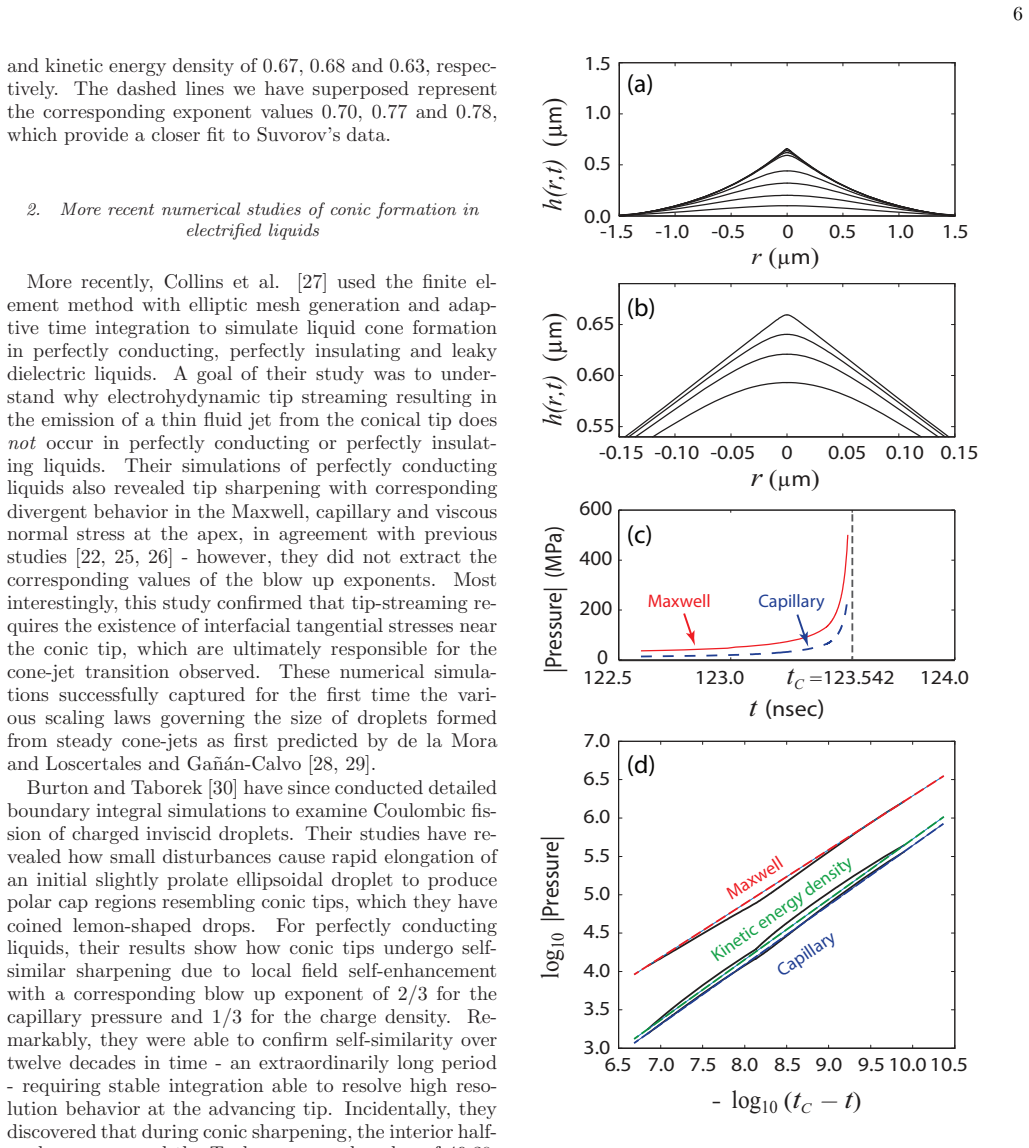
1 µ m centered about the origin. Initial electric field strength Eo = 4. 8 × 10⁸V/m. (a) Interface shapes shown at times t = 0, 81.2, 104.5, 116.1, 122.6, 123.1, 123.4 and 123.5 nsec. (b ) Magnified view of conic tip at t = 122.6, 123.1, 123.4 and 123.5 nsec. (c) Divergent behavior of the (positive) Maxwel l pressure and (negative) capillary pressure at the...
-
[2]
The entries were computed as follows
Restrictions due to maximum field strength To ascertain the parameter range of validity for the simulations in this study, we provide in Table III a list of derived values for three fluids at their melting tem- perature commonly used in liquid metal ion source de- vices, namely gallium (Ga), indium (In) and cesium (Cs). The entries were computed as follows....
work page 2014
-
[3]
On ‘Tonks’ theory of liquid surface rupture by a uniform electric field,
J. Frenkel, “On ‘Tonks’ theory of liquid surface rupture by a uniform electric field,” Phys. Z. Sowjetunion 8, 675 – 683 (1935)
work page 1935
-
[4]
Consequences of holding Ca constant in simulations In the results which follow, it is important to under- stand the consequences of holding the capillary number fixed when examining the flow behavior and interfacial shapes obtained at different Reynolds numbers. In par- ticular, given a liquid with fixed material constants, the restriction of fixed capillary n...
-
[5]
The region of largest strain rate is therefore nestled deep within the boundary layer which extends much further into the bulk liquid. C. Self-similar evolution of conic tip We now turn to evidence of self-similar growth irre- spective of Reynolds number for dynamic regimes span- ning the viscous to inviscid limit. The evolution of the magnitudes of the v...
-
[6]
Operational characteristics of colloid thrusters,
J. Perel, A. Y. Yahiku, J. F. Mahoney, H. L. Daley, and A. Sherman, “Operational characteristics of colloid thrusters,” J. Spacecraft Rockets 8, 702–708 (1971)
work page 1971
-
[7]
Determination of collapse time TC In order to extract accurate power law exponents cor- responding to the time at which the forces acting at the conic apex undergo divergence, it is first necessary to ex- tract from the simulations the asymptotic collapse time TC. For each run corresponding to a given value Re, this collapse time was determined by examinin...
work page 2001
-
[8]
at the apex is given by ∂V/∂Z , it must therefore scale as τ − β V = τ − 1. Our simulations confirm that at Re = 50, 000, the magnitude of this exponent has already reached a value 0 .9719 ± 0.0025, close to the asymptotic limit of one. The trend evident from Fig. 8 is that the magnitude of βV will further smoothly increase toward unity as Re → ∞. Zubarev’...
Show all 50 references
-
[9]
Advanced high- thrust colloid sources,
M. N. Huberman and S. G. Rosen, “Advanced high- thrust colloid sources,” J. Spacecraft Rockets 11, 475 – 480 (1974)
1974
-
[10]
Our simulations at Re = 0.1 yield a value βV = 1.0064 ± 0.0009, in excellent agreement with this prediction
at the apex is given by ∂V/∂Z , it must then be the case from the scalings for V and Z that the viscous normal stress scales as τ − 1, the same scaling obtained in the limit of high Re. Our simulations at Re = 0.1 yield a value βV = 1.0064 ± 0.0009, in excellent agreement with...
-
[11]
The simula- tions were also terminated once the dimensionless apex radius of curvature (normalized by ho) attained the value 2.722 × 10− 4
Restrictions due to Bond number In this study, the capillary number was held fixed at a value Ca = 7.0834 and gravity effects neglected such that the Bond number Bo =ρgh2 o/γ <<1. The simula- tions were also terminated once the dimensionless apex radius of curvature (normalized ...
-
[12]
Orloff, Utlaut M., and L Swanson, High Resolution Focused Ion Beams: FIB and Its Applications (Kluwer Academic, 2003)
J. Orloff, Utlaut M., and L Swanson, High Resolution Focused Ion Beams: FIB and Its Applications (Kluwer Academic, 2003)
2003
-
[13]
On the influence of electrification on ripples,
J. Larmor, “On the influence of electrification on ripples,” Proc. Cambridge Phil. Soc. 7, 69–71 (1890)
-
[14]
A theory of liquid surface rupture by a uni- form electric field,
L. Tonks, “A theory of liquid surface rupture by a uni- form electric field,” Phys. Rev 48, 562–568 (1935)
1935
-
[15]
NASA Technology Roadmaps TA2: In-Space Propulsion Technologies,
“NASA Technology Roadmaps TA2: In-Space Propulsion Technologies,” www.nasa.gov/offices/oct/home/roadmaps/index.html (2015)
2015
-
[16]
About the Tonks theory of liquid surface rupture by a uniform electric field in vacuum,
Ya. I. Frenkel, “About the Tonks theory of liquid surface rupture by a uniform electric field in vacuum,” Zh. Eksp. Teor. Fiz 6, 347–50 (1936)
1936
-
[17]
Liquid metal droplets for heavy parti- cle propulsion,
V. E. Krohn, “Liquid metal droplets for heavy parti- cle propulsion,” Prog. Astronautics Aeronautics 5, 73–80 (1984)
1984
-
[18]
Disintegration of water drops in an electric field,
G. I. Taylor, “Disintegration of water drops in an electric field,” Proc. R. Soc. Lond. A 280, 383–397 (1964)
1964
-
[19]
A capillary-fed annular colloid thruster,
A. G. Bailey, J. E. Bracher, and H. J. Von Rohden, “A capillary-fed annular colloid thruster,” J. Spacecraft Rockets 9, 518–521 (1972)
1972
-
[20]
One-mlb colloid thruster system develop- ment,
S. Zafran, J.C. Beynon, P.W. Kidd, H. Shelton, and F. A Jackson, “One-mlb colloid thruster system develop- ment,” J. Spacecraft Rockets 10, 531–533 (1973)
1973
-
[21]
Formation of conic cusps at the surface of liquid metal in electric field,
N. M. Zubarev, “Formation of conic cusps at the surface of liquid metal in electric field,” J. Exp. Theor. Phys. 30, 544–548 (2001)
2001
-
[22]
Secondary-ion collection system for an ion microprobe analyzer of high mass res- olution,
V. E. Krohn and G. R. Ringo, “Secondary-ion collection system for an ion microprobe analyzer of high mass res- olution,” Rev. Sci. Instrum. 43, 1771–1772 (1972)
1972
-
[23]
A high-intensity scanning ion probe with submicrometer spot size,
R. L. Seliger, J. W. Ward, V. Wang, and R. L. Kubena, “A high-intensity scanning ion probe with submicrometer spot size,” Appl. Phys. Lett. 34, 310–312 (1979)
1979
-
[24]
A new approach to simulating the operation of liquid metal ion sources,
C. Zheng and T. Linsu, “A new approach to simulating the operation of liquid metal ion sources,” J. Vac. Sci. & Tech. 6, 2104 – 2107 (1988)
1988
-
[25]
Electric micropropulsion- systems,
W. P. Wright and P. Ferrer, “Electric micropropulsion- systems,” Prog. Aero. Sci. 74, 48–61 (2015)
2015
-
[26]
although those simulations were constrained to two values of the Reynolds number, namely Re = 717 and Re = 178, respectively. Since charge transport in perfectly conducting liquids is essentially instantaneous in comparison to the time scale for viscous flow, the electrostatic ...
-
[27]
Literature study of field emission electric propulsion microthruster,
M. K. Bharti and S. Chalia, “Literature study of field emission electric propulsion microthruster,” Inter. Res. J. Eng. and Tech. 4, 2777–2781 (2017)
2017
-
[28]
Zheng You, Space Microsystems and Micro/Nano Satel- lites, National Defense Industry Press (Butterworth- Heinemann, Oxford, UK, 2017)
2017
-
[29]
On the equilibrium of liquid conducting masses charged with electricity,
Lord Rayleigh, “On the equilibrium of liquid conducting masses charged with electricity,” Philos. Mag. 14, 184– 186 (1882)
-
[30]
Simulations of coulombic fission of charged inviscid drops,
J. C. Burton and P. Taborek, “Simulations of coulombic fission of charged inviscid drops,” Phys. Rev. Lett. 106, 144501 (2011)
2011
-
[31]
De Magnete,
W. Gilbert, “De Magnete,” (Petrus Short, London, 1600 (in Latin)). Translation by P. F. Mottlay, pg. 89 (Dover, New York, 1958)
1958
-
[32]
II. A letter concerning the electricity of water,
S. Gray, “II. A letter concerning the electricity of water,” Proc. R. Soc. Lond. 37, 227–230 and 260 (1731)
-
[33]
Evolution of neutral and charged droplets in an electric field,
M. A. Fontelos, U. Kindel´ an, and O. Vantzos, “Evolution of neutral and charged droplets in an electric field,” Phys. Fluids , 092110 (2008)
2008
-
[34]
Dynamic taylor cone formation on liquid metal surface: numerical modeling,
V. G. Suvorov and E. A. Litvinov, “Dynamic taylor cone formation on liquid metal surface: numerical modeling,” J. Phys. D: Appl. Phys. 33, 1245–1251 (2000)
2000
-
[35]
O. M. Belozerkovskii, Numerical Simulations in Contin- uous Media Mechanics (Physics and Mathematics Liter- ature, Moscow, 1994) p. 442
1994
-
[36]
Singularity during the onset of an electrohydrodynamic spout,
L. Oddershede and S. R. Nagel, “Singularity during the onset of an electrohydrodynamic spout,” Phys. Rev. Lett. 85, 1234–1237 (2000)
2000
-
[37]
Numerical analysis of liquid metal flow in the presence of an electric field:application to liquid meta l ion source,
V. G. Suvorov, “Numerical analysis of liquid metal flow in the presence of an electric field:application to liquid meta l ion source,” Surf. Interface Anal. 36, 421–425 (2004)
2004
-
[38]
Formation of the taylor cone on the surface of liquid metal in the presence of an electric field,
V. G. Suvorov and N. M. Zubarev, “Formation of the taylor cone on the surface of liquid metal in the presence of an electric field,” J. Phys. D: Appl. Phys. 37, 289–297 22 (2004)
2004
-
[39]
Electrohydrodynamic tip streaming and emis- sion of charged drops from liquid cones,
R. T. Collins, J. J. Jones, M. T. Harris, and O. A. Basaran, “Electrohydrodynamic tip streaming and emis- sion of charged drops from liquid cones,” Nature Physics 4, 149–154 (2008)
2008
-
[40]
The current emitted by highly conducting taylor cones,
J. F. de la Mora and I. Loscertales, “The current emitted by highly conducting taylor cones,” J. Fluid Mech. 260, 155–184 (1994)
1994
-
[41]
Electrospray as a source of nanoparticles for efficient colloid thrusters,
A. M. Ga˜ n´ an-Calvo, “Electrospray as a source of nanoparticles for efficient colloid thrusters,” Phys. Rev. Lett. 17, 217–220 (2001)
2001
-
[43]
Numerical simulations of electrostatically driven jets from nonvis- cous droplets,
M. Garzon, L. J. Gray, and J. A. Sethian, “Numerical simulations of electrostatically driven jets from nonvis- cous droplets,” Phys. Rev. E 89, 033011 (2014)
2014
-
[44]
Singularities on charged viscous droplets,
S. I. Betel´ u, M. A. Fontelos, U. Kindel´ an, and O. Vant- zos, “Singularities on charged viscous droplets,” Phys. Fluids 18, 051706 (2006)
2006
-
[46]
Microfluidics module v5.2a,
Inc. COMSOL Multiphysics, “Microfluidics module v5.2a,” Burlington, MA, USA
-
[47]
Liquid metal ion sources,
R. G. Forbes and G. L. R. Mair, “Liquid metal ion sources,” in Handbook of charged particle optics , edited by J. Orloff (CRC Press, Boca Raton, FL, 2008) 2nd ed., Chap. 2
2008
-
[49]
De- tection of a dynamic cone-shaped meniscus on the surface of fluids in electric fields,
E. O. Elele, Y. Shen, D. R. Pettit, and B. Khusid, “De- tection of a dynamic cone-shaped meniscus on the surface of fluids in electric fields,” Phys. Rev. Lett. 114, 054501 (2015)
2015
-
[50]
Iida and R
T. Iida and R. I. L. Guthrie, The Physical Properties of Liquid Metals (Oxford University Press, 2007). 23 TABLE II. Data extracted from numerical simulations descri bed in the text for 0 . 1 ≤ Re ≤ 50, 000 at Ca = 7 . 0834. Description of mesh schemes A and B appears in Secti...
2007
-
[51]
For too small a value of the capillary number, the flow will be overwhelmed by the force of surface tension and budding protrusions will be rapidly leveled
and ( 52), it is evident that both the Reynolds and capillary number play a key role in the formation process. For too small a value of the capillary number, the flow will be overwhelmed by the force of surface tension and budding protrusions will be rapidly leveled. Too small ...
-
[52]
( 51), are shown to sustain extended self- similar growth upon approach to the collapse time
and the Navier-Stokes equation given by Eq. ( 51), are shown to sustain extended self- similar growth upon approach to the collapse time. Self- similar variable transformations obtained from exponents extracted from the numerical simulations conducted at various Re at fixed Ca ...
-
[54]
to deter- mine what was the resulting scaling for the viscous stress and found that ∂V ∂T/bracehtipupleft/bracehtipdownright/bracehtipdownleft/bracehtipupright 1 ∼V ∂V ∂Z/bracehtipupleft/bracehtipdownright/bracehtipdownleft/bracehtipupright 2 ∼ ∂P ∂Z/bracehtipupleft/bracehtipd...
Reviewed August 14, 2026 · model on record in the stance chip above.
Discussion (0). Continue with ORCID to comment.