REVIEW 3 major objections 4 minor 43 references
Multi-objective scheduling on two dedicated processors
T0 review · 3 major / 4 minor · reviewed 2026-08-14 · deepseek-v4-flash
Pith's one-line read Three genetic-algorithm variants (aggregative, Pareto, and NSGA-II) produce approximate Pareto fronts for the NP-hard problem of scheduling dedicated two-processor tasks under release dates, with lower bounds for makespan, total…
desk verdict Genuinely new tri-objective problem and a valid (if unproved) LBTC lower bound, but the 'effectiveness' claim is underdetermined by ratios to lower bounds of unknown tightness, especially for tardiness. read the letter →
The pith
A machine-rendered reading of the paper's core claim, the machinery that carries it, and where it could break.
The reading
What carries the argument
The load-bearing object is a single permutation-coded genetic algorithm whose selection pressure can be switched among three mechanisms. The aggregative mechanism draws weight vectors from a Uniform Design matrix, giving seven fitness functions that are weighted sums of the three normalized criteria. The Pareto mechanism keeps all non-dominated solutions in the population and fills the rest with the best individuals for each criterion. The NSGA-II mechanism merges parents and children, sorts into non-dominated fronts, and breaks ties by crowding distance. Alongside these, the paper installs three quality floors: $\mathrm{LB}_C$ from the two single-processor relaxations; $\mathrm{LB}_{\mathrm{TC}}$, built by splitting both kinds of tasks into half-length pieces, re-weighting them by $1/2$, adding the penalty $\sum_j p_j/4$ on each processor, and applying the SRPT-based theorem [10] to underestimate completion times; and $\mathrm{LB}_{\mathrm{TT}}$, built from the same splitting plus an assignment step solved by the Hungarian algorithm. The lower bounds do the work of turning the heuristic fronts into measurable claims about proximity to optimality.
What would settle it
Take a small instance (say five tasks with release dates), compute the paper's $\mathrm{LB}_{\mathrm{TC}}$ by hand, and compare it with the exact optimal total completion time from exhaustive enumeration. Any instance where $\mathrm{LB}_{\mathrm{TC}}$ exceeds the true optimum refutes the claimed bound and invalidates the $TC/\mathrm{LB}_{\mathrm{TC}}$ quality ratios.
Extended reading notes
Core claim
The paper's central assertion is that the tri-objective problem $P2|fixj,rj|C_{\max},\sum T_j,\sum C_j$ can be tackled effectively by adapting genetic algorithms, and that the quality of the solutions can be certified by criterion-specific lower bounds. For makespan, the bound $\mathrm{LB}_C$ comes from relaxing the problem into two single-processor sub-problems and taking the maximum of their optimal values. For total completion time, the paper proposes $\mathrm{LB}_{\mathrm{TC}} = \mathrm{Lb}_1 + \mathrm{Lb}_2$: bi-processor tasks are split into two mono-processor subtasks, mono-processor tasks are halved with shifted release dates, a penalty $\sum_j p_j/4$ is added on each processor, and the SRPT theorem supplies per-task completion-time underestimates. On the five instance types tested, the reported ratios $C/\mathrm{LB}_C$ are between about $1.03$ and $1.36$, the ratios $TC/\mathrm{LB}_{\mathrm{TC}}$ mostly between about $1.1$ and $2.2$, and $TT/\mathrm{LB}_{\mathrm{TT}}$ varies much more, especially when release dates are spread widely. The conclusion the paper draws is that the three methods are effective and complementary: each one leads on at least one criterion or instance type, and the fronts are diverse enough to be useful.
Load-bearing premise
The load-bearing premise is that the split-and-penalty relaxation, including the added term $\sum_j p_j/4$, gives a value at or below the true optimal total completion time; if that inequality ever fails, the $TC/\mathrm{LB}_{\mathrm{TC}}$ columns in the result tables are not valid quality measures.
Editorial extensions
If this is right
- For instances in the tested range ($n=10$ and $n=20$, five load-balance types), the algorithms produce useful approximate Pareto fronts in under a third of a second, so the approach is fast enough for interactive or repeated use.
- The total-completion-time lower bound $\mathrm{LB}_{\mathrm{TC}}$ gives future heuristics a concrete quality floor: any heuristic can be reported as a ratio $TC/\mathrm{LB}_{\mathrm{TC}}$, and a ratio near 1 indicates a schedule near the bound.
- No single selection mechanism dominates: the results imply that the right choice among aggregative, Pareto, and NSGA-II depends on the objective being prioritized and on the task-load distribution.
- Total tardiness is the criterion with the largest gap to its bound, especially at wide release-date spreads, identifying the place where better algorithms or tighter bounds would pay off.
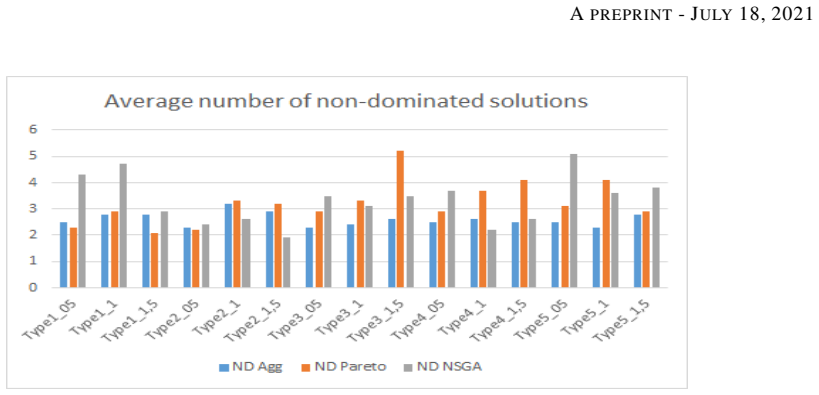
- The hypervolume ratio and the number of non-dominated solutions give a concrete way to rank the three methods on each instance group.
Reading between the lines
- A natural test not run in the paper is varying the split weight $w$ in $\mathrm{LB}_{\mathrm{TC}}$; the authors fix $w=1/2$, and checking whether other weights strengthen the bound would show whether that choice is essential.
- The same splitting idea could be extended to more than two dedicated processors, but the penalty argument would need a new proof, since the two-processor split and the added penalty term do not transfer automatically.
- Because the reported values are averages over ten random instances, reporting the spread across those instances would sharpen the effectiveness claim, a step the paper leaves implicit.
- The three selection mechanisms could be transferred to other multi-objective scheduling problems with fixed job-to-machine assignments, such as the parallel-machine case the conclusion names as future work.
Signed reviews
Editorial analysis
A structured set of objections, weighed in public.
Referee Report
Summary. The paper studies the tri-objective scheduling problem P2|fixj,rj|Cmax,ΣTj,ΣCj on two dedicated processors. It proposes three genetic algorithm variants: an aggregative method using uniform-design weights, a Pareto-based method, and NSGA-II. It also presents lower bounds for the three criteria (LBC for makespan, LBTC for total completion time, LBTT for total tardiness) and evaluates the algorithms on randomly generated instances with n=10 and n=20 across five problem types and three release-date ranges. The evaluation uses ratios of each objective to its lower bound, the number of non-dominated solutions, and a hypervolume ratio. The abstract and conclusion claim that the proposed algorithms are effective.
Significance. If the computational results were fully supported, the paper would make a useful contribution: a practical multi-objective heuristic study for an NP-hard scheduling problem, together with a new lower bound LBTC for the total completion time criterion. A strength is that the relative ranking of the three algorithms is internally coherent, since all comparisons use the same lower-bound baselines, and the LBTC construction is, on inspection, a valid relaxation: scheduling the two halves of each mono-processor task contiguously in any feasible original schedule yields a relaxed schedule whose weighted objective is ΣC_j − Σp_j/4 for the mono-processor tasks, so adding the p_j/4 penalty restores a valid lower bound. However, the manuscript does not provide this proof, and more importantly, it offers no validation against exact optima or against existing benchmarks. The problem sizes considered (n=10 and n=20) are small enough that exact MIP or branch-and-bound results should be obtainable for at least a subset of instances.
major comments (3)
- [§5.2, Tables 6–11] The absolute quality of the solutions is measured only by ratios to lower bounds whose tightness is never established. For example, Table 9 reports TT/LBTT = 99.889 for Type 2, α=1.5 with the aggregative method; this could mean either that the solutions are very poor for the total tardiness criterion or that LBTT is very weak. Similarly, TC/LBTC values above 2.0 in Tables 9–11 could reflect a loose bound rather than a poor front. Since the instances have only n=10 or n=20 jobs, exact methods are feasible: one could solve the single-criterion problems exactly (e.g., a MIP solver or the branch-and-bound of Manaa and Chu [33] for makespan, and analogous exact methods for the other criteria) and report true optimality gaps on at least a subset of instances. Without this, the abstract's statement that the obtained results show 'the effectiveness of the proposed algorithms' is not supported, even though the relative ordering of the three algorithms is largely unaffected by bound tightness.
- [Eq. (20), §5.2] The definition of the hypervolume ratio HVr is incomplete and, as written, appears incoherent. The formula HVr = 1 − (HV_LB − HV_Algorithm)/HV_LB requires an object HV_LB, which is never defined in the text. In the usual definition, the hypervolume of a single lower-bound point is zero, and if the lower bound is instead used as the reference point, the denominator vanishes. The text earlier states that the reference point is the worst value in each criterion among the initial solutions, which is inconsistent with Eq. (20). All HVr-based comparisons in Tables 6–11 and Figures 4 and 6 depend on this quantity, so the definition must be made precise, with a clear statement of how HV_LB is computed and why the resulting ratio measures what the paper claims.
- [§3.4] The lower bound LBTC is asserted without proof. The phrase 'with Σ_{j∈P1} p_j/4 is a penalty to be added according to Webster formula' is not a justification, and no reference to a 'Webster formula' is provided. The construction is in fact valid: for any feasible original schedule, scheduling each split mono-processor task's two halves contiguously yields a feasible relaxed schedule whose weighted objective equals ΣC_j − Σ_{j∈P1} p_j/4 on processor P1 (and analogously on P2), so adding the penalty over the mono-processor tasks gives a lower bound on the original total completion time. This argument should be written out explicitly in the paper, along with a clarification that the penalty applies only to mono-processor tasks and not to the bi-processor sub-tasks. As it stands, the validity of LBTC, and hence all TC/LBTC ratios in Tables 6–11, is not established in the manuscript itself.
minor comments (4)
- [§5.1, Table 5] The text reads '0, 300 seconds' where '0.300' is clearly intended; the comma should be a decimal point.
- [§5.2, discussion of Tables 6–8] The sentence 'For the problem of Type 2 with (α = 1.5, α = 1), Type 3 with (α = 1.5, α = 1) and Type 4 with (α = 1.5, α = 1)' is garbled; it appears that separate α values are meant for each problem type, and the repeated pairs should be corrected.
- [References] Several references contain typographical errors, for example [10] 'Naval Researech Logistics' should be 'Naval Research Logistics', and [15] is titled 'Some New Uniform Design' but appears to be an Emmons scheduling paper; these should be checked and corrected.
- [§4.2] The text says the aggregative method 'consists in generating weights for each sequence', but the uniform-design weights are generated once independently of the sequences; the wording should be clarified to avoid implying per-individual weight generation.
Circularity Check
No circular derivation: the algorithms and lower bounds are independent; the effectiveness claim is under-supported but not circular.
full rationale
The derivation chain is not circular. The three genetic algorithms produce schedules from random initial populations via crossover, mutation, and selection; no parameter is fitted to the reported quality metrics or to the lower bounds. The lower-bound ratios are computed after the fact as evaluation floors. The new LBTC in Section 3.4 is not an input-renaming: for any feasible original schedule, splitting each mono-processor job into two p/2 sub-jobs with shifted release dates and weight 1/2 gives a relaxed per-processor schedule whose weighted completion sum is sum(C_j) minus sum over mono jobs of p_j/4; adding the p_j/4 penalty restores the original objective contribution. Hence LBTC is a genuine relaxation lower bound, and its use as a denominator is not a self-justifying fit. The LBTT lower bound is imported from the authors' own prior work [24], but it is used as a published evaluation floor rather than as a step that defines the algorithms' outputs; no uniqueness theorem or ansatz is smuggled in. The paper does assert LBTC's validity without a full proof, which is an omitted-proof rigor gap rather than circularity. The real weakness is evidential: ratios such as C/LBC, TT/LBTT, and TC/LBTC are relative to bounds of unmeasured tightness, and no comparison to exact optima is provided even for n=10-20, so the blanket 'effectiveness' claim is underdetermined. That is a validation weakness, not a circular derivation.
Assumptions & free parameters
free parameters (2)
- weight w in LBTC =
0.5
- genetic algorithm parameters (population size, crossover/mutation rates) =
not reported
assumptions (4)
- standard math Chu's theorem: the SRPT rule yields pointwise minimum completion times for the single-machine preemptive problem 1|rj,pre|ΣCj
- ad hoc to paper Splitting bi-processor tasks into weighted mono-processor sub-tasks yields a valid relaxation (lower bound)
- ad hoc to paper The 'Webster formula' penalty of p_j/4 correctly converts the split-task completion time bound back to the original task completion time bound
- domain assumption Instance generation distributions (processing times uniform in {0,...,50}, release dates in {0,...,L}, due dates in {r_j+p_j,...,r_j+p_j+L})
Cite this review
Pith. "Pith review of Multi-objective scheduling on two dedicated processors." pith.science (2026). https://pith.science/paper/INU5NGDE
@misc{pith2026190804452,
  author       = {Pith},
  title        = {Pith review of: Multi-objective scheduling on two dedicated processors},
  year         = {2026},
  howpublished = {\url{https://pith.science/paper/INU5NGDE}},
  note         = {Machine review of arXiv:1908.04452}
}
read the original abstract
We study a multi-objective scheduling problem on two dedicated processors. The aim is to minimize simultaneously the makespan, the total tardiness and the total completion time. This NP-hard problem requires the use of well-adapted methods. For this, we adapted genetic algorithms to multi-objective case. Three methods are presented to solve this problem. The first is aggregative, the second is Pareto and the third is non-dominated sorting genetic algorithm II (NSGA-II). We proposed some adapted lower bounds for each criterion to evaluate the quality of the found results on a large set of instances. Indeed, these bounds also make it possible to determine the dominance of one algorithm over another based on the different results found by each of them. We used two metrics to measure the quality of the Pareto front: the hypervolume indicator (HV) and the number of solutions in the optimal front (ND). The obtained results show the effectiveness of the proposed algorithms.
Figures

Figures from the paper (3 more)


Reference graph
Works this paper leans on
-
[33]
Manaa, A. and Chu, C. Scheduling multiprocessor tasks to minimise the makespan on two dedicated processors. European Journal of Industrial Engineering 4(3) , pages 265–279., 2010
work page 2010
-
[1]
Afrati, F.N., Bampis, E., Chekuri, C., Karger, D.R., Kenyon, C., Khanna, S., Milis, I., Queyranne, M., Sartinutella, M. and Stein, C. and Sviridenko. M. Approximation schemes for minimizing average weighted completion time with release dates. In Symposium on F oundations of Computer Science, pages 32–44.IEEE, 1999. 15 A PREPRINT - JULY 18, 2021
work page 1999
-
[2]
Afrati, F.N. and Milis, I. Designing ptass for min-sum scheduling problems. In Discrete Applied Mathematics 154(4), pages 622–639., 2006
work page 2006
-
[3]
Alberto, I. and Mateo, PM. A crossover operator that uses Pareto optimality in its definition. In Top 19(1), Springer, pages 67–92., 2011
work page 2011
-
[4]
Allahverdi, A., Aydilek, H. and Aydilek, A. No-wait flowshop scheduling problem with two criteria; total tardiness and makespan. European Journal of Operational Research 269(2), pages 590–601.,2018
work page 2018
-
[5]
Alhadi, G., Kacem, I., Laroche, P. and Osman I. Approximation algorithms for minimizing the maximum lateness and makespan on parallel machines. Annals of Operations Research , DOI 10.1007/s10479-019-03250-x. ,2019
-
[6]
Berrichi, A., Amodeo, L., Yalaoui, F., Châtelet, E. and Mezghiche, M. Bi-objective optimization algorithms for joint production and maintenance scheduling: application to the parallel machine problem. Journal of Intelligent Manufacturing 20(4) , pages 389–400., 2007
work page 2007
-
[7]
Bianco, L., Blazewicz, J., Dell’Olmo, P. and Drozdowski, M. Preemptive multiprocessor task scheduling with release times and time windows. Annals of Operations Research 70(1) , pages 43–55.,1997
work page 1997
Show all 43 references
-
[8]
and Drozdowski, M
Blazewicz, J., Dell’Olmo, P. and Drozdowski, M. Scheduling multiprocessor tasks on two parallel processors. RAIRO-Operations Research 36(1), pages 37–51.,2002
2002
-
[9]
The hypervolume indicator for multi-objective optimisation: Calculation and use
Bradstreet, L. The hypervolume indicator for multi-objective optimisation: Calculation and use. PhD thesis, University of Western Australia, 2011
2011
-
[10]
Scheduling multiprocessor tasks on two parallel processors.A branch and bound algorithm to minimize the total of tardness with different release date
Chu, C. Scheduling multiprocessor tasks on two parallel processors.A branch and bound algorithm to minimize the total of tardness with different release date. Naval Researech Logistics 39(2), pages 256–283.,1992
1992
-
[11]
and LaPaugh, A.S
Coffman, E.G., Garey, M.R., Johnson, D.S. and LaPaugh, A.S. Scheduling file transfers. SIAM Journal on Computing 14(4), pages 743–780.,1985
1985
-
[12]
Craig, G.L., Kime, C. R. and Saluja, K.K. Test scheduling and control for vlsi built-in self-test. IEEE Transactions on Computers 37(9), pages 1099–1109.,1988
1988
-
[13]
and Meyarivan, T
Deb, K., Pratap, A., Agarwal, S. and Meyarivan, T. A fast and elitist multiobjective genetic algorithm: NSGA II. IEEE Transactions on Evolutionary Computation 6(2) , pages 182–197.,2002
2002
-
[14]
Scheduling multiprocessor tasks an overview
Drozdowski, M. Scheduling multiprocessor tasks an overview. European Journal of Operational Research 94(2) , pages 215–230.,1996
1996
-
[15]
Some New Uniform Design
Emmons, H. Some New Uniform Design. Operations Research 17(4), pages 701–715.,1969
1969
-
[16]
and Li, J.K
Fang, K.T. and Li, J.K. Multi-objective genetic algorithms made easy: selection, sharing and mating restrictions. Hong Kong, Baptist Univ., Hong Kong, Tech. Rep. Math-042, 1994
1994
-
[17]
and Guerreiro, A.P
Fonseca, L.C., Mand P., López-Ibñáez, M. and Guerreiro, A.P. Computation of the hypervolume indicator. http://lopez-ibanez.eu/hypervolume,, Accessed 3 Feb 2019
2019
-
[18]
Hoogeveen, J.A., Van de Velde. S.L. and Veltman, B. Complexity of scheduling multiprocessor tasks with prespecified processors allocations. Discrete Applied Mathematics 55(3), pages 259–272.,1994
1994
-
[19]
and Zhang, Y .F
Jia, H.Z., Fuh, J.Y ., Nee, A.Y . and Zhang, Y .F. Integration of genetic algorithm and Gantt chart for job shop scheduling in distributed manufacturing systems. Computers and Industrial Engineering 53(2) , pages 313– 320.,2007
2007
-
[20]
and Kim, B.S
Jung, S., Woo, Y .B. and Kim, B.S. Two-stage assembly scheduling problem for processing products with dynamic component-sizes and a setup time. omputers and Industrial Engineering 104 , pages 98–113.,2017
2017
-
[21]
Adaptation in Natural and Artifcial Systems
Holland, J. Adaptation in Natural and Artifcial Systems. Michigan Press, University of Michigan Press, USA, 1975
1975
-
[22]
Lower bounds for tardiness minimization on a single machine with family setup times
Kacem, I. Lower bounds for tardiness minimization on a single machine with family setup times. International Journal of Operations Research 4(1), pages 18–31., 2007
2007
-
[23]
and Dammak, A
Kacem, A. and Dammak, A. A genetic algorithm to minimize the makespan on two dedicated processors. Control, Decision and Information Technologies, Metz, france ,IEEE, pages 400–404., 3-5 Nov. 2014
2014
-
[24]
and Dammak, A
Kacem, A. and Dammak, A. A genetic algorithm to minimize the total of tardiness multiprocessing tasks on two dedicated processors. Control, Decision and Information Technologies, Barcelona, Spain ,IEEE, pages 85–90., 5-7 April 2017
2017
-
[25]
and Dammak, A
Kacem, A. and Dammak, A. Bi-objective scheduling of multi-processor tasks on two dedicated processors. International Conference of the African Federation of Operational Research Societies, Tunisia , 2-4 July., 2018. 16 A PREPRINT - JULY 18, 2021
2018
-
[26]
and Dammak, A
Kacem, A. and Dammak, A. Bi-objective scheduling on two dedicated processors. European Journal of Industrial Engineering 5, pages 681–700., 2019
2019
-
[27]
and Silav, A
Karasakal, E. and Silav, A. A multi-objective genetic algorithm for a bi-objective facility location problem with partial coverage. Top 24(1), Springer, pages 206–232., 2016
2016
-
[28]
Scheduling multiprocessor tasks on dedicated processors
Kramer, A. Scheduling multiprocessor tasks on dedicated processors. Universitat Osnabruck, Allemagne, 1995
1995
-
[29]
and Talbi, E
Lemesre, J. and Talbi, E. Méthodes exactes pour l’optimisation combinatoire multi-objectif: conception et application. EUniversité des sciences et technologies de Lille, France , 2006
2006
-
[30]
Single machine earliness and tardiness scheduling
Li, G. Single machine earliness and tardiness scheduling. European Journal of Operational Research 96(3), pages 546–558., 1997
1997
-
[31]
Minimizing total completion time in the assembly scheduling problem
Lee, I.S. Minimizing total completion time in the assembly scheduling problem. Computers and Industrial Engineering 122, pages 211–218., 2018
2018
-
[32]
and Wang, Y
Leung, Y .W. and Wang, Y . Multiobjective Programming Using Uniform Design and Genetic Algorithm.IEEE Transaction on Systems, Man and Cybernetics 30(c) , pages 293–303., 2000
2000
-
[34]
and Hur, S
Moon, C., Kim, J. and Hur, S. Integrated process planning and scheduling with minimizing total tardiness in multi-plants supply chain. Computers and Industrial Engineering 43(1-2) , pages 331–349., 2002
2002
-
[35]
and Andrade, E
Nogueira, B., Maciel, P., Tavares, E., Silva, R. and Andrade, E. Multi-objective optimization of multimedia embedded systems using genetic algorithms and stochastic simulation. Soft Computing 21(14), pages 4141–4158., 2017
2017
-
[36]
Cours économie politique
Pareto, V . Cours économie politique. Lausane Switzerland, Switzerland, 1896
-
[37]
and Adjallah, K
Rebai, M., Kacem, I. and Adjallah, K. Earliness tardiness minimization on a single machine to schedule preventive maintenance tasks: metaheuristic and exact methods. Journal of Intelligent Manufacturing 23(4), pages 1207–1224., 2010
2010
-
[38]
and Hakan, T
Mumtaz , K., Ilknur, K. and Hakan, T. An integrated multi-criteria decision making methodology for health technology assessment. European Journal of Industrial Engineering 12(4) , pages 504–534., 2018
2018
-
[39]
and Ercan, M.F
Oguz, C. and Ercan, M.F. A genetic algorithm for hybrid flow-shop scheduling with multiprocessor tasks. Journal of Scheduling 8(4), pages 323–351., 2005
2005
-
[40]
and Seyed, H
Salmasnia, A., Khatami, M., Kazemzadeh, R., Baradaran, Z. and Seyed, H. Bi-objective single machine scheduling problem with stochastic processing times. Top 23(1), Springer, pages 275–297., 2015
2015
-
[41]
European Journal of Operational Research 211(3), pages 612–622., 2011
Vallada, E and Ruiz, R.R A genetic algorithm for the unrelated parallel machine scheduling problem with sequence dependent setup times. European Journal of Operational Research 211(3), pages 612–622., 2011
2011
-
[42]
and Ruiz, R.R
Vallada, E. and Ruiz, R.R. Scheduling unrelated parallel machines with sequence dependent setup times and weighted earliness–tardiness minimization. Justin-Time Systems, Springer, pages 67–90., 2012
2012
-
[43]
and Viswanath, K.G
Venkata, P.P., Usha, M. and Viswanath, K.G. Order acceptance and scheduling in a parallel machine environment with weighted completion time. European Journal of Industrial Engineering 12(4) , pages 535–557., 2018. 17
2018
Reviewed August 14, 2026 · model on record in the stance chip above.
Discussion (0). Continue with ORCID to comment.