REVIEW 2 major objections 4 minor 24 references
Linking Graph Entities with Multiplicity and Provenance
T0 review · 2 major / 4 minor · reviewed 2026-08-14 · deepseek-v4-flash
Pith's one-line read Separating similarity-edge storage from profile nodes keeps entity-link updates scalable to 54 billion pairs on tiny clusters.
desk verdict A systems paper with a genuinely useful data model but a benchmark flaw in the HBase-1 comparison that makes the head-to-head performance ranking unproven. read the letter →
The pith
A machine-rendered reading of the paper's core claim, the machinery that carries it, and where it could break.
The reading
What carries the argument
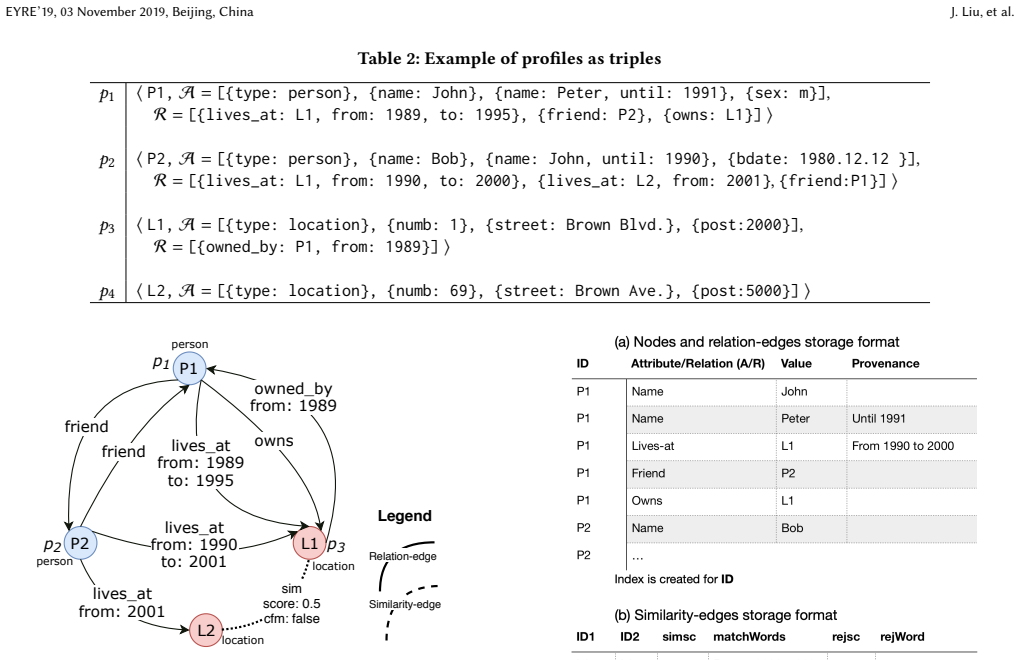
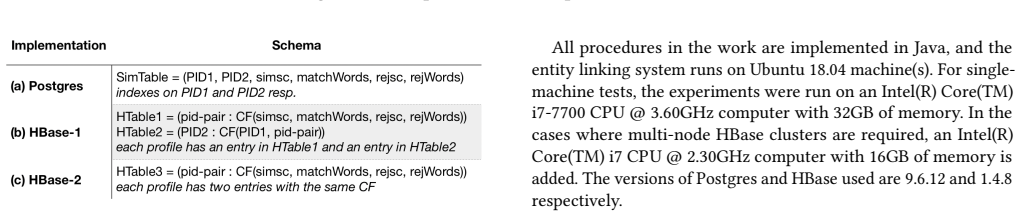
The central object is the similarity-edge table: a separate physical structure with one entry per profile pair, storing the similarity score, the rejection score, and a binary confirmation flag. The table receives the most frequent updates in the system, since every profile insertion or change triggers recomputation of scores against candidate profiles. The paper tests three implementations: a Postgres table with two id indexes, and two HBase column-family layouts—one with a single composite id-pair key and one that also stores the reverse id-pair key for bidirectional lookup. The nested-mapped Elasticsearch index is the supporting mechanism that preserves multiplicity and provenance semantics during search and blocking.
What would settle it
Run the same update-transaction benchmark on a real entity-linking workload—actual profiles, real similarity recomputations triggered by profile edits, and a measured read/write mix—comparing Postgres and HBase on the identical similarity-edge table; if Postgres no longer lags significantly or HBase throughput collapses below the 6–54 billion-pair range, the central scalability claim fails.
Extended reading notes
Core claim
The central claim is that the update bottleneck of entity linking can be isolated and tamed by a two-table physical model. Nodes and relation-edges live in one table; similarity-edges live in a separate table where each row holds a profile pair, its similarity score, its rejection score, and a confirmation flag. Because every profile change triggers re-scoring against candidate profiles, the similarity-edge table is the hot path, and the paper demonstrates that HBase column-family layouts handle inserts, searches, and replacements to 54 billion pairs on very small clusters, with the variant that stores both id-pair orientations performing best. The logical graph model supports this by defining profiles as triples with attribute and relationship lists of sets, each set containing an attribute or relation key, a value, and its provenance, so multiplicity and provenance survive ingestion and indexing. The indexing layer uses nested Elasticsearch mappings so that a profile like a name valid only until a certain date is not flattened into a lossy dictionary format.
Load-bearing premise
The experiments assume that updates to the similarity-edge table are the dominant bottleneck in real entity linking and that the synthetic profile-pair counts, with their unspecified value distributions and update mixes, represent real workloads; if actual systems have different read/write ratios or pair-score distributions, the reported HBase advantage may not transfer.
Editorial extensions
If this is right
- Profiles can hold several values for the same attribute or relationship, each with its own validity period or source, without forcing one value to overwrite another.
- Profile edits do not require rewriting the whole graph; only the affected similarity-edge entries are recomputed, because similarity-edges are decoupled from nodes and relation-edges.
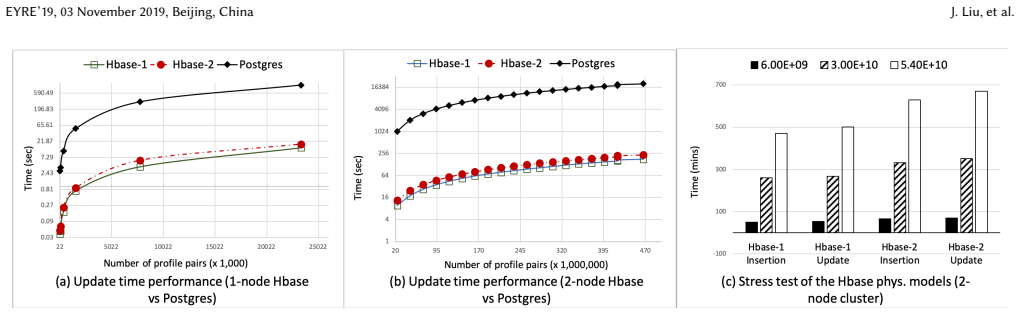
- HBase implementations sustain insert and replacement operations on 6, 30, and 54 billion profile pairs using just one- or two-node clusters, so very large entity-resolution workloads do not require large distributed deployments.
- Insertions into the similarity-edge table are faster than replacements in HBase, but both operations remain scalable at the largest tested size.
- Structural search over provenance-qualified values is supported by the nested index mapping, which the flat-format alternative would corrupt.
Reading between the lines
- If a separate similarity-edge store is the right decomposition for update-heavy entity linking, the same two-structure design could apply to other pairwise-update-heavy graph workloads such as recommendation scores, trust links, or co-occurrence weights.
- The scalability result is established on synthetic data with an unspecified distribution of attribute values and update mixes; a real workload trace with skewed pair scores and mixed reads and writes would test whether the HBase advantage survives realistic access patterns.
- The reverse id-pair key in the best HBase variant suggests that supporting symmetric lookup doubles the stored keys; a canonical ordering of the two ids could halve that overhead while preserving lookup semantics.
- Because the matching rule learner is presented in the companion Certus paper, the storage and indexing architecture could be reused with any similarity function, making the physical model independent of the specific matching logic.
Signed reviews
Editorial analysis
A structured set of objections, weighed in public.
Referee Report
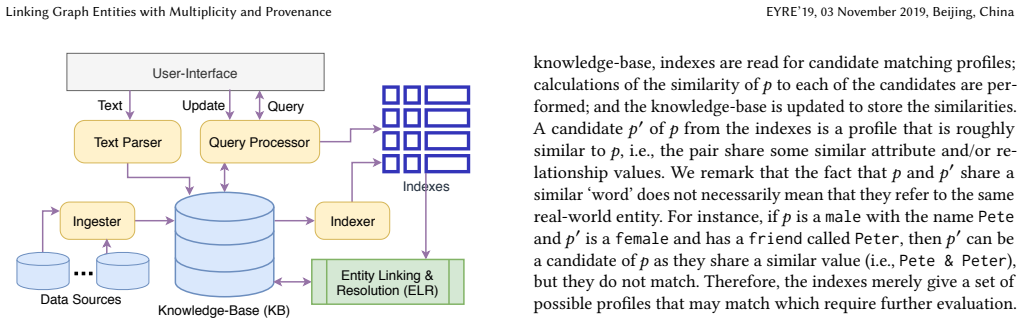
Summary. The paper presents Certus, an entity linking and resolution system whose design centers on a graph model of entity profiles that supports multiplicity and provenance of attribute and relationship values. It describes the system architecture, the logical and physical storage models for profiles and similarity edges, the index mappings in Elasticsearch, and a profile-pair similarity scoring process. The main empirical contribution is an experimental comparison of three implementations of the similarity-edge storage structure: a Postgres relational option with two indexes, an HBase option with a single row key per pair, and an HBase option that also stores the reverse pair key. The experiments measure update-transaction time for synthetic profile-pair datasets ranging from 23K to 54 billion pairs, and the authors conclude that the HBase options scale well and outperform the Postgres option.
Significance. If the storage results are valid, the paper provides useful evidence about a concrete system design choice: separating similarity edges from profile nodes and storing them in a scalable key-value structure. The explicit treatment of value multiplicity and provenance in the logical model, and the separation of storage performance from linking accuracy, are strengths. The experiments reach unusually large synthetic pair counts (54 billion), which makes the scalability claim non-trivial. However, the central storage claim is weakened by an apparent mismatch between a stated functional requirement (search from either ID) and the evaluated HBase-1 option, and by the absence of any workload specification or variance reporting. The paper does not claim accuracy improvements and correctly refers to [11] for the accuracy evaluation, so the storage claim is independently assessable.
major comments (2)
- [Section 6, Figure 5] As written, HBase-1 (option (b)) stores only the row key ID1+"-"+ID2, while Section 6 states that similarity search must be supported from either ID; only the Postgres option is said to create two indexes, and only HBase-2 (option (c)) stores the reverse pair. HBase-1 therefore appears unable to enumerate all similarity edges incident to a profile p when p appears as the second component of the row key, short of a full table scan. The ELR workflow in Section 5 is profile-centric, since changing a profile triggers re-computation of similarities against all candidates, so all incident similarity edges must be found and refreshed. The experiments report only the number of profile pairs updated, and do not state whether probe or update transactions were issued from both ID positions. Consequently, the better time of HBase-1 in Figure 4 may reflect the absence of a required reverse lookup rather than a genuinely better storage model. The authors should specify the exact update transaction sequence, repeat the comparison with reverse-ID probes for each implementation, or explicitly state that HBase-1 requires an additional reverse index.
- [Section 6, Figure 4] The experimental section does not describe how the synthetic data were generated: the number of underlying profiles, the distribution of attribute or candidate values, the selection of candidate pairs, and the mix of search, insertion, update, and deletion operations are all unspecified. The statement that for every 1,000 profiles the updated similarity entries are around 20,000-100,000 is not a workload definition, and it is not tied to any reported dataset. The reported averages over five iterations are given without standard deviations, min/max values, or any variance information, and the y-axis of Figure 4 uses a log2 scale without clarifying whether error bars are omitted intentionally. Without this information the conclusion that HBase 'scales very well for huge data sizes' is supported only for an unstated workload, and the comparison with Postgres cannot be extrapolated to real entity-linking workloads with different read-write ratios or pair-score distributions. The authors should provide a precise workload description and at least report per-iteration variation.
minor comments (4)
- [Section 5, Eq. (1)] The inf(w) weighting function relies on parameters α=0.1 and β=60, which are said to be suitable from empirical results, but no estimation procedure, data, or sensitivity analysis is provided; the relationship between the unknown k(w) and β is also asserted rather than formalized. If this scoring function remains in the paper, please give the estimation method or an explicit pointer to [11].
- [Section 4.2] The text says the size of the similarity-edge table is the square of the number of profiles, but the next sentence says a threshold may be used to filter out low-scored entries. Since the threshold implies that only a subset of pairs is stored, the 'square' statement is misleading and should be rephrased to describe the worst case.
- [Section 6, Figure 5] The HBase schemas are presented only through column-family abbreviations such as 'CF' with bracketed keys; please include the full schema, including column qualifiers, and the complete Postgres table definition with its two indexes, so that the implementations are reproducible.
- [Section 6, Figure 4] Reporting average times over five iterations without variance is not sufficient for a performance comparison; please report standard deviations or at least min/max ranges for each data point.
Circularity Check
No significant circularity: the storage-update benchmark is independent of the linking method and of any fitted accuracy parameters.
full rationale
The paper's central claim is about update-transaction performance of three physical similarity-edge storage options (Postgres, HBase-1, HBase-2), measured directly in Section 6 over varying profile-pair counts. These measurements are not derived from the graph model, the simsc/rejsc scoring functions, or the inf(w) parameters. The inf(w) function uses fitted values alpha=0.1 and beta=60, but the paper makes no accuracy prediction from it; accuracy is explicitly deferred to self-citation [11], and the storage experiments do not use that accuracy machinery as an input. The self-citation to Certus [11] is not load-bearing for the storage claim: Section 6 states that accuracy is already evaluated there, and the benchmark in this paper is purely about search, insert, update, and delete timing on the similarity structure. The possible concern that HBase-1 lacks a reverse-index lookup for the stated requirement of searching from either ID is an experimental-design or correctness threat, not a circular reduction, because the paper's equations do not define the reported timings as their own inputs. No derivation chain in the paper reduces any claimed result to its own assumptions.
Assumptions & free parameters
free parameters (4)
- Sigmoid inf(w) parameters =
alpha=0.1, beta=60
- Similarity-edge filter threshold =
not specified
- User-specified match threshold for M =
not specified
- Key attributes for rejsc =
application-defined (e.g., birth-date, zip-code)
assumptions (4)
- domain assumption Entity profiles can be represented as triples (id, attribute-list, relation-list) with values as sets of key-value pairs.
- domain assumption The workload of updating pairwise similarities is the dominant bottleneck.
- domain assumption Elasticsearch nested mappings preserve multiplicity semantics.
- standard math Standard similarity primitives (edit distance, n-gram matching, double metaphone) behave as described in the cited literature.
Cite this review
Pith. "Pith review of Linking Graph Entities with Multiplicity and Provenance." pith.science (2026). https://pith.science/paper/NG37OCS6
@misc{pith2026190804464,
  author       = {Pith},
  title        = {Pith review of: Linking Graph Entities with Multiplicity and Provenance},
  year         = {2026},
  howpublished = {\url{https://pith.science/paper/NG37OCS6}},
  note         = {Machine review of arXiv:1908.04464}
}
read the original abstract
Entity linking and resolution is a fundamental database problem with applications in data integration, data cleansing, information retrieval, knowledge fusion, and knowledge-base population. It is the task of accurately identifying multiple, differing, and possibly contradicting representations of the same real-world entity in data. In this work, we propose an entity linking and resolution system capable of linking entities across different databases and mentioned-entities extracted from text data. Our entity linking/resolution solution, called Certus, uses a graph model to represent the profiles of entities. The graph model is versatile, thus, it is capable of handling multiple values for an attribute or a relationship, as well as the provenance descriptions of the values. Provenance descriptions of a value provide the settings of the value, such as validity periods, sources, security requirements, etc. This paper presents the architecture for the entity linking system, the logical, physical, and indexing models used in the system, and the general linking process. Furthermore, we demonstrate the performance of update operations of the physical storage models when the system is implemented in two state-of-the-art database management systems, HBase and Postgres.
Figures
Figures from the paper (1 more)
Reference graph
Works this paper leans on
-
[11]
Selasi Kwashie, Jixue Liu, Jiuyong Li, Lin Liu, Markus Stumptner, and Lujing Yang
-
[1]
[n. d.]. Michael Jordan (disambiguation). https://en.wikipedia.org/wiki/Michael_ Jordan_(disambiguation). Last Accessed: 2019-07-24
work page 2019
-
[2]
David Guy Brizan and Abdullah Uz Tansel. 2006. A Survey of Entity Resolution and Record Linkage Methodologies. Communications of the IIMA 6, 3 (2006)
work page 2006
-
[3]
Diego Ceccarelli, Claudio Lucchese, Raffaele Perego, Salvatore Orlando, and Salvatore Trani. 2013. Dexter: an Open Source Framework for Entity Linking. Intl. workshop on Exploiting semantic annotations in information retrieval (ESAIR) (2013)
work page 2013
-
[4]
Peter Christen. 2012. A Survey of Indexing Techniques for Scalable Record Linkage and Deduplication. TKDE 24, 9 (2012), 1537 – 1555
work page 2012
-
[5]
Xiang Dai. 2018. Recognizing Complex Entity Mentions: A Review and Future Directions. Student Research Workshop, Association for Computational Linguistics (ACL) (2018)
work page 2018
-
[6]
Paolo Ferragina and Ugo Scaiella. 2010. TAGME: On-the-fly Annotation of Short Text Fragments (by Wikipedia Entities). CIKM (2010)
work page 2010
-
[7]
Jenny Rose Finkel, Trond Grenager, and Christopher Manning. 2005. Incor- porating Non-local Information into Information Extraction Systems by Gibbs Sampling. Annual Meeting of the Association for Computational Linguistics (ACL) (2005), 363–370
work page 2005
Show all 24 references
-
[8]
Faegheh Hasibi, Krisztian Balog, and Svein Erik Bratsberg. 2015. On the Repro- ducibility of the TAGME Entity Linking System. European Conf. on Information Retrieval (2015), 436–449
2015
-
[9]
Hanna Kopcke, Andreas Thor, and Erhard Rahm. 2010. Evaluation of entity resolution approaches on real-world match problems. VLDB Endowment 3, 1 (2010)
2010
-
[10]
Nick Koudas, Sunita Sarawagi, and Divesh Srivastava. 2006. Record linkage: similarity measures and algorithms. SIGMOD Conf. (2006)
2006
-
[12]
Phong Le and Ivan Titov. 2018. Improving Entity Linking by Modeling Latent Relations between Mentions. Annual Meeting Asso. for Computational Linguistics (ACL) (2018)
2018
-
[13]
David Milne and Ian H. Witten. 2008. Learning to link with Wikipedia. CIKM (2008)
2008
-
[14]
Felix Naumann and Melanie Herschel. 2010. An Introduction to Dupli- cate Detection . Morgan & Claypool Publishers. https://doi.org/10.2200/ S00262ED1V01Y201003DTM003
2010
-
[15]
Sarah Oppold and Melanie Herschel. 2018. Provenance for Entity Resolution. In Provenance and Annotation of Data and Processes - 7th International Provenance and Annotation Workshop, IPA W 2018, London, UK, July 9-10, 2018, Proceedings. 226–230. https://doi.org/10.1007/978-3-31...
2018 doi
-
[16]
Harinder Pal and Mausam. 2016. Demonyms and Compound Relational Nouns in Nominal Open IE. Workshop on Automated Knowledge Base Construction (AKBC) at NAACL (2016)
2016
-
[17]
George Papadakis, Jonathan Svirsky, Avigdor Gal, and Themis Palpanas. 2016. Comparative Analysis of Approximate Blocking Techniques for Entity Resolution. VLDB Endowment 9, 9 (2016)
2016
-
[18]
Lawrence Philips. 2000. The Double Metaphone Search Algorithm. C/C++ Users J. 18, 6 (June 2000), 38–43. http://dl.acm.org/citation.cfm?id=349124.349132
2000
-
[19]
Francesco Piccinno and Paolo Ferragina. 2014. From TagME to WAT: a new entity annotator. intl workshop on Entity recognition and disambiguation (2014)
2014
-
[20]
Wei Shen, Jianyong Wang, and Jiawei Han. 2015. Entity Linking with a Knowledge Base: Issues, Techniques, and Solutions. IEEE Transactions on Knowledge and Data Engineering (TKDE) 27, 2 (2015), 443–460
2015
-
[21]
Kristina Toutanova and Christopher D. Manning. 2000. Enriching the Knowledge Sources Used in a Maximum Entropy Part-of-Speech Tagger. Joint SIGDAT Conference on Empirical Methods in Natural Language Processing and Very Large Corpora (EMNLP/VLC-2000) (2000), 63–70
2000
-
[22]
Ricardo Usbeck, Michael RÃČÂűder, Axel-Cyrille Ngonga Ngomo, Ciro Baron, Andreas Both Unister, Martin BrÃČÂijmmer, Diego Ceccarelli, Marco Cornolti, and at. al. 2015. GERBIL: General Entity Annotator Benchmarking Framework. WWW Conf. (2015)
2015
-
[23]
Qing Wang, Klaus-Dieter Schewe, and Woods Wang. 2015. Provenance-Aware Entity Resolution: Leveraging Provenance to Improve Quality. In Database Systems for Advanced Applications - 20th International Conference, DASFAA 2015, Hanoi, Vietnam, April 20-23, 2015, Proceedings, Part ...
2015 doi
-
[2019]
PVLDB 12, 6 (2019), 653–666
Certus: An Effective Entity Resolution Approach with Graph Differential Dependencies (GDDs). PVLDB 12, 6 (2019), 653–666
2019
Reviewed August 14, 2026 · model on record in the stance chip above.
Discussion (0). Continue with ORCID to comment.