REVIEW 4 major objections 6 minor 35 references
Exploiting Multi-domain Visual Information for Fake News Detection
T0 review · 4 major / 6 minor · reviewed 2026-08-14 · deepseek-v4-flash
Pith's one-line read This paper claims that fusing frequency-domain and pixel-domain visual features detects fake-news images with 84.6% accuracy, outperforming visual-only baselines by at least 9.2%.
desk verdict A competent integration of frequency- and pixel-domain features for visual fake news detection, but the headline accuracy margin is a single-run point estimate from an underspecified split. read the letter →
The pith
A machine-rendered reading of the paper's core claim, the machinery that carries it, and where it could break.
The reading
What carries the argument
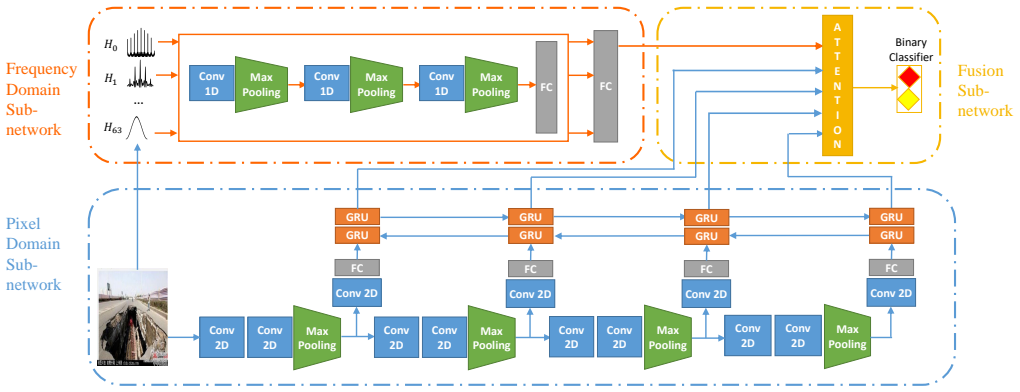
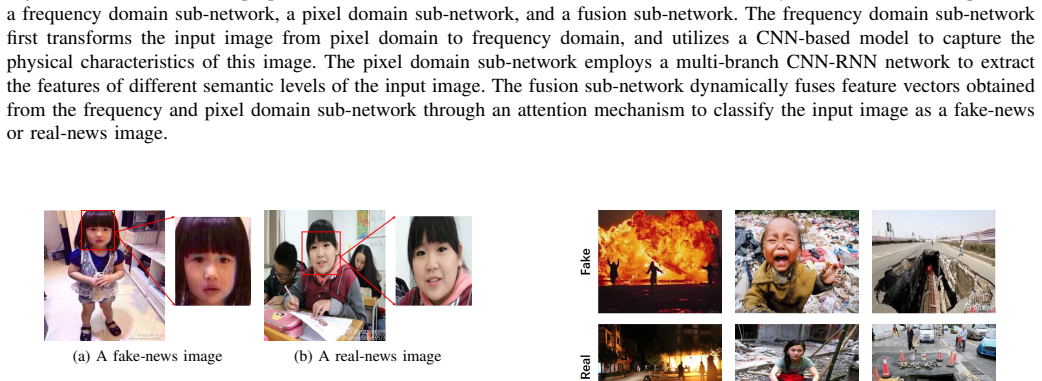
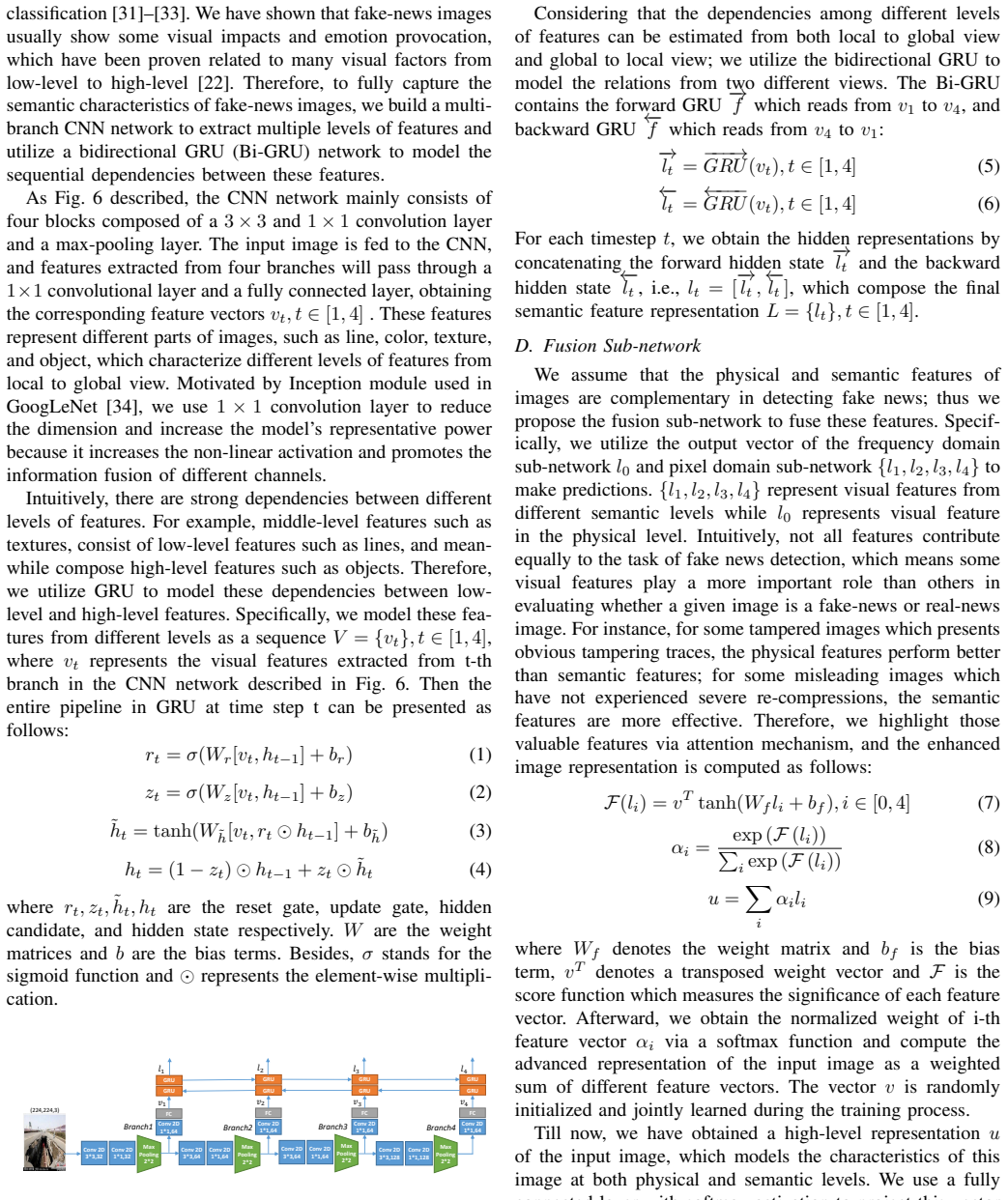
The mechanism is the MVNN architecture, which combines three sub-networks: a frequency-domain branch that applies block DCT and a 1-D Fourier transform to obtain 64 histograms of DCT coefficients, then feeds them through a shared 1D CNN; a pixel-domain branch that extracts features from four semantic levels using a multi-branch CNN, each branch feeding a fully connected layer, with a bidirectional GRU modeling dependencies between levels; and an attention-based fusion layer that dynamically weights the five feature vectors before classification.
What would settle it
Take a set of real photographs that appear in both real and fake posts, or relabel a fake post's real image as real, and test whether MVNN still flags the image; if accuracy on such relabeled or context-swapped images is near chance, the central claim about visual fake-news detection changes meaning.
Extended reading notes
Core claim
The central discovery is that fake-news images differ from real-news images at both physical and semantic levels, and that a model capturing both sets of cues classifies images better than models using either one alone. Removing the frequency domain drops accuracy by 5.2%; removing the pixel domain drops it by 10.9%. The paper further shows that the two domains are complementary, with some fake images detectable mainly through re-compression traces and others mainly through their emotionally provocative content.
Load-bearing premise
Each image inherits the veracity label of the post it appears in, so an unmanipulated real image placed in a fake post is treated as a fake-news image, and the reported accuracy measures the model's ability to learn this contextual label transfer rather than purely visual manipulation.
Editorial extensions
If this is right
- Visual-only fake news detection can be substantially improved by combining physical traces with semantic cues, enabling detection before text or propagation data is available.
- Frequency-domain and pixel-domain features are complementary, so systems relying on one type of visual evidence are leaving useful signal on the table.
- The learned visual representations can be plugged into multimodal detectors, improving accuracy by over 5.2% on the tested fusion methods.
- The improvement over fine-tuned VGG suggests that task-specific multi-level architectures beat generic pre-trained features for this problem.
Reading between the lines
- Because images inherit the veracity label of the post they appear in, the reported accuracy may reflect the model learning contextual associations—such as an image's typical use in fake posts—rather than purely visual manipulation evidence.
- A real deployment would need to test against adversarial fake-news creators who deliberately avoid both re-compression artifacts and emotional salience, since those are precisely the cues MVNN exploits.
- The approach could be extended to other platforms beyond the one microblog dataset evaluated here, but the paper itself notes that cross-platform generalization remains untested.
- An isolated comparison of the pixel-domain multi-branch network against a standard fine-tuned VGG on the same data would clarify how much of the gain comes from the architecture rather than the frequency fusion.
Signed reviews
Editorial analysis
A structured set of objections, weighed in public.
Referee Report
Summary. The paper proposes a Multi-domain Visual Neural Network (MVNN) for fake news detection using only the images attached to news posts. MVNN combines a frequency-domain sub-network that operates on DCT coefficient histograms and a pixel-domain sub-network that extracts multi-level semantic features via a multi-branch CNN with a Bi-GRU, followed by an attention-based fusion of the two domains. The authors evaluate MVNN on the Weibo dataset, reporting 84.6% accuracy for visual-only detection, outperforming the best baseline by at least 9.2% (Table I), and showing gains of over 5.2% in accuracy when the learned visual representations are used in three multimodal fusion frameworks (Table III). An ablation study (Table II) attributes the improvement to both frequency and pixel domains and to the attention, Bi-GRU, and multi-branch components.
Significance. If the reported results are robust, the paper demonstrates that combining frequency-domain forensics cues with semantic pixel-domain features yields substantial improvements in fake news detection, and that the learned representations can be plugged into existing multimodal systems. The use of an event-disjoint split to reduce topic overfitting and the systematic ablation study are methodological strengths. However, the evaluation rests on a single dataset, a single split, and single-run point estimates with no uncertainty quantification, and no code or data are released; these factors limit the confidence that can be placed in the claimed margins and the generalizability of the findings.
major comments (4)
- [Section V-A] The event-disjoint split is underspecified: the paper only states that K-means clustering is used to form 200 clusters and that the data are split into training, validation, and testing sets with an approximate 7:1:2 ratio. It does not report the feature space used for clustering, the rule for assigning clusters to splits, the cluster sizes, or any verification that clusters indeed correspond to distinct events. This is load-bearing for the 84.6% accuracy claim, because if the clustering is performed on visual features, the split may inadvertently separate image-quality or source-specific patterns that are correlated with labels, thereby inflating the result. The authors should specify the clustering feature space, report the exact number of posts in each split and the class balance, and provide evidence that no event spans multiple splits.
- [Tables I-III] All reported results are single-run point estimates with no standard deviations, no multiple random seeds, and no significance tests. The claimed 9.2% accuracy margin over the best baseline in Table I and the over-5.2% gains in Table III cannot be distinguished from random variation under these conditions. The authors should report means and standard deviations over at least five independent runs and conduct paired significance tests (e.g., McNemar's test) for the comparisons against the best baseline, especially for the small differences, such as the 1.9% and 1.8% drops in the ablation study.
- [Sections V-B and V-C] The baseline experimental protocols are underspecified, which undermines the fairness of the comparison. For FF+LR, the concrete forensics features are not enumerated; for Pre-trained VGG, the text says the output of the 'last layer' is used but a 4096-dimensional vector cannot be the softmax output of VGG19, and the fine-tuning details for Fine-tuned VGG are not given; no hyperparameter search or training procedure is described for any baseline. In contrast, MVNN's hyperparameters are tuned extensively ('after a lot of experiments'). The authors should provide complete configurations for all baselines, including feature definitions, network layers, optimization details, and the same tuning effort, to support the claim that MVNN's advantage is not due to undertuned baselines.
- [Section III, Problem 1] The problem formulation assigns the label of the post to the image, so a real image reused in a fake post is labeled 'fake' purely because of its context. The reported accuracy therefore measures the model's ability to learn a contextual-visual association rather than an intrinsic property of the image. The Abstract and Section I claim that MVNN captures the 'inherent characteristics of fake-news images', which overstates this interpretation. The authors should reframe the task definition and temper the case-study discussion in Section V-G, which interprets high-confidence predictions as evidence of tampering or re-compression, or provide an additional analysis that isolates the contribution of visual manipulation cues from context-driven cues.
minor comments (6)
- [Section III] In Problem 1, 'definite' should be 'define'.
- [Section IV-B] The phrase 'capturing the tampered and re-compressed architects' appears to be a typo; 'architects' should likely be 'artifacts'.
- [Section V-E] In the Qualitative Analysis paragraph, 'these is a relatively visible boundary' should be 'there is a relatively visible boundary'.
- [References] References [10] and [13] are the same paper (Wu et al., false rumors detection on sina weibo), and references [1] and [26] are also the same (Allcott and Gentzkow); these duplicates should be removed or consolidated.
- [Table III] The caption reads 'multi-modality'; this should be 'multimodality' or 'multi-modality' consistently, and the typo should be corrected.
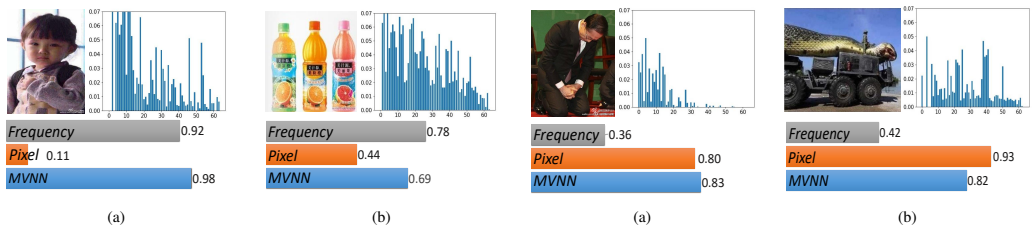
- [Figures 8 and 9] The numeric scores listed below the images in these figures are not explained in the caption or text; the authors should state explicitly what these numbers represent (e.g., predicted probabilities from each sub-network and MVNN).
Circularity Check
No significant circularity; MVNN's visual and multimodal accuracy claims are empirical held-out results, not artifacts of its definitions or self-citations.
full rationale
The paper's central claims (84.6% visual-only accuracy and >5.2% multimodal improvement) come from supervised training and evaluation on held-out test data under a clearly stated problem definition. Problem 1 (Section III) explicitly defines the task as learning f(i_t) using post labels y_t, so labeling an image by its post's veracity is the stated task construction, not a circular derivation. The paper does not claim to detect image manipulation independently of context, and no equation or model component is defined in terms of the quantity it is said to predict. The Weibo dataset is reused from the authors' prior work [16], and [16]'s attRNN is included as a baseline, but this is ordinary dataset and baseline reuse; the reported accuracy margins are measured against reimplemented baselines on the same split rather than being forced by construction. No fitted parameter is renamed as a prediction, no uniqueness theorem is imported from self-citations, and no known result is repackaged under new coordinates. Potential concerns about single-split point estimates, lack of error bars, and the underspecified K-means event-disjoint split are reproducibility and correctness risks, not circularity.
Assumptions & free parameters
free parameters (5)
- Number of branches in pixel domain sub-network =
4
- DCT coefficient sequence length after sampling =
250
- Number of frequency bands =
64
- Hidden units in GRU and fully connected layers =
32 and 64
- Training epochs with early stopping =
300
assumptions (4)
- domain assumption Fake-news images have distinct characteristics from real-news images at physical and semantic levels.
- domain assumption The veracity label of a post transfers to its attached image (y_t labels i_t).
- domain assumption DCT coefficient histograms followed by a 1-D Fourier transform capture re-compression and tampering periodicity.
- ad hoc to paper All 64 frequency bands contribute to fake news detection.
Cite this review
Pith. "Pith review of Exploiting Multi-domain Visual Information for Fake News Detection." pith.science (2026). https://pith.science/paper/OJRFL2PQ
@misc{pith2026190804472,
  author       = {Pith},
  title        = {Pith review of: Exploiting Multi-domain Visual Information for Fake News Detection},
  year         = {2026},
  howpublished = {\url{https://pith.science/paper/OJRFL2PQ}},
  note         = {Machine review of arXiv:1908.04472}
}
read the original abstract
The increasing popularity of social media promotes the proliferation of fake news. With the development of multimedia technology, fake news attempts to utilize multimedia contents with images or videos to attract and mislead readers for rapid dissemination, which makes visual contents an important part of fake news. Fake-news images, images attached in fake news posts,include not only fake images which are maliciously tampered but also real images which are wrongly used to represent irrelevant events. Hence, how to fully exploit the inherent characteristics of fake-news images is an important but challenging problem for fake news detection. In the real world, fake-news images may have significantly different characteristics from real-news images at both physical and semantic levels, which can be clearly reflected in the frequency and pixel domain, respectively. Therefore, we propose a novel framework Multi-domain Visual Neural Network (MVNN) to fuse the visual information of frequency and pixel domains for detecting fake news. Specifically, we design a CNN-based network to automatically capture the complex patterns of fake-news images in the frequency domain; and utilize a multi-branch CNN-RNN model to extract visual features from different semantic levels in the pixel domain. An attention mechanism is utilized to fuse the feature representations of frequency and pixel domains dynamically. Extensive experiments conducted on a real-world dataset demonstrate that MVNN outperforms existing methods with at least 9.2% in accuracy, and can help improve the performance of multimodal fake news detection by over 5.2%.
Figures

Figures from the paper (4 more)

Reference graph
Works this paper leans on
-
[2]
Fake news detection on social media: A data mining perspective,
K. Shu, A. Sliva, S. Wang, J. Tang, and H. Liu, “Fake news detection on social media: A data mining perspective,” ACM SIGKDD Explorations Newsletter, vol. 19, no. 1, pp. 22–36, 2017
2017
-
[3]
False information on web and social media: A survey,
S. Kumar and N. Shah, “False information on web and social media: A survey,” arXiv preprint arXiv:1804.08559 , 2018
arXiv 2018
-
[4]
Detection and resolution of rumours in social media: A survey,
A. Zubiaga, A. Aker, K. Bontcheva, M. Liakata, and R. Procter, “Detection and resolution of rumours in social media: A survey,” ACM Computing Surveys (CSUR) , vol. 51, no. 2, p. 32, 2018
work page 2018
-
[5]
Mining misinformation in social media,
L. Wu, F. Morstatter, X. Hu, and H. Liu, “Mining misinformation in social media,” Big Data in Complex and Social Networks , pp. 123–152, 2016
work page 2016
-
[6]
Novel visual and statisti- cal image features for microblogs news verification,
Z. Jin, J. Cao, Y . Zhang, J. Zhou, and Q. Tian, “Novel visual and statisti- cal image features for microblogs news verification,” IEEE Transactions on Multimedia, vol. 19, no. 3, pp. 598–608, 2017
work page 2017
-
[7]
Verifying multimedia use at mediaeval 2016
C. Boididou, S. Papadopoulos, D.-T. Dang-Nguyen, G. Boato, M. Riegler, S. E. Middleton, A. Petlund, Y . Kompatsiaris et al. , “Verifying multimedia use at mediaeval 2016.” in MediaEval, 2016
work page 2016
-
[8]
Detecting event rumors on sina weibo automatically,
S. Sun, H. Liu, J. He, and X. Du, “Detecting event rumors on sina weibo automatically,” in Asia-Pacific Web Conference. Springer, 2013, pp. 120–131
work page 2013
-
[9]
Information credibility on twitter,
C. Castillo, M. Mendoza, and B. Poblete, “Information credibility on twitter,” in Proceedings of the 20th International Conference on World Wide Web. ACM, 2011, pp. 675–684
work page 2011
Show all 35 references
-
[10]
False rumors detection on sina weibo by propagation structures,
K. Wu, S. Yang, and K. Q. Zhu, “False rumors detection on sina weibo by propagation structures,” in IEEE 31st International Conference on Data Engineering (ICDE) . IEEE, 2015, pp. 651–662
2015
-
[11]
Detecting rumors from microblogs with recurrent neural networks
J. Ma, W. Gao, P. Mitra, S. Kwon, B. J. Jansen, K.-F. Wong, and M. Cha, “Detecting rumors from microblogs with recurrent neural networks.” in International Joint Conference on Artificial Intelligence, 2016, pp. 3818– 3824
2016
-
[12]
Detect rumors on twitter by pro- moting information campaigns with generative adversarial learning,
J. Ma, W. Gao, and K.-F. Wong, “Detect rumors on twitter by pro- moting information campaigns with generative adversarial learning,” in Proceedings of the 2019 World Wide Web Conference . ACM, 2019
2019
-
[13]
False rumors detection on sina weibo by propagation structures,
K. Wu, S. Yang, and K. Q. Zhu, “False rumors detection on sina weibo by propagation structures,” in 2015 IEEE 31st International Conference on Data Engineering . IEEE, 2015, pp. 651–662
2015
-
[14]
Beyond news contents: The role of social context for fake news detection,
K. Shu, S. Wang, and H. Liu, “Beyond news contents: The role of social context for fake news detection,” Web Search and Data Mining , pp. 312–320, 2019
2019
-
[15]
The certh-unitn participation@ verifying multimedia use 2015
C. Boididou, S. Papadopoulos, D.-T. Dang-Nguyen, G. Boato, and Y . Kompatsiaris, “The certh-unitn participation@ verifying multimedia use 2015.” in MediaEval, 2015
2015
-
[16]
Multimodal fusion with recurrent neural networks for rumor detection on microblogs,
Z. Jin, J. Cao, H. Guo, Y . Zhang, and J. Luo, “Multimodal fusion with recurrent neural networks for rumor detection on microblogs,” in Proceedings of the 2017 ACM on Multimedia Conference. ACM, 2017, pp. 795–816
2017
-
[17]
Eann: Event adversarial neural networks for multi-modal fake news detection,
Y . Wang, F. Ma, Z. Jin, Y . Yuan, G. Xun, K. Jha, L. Su, and J. Gao, “Eann: Event adversarial neural networks for multi-modal fake news detection,” in Proceedings of the 24th ACM SIGKDD International Conference on Knowledge Discovery & Data Mining . ACM, 2018, pp. 849–857
2018
-
[18]
Mvae: Multi- modal variational autoencoder for fake news detection,
K. Dhruv, G. Jaipal Singh, G. Manish, and V . Vasudeva, “Mvae: Multi- modal variational autoencoder for fake news detection,” in Proceedings of the 2019 World Wide Web Conference . ACM, 2019
2019
-
[19]
Very deep convolutional networks for large-scale image recognition,
K. Simonyan and A. Zisserman, “Very deep convolutional networks for large-scale image recognition,” arXiv preprint arXiv:1409.1556 , 2014
2014 arXiv
-
[20]
Image credibility analy- sis with effective domain transferred deep networks,
Z. Jin, J. Cao, J. Luo, and Y . Zhang, “Image credibility analy- sis with effective domain transferred deep networks,” arXiv preprint arXiv:1611.05328, 2016
2016 arXiv
-
[21]
C. R. Sunstein, On Rumors. How Falsehoods Spread, Why We Believe Them, What Can Be Done . Farrar, Straus and Giroux, 2009
2009
-
[22]
A bio-informational theory of emotional imagery,
P. J. Lang, “A bio-informational theory of emotional imagery,” Psy- chophysiology, vol. 16, no. 6, pp. 495–512, 1979
1979
-
[23]
Neural machine translation by jointly learning to align and translate,
K. C. Dzmitry Bahdanau and Y . Bengio, “Neural machine translation by jointly learning to align and translate,” arXiv preprint arXiv:1409.0473, 2014
2014 arXiv
-
[24]
Automatic detection of rumor on sina weibo,
F. Yang, Y . Liu, X. Yu, and M. Yang, “Automatic detection of rumor on sina weibo,” in Proceedings of the ACM SIGKDD Workshop on Mining Data Semantics. ACM, 2012, p. 13
2012
-
[25]
Verifying multimedia use at mediaeval 2015
C. Boididou, K. Andreadou, S. Papadopoulos, D.-T. Dang-Nguyen, G. Boato, M. Riegler, Y . Kompatsiaris et al. , “Verifying multimedia use at mediaeval 2015.” in MediaEval, 2015
2015
-
[26]
Social media and fake news in the 2016 election,
H. Allcott and M. Gentzkow, “Social media and fake news in the 2016 election,” Journal of Economic Perspectives, vol. 31, no. 2, pp. 211–36, 2017
2016
-
[27]
Fast, automatic and fine- grained tampered jpeg image detection via dct coefficient analysis,
Z. Lin, J. He, X. Tang, and C.-K. Tang, “Fast, automatic and fine- grained tampered jpeg image detection via dct coefficient analysis,” Pattern Recognition, vol. 42, no. 11, pp. 2492–2501, 2009
2009
-
[28]
Detecting recompression of jpeg images via periodicity analysis of compression artifacts for tampering detection,
Y .-L. Chen and C.-T. Hsu, “Detecting recompression of jpeg images via periodicity analysis of compression artifacts for tampering detection,” IEEE Transactions on Information Forensics and Security, vol. 6, no. 2, pp. 396–406, 2011
2011
-
[29]
Image forgery localization via block-grained analysis of jpeg artifacts,
T. Bianchi and A. Piva, “Image forgery localization via block-grained analysis of jpeg artifacts,” IEEE Transactions on Information Forensics and Security, vol. 7, no. 3, pp. 1003–1017, 2012
2012
-
[30]
Double jpeg compression forensics based on a convolutional neural network,
Q. Wang and R. Zhang, “Double jpeg compression forensics based on a convolutional neural network,” EURASIP Journal on Information Security, vol. 2016, no. 1, p. 23, 2016
2016
-
[31]
Understanding image impressiveness inspired by instantaneous human perceptual cues,
J. Yang, Y . Sun, J. Liang, Y .-L. Yang, and M.-M. Cheng, “Understanding image impressiveness inspired by instantaneous human perceptual cues,” in Thirty-Second AAAI Conference on Artificial Intelligence , 2018
2018
-
[32]
De- pendency exploitation: A unified cnn-rnn approach for visual emotion recognition
X. Zhu, L. Li, W. Zhang, T. Rao, M. Xu, Q. Huang, and D. Xu, “De- pendency exploitation: A unified cnn-rnn approach for visual emotion recognition.” in International Joint Conference on Artificial Intelligence, 2017, pp. 3595–3601
2017
-
[33]
Amulet: Aggre- gating multi-level convolutional features for salient object detection,
P. Zhang, D. Wang, H. Lu, H. Wang, and X. Ruan, “Amulet: Aggre- gating multi-level convolutional features for salient object detection,” in Proceedings of the IEEE International Conference on Computer Vision , 2017, pp. 202–211
2017
-
[34]
Going deeper with convolutions,
C. Szegedy, W. Liu, Y . Jia, P. Sermanet, S. Reed, D. Anguelov, D. Erhan, V . Vanhoucke, and A. Rabinovich, “Going deeper with convolutions,” in Proceedings of the IEEE Conference on Computer Vision and Pattern Recognition, 2015, pp. 1–9
2015
-
[35]
Stacked convolutional auto-encoders for hierarchical feature extraction,
J. Masci, U. Meier, C. Dan, and J. Schmidhuber, “Stacked convolutional auto-encoders for hierarchical feature extraction,” in International Con- ference on Artificial Neural Networks , 2011
2011
-
[36]
Visualizing data using t-sne,
L. v. d. Maaten and G. Hinton, “Visualizing data using t-sne,” Journal of Machine Learning Research , vol. 9, no. Nov, pp. 2579–2605, 2008
2008
Reviewed August 14, 2026 · model on record in the stance chip above.
Discussion (0). Continue with ORCID to comment.