REVIEW 3 major objections 6 minor 1 cited by
Tight-Binding Kondo Model and Spin-Exchange Collision Rate of Alkaline-Earth Atoms in a Mixed-Dimensional Optical Lattice
T0 review · 3 major / 6 minor · reviewed 2026-08-14 · deepseek-v4-flash
Pith's one-line read This paper derives the interaction parameters of tight-binding Kondo models for alkaline-earth atoms in a mixed-dimensional lattice by matching the exact two-body scattering lengths.
desk verdict Solid microscopic derivation of lattice Kondo parameters; the experimental finite-momentum claim is a fit, not a prediction. read the letter →
The pith
A machine-rendered reading of the paper's core claim, the machinery that carries it, and where it could break.
The reading
What carries the argument
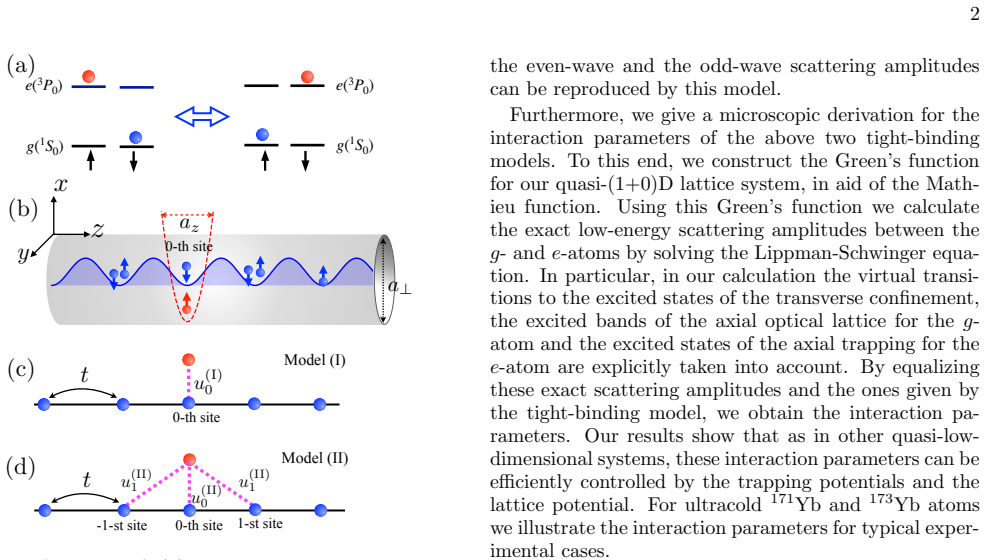
The central object is a pair of one-dimensional tight-binding Hamiltonians for a mobile g-atom on an optical lattice and a fixed e-atom impurity at site 0: model (I) with an on-site interaction $u_0$ and model (II) with an additional nearest-neighbor interaction $u_1$ at sites $\pm1$. The argument is carried by a matching procedure. For each spin channel, the exact low-energy even- and odd-wave scattering lengths $a_{e,\xi}$ and $a_{o,\xi}$ are computed from the full Hamiltonian using a Mathieu-function Green's function for the lattice and a Lippmann-Schwinger equation regularized by the Huang-Yang pseudopotential; the same scattering lengths are computed for the tight-binding models by solving the lattice Schrödinger equation. Equating the two determines the $u$-parameters while explicitly including virtual transitions to transverse excited states, axial trap states, and higher lattice bands.
What would settle it
A decisive check is to compute the exact two-body scattering amplitude in the second Bloch band at $k=1.8k_0$ and compare it with model (II) using the matched parameters; a discrepancy beyond the few-percent level found at $k\lesssim0.2k_0$ would show the zero-momentum matching does not control the regime used. Experimentally, a 173Yb gas cooled to the lowest band at known small quasi-momentum should show spin-flip resonance peaks at the small-$k$ lattice depths predicted by the theory, not at the $k=1.8k_0$ positions.
Extended reading notes
Core claim
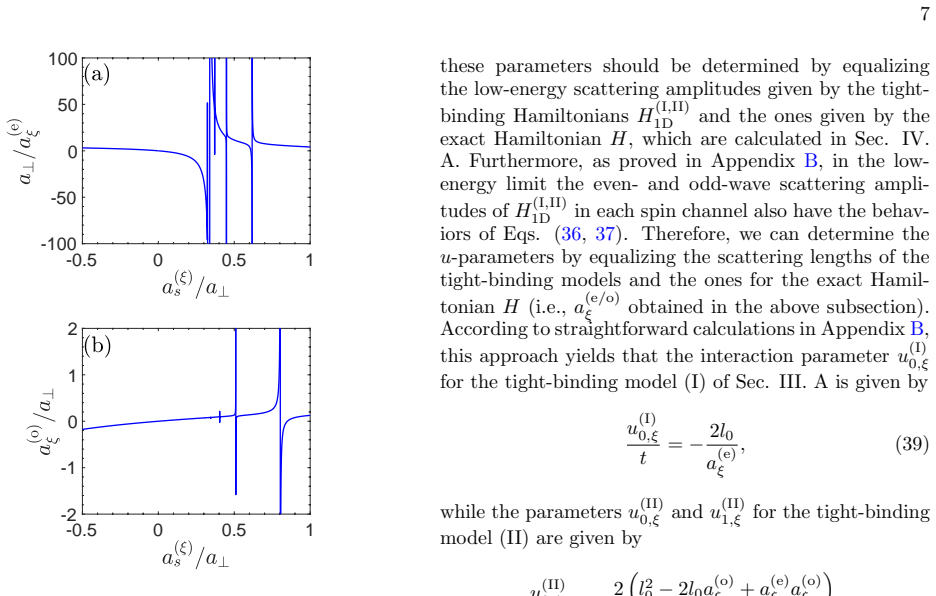
The authors establish that the quasi-(1+0)D alkaline-earth system with an axial lattice is faithfully represented by two tight-binding Hamiltonians, provided the interaction parameters are fixed by exact low-energy scattering lengths rather than by naive projection. Model (I) keeps only a local interaction at the e-atom site and is valid when odd-wave scattering is negligible; model (II) adds nearest-neighbor interactions and reproduces both partial-wave channels. The central results are the parameter formulas $u_{0,\xi}^{(I)}/t = -2l_0/a_{e,\xi}$, $u_{0,\xi}^{(II)}/t = -2(l_0^2-2l_0a_{o,\xi}+a_{e,\xi}a_{o,\xi})/(l_0(a_{e,\xi}-a_{o,\xi}))$, and $u_{1,\xi}^{(II)}/t = a_{o,\xi}/(l_0-a_{o,\xi})$, which are obtained by equating the scattering lengths of the exact Hamiltonian with those of the lattice models. These parameters can be tuned through the transverse and axial confinements and the lattice depth, and even- or odd-wave confinement-induced resonances appear where the spin-exchange terms are resonantly enhanced. The paper further shows that the spin-exchange collision rate in the 173Yb experiment depends strongly on the incident quasi-momentum, and that the observed resonance locations are reproduced only for $k\simeq1.8k_0$, already inside the second Bloch band.
Load-bearing premise
The argument stands or falls on whether matching the zero-momentum scattering lengths also makes the lattice model accurate at the high quasi-momenta (up to $1.8k_0$, in the second Bloch band) where the model is then used.
Editorial extensions
If this is right
- The matched $u$-parameters turn each confinement-induced resonance into a quantitative input for the Kondo model, so the spin-exchange strength can be resonantly enhanced while the spin-independent term stays finite.
- Model (II) reduces exactly to model (I) when the odd-wave scattering length vanishes, so the two models cover the even-wave-only and full cases without an adjustable switch.
- Under the projection approximation the interaction parameter is off by about 70 percent already at $a_s/a_\perp=0.1$, so quantitative simulations in this geometry need the matched parameters or direct calibration.
- The resonance positions of the spin-exchange collision rate shift significantly with incident quasi-momentum; matching the 173Yb data requires $k\simeq1.8k_0$, implying many g-atoms occupy the second lattice band and further cooling is needed for a single-band Kondo simulator.
- Thermal averaging over the g-atom quasi-momentum distribution broadens the predicted collision-rate peaks toward the observed widths, giving an experimentally testable line shape.
Reading between the lines
- I infer that the same scattering-length matching could be applied to arrays with several e-impurities or to higher band occupations, provided three-body losses remain negligible, turning the computed parameter curves into a design map for Kondo-lattice quantum simulators.
- I infer that a direct exact calculation of the two-body scattering amplitude in the second Bloch band would settle whether the zero-momentum matching controls the $k=1.8k_0$ regime; the paper asserts this extension only in a footnote.
- I infer that the predicted failure of the projection approximation can be probed experimentally by tuning $a_s/a_\perp$ through 0.1 and watching the interaction parameter diverge from the projected value, a sharp signature of virtual higher-band processes.
- I infer that the nearest-neighbor term $u_1$ of model (II) provides a route to realize odd-wave Hubbard-type interactions in optical lattices by working near an odd-wave confinement-induced resonance.
Signed reviews
Editorial analysis
A structured set of objections, weighed in public.
Referee Report
Summary. The paper studies two ultracold alkaline-earth-like atoms in a mixed-dimensional geometry: a quasi-1D tube, with the g-atom moving in a 1D optical lattice and the e-atom localized by an axial harmonic trap. It proposes two tight-binding Kondo-type models, depending on whether odd-wave scattering is negligible, and derives the interaction parameters u_0^(I), u_0^(II), u_1^(II) by matching the exact low-energy even- and odd-wave scattering lengths of the quasi-(1+0)D scattering problem. The scattering calculation is performed with a Mathieu-function Green's function and a Lippmann-Schwinger integral equation for the regularized wave-function derivative eta(z). The paper also tests the standard projection approximation for the interaction parameters, finding that it fails when the 3D scattering length is already of order 10% of the confinement lengths. Finally, it computes the spin-exchange collision rate R_se(k) for the 173Yb experiment of Ref. [4] and claims that the finite incident quasi-momentum effect is very significant, inferring that the g-atom quasi-momentum in that experiment may be as large as k=1.8k0, i.e., in the second band of the axial lattice.
Significance. The central derivation is a substantial technical contribution: it gives closed-form expressions for the tight-binding interaction parameters, Eqs. (39)-(41), anchors them to microscopic 3D scattering lengths, and provides a quantitative and convincing demonstration that the naive projection approximation is uncontrolled in realistic alkaline-earth lattice systems. The explicit Green's-function construction with virtual transitions to excited transverse, axial, and band states is detailed and internally consistent. If the finite-momentum part were as well supported as the zero-momentum derivation, the paper would be a strong candidate for publication. The experimental claim, however, rests on an unproven second-band generalization and on a fitted value of k, so the significance of the paper currently lies mainly in the tight-binding parameter derivation and the projection-approximation analysis, not in the quantitative comparison with Ref. [4].
major comments (3)
- [Sec. V and footnote [27]] The spin-exchange rate R_se(k) used for the experimental comparison is evaluated at k=1.8k0, which the authors identify with the second band of the axial lattice. However, the scattering amplitudes f_xi^(e/o)(k) entering Eqs. (50)-(52) are defined in Sec. IV A for an incident lowest-band Bloch state: Eq. (29) and the asymptotic boundary condition Eq. (34) are written for the lowest band, and the low-energy expansions (36)-(37) are threshold results. Footnote [27] states that the calculation is "generalized" to the second band, but no equations, boundary conditions, or validation are provided. The only finite-momentum test, Fig. 4, covers k in [0,k0] and a single small scattering length a_s^(xi)/a_perp=0.032, far from the 173Yb parameters used in the fit. The authors should either provide the explicit second-band generalization or soften the quantitative claim of Sec. V; as written, the k=1.8k0 result is not established.
- [Sec. V, Fig. 8, and last paragraph] The value k=1.8k0 is chosen by matching the computed peak positions to the experimental resonance peaks; it is not predicted independently from the model or from a measurement of k. Since the authors themselves list alternative mechanisms that could shift the effective k (many-body and multi-collision effects in footnote [28], and anharmonicity of the axial potential in the last paragraph of Sec. V), the conclusion that the finite-momentum effect is "very significant" and that the g-atoms may be in the second band is one consistent interpretation rather than a falsifiable prediction. The paper should quantify how robust the inferred k is against these uncertainties, for example by showing how much the peak locations move under reasonable variations of the model, or by comparing the thermal average in Fig. 8(d) with the experimental peak widths before drawing the strong conclusion.
- [Sec. IV B and Fig. 4] The u-parameters in Eqs. (39)-(41) are obtained by matching only the zero-momentum scattering lengths a_e and a_o. The finite-momentum validity of the tight-binding models is checked for one parameter set and for k up to about 0.2k0, where the amplitudes agree; for k>0.2k0 the paper itself reports differences of order 0.05 in the even-wave amplitude. Because the models are used in Sec. V at k=1.8k0 and for 173Yb scattering lengths (a_s^(+) = 1878 a0) much larger than the tested value, the matching at threshold does not control the on-shell amplitudes used in the experimental fit. A statement about the expected size of the higher-order terms in Eqs. (36)-(37), or an additional numerical test at the experimental parameters, is needed to justify the application of the single-band tight-binding amplitudes at large k.
minor comments (6)
- [Abstract] The abstract contains typos: "we further exam" should be "we further examine" and "which dependents on" should be "which depends on".
- [Sec. IV A, Eq. (34) and Appendix A] The notation is sometimes unclear about whether k is the quasi-momentum or the characteristic exponent of the Mathieu equation; a short sentence clarifying the relation between k, the band index, and the first Brillouin zone would help readers, especially because the paper later uses k=1.8k0.
- [Appendix A, Eq. (A22)] The numerical solution of the integral equation for eta(z) is described only by "we numerically solve this equation"; a brief description of the discretization, the number of grid points, and a convergence check would increase confidence in the quantitative results, particularly the projection-approximation error percentages quoted in Sec. IV C.
- [Sec. IV D] The statement that s_e is approximately 3.3s_g for both 173Yb and 171Yb is used to relate experimental parameters, but the accuracy of this relation is not discussed; a sentence on its expected uncertainty would be useful for the comparison with Ref. [4].
- [Fig. 4 caption] The caption contains a typo: "the the exact Hamiltonian" should read "the exact Hamiltonian".
- [Footnote [27]] Footnote [27] contains substantive technical content about the second-band generalization and should be promoted to the main text or an appendix, with the promised equations.
Circularity Check
No significant circularity: the tight-binding interaction parameters are obtained by explicit matching to independently computed exact scattering amplitudes, and the experimental analysis explicitly fits the quasi-momentum rather than presenting it as a prediction.
full rationale
The central derivation is not circular. Equations (39)-(41) are obtained in Appendix B by solving the tight-binding scattering problem and imposing equality of its scattering lengths with the even- and odd-wave scattering lengths a_e,xi and a_o,xi of the exact Hamiltonian, which are computed independently in Appendix A from the Huang-Yang pseudopotential via the Lippmann-Schwinger equation. This is a standard matching calculation: the u-parameters are constructed to reproduce the exact low-energy amplitudes, so the amplitudes are inputs, not outputs that are then renamed as predictions. The finite-momentum check in Fig. 4 is a genuine nontrivial validation of the matched models over a substantial fraction of the first Brillouin zone. The Sec. V experimental analysis is likewise not a circular prediction: the value k = 1.8 k0 is selected to align the calculated resonance positions with the measured ones, and the paper explicitly calls it 'the value of k given by our theoretical fitting' and acknowledges that many-body effects may make this fitted value higher than the actual quasi-momentum. The self-citations to Refs. [1-3] concern the Green's function treatment for the system without the axial lattice; the present paper reproduces the lattice generalization in Appendix A and does not import the central lattice result from those papers. The one legitimate concern is footnote [27], which asserts that the calculation is generalized to the second band for k = 1.8 k0 without showing the derivation or a finite-momentum check at that k; this is a missing-support or correctness concern, not a circularity, because the second-band amplitude is not defined in terms of the quantity it is used to explain. Overall, no circular step was found.
Assumptions & free parameters
free parameters (1)
- incident quasi-momentum k of the g-atom in the experimental fit =
1.8 k0 (inferred, in the second Brillouin zone)
assumptions (6)
- domain assumption Huang-Yang pseudopotential with free-space s-wave scattering lengths a_s^(+/-) describes the interatomic interaction under quasi-1D confinement.
- domain assumption Only the lowest band of the axial optical lattice and the ground states of the transverse and axial harmonic traps are occupied, and nearest-neighbor hopping suffices.
- standard math The low-energy scattering amplitudes have the forms f_e ~ -1/(1+i k a_e) and f_o ~ -i k/(i k + 1/a_o).
- ad hoc to paper The numerical solution of the integral equation for eta(z) in Eq. (A22) is converged and accurate after removal of singularities.
- domain assumption The axial trapping potential of the e-atom can be approximated as harmonic, and the transverse confinement as a 2D isotropic harmonic potential with equal frequency for both atoms.
- ad hoc to paper For k > k0, the scattering calculation can be generalized to the second band of the optical lattice.
Cite this review
Pith. "Pith review of Tight-Binding Kondo Model and Spin-Exchange Collision Rate of Alkaline-Earth Atoms in a Mixed-Dimensional Optical Lattice." pith.science (2026). https://pith.science/paper/Q36ZQ4RR
@misc{pith2026190804482,
  author       = {Pith},
  title        = {Pith review of: Tight-Binding Kondo Model and Spin-Exchange Collision Rate of Alkaline-Earth Atoms in a Mixed-Dimensional Optical Lattice},
  year         = {2026},
  howpublished = {\url{https://pith.science/paper/Q36ZQ4RR}},
  note         = {Machine review of arXiv:1908.04482}
}
abstract
We study the two-body problem of the ultracold fermionic alkaline-earth (like) atoms in the electronic $^1$S$_0$ state ($g$-state) and $^3$P$_0$ state ($e$-state), which are confined in a quasi-one-dimensional (quasi-1D) tube. In addition, in the axial direction, the $g$-atom experience a 1D optical lattice and the $e$-atom is localized by a harmonic potential. In this work, we propose two appropriate tight-binding models, which are applicable for the cases that the odd-wave scattering between the $g$- and $e$-atom is negligible or not, respectively. We further give a microscopic derivation for the inter-atomic interaction parameters of these tight-binding models, by exactly calculating the low-energy inter-atomic scattering amplitude. Our results show that, as one can predict, these interaction parameters can be efficiently controlled by the confinement potentials. We further exam the simple "projection approximation" with which one derives the interaction parameters by directly projecting the 3D Huang-Yang pseudopotential on the ground state of the confinement and the lowest band of the optical lattice. We find that one should be very careful about determining the interaction parameters in the tight-binding models. Furthermore, we calculate the spin-exchanging rate, which dependents on the incident quasi-momentum $k$ of the $g$-atom, for the recent experiment (L. Riegger, {\it et. al.,} Phys. Rev. Lett. {\bf 120}, 143601 (2018)) of $^{173}$Yb atoms in this quasi-(1+0)D system, and study finite-momentum effect in this experiment. Our results show that in this system the finite-momentum effect of the $g$-atom is very significant, and the momentum of the $g$-atoms in this experiment may be pretty high (already in the second Brillouin zone of the optical lattice)
Figures

Figures from the paper (4 more)


Forward citations
Cited by 1 Pith paper
-
Interaction Control of Ultracold Alkaline-Earth Atoms
A review of orbital Feshbach and confinement-induced resonances that control spin-independent and spin-exchanging interactions in ultracold alkaline-earth atoms.
Reference graph
Works this paper leans on
- [27]
-
[4]
Calculation of η(z) Now we show how to calculate the function η(z). Inserting Eq.(A8) into Eq.(A9), one immediately obtains the integral equation satisfied by η(z), η(z) =Ψin(0,z,z ) + 2πℏ2a(ξ) s µ ∂ ∂b ∫ dz′ [bG (0,z +b/2,z−b/2; 0,z′,z′)η(z′)] ⏐⏐⏐⏐ b→0+ . (A18) For the convenience of the following calculation, we further express the Green’s function G(0,z...
- [28]
-
[1]
1D Lattice Green’s function For future convenience, we start with the derivation of the Green’s function for a single atom in an 1D optical lattice. The Hamiltonian for such system can be written as H1D =− ℏ2 2m d2 dz2 +sER sin2 (k0z), (A1) where m is the single atom mass, ER = ℏ2k2 0/2m is the recoil energy with k0 being the wave vector, and s denotes la...
-
[2]
Lippmann-Schwinger Equation and Scattering Amplitude Now we return to our quasi-(1+0)D scattering problem governed by the Hamiltonian Hξ in Eq. (28). Using the expression of the Huang-Yang pseudo potential Uξ, we find that the scattering state Ψ ξ(ρ,ze,zg) corresponding to the incident wave function Ψ in(ρ,zg,ze) introduced in Eq. (29) satisfies the Lippman...
-
[3]
for the systems without the axial optical lattice. The key step of this generalization is the calculation of the Green’s function in the aid of the Mathieu function. For our system, a(e/o) ξ (ξ = +,−) depends not only on the 3D scattering length a(ξ) s , but also on the parameters of the axial lattice and the confinement potentials, i.e., sg, l0, and a⊥≡ √...
- [5]
- [6]
Show all 32 references
-
[7]
Zhang and P
R. Zhang and P. Zhang, Phys. Rev. A 98, 043627 (2018)
2018
-
[8]
Riegger, N
L. Riegger, N. Darkwah Oppong, M. H¨ ofer, D. R. Fer- nandes, I. Bloch, and S. F¨ olling, Phys. Rev. Lett. 120, 143601 (2018)
2018
-
[9]
H¨ ofer, L
M. H¨ ofer, L. Riegger, F. Scazza, C. Hofrichter, D. R. Fernandes, M. M. Parish, J. Levinsen, I. Bloch, and S. F¨ olling, Phys. Rev. Lett.115, 265302 (2015)
2015
-
[10]
K. Ono, J. Kobayashi, Y. Amano, K. Sato, and Y. Taka- hashi, Phys. Rev. A 99, 032707 (2019)
2019
-
[11]
Cappellini, M
G. Cappellini, M. Mancini, G. Pagano, P. Lombardi, L. Livi, M. Siciliani de Cumis, P. Cancio, M. Pizzocaro, D. Calonico, F. Levi, C. Sias, J. Catani, M. Inguscio, and L. Fallani, Phys. Rev. Lett. 113, 120402 (2014)
2014
-
[12]
Scazza, C
F. Scazza, C. Hofrichter, M. H¨ ofer, P. C. De Groot, I. Bloch, and S. F¨ olling, Nat. Phys. 10, 779 (2014)
2014
-
[13]
Zhang, M
X. Zhang, M. Bishof, S. L. Bromley, C. V. Kraus, M. S. Safronova, P. Zoller, A. M. Rey, and J. Ye, Science 345, 1467 (2014)
2014
-
[14]
A. V. Gorshkov, M. Hermele, V. Gurarie, C. Xu, P. S. Julienne, J. Ye, P. Zoller, E. Demler, M. D. Lukin, and A. M. Rey, Nat. Phys. 6, 289 (2010)
2010
-
[15]
Kuzmenko, T
I. Kuzmenko, T. Kuzmenko, Y. Avishai, and G.-B. Jo, Phys. Rev. B 97, 075124 (2018)
2018
-
[16]
Olshanii, Phys
M. Olshanii, Phys. Rev. Lett. 81, 938 (1998)
1998
-
[17]
Bergeman, M
T. Bergeman, M. G. Moore, and M. Olshanii, Phys. Rev. Lett. 91, 163201 (2003)
2003
-
[18]
Haller, M
E. Haller, M. J. Mark, R. Hart, J. G. Danzl, L. Re- ichs¨ ollner, V. Melezhik, P. Schmelcher, and H.-C. N¨ agerl, Phys. Rev. Lett. 104, 153203 (2010)
2010
-
[19]
A. C. Hewson, The Kondo Problem to Heavy Fermions (Cambridge University Press, Cambridge, 1993)
1993
-
[20]
Andrei, K
N. Andrei, K. Furuya, and J. H. Lowenstein, Rev. Mod. Phys. 55, 331 (1983)
1983
-
[21]
Bettelheim, Journal of Physics A: Mathematical and Theoretical 48, 165003 (2015)
E. Bettelheim, Journal of Physics A: Mathematical and Theoretical 48, 165003 (2015)
2015
-
[22]
Altland, B
A. Altland, B. B´ eri, R. Egger, and A. M. Tsvelik, Journal of Physics A: Mathematical and Theoretical 47, 265001 (2014)
2014
-
[23]
S.Doniach, Physica B 91, 231 (1977)
1977
-
[24]
Tsunetsugu, M
H. Tsunetsugu, M. Sigrist, and K. Ueda, Rev. Mod. Phys. 69, 809 (1997)
1997
-
[25]
Cappellini, L
G. Cappellini, L. F. Livi, L. Franchi, D. Tusi, D. Bene- dicto Orenes, M. Inguscio, J. Catani, and L. Fallani, Phys. Rev. X 9, 011028 (2019)
2019
-
[26]
Cosson, G
R. Cosson, G. Vernizzi, and X. Yang, Mathieu functions and numerical solutions of the Mathieu equation (2009) pp. 3–10
2009
-
[29]
Tan, Phys
S. Tan, Phys. Rev. Lett. 109, 020401 (2012)
2012
-
[30]
Lamporesi, J
G. Lamporesi, J. Catani, G. Barontini, Y. Nishida, M. In- guscio, and F. Minardi, Phys. Rev. Lett. 104, 153202 (2010)
2010
-
[31]
Accordingly, in our calculation we generalize our approach from Eq
When k > k0, the incident g-atom is actually in the second lowest band of the axial lattice. Accordingly, in our calculation we generalize our approach from Eq. (47) to Eq. (52) to include the effect induced by this band
-
[32]
The anharmonicity of confinement potential, which is not included in our model, may also lead to this consequence
Reviewed August 14, 2026 · model on record in the stance chip above.
Discussion (0). Continue with ORCID to comment.