REVIEW 3 major objections 4 minor 1 cited by
Frustrated orbital Feshbach resonances in a Fermi gas
T0 review · 3 major / 4 minor · reviewed 2026-08-14 · deepseek-v4-flash
Pith's one-line read The paper claims that occupying the closed channel of an orbital Feshbach resonance blocks the scattering that creates the resonance, suppressing the three-body binding energy and driving the many-body system toward weaker pairing.
desk verdict Solid few-body physics, but the many-body claim rests on an unstable mean-field branch. read the letter →
The pith
A machine-rendered reading of the paper's core claim, the machinery that carries it, and where it could break.
The reading
What carries the argument
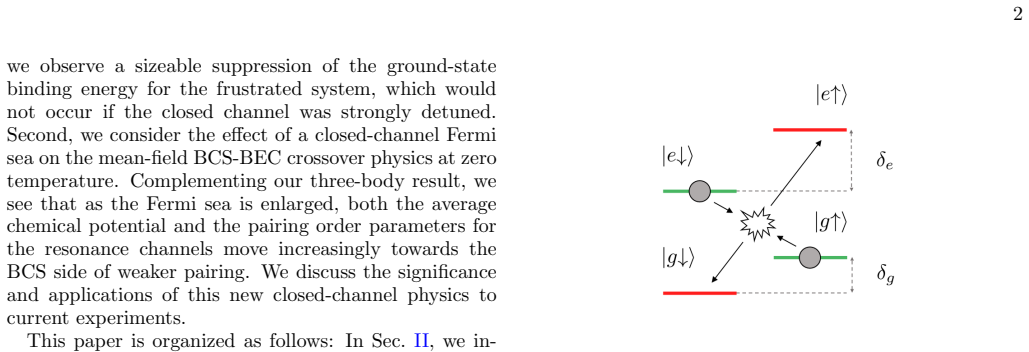
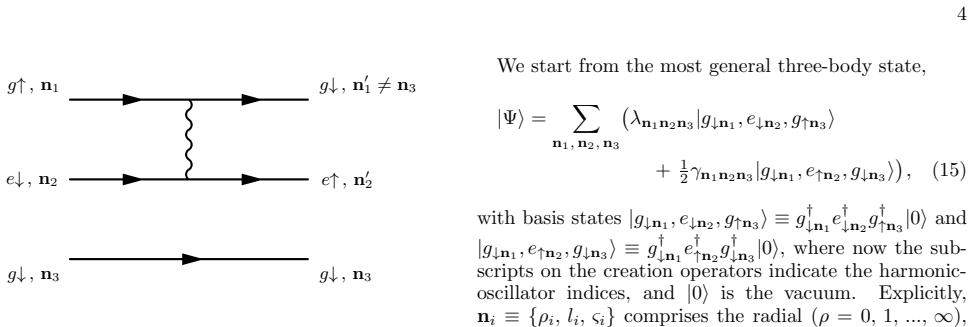
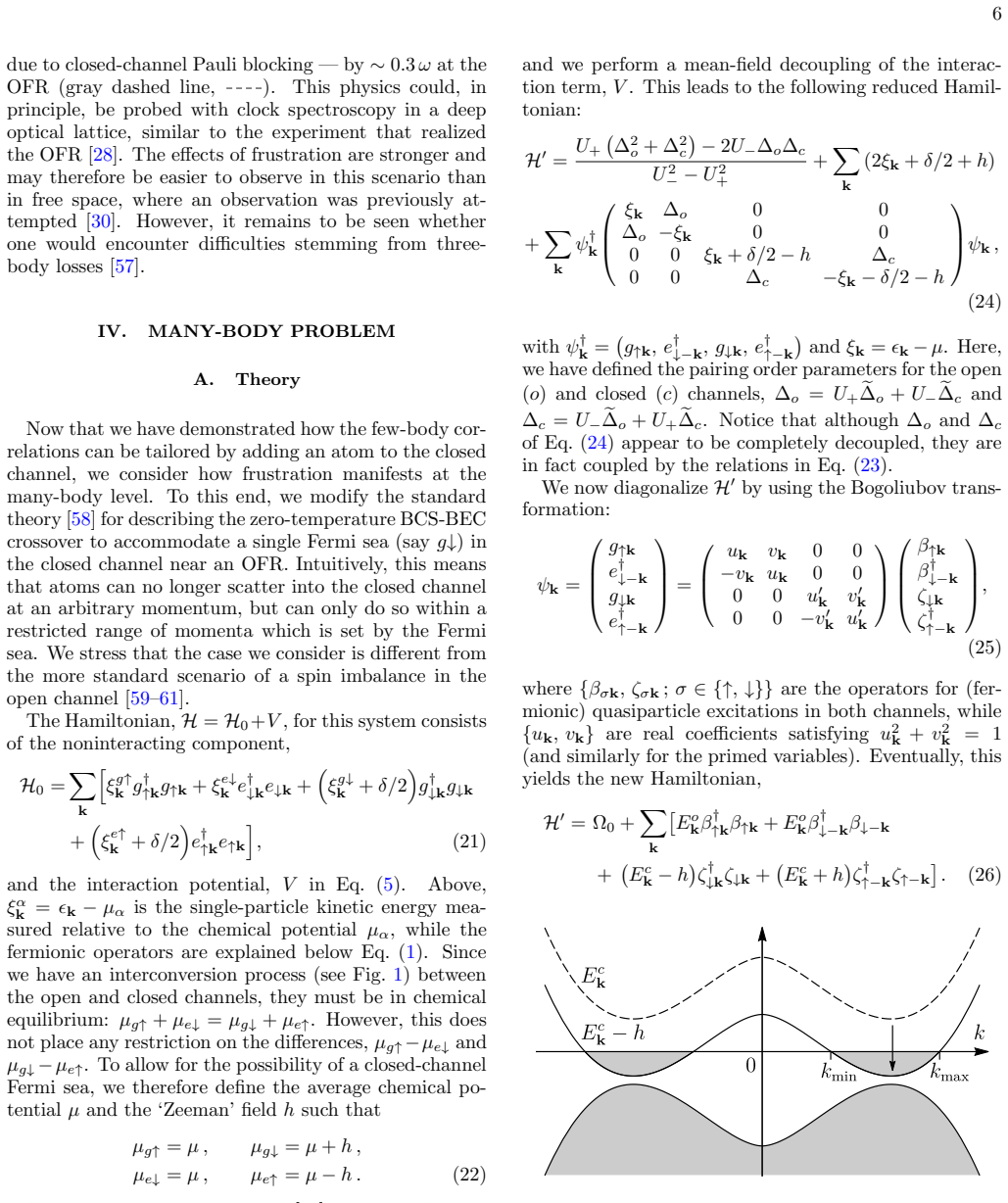
The central object is the two-channel transition matrix (T-matrix) of the OFR, built from the singlet and triplet scattering lengths $a_S$, $a_T$ and the detuning $\delta(B)$ between the open channel $|g\uparrow,e\downarrow\rangle$ and the closed channel $|g\downarrow,e\uparrow\rangle$. In the three-body problem the Pauli blocking enters as the minus sign in the kernel $A_{E-\delta}-B_{E-\delta}$, where $A$ describes two-body scattering and $B$ describes exchange between interacting pairs; this minus sign follows from fermionic antisymmetry, $\gamma_{n_1n_2n_3}=-\gamma_{n_3n_2n_1}$. In the many-body problem the analogous object is the Zeeman field $h$, which fills closed-channel quasiparticle states between momenta $k_{\rm min}$ and $k_{\rm max}$ and enters the coupled gap equations through the factor $1-\Theta(-E_c^k+h)$, removing those occupied states from the pairing sums.
What would settle it
Recompute the three-body and many-body quantities with the measured effective ranges $r_S\simeq126a_0$ and $r_T\simeq216a_0$ retained: if the predicted $\sim 0.3\omega$ binding suppression and the $\sim 0.2E_F$ chemical-potential shift move by an amount comparable to the effects, the zero-range premise fails; a clock-spectroscopy measurement of the three-atom bound state on a single lattice site would directly test the shift.
Extended reading notes
Core claim
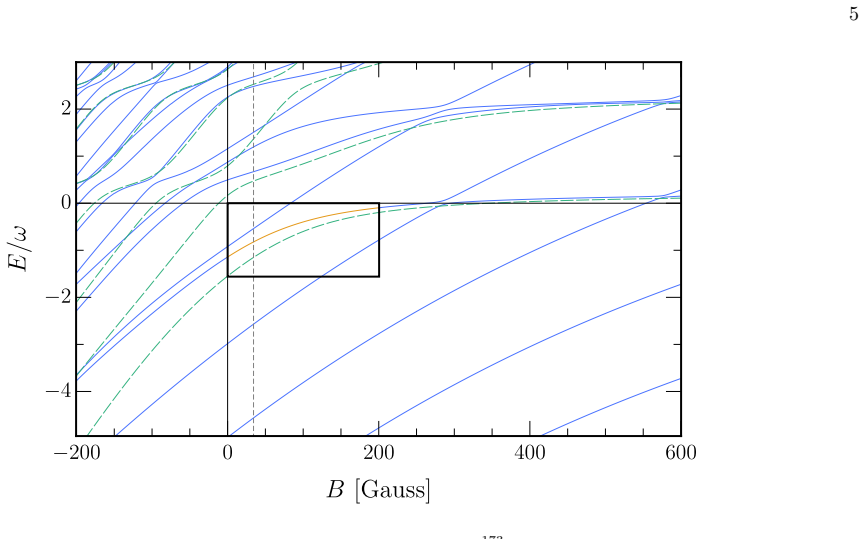
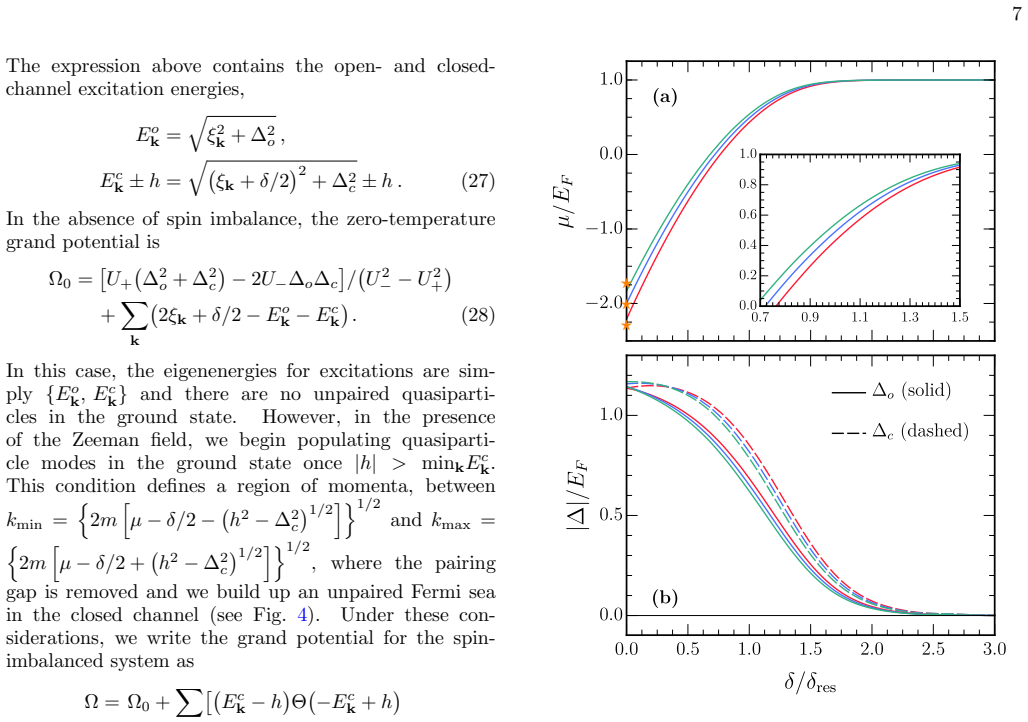
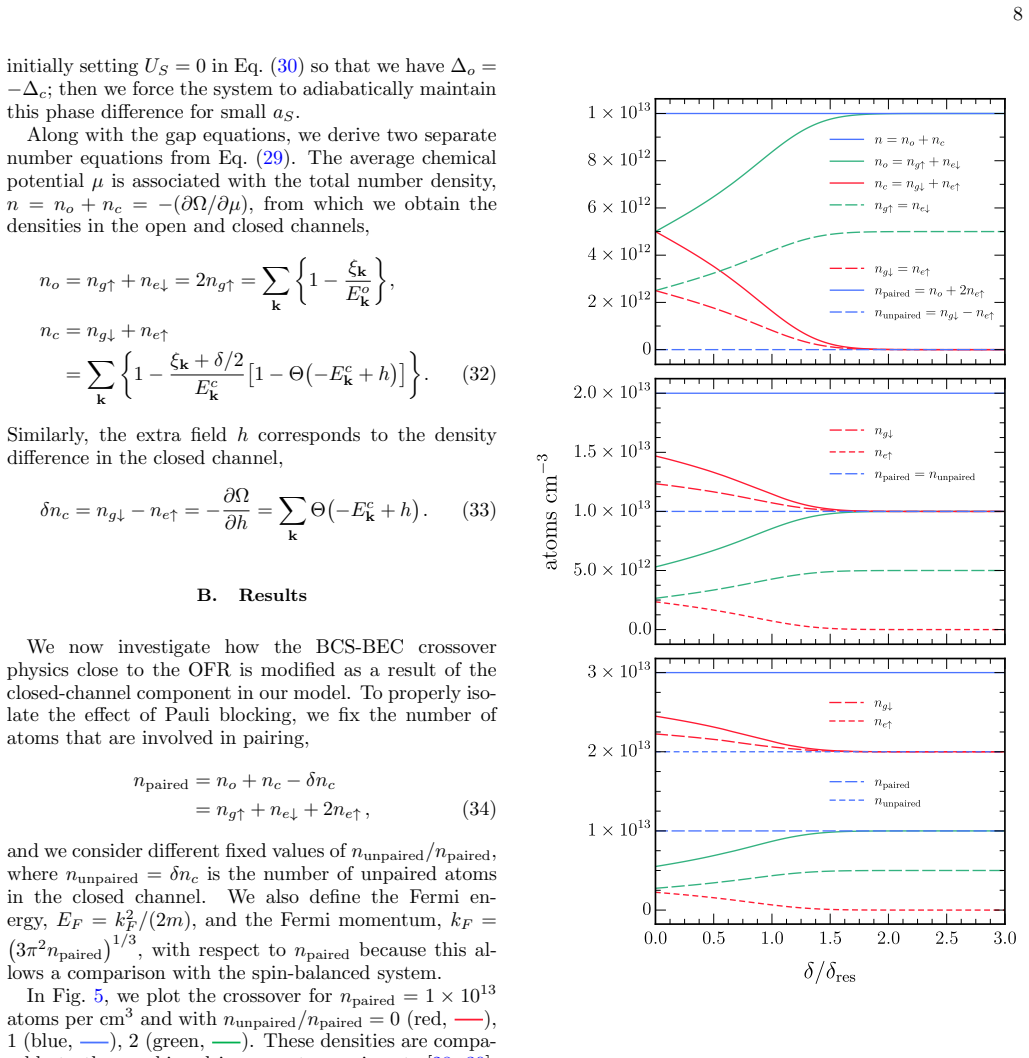
The paper's central claim is that a medium occupying the closed channel alters the resonance itself, not just the background: adding a single closed-channel atom to two trapped open-channel atoms reduces the ground-state binding energy by about $\sim 0.3\omega$ at the OFR, and adding a closed-channel Fermi sea at fixed paired density raises the average chemical potential by about $0.2E_F$ when the unpaired density is increased by $n_{\rm paired}$, while lowering $|\Delta_o|$ and $|\Delta_c|$. On the BEC side the shift takes the explicit form $\mu\simeq -\varepsilon_b/2 + (2\pi a_T/m)\,\delta n_c$, a mean-field boson-fermion repulsion between open-channel molecules and excess closed-channel fermions. The paper identifies the origin as Pauli blocking of the closed-channel scattering states, which is possible only because the OFR detuning is so small that a real, occupied medium in the closed channel matters.
Load-bearing premise
The numerical results assume the atoms collide only at a single point, with the two measured effective ranges set to zero, and the paper asserts this does not change the relative shifts without showing a sensitivity check.
Editorial extensions
If this is right
- In a deep optical lattice, the three-atom binding suppression of about $\sim 0.3\omega$ should be visible with clock spectroscopy, and the paper argues this few-body signal is easier to observe than the previously attempted free-space polaron shift.
- A fixed excess of closed-channel atoms pushes the OFR crossover toward the BCS side: both the average chemical potential and the open- and closed-channel gaps move in the direction of weaker pairing as the unpaired density grows.
- In the BEC limit the frustration shift is a linear mean-field effect, $\mu\simeq -\varepsilon_b/2+(2\pi a_T/m)\,\delta n_c$, so closed-channel occupation acts like a repulsive boson-fermion interaction.
- Because an occupied band Pauli-blocks pairing between other bands, the same mechanism offers a cold-atom analogue for how band filling suppresses superconductivity in multiband solid-state materials.
Reading between the lines
- The paper leaves implicit that the same gap equations could be scanned for stable breached-pair solutions, since the closed-channel Fermi sea removes the pairing gap over a finite momentum window; mapping that region is a direct next calculation.
- A time-resolved extension would fill the closed channel suddenly after preparing a paired state; the mean-field result predicts the gap should relax toward the BCS side, giving a dynamical signature of frustration.
- In the lattice setting, a concrete probe is to load exactly one $|g\downarrow\rangle$ atom with an open-channel pair on a single site and look for the $\sim 0.3\omega$ shift of the molecular line relative to the two-atom spectrum; the paper suggests clock spectroscopy but leaves the loading sequence unspecified.
Signed reviews
Editorial analysis
A structured set of objections, weighed in public.
Referee Report
Summary. The paper studies the orbital Feshbach resonance (OFR) in three-dimensional 173Yb, focusing on the fact that the open and closed channels are only weakly detuned. In the few-body part, the authors add a third atom to the closed channel of a two-body OFR collision inside a 3D harmonic trap, solve the three-body problem via the determinant equation (19), and report that the low-energy ground-state binding energy is suppressed by roughly 0.3 omega at the resonance because of closed-channel Pauli blocking. In the many-body part, they formulate a mean-field BCS-BEC crossover theory with a Zeeman field that creates a closed-channel Fermi sea, solve the coupled gap equations (31), and find that increasing the unpaired closed-channel density raises the average chemical potential and lowers the pairing gaps, i.e., drives the system toward the BCS side. They also derive an analytic BEC-limit shift, mu ≈ -epsilon_b/2 + (2 pi a_T / m) delta n_c. The stated conclusion is that a closed-channel medium acts as an independent tuning knob for OFR superfluids.
Significance. If the many-body branch discussed in the paper is physically realizable, the work introduces a genuinely new control mechanism for OFR superfluids and connects to multiband superconductivity. The few-body prediction is concrete and potentially testable with clock spectroscopy in an optical lattice. The paper has real technical strengths: the two-body T-matrix is renormalized explicitly, the three-body determinant derivation in Appendix A is detailed and self-contained, and the central predictions contain no fitted parameters, with the scattering lengths taken from experiment. The BEC-limit chemical-potential shift is obtained analytically. These strengths make the paper worth serious consideration, provided the stability of the many-body solution is addressed.
major comments (3)
- [Sec. IV B, after Eq. (31); Fig. 5] The many-body predictions in Fig. 5 are obtained from the out-of-phase solution of Eq. (31), which the text immediately identifies as "an excited saddlepoint" while the in-phase solution is "a very deep global minimum of Ω". A saddlepoint of the grand potential is unstable against small fluctuations, so the zero-temperature equilibrium ground state is the in-phase branch, not the branch plotted. The proposed selection protocol, described immediately after Eq. (31), is to "initially set US = 0 in Eq. (30)" and then "force the system to adiabatically maintain this phase difference". This does not resolve the stability problem, because US is fixed by the physical scattering lengths through Eq. (4) and is not an experimental tuning parameter, and an adiabatic sweep cannot keep a system on an unstable stationary point of Ω. Since the abstract's claim that a closed-channel Fermi sea "drive[s] the system towards weaker fermion pairing" rests on this branch, the authors should provide a stability analysis, for example the Hessian of Ω at the out-of-phase solution, and either show that the branch is at least metastable with an estimate of its lifetime or identify a physical mechanism that stabilizes it. Without such an analysis, the many-body claim should be presented as conditional.
- [Sec. II, footnote [51]; Sec. III; Sec. IV C] The quantitative predictions assume zero effective ranges rS and rT. For 173Yb, rT ≈ 216 a0 is roughly 10% of aT ≈ 1878 a0, and near the OFR the open-channel scattering length is tuned through the interference of the two channels, so finite-range corrections can affect both the resonance location and the low-energy amplitudes. Footnote [51] asserts that setting rS = rT = 0 "will not affect the relative shifts" between the two- and three-body results in Fig. 3 or between the spin-balanced and imbalanced systems in Fig. 5, but no sensitivity check is presented. Given that the central quantitative claims are the suppression of the binding energy by about 0.3ω and the BEC-limit shift μ ≈ -ε_b/2 + (2π a_T / m) δn_c, the authors should quantify the sensitivity to finite range, for instance by repeating the calculation with nonzero rS and rT or with a two-channel model that reproduces the experimental low-energy parameters.
- [Sec. III and Fig. 3] The orange branch in Fig. 3 is referred to as the "ground state" even though the text states that the model also contains "deep equidistant bound states" arising from the small singlet scattering length. These deep states are eigenstates of the same Hamiltonian, so the orange branch is not the global ground state but the lowest state in a restricted low-energy sector. The proposed clock-spectroscopy experiment would in principle populate the true ground state unless there is a mechanism that suppresses transitions to the deep states, such as a barrier or a short-distance loss process. The authors should either provide such a mechanism explicitly or consistently relabel this branch as a low-energy state rather than the ground state in the abstract and in Sec. III.
minor comments (4)
- [Fig. 3 caption] The caption does not state what the green dashed lines and blue solid lines correspond to in the figure labels, other than "two-atom problem" and "three-body" in the body text; a legend or explicit caption labels would help the reader.
- [Footnote [51]] The effective-range values rS ≈ 126 a0 and rT ≈ 216 a0 are stated without a reference; the authors should cite the source for these numbers.
- [Sec. III and Sec. IV] The phrase "ground state" is used in two different senses: in Sec. III it denotes the lowest low-energy branch, while in Sec. IV B it denotes the global minimum of the mean-field grand potential. This dual usage is confusing; consider using "low-energy branch" in Sec. III.
- [Sec. IV C, Eq. (35)] In the piecewise condition |μ| ≥ h, the variable h is defined in Sec. IV A, but the BEC-limit subsection does not explicitly remind the reader that h is tied to δn_c through Eq. (33); adding this connection would improve readability.
Circularity Check
No significant circularity: central predictions follow from external scattering-length inputs and the stated model; self-citations are technical or experimental, not load-bearing.
full rationale
The paper's central claims (three-body binding suppression and many-body pairing suppression with a closed-channel Fermi sea) are derived from the two-channel OFR model with scattering lengths aS ~ 219.7 a0 and aT ~ 1878 a0 taken from the experimental work Ref. [28]. These are external, measurable inputs; they are not fitted to the predicted energy shifts, and the predicted shifts are not used to determine them. The renormalization relation Eq. (4) and the T-matrix equations are standard, and Eq. (19) and Eqs. (30)-(31) are solved with these fixed inputs. No quantity that is called a prediction is, by construction, equal to an input: the three-body suppression emerges from the Pauli-blocking term A_{E-delta} - B_{E-delta} in Eq. (19), and the many-body shifts emerge from the gap and number equations (31)-(33). The self-citations to Refs. [63,64] concern technical reduction of summation indices in the three-body equations, not the physics of frustration, and Ref. [28] is an experimental measurement; neither is load-bearing in a circular way. The choice of the out-of-phase saddlepoint branch and the zero-effective-range approximation are explicit modeling assumptions with possible correctness or stability implications, but they are not circular because the results still derive from the stated model rather than being identical to an input. Overall, the derivation is self-contained against its external benchmarks, so the circularity score is low.
Assumptions & free parameters
assumptions (4)
- domain assumption The two-channel OFR is described by a zero-range model with s-wave scattering lengths aS ~ 219.7 a0 and aT ~ 1878 a0 measured in 173Yb experiments (Ref. [28]).
- ad hoc to paper The effective ranges rS, rT are set to zero (zero-range approximation).
- domain assumption In the many-body problem, the closed-channel Fermi sea is treated at mean-field level with Pauli blocking entering via occupation of negative-energy quasiparticle states.
- ad hoc to paper The physical many-body solution is the out-of-phase saddle point (Delta_o = -Delta_c limit) reached by starting from US = 0 and adiabatically following the phase difference.
Cite this review
Pith. "Pith review of Frustrated orbital Feshbach resonances in a Fermi gas." pith.science (2026). https://pith.science/paper/34TRX2H4
@misc{pith2026190804495,
  author       = {Pith},
  title        = {Pith review of: Frustrated orbital Feshbach resonances in a Fermi gas},
  year         = {2026},
  howpublished = {\url{https://pith.science/paper/34TRX2H4}},
  note         = {Machine review of arXiv:1908.04495}
}
abstract
The orbital Feshbach resonance (OFR) is a novel scheme for magnetically tuning the interactions in closed-shell fermionic atoms. Remarkably, unlike the Feshbach resonances in alkali atoms, the open and closed channels of the OFR are only very weakly detuned in energy. This leads to a unique effect whereby a medium in the closed channel can Pauli block, or frustrate, the two-body scattering processes. Here, we theoretically investigate the impact of frustration in the few- and many-body limits of the experimentally accessible three-dimensional $^{173}$Yb system. We find that by adding a closed-channel atom to the two-body problem, the binding energy of the ground state is significantly suppressed, and by introducing a closed-channel Fermi sea to the many-body problem, we can drive the system towards weaker fermion pairing. These results are potentially relevant to superconductivity in solid-state multiband materials, as well as to the current and continuing exploration of unconventional Fermi-gas superfluids near the OFR.
Figures
Figures from the paper (3 more)
Forward citations
Cited by 1 Pith paper
-
Interaction Control of Ultracold Alkaline-Earth Atoms
A review of orbital Feshbach and confinement-induced resonances that control spin-independent and spin-exchanging interactions in ultracold alkaline-earth atoms.
Reference graph
Works this paper leans on
-
[51]
We can see this another way by considering the permu- tation operator P↑,↓ which, when acted on a two-body state, exchanges the nuclear spins. Now P↑,↓ has or- bital symmetric and antisymmetric eigenstates,|g↓,e↑⟩∓ |g↑,e↓⟩ with eigenvalues∓1 (here written in terms of the open and closed channels). While P↑,↓ is only concerned with nuclear spin, the intera...
-
[1]
M. Lewenstein, A. Sanpera, V. Ahufinger, B. Damski, A. Sen(De), and U. Sen, Adv. Phys. 56, 243 (2007)
work page 2007
-
[2]
(A16) These relations allow us to convert Eq
By expanding both functions in the complete set of harmonic-oscillator eigenfunctions, we obtain δ(3)(x) = 1 4π ∑ κ Rκ(0)Rκ(x) and Gν(x) = 1 4π ∑ κ Rκ(0)Rκ(x) ν− 2κ . (A16) These relations allow us to convert Eq. (A13) into a one-dimensional integral, as shown: Bρ,ρ ′ E = 1 8 √ 2π ∑ κ Rκ(0) ∫ d(3)xd(3)yGE−2ρ′ ( x− √ 3y 2 ) Rκ(x)Rρ(y)Rρ′ (⏐⏐⏐⏐⏐ √ 3x + y 2 ...
-
[3]
Bloch, J
I. Bloch, J. Dalibard, and W. Zwerger, Rev. Mod. Phys. 80, 885 (2008)
2008
-
[4]
C. Chin, R. Grimm, P. Julienne, and E. Tiesinga, Rev. Mod. Phys. 82, 1225 (2010)
2010
-
[5]
M. H. Anderson, J. R. Ensher, M. R. Matthews, C. E. Wieman, and E. A. Cornell, Science 269, 198 (1995)
1995
-
[6]
C. C. Bradley, C. A. Sackett, J. J. Tollett, and R. G. Hulet, Phys. Rev. Lett. 75, 1687 (1995)
work page 1995
-
[7]
K. B. Davis, M. O. Mewes, M. R. Andrews, N. J. van Druten, D. S. Durfee, D. M. Kurn, and W. Ketterle, Phys. Rev. Lett. 75, 3969 (1995)
1995
Show all 69 references
-
[8]
Jaksch, C
D. Jaksch, C. Bruder, J. I. Cirac, C. W. Gardiner, and P. Zoller, Phys. Rev. Lett. 81, 3108 (1998)
1998
-
[9]
Greiner, O
M. Greiner, O. Mandel, T. Esslinger, T. W. H¨ ansch, and I. Bloch, Nature 415, 39 (2002)
2002
-
[10]
Paredes, A
B. Paredes, A. Widera, V. Murg, O. Mandel, S. F¨ olling, I. Cirac, G. V. Shlyapnikov, T. W. H¨ ansch, and I. Bloch, Nature 429, 277 (2004)
2004
-
[11]
Kinoshita, T
T. Kinoshita, T. Wenger, and D. S. Weiss, Science 305, 1125 (2004)
2004
-
[12]
DeMarco and D
B. DeMarco and D. S. Jin, Science 285, 1703 (1999)
1999
-
[13]
A. G. Truscott, K. E. Strecker, W. I. McAlexander, G. B. Partridge, and R. G. Hulet, Science 291, 2570 (2001)
2001
-
[14]
Schreck, L
F. Schreck, L. Khaykovich, K. L. Corwin, G. Ferrari, T. Bourdel, J. Cubizolles, and C. Salomon, Phys. Rev. Lett. 87, 080403 (2001)
2001
-
[15]
C. A. Regal, M. Greiner, and D. S. Jin, Phys. Rev. Lett. 92, 040403 (2004)
2004
-
[16]
Bartenstein, A
M. Bartenstein, A. Altmeyer, S. Riedl, S. Jochim, C. Chin, J. Hecker-Denschlag, and R. Grimm, Phys. Rev. Lett. 92, 120401 (2004)
2004
-
[17]
M. W. Zwierlein, C. A. Stan, C. H. Schunck, S. M. F. Raupach, A. J. Kerman, and W. Ketterle, Phys. Rev. Lett. 92, 120403 (2004)
2004
-
[18]
Bourdel, L
T. Bourdel, L. Khaykovich, J. Cubizolles, J. Zhang, F. Chevy, M. Teichmann, L. Tarruell, S. J. J. M. F. Kokkelmans, and C. Salomon, Phys. Rev. Lett. 93, 050401 (2004)
2004
-
[19]
M. W. Zwierlein, A. Schirotzek, C. H. Schunck, and W. Ketterle, Science 311, 492 (2006)
2006
-
[20]
G. B. Partridge, W. Li, R. I. Kamar, Y. Liao, and R. G. Hulet, Science 311, 503 (2006)
2006
-
[21]
M. M. Parish, F. M. Marchetti, A. Lamacraft, and B. D. Simons, Nat. Phys. 3, 124 (2007)
2007
-
[22]
D. E. Sheehy and L. Radzihovsky, Ann. Phys. 322, 1790 (2007)
2007
-
[23]
Zhang, Y
R. Zhang, Y. Cheng, H. Zhai, and P. Zhang, Phys. Rev. Lett. 115, 135301 (2015)
2015
-
[24]
The reason is that the even number of electrons (from the full outer shell) implies an even number of protons and, in turn, an even number of neutrons to render the atom a boson
Bosonic alkaline-earth atoms do not offer the same utility, here, because their nuclei always have vanishing spins. The reason is that the even number of electrons (from the full outer shell) implies an even number of protons and, in turn, an even number of neutrons to render t...
-
[25]
Consequently, 3P0 is metastable with a lifetime that exceeds∼ 10 seconds [67]
A decay from the excited state, 2S+1LJ = 3P0, back to the ground state, 1S0, is doubly forbidden in the dipole approximation, since it would involve a spin flip (∆S⁄= 0) and also because we cannot transition between twoJ = 0 states. Consequently, 3P0 is metastable with a lifeti...
-
[26]
Scazza, C
F. Scazza, C. Hofrichter, M. H¨ ofer, P. C. D. Groot, I. Bloch, and S. F¨ olling, Nat. Phys. 10, 779 (2014)
2014
-
[27]
Cappellini, M
G. Cappellini, M. Mancini, G. Pagano, P. Lombardi, L. Livi, M. Siciliani de Cumis, P. Cancio, M. Pizzocaro, D. Calonico, F. Levi, C. Sias, J. Catani, M. Inguscio, and L. Fallani, Phys. Rev. Lett. 113, 120402 (2014)
2014
-
[28]
Zhang, M
X. Zhang, M. Bishof, S. L. Bromley, C. V. Kraus, M. S. Safronova, P. Zoller, A. M. Rey, and J. Ye, Science 345, 1467 (2014)
2014
-
[29]
H¨ ofer, L
M. H¨ ofer, L. Riegger, F. Scazza, C. Hofrichter, D. R. Fernandes, M. M. Parish, J. Levinsen, I. Bloch, and S. F¨ olling, Phys. Rev. Lett.115, 265302 (2015)
2015
-
[30]
Pagano, M
G. Pagano, M. Mancini, G. Cappellini, L. Livi, C. Sias, J. Catani, M. Inguscio, and L. Fallani, Phys. Rev. Lett. 115, 265301 (2015)
2015
-
[31]
Darkwah Oppong, L
N. Darkwah Oppong, L. Riegger, O. Bettermann, M. H¨ ofer, J. Levinsen, M. M. Parish, I. Bloch, and S. F¨ olling, Phys. Rev. Lett.122, 193604 (2019)
2019
-
[32]
Cappellini, L
G. Cappellini, L. F. Livi, L. Franchi, D. Tusi, D. Bene- dicto Orenes, M. Inguscio, J. Catani, and L. Fallani, Phys. Rev. X 9, 011028 (2019). 14
2019
-
[33]
J. Xu, R. Zhang, Y. Cheng, P. Zhang, R. Qi, and H. Zhai, Phys. Rev. A 94, 033609 (2016)
2016
-
[34]
L. He, J. Wang, S.-G. Peng, X.-J. Liu, and H. Hu, Phys. Rev. A 94, 043624 (2016)
2016
-
[35]
Mondal, D
S. Mondal, D. Inotani, and Y. Ohashi, J. Phys. Conf. Ser. 969, 012017 (2018)
2018
-
[36]
Mondal, D
S. Mondal, D. Inotani, and Y. Ohashi, J. Phys. Soc. Jpn. 87, 084302 (2018)
2018
-
[37]
Wang, J.-S
S. Wang, J.-S. Pan, X. Cui, W. Zhang, and W. Yi, Phys. Rev. A 95, 043634 (2017)
2017
-
[38]
Cheng, R
Y. Cheng, R. Zhang, and P. Zhang, Phys. Rev. A 93, 042708 (2016)
2016
-
[39]
Iskin, Phys
M. Iskin, Phys. Rev. A 95, 013618 (2017)
2017
-
[40]
Cheng, R
Y. Cheng, R. Zhang, and P. Zhang, Phys. Rev. A 95, 013624 (2017)
2017
-
[41]
Zhang, S
Y.-C. Zhang, S. Ding, and S. Zhang, Phys. Rev. A 95, 041603 (2017)
2017
-
[42]
T.-S. Deng, W. Zhang, and W. Yi, Phys. Rev. A 96, 050701 (2017)
2017
-
[43]
P. Zou, L. He, X.-J. Liu, and H. Hu, Phys. Rev. A 97, 043616 (2018)
2018
-
[44]
Riegger, N
L. Riegger, N. Darkwah Oppong, M. H¨ ofer, D. R. Fer- nandes, I. Bloch, and S. F¨ olling, Phys. Rev. Lett. 120, 143601 (2018)
2018
-
[45]
M. M. Boyd, T. Zelevinsky, A. D. Ludlow, S. Blatt, T. Zanon-Willette, S. M. Foreman, and J. Ye, Phys. Rev. A 76, 022510 (2007)
2007
-
[46]
H¨ ofer, Ph
M. H¨ ofer, Ph. D. Thesis, Ludwig-Maximilians-Univers- it¨ at M¨ unchen (2017)
2017
-
[47]
Chen, Y.-R
J.-G. Chen, Y.-R. Shi, X. Zhang, and W. Zhang, Front. Phys. 13, 136702 (2018)
2018
-
[48]
This bestows on the system an SU( N) symme- try (N ≤ 2F + 1) [68] where the collisions do not de- pend on nuclear spin
There is a large decoupling between the electronic-orbital and nuclear-spin degrees of freedom since the total elec- tronic angular momentum ( J) for both |g⟩ and |e⟩ is zero. This bestows on the system an SU( N) symme- try (N ≤ 2F + 1) [68] where the collisions do not de- pen...
-
[49]
open” and “closed
We see in Fig. 1 that the atom pair ( g↑, e↓) has a lower energy than the pair ( g↓, e↑), which leads to the labels of “open” and “closed” for the scattering channels. How- ever this designation is somewhat arbitrary since, by in- terchanging the channel labels and reversing t...
-
[50]
The mass of the fermionic isotope 173Yb is 172.9 amu
-
[52]
[28]: aS≃ 219.7a0 and aT ≃ 1878a0, where a0 = 0.529 ˚A is the Bohr radius
We use scattering lengths for the 173Yb system that have been experimentally determined in Ref. [28]: aS≃ 219.7a0 and aT ≃ 1878a0, where a0 = 0.529 ˚A is the Bohr radius. For simplicity, we set the singlet and triplet effective ranges, rS ≃ 126a0 and rT ≃ 216a0, to zero. We do ...
-
[53]
B. A. Lippmann and J. Schwinger, Phys. Rev. 79, 469 (1950)
1950
-
[54]
[28] employed a 3D optical lattice at a wavelength of 759 .3 nm and with a depth of 29.8 times the recoil energy, giving a confinement frequency ω≃ 2π× 20 kHz
The experiment in Ref. [28] employed a 3D optical lattice at a wavelength of 759 .3 nm and with a depth of 29.8 times the recoil energy, giving a confinement frequency ω≃ 2π× 20 kHz
-
[55]
For convenience, the factors of √ 2 are chosen so that the effective masses for the center-of-mass motion and the relative motion are the same
-
[56]
Smirnov, Nucl
Y. Smirnov, Nucl. Phys. 39, 346 (1962)
1962
-
[57]
Busch, B.-G
T. Busch, B.-G. Englert, K. Rzaewski, and M. Wilkens, Found. Phys. 28, 549 (1998)
1998
-
[58]
Hofrichter, L
C. Hofrichter, L. Riegger, F. Scazza, M. H¨ ofer, D. R. Fernandes, I. Bloch, and S. F¨ olling, Phys. Rev. X 6, 021030 (2016)
2016
-
[59]
Giorgini, L
S. Giorgini, L. P. Pitaevskii, and S. Stringari, Rev. Mod. Phys. 80, 1215 (2008)
2008
-
[60]
Chen, T.-S
J.-G. Chen, T.-S. Deng, W. Yi, and W. Zhang, Phys. Rev. A 94, 053627 (2016)
2016
-
[61]
Deng, Z.-C
T.-S. Deng, Z.-C. Lu, Y.-R. Shi, J.-G. Chen, W. Zhang, and W. Yi, Phys. Rev. A 97, 013635 (2018)
2018
-
[62]
Xu and R
J. Xu and R. Qi, Eur. Phys. J. 72, 65 (2018)
2018
-
[63]
W. V. Liu and F. Wilczek, Phys. Rev. Lett. 90, 047002 (2003)
2003
-
[64]
E. K. Laird, Z.-Y. Shi, M. M. Parish, and J. Levinsen, Phys. Rev. A 96, 032701 (2017)
2017
-
[65]
E. K. Laird, T. Kirk, M. M. Parish, and J. Levinsen, Phys. Rev. A 97, 042711 (2018)
2018
-
[66]
X.-J. Liu, H. Hu, and P. D. Drummond, Phys. Rev. A 82, 023619 (2010)
2010
-
[67]
Scazza, Ph
F. Scazza, Ph. D. Thesis, Ludwig-Maximilians-Univers- it¨ at M¨ unchen (2015)
2015
-
[68]
S. G. Porsev, A. Derevianko, and E. N. Fortson, Phys. Rev. A 69, 021403 (2004)
2004
-
[69]
M. A. Cazalilla and A. M. Rey, Rep. Prog. Phys. 77, 124401 (2014)
2014
Reviewed August 14, 2026 · model on record in the stance chip above.
Discussion (0). Continue with ORCID to comment.