REVIEW 3 major objections 4 minor 30 references
On the Complexity of Checking Transactional Consistency
T0 review · 3 major / 4 minor · reviewed 2026-08-14 · deepseek-v4-flash
Pith's one-line read The paper proves that checking read committed, read atomic, and causal consistency is polynomial-time, while checking prefix consistency and snapshot isolation is NP-complete, with polynomial-time algorithms for the hard cases when the…
desk verdict Solid complexity results for PC and SI, but the RC algorithm is buggy and the model omits commit timing, so the practical claims need a careful rewrite. read the letter →
The pith
A machine-rendered reading of the paper's core claim, the machinery that carries it, and where it could break.
The reading
What carries the argument
The load-bearing object is the uniform axiomatic schema for consistency criteria, in which each axiom is a first-order implication forcing commit-order predecessors for any transaction whose write is read. The paper also uses two algorithmic constructions: a saturation procedure that instantiates these axioms to close a partial commit order, and a reduction from prefix consistency and snapshot isolation to serializability that splits each transaction into separate read and write transactions, with auxiliary variables for snapshot isolation to forbid conflicting transactions from observing the same prefix. For bounded width, serializability is checked by a search over antichains of the session order, and for communication graphs, by checking each biconnected component in isolation.
What would settle it
Take a database execution whose write-read relation is fixed and compare the paper's Read Committed axiom with the ANSI SQL read-committed definition: if a history is rejected by the paper's monotonicity condition but accepted by the SQL definition, the polynomial-time result would not transfer to standard read committed. For the NP-hardness half, a direct check is to instantiate the SAT reduction on a small satisfiable formula and verify that the constructed history is prefix consistent exactly when the formula is satisfiable, and that an unsatisfiable formula yields a cyclic commit order.
Extended reading notes
Core claim
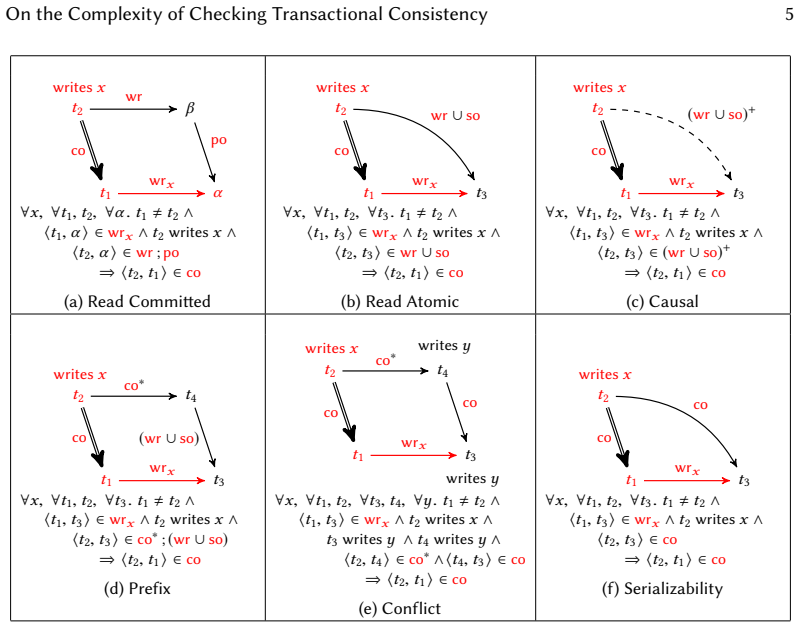
The paper's central discovery is a complexity dichotomy for verifying transactional consistency, expressed through a uniform axiomatic framework. A history is a set of transactions with a session order and a write-read relation, and each criterion is the existence of a total commit order extending both and satisfying an axiom of the form: whenever a transaction $t_1$ writing $x$ is read by $t_3$, every competing writer $t_2$ of $x$ that is related to $t_3$ in a criterion-specific way must commit before $t_1$. Under this framework, read committed, read atomic, and causal consistency yield acyclic forced-order constraints computable in polynomial time, so checking them is polynomial. Prefix consistency and snapshot isolation are NP-complete, proved by one SAT reduction in which truth values of formula variables and literals are encoded by the polarity of the commit order between paired transactions, and unsatisfied clauses become commit-order cycles. The same reduction also gives a new NP-completeness proof for serializability. The paper further proves that prefix consistency, snapshot isolation, and serializability become polynomial when the history width is bounded, by reducing the first two to serializability through splitting each transaction into a read part and a write part, adding auxiliary variables for snapshot isolation, and solving serializability by search over session-order antichains; and that all criteria decompose over biconnected components of the communication graph.
Load-bearing premise
The complexity proofs assume the paper's axiomatic definitions are faithful to what databases mean by these consistency levels; in particular, its Read Committed axiom includes a within-transaction monotonicity condition that may be stronger than the ANSI SQL definition of read committed.
Editorial extensions
If this is right
- Checking read committed, read atomic, and causal consistency can be fully automated in polynomial time for arbitrary histories, enabling precise black-box monitoring rather than anomaly-pattern matching.
- Prefix consistency and snapshot isolation are NP-complete in general, so no polynomial-time algorithm for arbitrary histories exists unless P equals NP.
- When the number of sessions or the width of a history is fixed, prefix consistency, snapshot isolation, and serializability become polynomial-time checkable, making them practical for many real deployments.
- When every biconnected component of the communication graph has bounded size, all the considered consistency criteria are polynomial-time checkable even if the total number of sessions is unbounded.
- The experimental results show that these algorithms can be orders of magnitude more efficient than direct SAT encodings and can expose consistency violations in production database executions.
Reading between the lines
- If the axiomatic equivalence to earlier formalizations holds only for histories where every value is written at most once, then databases whose behavior depends on concrete values, violating data independence, could escape both the polynomial algorithms and the NP-completeness transfer.
- The same axiom schema could classify other consistency models: any criterion expressible with a fixed first-order axiom of that shape would inherit the polynomial saturation argument unless the axiom mentions commit order on the left-hand side.
- The read/write-splitting reduction turns a prefix consistency or snapshot isolation checker into a serializability checker, so tools built for serializability monitoring could be repurposed for weaker models with the same core engine.
- The reported absence of large biconnected components in experimental histories suggests the worst case may be rare; testing on histories with more sessions and variables could reveal when communication-graph decomposition actually pays off.
Signed reviews
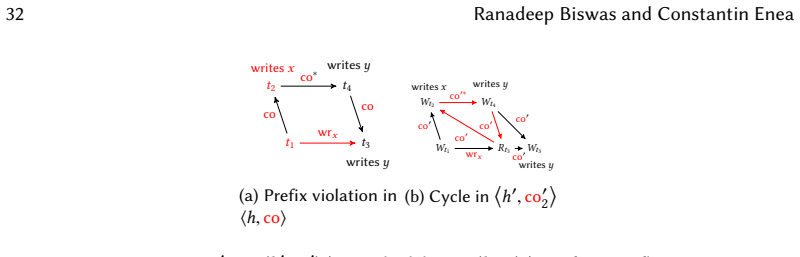
Editorial analysis
A structured set of objections, weighed in public.
Referee Report
Summary. The paper introduces an axiomatic framework for read committed (RC), read atomic (RA), causal consistency (CC), prefix consistency (PC), snapshot isolation (SI), and serializability (SER), where histories are triples (T, so, wr) and a consistency criterion holds if a total commit order co extending so ∪ wr satisfies a set of first-order axioms. The main theoretical results are that RC, RA, and CC are polynomial-time checkable, while PC, SI, and SER are NP-complete, with polynomial-time algorithms when the width of the session order or the size of biconnected components of the communication graph is fixed. The paper also reports an experimental evaluation on histories extracted from CockroachDB, Galera, and AntidoteDB.
Significance. If the axiomatic definitions are accepted as faithful formalizations of the named consistency models, the paper fills a real gap in the literature: it provides the first systematic complexity study of checking transactional consistency beyond serializability, gives a uniform SAT-reduction for the NP-complete cases, and supplies fixed-parameter tractability results for bounded width and bounded biconnected components. The proofs are largely self-contained and do not appear circular; the reduction in Section 3.2 is concrete, and the algorithms in Sections 4 and 5 are clearly defined and backed by an experimental comparison against a SAT baseline. The main value of the paper is therefore contingent on the semantic fidelity of the axiom system to the consistency models that databases actually implement.
major comments (3)
- [§2.2, Fig. 2(a), Def. 2.5] The formalization of Read Committed does not capture the standard P1 (dirty read) prohibition, because Def. 2.2 histories contain no commit timestamps or read timestamps. A history with transaction t1 writing x, transaction t2 reading x from t1, and t1 committing only after that read but before t2 commits has exactly the same representation as a clean read, and the RC axiom in Fig. 2(a) is vacuous when the read is the first read of x in t2. Thus the polynomial-time result of Thm. 3.1 for RC is not a complexity result for the ANSI/SQL read-committed semantics, which forbids dirty reads. Moreover, the RC axiom adds a within-transaction monotonicity condition that is stronger than standard read committed, so even after adding timestamps the equivalence would require justification.
- [§3, Appendix E] The claimed equivalence with the Cerone et al. formalization is not sufficient to repair the dirty-read gap. Appendix E defines the visibility relation as wr ∪ so or its transitive closure, which makes every writer in wr visible to the reader, including a writer that has not committed at the time of the read; no axiom or preprocessing step in the paper rules out such writes. Since the appended equivalence proof is informal and, as the appendix itself notes, does not cover RC at all, the paper has not established that any of the main results apply to the standard consistency models rather than to the paper's own axioms. This is a load-bearing assumption for the title and abstract claims.
- [Appendix B, Algorithm 3] The printed algorithm for Read Committed does not implement the RC axiom of Fig. 2(a). The axiom's antecedent requires ⟨t2, α⟩ ∈ wr ; po, but line 6 of Algorithm 3 checks ∃α, β with ⟨t1, α⟩ ∈ wrx, ⟨t2, β⟩ ∈ (so ∪ wr), and ⟨α, β⟩ ∈ po. This is type-incorrect because so relates transactions while α and β are operations, and it differs from the proof text in the same appendix, which correctly uses ⟨t2, β⟩ ∈ wr. As printed, Algorithm 3 checks a different property, so Thm. 3.1's proof does not match the algorithm it refers to. The output comments of Algorithms 3 and 4 also incorrectly say 'Causal consistency' instead of the intended models.
minor comments (4)
- [§7] The sentence 'sequential consistency is g serializability' is garbled and should be rewritten, as it does not convey a coherent technical claim.
- [Appendix E] The equivalence proofs are only sketched; for reproducibility, the construction of the visibility relation vis from a given commit order co should be given explicitly in both directions for each model, rather than by example and assertion.
- [§6, Table 2] The violation statistics are interesting, but the paper should state whether the extracted histories were filtered to exclude executions in which a transaction reads a value written by a not-yet-committed transaction; without such a statement, the experimental results inherit the semantic ambiguity of the RC/RA definitions.
- [§2.1] The remark that 'A history includes only successful or committed transactions' conflates 'successful' with 'committed'; a transaction can be successful but uncommitted at the time of a read, and the formalism should be explicit about how commit events are represented.
Circularity Check
No circularity: the complexity theorems are proved directly from the paper's own explicit axioms and reductions, with self-citations present only in contextual related-work passages.
full rationale
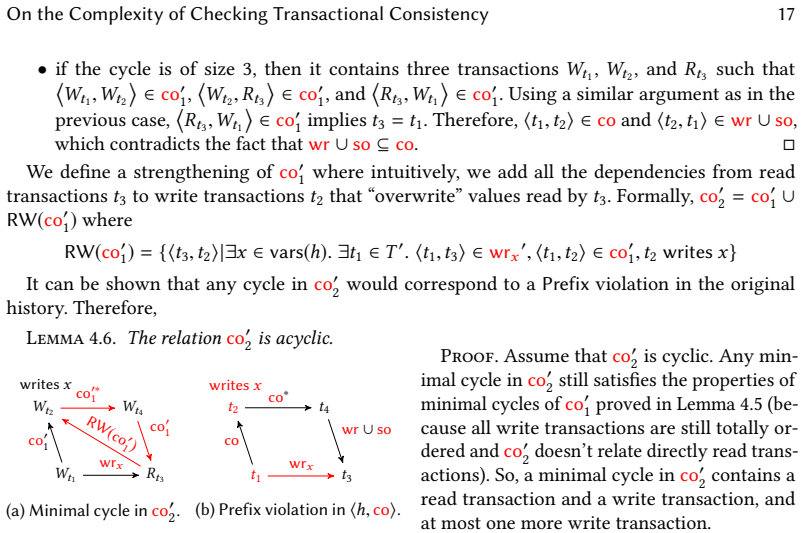
I walked the derivation chain for the central claims (polynomial-time checkability of RC/RA/CC, NP-completeness of PC/SI/SER, and the bounded-width and biconnected-component fixed-parameter tractability results). All of these are proved directly from the paper's explicitly stated axiomatic definitions (Definition 2.5, Figure 2, Table 1). The polynomial-time algorithms (Algorithm 1 and its RC/RA analogues) are saturation procedures whose soundness and completeness are proved in Appendix B by showing that the saturated order is acyclic iff a valid total commit order exists; no fitted parameter or target-consistency assumption is used as an input. The NP-hardness proof (Theorem 3.2) is a self-contained reduction from SAT to histories h_phi, with the two implications proved from the Prefix/Serializability axioms and Lemma 3.3. The PC-to-SER and SI-to-SER reductions (Section 4) are explicit constructions with acyclicity arguments relating co'_1, co'_2, RW(co'_1), and WR(co'_1) to Prefix/Conflict violations; they are not circular. The communication-graph decomposition (Section 5) is proved by a minimal-path argument over biconnected components. The only self-citations are [11] and [17], used in related work to position the results as extensions of prior causal-consistency and linearizability-monitoring work; these citations are not load-bearing for the paper's proofs. The claim that the axiomatic definitions are equivalent to the formalization of Cerone et al. [14] (Appendix E) is informal and concerns external semantic adequacy, not circular reasoning: a mismatch with database implementations would be a correctness or scope issue, not a reduction of a claimed result to its own input. No self-definitional, fitted-input, or uniqueness-imported-by-self-citation pattern is present.
Assumptions & free parameters
assumptions (5)
- domain assumption Histories come with an explicit write-read relation wr, and executions can be restricted to those where each value is written at most once.
- domain assumption Each transaction has at most one write per variable, and reads of a variable are not preceded by writes to that variable in the same transaction.
- domain assumption Aborted transactions can be ignored because their effects are never visible.
- domain assumption The axiomatic definitions in Figure 2 are equivalent to previous formalizations by Cerone et al. [14].
- domain assumption The session order is a strict partial order that is a union of sequences (sessions), and the number of sessions or width is a relevant fixed parameter.
Cite this review
Pith. "Pith review of On the Complexity of Checking Transactional Consistency." pith.science (2026). https://pith.science/paper/6TDQAVBX
@misc{pith2026190804509,
  author       = {Pith},
  title        = {Pith review of: On the Complexity of Checking Transactional Consistency},
  year         = {2026},
  howpublished = {\url{https://pith.science/paper/6TDQAVBX}},
  note         = {Machine review of arXiv:1908.04509}
}
read the original abstract
Transactions simplify concurrent programming by enabling computations on shared data that are isolated from other concurrent computations and are resilient to failures. Modern databases provide different consistency models for transactions corresponding to different tradeoffs between consistency and availability. In this work, we investigate the problem of checking whether a given execution of a transactional database adheres to some consistency model. We show that consistency models like read committed, read atomic, and causal consistency are polynomial time checkable while prefix consistency and snapshot isolation are NP-complete in general. These results complement a previous NP-completeness result concerning serializability. Moreover, in the context of NP-complete consistency models, we devise algorithms that are polynomial time assuming that certain parameters in the input executions, e.g., the number of sessions, are fixed. We evaluate the scalability of these algorithms in the context of several production databases.
Figures


Figures from the paper (14 more)




Reference graph
Works this paper leans on
-
[1]
[n. d.]. http://jepsen.io Retrieved March 28th, 2019
work page 2019
-
[2]
[n. d.]. https://github.com/jepsen-io/jepsen/blob/master/galera/src/jepsen/galera/dirty_reads.clj Retrieved March 28th, 2019
work page 2019
-
[3]
[n. d.]. https://github.com/cockroachdb/cockroach Retrieved March 28th, 2019
work page 2019
-
[4]
[n. d.]. https://www.cockroachlabs.com/docs/v2.1/transactions.html#isolation-levels Retrieved March 28th, 2019
work page 2019
-
[5]
[n. d.]. http://galeracluster.com Retrieved March 28th, 2019
work page 2019
-
[6]
[n. d.]. http://galeracluster.com/documentation-webpages/faq.html Retrieved March 28th, 2019
work page 2019
-
[7]
[n. d.]. http://galeracluster.com/documentation-webpages/isolationlevels.html# intra-node-vs-inter-node-isolation-in-galera-cluster Retrieved March 28th, 2019
work page 2019
-
[8]
[n. d.]. https://www.antidotedb.eu Retrieved March 28th, 2019
work page 2019
Show all 30 references
-
[9]
[n. d.]. https://antidotedb.gitbook.io/documentation/overview/configuration Retrieved March 28th, 2019
2019
-
[10]
Bernstein, Jim Gray, Jim Melton, Elizabeth J
Hal Berenson, Philip A. Bernstein, Jim Gray, Jim Melton, Elizabeth J. O’Neil, and Patrick E. O’Neil. 1995. A Critique of ANSI SQL Isolation Levels. In Proceedings of the 1995 ACM SIGMOD International Conference on Management of Data, San Jose, California, USA, May 22-25, 1995....
1995
-
[11]
Ahmed Bouajjani, Constantin Enea, Rachid Guerraoui, and Jad Hamza. 2017. On verifying causal consistency. In Proceedings of the 44th ACM SIGPLAN Symposium on Principles of Programming Languages, POPL 2017, Paris, France, January 18-20, 2017 , Giuseppe Castagna and Andrew D. Go...
2017
-
[12]
Sebastian Burckhardt, Alexey Gotsman, Hongseok Yang, and Marek Zawirski. 2014. Replicated data types: specification, verification, optimality. In The 41st Annual ACM SIGPLAN-SIGACT Symposium on Principles of Programming Languages, POPL ’14, San Diego, CA, USA, January 20-21, 2...
2014
-
[13]
Sebastian Burckhardt, Daan Leijen, Jonathan Protzenko, and Manuel Fähndrich. 2015. Global Sequence Protocol: A Robust Abstraction for Replicated Shared State. In 29th European Conference on Object-Oriented Programming, ECOOP 2015, July 5-10, 2015, Prague, Czech Republic (LIPIc...
2015 doi
-
[14]
Andrea Cerone, Giovanni Bernardi, and Alexey Gotsman. 2015. A Framework for Transactional Consistency Models with Atomic Visibility. In 26th International Conference on Concurrency Theory, CONCUR 2015, Madrid, Spain, September 1.4, 2015 (LIPIcs) , Luca Aceto and David de Fruto...
2015 doi
-
[15]
Marek Chalupa, Krishnendu Chatterjee, Andreas Pavlogiannis, Nishant Sinha, and Kapil Vaidya. 2018. Data-centric dynamic partial order reduction. PACMPL 2, POPL (2018), 31:1–31:30. https://doi.org/10.1145/3158119
2018 doi
-
[16]
Niklas Eén and Niklas Sörensson. 2003. An Extensible SAT-solver. In Theory and Applications of Satisfiability Testing, 6th International Conference, SAT 2003. Santa Margherita Ligure, Italy, May 5-8, 2003 Selected Revised Papers (Lecture Notes in Computer Science) , Enrico Giu...
2003 doi
-
[17]
Michael Emmi and Constantin Enea. 2018. Sound, complete, and tractable linearizability monitoring for concurrent collections. PACMPL 2, POPL (2018), 25:1–25:27. https://doi.org/10.1145/3158113
2018 doi
-
[18]
Cormac Flanagan and Patrice Godefroid. 2005. Dynamic partial-order reduction for model checking software. In Proceedings of the 32nd ACM SIGPLAN-SIGACT Symposium on Principles of Programming Languages, POPL 2005, Long Beach, California, USA, January 12-14, 2005 , Jens Palsberg...
2005
-
[19]
Gibbons and Ephraim Korach
Phillip B. Gibbons and Ephraim Korach. 1997. Testing Shared Memories. SIAM J. Comput. 26, 4 (1997), 1208–1244. https://doi.org/10.1137/S0097539794279614
1997 doi
-
[20]
Leslie Lamport. 1978. Time, Clocks, and the Ordering of Events in a Distributed System. Commun. ACM 21, 7 (1978), 558–565. https://doi.org/10.1145/359545.359563
1978
-
[21]
Mazurkiewicz
Antoni W. Mazurkiewicz. 1986. Trace Theory. In Petri Nets: Central Models and Their Properties, Advances in Petri Nets 1986, Part II, Proceedings of an Advanced Course, Bad Honnef, Germany, 8-19 September 1986 (Lecture Notes in Computer Science), Wilfried Brauer, Wolfgang Reis...
1986 doi
-
[22]
Burcu Kulahcioglu Ozkan, Rupak Majumdar, Filip Niksic, Mitra Tabaei Befrouei, and Georg Weissenbacher. 2018. Randomized testing of distributed systems with probabilistic guarantees. PACMPL 2, OOPSLA (2018), 160:1–160:28. https://doi.org/10.1145/3276530
2018 doi
-
[23]
Papadimitriou
Christos H. Papadimitriou. 1979. The serializability of concurrent database updates. J. ACM 26, 4 (1979), 631–653. https://doi.org/10.1145/322154.322158 , Vol. 1, No. 1, Article . Publication date: August 2018. On the Complexity of Checking Transactional Consistency 27
1979
-
[24]
Terry, Alan J
Douglas B. Terry, Alan J. Demers, Karin Petersen, Mike Spreitzer, Marvin Theimer, and Brent B. Welch. 1994. Session Guarantees for Weakly Consistent Replicated Data. In Proceedings of the Third International Conference on Parallel and Distributed Information Systems (PDIS 94),...
1994
-
[25]
Pierre Wolper. 1986. Expressing Interesting Properties of Programs in Propositional Temporal Logic. InConference Record of the Thirteenth Annual ACM Symposium on Principles of Programming Languages, St. Petersburg Beach, Florida, USA, January 1986. ACM Press, 184–193. https://...
1986
-
[26]
Along with them, we define a partial commit order WR(co′ 1) WR(co′
as in the case of prefix consistency. Along with them, we define a partial commit order WR(co′ 1) WR(co′
-
[27]
={ Wt1, Rt2 |∃x2,1∈ vars(hc R|W). Rt2,Wt2 ∈ wrx2, 1 ′, Wt1,Wt2 ∈ co′ 1,Wt1 writes x2,1} which intuitively, enforces that the read part Rt2 of a transaction t2 observes the effects of the write part Wt1 of a transaction t1 when t1 and t2 write on a common variable and the commi...
-
[28]
Differently from the previous case, the cycle in co′ 2 here can also contains the dependencies in WR(co′
since this would imply that it contains two non-consecutive write transactions. Differently from the previous case, the cycle in co′ 2 here can also contains the dependencies in WR(co′
-
[29]
The case of minimal cycles in co′ 2 that contain only a dependency from RW(co′ 1), and no dependencies from WR(co′ 1), can be dealt with as in the case of PC
which are from write transactions to read transactions. The case of minimal cycles in co′ 2 that contain only a dependency from RW(co′ 1), and no dependencies from WR(co′ 1), can be dealt with as in the case of PC. Consider a minimal cycle ofco′ 2 that contains a dependency Wt...
-
[30]
For the “if” direction, let co′ be a commit (total) order on transactions of hc R|W which satis- fies the serializability axiom
The relations between these transactions of hc R|W imply that the corresponding transactions of h are related as shown in Figure 16b, which implies a violation of Conflict, a contradiction of the hypothesis. For the “if” direction, let co′ be a commit (total) order on transact...
2018
Reviewed August 14, 2026 · model on record in the stance chip above.
Discussion (0). Continue with ORCID to comment.