REVIEW 4 major objections 4 minor 31 references
Integration by parts formula for killed processes: A point of view from approximation theory
T0 review · 4 major / 4 minor · reviewed 2026-08-14 · deepseek-v4-flash
Pith's one-line read This paper proves that derivatives of killed-diffusion expectations can be written as exact expectations over a reflected Markov chain sampled at Poisson jump times, yielding unbiased Monte Carlo estimators.
desk verdict The construction is genuinely new and the boundary merging is clever, but the proof of the central representation relies on a semigroup regularity estimate that appears false as stated. read the letter →
The pith
A machine-rendered reading of the paper's core claim, the machinery that carries it, and where it could break.
The reading
What carries the argument
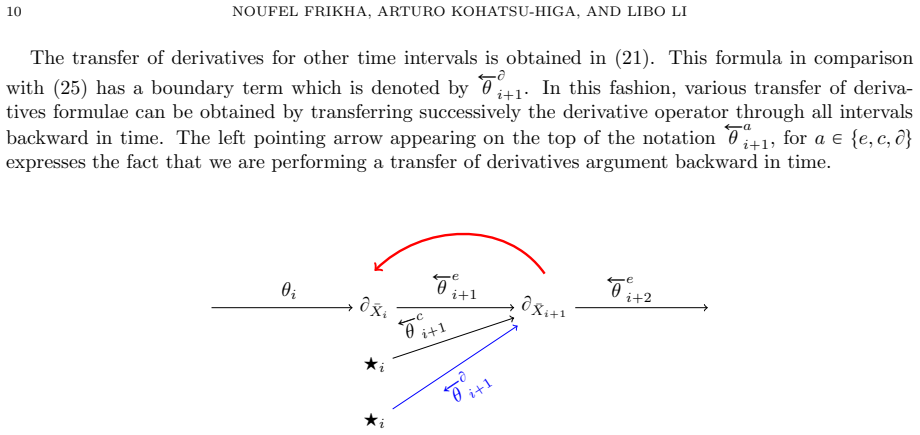
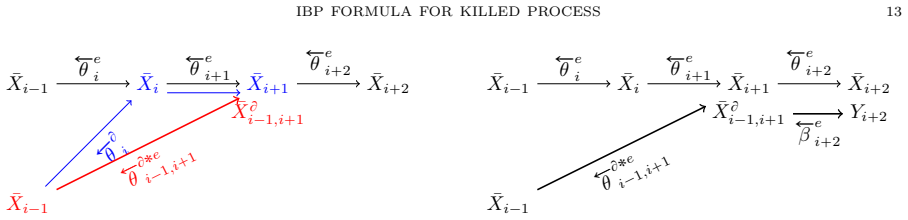
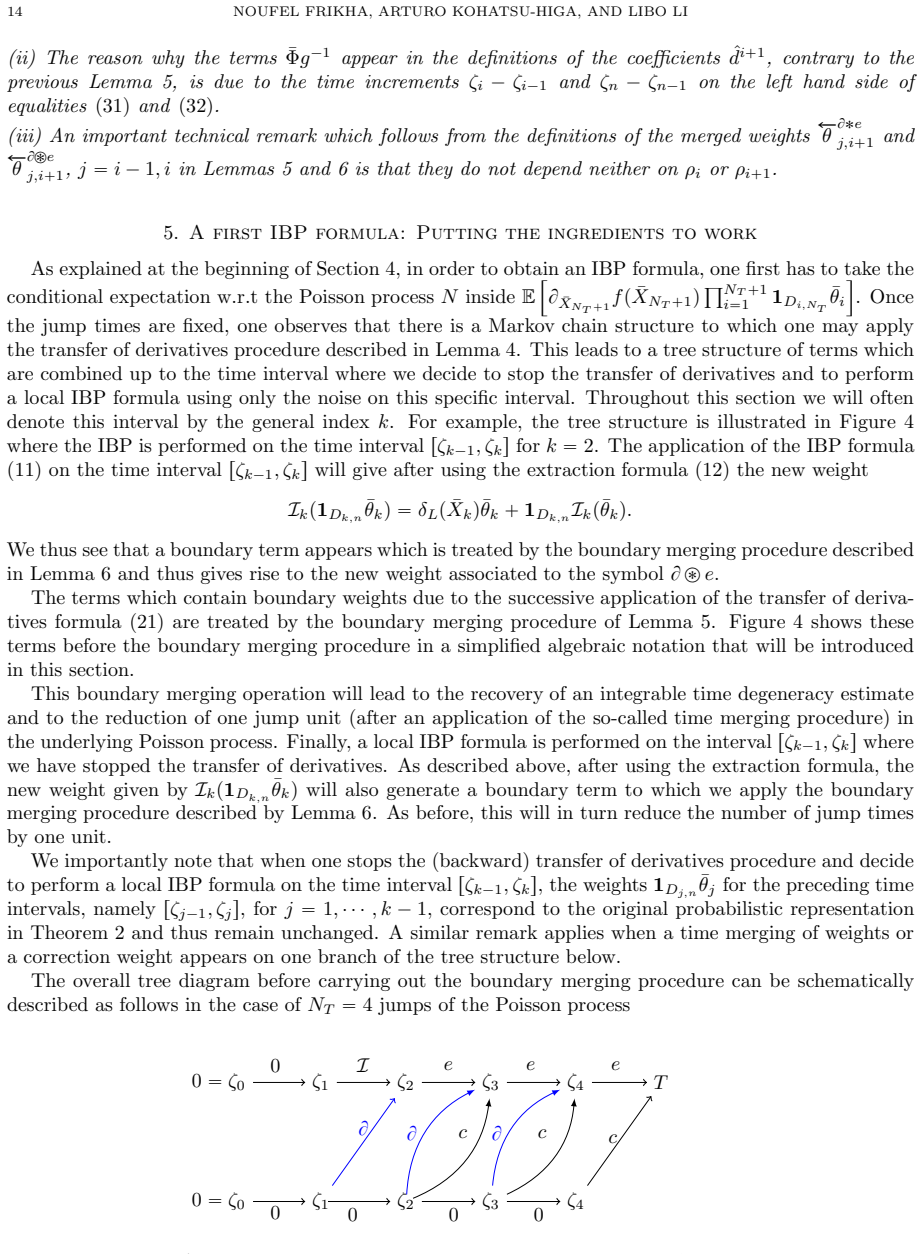
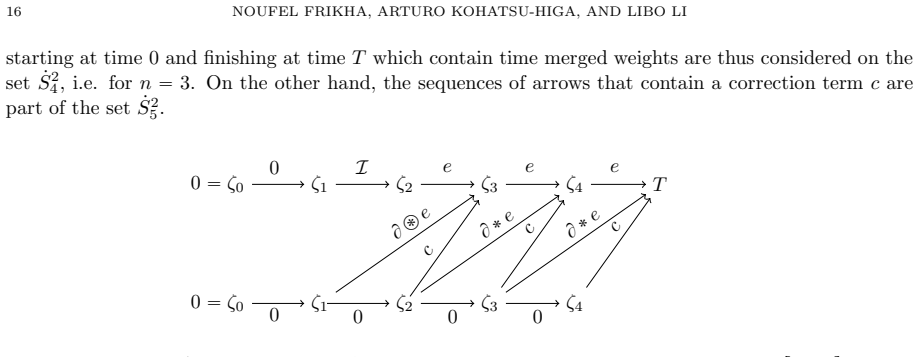
The central object is the reflected one-step Markov chain $\bar X_{i+1}=\rho_{i+1}\bar X_i+(1-\rho_{i+1})(2L-\bar X_i)+\sigma(\bar X_i)(W_{\zeta_{i+1}}-W_{\zeta_i})$, where $\rho_{i+1}$ is a Bernoulli(1/2) coin flip and the $\zeta_i$ are Poisson jump times; the reflection principle makes its law match a killed Brownian step. On this chain the paper builds a finite-dimensional Malliavin calculus: a derivative $D_{i+1}$ in the Gaussian increment $Z_{i+1}$ and an adjoint integral operator $I_{i+1}$ satisfying the duality $E[D_{i+1}f(\bar X_{i+1})H]=E[f(\bar X_{i+1})I_{i+1}(H)]$. The load-bearing mechanism is the boundary-merging lemma: when a transferred derivative leaves a weight multiplied by $\delta_L(\bar X_i)$, one conditions on the intermediate jump time $\zeta_i$, uses explicit Gaussian time-convolution identities, and replaces the two transitions by a single transition of the merged boundary chain $\bar X^B$. This removes the time singularity and keeps the final estimator in $L^p$ for $p<2$, or for every $p\ge1$ under Beta importance sampling.
What would settle it
Use killed Brownian motion with constant drift, where $E[f(X_T)1_{\tau\ge T}]$ and its derivatives have closed-form expressions, and Monte Carlo evaluate the right-hand side of Theorem 7 with increasing sample sizes; any systematic mismatch between the estimator's average and the closed-form derivative would refute the identity.
Extended reading notes
Core claim
Under Assumption (H) (smooth, bounded, uniformly elliptic coefficients), for test functions $f\in C_b^1(\mathbb{R})$ with $f(L)=0$, the paper proves Theorem 5: $T E[f'(X_T)1_{\tau\ge T}]$ equals an expectation over the reflected chain $\bar X$ and its boundary-merged variant $\bar X^B$, with explicit weights built from the chain increments and Poisson jump times. Theorem 7 gives the parallel Bismut-Elworthy-Li formula for $T\partial_x E[f(X_T)1_{\tau\ge T}]$, obtained by transferring derivatives forward in time; there the boundary terms vanish because $f(L)=0$, so no merging is needed. Corollaries 1 and 2 convert these representations into formulas for the derivatives of the killed transition density with respect to the terminal point and the starting point. The whole construction is designed so that an unbiased Monte Carlo simulation follows directly, with no discretization bias.
Load-bearing premise
The argument needs the survival expectation $P_t f(x)=E[f(X_t)1_{\tau>t}]$ to be twice differentiable in space and once in time, with bounded derivatives up to the killing level; if this regularity fails, the one-step Ito expansion that connects the diffusion to the reflected chain breaks down.
Editorial extensions
If this is right
- Theorem 5 gives an exact, unbiased Monte Carlo estimator for $T E[f'(X_T)1_{\tau\ge T}]$ without any time discretization bias.
- Theorem 7 gives the corresponding Bismut-Elworthy-Li estimator for the derivative with respect to the starting point, with no boundary-merging step needed.
- Corollaries 1 and 2 provide probabilistic representations of the derivatives of the killed transition density with respect to the terminal and initial points.
- Choosing Beta-distributed jump times makes the estimator's moments finite for every $p\ge 1$, whereas exponential jump times guarantee only $p<2$.
- The condition $f(L)=0$ can be removed by replacing $f$ with $f-f(L)$, so the formulas extend to general smooth test functions.
Reading between the lines
- The boundary-merging recipe is likely a general template: whenever a local Malliavin weight collides with a Dirac boundary term, averaging over the intermediate jump time convolves two Gaussian densities and weakens the singularity; the same template may apply to local times, occupation times, or running maxima of one-dimensional diffusions.
- The paper's restriction to one dimension is driven by the reflection principle and explicit Gaussian kernels; in multidimensional settings where a reflection principle or explicit transition density for the approximating chain exists, the perturbation-plus-merging argument may extend.
- The numerical tests show variance growing sharply as the sinusoidal modulation of the diffusion coefficient increases, which suggests the method is most effective for nearly constant coefficients and would need higher-order variance reduction for strongly state-dependent noise.
Signed reviews
Editorial analysis
A structured set of objections, weighed in public.
Referee Report
Summary. The paper establishes probabilistic representations for two integration by parts formulas for a one-dimensional diffusion killed at a fixed level L: one of Bismut-Elworthy-Li type for the derivative of the killed semigroup with respect to the starting point, and one for the derivative with respect to the terminal point, i.e., a representation for E[f'(X_T)1_{τ≥T}] and ∂_x E[f(X_T)1_{τ≥T}]. The approach combines a Markov chain approximation of the killed process, based on the reflection principle, with a finite-dimensional Malliavin calculus built on the Gaussian increments of the chain and the jump times of an independent Poisson process. The main results, Theorem 5 and Theorem 7, express these derivatives as expectations of the test function evaluated on the chain multiplied by explicit random weights; the paper further shows how to apply importance sampling on the jump times to obtain finite variance and provides numerical tests.
Significance. The methodology is original and potentially valuable: using the Poisson jump times to merge boundary terms is an elegant way to regularize Dirac-type singularities without the usual localisation arguments, and the resulting representations are directly usable for unbiased Monte Carlo simulation. The boundary merging lemmas in the appendix are nontrivial and are supported by explicit Gaussian convolution computations. If the technical gaps identified below are fixed, the paper would be a meaningful contribution to Monte Carlo methods for killed diffusions and to Malliavin calculus on discrete-time approximations. The numerical experiments give concrete evidence for the practical behaviour of the estimators, although the reported variances remain large for higher oscillation of the coefficients.
major comments (4)
- [10.1] The proof of Theorem 2 rests on the imported regularity assertion that under (H), for smooth f with f(L)=0, the killed semigroup satisfies P f ∈ C^{1,2}((0,T]×[L,∞)) and sup_{0≤t≤T}|∂_x^ℓ P_t f|∞ ≤ C for ℓ=1,2 (Section 10.1, before Eq. (54)). The manuscript does not verify that the cited results [15,16] apply to the half-line domain with initial data in the paper's class C^1_b, which allows unbounded functions with bounded derivative. For such data the second-derivative bound is not a standard consequence: for a compactly supported C^1 function that behaves like (y-L)^{3/2} near L, ∂_x^2 P_t f diverges like t^{-1/4} as t↓0. Since the one-step expansion (54), the estimates (56) and the induction (58) all depend on this bound, the derivation of the representation (16) for the full class in Theorem 2 is incomplete. The authors should either prove a version of the bound under their stated assumptions or provide an explicit approximation argument that proves (16) for arbitrary f in that class without assuming the uniform second-derivative bound.
- [6 (Lemma 7)] Lemma 7, the forward transfer-of-derivatives formula, is the key ingredient in the proof of the Bismut-Elworthy-Li formula (Theorem 7), but its proof is omitted with only the remark that it is similar to Lemma 4. Given that the proof of Lemma 4 itself relies on the nontrivial identities (61) and Corollary 3, the omission leaves Theorem 7 without a verifiable derivation. Please include a complete proof of Lemma 7 or point to a fully specified appendix where every step is carried out.
- [7 (importance sampling)] The central practical claim of Section 7 is that Beta-distributed jump times achieve finite moments of all orders for the estimators from Theorems 2, 5 and 7. For the Markov-chain representation (45) a calculation is sketched, but for the IBP weights the text states that the proof 'follows similar lines of reasonings ... and is thus omitted'. This is a load-bearing claim because the weights in (48)-(50) are more singular than the weights in (46). The authors should provide the moment estimate for the IBP estimators, including the verification of the time-degeneracy estimates (51)-(52) for the reweighted boundary-merging weights.
- [5.3 (Theorem 5, Step 6)] The final Step 6 of the proof of Theorem 5 only sketches the absolute convergence and the L^p-integrability (p<2) of the right-hand side, referring to 'a similar argument' as in Section 10. The argument for the terms involving G1 and G2 and the application of Lemma 13 require a careful justification of the uniform integrability over the infinite sum over n. Moreover, Lemma 13, which is used crucially in the jump-reduction procedure, is stated without proof. Please provide the proof of Lemma 13 and a complete derivation of the moment bounds for the tree weights.
minor comments (4)
- [1] The reference in the Introduction to 'Anderson and Kohatsu-Higa [3]' should be 'Andersson and Kohatsu-Higa'; the same typo appears in the bibliography, where reference [4] is dated '20 18'.
- [Notation] The symbol E= is used without a formal definition in Section 10.1 and elsewhere; it should be defined explicitly in the notation section, as it may be confused with equality in law.
- [10.1] The sentence 'Under the condition ... P_t f(L)=f(L)=0 together with P_0 f(x)=f(x)' overloads the symbol P (semigroup vs probability) and would be clearer if written as 'the semigroup P_t satisfies the Dirichlet condition P_t f(L)=0'.
- [5.1] The description of the symbol sets S_{n+1}, \bar S^k_{n+1} and \hat S^k_{n+1} is terse; a small table with the meaning of each symbol (0, e, c, I, B*e, Bfe) would improve readability.
Circularity Check
No circular reduction: IBP formulas are derived from the Markov-chain representation and Gaussian duality, not from the target formulas.
full rationale
I walked the derivation chain of the paper. The central representation (16) in Theorem 2 is obtained in Section 10.1 by a one-step Itô expansion of the killed semigroup P_t f around the reflected Gaussian chain, followed by an induction using the finite-dimensional Gaussian IBP duality (11). That IBP duality is a standard one-step integration by parts for Gaussian increments, not the paper's target IBP formulas. The later transfer and boundary-merging lemmas (Lemmas 4--6 and 13) are algebraic consequences of the same duality together with explicit Gaussian time convolutions; they manipulate weights and indicators and do not assume the killed-process IBP formulas being proved. No fitted parameter is called a prediction; no uniqueness theorem from the authors' prior work is invoked; no ansatz is smuggled in by citation; and no known result is merely renamed. The only genuinely external input is the C^{1,2} regularity of the killed semigroup imported from Garroni--Menaldi [15,16] in Section 10.1; this is an analytic regularity assumption and a potential correctness risk, but it is not circular. The self-citations to the authors' [14] are parenthetical: they supply an analytic alternative for density differentiability, a representation for P(tau>=T), and an analytic proof of residual-term convergence, while the main argument also provides convergence via the estimates of Lemmas 8 and 9. Several proofs are omitted (e.g., Lemma 7, the standard approximation in Corollary 1, moment arguments in Section 7), but these are expositional gaps, not circular reductions. I therefore find no circular step; the minor self-citations are not load-bearing, so the score is 1.
Assumptions & free parameters
free parameters (2)
- lambda (Poisson intensity)
- Importance sampling parameters (alpha, beta, tau_bar) =
alpha=1/2 in examples
assumptions (4)
- domain assumption Assumption (H): b, sigma are smooth and bounded, sigma^2 is uniformly elliptic (sigma>=a>0)
- domain assumption Killed semigroup regularity: P_t f in C^{1,2} with bounded derivatives for f smooth with f(L)=0, imported from Garroni-Menaldi [15,16]
- standard math Gaussian integration by parts formula (11) for the Markov chain increments
- standard math Reflection principle for Brownian motion (Lemma 1)
invented entities (2)
-
Reflected Markov chain X_bar with random weights theta_i
-
Merged boundary process X_bar^B
Cite this review
Pith. "Pith review of Integration by parts formula for killed processes: A point of view from approximation theory." pith.science (2026). https://pith.science/paper/JQ3AABS5
@misc{pith2026190804550,
  author       = {Pith},
  title        = {Pith review of: Integration by parts formula for killed processes: A point of view from approximation theory},
  year         = {2026},
  howpublished = {\url{https://pith.science/paper/JQ3AABS5}},
  note         = {Machine review of arXiv:1908.04550}
}
read the original abstract
In this paper, we establish a probabilistic representation for two integration by parts formulas, one being of Bismut-Elworthy-Li's type, for the marginal law of a one-dimensional diffusion process killed at a given level. These formulas are established by combining a Markovian perturbation argument with a tailor-made Malliavin calculus for the underlying Markov chain structure involved in the probabilistic representation of the original marginal law. Among other applications, an unbiased Monte Carlo path simulation method for both integration by parts formula stems from the previous probabilistic representations.
Figures

Figures from the paper (2 more)
Reference graph
Works this paper leans on
-
[1]
A. Agarwal and E. Gobet. Finite variance unbiased estima tion of stochastic differential equations. Proceedings of the 2017 Winter Simulation Conference , pages 1950–1961, 2017
work page 2017
-
[2]
J. Akahori and Y. Imamura. On a symmetrization of diffusio n processes. Quantitative Finance, 14(7):1211–1216, 2014
work page 2014
-
[3]
P. Andersson and A. Kohatsu-Higa. Unbiased simulation o f stochastic differential equations using parametrix expan - sions. Bernoulli, 23(3):2028–2057, 2017
work page 2017
-
[4]
P. Andersson, A. Kohatsu-Higa, and T. Yuasa. Second orde r probabilistic parametrix method for unbiased simulation of stochastic differential equations. Technical report, 20 18. 30 NOUFEL FRIKHA, ARTURO KOHATSU-HIGA, AND LIBO LI
-
[5]
M. Arnaudon and A. Thalmaier. Gradient estimates for pos itive harmonic functions by stochastic analysis. Stochastic Processes and their Applications , 117(2):202–220, 2007
work page 2007
-
[6]
M. Arnaudon and A. Thalmaier. The differentiation of hypo elliptic diffusion semigroups. Illinois J. Math. , 54(4):1285– 1311, 2010
work page 2010
-
[7]
V. Bally and A. Kohatsu-Higa. A probabilistic interpret ation of the parametrix method. Ann. Appl. Probab. , 25(6):3095–3138, 12 2015
work page 2015
- [8]
Show all 31 references
-
[9]
Beskos, O
A. Beskos, O. Papaspiliopoulos, and G. O. Roberts. Retro spective exact simulation of diffusion sample paths with applications. Bernoulli, 12(6):1077–1098, 12 2006
2006
-
[10]
Defosseux
M. Defosseux. Affine lie algebras and conditioned space- time brownian motions in affine weyl chambers. Probab. Theory Relat. Fields , pages 649–665, 2016
2016
-
[11]
F. Delarue. Estimates of the solutions of a system of qua si-linear PDEs. A probabilistic scheme. In S´ eminaire de Probabilit´ es XXXVII, volume 1832 of Lecture Notes in Math. , pages 290–332. Springer, Berlin, 2003
2003
-
[12]
Fourni´ e, J.-M
E. Fourni´ e, J.-M. Lasry, J. Lebuchoux, and P.-L. Lions . Applications of Malliavin calculus to Monte-Carlo method s in finance. II. Finance Stoch., 5(2):201–236, 2001
2001
-
[13]
Fourni´ e, J.-M
E. Fourni´ e, J.-M. Lasry, J. Lebuchoux, P.-L. Lions, an d N. Touzi. Applications of Malliavin calculus to Monte Carl o methods in finance. Finance Stoch., 3(4):391–412, 1999
1999
-
[14]
Frikha, A
N. Frikha, A. Kohatsu-Higa, and L. Li. On the first hittin g times of one dimensional elliptic diffusions. arXiv preprint arXiv:1609.09327, 2016
2016 arXiv
-
[15]
M. G. Garroni and J.-L. Menaldi. Green functions for second order parabolic integro-differe ntial problems, volume 275 of Pitman Research Notes in Mathematics Series . Longman Scientific & Technical, Harlow; copublished in the United States with John Wiley & Sons, Inc., New York, 1992
1992
-
[16]
M. G. Garroni and J. L. Menaldi. Second order elliptic integro-differential problems , volume 430 of Chapman & Hall/CRC Research Notes in Mathematics . Chapman & Hall/CRC, Boca Raton, FL, 2002
2002
-
[17]
E. Gobet. W eak approximation of killed diffusion using E uler schemes. Stochastic Process. Appl., 87(2):167–197, 2000
2000
-
[18]
Gobet and A
E. Gobet and A. Kohatsu-Higa. Computation of Greeks for barrier and look-back options using Malliavin calculus. Electron. Comm. Probab. , 8:51–62, 2003
2003
-
[19]
Gobet and S
E. Gobet and S. Menozzi. Exact approximation rate of kil led hypoelliptic diffusions using the discrete Euler scheme . Stoch. Proc. and Appl. , 112:210–223, 2004
2004
-
[20]
Henry-Labord` ere, X
P. Henry-Labord` ere, X. Tan, and N. Touzi. Unbiased sim ulation of stochastic differential equations. Ann. Appl. Probab., 27(6):3305–3341, 12 2017
2017
-
[21]
Herrmann and C
S. Herrmann and C. Zucca. Exact simulation of the first-p assage time of diffusions. ArXiv e-prints , May 2017
2017
-
[22]
Ikeda and S
N. Ikeda and S. W atanabe. Stochastic differential equations and diffusion processes , volume 24 of North-Holland Mathematical Library. North-Holland Publishing Co., Amsterdam; Kodansha, Ltd. , Tokyo, second edition, 1989
1989
-
[23]
P. A. Jenkins. Exact simulation of the sample paths of a d iffusion with a finite entrance boundary. ArXiv e-prints , Nov. 2013
2013
-
[24]
Karatzas and S
I. Karatzas and S. E. Shreve. Brownian motion and stochastic calculus . Springer, 2 edition, 1991
1991
-
[25]
Malliavin and A
P. Malliavin and A. Thalmaier. Stochastic Calculus of Variations in Mathematical Finance . Springer Finance. Springer Berlin Heidelberg, 2005
2005
-
[26]
T. Nakatsu. Integration by parts formulas concerning m axima of some SDEs with applications to study on density functions. Stoch. Anal. Appl. , 34(2):293–317, 2016
2016
-
[27]
D. Nualart. The Malliavin calculus and related topics . Probability and its Applications (New York). Springer-Ve rlag, Berlin, second edition, 2006
2006
-
[28]
Reutenauer and E
V. Reutenauer and E. Tanr´ e. An unbiased Monte Carlo est imator for derivatives. Application to CIR. Technical repo rt, arXiv:1609.07431, 2016
2016 arXiv
-
[29]
Revuz and M
D. Revuz and M. Yor. Continuous Martingales and Brownian motion . Grundlehren der Mathematischen Wissensch Series. Springer, 1991
1991
-
[30]
f p ¯XT q2p2ρ ´ 1q ` 2p2ρ ´ 1q ż T 0 ˆ 1 2 ` ap ¯Xsq ´ apxq ˘ B2 xPT ´sf p ¯Xsq ` bp ¯XsqBxPT ´sf p ¯Xsq ˙ 1t ¯XsěLuds(54) E“ f p ¯XNT `1qθNT `11tNT “0u ` eλT 2λ´1p2ρNT ´ 1q
Appendix 10.1. Proof of the probabilistic representation in Theorem 2. Let X be the solution to (1). Let P denote the semigroup operator associated with the killed process. That is, for a measurable and bounded function f , one defines Ptf pxq “ E “ f pXtq1tτ ątu ‰ . We remark ...
-
[31]
f p ¯Xi`1qδLp ¯Xi`1q¯θi`1 ‰ “Ei,n
Then for any p P r0, 2q, we have the following moment estimate: E «ˇ ˇ ˇ NT `1ź i“1 1Di,NT ¯θi ˇ ˇ ˇ p ff ď E1´ p 2 ,1pCT ´ p 2 `1q ă 8 . Here E1´ p 2 ,1 stands for the Mittag-Leffler function Eα,βpzq :“ ř ně0 zk Γ pβ`kαq with parameters α “ 1 ´ p 2 , β “ 1. Proof. For the proof,...
Reviewed August 14, 2026 · model on record in the stance chip above.
Discussion (0). Continue with ORCID to comment.