REVIEW 3 major objections 4 minor 22 references
Study of Particle Multiplicity of Cosmic Ray Events using 2m$\times$2m Resistive Plate Chamber Stack at IICHEP-Madurai
T0 review · 3 major / 4 minor · reviewed 2026-08-14 · deepseek-v4-flash
Pith's one-line read A 12-layer muon detector stack measured 2-, 3-, and 4-parallel-track cosmic-ray event rates that exceed air-shower simulation predictions by factors of about 3, 5, and 6.
desk verdict A careful surface muon-multiplicity measurement that reports a real-looking excess over CORSIKA, but the MC comparison is under-specified at the high-energy end and the 4-track bin is statistically thin. read the letter →
The pith
A machine-rendered reading of the paper's core claim, the machinery that carries it, and where it could break.
The reading
What carries the argument
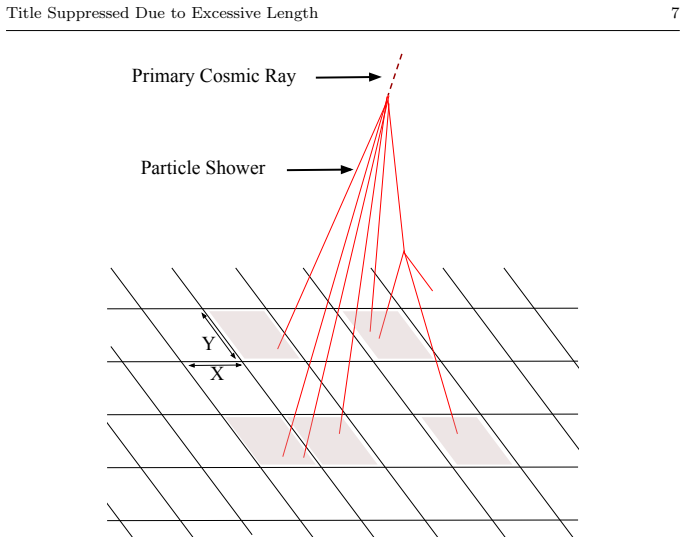
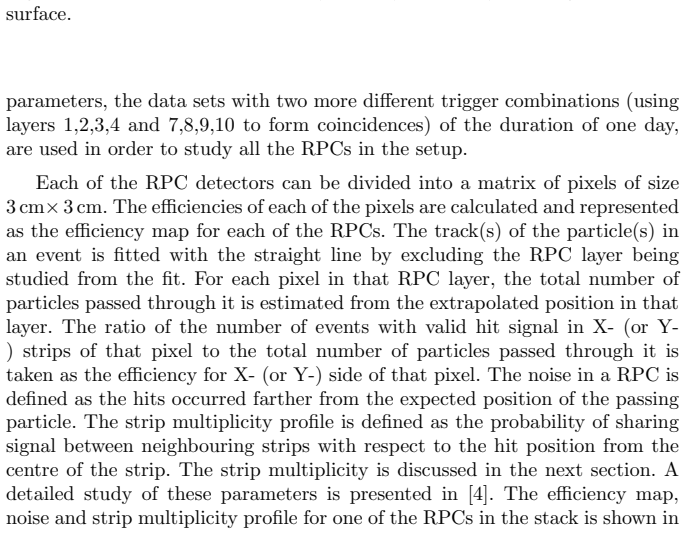
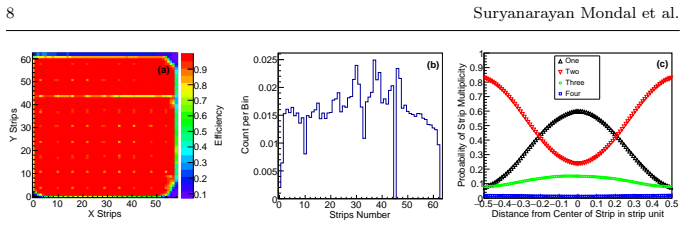
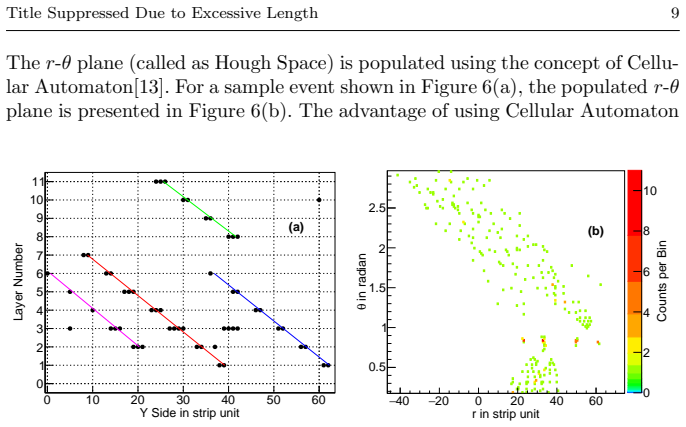
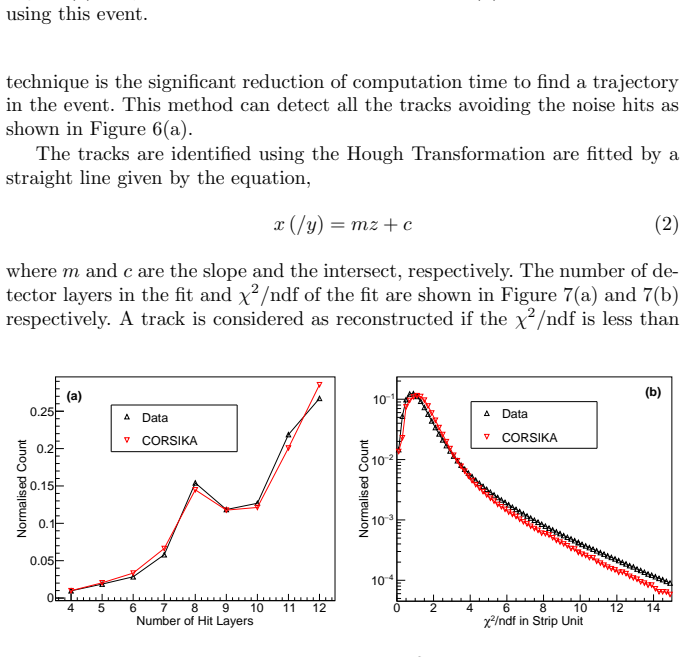
The load-bearing element is the parallel-track selection applied to events reconstructed by the Hough transform. In each event, strip hits are grouped into straight-line candidates in the X-Z and Y-Z projections, and a candidate is a track if at least four layers fit with $\chi^2/\text{ndf}<10$. A pair of tracks is accepted as coming from the same cosmic-ray shower only when the skew angle between the pair is below $2.5^\circ$, about $3\sigma_0$ of the triple-Gaussian resolution function measured from simulated pairs; this cut removes random coincidences between independent showers and secondaries produced in the roof. On the simulation side, the same reconstruction runs on CORSIKA showers for hydrogen, helium, carbon, oxygen, silicon, and iron primaries that have been propagated through a GEANT4 detector model whose digitization uses measured efficiency maps, noise, and strip multiplicities, and the per-primary fractions are combined with standard abundance weights.
What would settle it
Remove the 22 cm concrete roof from the GEANT4 geometry and rerun the full analysis on the same CORSIKA input: if the measured 2-track fraction drops from its observed $6.35\times10^{-5}$ toward the simulated $2.35\times10^{-5}$ while the single-track rate barely changes, the extra parallel tracks are produced by roof interactions that the simulation mishandles; if the factor-of-about-3 excess survives without the roof, the discrepancy is genuinely atmospheric.
Extended reading notes
Core claim
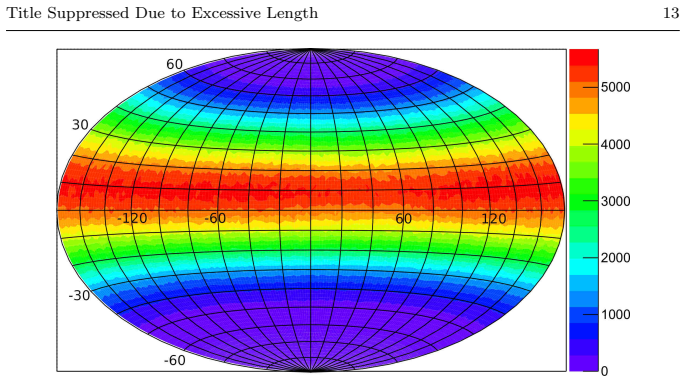
The central claim is that the normalized fractions of cosmic-ray events containing 2, 3, and 4 parallel reconstructed tracks are $(6.35\pm0.05)\times10^{-5}$, $(5.82\pm0.53)\times10^{-7}$, and $(1.94\pm0.97)\times10^{-8}$, several times larger than the corresponding composition-weighted CORSIKA/QGSJET-II-04 predictions of $(2.35\pm0.13)\times10^{-5}$, $(1.12\pm0.13)\times10^{-7}$, and $(3.21\pm0.87)\times10^{-9}$. The same deficit appears with QGSJET01d, so it is not specific to one hadronic model. Because the reconstructed directions show no anisotropy and the quoted systematic uncertainties from roof thickness, material budget, strip multiplicity, noise, efficiency, and GEANT4 physics are much smaller than the gap, the paper concludes that the simulation chain underestimates the rate of parallel muons from cosmic-ray showers and that the missing ingredient most plausibly lies in the extrapolation of hadronic interactions to energies beyond current collider coverage, or in the assumed primary spectrum and composition.
Load-bearing premise
The comparison stands on the assumption that the detector simulation and the reconstruction cuts, including the 2.5-degree parallel-track definition, translate a given number of true muons into a recorded number of parallel tracks in data and simulation with equal fidelity; if the simulation mis-models multi-track response or the reconstruction fabricates extra tracks in data, the inferred excess would be an artifact, not a property of cosmic-ray showers.
Editorial extensions
If this is right
- Standard CORSIKA/QGSJET simulations underproduce ground-level muon bundles: by factors of roughly 3, 5, and 6 for 2, 3, and 4 parallel muons, so underground experiments that use these simulations for atmospheric-muon backgrounds will undercount correlated multi-muon events.
- Because the measured fractions are normalized to single-track events and the same reconstruction is applied to data and simulation, a uniform inefficiency would cancel; the discrepancy therefore lives specifically in how often the simulation produces additional parallel muons.
- The disagreement appears for both QGSJET-II-04 and QGSJET01d, so it is common to those high-energy hadronic models rather than a quirk of one; the paper places the likely cause in the forward-region extrapolation beyond collider energies or in the assumed primary composition and spectral index.
- Multiplicity ratios of this kind offer a rare surface-level constraint on the high-energy tail of the cosmic-ray spectrum and on hadronic models, which is why the authors propose using the result to tune hadronic parameters or composition.
- The paper notes that earlier underground multi-muon measurements and KASCADE-Grande's shorter simulated muon attenuation length point in the same direction, so the new ground-level result adds to a pattern of simulations underestimating atmospheric muons.
Reading between the lines
- Beyond the paper: a direct extension would be to repeat the analysis with other hadronic models such as EPOS-LHC or Sibyll and with the primary composition weights left as free parameters; if no physically reasonable composition reaches the 4-track rate, the problem would be isolated to forward hadron production in the simulation.
- Beyond the paper: because the stack spans only 2 m by 2 m, the observed fractions are sensitive to muon lateral density at small separation; a wider array or a longer-baseline pair of stacks could test whether the simulation underestimates muon density in small cells or simply produces too few high-energy muon bundles.
- Beyond the paper: if the excess is physical, correlated-muon backgrounds for rare-event searches in underground detectors would be underestimated by the same simulations; the paper does not quantify this, but the direction of the discrepancy makes it a relevant check.
- Beyond the paper: the same data set could be used to derive a lower bound on the rate of high-energy primaries that produce multi-muon final states, by unfolding detector response and comparing with collider-constrained models; this would give a quantitative handle on the forward region that colliders cannot see.
Signed reviews
Editorial analysis
A structured set of objections, weighed in public.
Referee Report
Summary. Using a 12-layer stack of 2 m x 2 m glass RPCs at IICHEP-Madurai, the authors analyze roughly 250 million cosmic-ray triggered events (206 million with at least one reconstructed track). They reconstruct tracks with a Hough transform and select events with 2, 3, or 4 parallel tracks using a 2.5-degree skewed-angle cut. The measured fractions relative to single-track events are (6.35 +/- 0.05) x 10^-5, (5.82 +/- 0.53) x 10^-7, and (1.94 +/- 0.97) x 10^-8. These are compared with CORSIKA v7.6300 simulations using an E^-2.7 spectrum over 10-10^6 GeV, six primary species, and two QGSJET hadronic models, followed by a GEANT4 detector simulation that includes measured detector parameters. The paper finds that the data exceed the simulations by factors of roughly 2.7, 5, and 6-8 for 2, 3, and 4 tracks, respectively, and concludes that the EAS simulation cannot reproduce the observed multi-muon rates.
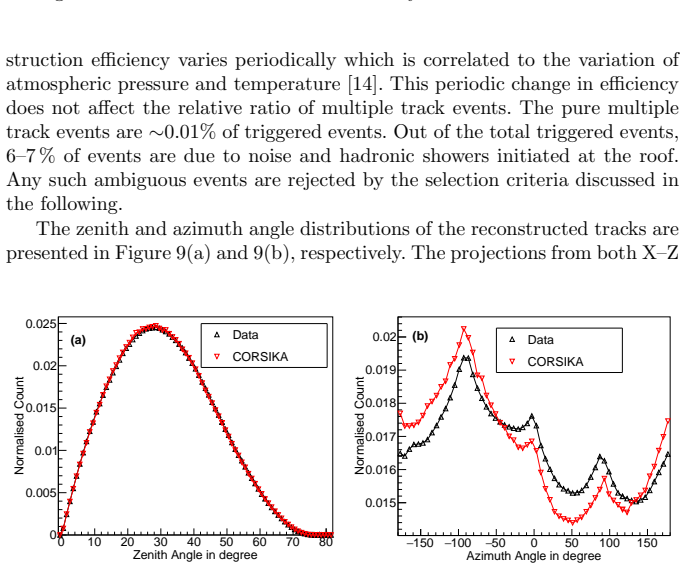
Significance. The measurement is potentially valuable: the data set is large, the detector response is calibrated from data, and the reconstructed angular distributions match the simulation, giving confidence in the basic reconstruction pipeline. If the discrepancy survives the additional checks described below, it would provide a useful ground-level constraint on high-energy hadronic interaction models and on the muon content of air showers. However, the paper does not currently establish the discrepancy quantitatively because of an unexamined energy cutoff in the CORSIKA sample and the absence of a systematic uncertainty budget for the simulation prediction.
major comments (3)
- [Section 3.1, Tables 1-2] The CORSIKA primary-energy range is stated as 10-10^6 GeV, but the paper does not report the primary-energy distribution of simulated events that survive the 2-, 3-, and 4-track selections. The rate of high-multiplicity events rises steeply with primary energy, and the manuscript itself notes in Section 5 that a significant fraction of the interactions responsible for high multiplicities are beyond current collider energies. If the selected simulated events cluster near the 10^6 GeV boundary, extending the range to 10^7-10^8 GeV with the same spectrum and composition could raise the predicted fractions by factors comparable to the reported excess. The paper must either show that the selected events are safely below the cutoff or extend the simulation range; otherwise the claimed discrepancy may be an artifact of the truncation.
- [Section 5, paragraph after Table 2] The statement that 'Systematic error due to uncertainties of roof thickness, material in the detector setup, strip multiplicity, noise, efficiencies and the physics models used in GEANT4 are much smaller than the observed discrepancy' is not supported by any quantitative estimate. In particular, the primary-composition weights, the spectral index gamma, the low-energy hadronic model, and the parallel-track angle cut are not varied. Since the Introduction identifies composition and spectral index as dominant factors for multiplicity, a scan over these inputs is required before the discrepancy can be considered model-independent.
- [Table 2] For the 4-track fraction, the data value (1.94 +/- 0.97) x 10^-8 and the QGSJET-II-04 prediction (3.21 +/- 0.87) x 10^-9 differ by only about 1.7 standard deviations when the quoted errors are combined; the QGSJET01d prediction gives a similar conclusion. The paper therefore overstates the evidence for a 4-track discrepancy. This limited significance should be stated explicitly and the conclusions adjusted accordingly.
minor comments (4)
- [Table 1] The header 'QGSJET-II-042' appears to be a typo for 'QGSJET-II-04'; please correct it.
- [Section 5] The phrase 'within one order of magnitude less' is imprecise; Table 2 shows factors of about 2.7, 5.2, and 6-8 for 2, 3, and 4 tracks, respectively.
- [Section 4] The statement that 'the maximum number of tracks reconstructed in an event is 4' should clarify whether this is a hard algorithmic cap and, if so, how it affects the comparison of data and simulation.
- [References] Reference [15] is from 1969; more recent cosmic-ray composition measurements would be more appropriate for weighting the simulated primary species.
Circularity Check
No significant circularity: the simulated track fractions come from independent CORSIKA/GEANT4 models and external composition inputs, while detector parameters are standard calibration.
full rationale
The paper's central comparison is between measured normalized track fractions (6.35e-5, 5.82e-7, 1.94e-8) and predictions from CORSIKA with QGSJET hadronic models, weighted by primary abundances taken from external references [5,15]. These simulated fractions are not fitted to the data; they are generated by independent shower and detector simulations. The detector-specific inputs (efficiency maps, noise, strip multiplicity) are measured from the same detector, but this is standard calibration: the parameters are derived from single-track fits excluding the layer under study, and they do not determine the multi-track multiplicity fractions. The skewed-angle resolution used for the 2.5-degree parallel-track cut is calibrated with GEANT4 simulations of generated particle pairs, not from the cosmic-ray multiplicity data itself. The self-citations to earlier work from the same group ([4] for detector parameters and muon studies, [14] for RPC leak-test pressure monitoring) are contextual and do not carry the load of the discrepancy claim. No equation in the paper reduces the prediction to the data by construction, and no fitted parameter is renamed as a prediction. Consequently, there is no circularity in the derivation chain.
Assumptions & free parameters
free parameters (3)
- Parallel-track angle cut =
2.5 degrees
- Noisy layer thresholds =
15 strip hits, 10 clusters, 3 noisy layers
- Maximum cluster size =
4 strips
assumptions (4)
- domain assumption CORSIKA with QGSJET-II-04 or QGSJET01d and GHEISHA accurately models the development of extensive air showers.
- domain assumption The primary cosmic ray composition and the E^-2.7 spectral index, taken from references [15] and [5], correctly represent the flux at IICHEP-Madurai.
- domain assumption The GEANT4 physics list QGSP BERT HP and the constructed detector geometry, including the roof material budget, correctly simulate the detector response.
- domain assumption The track reconstruction chain, including the Hough transform, the chi2/ndf < 10 cut, and the minimum of 4 hit layers, reconstructs true tracks with the same efficiency and purity in data and in simulation.
Cite this review
Pith. "Pith review of Study of Particle Multiplicity of Cosmic Ray Events using 2m$\times$2m Resistive Plate Chamber Stack at IICHEP-Madurai." pith.science (2026). https://pith.science/paper/46PGAD6I
@misc{pith2026190804589,
  author       = {Pith},
  title        = {Pith review of: Study of Particle Multiplicity of Cosmic Ray Events using 2m$\times$2m Resistive Plate Chamber Stack at IICHEP-Madurai},
  year         = {2026},
  howpublished = {\url{https://pith.science/paper/46PGAD6I}},
  note         = {Machine review of arXiv:1908.04589}
}
abstract
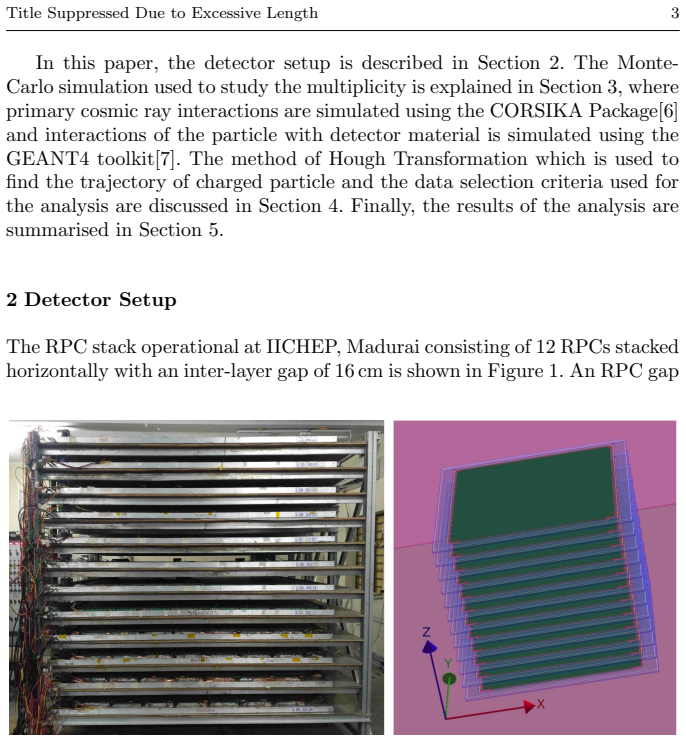
An experimental setup consisting of 12 layers of glass Resistive Plate Chambers (RPCs) of size 2\,m\,$\times$\,2\,m has been built at IICHEP-Madurai (\ang{9;56;14.5}\,N \ang{78;00;47.9}\,E, on the surface) to study the long term performance and stability of RPCs produced on large scale in Indian industry. This setup has been collecting data triggered by the passage of charged particles. The measurement of the multiplicity of charged particles due to cosmic ray interactions are presented here. Finally, the results are compared with different hadronic models of the CORSIKA simulation.
Figures
Figures from the paper (10 more)


Reference graph
Works this paper leans on
-
[1]
Phys., Volume 88(5), 79 (Apr 2017)
ICAL Collaboration, Invited review: Physics potential of the ICAL Detector at the India- based Neutrino Observatory (INO) , Pramana J. Phys., Volume 88(5), 79 (Apr 2017)
work page 2017
-
[2]
Pestov, Yu. N. and Fedotovich, G. V., A PICOSECOND TIME-OF-FLIGHT SPEC- TROMETER FOR THE VEPP-2M BASED ON LOCAL - DISCHARGE SPARK COUNTER, SLAC-TRANS-0184, IYF-77-78 (1978)
work page 1978
-
[3]
R. Santonico and R. Cardarelli, Development of resistive plate counters , Nuclear Instru- ments and Methods in Physics Research, Volume 187 (1981) 377-380
work page 1981
-
[4]
S. Pethuraj et. al., Measurement of cosmic muon angular distribution and vertical in- tegrated flux by 2 m ×2 m RPC stack at IICHEP-Madurai , Journal of Cosmology and Astroparticle Physics, Vol 09 (2017) 021-021
work page 2017
-
[5]
M. Tanabashi et al. (Particle Data Group), The Review of Particle Physics , Phys. Rev. D, 98 030001 (2018)
work page 2018
-
[6]
D. Heck, J. Knapp, J. N. Capdevielle, G. Schatz and T. Thouw, 1998 CORSIKA: A Monte Carlo Code to Simulate Extensive Air Showers , Forschungszentrum Karlsruhe Report FZKA 6019
work page 1998
-
[7]
Agostinelli et al., GEANT4: A Simulation toolkit , Nucl
GEANT4 collaboration, S. Agostinelli et al., GEANT4: A Simulation toolkit , Nucl. In- strum. Meth. A 506 (2003) 250 [ IN SPIRE ]
work page 2003
-
[8]
F. Anghinolfi et al., NINO: an ultra-fast and low-poer front-end amplifier/discriminator ASIC designed for the multigap resistive plate chamber , Nucl. Instrum. Methods A 533 (2004) 183-187
work page 2004
Show all 22 references
-
[9]
V. B. Chandratre, Menka Sukhwani, K Hari Prasad, Sourav Mukhopadhyay, Megha Thomas, Ravindra Shinde and Satyanarayana B., ANUSPARSH-II frontend ASIC for avalanche mode of RPC detector using regulated cascode trans-impedance am- plifier, Proceedings of the DAE-BRNS Symp. on Nucl...
2015
-
[10]
et al., Electronics, Trigger and Data Acquisition Systems for the INO ICAL Experiment
Achrekar S. et al., Electronics, Trigger and Data Acquisition Systems for the INO ICAL Experiment. In: Liu ZA. (eds) Proceedings of International Conference on Technology and Instrumentation in Particle Physics 2017. TIPP 2017. Springer Proceedings in Physics, vol 212. Springe...
2018
-
[11]
Duda, Peter E
Richard O. Duda, Peter E. Hart, Use of the Hough transformation to detect lines and curves in pictures , Communications of the ACM, Vol 15(1) (1972) 11-15
1972
-
[12]
Niu Li-Bo, Li Yu-Lan, Huang Meng, He Bin and Li Yuan-Jing, Track reconstruction based on Hough-transform for nTPC , Chinese Physics C, Vol 38(12) 126201
-
[13]
Zhaoyi Qu, Sadakazu Haino, Paolo Zuccon and Minggang Zhao, New track finding based on cellar automaton for AMS-02 detector , Nuclear Instruments and Methods in Physics Research Section A, Vol 869 (11 Oct 2017) 135-140
2017
-
[14]
al., Leak test of Resistive Plate Chamber gap by moni- toring absolute pressure , Journal of Instrumentation, Vol 14(04) P04009 (April 2019) 10.1088/1748-0221/14/04/P04009
Suryanarayan Mondal, et. al., Leak test of Resistive Plate Chamber gap by moni- toring absolute pressure , Journal of Instrumentation, Vol 14(04) P04009 (April 2019) 10.1088/1748-0221/14/04/P04009
2019 doi
-
[15]
M. M. Shapiro, R. Silberberg, C. H. Tsao, Relative Abundances of Cosmic Rays at their Source (Proceedings of 11th International Conference on Cosmic Rays, Budapest 1969) , Acta Physica Academiae Scientiarum Hungaricae , 29 Suppl. 1 (1970) 479-484
1970
-
[16]
Adarkar et
H. Adarkar et. al., A multi TeV muon bundle observed in the KGF underground detector, Physics Letters B, Vol 267(1) (September 1991) 138-142 [10.1016/0370- 2693(91)90539-3]
1991 doi
-
[17]
The ALICE Collaboration, Study of cosmic ray events with high muon multiplicity using the ALICE detector at the CERN Large Hadron Collider , Journal of Cosmology and Astroparticle Physics, Vol 2016 (January 2016) 032 [10.1088/1475-7516/2016/01/032]
2016 doi
-
[18]
The MACRO Collaboration, Multiple Muon Measurements with MACRO , Proceed- ings, Very High Energy Cosmic Ray Interactions, C94-07-24 (1994) 711-722 [hep- ex/9410001]
1994
-
[19]
The DELPHI Collaboration, Study of multi-muon bundles in cosmic ray showers de- tected with the DELPHI detector at LEP , Astroparticle Physics, Volume 28(3) (Novem- ber 2007) 273-286 [10.1016/j.astropartphys.2007.06.001]
2007 doi
-
[20]
Avati et
V. Avati et. al., Cosmic multi-muon events observed in the underground CERN-LEP tunnel with the ALEPH experiment , Astroparticle Physics, Volume 19(3) (November
-
[21]
W. D. Apel et. al., Probing the evolution of the EAS muon content in the at- mosphere with KASCADE-Grande , Astroparticle Physics, Volume 95 (2017) 25–43 [10.1016/j.astropartphys.2017.07.001]
2017 doi
-
[2002]
513–523 [10.1016/S0927-6505(02)00247-5]
Reviewed August 14, 2026 · model on record in the stance chip above.
Discussion (0). Continue with ORCID to comment.