REVIEW 3 major objections 5 minor 23 references
Fundamental Decompositions and Multistationarity of Power-Law Kinetic Systems
T0 review · 3 major / 5 minor · reviewed 2026-08-14 · deepseek-v4-flash
Pith's one-line read This paper claims that for power-law kinetic systems with an independent F-decomposition, the multistationarity algorithm can be applied directly, without first converting non-reactant-determined interactions into reactant-determined ones.
desk verdict Useful F-decomposition results, but the advertised MSA improvement outruns the proofs. read the letter →
The pith
A machine-rendered reading of the paper's core claim, the machinery that carries it, and where it could break.
The reading
What carries the argument
The F-decomposition is the partition of the reaction set into fundamental classes, where two characteristic vectors are in the same class if they are pairwise dependent in the factor space $\mathbb{R}^R/(\operatorname{Ker} L_O)^\perp$, with reversible pairs and the zero class handled separately. The argument runs through the equivalence in Theorem 3.13, which transfers independence and incidence-independence between the P-decomposition and the F-decomposition, and through the CF-RI+ transformation, a variant of CF-RM that adds catalytic complexes to split non-reactant-determined nodes while preserving reaction reversibility and reaction vectors. Independence of the decomposition is what lets the multistationarity computation bypass the usual kinetic-order conversion step.
What would settle it
Construct a small CRN with two fundamental classes that share at least one complex, compute the image of the full incidence map and compare it with the direct sum of the images of the subnetwork incidence maps; if they differ, the incidence-independence equivalence in Theorem 3.13(ii) fails for that network.
Extended reading notes
Core claim
The central claim is an equivalence: for any orientation of a chemical reaction network, the P-decomposition's independence is equivalent to the F-decomposition's independence, and likewise for incidence-independence and bi-independence (Theorem 3.13). Consequently, the fundamental decomposition carries the same structural information regardless of the chosen orientation. On this basis, the paper shows that a power-law kinetic system with non-reactant-determined interactions and an independent F-decomposition can be fed directly to the multistationarity algorithm: the CF-RI+ transformation preserves both orientation size and F-decomposition independence (Theorem 6.1), so the conversion to a reactant-determined system required in the original MSA is unnecessary.
Load-bearing premise
The proof of Theorem 3.13(ii) assumes that grouping reactions into fundamental classes makes the incidence matrix block-diagonal over the subnetworks, which requires the fundamental classes to partition the complex set; but fundamental classes need not divide the complexes disjointly.
Editorial extensions
If this is right
- If the F-decomposition is independent, the multistationarity algorithm can be applied directly to PL-NDK systems, eliminating the CF-RM conversion step required in the original MSA.
- The class of systems checkable by the MSA includes PL-NDK systems with independent F-decompositions, such as the carbon-cycle subnetwork used as the running example.
- Phosphorylation/dephosphorylation networks, including processive, distributive, dual-site ERK, and mixed-mechanism variants, have bi-independent F-decompositions and therefore fall into this favorable class.
- An independent F-decomposition implies the deficiency bound $\delta \le w_{II}$, and a CRN with an independent F-decomposition without Type II subnetworks has zero deficiency, so known equilibrium results apply.
Reading between the lines
- A natural testable extension is to search for a CRN with an independent F-decomposition whose fundamental classes share complexes, and check computationally whether the incidence-independence equivalence of Theorem 3.13 still holds for that network.
- Since the decomposition arguments are largely independent of the particular kinetics, the same shortcut may extend beyond power-law kinetics to generalized mass-action or other complex-factorizable kinetic systems.
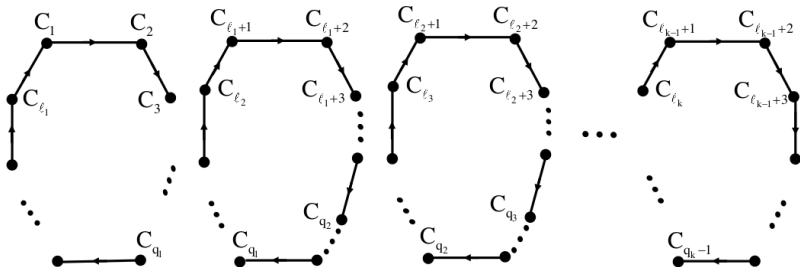
- The carbon-cycle example points to a broader family of networks formed by chains of long monomolecular directed cycles with shared boundary complexes, as generalized in Theorem 4.14; one could test whether the MSA shortcut persists when the chain is broken at several places.
- If the block-diagonal assumption behind Theorem 3.13(ii) fails, the practical impact may be limited to C-decomposition-like cases, so identifying the exact boundary of validity would sharpen the algorithm's applicability.
Signed reviews
Editorial analysis
A structured set of objections, weighed in public.
Referee Report
Summary. The paper studies the fundamental (F-)decomposition of chemical reaction networks, which partitions reactions into fundamental classes introduced by Ji and Feinberg for the higher deficiency algorithm. The first part characterizes independence and incidence-independence of F-decompositions and relates these to P- and O-decompositions, with applications to S-system and phosphorylation/dephosphorylation networks. The second part introduces a transformation CF-RI+ that preserves reaction reversibility and claims that, for power-law kinetic systems with non-reactant-determined interactions (PL-NDK) whose F-decomposition is independent, the original Multistationarity Algorithm (MSA) can be applied without first transforming to a reactant-determined (PL-RDK) system. The running example is a subnetwork of Schmitz's carbon cycle model. The paper concludes that the CF-RM transformation is unnecessary under the independence assumption.
Significance. If the central claims hold, the paper would provide useful structural tools for F-decompositions and a practical simplification of the MSA for a class of PL-NDK systems. The identification of network classes with bi-independent F-decompositions (S-systems, phosphorylation/dephosphorylation networks) and the running carbon-cycle example are valuable and clearly presented. However, the advertised MSA improvement is not proven by the stated theorems, and the proof of a key structural equivalence (Theorem 3.13(ii)) relies on a false block-diagonal assertion. The paper is therefore a useful contribution in need of substantial revision, but the central application claim requires new arguments or a reformulation.
major comments (3)
- [Section 3.2, Theorem 3.13(ii), proof] The proof asserts that 'By definition, the incidence matrix of the network is the direct sum of the incidence matrices of the fundamental classes' and displays a block-diagonal matrix with blocks F0,...,Fw. This would require the set of complexes to be partitioned by the fundamental classes, but F-decompositions partition only the reaction set. In the running example (Running Examples 3.12 and 3.14), the subnetworks N1 and N2 share the complex M1, so the incidence matrix cannot be block-diagonal after reordering rows and columns. Consequently, the equivalence between P-decomposition and F-decomposition incidence-independence is not established by the given proof. This is load-bearing for the structural results in Sections 3 and 4 (including the bi-independence claims), and a corrected proof or an added hypothesis is needed.
- [Section 6, Theorem 6.1 and the preceding paragraph] The abstract claims that for PL-NDK systems with an independent F-decomposition, 'the transformation to a dynamically equivalent system with reactant-determined interactions ... is not necessary.' Theorem 6.1, however, proves only that CF-RI+ preserves orientation size and that F-decomposition independence is equivalent between N and NRI. It does not state or prove that the MSA's multistationarity computation is unchanged, that the equivalence classes used by the higher deficiency algorithm are retained, or that the extended HDA can be applied directly to a PL-NDK system. The paragraph before Theorem 6.1 asserts this implication without a proof. As written, the advertised improvement is unsupported and needs either a precise theorem connecting preservation of F-decomposition independence to the MSA's output, or a weakening of the claim.
- [Section 6, proof of Theorem 6.1] The proof states that 'we can choose the same basis for Ker LO and Ker LORI such that the order of the rows of the reactions corresponding to the basis remains the same' and concludes that 'the equivalence classes are retained under the transformation.' This is asserted without a proof. CF-RI+ changes the complexes but leaves reaction vectors unchanged; a careful argument is needed to show that the equivalence classes of reactions (as subsets of the reaction index set) are indeed identical before and after transformation, especially when a fundamental class contains reactions with shared complexes. Without this lemma, the transfer of independence from N to NRI is incomplete.
minor comments (5)
- [Throughout] There are several typographical errors, including 'stochiometric' in Proposition 5.2(ii), 'the the network' in the proof of Theorem 3.13(ii), and 'disscussion' in Section 3.1. These should be corrected.
- [Section 3.1, Definition of fundamental classes] The definition of fundamental classes is written with repeated symbols such as 'y→y′ and y→y′', which makes the intended meaning unclear. Please rewrite using distinct reaction labels.
- [Section 3.2, Running Example 3.14] The text says 'the dimension of the stoichiometric subspaces of the fundamental classes under the F-decomposition is equal to the dimension of the stoichiometric subspaces of N'; it should say that the sum of the dimensions of the subnetwork stoichiometric subspaces equals the dimension of the stoichiometric subspace of N.
- [Section 4.3, Theorem 4.14 proof] The proof of Theorem 4.14 is very difficult to follow because of the notation using primes and double primes on complex labels and coefficients. A clearer notation (e.g., subscripted indices) and a more structured argument would substantially improve readability.
- [References] The paper relies heavily on unpublished or in-preparation references: [6] (Farinas et al., 'in preparation'), [12] (Gross et al., 'submitted'), and [13] (Hernandez et al., 'to appear'). Please update these references where possible and clarify the status of [6], since Theorem 2.22 and several examples depend on it.
Circularity Check
No circularity: the structural decompositions and the CF-RI+ invariance proof are derived in-paper; self-citations are not load-bearing.
full rationale
The paper's central claim is that a PL-NDK system with an independent F-decomposition can be processed by the MSA without first applying CF-RM. The supporting argument is Theorem 6.1, which shows that CF-RI+ preserves orientation size and F-decomposition independence because reaction vectors and reversibility/irreversibility are preserved. This is a structural inference from the transformation, not an assumption of the conclusion; no equation is fitted and no fitted parameter is renamed as a prediction. Theorem 3.13 connects P- and F-decomposition independence and is proved in the text, and Theorem 6.1 applies it to the transformed network. The paper relies on the authors' earlier MSA, CF-RM+, and on the unpublished reference [6] for background decomposition facts, but none of these citations supplies the specific claim that the transformation can be omitted; they supply the algorithm being modified and auxiliary lemmas. I therefore find no self-definitional, fitted-input, or citation-chain circularity. The abstract's stronger wording that the multistationarity computations are the same goes beyond what Theorem 6.1 states, and the proof of Theorem 3.13 contains a questionable block-diagonal incidence-matrix claim when subnetworks share complexes; these are correctness and rigor concerns, not circularity, so they do not raise the circularity score.
Assumptions & free parameters
assumptions (5)
- domain assumption The F-decomposition and P-decomposition are defined by equivalence classes of reactions in the factor space R^R/(Ker L_O)^perp, following Ji and Feinberg [14].
- standard math The incidence map and stoichiometric subspace are over the real numbers, with rank-nullity applied to L_O.
- domain assumption A decomposition is independent when the stoichiometric subspace is a direct sum, and incidence-independent when the image of the incidence map is a direct sum, per Feinberg [7] and Farinas et al. [6].
- domain assumption The kinetic order matrix F and rate constants k_i define power-law kinetics on the positive orthant, and CF-RM/CF-RI+ preserve reaction vectors and kinetic order matrices.
- domain assumption Proposition 3.30 and the S-system species-decomposition equivalence are taken from the unpublished reference [6].
Cite this review
Pith. "Pith review of Fundamental Decompositions and Multistationarity of Power-Law Kinetic Systems." pith.science (2026). https://pith.science/paper/HXWS7KYL
@misc{pith2026190804593,
  author       = {Pith},
  title        = {Pith review of: Fundamental Decompositions and Multistationarity of Power-Law Kinetic Systems},
  year         = {2026},
  howpublished = {\url{https://pith.science/paper/HXWS7KYL}},
  note         = {Machine review of arXiv:1908.04593}
}
abstract
The fundamental decomposition of a chemical reaction network (also called its "$\mathscr{F}$-decomposition") is the set of subnetworks generated by the partition of its set of reactions into the "fundamental classes" introduced by Ji and Feinberg in 2011 as the basis of their "higher deficiency algorithm" for mass action systems. The first part of this paper studies the properties of the $\mathscr{F}$-decomposition, in particular, its independence (i.e., the network's stoichiometric subspace is the direct sum of the subnetworks' stoichiometric subspaces) and its incidence-independence (i.e., the image of the network's incidence map is the direct sum of the incidence maps' images of the subnetworks). We derive necessary and sufficient conditions for these properties and identify network classes where the $\mathscr{F}$-decomposition coincides with other known decompositions. The second part of the paper applies the above-mentioned results to improve the Multistationarity Algorithm for power-law kinetic systems (MSA), a general computational approach that we introduced in previous work. We show that for systems with non-reactant determined interactions but with an independent $\mathscr{F}$-decomposition, the transformation to a dynamically equivalent system with reactant-determined interactions -- required in the original MSA -- is not necessary. We illustrate this improvement with the subnetwork of Schmitz's carbon cycle model recently analyzed by Fortun et al.
Figures

Reference graph
Works this paper leans on
-
[13]
B. Hernandez, E. Mendoza, A. de los Reyes V, A computational approach to mul- tistationarity of power-law kinetic systems, (to appear in J. Math. Chem. ) (2019). DOI: 10.1007/s10910-019-01072-7
-
[1]
C. P. Arceo, E. Jose, A. Mar´ ın-Sanguino, E. Mendoza, Chemical reaction network approaches to Biochemical Systems Theory, Math. Biosci. 269 (2015) 135–152
work page 2015
-
[2]
C. P. Arceo, E. Jose, A. Lao, E. Mendoza, Reaction networks and kinetics of bio- chemical systems, Math. Biosci. 283 (2017) 13–29
work page 2017
-
[3]
C. Conradi, A. Shiu, Dynamics of post-translational modification systems: recent results and future directions, Biophysical Journal 114(3) (2018) 507–515
work page 2018
-
[4]
R. Cressman, Y. Tao, The replicator equation and other game dynamics, Proc. Natl. Acad. Sci. USA 111 (2014)
work page 2014
-
[5]
Ellison, The advanced deficiency algorithm and its applications to mechanism discrimination, Ph.D
P. Ellison, The advanced deficiency algorithm and its applications to mechanism discrimination, Ph.D. thesis, Department of Chemical Engineering, University of Rochester, 1998
work page 1998
-
[6]
H. Farinas, E. Mendoza, A. Lao, Decompositions of chemical reaction networks and embedded networks of S-systems, in preparation
-
[7]
M. Feinberg, Chemical reaction network structure and the stability of complex isothermal reactors I: The deficiency zero and deficiency one theorems, Chem. Eng. Sci. 42 (1987) 2229–2268
work page 1987
Show all 23 references
-
[8]
Feinberg, Lectures on chemical reaction networks
M. Feinberg, Lectures on chemical reaction networks . Notes of lectures given at the Mathematics Research Center of the University of Wisconsin, 1979. Available at https://crnt.osu.edu/LecturesOnReactionNetworks
1979
-
[9]
Feinberg, Multiple steady states for chemical reaction networks of deficiency one, Arch
M. Feinberg, Multiple steady states for chemical reaction networks of deficiency one, Arch. Ration. Mech. Anal., 132 (1995) 371–406
1995
-
[10]
Feinberg, The existence and uniqueness of steady states for a class of chemical reaction networks, Arch
M. Feinberg, The existence and uniqueness of steady states for a class of chemical reaction networks, Arch. Ration. Mech. Anal. 132 (1995) 311–370
1995
-
[11]
Fortun, A
N. Fortun, A. Lao, L. Razon, E. Mendoza, A deficiency zero theorem for a class of power-law kinetic systems with non-reactant-determined interactions, MATCH Commun. Math. Comput. Chem. 81(3) (2019) 621–638
2019
-
[12]
Gross, H
E. Gross, H. Harrington, N. Meshkat, A. Shiu, Joining and decomposing reaction networks, (2018, submitted)
2018
-
[14]
Ji, Uniqueness of equilibria for complex chemical reaction networks, Ph.D
H. Ji, Uniqueness of equilibria for complex chemical reaction networks, Ph.D. Dis- sertation, Ohio State University, 2011
2011
-
[15]
Joshi, A
B. Joshi, A. Shiu, Atoms of multistationarity in chemical reaction network, J. Math. Chem. 51(1) (2013) 153–178
2013
-
[16]
M¨ uller, G
S. M¨ uller, G. Regensburger, Generalized mass action systems and positive solutions of polynomial equations with real and symbolic exponents (invited talk), in: W. M. Seiler, E. V. Vorozhtsov (Eds.), Computer Algebra in Scientific Computing, CASC 2014 , Springer, Cham, 2014, p...
2014
-
[17]
Nazareno, R
A. Nazareno, R. Eclarin, E. Mendoza, A. Lao, Linear conjugacy of chemical kinetic systems, Math. Biosci. Eng. 16(6) (2019) 8322–8355
2019
-
[18]
Schmitz, The Earth’s carbon cycle: Chemical engineering course material, Chem- ical Engineering Education 36(4) (2002) 296–309
R. Schmitz, The Earth’s carbon cycle: Chemical engineering course material, Chem- ical Engineering Education 36(4) (2002) 296–309
2002
-
[19]
Shinar, M
G. Shinar, M. Feinberg, Structural sources of robustness in biochemical reaction networks, Science 327 (2010) 1389–1391
2010
-
[20]
D. A. Talabis, C. P. Arceo, E. Mendoza, Positive equilibria of a class of power-law kinetics, J. Math. Chem. 56(2) (2018) 358–394
2018
-
[21]
Talabis, D
D. Talabis, D. Magpantay, E. Mendoza, E. Nocon, E. Jose, Complex balanced equi- libria of weakly reversible poly-PL kinetic systems and evolutionary games, MATCH Commun. Math. Comput. Chem. 2019 accepted
2019
-
[22]
Veloz, P
T. Veloz, P. Razeto-Barry, P. Dittrich, A. Fajardo, Reaction networks and evolution- ary game theory, J.Math. Biol. 68 (2014) 181–206
2014
-
[23]
Voit, Computational analysis of biochemical systems: A practical guide for bio- chemists and molecular biologists, Cambridge Univ
E. Voit, Computational analysis of biochemical systems: A practical guide for bio- chemists and molecular biologists, Cambridge Univ. Press , Cambridge, 2000. A Nomenclature A.1 List of abbreviations Abbreviation Meaning CF complex factorizable CKS chemical kinetic system CRN ...
2000
Reviewed August 14, 2026 · model on record in the stance chip above.
Discussion (0). Continue with ORCID to comment.