REVIEW 4 major objections 6 minor 32 references
Inverse Parametric Uncertain Identification using Polynomial Chaos and high-order Moment Matching benchmarked on a Wet Friction Clutch
T0 review · 4 major / 6 minor · reviewed 2026-08-14 · deepseek-v4-flash
Pith's one-line read A generalized polynomial chaos moment-matching method identifies parametric uncertainty in a wet clutch model with one order of magnitude fewer simulations than Monte Carlo.
desk verdict The core gPC high-order moment algorithm is clean and useful, but the wet clutch demonstration is too thin to support the headline gains until the surrogate accuracy is checked across the searched parameter space. read the letter →
The pith
A machine-rendered reading of the paper's core claim, the machinery that carries it, and where it could break.
The reading
What carries the argument
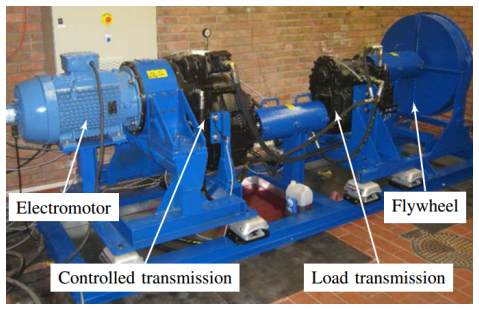
The carrying object is the generalized polynomial chaos expansion $y^{(d)}(\theta)=\sum_{i\in\mathcal{I}} c_i \psi_i(\theta)$, with basis $\psi_i$ orthogonal with respect to the input density and with coefficients computed by Gaussian quadrature. The paper's novel piece is a multinomial-theorem formula (equations 9-10) that rewrites the $m$-th output moment as a sum over multi-indices whose high-order inner products factor into products of univariate inner products, so moments up to order 4 or 5 are available from the same coefficients without multivariate quadrature. These moments are then fed to a maximum-entropy density $f_Y(y|\lambda)=\exp\left(-\sum_{m=0}^M \lambda_m y^m\right)$ whose parameters solve a dual unconstrained optimization; four moments let the fitted density represent asymmetric or bimodal output shapes that a Gaussian cannot.
What would settle it
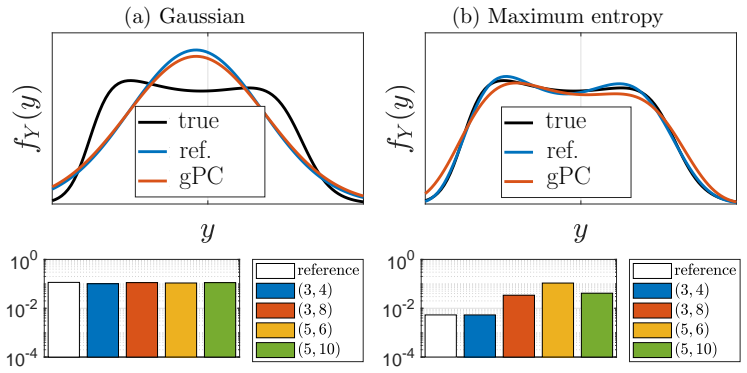
For a set of experiments with visibly skewed output distributions, evaluate the first four gPC moments and the maximum-entropy PDF at several $\alpha$ values spread over the genetic algorithm's search range, and compare them with a 200,000-sample Monte Carlo reference; if the Earth mover's distance of the gPC-based maximum-entropy fit exceeds that of the Gaussian fit at those points, the claimed 47% improvement and the 4% log-likelihood gain would not generalize.
Extended reading notes
Core claim
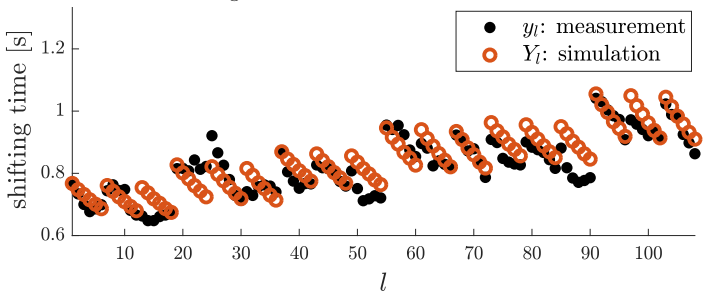
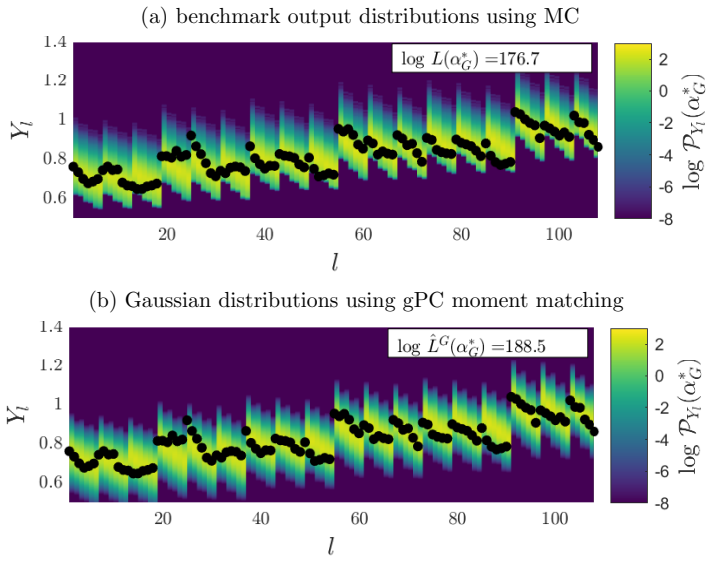
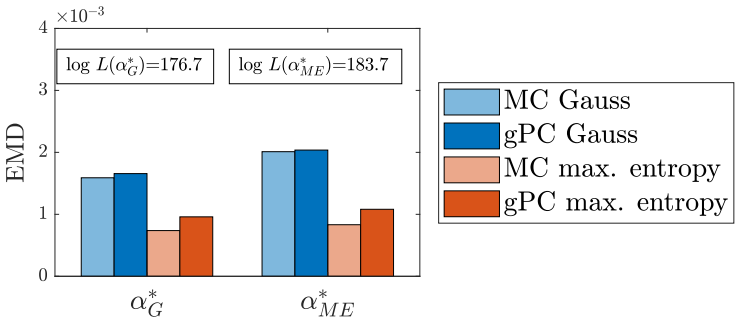
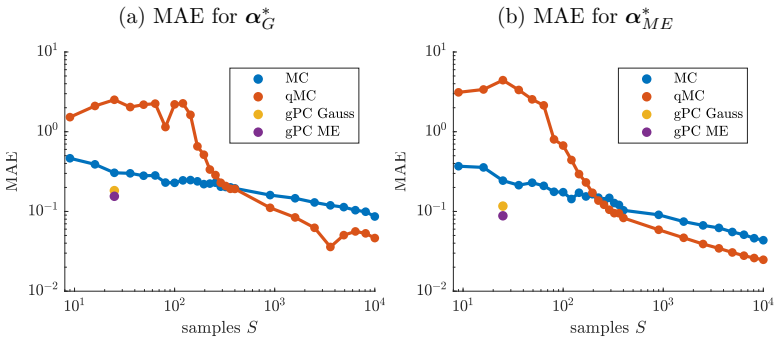
The central claim is that maximum likelihood identification of an input probability model can be made numerically tractable by expanding the stochastic model output in an orthogonal polynomial basis chosen for the input distribution, extracting high-order output moments directly from the gPC coefficients via a multinomial-theorem formula instead of by sampling, and reconstructing the conditional output density with a maximum-entropy distribution matched to those moments. For the wet clutch, a degree-4 Hermite-chaos expansion with 5-point Gaussian quadrature uses 25 model evaluations per experiment and reaches the same log-likelihood estimation accuracy as Monte Carlo with hundreds of thousands of samples. The identified input model with a four-moment maximum-entropy output distribution attains a true log-likelihood of 183.7 versus 176.7 for the Gaussian-output model, and reduces the average Earth mover's distance to the reference output distribution by 42-47%.
Load-bearing premise
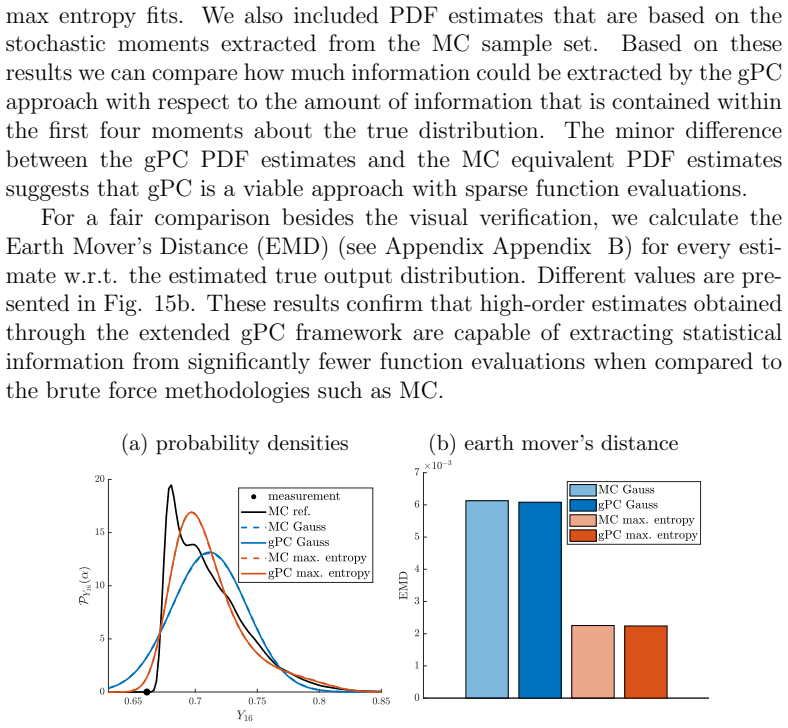
The polynomial-chaos surrogate (degree 4, 5-point quadrature, 25 simulations) is accurate enough to represent the output distribution for every one of the 108 experiments and every candidate parameter vector the optimizer tries, but the paper validates it only for experiment 16 at one parameter value, $\alpha=(1,1,0.07,0.02)$.
Editorial extensions
If this is right
- Inverse uncertainty identification for models with few stochastic parameters can be run with tens of forward simulations per experiment instead of thousands or hundreds of thousands.
- Maximum-likelihood scores computed from the moment-matched densities are close enough to Monte Carlo references that the optimizer can be driven by gPC moments, with the four-moment maximum-entropy fit reducing the score mismatch by about 55% relative to the Gaussian fit.
- The identified input uncertainty for the wet clutch has the same mean under both output models, but the maximum-entropy output model attributes larger variance to the two stochastic parameters, capturing experiments with asymmetric output distributions that Gaussian fits over-penalize.
- Because the high-order moment computation is a precomputable offline step, the per-experiment cost of evaluating the likelihood is dominated by the 25 model runs needed for the gPC coefficients.
Reading between the lines
- A natural transfer test is to apply the same pipeline to other nonlinear mechanical models with two or three stochastic parameters, using sparse-grid quadrature to see whether the efficiency gain survives scaling up the parameter dimension.
- The paper validates the surrogate at one parameter setting only, so a decisive extension would compare gPC moment estimates with a large Monte Carlo reference across the whole region of $\alpha$ explored by the genetic algorithm.
- The reported 4% log-likelihood gain and up-to-47% EMD reduction are dataset-specific; on outputs closer to Gaussian, the method should converge to the Gaussian fit and the advantage should shrink.
- Because the identified input distribution is a clipped normal over two physical parameters, a user could directly employ it for robust control or fault diagnosis of the clutch, for example to compute the probability that shifting time exceeds a given limit.
Signed reviews
Editorial analysis
A structured set of objections, weighed in public.
Referee Report
Summary. The paper presents an inverse method for identifying parametric uncertainty in nonlinear models. Using generalized Polynomial Chaos (gPC), it computes high-order moments of the model output with few forward evaluations; these moments are then matched to either Gaussian or maximum-entropy densities to evaluate the likelihood of experimental observations. The wet clutch application uses 108 experiments and two clipped Gaussian uncertain scaling factors, and a genetic algorithm maximizes the log-likelihood. The authors report that 25 gPC model evaluations per experiment achieve the same per-experiment log-likelihood accuracy as hundreds of Monte Carlo samples, that the identified max-entropy model increases the true log-likelihood by about 4% over the Gaussian model, and that the Earth Mover's Distance of the estimated output PDF is reduced by up to 47%.
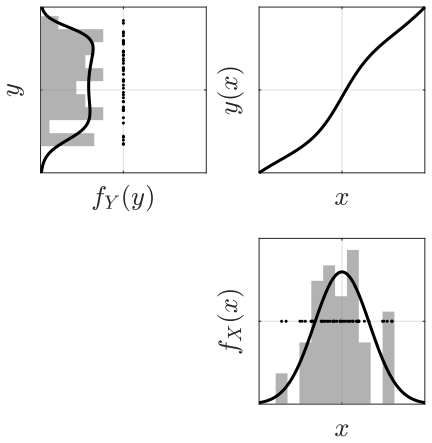
Significance. The high-order moment formulas in Sections 2.3-2.5 are a genuine contribution: the multinomial expansion with a sparse set of nonzero inner products makes moments beyond the second order computationally tractable, and the toy example in Section 2.6 supports the claimed accuracy of the moment calculations. If the wet-clutch results were properly validated, the paper would provide a convincing demonstration that gPC-based MLE can reduce forward simulation costs in inverse uncertainty quantification. However, the current validation is too narrow for the quantitative claims: the surrogate is checked at one operating point and the Monte Carlo reference lacks error bars. The methodology is defensible, but the evidence for the 4% log-likelihood and 47% EMD improvements needs strengthening before publication.
major comments (4)
- [4.1 and 4.2] Section 4.1, Fig. 15: gPC surrogate accuracy is demonstrated for one experiment (l=16) at one alpha=(1,1,0.07,0.02), while the genetic algorithm in Section 4.2 searches over the alpha space. At the identified alpha, Section 4.2 reports that gPC overestimates the MC log-likelihood by 11.8 nats for the Gaussian fit and 5.3 nats for the max-entropy fit, and Fig. 18 shows per-experiment errors only at the final alpha. If the positive bias varies with alpha, the GA can converge to a biased optimum and the claimed 4% log-likelihood and 47% EMD gains may not survive an unbiased evaluation. Please characterize the gPC bias as a function of alpha (e.g., by comparing gPC to MC at multiple alpha values along the GA trajectory or on a grid) and validate the surrogate for all 108 experiments at those alpha values.
- [4 (intro) and Table 2] The Monte Carlo reference is a spline fit to histograms of 200,000 samples, but no error bars or convergence study are provided. The key comparison is a difference of 183.7-176.7 = 7.0 nats (about 4%) in true log-likelihood between alpha*_ME and alpha*_G; without uncertainty quantification on the reference, it is unclear whether this difference is statistically significant. Please provide repeated independent MC estimates, bootstrap intervals, or a sample-size convergence plot for the reference log-likelihoods and for the EMD values in Fig. 19.
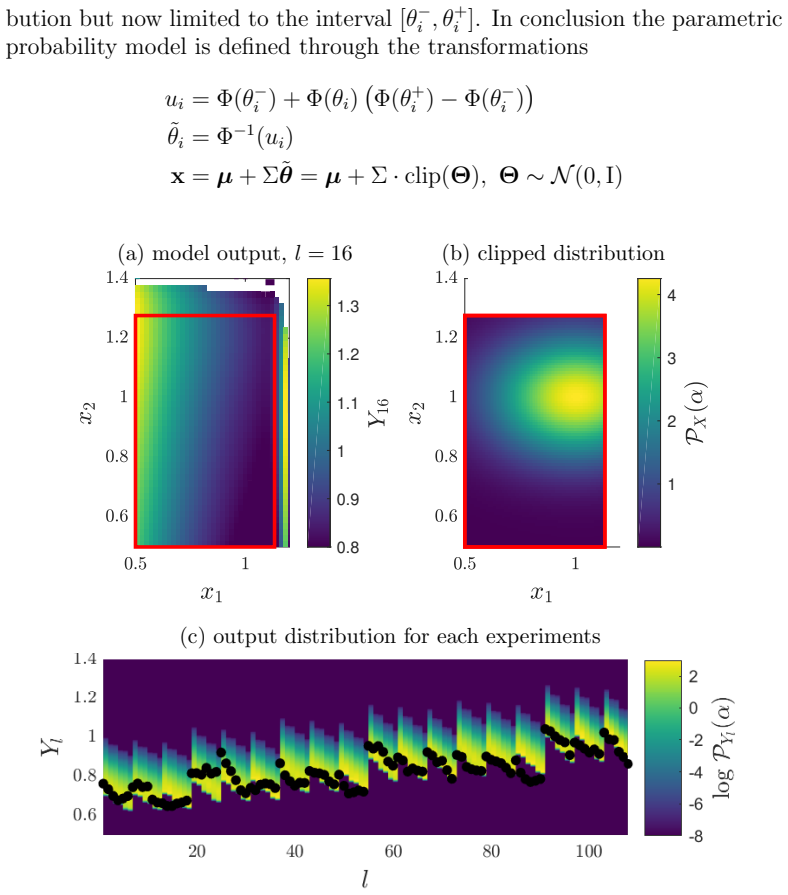
- [3.5] The clipping bounds x- and x+ in Section 3.5 are chosen to maximize the feasible region across all 108 experiments, i.e., they are fit on the same data used for likelihood evaluation. This data-dependent choice breaks the likelihood interpretation of the MLE and can bias the identified alpha. The bounds should be estimated jointly as part of the parametric model, fixed by a separate calibration procedure, or the sensitivity of the identified alpha and of the log-likelihood gains to the bounds should be reported.
- [4.3 and Table 2] The one-order-of-magnitude reduction is demonstrated only for forward propagation at a fixed alpha: 25 gPC evaluations per experiment versus hundreds to thousands of MC samples. The abstract states the reduction for the inverse identification method, but the total cost includes every alpha visited by the genetic algorithm. Please either benchmark the end-to-end gPC-based MLE against an MC-based MLE at equal accuracy, or limit the claim to the forward propagation step and adjust the abstract and conclusion accordingly.
minor comments (6)
- [2.4] In the dual optimization problem for the max-entropy distribution, the last sum is written as sum_{k=1}^M lambda_m mu^{(d)}_m; the indices should be consistent, e.g., sum_{m=1}^M lambda_m mu^{(d)}_m.
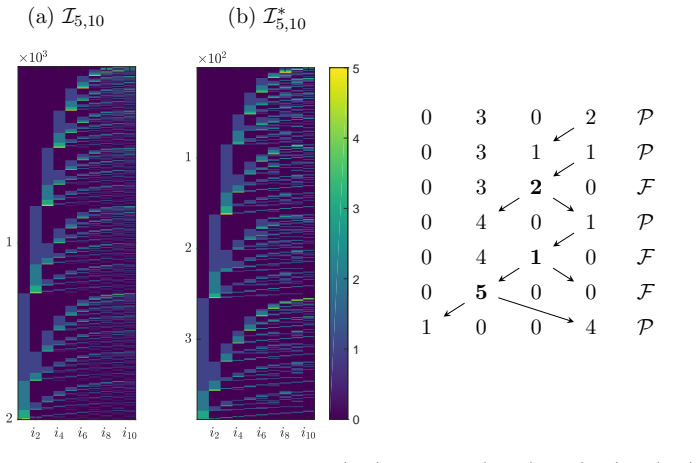
- [2.3.1 and Eq. (9)] The set I_{m,p} is defined as {i in I^{m,p} : |i| = m} without defining I^{m,p}; please define the multi-index set explicitly.
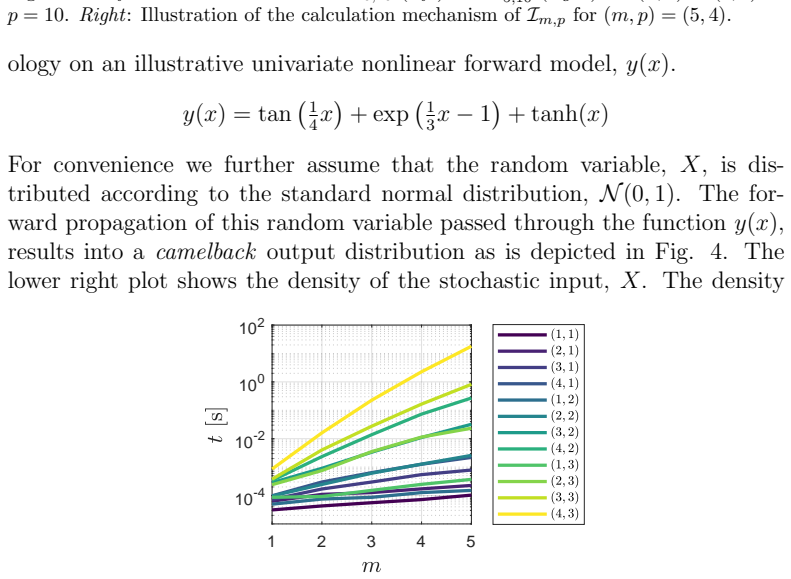
- [2.5, Fig. 3] For the offline timing plot, report the hardware, dimension n, degree d, maximum moment m, and quadrature order q, since these determine the reported 18 s.
- [Fig. 14c caption] The sentence 'The log-likelihood of the test scenarios for given input distributions is also given' is not explained in the text; either elaborate or remove it.
- [Throughout] The term 'true log-likelihood' for the spline-MC estimate is misleading; consider calling it the 'MC reference log-likelihood' throughout the paper.
- [Reproducibility] No code or data are released. For a method whose value rests on the offline multi-index tables and the max-entropy fitting, a reproducibility statement (even for the synthetic example) would help.
Circularity Check
The claimed gains are benchmarked against an independent Monte Carlo reference; no step reduces to its own input.
full rationale
The central comparison is not circular: the paper optimizes alpha using a gPC-based likelihood, then evaluates the identified alpha with an independent Monte Carlo reference of 200,000 simulation samples (Section 4.2). The reported one-order-of-magnitude reduction in required simulations (Table 2) is an interpolation against this MC benchmark, not a quantity forced by the gPC fit. The 4% log-likelihood gain and 47% EMD improvement compare Gaussian versus maximum-entropy output abstractions under the same MC-referenced evaluation, so they are not definitionally equal to the fitted moments. The only self-citation [29] provides the clutch model and is not load-bearing for the methodological claim. The paper's acknowledged limitation, that the gPC surrogate is demonstrated at one experiment and one alpha, is a robustness concern rather than circularity. No fitted parameter or cited result is renamed as a prediction, so the derivation chain is self-contained with respect to circularity.
Assumptions & free parameters
free parameters (9)
- mu1 =
0.91 (both alpha_G and alpha_ME)
- mu2 =
0.55 (both alpha_G and alpha_ME)
- sigma1 =
0.077 (Gaussian output); 0.081 (max entropy output)
- sigma2 =
0.014 (Gaussian output); 0.046 (max entropy output)
- clipping bounds x-, x+ =
not reported numerically
- polynomial degree d =
4
- quadrature order q =
5
- max moment order m =
4
- GA population size =
50
assumptions (8)
- standard math Polynomial approximation theorem and Wiener-Askey orthogonality (Section 2.3.1, Eq. 3)
- standard math Multinomial theorem and tensorization of high-order inner products (Section 2.5, Eq. 9, Appendix C)
- standard math Maximum entropy dual problem is well-posed and solvable (Appendix A)
- domain assumption Wet clutch model equations in Section 3.2 are valid enough representations of the physical system
- domain assumption All discrepancy between measured and simulated shifting times is attributed to X1 and X2, with no measurement noise
- domain assumption X1 and X2 are independent and normally distributed before clipping (Section 3.5)
- ad hoc to paper Clipping bounds selected from the full dataset do not bias the MLE
- ad hoc to paper Degree-4 gPC with quadrature q=5 is accurate for all experiments and alpha values used in optimization
invented entities (1)
-
Latent scaling factors X1 and X2 for model parameters c2 and zp
Cite this review
Pith. "Pith review of Inverse Parametric Uncertain Identification using Polynomial Chaos and high-order Moment Matching benchmarked on a Wet Friction Clutch." pith.science (2026). https://pith.science/paper/4MNKNJ4B
@misc{pith2026190804597,
  author       = {Pith},
  title        = {Pith review of: Inverse Parametric Uncertain Identification using Polynomial Chaos and high-order Moment Matching benchmarked on a Wet Friction Clutch},
  year         = {2026},
  howpublished = {\url{https://pith.science/paper/4MNKNJ4B}},
  note         = {Machine review of arXiv:1908.04597}
}
read the original abstract
A numerically efficient inverse method for parametric model uncertainty identification using maximum likelihood estimation is presented. The goal is to identify a probability model for a fixed number of model parameters based on a set of experiments. To perform maximum likelihood estimation, the output probability density function is required. Forward propagation of input uncertainty is established combining Polynomial Chaos and moment matching. High-order moments of the output distribution are estimated using the generalized Polynomial Chaos framework. Next, a maximum entropy parametric distribution is matched with the estimated moments. This method is numerically very attractive due to reduced forward sampling and deterministic nature of the propagation strategy. The methodology is applied on a wet clutch system for which certain model variables are considered as stochastic. The number of required model simulations to achieve the same accuracy as the brute force methodologies is decreased by one order of magnitude. The probability model identified with the high order estimates resulted into a true log-likelihood increase of about 4% since the accuracy of the estimated output probability density function could be improved up to 47%.
Figures

Figures from the paper (17 more)




Reference graph
Works this paper leans on
- [1]
-
[2]
W. Widanage, J. Stoev, A. Van Mulders, J. Schoukens, G. Pinte, Non- linear system-identification of the filling phase of a wet-clutch system, Control Engineering Practice 19 (2011) 1506–1516
work page 2011
-
[3]
S. Foulard, S. Rinderknecht, M. Ichchou, J. Perret-Liaudet, Automotive drivetrain model for transmission damage prediction, Mechatronics 30 (2015) 27–54
work page 2015
-
[4]
A. Della Gatta, L. Iannelli, M. Pisaturo, A. Senatore, F. Vasca, A survey on modeling and engagement control for automotive dry clutch, Mechatronics 55 (2018) 63–75
work page 2018
-
[5]
A. P. Ompusunggu, P. Sas, H. Van Brussel, Modeling and simulation of the engagement dynamics of a wet friction clutch system subjected to degradation: An application to condition monitoring and prognostics, Mechatronics 23 (2013) 700–712
work page 2013
-
[6]
B. Depraetere, G. Pinte, W. Symens, J. Swevers, A two-level iterative learning control scheme for the engagement of wet clutches, Mechatron- ics 21 (2011) 501–508
work page 2011
- [7]
- [8]
Show all 32 references
-
[9]
Touati, R
Y. Touati, R. Merzouki, B. O. Bouamama, Robust diagnosis to mea- surement uncertainties using bond graph approach: Application to in- telligent autonomous vehicle, Mechatronics 22 (2012) 1148–1160
2012
-
[10]
Marconi, R
L. Marconi, R. Naldi, Aggressive control of helicopters in presence of parametric and dynamical uncertainties, Mechatronics 18 (2008) 381– 389
2008
-
[11]
Abdeetedal, H
M. Abdeetedal, H. Rezaee, H. A. Talebi, F. Abdollahi, Optimal adaptive jacobian internal forces controller for multiple whole-limb manipulators in the presence of kinematic uncertainties, Mechatronics 53 (2018) 1–7
2018
-
[12]
Hajiloo, N
A. Hajiloo, N. Nariman-Zadeh, A. Moeini, Pareto optimal robust design of fractional-order pid controllers for systems with probabilistic uncer- tainties, Mechatronics 22 (2012) 788–801
2012
-
[13]
Stein, Large sample properties of simulations using latin hypercube sampling, Technometrics 29 (1987) 143–151
M. Stein, Large sample properties of simulations using latin hypercube sampling, Technometrics 29 (1987) 143–151
1987
-
[14]
Caflisch, Monte carlo and quasi-monte carlo methods, Acta numerica 7 (1998) 1–49
R. Caflisch, Monte carlo and quasi-monte carlo methods, Acta numerica 7 (1998) 1–49
1998
-
[15]
D. Xiu, G. Karniadakis, The wiener–askey polynomial chaos for stochas- tic differential equations, SIAM journal on scientific computing 24 (2002) 619–644
2002
-
[16]
D. Xiu, G. Karniadakis, Modeling uncertainty in flow simulations via generalized polynomial chaos, Journal of computational physics 187 (2003) 137–167
2003
-
[17]
D. Xiu, J. Hesthaven, High-order collocation methods for differential equations with random inputs, SIAM Journal on Scientific Computing 27 (2005) 1118–1139. 35
2005
-
[18]
Xiu, Efficient collocational approach for parametric uncertainty anal- ysis, Commun
D. Xiu, Efficient collocational approach for parametric uncertainty anal- ysis, Commun. Comput. Phys 2 (2007) 293–309
2007
-
[19]
Blatman, B
G. Blatman, B. Sudret, Adaptive sparse polynomial chaos expansion based on least angle regression, Journal of Computational Physics 230 (2011) 2345–2367
2011
-
[20]
Bowman, L
K. Bowman, L. Shenton, Estimation: Method of moments, Encyclope- dia of statistical sciences 3 (2004)
2004
-
[21]
Munkhammar, L
J. Munkhammar, L. Mattsson, J. Ryd´ en, Polynomial probability dis- tribution estimation using the method of moments, PloS one 12 (2017) e0174573
2017
-
[22]
P. J. Bickel, K. A. Doksum, Mathematical statistics: basic ideas and selected topics, volume I, volume 117, CRC Press, 2015
2015
-
[23]
K. Berx, E. Hostens, W. Driesen, G. Pinte, Identification and prop- agation of parametric uncertainty of a hydrostatic drive train model, International Conference on Noise and Vibration Engineering (2014)
2014
-
[24]
C. Chan, G. Liu, Hysteresis identification and compensation using a genetic algorithm with adaptive search space, Mechatronics 17 (2007) 391–402
2007
-
[25]
Ghanem, P
R. Ghanem, P. Spanos, Stochastic finite element method: Response statistics, in: Stochastic Finite Elements: A Spectral Approach, Springer, 1991, pp. 101–119
1991
-
[26]
S. Lee, W. Chen, A comparative study of uncertainty propagation meth- ods for black-box-type problems, Structural and Multidisciplinary Op- timization 37 (2009) 239
2009
-
[27]
Rajabi, B
M. Rajabi, B. Ataie-Ashtiani, C. Simmons, Polynomial chaos expan- sions for uncertainty propagation and moment independent sensitivity analysis of seawater intrusion simulations, Journal of Hydrology 520 (2015) 101–122
2015
-
[28]
Najm, Uncertainty quantification and polynomial chaos techniques in computational fluid dynamics, Annual review of fluid mechanics 41 (2009) 35–52
H. Najm, Uncertainty quantification and polynomial chaos techniques in computational fluid dynamics, Annual review of fluid mechanics 41 (2009) 35–52. 36
2009
-
[29]
G. Tod, W. De Groote, T. Lefebvre, N. De Geeter, B. Depraetere, G. Crevecoeur, S. Van Poppel, Parametric uncertainty quantification using polynomial chaos expansion applied to a wet clutch model, Pro- ceedings of the 7th International Conference of System Modeling and Optimizat...
2019
-
[30]
Iqbal, F
S. Iqbal, F. Al-Bender, A. P. Ompusunggu, B. Pluymers, W. Desmet, Modeling and analysis of wet friction clutch engagement dynamics, Me- chanical Systems and Signal Processing 60 (2015) 420–436
2015
-
[31]
L. Mead, N. Papanicolaou, Maximum entropy in the problem of mo- ments, Journal of Mathematical Physics 25 (1984) 2404–2417
1984
-
[32]
Rubner, C
Y. Rubner, C. Tomasi, L. Guibas, The earth mover’s distance as a metric for image retrieval, International journal of computer vision 40 (2000) 99–121. 37
2000
Reviewed August 14, 2026 · model on record in the stance chip above.
Discussion (0). Continue with ORCID to comment.