REVIEW 3 major objections 6 minor 14 references
Cosmic ray ensembles from ultra-high energy photons propagating in the galactic and intergalactic space
T0 review · 3 major / 6 minor · reviewed 2026-08-14 · deepseek-v4-flash
Pith's one-line read A single ultra-high-energy photon can arrive at Earth as a cascade of thousands of correlated photons spread over hundreds of kilometres, according to Monte Carlo simulations of propagation through solar and galactic magnetic fields.
desk verdict Solar-magnetosphere preshower footprints are a plausible simulation result worth a referee; the '10 Mpc' distant-cascade claim overreaches because the intergalactic transport is skipped. read the letter →
The pith
A machine-rendered reading of the paper's core claim, the machinery that carries it, and where it could break.
The reading
What carries the argument
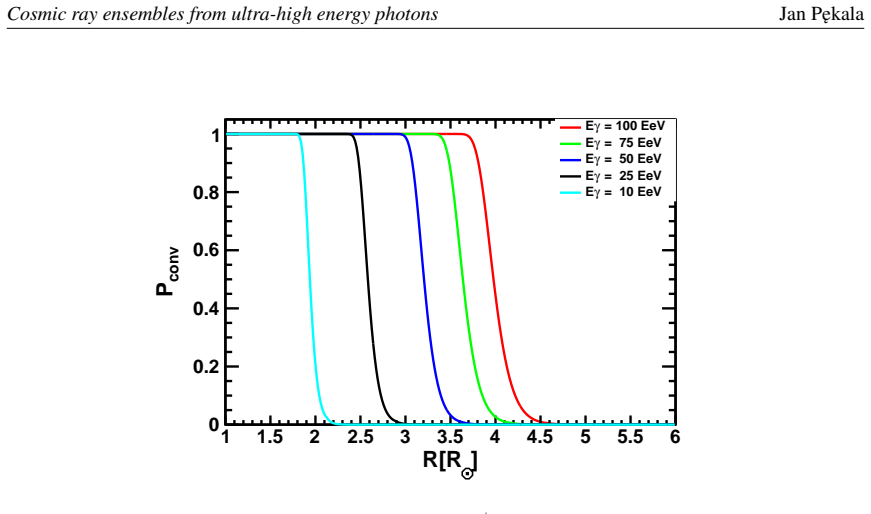
The engine of the cascade is the two-step process of magnetic pair production — a photon converting to an electron-positron pair in a magnetic field — followed by synchrotron radiation from those charged particles, which produces new photons that can convert again. The paper's quantitative claims come from two Monte Carlo tools: PRESHOWER 3.0, which adds three-dimensional tracking and timing to the earlier PRESHOWER code and is used for the solar-magnetosphere cascades, and CRPropa 3, used for propagation through galactic and extragalactic space. Two solar magnetic field models (a dipole and the dipole-quadrupole-current-sheet model) bracket the near-Sun results, while the Jansson-Farrar model of the galactic magnetic field drives the distant-cascade calculations. The physically central quantity is the probability of pair conversion as a function of field strength and photon energy, together with the synchrotron photon spectrum, which together determine how many correlated photons survive to Earth.
What would settle it
Recompute the distant-cascade photon count at an Earth-sized sphere using an alternative galactic magnetic field model or a full simulation that does not skip the first pair production: if the number of >1 TeV correlated photons changes by orders of magnitude, the few-photon ensemble prediction is not robust. Alternatively, search existing global detector data for time-correlated, line-like multi-photon events matching the Sun-vicinity geometry; finding none at the expected rate would rule out the proposed detection scenario.
Extended reading notes
Core claim
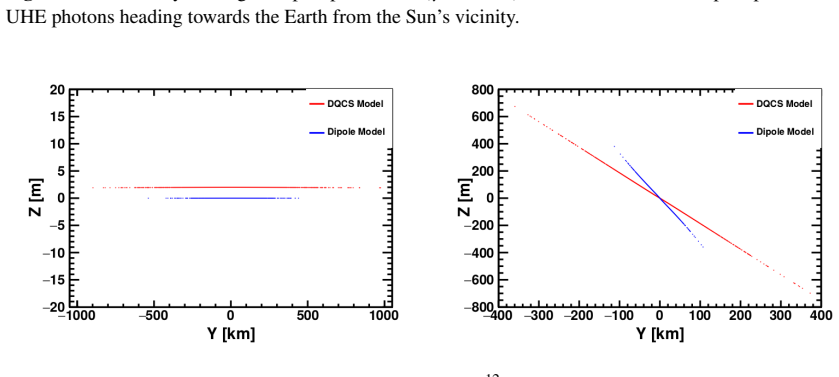
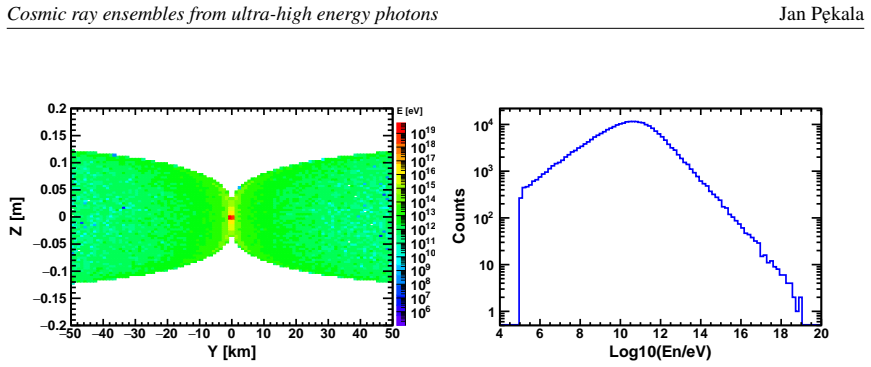
The central claim is that the observable signature of a UHE photon can be an extended, time-correlated ensemble of photons rather than a lone primary. Using PRESHOWER 3.0, the authors simulate 100 EeV photons passing near the Sun and find cascades of about $10^{4}$ synchrotron photons that arrive at the top of the Earth's atmosphere as a line-like footprint several hundred kilometres long, with the most energetic photons near the core and a spread from GeV to EeV. Using CRPropa 3 with the Jansson-Farrar galactic magnetic field model, they replace the first pair production by injecting EeV electrons at the galactic entry point and find that for a distant cascade up to about ten photons with energies above 1 TeV can reach an Earth-sized sphere, arriving as correlated particles. The upshot is that UHE photon searches should look for cosmic ray ensembles — correlated multi-particle events — in addition to isolated air showers.
Load-bearing premise
The predicted number and spread of cascade photons depend on the chosen solar and galactic magnetic field models, and on the simplification of skipping the first pair production in the distant case; if those choices are wrong, the expected ensemble changes materially.
Editorial extensions
If this is right
- UHE photon observatories should add a search for extended, time-correlated multi-photon events, since a preshowered photon would not look like a standard single air shower.
- A cascade from the solar magnetosphere would leave a line-like footprint hundreds of kilometres long at the top of the atmosphere, so geographically distributed small detectors can catch pieces of the same event.
- Distant cascades can deposit a few correlated photons across the whole planet, making a global network of detectors rather than a single large array the only way to see them.
- Because cascade photons span GeV to EeV energies, detectors with lower energy thresholds than current UHE observatories could contribute to UHE photon searches.
- Current photon flux upper limits, derived from air-shower searches, may not capture photons that preshower before reaching the atmosphere; the ensemble search is a complementary probe of top-down production models.
Reading between the lines
- If the distant-cascade prediction is right, then the effective detection rate depends strongly on collecting area and timing precision: a few photons across an Earth-sized sphere means the signal is sparse, and its uniqueness lies in the time correlation and common arrival direction rather than in a single bright shower.
- The same pair-production and synchrotron mechanism should operate around other magnetized structures, such as magnetars or galaxy clusters; searching for time-correlated photon ensembles from such directions would test whether the cascade picture generalises.
- The paper's shortcut of skipping the first pair production and injecting EeV electrons at the galaxy could be tested by running a full simulation; if the first conversion point moves the ensemble's photon count or arrival spread materially, the predicted few-photon signature would need to be revised.
- A future multi-messenger test: monitor regions behind the Sun for flaring UHE photon sources; a line-like, time-correlated footprint appearing with the expected geometry would confirm the solar cascade mechanism, while its absence would set limits on the UHE photon flux.
Signed reviews
Editorial analysis
A structured set of objections, weighed in public.
Referee Report
Summary. The manuscript reports Monte Carlo simulations of electromagnetic cascades initiated by ultra-high-energy (UHE) photons propagating in magnetic fields, with the goal of establishing a new observable signature: a correlated "cosmic ray ensemble" (CRE) arriving at Earth. For photon primaries passing near the Sun, the authors use PRESHOWER 3.0 with a dipole and a dipole-quadrupole-current-sheet model of the solar magnetic field and find that on the order of 10^4 synchrotron photons arrive at the top of the atmosphere in a line-like footprint of hundreds of kilometers. For distant cascades, they use CRPropa 3 with the Jansson-Farrar Galactic magnetic field, injecting EeV electrons at the Galactic edge, and report that about 16 photons above 1 TeV can land on an Earth-sized sphere, leading to the expectation of a few time-correlated photons from sources up to 10 Mpc away. The paper argues that CREDO, a global network of cosmic-ray detectors, could detect these signatures.
Significance. If the solar-magnetosphere result is correct, it is a concrete and falsifiable prediction: a single UHE photon skimming the Sun would arrive not as one air shower but as a spatially extended, time-correlated line-like ensemble, providing a new search channel complementary to existing UHE photon limits. The use of publicly available codes (PRESHOWER and CRPropa 3), explicit interaction probabilities, and specific magnetic field models lends reproducibility to the study. The distant-cascade claim, if fully supported, would extend the CRE idea to astrophysical sources; at present, however, that extension is not demonstrated by the simulations described.
major comments (3)
- [Section 3] The 10-Mpc cascade claim in the Abstract and Section 3 is not supported by the simulation as described. The text states that the first e+e− pair production is skipped and that EeV electrons are injected 'entering the galaxy' already directed toward the Solar System. The extragalactic stage—pair conversion of the UHE photon on cosmic background photons and the subsequent megaparsec-scale transport of the pair with energy losses and magnetic deflections—is exactly what determines whether, when, and at what energy an electron reaches the Galactic edge. Figure 5 therefore tests a fine-tuned initial condition, not cascades starting 10 Mpc away. Please either include the extragalactic propagation for at least a representative source distance and intergalactic magnetic field strength, or restrict the conclusion to Galactic propagation of an injected electron and state explicitly how the predicted multiplicity depends on the injection energy, direction, and position.
- [Section 3, Figs. 3-5] The quantitative claims are single-realization results without event statistics or validation. No number of simulated primaries, no convergence check, and no comparison with existing preshower calculations (e.g., geomagnetic preshower from Ref. [10]) are given. As a result, one cannot assess whether the quoted ~10^4 photons, hundreds-of-kilometer extent, or ~16 photons on the Earth sphere are typical values or statistical fluctuations. Please provide ensemble statistics (mean and spread over many simulated primaries) and, ideally, a validation run against a known case to establish the reliability of the simulation chain.
- [Abstract and Section 3] The phrase 'correlated in time' is never defined or quantified. The authors note that PRESHOWER 3.0 tracks time, but no arrival-time distributions, coincidence windows, or time spreads are shown for either scenario. Since the proposed CREDO detection strategy relies on temporal correlation, the paper should report the time spread of the CRE photons and define the 'together' criterion used in Figure 5.
minor comments (6)
- [Fig. 2] The horizontal axis label 'R[R0]' is undefined; please state explicitly that R0 is the solar radius (or define it in the caption).
- [Fig. 3] The red-shifted distribution in the left panel is mentioned in the caption but not explained in the text; clarify why a 2 km shift is shown.
- [Fig. 4] The caption states 'Energy distribution of CRE photons with energies larger than 10^5 eV for the same CRE' after describing only one panel, and the axis scales differ between the two panels; please label both panels and indicate which panel corresponds to which quantity.
- [Fig. 5] The right panel has unlabeled axes; specify what is plotted (e.g., number of photons above a given energy as a function of multiplicity) and the units of the abscissa.
- [Section 4 vs. Abstract] The Summary says 'a few tens of correlated particles' while the Abstract says 'a few photons' and the example in Fig. 5 gives 16 photons; please make the claimed number consistent.
- [Text] The phrase 'a straight-forward detection' should be 'a straightforward detection'.
Circularity Check
No significant circularity: the cascade predictions are Monte Carlo outputs of PRESHOWER 3.0 and CRPropa 3, with no parameter fitting or self-citation chain forcing the claimed results.
full rationale
The paper's central claims are produced by two independent Monte Carlo codes, and the text quotes the actual physics inputs (magnetic pair-production probability in Eqs. 2.1-2.2 and the synchrotron spectrum in Eq. 2.3). The solar-magnetosphere result - thousands of synchrotron photons spread over hundreds of kilometres - is a direct simulation output for a 100 EeV photon in the dipole or DQCS solar field, not a quantity fitted to the conclusion. The distant-cascade result is likewise obtained by propagating EeV electrons in the Jansson-Farrar Galactic magnetic field and counting photons on an Earth-sized sphere; no parameter is tuned to make 'a few photons' appear. The manuscript's citation of PRESHOWER 3.0 [8] (in preparation, same group) is a tool citation and is not load-bearing, since the governing equations are stated in the paper and the code is being used as a simulator rather than as an authority for the target claim. The noted limitation in Section 3 - 'we skip the first e+e- pair production and simulate EeV electrons entering the galaxy' - is a physical approximation about where the cascade begins, not a circular definition. It shifts the scope of the distant-cascade prediction from a full 10 Mpc transport problem to a Galactic-propagation problem, which is a correctness/validity concern, not a circularity. No step reduces one of the paper's equations to its own inputs or renames a fitted parameter as a prediction.
Assumptions & free parameters
free parameters (5)
- Primary photon energy E_gamma =
100 EeV in main examples (10, 25, 50, 75 EeV in probability scan)
- Impact parameter relative to Sun =
3 R_sun for the main CRE examples
- Heliocentric latitude of closest approach =
90 degrees, 45 degrees, and 0 degrees in examples
- Distance to cascade origin =
10 Mpc for the distant scenario; electrons injected at the galaxy boundary
- Energy thresholds for counting photons =
>1e12 eV in Fig. 3, >1 TeV in Fig. 5, >1e5 eV in Fig. 4
assumptions (6)
- domain assumption Magnetic pair production probability formula alpha(chi) (Eq. 2.2) is valid at ultra-high energies.
- domain assumption Synchrotron spectral distribution f(y) (Eq. 2.3) correctly describes photon emission from e+e- pairs at UHE.
- domain assumption PRESHOWER 3.0 and CRPropa 3 simulation codes correctly implement the relevant physics.
- domain assumption Solar magnetic field models (dipole and DQCS) provide a sufficient approximation for studying cascades from the Sun's vicinity.
- domain assumption Jansson and Farrar galactic magnetic field model is a sufficient description for intergalactic cascade propagation.
- ad hoc to paper Skipping the first e+e- pair production and injecting EeV electrons at the galaxy is an acceptable approximation for studying distant cascades.
Cite this review
Pith. "Pith review of Cosmic ray ensembles from ultra-high energy photons propagating in the galactic and intergalactic space." pith.science (2026). https://pith.science/paper/TZVJLG7R
@misc{pith2026190804600,
  author       = {Pith},
  title        = {Pith review of: Cosmic ray ensembles from ultra-high energy photons propagating in the galactic and intergalactic space},
  year         = {2026},
  howpublished = {\url{https://pith.science/paper/TZVJLG7R}},
  note         = {Machine review of arXiv:1908.04600}
}
read the original abstract
Propagation of ultra-high energy photons in the galactic and intergalactic space gives rise to cascades comprising thousands of photons. Using Monte Carlo simulations, we investigate the development of such cascades in the solar magnetosphere, and find that the photons in the cascades are distributed over hundreds of kilometers as they arrive at the top of the Earth's atmosphere. We also perform similar study for cascades starting as far as 10 Mpc away from us using relevant magnetic field models. A few photons correlated in time are expected to arrive at the Earth from the latter type of cascade. We present our simulation results and discuss the prospects for detection of these cascades with the Cosmic-Ray Extremely Distributed Observatory.
Figures

Figures from the paper (2 more)

Reference graph
Works this paper leans on
-
[10]
Homola et al., Simulation of ultrahigh energy photon propagation in the geomagnetic field, Comput
P. Homola et al., Simulation of ultrahigh energy photon propagation in the geomagnetic field, Comput. Phys. Commun. 173, 71 (2005)
work page 2005
-
[1]
R. U. Abbasi et al. [Telescope Array Collaboration], Mass composition of ultrahigh-energy cosmic rays with the Telescope Array Surface Detector data, Phys. Rev. D 99, no. 2, 022002 (2019)
work page 2019
- [2]
-
[3]
R. U. Abbasi et al. [HiRes Collaboration], Indications of Proton-Dominated Cosmic Ray Composition above 1.6 EeV, Phys. Rev. Lett. 104, 161101 (2010)
work page 2010
- [4]
-
[5]
Kachelriess, The rise and fall of top-down models as main UHECR sources, arXiv:0810.3017 [astro-ph]
M. Kachelriess, The rise and fall of top-down models as main UHECR sources, arXiv:0810.3017 [astro-ph]
-
[6]
T. Abu-Zayyad et al. [Telescope Array Collaboration],Upper limit on the flux of photons with energies above 1019 eV using the Telescope Array surface detector, Phys. Rev. D 88, no. 11, 112005 (2013)
work page 2013
- [7]
Show all 14 references
-
[8]
Dhital et al., Simulation of ultra-high energy photon propagation with PRESHOWER 3.0, (in preparation)
N. Dhital et al., Simulation of ultra-high energy photon propagation with PRESHOWER 3.0, (in preparation). 6 Cosmic ray ensembles from ultra-high energy photons Jan P˛ ekala
-
[9]
Alves Batista et al., CRPropa 3 - a Public Astrophysical Simulation Framework for Propagating Extraterrestrial Ultra-High Energy Particles, JCAP 1605, no
R. Alves Batista et al., CRPropa 3 - a Public Astrophysical Simulation Framework for Propagating Extraterrestrial Ultra-High Energy Particles, JCAP 1605, no. 05, 038 (2016)
2016
-
[11]
A. A. Sokolov, I. M. Ternov and C. W. Kilmister, Radiation From Relativistic Electrons, NEW YORK, USA: AIP (1986) 312 P. (AIP TRANSLATION SERIES)
1986
-
[12]
Banaszkiewicz, W
M. Banaszkiewicz, W. I. Axford and J. F. McKenzie, An analytic solar magnetic field model, A & A 337 (1998) 940
1998
-
[13]
Jansson and G
R. Jansson and G. R. Farrar, A New Model of the Galactic Magnetic Field, Astrophys. J. 757, 14 (2012) doi:10.1088/0004-637X/757/1/14 [arXiv:1204.3662 [astro-ph.GA]]
2012 arXiv
-
[14]
Góra for the CREDO Collaboration, Cosmic Ray Extremely Distributed Observatory: Status and perspectives of a global cosmic ray detection framework, these proceedings
D. Góra for the CREDO Collaboration, Cosmic Ray Extremely Distributed Observatory: Status and perspectives of a global cosmic ray detection framework, these proceedings. 7
Reviewed August 14, 2026 · model on record in the stance chip above.
Discussion (0). Continue with ORCID to comment.