REVIEW 2 major objections 6 minor 26 references
Resolved ALMA continuum image of the circumbinary ring and circumstellar disks in the L1551 IRS 5 system
T0 review · 2 major / 6 minor · reviewed 2026-08-14 · deepseek-v4-flash
Pith's one-line read ALMA resolves the circumbinary ring around L1551 IRS 5, peaking at 100 au and 38 au wide.
desk verdict First resolved look at the L1551 IRS 5 circumbinary ring, but the ring is a subtraction residual and needs a synthetic recovery test before the geometry is taken as firm. read the letter →
The pith
A machine-rendered reading of the paper's core claim, the machinery that carries it, and where it could break.
The reading
What carries the argument
The analysis rests on ALMA 1.3 mm continuum images made by concatenating 7 m and 12 m array visibilities, giving a 21 au by 15 au synthesized beam in the uniform-weighted image. The circumstellar disk emission is removed by fitting each disk with two 2D Gaussians, the second component representing unresolved jet-contaminated emission, and the ring is characterized from the deprojected, radially averaged residual profile fit with a 1D Gaussian to extract peak radius and width. A RADMC-3D radiative transfer model, using the surface-density parametrization of Andrews et al. (2009), is fit via an MCMC routine to test whether the observed brightness asymmetries can be explained purely as geometric projection.
What would settle it
Re-observe L1551 IRS 5 at 0.87 mm with ALMA at a resolution of about 10 au or better, resolve the jet components independently, and redo the subtraction with a PSF-matched model of each disk. If the residual ring's peak radius (100 au) or width (38 au) shifts beyond the quoted uncertainties, or the ring disappears, the circumbinary ring detection is an artifact of the Gaussian subtraction.
Extended reading notes
Core claim
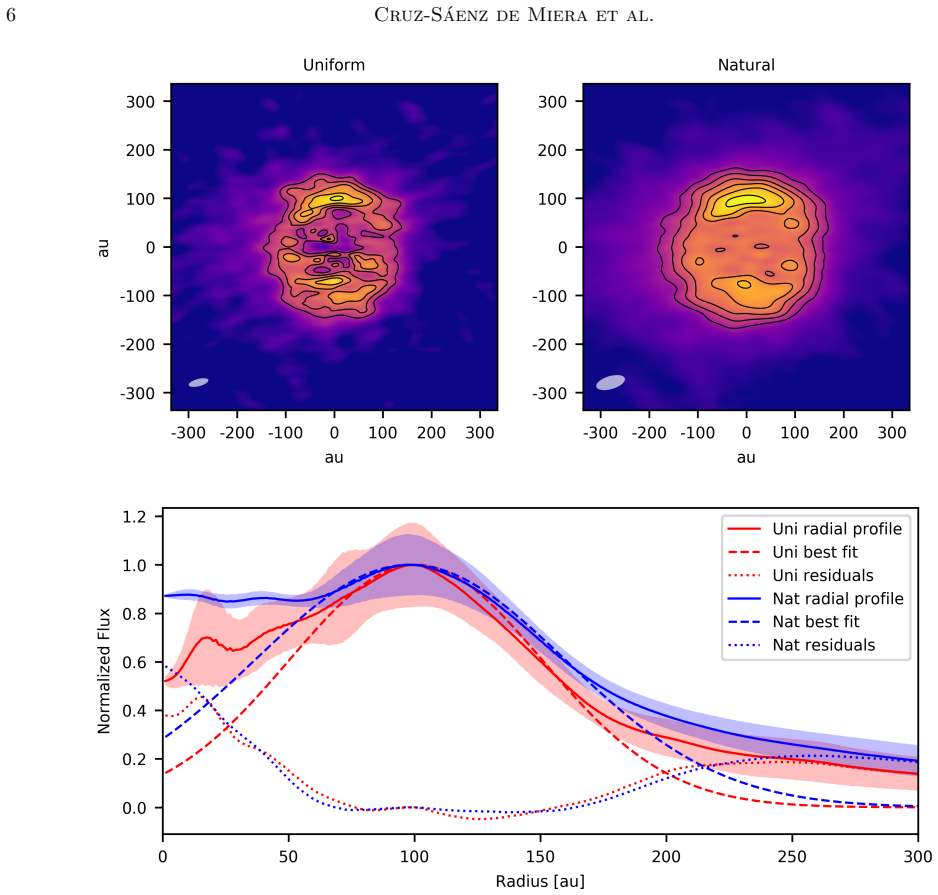
The central claim is that, after subtracting multi-Gaussian models of the two circumstellar disks from the ALMA 1.3 mm image, the residual emission is a resolved circumbinary ring rather than an artifact. The ring is measured to peak at 100 ± 1 au with a width of 38 ± 0.6 au, inclined at roughly 60 degrees with a position angle around 161 degrees. A RADMC-3D radiative transfer model reproduces the stronger northern and weaker southern brightness as the projection of an inclined, optically thin ring; the remaining positive and negative residuals are interpreted as non-axisymmetric dust density structure and envelope emission. The two circumstellar disks are marginally resolved at roughly 9–14 au radii, with the northern disk about twice as bright as the southern, supporting the view that the northern star is the active eruptive source.
Load-bearing premise
The ring is seen only after subtracting fitted Gaussian models of the circumstellar disks, and the paper concedes that the disk emission is mixed with unresolved jet emission; if the subtraction creates or erases the ring-like residual, the measured ring is not real.
Editorial extensions
If this is right
- If the ring detection is correct, L1551 IRS 5 becomes one of the few embedded multiple systems with directly measured circumbinary ring geometry, providing a clean target for disk-truncation and binary-accretion models.
- The measured ring radius (~100 au) and width (~38 au) can be used to estimate the binary's viscous timescale and to test whether the circumbinary disk is being tidally sculpted by the 50 au binary.
- The marginal resolution of both circumstellar disks, with the northern disk brighter and slightly larger, strengthens the interpretation that the northern star is the current FUor-like eruptive source.
- The optically thick spectral indices imply that the reported disk masses are lower limits, possibly underestimating the true masses by up to 90%, which would place the disks squarely in the FUor mass range.
- The mostly axisymmetric ring contrasts with the strongly asymmetric circumbinary material around the similar binary L1551 NE, suggesting that different binary configurations or accretion states produce measurably different circumbinary structures.
Reading between the lines
- If the ring is real, its narrow radial width (38 au at a 100 au peak) implies a sharply edged ring rather than a smoothly extended disk, possibly sculpted by tidal interaction with the binary or by a recent accretion event.
- The third bright component near the northern disk, previously undetected, could be a jet knot or an unresolved companion; if confirmed, it would complicate the binary's dynamical history and the interpretation of the disk subtraction.
- A testable extension: observe the system at 3 mm where the circumstellar disks are more optically thin; if the ring persists with the same radius and width, the Gaussian-subtraction interpretation is secure, while a changed shape would indicate residual contamination.
- The radiative transfer model treats the ring as optically thin at 1.3 mm; comparing the ring's flux ratio at 0.87 mm and 1.3 mm would directly test this assumption, since an optically thin ring should follow the dust opacity law.
Signed reviews
Editorial analysis
A structured set of objections, weighed in public.
Referee Report
Summary. This paper presents ALMA Band 6 (1.3 mm) continuum observations of the young binary L1551 IRS 5, combining 7 m and 12 m array data to image the system at approximately 15–29 au resolution. The authors fit two-dimensional Gaussian models to the two circumstellar disks, subtract these models from the cleaned images, and identify the residual emission as a resolved circumbinary ring, reporting a peak radius of 100 ± 1 au and a deconvolved width of 38 ± 0.6 au. They also measure the radii, fluxes, and lower-limit masses of the two circumstellar disks, estimate in-band spectral indices, and fit a RADMC-3D radiative transfer model to argue that some brightness asymmetries in the ring are geometric in origin. The paper concludes that these are the first resolved observations of the circumbinary material in L1551 IRS 5.
Significance. If the ring detection is robust, this would be the first resolved image of the circumbinary ring in L1551 IRS 5, providing a direct measurement of its radius and width and enabling comparison with other young binary systems such as L1551 NE. The paper also contributes photometry and conservative mass lower limits for the two circumstellar disks in a FUor-like system, which is useful given the scarcity of resolved FUor disk measurements. The ALMA data are of high quality, and the total flux is consistent with previous SMA measurements. However, the central claim depends entirely on a model-subtraction procedure whose robustness is not demonstrated: no synthetic recovery test is presented, and the radiative transfer analysis is under-reported. The paper's impact is therefore conditional on the ring detection withstanding additional scrutiny.
major comments (2)
- [§4, Fig. 1(e,f), Table 1] The detection of the circumbinary ring is entirely a residual product: the ring parameters are measured after subtracting four 2D Gaussian components (two per circumstellar disk) from the cleaned continuum images. The CS disks are only marginally resolved (fitted radii 8.8–14.0 au versus synthesized beams of 15–29 au, Table 1), and the authors themselves concede in §4 that the CS disk emission is mixed with other components, including possible jet emission, that cannot be resolved with the current angular resolution. In this regime, over-subtraction of the disk model can carve out a central depression and leave a positive annulus that mimics a ring. Agreement between the uniform and natural weighting schemes is reassuring, but it is not a sufficient control because both images are cleaned and then processed with the same multi-Gaussian subtraction procedure. Moreover, the quoted uncertainty of 0.6 au on the ring width is a formal 1D-Gaussian fit error and does not include model-subtraction systematics. I request a synthetic recovery test: inject a model without any circumbinary ring (for example, the fitted CS disk and jet-like components) into the visibilities, image and clean using the same parameters, run the same four-Gaussian subtraction, and show that no residual ring at ~100 au is produced. Without such a test, the central claim of a 'first resolved circumbinary ring' is not yet established.
- [§5.3, Fig. 3] The radiative transfer modeling section does not report the fitted values of the key model parameters, making the stated conclusion difficult to evaluate. Only the characteristic radius Rc = 110.9^{+0.12}_{-0.18} au is given; the surface density gradient γ, the scale height at Rc (hc), the flaring index ψ, and the normalization Σc are not listed, and no corner plots or goodness-of-fit diagnostics are shown. Consequently, the claim that 'geometrical effects can explain some of the brightness asymmetries found in the ring' is not testable from the paper, and the interpretation of the remaining residuals as dust density enhancements is not justified by the presented material. In addition, the quoted uncertainty on Rc is unrealistically small given the systematic residuals visible in the right panel of Fig. 3 (positive emission in the inner cavity and negative emission east of the ring). The authors should report the full fitted parameter set, the MCMC exploration, and a quantitative model-data residual analysis.
minor comments (6)
- [§4] The sentence 'the residuals show less emission in the center of the image, indicating the presence on a circumbinary ring' contains a typo: 'on' should be 'of'.
- [§5.3] The word 'non-axysimmetric' should read 'non-axisymmetric'.
- [§5.1, Eq. (1)] In the description of the in-band spectral index, 'the amplitude for each spectral window' should be 'the integrated flux density in each spectral window', since Eq. (1) uses Fν in units of flux density.
- [§5.2] The dust temperature for the circumbinary ring mass estimate, Tdust,R = 80 K, is taken from the same radiative transfer model that was fitted to the same data; this is a mild circularity and should be stated explicitly, or an independent temperature estimate should be used to check the sensitivity of the mass.
- [§4, Fig. 2] The measured ring peak and width are obtained after removing a bright source north of the N disk with a 2D Gaussian, but the sensitivity of the ring parameters to this removal is not quantified; an estimate of this systematic uncertainty should be provided.
- [Table 1] The 'Disk mass' rows for the circumbinary ring are listed alongside the CS disk masses; the text should clarify explicitly that these are lower limits that depend on the assumed dust temperature and opacity.
Circularity Check
No significant circularity: the ring geometry is measured from residual image, not derived from the fitted models.
full rationale
The central result—the resolved circumbinary ring peaking at 100 ± 1 au with width 38 ± 0.6 au—is measured directly from the residual image after subtracting fitted 2D Gaussian disk models (Section 4, Figs. 1e-f and 2). The ring parameters are not predetermined by the disk fit: the residual could in principle have been noise or negative, and no equation forces the ring radius or width to equal any fitted disk parameter. The RADMC-3D model in Section 5.3 is a forward radiative transfer fit used to interpret brightness asymmetries in an already-detected ring, not to generate the detection; the MCMC fit is thus a consistency check rather than an independent prediction. The only mild coupling is in Section 5.2, where the ring mass lower limit uses Tdust,R = 80 K taken from that same model; however, this is explicitly labeled a lower-limit estimate and does not feed back into the ring geometry claim. Self-citations to Lim et al. (2016), Chou et al. (2014), and Liu et al. (2018) are contextual or methodological and are not load-bearing. The paper's own caveat that CS-disk emission is mixed with unresolved components (Section 4) is a robustness limitation affecting model-subtraction systematics, not circularity.
Assumptions & free parameters
free parameters (15)
- CS disk N radius =
10.3-13.3 au (Table 1)
- CS disk N inclination =
35-40 deg
- CS disk N position angle =
156-169 deg
- CS disk S radius =
8.8-14.0 au
- CS disk S inclination =
24-45 deg
- CS disk S position angle =
80-110 deg
- CB ring radius from ellipse fit =
137-142 au
- CB ring inclination =
59.5-61.5 deg
- CB ring position angle =
161-162 deg
- CB ring peak radius (radial profile) =
100 +/- 1 au
- RT model characteristic radius Rc =
110.9 au (+0.12 -0.18)
- RT model surface density gradient gamma
- RT model scale height at Rc (hc)
- RT model flaring index psi
- CB ring dust temperature =
80 K
assumptions (7)
- domain assumption Distance to L1551 IRS 5 is 147 +/- 5 pc.
- domain assumption Dust opacity at 1.3 mm is 0.22 square meters per kg.
- domain assumption Gas-to-dust mass ratio is 100:1.
- domain assumption Emission is optically thin at 1.3 mm.
- domain assumption Heating sources in the RT model have T* = 10,000 K and R* = 2 solar radii.
- domain assumption The heating sources and the circumbinary ring are in the same plane.
- ad hoc to paper The residual emission after subtracting CS disk models is dominated by the circumbinary ring and envelope, not subtraction artifacts.
Cite this review
Pith. "Pith review of Resolved ALMA continuum image of the circumbinary ring and circumstellar disks in the L1551 IRS 5 system." pith.science (2026). https://pith.science/paper/6DHCY6YI
@misc{pith2026190804649,
  author       = {Pith},
  title        = {Pith review of: Resolved ALMA continuum image of the circumbinary ring and circumstellar disks in the L1551 IRS 5 system},
  year         = {2026},
  howpublished = {\url{https://pith.science/paper/6DHCY6YI}},
  note         = {Machine review of arXiv:1908.04649}
}
read the original abstract
L1551 IRS 5 is a FUor-like object located in the Taurus star forming region. We present ALMA 1.3 mm continuum observations using a wide range of baselines. The observations recovered the two circumstellar disks composing the system and, for the first time, resolved the circumbinary ring. We determined the geometry and estimated lower mass limits for the circumstellar disks using simple models. We calculated lower limits for the total mass of both circumstellar disks. After subtracting the two circumstellar disk models from the image, the residuals show a clearly resolved circumbinary ring. Using a radiative transfer model, we show that geometrical effects can explain some of the brightness asymmetries found in the ring. The remaining features are interpreted as enhancements in the dust density.
Figures


Reference graph
Works this paper leans on
-
[1]
Dullemond, C. P. 2009, ApJ, 700, 1502 —. 2010, ApJ, 723, 1241 8 Cruz-S´aenz de Miera et al
work page 2009
-
[2]
Artymowicz, P., & Lubow, S. H. 1994, ApJ, 421, 651 Astropy Collaboration, Robitaille, T. P., Tollerud, E. J., et al. 2013, A&A, 558, A33
work page 1994
-
[3]
Bate, M. R. 2000, MNRAS, 314, 33
work page 2000
- [4]
- [5]
-
[6]
Chou, T.-L., Takakuwa, S., Yen, H.-W., Ohashi, N., & Ho, P. T. P. 2014, ApJ, 796, 70
work page 2014
-
[7]
A., Ru´ ız-Rodr´ ıguez, D., Perez, S., et al
Cieza, L. A., Ru´ ız-Rodr´ ıguez, D., Perez, S., et al. 2018, MNRAS, 474, 4347
work page 2018
-
[8]
Connelley, M. S., & Reipurth, B. 2018, ApJ, 861, 145 Duchˆ ene, G., Bontemps, S., Bouvier, J., et al. 2007, A&A, 476, 229 Duchˆ ene, G., & Kraus, A. 2013, ARA&A, 51, 269
work page 2018
Show all 26 references
-
[9]
P., Juhasz, A., Pohl, A., et al
Dullemond, C. P., Juhasz, A., Pohl, A., et al. 2012, RADMC-3D: A multi-purpose radiative transfer tool, Astrophysics Source Code Library, , , ascl:1202.015
2012
-
[10]
2014, Nature, 514, 600
Dutrey, A., di Folco, E., Guilloteau, S., et al. 2014, Nature, 514, 600
2014
-
[11]
W., Lang, D., & Goodman, J
Foreman-Mackey, D., Hogg, D. W., Lang, D., & Goodman, J. 2013, PASP, 125, 306
2013
-
[12]
1998, ApJ, 492, 323
Gullbring, E., Hartmann, L., Brice˜ no, C., & Calvet, N. 1998, ApJ, 492, 323
1998
-
[13]
Lim, J., Yeung, P. K. H., Hanawa, T., et al. 2016, ApJ, 826, 153
2016
-
[14]
Liseau, R., Fridlund, C. V. M., & Larsson, B. 2005, ApJ, 619, 959
2005
-
[15]
B., Dunham, M
Liu, H. B., Dunham, M. M., Pascucci, I., et al. 2018, A&A, 612, A54
2018
-
[16]
2010, Science, 327, 306
Mayama, S., Tamura, M., Hanawa, T., et al. 2010, Science, 327, 306
2010
-
[17]
2007, in Astronomical Society of the Pacific Conference Series, Vol
Golap, K. 2007, in Astronomical Society of the Pacific Conference Series, Vol. 376, Astronomical Data Analysis Software and Systems XVI, ed. R. A. Shaw, F. Hill, & D. J. Bell, 127
2007
-
[18]
2003, ApJ, 586, 1148
Hartmann, L. 2003, ApJ, 586, 1148
2003
-
[19]
J., Cuello, N., Pinte, C., et al
Price, D. J., Cuello, N., Pinte, C., et al. 2018, MNRAS, 477, 1270
2018
-
[20]
J., Boss, A
Reipurth, B., Clarke, C. J., Boss, A. P., et al. 2014, Protostars and Planets VI, 267 Rodr´ ıguez, L. F., Porras, A., Claussen, M. J., et al. 2003, ApJL, 586, L137
2014
-
[21]
2017, ApJ, 837, 86
Takakuwa, S., Saigo, K., Matsumoto, T., et al. 2017, ApJ, 837, 86
2017
-
[22]
2014, Protostars and Planets VI, 339
Testi, L., Birnstiel, T., Ricci, L., et al. 2014, Protostars and Planets VI, 339
2014
-
[23]
J., Looney, L
Tobin, J. J., Looney, L. W., Li, Z.-Y., et al. 2018, ApJ, 867, 43
2018
-
[24]
2018, ApJ, 854, 130
Wagner, K., Dong, R., Sheehan, P., et al. 2018, ApJ, 854, 130
2018
-
[25]
F., Orosz, J
Welsh, W. F., Orosz, J. A., Short, D. R., et al. 2015, ApJ, 809, 26
2015
-
[26]
2016, A&A, 586, A103
Woitke, P., Min, M., Pinte, C., et al. 2016, A&A, 586, A103
2016
Reviewed August 14, 2026 · model on record in the stance chip above.
Discussion (0). Continue with ORCID to comment.