REVIEW 3 major objections 5 minor 10 references
On Range Sidelobe Reduction for Dual-functional Radar-Communication Waveforms
T0 review · 3 major / 5 minor · reviewed 2026-08-14 · deepseek-v4-flash
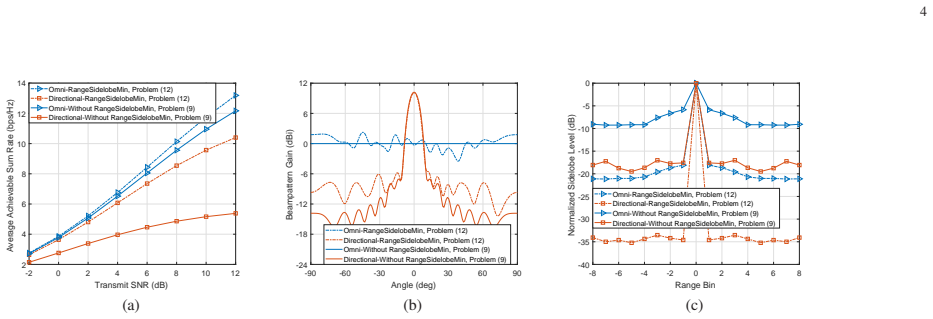
Pith's one-line read A MIMO DFRC waveform can be jointly optimized for radar and communication, cutting range sidelobes by up to 17 dB while improving achievable sum-rate.
desk verdict A useful sidelobe-control extension of the authors' prior DFRC design, but the printed equations do not actually implement the stated objective and need correction before the results can be trusted. read the letter →
The pith
A machine-rendered reading of the paper's core claim, the machinery that carries it, and where it could break.
The reading
What carries the argument
The carrying object is the complex oblique manifold $\mathcal{M}=\{X\in\mathbb{C}^{N\times L}:\operatorname{diag}(XX^H)=\frac{LP_T}{N}\mathbf{1}_N\}$, the set of waveforms that respect the per-antenna power budget. On this manifold the paper runs a Riemannian conjugate gradient (RCG) algorithm: the Euclidean gradient is projected onto the tangent space, combined with the previous descent direction using a Polak-Ribiere coefficient, and brought back to the manifold by the retraction $R_X(Z)=\beta\,\operatorname{ddiag}((X+Z)(X+Z)^H)^{-1/2}(X+Z)$ with $\beta=\sqrt{LP_T/N}$. This machinery keeps every iterate feasible while descending, and the per-iteration complexity is dominated by the gradient computation, stated as $O(N^2PL-N^2P^2/2)$.
What would settle it
Re-run the algorithm from many random initializations under the paper's settings ($N=16$, $K=4$, $L=100$, $P=8$, $\rho_1=\rho_3=0.15$, $\rho_2=0.7$) and record the converged objective and range-sidelobe level; if the outcomes spread widely or the gradient norm does not fall below $10^{-6}$ within the reported tens of iterations, the claimed 12/17 dB reductions are initialization-dependent rather than a stable property of the design. A second check is to vary the weights and channel realizations and see whether convergence and the sidelobe gain survive.
Extended reading notes
Core claim
The central claim is that range-sidelobe suppression can be folded directly into the DFRC waveform optimization without requiring the waveform covariance to equal a fixed radar covariance. The paper minimizes $F(X)=\rho_1\|HX-S\|_F^2+\rho_2\sum_{p=-P,p\neq 0}^{P}\|XJ_pX^H\|_F^2+\rho_3\|X-X_0\|_F^2$ subject to $\operatorname{diag}(XX^H)=\frac{LP_T}{N}\mathbf{1}_N$, where the first term is multi-user interference, the second is the integrated sidelobe level, and the third keeps the waveform close to a radar-friendly reference. Because the feasible set is a complex oblique manifold, the algorithm projects the Euclidean gradient onto the tangent space, forms a conjugate descent direction via the Polak-Ribiere coefficient, and retracts back to the manifold. The reported result is that this relaxed, weighted design beats the closed-form beampattern-constrained design in both communication sum-rate and range sidelobe level, at the cost of a small mismatch in the spatial beampattern.
Load-bearing premise
Everything rests on the iterative algorithm actually finding a low-enough local minimum of the nonconvex objective in tens of iterations; the paper states that strict convergence analysis remains open, so a stall in a poor local valley would undo the claimed sidelobe and rate gains.
Editorial extensions
If this is right
- Should the claim hold, DFRC base stations can produce a single waveform that serves downlink users and suppresses range sidelobes at the same time, with the reported 12 dB omni-directional and 17 dB directional sidelobe reductions.
- The weighted objective relaxes the rigid covariance equality of the closed-form design, so the radar beampattern is only approximately matched; the authors argue this mismatch is acceptable given the improved sum-rate.
- The per-antenna power constraint is maintained exactly at every iteration, so the resulting waveform is directly transmittable with the intended power distribution.
- Because the per-iteration cost is a matrix gradient computation, the design is computationally light enough to permit re-optimization as the communication channel changes, assuming the observed convergence behavior persists.
Reading between the lines
- Beyond the paper, the same manifold formulation is a natural template for adding other radar constraints, such as Doppler sidelobe levels or peak-to-average-power ratio, by changing the objective or the retraction while keeping the per-antenna power constraint built in.
- Beyond the paper, initializing at the closed-form solution (10) instead of a random point may improve convergence stability and give a more direct comparison, since that solution is the reference the relaxation is built around.
- Beyond the paper, the reported 12/17 dB gains are tied to one weight setting and simulation choice; a deployment-oriented test would vary antenna counts, user numbers, block lengths, and weights to see whether the sidelobe reductions persist and whether a principled weight-selection rule emerges.
Signed reviews
Editorial analysis
A structured set of objections, weighed in public.
Referee Report
Summary. The manuscript proposes a waveform design for MIMO dual-functional radar-communication (DFRC) systems that jointly minimizes multiuser interference (MUI), integrated sidelobe level (ISL), and a similarity penalty with respect to a reference waveform, subject to a per-antenna power constraint. The optimization problem is non-convex, and the authors develop a Riemannian conjugate gradient (RCG) method on the complex oblique manifold. Numerical simulations for N=16, K=4, L=100 report 12 dB and 17 dB range-sidelobe reductions in omni-directional and directional designs, respectively, together with improved sum-rate over the closed-form baseline of [4]. The core idea is plausible and relevant, but the printed formulation contains algebraic inconsistencies that affect the exact algorithm as described.
Significance. If the formulation and algorithm were corrected, the contribution would be significant for DFRC waveform design: it is one of the first attempts to control range sidelobes explicitly in a joint radar-communication waveform, and the manifold-based approach offers a computationally efficient first-order descent method with per-antenna power control. The numerical study is reasonably comprehensive for the system size considered. However, the load-bearing derivations in Section IV are not correct as printed, so the reported gains cannot be attributed to Algorithm 1 as written. The strengths are the clear system model, the explicit integrated-sidelobe metric, and the use of the oblique manifold to handle the per-antenna constraint; the weakness is the inconsistency among equations (12), (13), (15), and (17).
major comments (3)
- [Section IV, Eq. (13)] The identity ρ1PMUI + ρ2PISL = ‖AX−B‖_F^2 with A=[√ρ1 H; √ρ2 I_N] and B=[√ρ1 S; √ρ2 X0] is false; direct expansion gives ρ1‖HX−S‖_F^2 + ρ2‖X−X0‖_F^2 = ρ1PMUI + ρ2PSIM. Consequently, problem (15), which is derived from this identity, is not a recasting of (12): the weights of the ISL and similarity terms are swapped between the two formulations. Since Section V sets ρ1=ρ3=0.15 and ρ2=0.7, the reported 12–17 dB sidelobe reductions are not tied to a single well-defined objective; the paper must be corrected so that (12), (13), and (15) refer to the same weighted problem.
- [Section IV, Eq. (17)] The Euclidean gradient printed for the objective in (15) omits the factor ρ3 multiplying the quartic ISL term. The correct gradient is 2 A^H(AX−B) + 2ρ3 Σ_{p≠0}(XJp X^H X Jp^H + X Jp^H X^H X Jp). As printed, the gradient has no dependence on the ISL weight, so Algorithm 1, if implemented literally with (17), would not account for the sidelobe term; the documented sidelobe suppression therefore has no explanation in the printed algorithm. The authors should either state that the numerical results were obtained with a corrected gradient (and provide it) or revise the algorithm description.
- [Algorithm 1 and Remark, Section IV] The algorithm input specifies ρ_i for all i, but the construction of A and B in (14) uses only ρ1 and ρ2, and the gradient (17) does not use ρ3 at all; the role of ρ3 in the iteration is therefore undefined. The Remark's admission that strict convergence analysis remains open is a useful limitation, but it does not resolve the inconsistency between the stated problem (12) and the problem actually implemented by the algorithm.
minor comments (5)
- [Section IV, Eq. (20)] The term PXk(F(Xk−1)) is not well-defined because F(Xk−1) is a scalar; the standard Polak-Ribière formula on a manifold involves the projected previous gradient (or descent direction), for instance PXk(grad F(Xk−1)) or PXk(Πk−1), depending on convention.
- [Section V] The sentence 'by solving (12) under only a small weighting factor ρ3 = 0.15' appears to treat ρ3 as the ISL weight, whereas in (12) ρ3 multiplies the similarity term PSIM; this sentence should be reworded after the weight notation is fixed.
- [Algorithm 1 input] The list of inputs should be aligned with the corrected notation, making explicit which weights enter the quadratic part and which enter the quartic part of the objective.
- [Section V, numerical results] The number of Monte-Carlo trials used for the sum-rate curves is not reported, and no error bars are shown; adding this information would improve reproducibility.
- [Throughout] Minor typographical issues: 'interets' in the Introduction should be 'interests', and the phrase 'remains open problem' in the Remark should be 'remains an open problem'.
Circularity Check
No significant circularity; the derivation is self-contained, with algebraic inconsistencies in Eqs. (13)/(17) that are correctness issues rather than circularity.
full rationale
The paper's central chain—defining the radar and communication metrics in Eqs. (3), (7), and (11), forming the weighted objective (12), and then applying an oblique-manifold RCG algorithm to the feasible set—is self-contained. The reference waveform X0 and the benchmark (9) are taken from the authors' prior work [4], but that is a published closed-form solution with an independent derivation, not a privately asserted premise that guarantees the conclusion. The proposed objective and its numerical evaluation do not define the reported sidelobe reduction in terms of the input waveform or the benchmark; the sidelobe reduction is an optimized quantity measured by an independent figure of merit. The Remark after Algorithm 1 explicitly states that strict convergence analysis of RCG remains an open problem, which is a stated limitation about iteration guarantees, not a circular reliance on the target result. Separately, Eqs. (13) and (17) contain algebraic inconsistencies: Eq. (13) equates a ρ2-weighted integrated-sidelobe term with a ρ2-weighted similarity term ||X−X0||^2_F, and Eq. (17) omits the ρ3 prefactor on the quartic ISL gradient. These are correctness concerns about whether Algorithm 1 as printed minimizes the claimed objective (12), but they do not make any predicted quantity equivalent to an input by construction, and therefore they do not amount to circularity under the rubric used here.
Assumptions & free parameters
free parameters (1)
- Weighting factors ρ1, ρ2, ρ3 =
ρ1 = 0.15, ρ2 = 0.7, ρ3 = 0.15 (simulation settings; notation inconsistent between (12) and (15))
assumptions (4)
- domain assumption The radar model (4)-(7) with point scatterers and the integrated sidelobe power PISL as defined is an adequate measure of radar range-sidelobe performance.
- domain assumption The communication channel H is perfectly known at the BS, and minimizing the MUI energy PMUI in (3) is a valid surrogate for maximizing achievable sum-rate.
- standard math The closed-form solution (10) to problem (9) from [4] is correct and produces a valid reference waveform X0.
- ad hoc to paper The Riemannian Conjugate Gradient algorithm on the complex oblique manifold converges to a useful near-optimal stationary point within tens of iterations.
Cite this review
Pith. "Pith review of On Range Sidelobe Reduction for Dual-functional Radar-Communication Waveforms." pith.science (2026). https://pith.science/paper/2RXNPEU4
@misc{pith2026190804650,
  author       = {Pith},
  title        = {Pith review of: On Range Sidelobe Reduction for Dual-functional Radar-Communication Waveforms},
  year         = {2026},
  howpublished = {\url{https://pith.science/paper/2RXNPEU4}},
  note         = {Machine review of arXiv:1908.04650}
}
read the original abstract
In this paper, we propose a novel waveform design for multi-input multi-output (MIMO) dual-functional radar-communication systems by taking the range sidelobe control into consideration. In particular, we focus on optimizing the weighted summation of communication and radar metrics under per-antenna power budget. While the formulated optimization problem is non-convex, we develop a first-order descent algorithm by exploiting the manifold structure of its feasible region, which finds a near-optimal solution within a low computational overhead. Numerical results show that the proposed waveform design outperforms the conventional techniques by improving the communication rate while reducing the range sidelobe level.
Figures

Reference graph
Works this paper leans on
-
[4]
F. Liu , C. Masouros , A. Li , H. Sun , and L. Hanzo , `` MU-MIMO communications with MIMO radar: F rom co-existence to joint transmission,'' IEEE Trans. Wireless Commun., vol. 17, no. 4, pp. 2755--2770, Apr 2018
work page 2018
-
[1]
11em plus .33em minus .07em 4000 4000 100 4000 4000 500 `\.=1000 = #1 \@IEEEnotcompsoconly \@IEEEcompsoconly #1 * [1] 0pt [0pt][0pt] #1 * [1] 0pt [0pt][0pt] #1 * \| ** #1 \@IEEEauthorblockNstyle \@IEEEcompsocnotconfonly \@IEEEauthorblockAstyle \@IEEEcompsocnotconfonly \@IEEEcompsocconfonly \@IEEEauthordefaulttextstyle \@IEEEcompsocnotconfonly \@IEEEauthor...
- [2]
-
[3]
A. Hassanien , M. G. Amin , Y. D. Zhang , and F. Ahmad , ``Dual-function radar-communications: Information embedding using sidelobe control and waveform diversity,'' IEEE Trans. Signal Process., vol. 64, no. 8, pp. 2168--2181, Apr 2016
work page 2016
-
[5]
F. Liu , L. Zhou , C. Masouros , A. Li , W. Luo , and A. Petropulu , ``Toward dual-functional radar-communication systems: O ptimal waveform design,'' IEEE Trans. Signal Process., vol. 66, no. 16, pp. 4264--4279, Aug 2018
work page 2018
- [6]
-
[7]
S. K. Mohammed and E. G. Larsson , ``Per-antenna constant envelope precoding for large multi-user MIMO systems,'' IEEE Trans. Commun., vol. 61, no. 3, pp. 1059--1071, Mar 2013
work page 2013
- [8]
Show all 10 references
-
[9]
Absil, R
P.-A. Absil, R. Mahony, and R. Sepulchre, Optimization algorithms on matrix manifolds. 1em plus 0.5em minus 0.4em Princeton University Press, 2009
2009
-
[10]
Nocedal and S
J. Nocedal and S. Wright, Numerical optimization. 1em plus 0.5em minus 0.4em Springer, 2006
2006
Reviewed August 14, 2026 · model on record in the stance chip above.
Discussion (0). Continue with ORCID to comment.