REVIEW 3 major objections 4 minor 45 references
Generic Properties of Geodesic Flows on Analytic Hypersurfaces of Euclidean Space
T0 review · 3 major / 4 minor · reviewed 2026-08-14 · deepseek-v4-flash
Pith's one-line read Generically, analytic convex surfaces in 3D have chaotic geodesic flow
desk verdict A genuinely useful real-analytic perturbation paper whose first three theorems look solid, but Theorem 5's Section 6 argument has a real gap at the boundary of the extended Poincaré map. read the letter →
The pith
A machine-rendered reading of the paper's core claim, the machinery that carries it, and where it could break.
The reading
What carries the argument
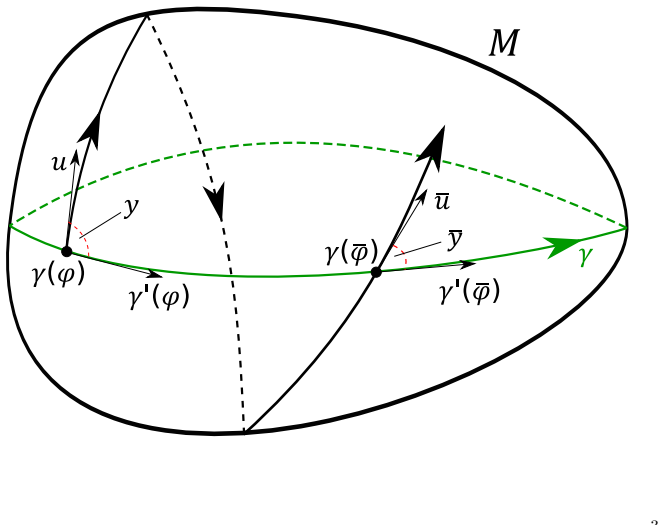
The carrying mechanism is the Fermi-coordinate formula for how a localized change $Q\mapsto Q+\epsilon\psi$ in the defining function alters the induced metric: $\bar g(y^0,y)=2\psi(y^0,y)\tilde C(y^0,y)$, where $\tilde C$ is the second-derivative curvature matrix pulled back along the geodesic. This formula constrains the perturbation to act through the curvature matrix times a scalar, and it shows that when the normal curvature along a geodesic segment does not vanish one can choose $\psi$ to realize essentially arbitrary $k$-jets of the corresponding Poincaré map. The resulting jet-transversality lemma is the workhorse behind the nondegeneracy, $k$-jet, and transversality theorems. For the convex-surface theorem, the extra mechanism is a global Poincaré map defined on an annulus by a simple closed minimax geodesic; the paper feeds this map into a closure-of-branches theorem for area-preserving surface homeomorphisms and a crossing lemma for annulus diffeomorphisms, which force the stable and unstable branches of a hyperbolic fixed point to intersect transversely.
What would settle it
Inspect the extended map in the proof of Theorem 5: compute the derivative of the reflected global Poincaré map at a boundary point sitting on the minimax geodesic. If the map is not a $C^1$ diffeomorphism near that boundary circle, or if one of its boundary fixed points is neither sectorial periodic nor stable in the required sense, then the cited closure-of-branches and crossing theorems cannot be applied at that point, and the proof of Theorem 5 has a gap exactly at the passage from the interior annulus to the boundary.
Extended reading notes
Core claim
The paper's central claim is that chaos is generic for these flows despite the severely restricted class of perturbations: only the shape of the hypersurface changes, the metric stays Euclidean, and all perturbing functions must be real-analytic. Concretely, Theorem 4 asserts that whenever a real-analytic closed hypersurface in $\mathbb{R}^n$, $n\ge 3$, has a nonhyperbolic periodic orbit, the hypersurface can be perturbed $C^\omega$-generically so that the new flow has a hyperbolic periodic orbit with a transverse homoclinic orbit. Theorem 5 asserts that among real-analytic, closed, strictly convex surfaces in $\mathbb{R}^3$ there is a $C^\omega$-open and dense set for which the same conclusion holds. Since a transverse homoclinic orbit produces a nontrivial hyperbolic basic set and positive topological entropy, these theorems say that chaotic geodesic motion is the typical outcome, not an exceptional one. The supporting results are a generic nondegeneracy theorem for closed geodesics, a theorem controlling $k$-jets of Poincaré maps along geodesic segments, and a generic transversality theorem for stable and unstable manifolds, all proved in the real-analytic topology.
Load-bearing premise
The load-bearing premise of the convex-surface theorem is that the global Poincaré map on the annulus, after being extended across the minimax geodesic by reflection to an open annulus, still satisfies the hypotheses of the two cited theorems used there: every fixed point on the new boundary circle must be of one of the two admissible stability types, and the extension must be a diffeomorphism; the paper verifies these properties only for fixed points in the interior of the original annulus.
Editorial extensions
If this is right
- If a real-analytic closed hypersurface in $\mathbb{R}^n$, $n\ge 3$, has a nonhyperbolic periodic orbit, then a $C^\omega$-generic perturbation of the hypersurface gives a hyperbolic periodic orbit with a transverse homoclinic orbit, hence a nontrivial hyperbolic basic set.
- The Euclidean geodesic flow on a $C^\omega$-open and dense set of real-analytic, closed, strictly convex surfaces in $\mathbb{R}^3$ has positive topological entropy.
- Generically, every closed geodesic is nondegenerate and every homoclinic or heteroclinic intersection is transverse, so the flow satisfies the full generic transversality condition.
- The same argument yields real-analytic versions of the nondegeneracy, $k$-jet, and transversality theorems in the classical setting where Riemannian metrics themselves are perturbed.
- The generic surfaces obtained satisfy the hypotheses needed for Arnold diffusion in the associated billiard dynamics, an application noted by the paper.
Reading between the lines
- Editorial inference: the proof of Theorem 5 exploits a global surface of section; the same two-step mechanism (a branch-closure theorem for area-preserving maps, then a crossing criterion) should transfer to any 3-dimensional Reeb flow that admits such a section, not only Euclidean convex surfaces.
- Editorial inference: if a future theorem shows that all closed geodesics are hyperbolic on a $C^\omega$-generic convex hypersurface in higher dimensions, the paper's route would extend Theorem 5 to every dimension and would make the Arnold-diffusion phenomenon generic throughout the convex class; the paper explicitly identifies this as an open direction.
- Editorial inference: the linear-algebra lemma that passes from compactly supported smooth perturbations to real-analytic ones suggests that other bump-function genericity arguments may admit real-analytic analogues whenever the desired property is open in a weaker topology and depends on finitely many jets.
Signed reviews
Editorial analysis
A structured set of objections, weighed in public.
Referee Report
Summary. The paper studies geodesic flows on real-analytic closed hypersurfaces of Euclidean space equipped with the induced Euclidean metric, with perturbations made by deforming the hypersurface rather than the metric. It proves real-analytic analogues of the bumpy metric theorem (Theorem 1), the Klingenberg–Takens k-jet genericity theorem (Theorem 2), and the Kupka–Smale theorem for this class (Theorem 3). Using these, it claims a generic hyperbolic periodic orbit with transverse homoclinic orbit whenever a nonhyperbolic periodic orbit exists (Theorem 4), and a C^omega open and dense set of strictly convex real-analytic surfaces in R^3 whose geodesic flow has a hyperbolic periodic orbit with a transverse homoclinic orbit, hence a nontrivial hyperbolic basic set and positive entropy (Theorem 5). The main technical content is an explicit first-order computation of the effect of a hypersurface perturbation on the geodesic flow in Fermi coordinates, a controllability lemma for the perturbed Jacobi equation, and an application of Broer–Tangerman approximation to pass from locally supported smooth perturbations to real-analytic ones.
Significance. If the theorems are correct, this is a genuinely new perturbation-theoretic result in the real-analytic category: it bypasses the usual use of bump functions, works with a restricted class of metric perturbations coming from hypersurface deformations, and gives one of the first generic statements of chaotic dynamics for Euclidean geodesic flows on analytic convex surfaces. The paper is also explicit and checkable in its perturbation calculations: the first-order formula (23), the controllability Lemma 15, and the k-jet transversality machinery in Section 4 are concrete and are the strongest parts of the manuscript. The main weakness is the final global step: the proof of Theorem 5 applies Mather's theorem and the Knieper–Weiss proposition to a boundary extension of the global Poincaré map whose hypotheses are not verified. The omission of the proof of Theorem 4, and the reliance on several unproved lemmas from Anosov, are additional obstacles to accepting the central claims as they stand.
major comments (3)
- [Section 6, paragraph beginning 'Since the map must be defined on an open set'] The proof of Theorem 5 applies Mather's Theorem 28 to a continuous extension of P to an open annulus A' obtained by reflecting P|Int(A) across ∂A. The boundary ∂A is pointwise fixed by P, because it corresponds to the minimax geodesic itself, so the extension contains a whole circle of fixed points. The paper verifies the sectorial-periodic or Moser-stable hypotheses only for fixed points in Int(A); a non-isolated circle of fixed points cannot be sectorial periodic, and Moser stability at the boundary is not demonstrated. Moreover, Proposition 29 is stated for a diffeomorphism f:A→A, while a reflection extension of a map that is only continuous on ∂A cannot be assumed C^1 at ∂A. Since the Mather–Knieper–Weiss step is the only mechanism producing the homoclinic point in the hyperbolic case, the proof of Theorem 5 is unsupported as written. This gap is potentially repairable by a different argument that avoids the boundary extension, but the manuscript currently does not provide one.
- [Section 1, paragraph following the statement of Theorem 4] Theorem 4 is asserted without proof: the text says 'As his proof applies directly, once Theorem 3 is proved, to the case of geodesic flows on real-analytic closed hypersurfaces of Euclidean space, we do not include it here.' This is a central theorem and it is used in the proof of Theorem 5. Because the entire paper emphasizes that the perturbation class is strictly smaller than the class of all metric perturbations and that the analytic topology forbids bump functions, it is not self-evident that Contreras's argument transfers verbatim. The manuscript should supply the reduction or, at minimum, a detailed statement of why each step of Contreras's proof remains valid for perturbations of the form (23) and in the C^omega topology.
- [Section 3, Lemmas 7, 8, 12 and the deduction of Lemma 6 from Lemma 15] The proofs of Lemmas 7, 8, and 12 are omitted and referred to [6], as is the deduction of Lemma 6 from Lemma 15. While citing Anosov for standard transversality and persistence arguments is acceptable, the setting here is not identical: the phase space is a reference sphere bundle equipped with metrics induced by embeddings into Euclidean space, and the perturbation class is the restricted one from Section 2. It is not automatic that every statement from [6] applies verbatim. The manuscript should indicate which parts of [6] carry over unchanged and which require modification, so that the proof of Theorem 1 can be independently checked.
minor comments (4)
- [Throughout] There are several typographical errors, including 'siffuciently' (Section 5), 'satisified' (Section 1 and Remark 3), and 'autormorphisms' (Section 1 before Theorem 2). The paper would benefit from a careful proofreading pass.
- [Section 6] The text refers to 'Figure 1' and includes a caption, but no figure appears in the manuscript. Either include the figure or remove the reference.
- [Abstract and Section 1] The dimension convention is stated in the abstract as n≥3, but the body uses d with n=d+2. State this convention explicitly at the first use of d to avoid confusion.
- [Lemma 15, equation (37)] The passage from delta-forced solutions to bump-function-forced solutions states that 'we can still obtain any vectors by varying α,β' but does not spell out the continuity argument. Since the delta limit is explicit and the map (α,β) ↦ (γ̄(L), γ̄′(L)) is continuous in the forcing for small support, a few sentences would make the surjectivity uniform in the smoothing parameter.
Circularity Check
No circular derivation: Theorems 1–3 are proved from first principles; Theorems 4–5 rely on external results; the only self-citation is a non-load-bearing application.
full rationale
The derivation chain in Sections 2–5 is self-contained: the perturbation formula, the surjectivity of the derivative of the Poincaré map, the k-jet perturbation lemmas, and the transversality theorem are all proved directly from the geometry of the hypersurface and the geodesic Hamiltonian. Theorem 3 is assembled from these lemmas. Theorems 4 and 5 invoke external results—Contreras, Mather, and Knieper–Weiss—rather than defining the conclusion into the inputs. The one self-citation, Clarke and Turaev [13], is used only to state a motivational application of Theorems 4 and 5, so no load-bearing claim is justified by self-citation. The Section 6 application of Mather's theorem via a reflection extension appears to contain a genuine proof gap—the boundary circle of fixed points is not checked against Mather's hypotheses, and Proposition 29 requires a diffeomorphism—but that is a correctness gap, not circularity: the transverse homoclinic is not an input to the extension or to the cited theorems, and no fitted parameter is renamed as a prediction.
Assumptions & free parameters
assumptions (8)
- standard math Real-analytic Sard theorem (Souček-Souček) gives a real-analytic version of Abraham's transversality theorem.
- domain assumption Anosov's lemmas on absence of short periodic orbits, openness of nonparabolicity, and persistence of periodic orbits transfer verbatim to the hypersurface perturbation setting.
- domain assumption Broer-Tangerman analytic approximation: C^infty locally supported perturbation families satisfying C^r-open conditions can be approximated by real-analytic families preserving those conditions.
- standard math Stojanov-Takens C^infty k-genericity of linearized Poincaré maps and Klingenberg-Takens Proposition 17 hold as stated.
- domain assumption Contreras's proof that Theorem 3 implies Theorem 4 transfers directly to this setting.
- standard math Birkhoff's global surface of section theorem, the existence of the minimax geodesic, and the theorem of three closed geodesics on convex spheres.
- domain assumption Mather's theorem and the Knieper-Weiss proposition apply to the Poincaré map P and its continuation.
- standard math Lagrangian manifold properties of stable and unstable manifolds of hyperbolic Hamiltonian orbits (Lemma 24).
Cite this review
Pith. "Pith review of Generic Properties of Geodesic Flows on Analytic Hypersurfaces of Euclidean Space." pith.science (2026). https://pith.science/paper/7WAQNS32
@misc{pith2026190804662,
  author       = {Pith},
  title        = {Pith review of: Generic Properties of Geodesic Flows on Analytic Hypersurfaces of Euclidean Space},
  year         = {2026},
  howpublished = {\url{https://pith.science/paper/7WAQNS32}},
  note         = {Machine review of arXiv:1908.04662}
}
abstract
Consider the geodesic flow on a real-analytic closed hypersurface $M$ of $\mathbb{R}^n$, equipped with the standard Euclidean metric. The flow is entirely determined by the manifold and the Riemannian metric. Typically, geodesic flows are perturbed by varying the metric. In the present paper, however, only the Euclidean metric is used, and instead the manifold $M$ is perturbed. In this context, analogues of the following theorems are proved: the bumpy metric theorem; a theorem of Klingenberg and Takens regarding generic properties of $k$-jets of Poincar\'e maps along geodesics; and the Kupka-Smale theorem. Moreover, the proofs presented here are valid in the real-analytic topology. Together, these results imply the following two main theorems: if $M$ is a real-analytic closed hypersurface in $\mathbb{R}^n$ (with $n \geq 3$) on which the geodesic flow with respect to the Euclidean metric has a nonhyperbolic periodic orbit, then $C^{\omega}$-generically the geodesic flow on $M$ with respect to the Euclidean metric has a hyperbolic periodic orbit with a transverse homoclinic orbit; and there is a $C^{\omega}$-open and dense set of real-analytic, closed, and strictly convex surfaces $M$ in $\mathbb{R}^3$ on which the geodesic flow with respect to the Euclidean metric has a hyperbolic periodic orbit with a transverse homoclinic orbit. The methods used here also apply to the classical setting of perturbations of metrics on a Riemannian manifold to obtain real-analytic versions of these theorems in that case. These are among the first perturbation-theoretic results for real-analytic geodesic flows.
Figures
Reference graph
Works this paper leans on
-
[6]
D. V. Anosov. On generic properties of closed geodesics. Mathematics of the USSR-Izvestiya , 21(1):1, 1983
work page 1983
-
[1]
R. Abraham. Transversality in manifolds of mappings. Bull. Amer. Math. Soc, 69(196):470–474, 1963
work page 1963
-
[2]
R. Abraham. Bumpy metrics. In Global Analysis, Proc. Sympos. Pure Math, volume 14, pages 1–3, 1970
work page 1970
-
[3]
R. Abraham and J. Robbin. Transversal mappings and flows . WA Benjamin New York, 1967
work page 1967
-
[4]
R. H. Abraham and S. Smale. Lectures of Smale on differential topology. Columbia University, Department of Mathematics, 1963
work page 1963
-
[5]
D. V. Anosov. Geodesic flows on closed riemannian manifolds of negative curvature. Trudy Matematicheskogo Instituta Imeni VA Steklova , 90:3– 210, 1967
work page 1967
-
[7]
M.-C. Arnaud. Type des points fixes des diff´ eomorphismes symplec- tiques de Tn× Rn. M´ em. Soc. Math. France (NS) No, 48:63, 1992
work page 1992
- [8]
Show all 45 references
-
[9]
G. D. Birkhoff. Dynamical systems with two degrees of freedom. Pro- ceedings of the National Academy of Sciences of the United States of America, 3(4):314, 1917. 45
1917
-
[10]
G. D. Birkhoff. Dynamical systems, volume 9. American Mathematical Soc., 1927
1927
-
[11]
Broer and F
H. Broer and F. Tangerman. From a differentiable to a real analytic perturbation theory, applications to the Kupka Smale theorems.Ergodic Theory and Dynamical Systems , 6(3):345–362, 1986
1986
-
[12]
Carballo and J
C. Carballo and J. Miranda. Jets of closed orbits of Man´ e’s generic Hamiltonian flows. Bulletin of the Brazilian Mathematical Society, New Series, 44(2):219–232, 2013
2013
-
[13]
Clarke and D
A. Clarke and D. Turaev. Arnold diffusion in multi-dimensional convex billiards. arXiv preprint arXiv:1906.07778 , 2019
1906 arXiv
-
[14]
T. H. Colding and W. P. Minicozzi. A course in minimal surfaces , volume 121. American Mathematical Soc., 2011
2011
-
[15]
Contreras
G. Contreras. Geodesic flows with positive topological entropy, twist maps and hyperbolicity. Annals of mathematics , pages 761–808, 2010
2010
-
[16]
Contreras-Barandiar´ an and G
G. Contreras-Barandiar´ an and G. P. Paternain. Genericity of geodesic flows with positive topological entropy on S2. Journal of Differential Geometry, 61(1):1–49, 2002
2002
-
[17]
C. B. Croke. Area and the length of the shortest closed geodesic. Journal of Differential Geometry, 27(1):1–21, 1988
1988
-
[18]
V. J. Donnay. Transverse homoclinic connections for geodesic flows. In Hamiltonian dynamical systems , pages 115–125. Springer, 1995
1995
-
[19]
Gelfreich and D
V. Gelfreich and D. Turaev. Arnold diffusion in a priori chaotic symplec- tic maps. Communications in Mathematical Physics , 353(2):507–547, 2017
2017
-
[20]
Gonchenko, D
S. Gonchenko, D. Turaev, and L. Shilnikov. Homoclinic tangencies of arbitrarily high orders in conservative and dissipative two-dimensional maps. Nonlinearity, 20(2):241, 2007
2007
-
[21]
Hofer, K
H. Hofer, K. Wysocki, and E. Zehnder. Pseudoholomorphic curves and dynamics in three dimensions. In Handbook of dynamical systems , vol- ume 1, pages 1129–1188. Elsevier, 2002
2002
-
[22]
Hofer, K
H. Hofer, K. Wysocki, and E. Zehnder. Finite energy foliations of tight three-spheres and hamiltonian dynamics. Annals of Mathematics, pages 125–255, 2003. 46
2003
-
[23]
C. G. J. Jacobi. Vorlesungen ¨ uber dynamik. G. Reimer, Berlin, 1884
-
[24]
Katok and B
A. Katok and B. Hasselblatt. Introduction to the modern theory of dynamical systems, volume 54. Cambridge university press, 1995
1995
-
[25]
Klingenberg
W. Klingenberg. Lectures on closed geodesics. Mathematisches Institut der Universitat Bonn, 1976
1976
-
[26]
Klingenberg and F
W. Klingenberg and F. Takens. Generic properties of geodesic flows. Mathematische Annalen, 197(4):323–334, 1972
1972
-
[27]
Knieper and H
G. Knieper and H. Weiss. A surface with positive curvature and positive topological entropy. Journal of Differential geometry , 39(2):229–249, 1994
1994
-
[28]
Knieper and H
G. Knieper and H. Weiss. C∞ genericity of positive topological entropy for geodesic flows on S2. Journal of Differential Geometry , 62(1):127– 141, 2002
2002
-
[29]
Le Calvez
P. Le Calvez. Propri´ et´ es dynamiques des diff´ eomorphismes de l’anneau et du tore . Soci´ et´ e math´ ematique de France, 1991
1991
-
[30]
Ma˜ n´ e
R. Ma˜ n´ e. Oseledec’s theorem from the generic viewpoint. In Proceed- ings of the international Congress of Mathematicians , volume 1, page 2. Warsaw, 1983
1983
-
[31]
J. Mather. Invariant subsets of area-preserving homeomorphisms of sur- faces. Mathematical Analysis and Applications , 7B:531–561, 1981
1981
-
[32]
J. Moser. Geometry of quadrics and spectral theory. In The Chern Symposium 1979, pages 147–188. Springer, 1980
1979
-
[33]
J. Moser. Various aspects of integrable hamiltonian systems. In Dynam- ical systems, pages 137–195. Springer, 1980
1980
-
[34]
G. P. Paternain. Geodesic flows, volume 180. Springer Science & Busi- ness Media, 2012
2012
-
[35]
D. Petroll. Existenz und Transversalit¨ at von homoklinen und heterokli- nen Orbits beim geod¨ atischen Fluß. PhD thesis, University of Freiburg, 1996
1996
-
[36]
Poincar´ e.Les m´ ethodes nouvelles de la m´ ecanique celeste
H. Poincar´ e.Les m´ ethodes nouvelles de la m´ ecanique celeste. Springer, 1899. 47
-
[37]
Rifford and R
L. Rifford and R. O. Ruggiero. Generic properties of closed orbits of hamiltonian flows from Ma˜ n´ e’s viewpoint.International Mathematics Research Notices, 2012(22):5246–5265, 2012
2012
-
[38]
R. C. Robinson. Generic properties of conservative systems. American Journal of Mathematics , 92(3):562–603, 1970
1970
-
[39]
Shilnikov
L. Shilnikov. A case of the existence of a countable number of periodic orbits. In Sov. Math. Dokl , volume 6, pages 163–166, 1965
1965
-
[40]
S. Smale. Differentiable dynamical systems. Bulletin of the American mathematical Society, 73(6):747–817, 1967
1967
-
[41]
Souˇ cek and V
J. Souˇ cek and V. Souˇ cek. Morse-sard theorem for real-analytic func- tions. Commentationes Mathematicae Universitatis Carolinae, 13(1):45– 51, 1972
1972
-
[42]
Stojanov
L. Stojanov. A bumpy metric theorem and the poisson relation for generic strictly convex domains. Mathematische Annalen , 287(1):675– 696, 1990
1990
-
[43]
Stojanov and F
L. Stojanov and F. Takens. Generic properties of closed geodesics on smooth hypersurfaces. Mathematische Annalen, 296(1):385–402, 1993
1993
-
[44]
S. L. Tabachnikov. Ellipsoids, complete integrability and hyperbolic geometry. Moscow Mathematical Journal, 2(1):183–196, 2002
2002
-
[45]
E. Zehnder. Homoclinic points near elliptic fixed points. Communica- tions on Pure and Applied Mathematics , 26(2):131–182, 1973. 48
1973
Reviewed August 14, 2026 · model on record in the stance chip above.
Discussion (0). Continue with ORCID to comment.