REVIEW 3 major objections 6 minor 14 references
Estimating & Mitigating the Impact of Acoustic Environments on Machine-to-Machine Signalling
T0 review · 3 major / 6 minor · reviewed 2026-08-14 · deepseek-v4-flash
Pith's one-line read A simple echo-removal preprocessor raises data-over-sound decode rates by 25 percentage points.
desk verdict A plainly written, well-scoped extension of single-channel spectral subtraction to data-over-sound M2M Chirp signals, with a large simulated evaluation and a genuinely useful decode-rate gain—held back by missing tuning details, absent significance tests, and no code. read the letter →
The pith
A machine-rendered reading of the paper's core claim, the machinery that carries it, and where it could break.
The reading
What carries the argument
The load-bearing object is the per-frequency-band energy decay curve (EDC) of the received Chirp packet, combined with the Polack-style assumption that this decay follows the room impulse response's exponential envelope. The RT60 estimator locates each subband's energy peak, starts the decay curve at a fixed offset after the tone, regresses log-energy from -5 dB to -35 dB, and maps the regression's x-intercept to a 60 dB decay time; thresholded subbands are excluded and the survivors are averaged. That RT60 estimate is then inserted into the late-reverberation PSD model $\gamma_{x_r x_r}(k,l)=e^{-2\Delta T}\gamma_{xx}(k,l-T)$, whose output drives the spectral subtraction gain $G(k,l)=1-1/\sqrt{\text{SNR}_{\text{post}}(k,l)}$ with smoothing and a non-zero floor. This machinery is what lets a single microphone, with no known impulse response, turn room acoustics into a predictable quantity.
What would settle it
Take a Chirp packet with a known RT60 synthetic tail and add a second overlapping monophonic tone that starts inside the -5 dB to -35 dB regression window; if the estimated RT60 shifts by more than the reported roughly 0.2 second mean absolute error, or the post-dereverberation decode rate stops improving, the clean-decay assumption is the failure point.
Extended reading notes
Core claim
On its own terms, the paper's central discovery is that a classic speech-dereverberation technique, spectral subtraction, transfers to non-speech data-carrier signals when its input parameter, the reverberation time RT60, is estimated from the received signal itself rather than assumed or measured in advance. The authors model each STFT subband's post-tone energy decay as a straight line in log energy, fit it by least squares between -5 dB and -35 dB below the peak, read off RT60 from the 60 dB intercept, and feed that estimate into the standard delayed and attenuated late-reverberation PSD prediction of spectral subtraction. Evaluated against a real Frequency-Shift-Keying Chirp decoder, the complete preprocessor raises the audible decode rate from 54.53% to 79.78% and the ultrasonic rate from 86.15% to 92.11% across 59,000 convolved signals per band. In a small head-to-head comparison it also decodes better and runs faster than LP residual cepstrum and source-enhancement alternatives.
Load-bearing premise
The load-bearing premise is that after each Chirp tone the energy in each frequency band decays as one clean exponential tied to the room's reverberation time, so a straight-line fit over the 30 dB tail recovers the true RT60; overlapping tones or noise that contaminate that tail bias the estimate and the whole dereverberation.
Editorial extensions
If this is right
- A decoder-agnostic preprocessor can sit in front of an existing Chirp receiver: no changes to the modulation, error-correction, or decoding logic are needed to get the reported gains.
- Audible data-over-sound links become usable in ordinary rooms, where RT60 below 2 seconds shows mean RT60 estimation error around 0.11 seconds.
- Ultrasonic links gain only modestly because they already decode well; the method's value there is small but positive, at 6 percentage points.
- Because the gain computation costs about 1.76 seconds per signal versus 3.2 to 17.8 seconds for the compared methods, the preprocessor is viable for real-time or embedded use.
- For very dry rooms with RT60 below 0.6 seconds the paper observes a slight decode-rate decrease, so the preprocessor is best applied when reverberation is actually present.
Reading between the lines
- If the decay-slope estimator is as robust as reported, it could serve as a standalone single-channel RT60 meter for any tonal or pulsed signal, not only Chirp packets, since it needs only a post-burst decay tail.
- The same pipeline should transfer to other frequency-shift-keying data-over-sound codecs; the argument depends on tone-like stationarity and a quiet tail, not on Chirp's specific packet structure.
- A harder test the paper does not run is live-room playback: the 118,000 signals are all RIR convolutions, and real microphone noise, movement, and non-stationary interferers could break the clean-decay assumption.
- One could extend the estimator to jointly estimate the noise floor and early-to-late energy ratio, which would let the preprocessor adapt its -35 dB regression limit and non-zero gain floor per room.
Signed reviews
Editorial analysis
A structured set of objections, weighed in public.
Referee Report
Summary. The paper addresses reverberation-induced decoding failures in machine-to-machine (M2M) Data-over-Sound signals, specifically Chirp's FSK-based codec. It proposes a single-channel dereverberation pipeline: (i) estimate the room's RT60 from the energy decay of individual STFT subbands; (ii) estimate the late-reverberation PSD from a delayed and attenuated copy of the observed PSD; and (iii) apply spectral subtraction with a gain floor. The method is evaluated on 118,000 simulated reverberant signals (59,000 audible and 59,000 ultrasonic) generated by convolving 100 Chirp packets with 590 AcouSP room impulse responses. The authors report an increase in decode rate from 54.53% to 79.78% for audible signals and from 86.15% to 92.11% for inaudible signals, together with log-spectral-distortion and reverberation-reduction metrics, and a comparison against LP residual cepstrum and source enhancement.
Significance. If the results hold, the paper offers a practically useful single-channel preprocessing method for data-over-sound in reverberant environments, a domain that is less studied than speech dereverberation. The evaluation scale is a strength: using 118,000 reverberant signals and a real Chirp decoder gives the result ecological validity, and the comparison with two established dereverberation baselines is useful. The reported gains are also broadly consistent with the improvement in LSD and RR. However, the technical presentation is incomplete in several load-bearing places, and the statistical evaluation lacks confidence intervals or significance tests, so the current manuscript does not yet support the strength of the claims made.
major comments (3)
- [§III-B, Eq. (5)] Equation (5) uses the decay-rate constant Δ (or Delta) in the exponential factor e^{-2ΔT}, but Δ is never defined in the manuscript. Without a definition relating Δ to RT60 (e.g., Δ = 3 ln(10)/RT60), the core dereverberation equation cannot be implemented or checked, and the link between the proposed RT60 estimator and the attenuation applied in Eq. (6) is not established. In addition, the sentence '80ms was found to be the best resulting value of T' gives no tuning procedure. If T was selected on the same 118,000-signal evaluation set used in Table I, the reported decode-rate improvements may be optimistic; the authors should describe the tuning protocol and, ideally, a validation split.
- [§III-A, RT60 estimation] The RT60 estimator assumes that, after the energy peak and a fixed offset, the STFT subband decay between -5 dB and -35 dB is governed by the room's impulse response. This assumption is load-bearing because a biased RT60 directly biases the late-reverberation PSD in Eq. (5) and hence the gain function. The paper does not check the anechoic subband envelopes for self-contamination from FSK tones: overlapping tones, spectral leakage from adjacent subbands, or repeated frequencies re-entering the decay window before -35 dB could all corrupt the regression. The validation in §IV-A reports only the overall mean error (0.11 s for RT60 < 2 s), averaged over 590 RIRs, and does not report failure rates or errors in the specific time-frequency regions used by the decoder. The authors should add an anechoic-control experiment and a per-RIR error analysis.
- [Abstract, §I, and §VI] The abstract and the introduction state that the dereverberation method was shortlisted through a pilot test, but no pilot test is described anywhere in the manuscript. The absence of the pilot protocol and selection criterion makes the method-selection step non-reproducible. Please add a description of the pilot test, including which methods were compared, the data used, and the metric that led to selecting spectral subtraction.
minor comments (6)
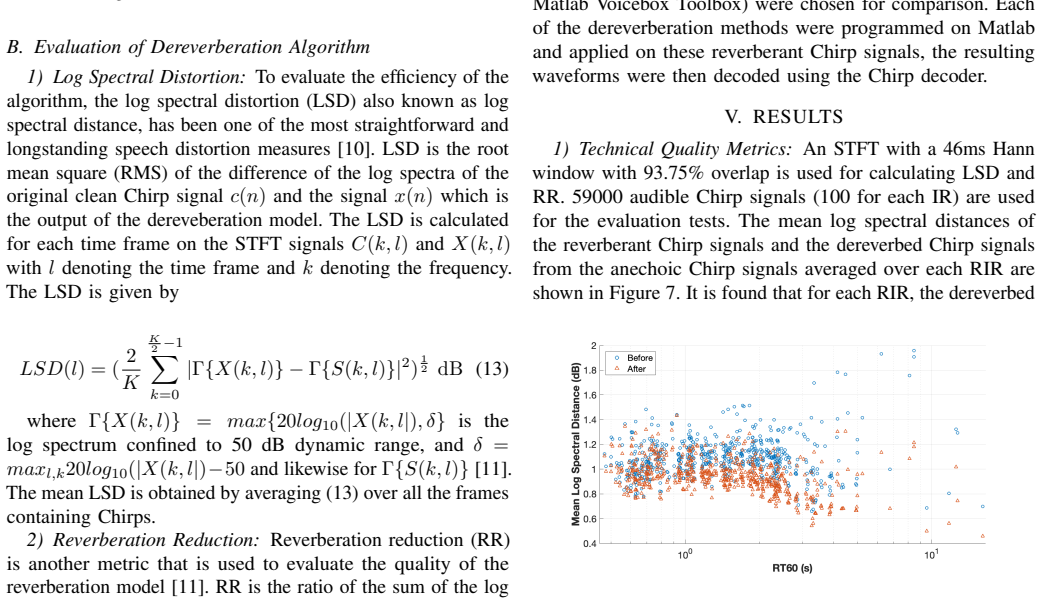
- [Table I and §V-B2] The decode-rate change in Table I is reported without confidence intervals or significance tests. Given the large sample size the effect is likely real, but because the 100 packets are reused across all 590 RIRs, a clustered analysis or a paired confidence interval would strengthen the claim.
- [§IV-B2 and Table II] The 'After' decode rates in Table II (77.79% audible, 87.79% inaudible) differ from the corresponding values in Table I (79.78% and 92.11%). The text should explicitly state that Table II uses a much smaller set (one packet per protocol, 590 RIRs) and explain why the absolute numbers differ.
- [§IV-B1, Eq. (13)] Equation (13) uses both X(k,l) and S(k,l), while the surrounding text refers to c(n) and x(n). The clean-signal symbol should be defined consistently, and the notation for the STFT of the clean signal should be introduced before the LSD formula.
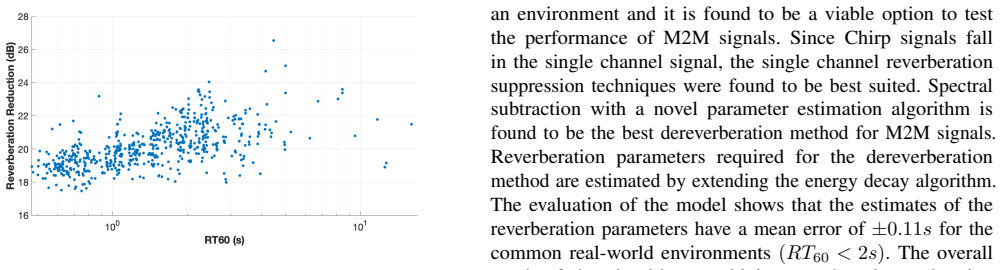
- [Figure 8 and §V-B1] The text says a positive correlation is noticed between reverberation reduction and RT60, but no correlation coefficient or fit is reported. Please include the numeric correlation and, if possible, a scatter plot with a trend line.
- [Throughout] There are several typos and formatting issues: 'dereveberation' in §IV-B, 'the the' in the introduction, and 'signifies' in §V-B1. These should be corrected in a final pass.
- [Reference [13]] Reference [13] is cited as the AcouSP RIR database, but the listed reference is a recommendation document for annotation of acoustic data collections. Please cite the actual RIR database with a URL and access date, or clarify how the 590 RIRs were obtained.
Circularity Check
No circular derivation: the decode-rate gain is an empirical outcome measured with an external decoder, and the RT60 estimator is validated against independently known RIR parameters.
full rationale
The paper makes no claim that the dereverberation improvement follows analytically from its inputs. The RT60 estimate is obtained by linear least-squares regression over measured subband energy decay (Sec. III-A, Eq. 3) and is checked against the known RT60 of 590 AcouSP RIRs (Sec. IV-A); the reported mean error of 0.11s for RT60 < 2s is an external validation, not a restatement of the algorithm's assumptions. The reverberation PSD (Eq. 5) is the standard Habets late-reverberation model, cited to [11]; the exponential attenuation is not defined out of the paper's own output. The central claim is the measured decode-rate change in Table I, before (54.53%, 86.15%) vs after (79.78%, 92.11%), obtained by running an actual Chirp decoder on 118,000 convolved signals. No equation in the paper reduces to its input by construction, no self-citation is load-bearing, and no fitted parameter is renamed as a prediction. The unreported pilot test and the manually chosen constants (T=80ms, beta=0.9, lambda=0.1) raise reproducibility and overfitting concerns, but they are not circularity: the reported outcome could have gone the other way under different choices and is measured, not derived.
Assumptions & free parameters
free parameters (5)
- Late-reverberation PSD delay T =
80 ms
- A priori SNR smoothing factor beta =
0.9
- Gain floor lambda =
0.1
- EDC regression range and subband threshold =
-5 dB to -35 dB; threshold value not reported
- Offset constant between energy peak and tone end =
Not reported
assumptions (4)
- domain assumption Each STFT subband of the reverberant Chirp signal follows Polack's exponentially decaying room model, so Eq. (2) holds per frequency bin.
- domain assumption The Chirp signal is stationary over short segments Tc with Tc <= T << RT60, allowing the late-reverberation PSD to be estimated as a delayed, attenuated copy of the past PSD in Eq. (5).
- domain assumption Synthetic convolution with the 590 AcouSP RIRs is a valid proxy for real-world M2M acoustic channels.
- domain assumption Linear least-squares regression of log-energy decay from -5 dB to -35 dB extrapolates to the -60 dB intercept.
Cite this review
Pith. "Pith review of Estimating & Mitigating the Impact of Acoustic Environments on Machine-to-Machine Signalling." pith.science (2026). https://pith.science/paper/4NBT6QKY
@misc{pith2026190804672,
  author       = {Pith},
  title        = {Pith review of: Estimating & Mitigating the Impact of Acoustic Environments on Machine-to-Machine Signalling},
  year         = {2026},
  howpublished = {\url{https://pith.science/paper/4NBT6QKY}},
  note         = {Machine review of arXiv:1908.04672}
}
read the original abstract
The advance of technology for transmitting Data-over-Sound in various IoT and telecommunication applications has led to the concept of machine-to-machine over-the-air acoustic signalling. Reverberation can have a detrimental effect on such machine-to-machine signals while decoding. Various methods have been studied to combat the effects of reverberation in speech and audio signals, but it is not clear how well they generalise to other sound types. We look at extending these models to facilitate machine-to-machine acoustic signalling. This research investigates dereverberation techniques to shortlist a single-channel reverberation suppression method through a pilot test. In order to apply the chosen dereverberation method a novel method of estimating acoustic parameters governing reverberation is proposed. The performance of the final algorithm is evaluated on quality metrics as well as the performance of a real machine-to-machine decoder. We demonstrate a dramatic reduction in error rate for both audible and ultrasonic signals.
Figures


Figures from the paper (4 more)


Reference graph
Works this paper leans on
-
[1]
Context-aware computing with sound,
A. Madhavapeddy, D. Scott, and R. Sharp, “Context-aware computing with sound,” Lecture Notes in Computer Science , vol. 2864, 12 2003
work page 2003
-
[2]
J. F ¨urst, K. Chen, M. Aljarrah, and P. Bonnet, “Leveraging physical locality to integrate smart appliances in non-residential buildings with ul- trasound and bluetooth low energy,” IEEE First International Conference on Internet-of-Things Design and Implementation (IoTDI) , 04 2016
work page 2016
-
[3]
Dhwani: Secure peer-to-peer acoustic nfc,
R. Nandakumar, K. K. Chintalapudi, V . Padmanabhan, and R. Venkatesan, “Dhwani: Secure peer-to-peer acoustic nfc,” in Proceedings of the ACM SIGCOMM 2013 Conference on SIGCOMM , SIGCOMM ’13, (New York, NY , USA), pp. 63–74, ACM, 2013
work page 2013
-
[4]
J. Pearson, S. Robinson, M. Jones, A. A. Nanavati, and N. Rajput, “Acqr: acoustic quick response codes for content sharing on low end phones with no internet connectivity,” in Mobile HCI, 2013
work page 2013
-
[5]
Single-channel online enhancement of speech corrupted by reverberation and noise,
C. S. J. Doire, M. Brookes, P. A. Naylor, C. M. Hicks, D. Betts, M. A. Dmour, and S. H. Jensen, “Single-channel online enhancement of speech corrupted by reverberation and noise,” IEEE/ACM Transactions on Audio, Speech, and Language Processing , vol. 25, pp. 572–587, March 2017
work page 2017
-
[6]
M. Wroblewski, D. E. Lewis, D. L. Valente, and P. G. Stelmachowicz, “Effects of reverberation on speech recognition in stationary and modu- lated noise by school-aged children and young adults,” Ear Hear, vol. 33, no. 6, pp. 731–744, 2012
work page 2012
-
[7]
O. Hazrati and P. C. Loizou, “The combined effects of reverberation and noise on speech intelligibility by cochlear implant listeners,” Int J Audiol, vol. 51, pp. 437–443, Jun 2012
work page 2012
-
[8]
M. Klatte, T. Lachmann, and M. Meis, “Effects of noise and reverberation on speech perception and listening comprehension of children and adults in a classroom-like setting,” Noise Health, vol. 12, no. 49, pp. 270–282, 2010
work page 2010
Show all 14 references
-
[9]
Near-ultrasound communication for tv’s 2nd screen services,
S. Ka, T. Hyun Kim, J. Ha, S. Hong Lim, S. Cheol Shin, J. Choi, C. Kwak, and S. Choi, “Near-ultrasound communication for tv’s 2nd screen services,” 22nd Annual International Conference , pp. 42–54, 10 2016
2016
-
[10]
P. A. Naylor and N. D. Gaubitch, Speech Dereverberation. Springer Publishing Company, Incorporated, 1st ed., 2010
2010
-
[11]
Single-channel speech dereverberation based on spectral subtraction,
E. Habets, “Single-channel speech dereverberation based on spectral subtraction,” Proceedings of the 15th Annual Workshop on Circuits, Systems and Signal Processing (ProRISC) , 01 2004
2004
-
[12]
J. D. Polack, La transmission de l’energie sonore dans les salles . Ph.D. dissertation, Universit´e du Maine, Le Mans, 1988
1988
-
[13]
The acousp recommendation for annotation of acoustic data collections. (version 1.0),
W. Kellermann, S. Makino, P. A. Naylor, and M. Omologo, “The acousp recommendation for annotation of acoustic data collections. (version 1.0),”
-
[2010]
Available:www.commsp.ee.ic.ac.uk/ acousp Accessed: 02-07-2018
[On-line]. Available:www.commsp.ee.ic.ac.uk/ acousp Accessed: 02-07-2018
2018
Reviewed August 14, 2026 · model on record in the stance chip above.
Discussion (0). Continue with ORCID to comment.