REVIEW 3 major objections 5 minor 24 references
Two-row $W$-graphs in affine type $A$
T0 review · 3 major / 5 minor · reviewed 2026-08-14 · deepseek-v4-flash
Pith's one-line read For two-row partitions of n, this paper constructs finite W-graphs for the affine symmetric group, proves their uniqueness under admissibility, and identifies them with quotients of periodic W-graphs under a positivity assumption.
desk verdict First family of finite affine-type W-graphs, with a real and potentially repairable gap: the paper repeatedly extends three external theorems to non-bipartite graphs without proof. read the letter →
The pith
A machine-rendered reading of the paper's core claim, the machinery that carries it, and where it could break.
The reading
What carries the argument
The load-bearing object is Γ_λ: the [1,n]-labeled graph whose vertices are row-standard Young tableaux of shape λ, whose labels are descent sets, and whose directed edges are the first-kind and second-kind moves, where second-kind moves are governed by five explicit arithmetic conditions involving cyclic intervals. This graph is checked against four Stembridge rules for admissible W-graphs; the polygon rule, requiring equality of path counts N^r_{ij}(u,v)=N^r_{ji}(u,v) over two- and three-step paths, is the technical heart and is proven by a detailed case analysis on pairs of tableaux differing in two or four entries. The same graph and its restriction to the finite symmetric group then serve as the uniqueness classifier: the admissibility theorems for type-A W-graphs, taken in their non-bipartite form, identify cells with standard graphs and force the directed edges of any competing graph to match those of Γ_λ.
What would settle it
Check whether the standard admissibility characterization really survives without bipartiteness: either the original proof uses bipartiteness at some step, or one can find a non-bipartite nb-admissible graph satisfying the four rules that is not a W-graph. A computational search over small finite graphs with descent-like labels would settle the theorem that certifies Γ_λ.
Extended reading notes
Core claim
Γ_λ is an [1,n]-labeled graph on RSYT(λ) with descent labels and edge weights 0 or 1. Its directed edges are of two kinds: first-kind moves swap i and i+1 between the two rows, while second-kind moves swap i from the second row with j from the first row subject to five explicit conditions about odd differences, neighboring entries, and interval counts. The main theorem is that Γ_λ satisfies the four local rules — compatibility, simplicity, bonding, and polygon — and therefore, by the extended admissibility theorem, is a true W-graph. The polygon rule, which equates two-step path counts, is verified case by case according to whether the endpoints differ by two or by four entries. The undirected skeleton U(Γ_λ) is exactly the affine dual equivalence graph D_λ, and the restriction of Γ_λ to the finite symmetric group splits into cells isomorphic to standard type-A W-graphs, labeled by semistandard tableaux. The uniqueness theorem states that when λ=(λ1,λ2) with λ1>λ2, any nb-admissible W-graph with underlying graph D_λ is isomorphic to Γ_λ; in the equal-row case the paper exhibits a minimal graph Γ'_λ embedded in every such graph and shows that Γ_λ is maximal among translation-invariant ones. Under the conjectural nonnegativity of periodic W-graph coefficients, Γ_λ is isomorphic to the quotient Γ^quot_λ of the periodic W-graph.
Load-bearing premise
The argument depends on the assertion that the standard structure theorems for admissible W-graphs remain true when the bipartiteness condition is removed, with proofs said to carry over essentially verbatim even though no demonstration is supplied.
Editorial extensions
If this is right
- If correct, the paper supplies the first infinite family of finite W-graphs in an affine type that is built purely combinatorially, without representation-theoretic input.
- Every two-row affine dual equivalence graph can be enriched with directed edges to a genuine W-graph, resolving the enrichment question for these shapes.
- When the two rows have unequal length, the W-graph is pinned down by its undirected skeleton: any nb-admissible W-graph with that skeleton is the same graph, so the directed edges are not extra free data.
- Restricting Γ_λ to the finite symmetric group gives modules whose Frobenius characters are Hall-Littlewood symmetric functions, yielding a tableau model for those representations.
- If the periodic-W-graph coefficients are nonnegative, the affine two-row W-graphs coincide with quotients of periodic W-graphs, connecting the construction to canonical bases and Springer theory.
Reading between the lines
- One implicit consequence is that the bipartiteness hypothesis may be safely dropped throughout the theory of admissible W-graphs; if so, the same four-rule characterization can be used to search for finite W-graphs in other affine types.
- The move rules for Γ_λ resemble an affine analogue of Knuth moves, so they may yield a new notion of affine dual equivalence useful for other representation-theoretic statistics.
- The equal-length case hints at a whole family of intermediate graphs parameterized by integer weights on cross-component edges; the paper notes this possibility but does not develop it, so one could test systematically which of those intermediate graphs are W-graphs.
- The isomorphism with quotients of periodic W-graphs is conditional on a positivity conjecture; if that conjecture holds, the explicit moves give a combinatorial handle on canonical bases in affine Springer theory.
Signed reviews
Editorial analysis
A structured set of objections, weighed in public.
Referee Report
Summary. The paper constructs a finite [1,n]-labeled graph Γ_λ on row-standard Young tableaux of a two-row partition λ, with moves of the first and second kind defined in Section 4.1, and claims in Theorem 4.9 that Γ_λ is a finite W-graph (S̃_n-graph) for the affine symmetric group. The proof checks Stembridge's four rules for nb-admissible graphs via a lengthy case analysis in Sections 5–6, using Theorem 3.1, an asserted extension of Stembridge's characterization to non-bipartite admissible graphs. The paper further proves uniqueness of such W-graphs for unequal two-row shapes (Theorem 8.6), minimality and maximality results for equal shapes (Theorems 9.6 and 9.10), and identifies the construction with a quotient of Lusztig's periodic W-graphs under a positivity assumption (Theorem 10.7).
Significance. If the main theorems hold, this is the first non-trivial family of finite W-graphs in an affine type with an explicit combinatorial rule, and it gives a strong uniqueness statement. The construction is concrete and testable: Γ_λ has no free parameters, its undirected part is the affine dual equivalence graph D_λ from [CLP17, CPY18], and the paper provides many worked examples. The proof structure is transparent, and the comparison with periodic W-graphs suggests a general conjecture. The main weakness is the repeated reliance on unproved 'verbatim' extensions of external theorems to the non-bipartite setting, which are load-bearing for both existence and uniqueness.
major comments (3)
- [§3.7, Theorem 3.1] The proof of Theorem 3.1 is a one-sentence appeal to [Ste08a, Theorem 4.9] with the assertion that Stembridge's proof 'does not use the bipartition assumption.' This is not a proof. The notion of nb-admissible graphs is new to this paper, and the bipartiteness condition may be used implicitly in Stembridge's arguments (for example, in defining the sign conventions in the Simplicity Rule or in the derivation of the Polygon Rule). Since Theorem 4.9 invokes Theorem 3.1 directly, the existence of Γ_λ as a W-graph is not independently verifiable from the manuscript. Please provide a complete proof of Theorem 3.1, or at minimum a detailed line-by-line verification that each step of Stembridge's proof survives without bipartiteness, with specific references to [Ste08a].
- [§7.2, Theorems 7.1–7.3 and Lemma 9.8] The same verbatim-transfer argument is used for Chmutov's Theorem 7.1, Nguyen's Theorems 7.2 and 7.3, and Chmutov's arc-transport Lemma 9.8. These results are not peripheral: Theorem 7.1 underlies the description of cells in Proposition 7.5, Theorem 7.2 and Theorem 7.3 are used in the proof of uniqueness (Theorem 8.6) and in Theorems 9.6 and 9.10, and Lemma 9.8 is used in the maximality argument. The paper does not identify where bipartiteness is used (or not used) in the original sources. As a result, the uniqueness theorem inherits the same gap. Please provide either full proofs adapted to nb-admissible graphs or precise statements of the corresponding theorems in the original setting and a reduction from the nb-admissible case to the admissible case.
- [§6.2.3 and Lemma 6.1] The Polygon Rule verification for the four-element case (Section 6) is the core technical argument for Theorem 4.9, but several subcases are not actually written out. In Section 6.2.3, the cases d = a+2, d = a−1, b = a−1, b = a+2 are each dismissed with 'the same argument works verbatim' from generic cases, and in Lemma 6.1 the case {i,j} = {a,b} is declared 'essentially verbatim' after a substitution. The reader cannot check whether the inequalities in conditions (d) and (e) of Definition 4.1 behave identically in these special cases (for instance, when intervals such as ⌜d+2, a−2⌟ become empty). Please write out these subcases or give a precise reduction that proves the equality from the generic case.
minor comments (5)
- [§5.3.2] In the paragraph following the definition of the set T, the expression 'n − 2k ∈ f T' appears to be a typo for 'n − 2k ∈ T'.
- [§4.3] The condition 'i ⁄∈ {j − 1, j, j + 1}' is typeset with a nonstandard symbol; it should be the standard 'i ∉ {j−1, j, j+1}'.
- [§7.3, Proposition 7.4] The term 'dual Knuth move' is used without a definition in the text; the reader must infer it from the context of [Hai92].
- [References] The references [Fun03a] and [Fun03b] appear to refer to the same paper; the text uses both labels in a way that may confuse readers.
- [§10.5] The construction of Γ^quot_λ involves finite sums over infinite γ-orbits; the paper states that finiteness follows from [Var04] and [Lus97, Consequence 13.8], but the precise statement of that consequence is not quoted, making the finiteness claim hard to verify without consulting the sources.
Circularity Check
No significant circularity; the central W-graph claim is verified against Stembridge's external characterization, and uniqueness is benchmarked to Chmutov and Nguyen's external results.
full rationale
The derivation chain is not circular. The graph Γ_λ is explicitly defined by concrete moves on RSYT(λ), and Theorem 4.9 is proved by verifying Stembridge's four combinatorial rules, using Theorem 3.1 as an external characterization theorem. The only 'verbatim' extension is Stembridge's theorem from admissible to nb-admissible graphs (Section 3.7); this is a correctness assumption about the scope of an external theorem, not a definitional reduction of the conclusion to the hypothesis. The uniqueness Theorem 8.6 invokes Chmutov's Theorem 7.1 and Nguyen's Theorems 7.2 and 7.3 as external benchmarks; these are not results of the present paper and are not derived from Γ_λ. The affine dual equivalence graph D_λ from [CLP17, CPY18] is used as an input constraint U(Γ) ≅ D_λ, not as the target of derivation. Section 10 explicitly assumes Lusztig's open positivity conjecture when identifying Γ_λ with the quotient of a periodic W-graph, and the paper flags this dependence; this is uncertainty, not circularity. No parameter is fitted, no input is renamed as a prediction, and no load-bearing step reduces by construction to the paper's own assertions. The repeated claim that Stembridge, Chmutov, and Nguyen proofs 'carry through essentially verbatim' without bipartiteness is a verification gap, but a gap is not circularity.
Assumptions & free parameters
assumptions (7)
- domain assumption Stembridge's characterization of admissible W-graphs extends to nb-admissible (non-bipartite) graphs.
- domain assumption Chmutov's theorem that cells of nb-admissible S_n-graphs are simple components isomorphic to D_µ remains valid without bipartiteness.
- domain assumption Nguyen's theorems, that every nb-admissible S_n-graph has Kazhdan-Lusztig cells and is ordered, remain valid without bipartiteness.
- standard math The affine dual equivalence graph D_λ of [CLP17, CPY18] and its connectivity properties, including the charge modulo 2 structure.
- domain assumption Nonnegativity of the µ-function, equivalently Lusztig's Conjecture 13.16, for Lusztig's periodic W-graphs.
- standard math Varagnolo's finiteness theorem for the periodic W-graph canonical basis in type A.
- standard math Standard Robinson-Schensted-Knuth correspondence facts and jeu-de-taquin/promotion facts used in Section 8.1.
invented entities (2)
-
Finite W-graph Γ_λ for two-row shapes in affine type A
independent evidence
-
nb-admissible W-graphs (admissibility without bipartiteness)
Cite this review
Pith. "Pith review of Two-row $W$-graphs in affine type $A$." pith.science (2026). https://pith.science/paper/VDSABSZP
@misc{pith2026190804707,
  author       = {Pith},
  title        = {Pith review of: Two-row $W$-graphs in affine type $A$},
  year         = {2026},
  howpublished = {\url{https://pith.science/paper/VDSABSZP}},
  note         = {Machine review of arXiv:1908.04707}
}
abstract
For affine symmetric groups we construct finite $W$-graphs corresponding to two-row shapes, and prove their uniqueness. This gives the first non-trivial family of examples of finite $W$-graphs in an affine type. We compare our construction with quotients of periodic $W$-graphs defined by Lusztig. Under certain positivity assumption on the latter the two are shown to be isomorphic.
Figures

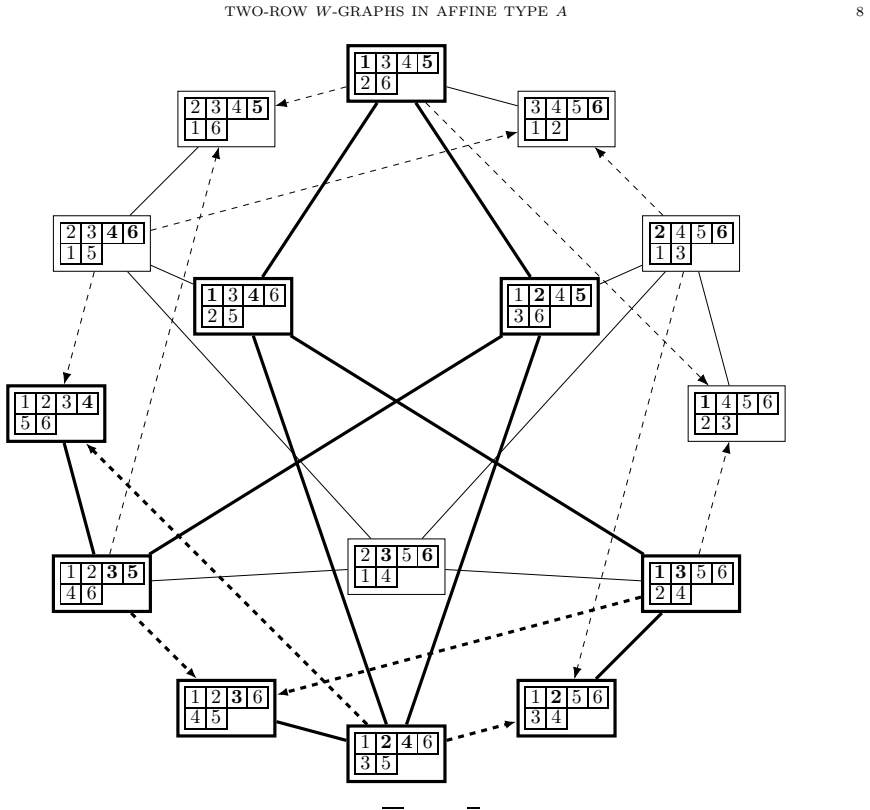
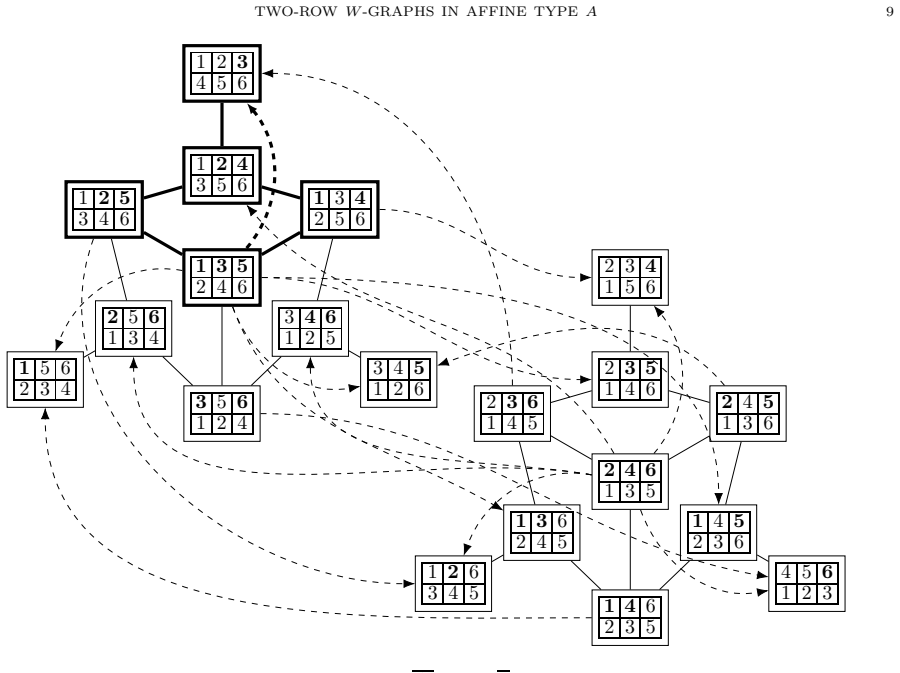
Figures from the paper (2 more)
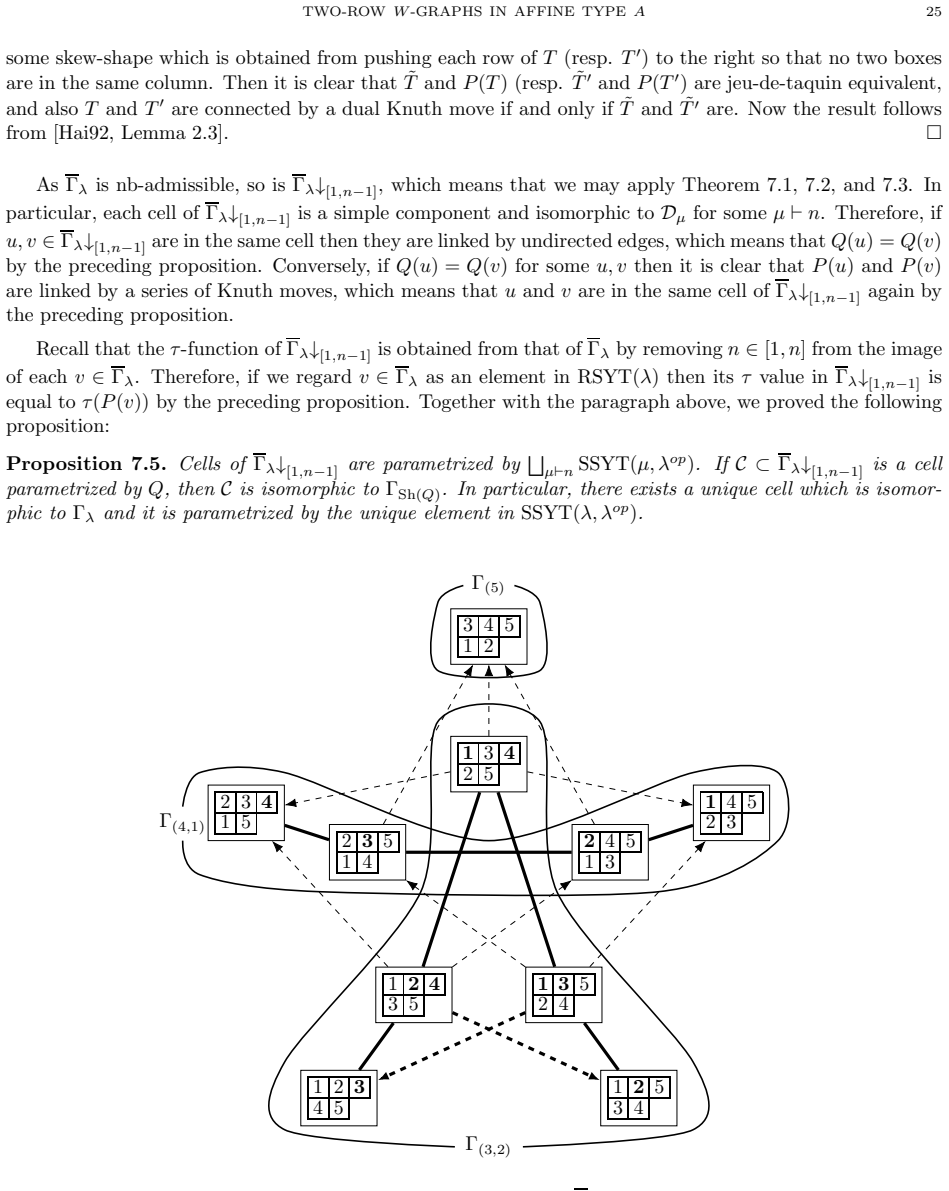

Reference graph
Works this paper leans on
-
[1]
Sami H. Assaf and Sara C. Billey, Affine dual equivalence and k - S chur functions , J. Comb. 3 (2012), no. 3, 343--399
work page 2012
-
[2]
Sami Hayes Assaf, Dual equivalence graphs, ribbon tableaux and M acdonald polynomials , ProQuest LLC, Ann Arbor, MI, 2007, Thesis (Ph.D.)--University of California, Berkeley
work page 2007
-
[3]
Roman Bezrukavnikov and Ivan Mirkovi \'c , Representations of semisimple L ie algebras in prime characteristic and noncommutative S pringer resolution , Ann. of Math. (2) 178 (2013), no. 3, 835--919
work page 2013
-
[4]
Michael Chmutov, Gabriel Frieden, Dongkwan Kim, Joel Brewster Lewis, and Elena Yudovina, An affine generalization of evacuation, Available at https://arxiv.org/abs/1806.07429 (2018)
work page Pith review arXiv 2018
-
[5]
Michael Chmutov, Type A molecules are K azhdan- L usztig , J. Algebraic Combin. 42 (2015), 1059--1076
work page 2015
-
[6]
Michael Chmutov, Joel Brewster Lewis, and Pavlo Pylyavskyy, Monodromy in K azhdan- L usztig cells in affine type A , Available at https://arxiv.org/abs/1706.00471 (2017)
work page Pith review arXiv 2017
-
[7]
Michael Chmutov, Pavlo Pylyavskyy, and Elena Yudovina, Matrix-ball construction of affine R obinson- S chensted correspondence , Selecta Math. (N. S.) 24 (2018), no. 2, 667--750
work page 2018
-
[8]
Francis Y. C. Fung, On the topology of components of some S pringer fibers and their relation to K azhdan- L usztig theory , Adv. Math. 178 (2003), no. 2, 244--276
work page 2003
Show all 24 references
-
[9]
, On the topology of components of some S pringer fibers and their relation to K azhdan- L usztig theory , Adv. Math. 178 (2003), 244--276
2003
-
[10]
Haiman, Dual equivalence with applications, including a conjecture of P roctor , Discrete Math
Mark D. Haiman, Dual equivalence with applications, including a conjecture of P roctor , Discrete Math. 99 (1992), no. 1--3, 79--113
1992
-
[11]
David Kazhdan and George Lusztig, Representations of C oxeter groups and H ecke algebras , Invent. Math. 53 (1979), no. 2, 165--184
1979
-
[12]
, Fixed point varieties on affine flag manifolds, Israel J. Math. 62 (1988), no. 2, 129--168
1988
-
[13]
Knuth, Permutations, matrices, and generalized Y oung tableaux , Pacific J
Donald E. Knuth, Permutations, matrices, and generalized Y oung tableaux , Pacific J. Math. 34 (70), no. 3, 709--727
-
[14]
George Lusztig, Hecke algebras and J antzen's generic decomposition patterns , Adv. Math. 37 (1980), 121--164
1980
-
[15]
Theory 1 (1997), 207--279
, Periodic W -graphs , Represent. Theory 1 (1997), 207--279
1997
-
[16]
I I , Represent
, Bases in equivariant K -theory. I I , Represent. Theory 3 (1999), 281--353
1999
-
[17]
Van Minh Nguyen, Type A -admissible cells are K azhdan- L usztig , Available at https://arxiv.org/abs/1807.07457 (2018)
2018 arXiv
-
[18]
Arun Ram, A F robenius formula for the characters of the H ecke algebras , Invent. Math. 106 (1991), no. 3, 461--488
1991
-
[19]
392, Cambridge U niversity P ress, 2011, pp
Bruce Sagan, The cyclic sieving phenomenon: a survey, Surveys in C ombinatorics 2011 (Robin Chapman, ed.), London M athematical S ociety L ecture N ote S eries, vol. 392, Cambridge U niversity P ress, 2011, pp. 183--234
2011
-
[20]
2, Cambridge S tudies in A dvanced M athematics, no
Richard Peter Stanley, Enumerative C ombinatorics , vol. 2, Cambridge S tudies in A dvanced M athematics, no. 62, Cambridge U niversity P ress, 1986
1986
-
[21]
Stembridge, Admissible W -graphs , Represent
John R. Stembridge, Admissible W -graphs , Represent. Theory 12 (2008), 346--368
2008
-
[22]
, More W -graphs and cells: molecular components and cell synthesis , Available at http://atlas.math.umd.edu/papers/summer08/stembridge08.pdf, 2008
2008
-
[23]
Groups 9 (2004), no
Michela Varagnolo, Periodic modules and quantum groups, Transform. Groups 9 (2004), no. 1, 73--87
2004
-
[24]
Westbury, The representation theory of the T emperley- L ieb algebras , Math
Bruce W. Westbury, The representation theory of the T emperley- L ieb algebras , Math. Z. 219 (1995), 539--565
1995
Reviewed August 14, 2026 · model on record in the stance chip above.
Discussion (0). Continue with ORCID to comment.