REVIEW 3 major objections 5 minor 42 references
Quantifying information loss on chaotic attractors through recurrence networks
T0 review · 3 major / 5 minor · reviewed 2026-08-14 · deepseek-v4-flash
Pith's one-line read The paper shows that a new recurrence-network entropy measure saturates as a chaotic-attractor fingerprint and quantifies noise-driven information loss through link-density gaps.
desk verdict The proposed entropy measure for recurrence networks is plausible and partly useful, but Table 1's numbers do not satisfy the paper's own defining relation, so the central quantitative claim currently does not hold. read the letter →
The pith
A machine-rendered reading of the paper's core claim, the machinery that carries it, and where it could break.
The reading
What carries the argument
The load-bearing object is the network entropy $$E_m = -\frac{1}{N}\sum_{i=1}^N \left[p_i\log p_i + (1-p_i)\log(1-p_i)\right],\qquad p_i = \frac{k_i}{N-1},$$ with $k_i$ the degree of node $i$. The second term, counting the information carried by absent links, is the paper's addition to the usual Shannon entropy of the degree distribution. For a homogeneous network the formula collapses to $E_m^h(\rho) = -[\rho\log\rho - \rho\log(1-\rho)+\log(1-\rho)]$, where $\rho = 2L/N(N-1)$ is the link density; this one-hump function peaks at $\rho=1/2$ with value $\log 2$. The recurrence network itself is constructed by time-delay embedding of the time series and placing an edge between two nodes when their embedded points lie within a threshold $\epsilon$, with $\epsilon$ fixed by the authors' earlier scheme. The machinery works by comparing the measured $E_m$ of a recurrence network with the homogeneous value at the same link density: the deficit $\Delta E_m$, or equivalently the link-density shift $\Delta\rho$, is interpreted as structural information loss.
What would settle it
Compute $E_m$ for recurrence networks built from a chaotic system with strongly non-uniform phase-space density, such as a hyperchaotic or intermittent system, using the same $\epsilon$ values ($0.06, 0.10, 0.14, 0.18$ for $M=2$ to $5$): if $E_m$ fails to saturate with $N$ or $M$, or drifts toward the white-noise value, the claim that $E_m$ is a characteristic attractor property is falsified. A second check is to rebuild the same attractors with a different accepted threshold rule and see whether the ordering of $\Delta\rho$ across attractors is preserved.
Extended reading notes
Core claim
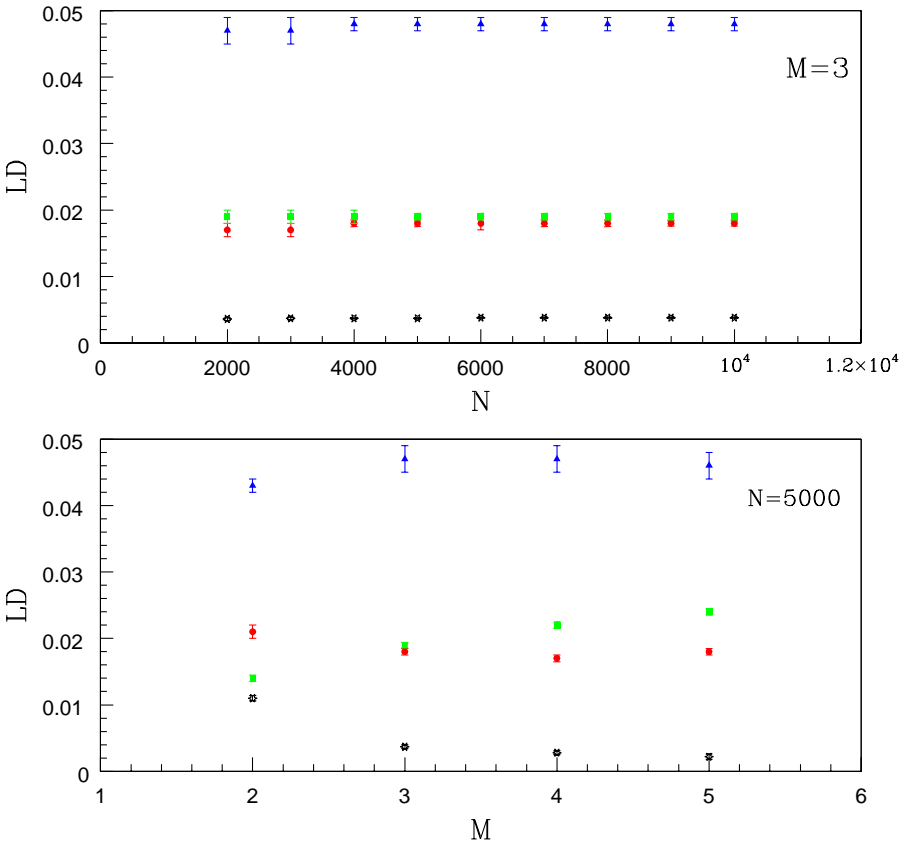
The paper's central claim is that the recurrence-network entropy $E_m$ defined in Eq. (2) is a characteristic property of a chaotic attractor: under the authors' recurrence-threshold scheme, $E_m$ converges to a constant as the number of nodes $N$ and embedding dimension $M$ increase, and it separates chaotic attractors from white noise. For an attractor's recurrence network with link density $\rho_c$ and entropy $E_m^c$, the gap $\Delta E_m = |E_m^h(\rho_c) - E_m^c|$ to the homogeneous network of the same link density, equivalently expressed as the link-density difference $\Delta \rho = |\rho_c - \rho_h|$, is taken as the information loss caused by structural change. The paper demonstrates the measure on noise-contaminated attractors and on a variable-star light curve, where the computed $\Delta E_m$ and $\Delta \rho$ indicate nonlinear, non-stochastic variability.
Load-bearing premise
The load-bearing premise is that the fixed recurrence threshold $\epsilon$ chosen per embedding dimension by the authors' earlier scheme faithfully captures attractor structure for every chaotic system and for white noise; the paper tests stability around those values mainly for the Lorenz system and white noise, so if the threshold rule fails elsewhere the saturation and information-loss claims could be artifacts of that choice.
Editorial extensions
If this is right
- For fixed embedding dimensions $M=2$ to $5$, $E_m$ can be treated as a stable fingerprint of a chaotic attractor, independent of time-series length once $N$ exceeds a few thousand points.
- Noise-induced structural loss can be tracked by the ratio $R(\rho)=(\rho_c-\rho)/(\rho_c-\rho_w)$, which rises from $0$ for the clean attractor to $1$ for white noise and behaves approximately identically for different chaotic systems.
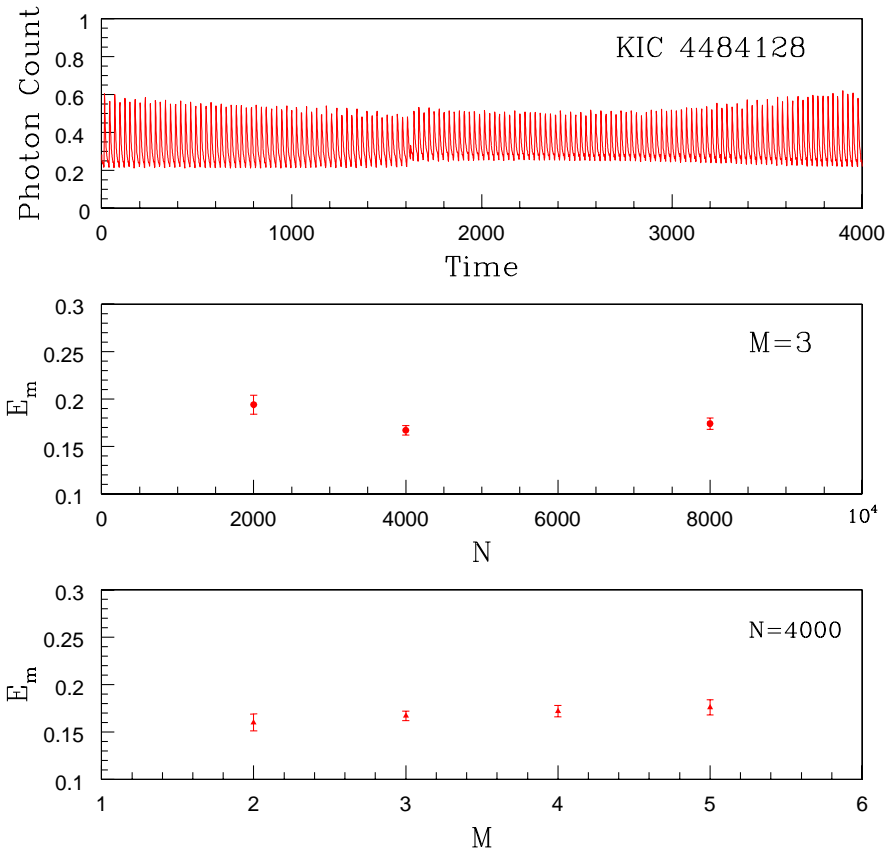
- The gap measures $\Delta E_m$ and $\Delta \rho$ provide a discriminating statistic for real data: the variable-star light curve KIC 4484128 yields values close to those of chaotic systems, arguing against a purely stochastic origin.
- Because the measure is normalized by $N$, it avoids the finite-data problems of correlation-dimension estimates for short experimental records.
Reading between the lines
- Beyond the paper, the same entropy gap could serve as a general structural-complexity index for any unweighted undirected network, not only recurrence networks, letting practitioners compare networks of different sizes on a common scale.
- The near-universal curve for $R(\rho)$ suggests a possible noise-amplitude estimator, but only if colored noise and dynamical noise are tested; the paper itself tests only additive white noise.
- If the threshold scheme is replaced by a fixed link-density rule, the ordering of attractors by $\Delta \rho$ may change; this is a testable extension that would separate the measure's content from the threshold convention.
Signed reviews
Editorial analysis
A structured set of objections, weighed in public.
Referee Report
Summary. The paper introduces an entropy measure Em for unweighted undirected networks, defined through per-node probabilities p_i=k_i/(N-1) in Eq. (2), with an extra term accounting for absent links. For homogeneous networks the measure reduces to the closed form Eh_m(ρ) in Eq. (7), a one-hump function of link density with maximum log 2 at ρ=1/2. Recurrence networks are constructed from chaotic time series using the threshold scheme of the authors' prior work, and numerical experiments on Lorenz, Rössler, Hénon, and white noise show saturation of Em with the number of nodes N and embedding dimension M. The paper proposes that the difference ΔEm=|Eh_m(ρc)−Ec_m|, together with the associated link-density difference Δρ=|ρc−ρh|, quantifies structural information loss on chaotic attractors, and applies the approach to a Kepler RR Lyrae light curve, claiming that the measure rules out pure stochastic variability.
Significance. If the central claims hold, the measure would be a simple, directly computable scalar that is stable with respect to N and M and could quantify noise-induced structural change on attractors in terms of link density. The homogeneous-network formula is exact, and the saturation plots for standard attractors are a useful check. The potential applicability to short real-world time series is also attractive. However, the quantitative connection between entropy difference and link-density difference currently rests on Table 1, which is internally inconsistent, and several statements (uniqueness, the heterogeneous-network minimum, and the claim of ruling out stochastic processes) exceed what the presented evidence supports. With those points corrected, the contribution would be a modest but useful addition to recurrence-network analysis.
major comments (3)
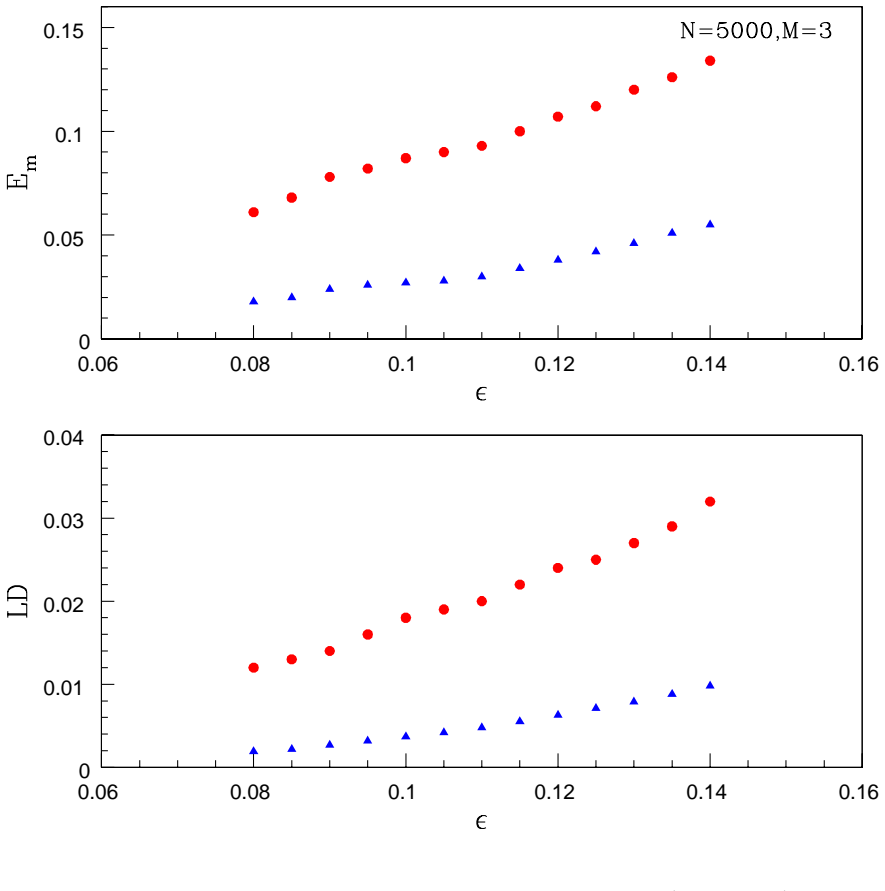
- [Section 4, Table 1] The numbers in Table 1 do not satisfy the defining relation Eh_m(ρh)=Ec_m stated in the text. For Lorenz, with ρc=0.0184 and ΔEm=0.0034, Eq. (7) gives Eh_m(ρc)=0.0917 nats, so Ec_m=0.0883; solving Eh_m(ρ)=0.0883 gives ρ≈0.0175, not the reported ρh=0.0162. The same discrepancy appears for Rössler (reported 0.0194 vs computed about 0.0204) and Hénon (0.0421 vs about 0.0434); only the white-noise row is roughly consistent. Because the paper's headline claim is that Δρ measures information loss through the relation between Eh_m and Ec_m, this inconsistency is load-bearing. Please recompute Table 1 or clarify the definitions of ρh and Δρ.
- [Section 2, paragraph after Eq. (7)] The assertion that 'the entropy measure proposed here is minimum for the completely heterogeneous network' with degree sequence {1,2,...,N−1} is not proved and is not correct as stated. For N nodes there are only N−1 positive degree values available, so no network with no isolated nodes can realize a distinct degree for every node; moreover, for a fixed link density ρ, the minimum of the per-node binary entropy sum occurs at extremal distributions (as many p_i as possible at 0 or 1), not at the uniformly spread sequence {1,...,N−1}, which has mean ρ=1/2. The maximum property Eh_m≥Em used in Section 4 follows from concavity and is sufficient; the minimum claim should be removed or replaced by a correct statement.
- [Sections 3 and 5] The generality of the threshold scheme is assumed rather than demonstrated. Fig. 3 tests robustness to ε only for Lorenz and white noise, yet the paper concludes that Em is a characteristic property of 'every chaotic attractor' and applies the measure unconditionally to real data. In particular, the statement in Section 5 that the average values ΔEm=0.0066 and Δρ=0.0031 for the light curve 'rules out pure stochastic process' is not justified without a null model or surrogate test; white noise is only one member of the stochastic class, and colored or measurement noise could give similar values. Please add a surrogate analysis or soften the claim.
minor comments (5)
- [Section 3, Fig. 4] The text says 'as Δt becomes large, the attractor gets slightly over sampled'; a larger sampling interval corresponds to undersampling, not oversampling. Please correct the wording.
- [Eq. (3)] Eq. (3) contains a redundant expression and can be simplified to the form in Eq. (7); please use the consistent form −[ρ log ρ + (1−ρ) log(1−ρ)] throughout to avoid sign-convention misreading.
- [Section 5] The values ΔEm=0.0066 and Δρ=0.0031 for the light-curve segments are reported without segment-to-segment variability; given that the data are divided into several segments, please report mean ± standard deviation or a range.
- [Section 6] The conclusion states that 'the finiteness of the data will not affect the accuracy of the analysis since the measure is independent of N', but Fig. 1 shows saturation rather than exact independence for all N; please rephrase to 'approximately independent after saturation'.
- [Throughout] Minor typographical issues include 'un-weighted' and 'un-directed' in the Abstract and an encoding artifact in 'R¨ossler' in the text.
Circularity Check
No significant circularity: the entropy measure is computed directly from the data, and the link-density representation is a reparameterization rather than a fitted prediction.
full rationale
The proposed measure Em is computed directly from the recurrence-network degree distribution via Eq. (2), with no fitted parameters, and its saturation with N and M and its distinction from white noise are established by direct computation on standard systems. The information-loss quantification in Sec. 4 is a reparameterization: rho_h is defined by the condition E^h_m(rho_h) = E^c_m, so Delta_rho = |rho_c - rho_h| is a monotone function of Delta E_m by construction. This is an equivalent representation of the entropy difference, not a prediction derived from fitted inputs. The only self-citation is the recurrence-threshold scheme of Ref. [37], which is a construction rule for the networks; the paper tests stability around the chosen thresholds in Fig. 3 and does not use the citation to import a uniqueness theorem or to forbid alternatives. A reviewer's arithmetic check indicates that the reported values in Table 1 may not satisfy Eq. (7) for all rows, but that would be a consistency/correctness issue rather than a circularity; it does not show that any claimed result reduces to its own input. Overall, no circular step is exhibited.
Assumptions & free parameters
free parameters (3)
- Recurrence threshold epsilon(M) =
0.06, 0.10, 0.14, 0.18 for M = 2, 3, 4, 5
- Sampling interval Delta t =
0.05 (Lorenz)
- Embedding delay tau
assumptions (4)
- domain assumption The recurrence threshold scheme from Ref. [37] is valid: the critical range of epsilon is approximately identical for chaotic systems and white noise and depends only on embedding dimension M.
- standard math Takens' time-delay embedding theorem reconstructs the attractor from a scalar time series.
- ad hoc to paper The entropy measure Em is minimum for the completely heterogeneous network with degree sequence {1,2,...,N-1}.
- domain assumption The difference between Em and the homogeneous-network entropy |E_h^m - E_m| represents the information needed to transform one network into another.
Cite this review
Pith. "Pith review of Quantifying information loss on chaotic attractors through recurrence networks." pith.science (2026). https://pith.science/paper/WHZSLW4D
@misc{pith2026190804731,
  author       = {Pith},
  title        = {Pith review of: Quantifying information loss on chaotic attractors through recurrence networks},
  year         = {2026},
  howpublished = {\url{https://pith.science/paper/WHZSLW4D}},
  note         = {Machine review of arXiv:1908.04731}
}
read the original abstract
We propose an entropy measure for the analysis of chaotic attractors through recurrence networks which are un-weighted and un-directed complex networks constructed from time series of dynamical systems using specific criteria. We show that the proposed measure converges to a constant value with increase in the number of data points on the attractor (or the number of nodes on the network) and the embedding dimension used for the construction of the network, and clearly distinguishes between the recurrence network from chaotic time series and white noise. Since the measure is characteristic to the network topology, it can be used to quantify the information loss associated with the structural change of a chaotic attractor in terms of the difference in the link density of the corresponding recurrence networks. We also indicate some practical applications of the proposed measure in the recurrence analysis of chaotic attractors as well as the relevance of the proposed measure in the context of the general theory of complex networks.
Figures

Figures from the paper (4 more)


Reference graph
Works this paper leans on
-
[1]
J. C. Sprott, Chaos and Time Series Analysis (Oxford University Press, Oxford, 2003)
work page 2003
-
[2]
R. C. Hilborn, Chaos and Nonlinear Dynamics , (Oxford University Press, Oxford, 1994)
work page 1994
-
[3]
M. B. Kennel and S. Isabelle, Method to distinguish possible chaos from colored noise, Phys. Rev. A 46, 3111 (1992)
work page 1992
-
[4]
H. D. I. Abarbanel, Analysis of observed chaotic data , (Springer, New York, 1996)
work page 1996
- [5]
- [6]
-
[7]
Y. Yang and H. Yang, Complex network based time series analysis , Physica A 387, 1381 (2008) 18
work page 2008
-
[8]
R. V. Donner, Y. Zou, J. F. Donges, N. Marwan and J. Kurths, Recurrence networks: A novel paradigm for nonlinear time series analys is, New J. Phys. 12, 033025 (2010)
work page 2010
Show all 42 references
-
[9]
S. H. Strogatz, Exploring complex networks , Nature 410, 268 (2001)
2001
-
[10]
M. E. J. Newman, The structure and function of complex networks , SIAM Rev. 45, 167 (2003)
2003
-
[11]
Barzel and A
B. Barzel and A. L. Barabasi, Universality in network dynamics , Nature Phys. 9, 673 (2013)
2013
-
[12]
Pompe, Permutation entropy: A natural complexity measure for time series analysis , Phys
C.Bandt and B. Pompe, Permutation entropy: A natural complexity measure for time series analysis , Phys. Rev. Lett. 88, 174102 (2002)
2002
-
[13]
Demetrius and T
L. Demetrius and T. Manke, Robustness and network evolution - an entropic principle, Physica A 346, 682 (2005)
2005
-
[14]
M. H. Safar, I. Y. Sorkhoh, H. M. Farahat and K. A. Mahdi, On maximizing the entropy of complexnetworks , Procedia Comp. Sci. 5, 480 (2011)
2011
-
[15]
Bianconi, Entropy of network ensembles , Phys
G. Bianconi, Entropy of network ensembles , Phys. Rev. E 79, 036114 (2009)
2009
-
[16]
J. P. Eckmann, S. O. Kamphorst and D. Ruelle, Recurrence plot of dynamical systems, Europhys Letters 5, 973 (1987)
1987
-
[17]
Balian, From Microphysics to Macrophysics , (Springer, New York, 1991)
R. Balian, From Microphysics to Macrophysics , (Springer, New York, 1991)
1991
-
[18]
T. M. Cover and J. A. Thomas, Elements of Information Theory , (Wiley, New York, 1991)
1991
-
[19]
Beck and F
C. Beck and F. Schlogl, Thermodynamics of chaotic systems , (Cambridge University Press, Cambridge, 1993)
1993
-
[20]
Bonchev, Information theoretic indices for characterization of chem ical structures, (Research Studies Press, Chichester, 1983)
D. Bonchev, Information theoretic indices for characterization of chem ical structures, (Research Studies Press, Chichester, 1983)
1983
-
[21]
Dehmer and A
M. Dehmer and A. Mowshowitz, A history of graph entropy measures , Information Sciences 181, 57 (2011)
2011
-
[22]
Anand and G
K. Anand and G. Bianconi, Entropy measures for networks: Toward an information theory of complex topologies , Phys. Rev. E 80, 045102(R) (2009)
2009
-
[23]
Y. Zou, R. V.Donner, N. Marwan, J. F. Donges and J. Kurths , Complex network approaches to nonlinear time series analysis , Phys. Reports 787, 1-97 (2019)
2019
-
[24]
Sole and S
R. Sole and S. Volverde, Information theory of complex networks: On evolution and architectural constraints, Complex Networks 650, 189 (2004)
2004
-
[25]
Rinku Jacob, K. P. Harikrishnan, R. Misra and G. Ambika, Measure for degree heterogeneity in complex networks and its application to re currence network analysis, Royal Soc. Open Sci. 4, 160757 (2017)
2017
-
[26]
Zhang and M
J. Zhang and M. Small, Complex networks from pseudoperiodic time series: topology versus dynamics , Phys. Rev. Lett. 96, 238701 (2006) 19
2006
-
[27]
X. Xu, J. Zhang and M. Small, Super family phenomena and motifs of networks induced from time series , Proc. Natl. Acad. Sci. USA 105, 19601 (2008)
2008
-
[28]
Gao and N
Z. Gao and N. Jin, Complex networks from time series based on phase space reconstruction, Chaos 19, 033137 (2009)
2009
-
[29]
R. V. Donner, M. Small, J. F. Donges, N. Marwan, Y. Zou, R. Xiang and J. Kurths, Recurrence based time series analysis by means of complex ne twork methods, Int. J. Bif. Chaos 21, 1019 (2011)
2011
-
[30]
R. V. Donner, J. Heitzig, J. F. Donges, Y. Zou, N. Marwan a nd J. Kurths, The geometry of chaotic dynamics-A complex network perspectiv e, European Phys. J. B 84, 653 (2011)
2011
-
[31]
J. F. Donges, R. V. Donner, K. Rehfeld, N. Marwan, M. H. Tr auth and J. Kurths, Identification of dynamical transitions in marine palaeocli mate records by recurrence network analysis , Nonlinear Proc. Geophys. 18, 545 (2011)
2011
-
[32]
Marwan and J
N. Marwan and J. Kurths, Complex network based techniques to identify extreme events and (sudden) transitions in spatio-temporal system s, Chaos 25, 097609 (2015)
2015
-
[33]
Marwan, N
N. Marwan, N. Wessel, U. Meyerfeldt, A. Schirdewan and J . Kurths, Recurrence plot measures of complexity and its application to heart rat e variability data , Phys. Rev. E 66, 026702 (2002)
2002
-
[34]
Marwan, M
N. Marwan, M. H. Trauth, M. Vuille and J. Kurths, Comparing modern and Pleistocene ENSO-like influences in NW Argentina using nonl inear time series analysis, Clim. Dynamics 21, 317 (2003)
2003
-
[35]
Boers, B
N. Boers, B. Bookhagen, H. M. J. Barbosa, N. Marwan, J. Ku rths and J. Marengo, Prediction of extreme floods in the eastern Central Andes base d on complex network approach , Nature Comm. 5, 5199 (2014)
2014
-
[36]
Grassberger and I
P. Grassberger and I. Procaccia, Measuring the strangeness of strange attractors, Physica D 9, 189 (1983)
1983
-
[37]
Rinku Jacob, K. P. Harikrishnan, R. Misra and G. Ambika, Uniform framework for the recurrence-network analysis of chaotic time series , Phys. Rev. E 93, 012202 (2016)
2016
-
[38]
Rinku Jacob, K. P. Harikrishnan, R. Misra and G. Ambika, Characterization of chaotic attractors under noise: A recurrence network per spective, Commun. Nonlinear Sci. Numer. Simulat. 41, 32 (2016)
2016
-
[39]
Rinku Jacob, K. P. Harikrishnan, R. Misra and G. Ambika, Recurrence network measures for hypothesis testing using surrogate data: Appl ication to black hole light curves , Commun. Nonlinear Sci. Numer. Simulat. 54, 84(2018)
2018
-
[40]
J. F. Lindner, V. Kohar, B. Kia, M. Hippke, J. G.Learned a nd W. L.Ditto, Strange nonchaotic stars , Phys. Rev. Lett. 114, 054101 (2015) 20
2015
-
[41]
S. V. George, G. Ambika and R. Misra, Detecting dynamical states from noisy time series using bicoherence , Nonlinear Dyn. 89, 465 (2017)
2017
-
[42]
Gomez-Gardenes and V
J. Gomez-Gardenes and V. Latora, Entropy rate of diffusion processes on complex networks , Phys. Rev. E 78, 065102(R) (2008) 21
2008
Reviewed August 14, 2026 · model on record in the stance chip above.
Discussion (0). Continue with ORCID to comment.