REVIEW 3 major objections 6 minor 45 references
Nonintegrable Spatial Discrete Nonlocal Nonlinear Schr\"odinger Equation
T0 review · 3 major / 6 minor · reviewed 2026-08-14 · deepseek-v4-flash
Pith's one-line read A nonintegrable discrete nonlocal NLS has linearly unstable solitary waves and phase-controlled blow-up.
desk verdict A plausible but over-claimed numerical study of a new nonintegrable discrete nonlocal NLS; the stability observations are worth checking, but the 'blow-up' claim does not survive contact with the data. read the letter →
The pith
A machine-rendered reading of the paper's core claim, the machinery that carries it, and where it could break.
The reading
What carries the argument
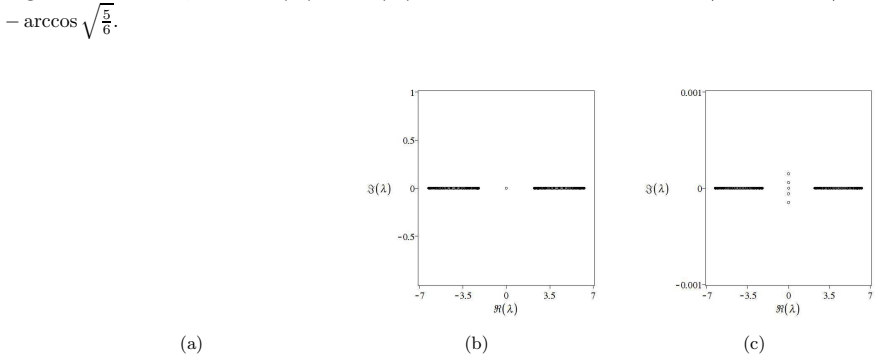
The argument rests on the stationary-wave ansatz $u_n(t)=[F(nh)+iG(nh)]e^{i\omega t}$, which converts equation (6) into the advance-delay system (11) with the parity operator $P X(nh)=X(-nh)$. The paper decomposes $F,G$ into even and odd parts, applies the discrete Fourier transform to obtain the nonlinear integral system (16), and solves it by a modified Neumann iteration (18), a fixed-point iteration equipped with the stabilizing factor $|\alpha/\beta|^{3/2}$; the converged fixed point is inverse-transformed to give the approximate solitary wave. Linear stability is then decided by the matrix eigenvalue problem (28) built from a tridiagonal matrix $A$ and a diagonal matrix $B$; eigenvalues with nonzero imaginary part are the criterion for linear instability. The same eigenvalue construction is applied to the integrable discrete nonlocal NLS to produce the comparison stable and unstable cases.
What would settle it
Evaluate the residual of the stationary advance-delay system (11) at the converged iterate $\hat F_{e,16},\tilde F_{o,16},\hat G_{e,16},\tilde G_{o,16}$ on a lattice wider than the soliton; if its $L^2$ norm does not tend to zero as the iteration count and lattice cutoff increase, the claimed stationary wave is a numerical artifact and the instability eigenvalues do not describe the true equation. For the Cauchy problem, check whether the time for $\max_n |u_n|$ to exceed 1000, then $10^4$, continues to decrease as $N$ grows; if it does not, the apparent blow-up is a discretization effect.
Extended reading notes
Core claim
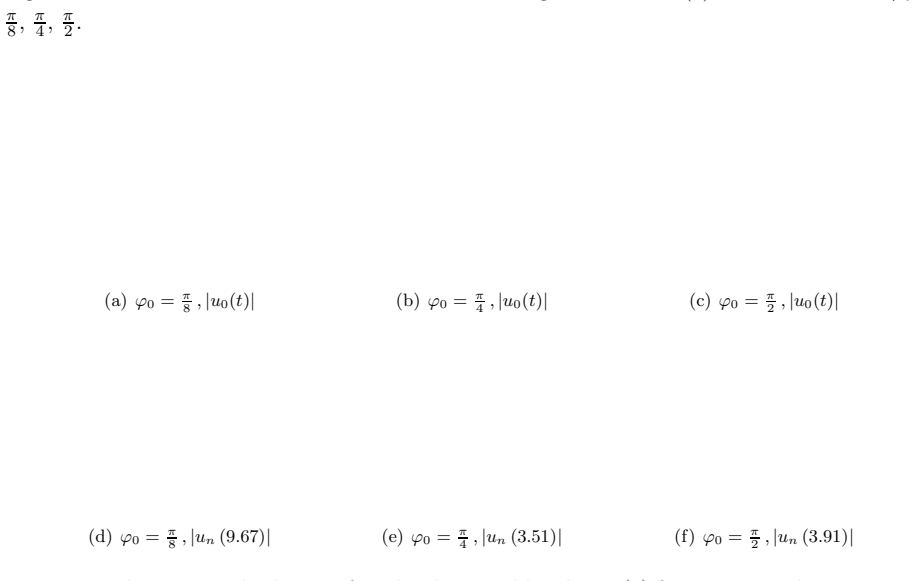
On the paper's own terms, the discovery is that the nonintegrable spatial discretization (6) of the reverse-space nonlocal NLS has two dynamical signatures that the integrable and classical versions do not share. Stationary solitary waves obtained as fixed points of the Fourier-domain iteration (18) are linearly unstable: the eigenvalue problem (28) produces eight eigenvalues with nonzero imaginary part, so small perturbations grow. In the periodic Cauchy problem (9), the numerical solution reaches large amplitude (what the paper calls blow-up, in the operative sense of $\max_n|u_n|=100$) at a site selected by the phase $\phi_0$ of the initial modulation: for $\phi_0\in(-\pi/2,\pi/2)$ the maximum first grows at $n=0$, for $\phi_0\in(\pi/2,3\pi/2)$ at $n=L/(2h)$, and for $\phi_0=\pm\pi/2$ at both sites. The time required to reach that amplitude increases as $\phi_0$ runs from $0$ to $\pi/2$, and with mesh refinement the solution oscillates quasiperiodically before the large-amplitude growth. The integrable discrete nonlocal NLS (5), run with the same initial data, takes far longer to reach the same amplitude and always does so at $n=0$.
Load-bearing premise
The paper relies on the numerical fixed point reached by the modified Neumann iteration at step 16 being a true stationary solution of the infinite-lattice equation; the table reports only how much the solution changed between iterations, not how well it satisfies the equation itself.
Editorial extensions
If this is right
- Stationary solitary waves of the nonintegrable discrete nonlocal NLS (6) are linearly unstable, so small perturbations grow exponentially; stable discrete solitons in this model would require a different nonlinearity or parameter regime.
- For the periodic Cauchy problem, the nonintegrable discretization predicts large-amplitude growth whose lattice site is fixed by the initial phase $\phi_0$: $n=0$ for $\phi_0\in(-\pi/2,\pi/2)$, $n=L/(2h)$ for $\phi_0\in(\pi/2,3\pi/2)$, and both sites at $\phi_0=\pm\pi/2$.
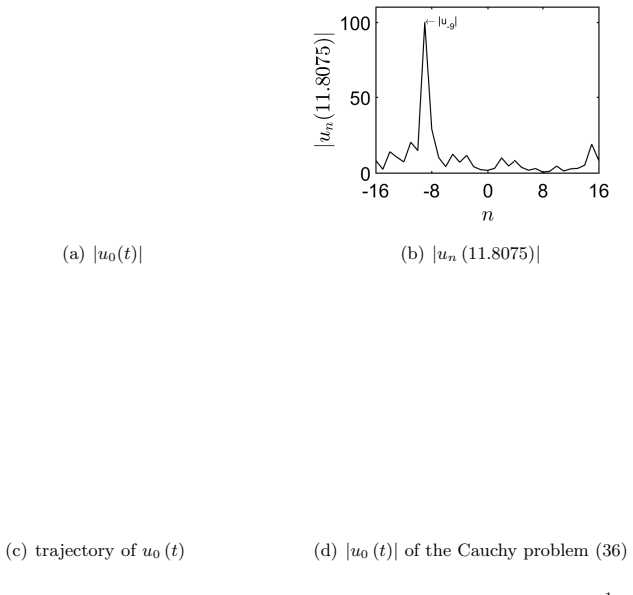
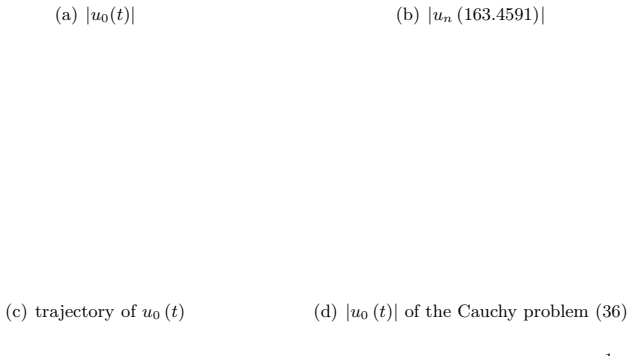
- Mesh refinement from $N=32$ to $64$ to $128$ delays the moment at which $\max_n|u_n|$ reaches 100, from about 11.8 to 81.5 to 163.5 time units, and makes the pre-growth dynamics quasiperiodic, whereas the classical nonintegrable discrete NLS gives bounded solutions for the same initial data.
- The integrable discrete nonlocal NLS (5) reaches the same large amplitude much later and always at $n=0$, so integrability changes both the location and the time scale of the singularity-like growth.
Reading between the lines
- The paper leaves implicit that the two blow-up sites are exactly the sites fixed by the lattice symmetry $n\mapsto -n$ under periodic boundary conditions; at $n=0$ and $n=N/2$ the nonlocal term $u_n^2u_{-n}^*$ reduces to the local term $|u_n|^2u_n$, which may explain why the singularity is pinned to those sites.
- A testable extension is to raise the amplitude threshold from 100 to 1000 or $10^4$ and track whether the time-to-threshold follows a consistent finite-time blow-up law as $N$ grows; if the delay grows without bound, the reported blow-up is a property of the nonintegrable discretization rather than of the nonlocal NLS itself.
- The linear instability of the stationary waves and the phase-dependent growth in the Cauchy problem may share a mechanism: the eigenvalue with nonzero imaginary part from the stability spectrum should set the growth rate seen in the time simulations, and comparing the two rates would test that connection.
Signed reviews
Editorial analysis
A structured set of objections, weighed in public.
Referee Report
Summary. The paper studies the nonintegrable spatial discrete nonlocal NLS equation (6), a PT-symmetric discretization of the reverse-space nonlocal NLS (4). It constructs stationary solitary-wave solutions by a discrete Fourier transform and a modified Neumann/Petviashvili-type iteration (18), examines their linear stability via an eigenvalue problem (28), and numerically investigates the Cauchy problem with periodic boundary conditions using the nonintegrable scheme (34) and the integrable scheme (35). The reported findings are that the stationary waves are linearly unstable, that the nonintegrable scheme (34) can produce large-amplitude growth that the standard discrete NLS (36) does not, and that the blow-up time and location depend strongly on the initial phase.
Significance. If the results are read as properties of the discrete nonlocal models, the paper is a useful numerical case study: the stationary-solution iteration is parameter-free, the stability comparison between the nonintegrable and integrable discrete nonlocal equations is suggestive, and the demonstrated sensitivity to the initial phase in (34)/(35) contrasts with the standard discrete NLS (36). The paper also ships concrete parameter sets and figures that allow the main computations to be reproduced. The central weakness is that the headline claim is phrased for the continuum Cauchy problem (9), whereas all evidence is obtained for the discrete schemes (34)/(35), and the 'blow-up' diagnostic is an unvalidated amplitude threshold. With a corrected interpretation or an added convergence study, the work would be a reasonable contribution.
major comments (3)
- [§4, Eq. (34), Figs. 7–9] The claim that 'the numerical solution of Cauchy problem (9) yields the blow-up phenomenon' is not supported by the evidence, because the simulations solve the discrete scheme (34), not the continuum equation (9), and no convergence or residual study linking (34) to (9) is provided. Moreover, the threshold times for max_n |u_n| = 100 increase from 11.8075 (N=32) to 81.5007 (N=64) and 163.4591 (N=128), which is the opposite of the behavior one expects for a converged finite-time singularity as h→0. The statement in §4 that the solutions 'become quasiperiodic before the solution blows up with the mesh refinement increasing' strengthens this concern. Please either add a genuine convergence study with a threshold-independent singularity diagnostic, or explicitly reframe the claim as a property of the discrete nonintegrable model (34).
- [§2, table on p.7, Eq. (18)] The convergence table reports only successive-iterate differences (e.g., |||F_e,n| − |F_e,s|||_L2) and |α/β|; it does not report the residual of the stationary equation (11) or (23) at the computed fixed point. Because the linear stability analysis in §3 starts from this numerical stationary solution, an unverified fixed point would propagate directly into the eigenvalue conclusion. Please report the maximum and L2 residuals of (23) at the working truncation, and state the lattice cut-off N used for the fixed-point computation.
- [§3, Eq. (28), Figs. 3–4] The stability calculation is not fully reproducible as written: the text does not specify the cut-off N or the number of lattice sites used in the finite truncation of the infinite eigenvalue problem, nor does it report convergence checks in N. The statement that 'this stability problem contains eight eigenvalues with nonzero imaginary part' (p.8) is therefore hard to verify. Please add the truncation details and a brief check that the relevant unstable eigenvalues converge as N increases.
minor comments (6)
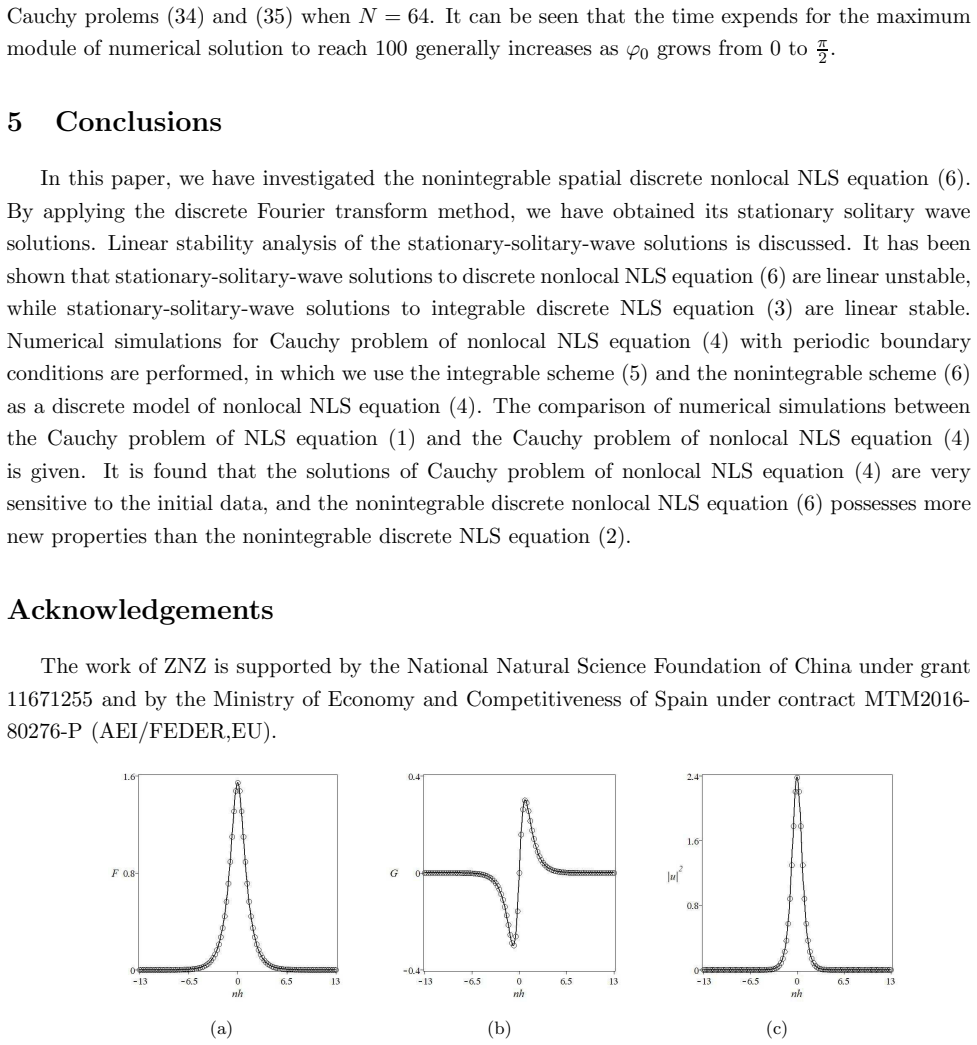
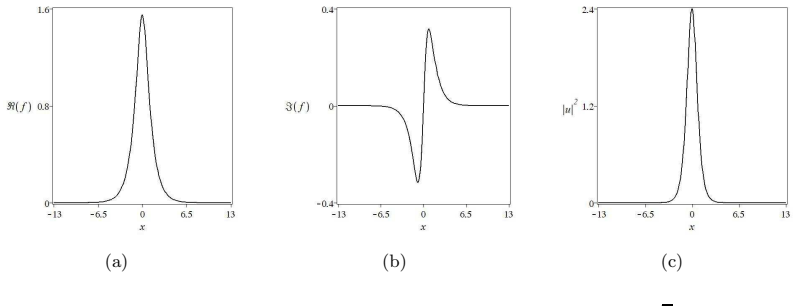
- [§2, Fig. 2, Eq. (22)] The match between the numerical stationary mode and the continuum solution (22) is asserted visually only; please report a quantitative error norm (e.g., L2 or L∞ difference) at the working resolution.
- [General] There are several typographical errors: 'extensely' on p.2, 'wherw' on p.7, 'envolution' on p.10, and 'let us we discuss' on p.8.
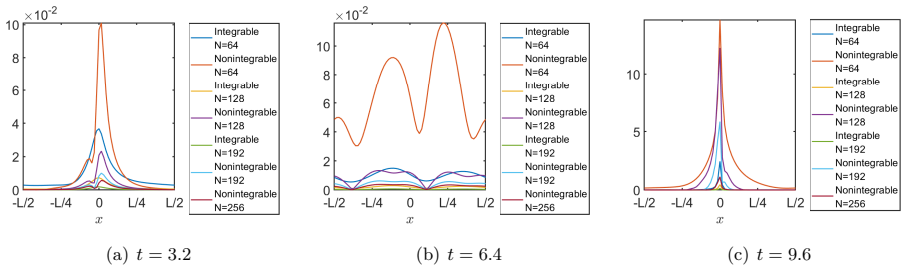
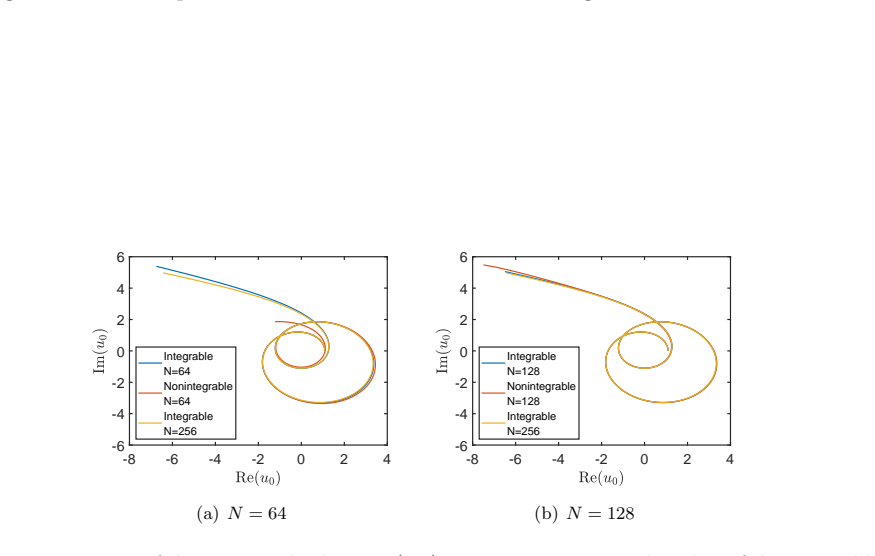
- [§4, p.10, Figs. 5–6] The sentence that 'the discrete solution of Cauchy problem (35) converges to the one of Cauchy problem (9)' should be sharpened: the numerical reference u^256_n is itself a discrete solution, so the plotted errors compare two discrete schemes rather than verifying convergence to the PDE (9).
- [§2, Eq. (16)] The convolution star is used in expressions such as Q1 * F_e(q) without explicitly defining the two-function convolution; the definition of the triple convolution is given, but the binary case should be stated as well.
- [§4, Figs. 7–9] Captions (d) say '|u0(t)| of the Cauchy problem (36)' while the text describes the maximum module over n; please clarify whether the plotted quantity is |u0(t)| or max_n |u_n(t)|.
- [References] Reference [44] appears in the bibliography but is not cited in the body of the paper.
Circularity Check
No significant circularity: stationary solutions and stability are direct numerical computations, and the Cauchy simulations are reported observations rather than fitted predictions.
full rationale
The stationary-solitary-wave solutions are obtained by solving the fixed-point system (16)-(18) directly from the discrete equation (6), starting from unpinned seed data (20); no parameter of equation (6) is fitted to the target solution, and the match with the continuum solution (22) is only a post-hoc consistency check. The linear-stability conclusion follows from numerically diagonalizing the eigenvalue problem (28) built from the computed stationary profile and the linearized equations (25)-(27), so it is not an input to the computation. The Cauchy-problem section evolves the discrete schemes (34)-(35) and reports the observed times and positions at which |u_n| reaches 100; even though the paper loosely attributes this to the continuum problem (9) without a convergence study, that is a numerical-validation gap rather than a circular reduction. The only self-citation of note, Ref. [41] (Ma and Zhu) for the comparison soliton (32), is used for the integrable case and is not load-bearing for the central nonintegrable claims. Hence no step in the derivation chain is equivalent to its own input by construction.
Assumptions & free parameters
free parameters (1)
- Parameters of the reference continuum solution (22) used for visual matching =
a = 1/sqrt(2), theta1 = 3*pi/2, theta2 = -arccos(sqrt(5)/6)
assumptions (3)
- domain assumption The modified Neumann iteration (18) converges to a fixed point of the nonlinear integral system for the chosen initial data (20), and the fixed point satisfies the stationary equation (11) to within numerical error.
- domain assumption The finite-N truncation of the infinite lattice for the eigenvalue problem (28) gives a reliable picture of the spectrum of the full linearized operator.
- domain assumption The sixth-order Runge-Kutta solver DVERK [45] provides time-accurate solutions of the ODE system (34)-(35) up to the stop time.
Cite this review
Pith. "Pith review of Nonintegrable Spatial Discrete Nonlocal Nonlinear Schr\"odinger Equation." pith.science (2026). https://pith.science/paper/2KKWBQAS
@misc{pith2026190804745,
  author       = {Pith},
  title        = {Pith review of: Nonintegrable Spatial Discrete Nonlocal Nonlinear Schr\"odinger Equation},
  year         = {2026},
  howpublished = {\url{https://pith.science/paper/2KKWBQAS}},
  note         = {Machine review of arXiv:1908.04745}
}
read the original abstract
Integrable and nonintegrable discrete nonlinear Schr\"odinger equations (NLS) are significant models to describe many phenomena in physics. Recently, Ablowitz and Musslimani introduced a class of reverse space, reverse time and reverse space-time nonlocal integrable equations, including nonlocal NLS, nonlocal sine-Gordon equation and nonlocal Davey-Stewartson equation etc. And, the integrable nonlocal discrete NLS has been exactly solved by inverse scattering transform. In this paper, we study a nonintegrable discrete nonlocal NLS which is direct discretization version of the reverse space nonlocal NLS. By applying discrete Fourier transform and modified Neumann iteration, we present its stationary solutions numerically. The linear stability of the stationary solutions is examined. Finally, we study the Cauchy problem for nonlocal NLS equation numerically and find some different and new properties on the numerical solutions comparing with the numerical solutions of the Cauchy problem for NLS equation.
Figures
Figures from the paper (10 more)





Reference graph
Works this paper leans on
-
[1]
C. Sulem and P.-L. Sulem, The nonlinear Schr¨ odinger equation: self-focusing and wave collapse (Springer Science & Business Media, 2007)
work page 2007
- [2]
-
[3]
J. J. Rasmussen and K. Rypdal, Blow-up in nonlinear Schr¨ odinger equations-I. A general review, Phys. Scr. 33, 481-497 (1986)
work page 1986
-
[4]
K. Rypdal and J. J. Rasmussen, Blow-up in nonlinear Schr¨ odinger equations-II. Similarity structure of the blow-up singularity, Phys. Scr. 33, 498-504 (1986)
work page 1986
-
[5]
M. J. Ablowitz and G. Biondini, Multiscale pulse dynamic s in communication systems with strong dispersion management, Opt. Lett. 23, 1668-1670 (1998)
work page 1998
-
[6]
M. J. Ablowitz, B. Prinari and A. D. Trubatch, Discrete and continuous nonlinear Schr¨ odinger systems (Cambridge University Press, 2004)
work page 2004
-
[7]
D. E. Pelinovsky, Translationally invariant nonlinear Schr¨ odinger lattices, Nonlinearity 19, 2695-2716 (2006). 20
work page 2006
-
[8]
Yang, Nonlinear waves in integrable and nonintegrable systems (SIAM, Philadelphia, 2010)
J. Yang, Nonlinear waves in integrable and nonintegrable systems (SIAM, Philadelphia, 2010)
work page 2010
Show all 45 references
-
[9]
Hasegawa and F
A. Hasegawa and F. Tappert, Transmission of stationary n onlinear optical pulses in dispersive dielectric fibers. I. Anomalous dispersion, Appl. Phys. Let t. 23, 142-144 (1973)
1973
-
[10]
Hasegawa and F
A. Hasegawa and F. Tappert, Transmission of stationary nonlinear optical pulses in dispersive dielectric fibers. II. Normal dispersion, Appl. Phys. Lett. 23, 171-172 (1973)
1973
-
[11]
A. K. Zvezdin and A. F. PopkovS, Contribution to the nonl inear theory of magnetostatic spin waves, Sov. Phys. JETP 2, 350-355 (1983)
1983
-
[12]
Peregrine, Water waves, nonlinear Schr¨ odinger equ ations and their solutions, J
D. Peregrine, Water waves, nonlinear Schr¨ odinger equ ations and their solutions, J. Austral. Math. Soc. Ser. B 25, 16-43 (1983)
1983
-
[13]
Benney and A
D. Benney and A. Newell, The propagation of nonlinear wa ve envelopes, J. Math. Phys. 46, 133-139 (1967)
1967
-
[14]
V. E. Zakharov, Stability of periodic waves of finite amp litude on the surface of a deep fluid, J. Appl. Mech. Tech. Phys. 9, 190-194 (1968)
1968
-
[15]
Benney and G
D. Benney and G. J. Roskes, Wave instabilities, Stud. Ap pl. Math. 48, 377-385 (1969)
1969
-
[16]
V. E. Zakharov, Collapse of Langmuir waves, Sov. Phys. J ETP 35, 908-914 (1972)
1972
-
[17]
Zakharov and A
V. Zakharov and A. Shabat, Exact theory of two-dimensio nal self-focusing and one-dimensional self-modulation of waves in nonlinear media, Sov. Phys. JET P 34, 62-69 (1972)
1972
-
[18]
Zakharov and A
V. Zakharov and A. Shabat, Interaction between soliton s in a stable medium, Sov. Phys. JETP 37, 823-828 (1973)
1973
-
[19]
M. J. Ablowitz and J. F. Ladik, Nonlinear differential-di fference equations, J. Math. Phys. 16, 598-603 (1975)
1975
-
[20]
M. J. Ablowitz and J. F. Ladik, Nonlinear differential-di fference equations and Fourier analysis, J. Math. Phys. 17, 1011-1018 (1976)
1976
-
[21]
A. R. Chowdhury and G. Mahato, A Darboux-B¨ acklund tran sformation associated with a discrete nonlinear Schr¨ odinger equation, Lett. Math. Phys. 7, 313-317 (1983)
1983
-
[22]
Hennig et al
D. Hennig et al. , Spatial properties of integrable and nonintegrable discr ete nonlinear Schr¨ odinger equations, Phys. Rev. E 52, 255-269 (1995). 21
1995
-
[23]
P. G. Kevrekidis, K. Ø. Rasmussen and A. R. Bishop, The di screte nonlinear Schr¨ odinger equation: a survey of recent results, Int. J. Mod. Phys. B 15, 2833-2900 (2001)
2001
-
[24]
B. M. Herbst and M. J. Ablowitz, Numerically induced cha os in the nonlinear Schr¨ odinger equation, Phys. Rev. Lett. 62, 2065-2068 (1989)
1989
-
[25]
Kopidakis, S
G. Kopidakis, S. Aubry and G. Tsironis, Targeted energy transfer through discrete breathers in nonlinear systems, Phys. Rev. Lett. 87, 165501 (2001)
2001
-
[26]
J. W. Fleischer et al. , Observation of discrete solitons in optically induced rea l time waveguide arrays, Phys. Rev. Lett. 90, 023902 (2003)
2003
-
[27]
J. W. Fleischer et al. , Observation of two-dimensional discrete solitons in opti cally induced nonlinear photonic lattices, Nature 422, 147-150 (2003)
2003
-
[28]
Y. S. Kivshar and G. Agrawal, Optical solitons: from fibers to photonic crystals (Academic press, 2003)
2003
-
[29]
M. J. Ablowitz, Z. H. Musslimani and G. Biondini, Method s for discrete solitons in nonlinear lattices, Phys. Rev. E 65, 026602 (2002)
2002
-
[30]
M. J. Ablowitz and Z. H. Musslimani, Integrable nonloca l nonlinear Schr¨ odinger equation, Phys. Rev. Lett. 110, 064105 (2013)
2013
-
[31]
M. J. Ablowitz and Z. H. Musslimani, Integrable nonloca l nonlinear equations, Stud. Appl. Math. 139, 7-59 (2017)
2017
-
[32]
M. J. Ablowitz and Z. H. Musslimani, Inverse scattering transform for the integrable nonlocal nonlinear Schr¨ odinger equation, Nonlinearity29, 915-946 (2016)
2016
-
[33]
Li and T
M. Li and T. Xu, Dark and antidark soliton interactions i n the nonlocal nonlinear Schr¨ odinger equation with the self-induced parity-time-symmetric pot ential, Phys. Rev. E 91, 033202 (2015)
2015
-
[34]
M. Li, T. Xu, and D. Meng, Rational solitons in the parity -time-symmetric nonlocal nonlinear Schr¨ odinger model, J. Phys. Soc. Jpn. 85, 124001 (2016)
2016
-
[35]
X.-Y. Wen, Z. Yan and Y. Yang, Dynamics of higher-order r ational solitons for the nonlocal nonlinear Schr¨ odinger equation with the self-induced par ity-timesymmetric potential, Chaos 26, 063123 (2016). 22
2016
-
[36]
S. K. Gupta and A. K. Sarma, Peregrine rogue wave dynamic s in the continuous nonlinear Schr¨ odinger system with parity-time symmetric Kerr nonli nearity, Commun. Nonlinear Sci. Numer. Simul. 36, 141-147 (2016)
2016
-
[37]
Ma and Z
L. Ma and Z. Zhu, Nonlocal nonlinear Schr¨ odinger equat ion and its discrete version: Soliton solutions and gauge equivalence, J. Math. Phys 57, 083507 (2016)
2016
-
[38]
T. A. Gadzhimuradov and A. M. Agalarov, Towards a gauge- equivalent magnetic structure of the nonlocal nonlinear Schr¨ odinger equation, Phys. Rev. A 93, 062124 (2016)
2016
-
[39]
Fokas, Integrable multidimensional versions of the nonlocal nonlinear Schr¨ odinger equation, Nonlinearity 29, 319-324 (2016)
A. Fokas, Integrable multidimensional versions of the nonlocal nonlinear Schr¨ odinger equation, Nonlinearity 29, 319-324 (2016)
2016
-
[40]
M. J. Ablowitz and Z. H. Musslimani, Integrable discret e PT symmetric model, Phys. Rev. E 90, 032912 (2014)
2014
-
[41]
Ma and Z
L. Ma and Z. Zhu, N -soliton solution for an integrable nonlocal discrete focu sing nonlinear Schr¨ odinger equation, Appl. Math. Lett. 59, 115-121 (2016)
2016
-
[42]
Petviashvili, Equation of an extraordinary soliton , Sov
V. Petviashvili, Equation of an extraordinary soliton , Sov. J. Plasma Phys. 2, 469-472 (1976)
1976
-
[43]
Huang and L
X. Huang and L. M. Ling, Soliton solutions for the nonloc al nonlinear Schr¨ odinger equation, Eur. Phys. J. Plus 131, 148 (2016)
2016
-
[44]
J. C. Eilbeck, P. Lomdahl and A. Scott, The discrete self -trapping equation, Physica D 16, 318-338 (1985)
1985
-
[45]
W. W. H. Enright, T. Hull and K. Jackson, User’s guide for DVERK: A subroutine for solving non-stiff ODE’s (University of Toronto, Department of Computer Science, 19 76). 23
Reviewed August 14, 2026 · model on record in the stance chip above.
Discussion (0). Continue with ORCID to comment.