REVIEW 3 major objections 5 minor 115 references
Differentiating short gamma-ray bursts progenitors through multi-MeV neutrinos
T0 review · 3 major / 5 minor · reviewed 2026-08-14 · deepseek-v4-flash
Pith's one-line read MeV neutrinos can distinguish neutron-star mergers from black-hole mergers in short gamma-ray bursts.
desk verdict A fresh opacity-based diagnostic for short GRB progenitors is worth a hard look, but the flavor-ratio discriminator is undermined by a decoherence inconsistency. read the letter →
The pith
A machine-rendered reading of the paper's core claim, the machinery that carries it, and where it could break.
The reading
What carries the argument
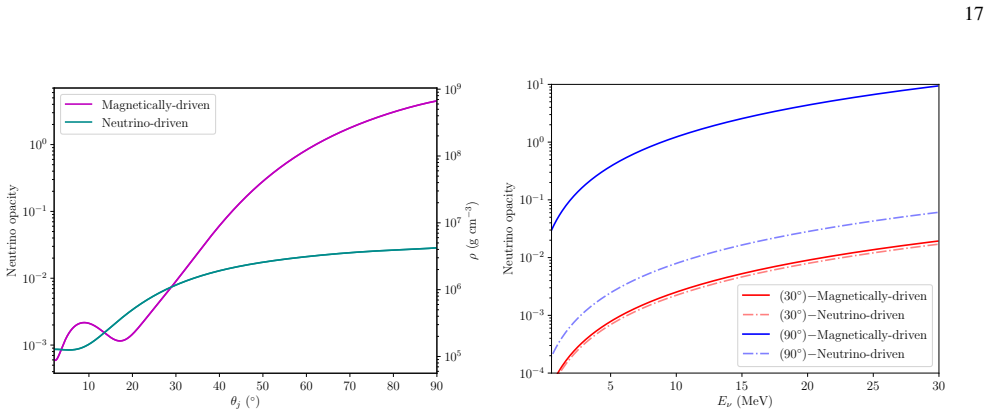
The central object is the neutrino effective potential $V_{\rm eff}$ computed from the neutrino self-energy via W-boson exchange in a magnetized, finite-temperature medium, evaluated in both the strong-field limit ($B\gg B_c$, used for NS-NS) and the weak-field limit ($B\ll B_c$, used for BH-NS). This potential feeds the MSW resonance condition and the three-flavor oscillation probabilities, producing the predicted flavor ratios; separately, the neutrino opacity is computed from the baryon density profiles of neutrino-driven versus magnetically-driven winds, giving the angle-dependent confinement.
What would settle it
Detect neutrinos from an off-axis short GRB with a known viewing angle and an identified electromagnetic counterpart: if neutrinos arrive from a line of sight greater than about $62^\circ$ at 20 MeV (or the corresponding critical angle at another energy), the NS-NS confinement prediction fails; alternatively, measure the flavor ratio in multiple energy bins from a source independently identified as an NS-NS merger, and an energy-independent ratio would falsify the flavor-ratio branch.
Extended reading notes
Core claim
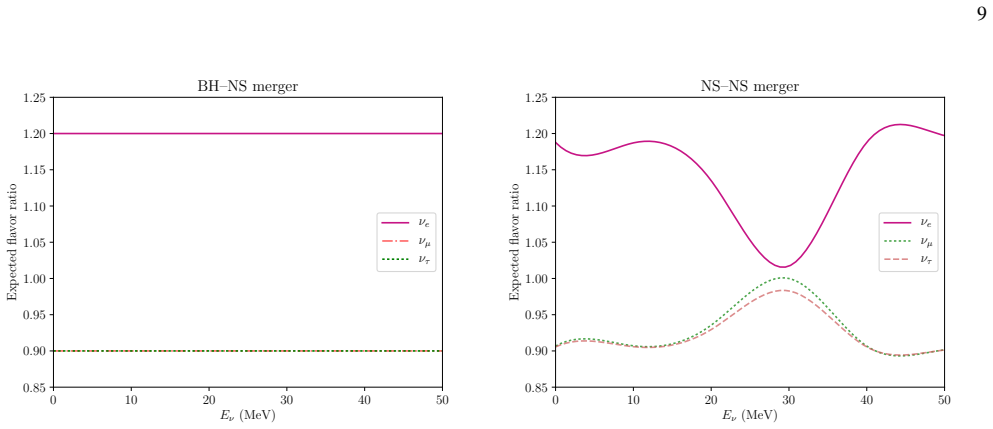
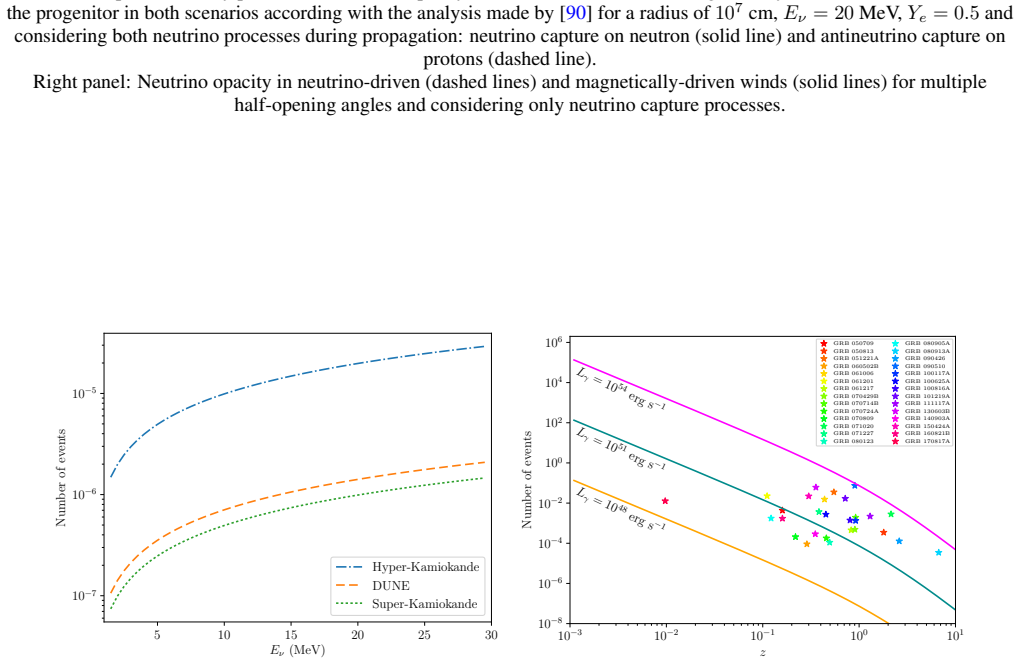
The paper claims that the two leading short-GRB progenitor scenarios leave distinct, observable neutrino signatures. For an NS-NS merger, thermal neutrinos undergo MSW resonant oscillations in a strongly magnetized fireball, producing an energy-dependent flavor ratio at Earth (for example, $\nu_e:\nu_\mu:\nu_\tau = 1.1871:0.9071:0.9059$ at $E_\nu=10$ MeV versus $1.0171:1.000:0.9829$ at 30 MeV), while for a BH-NS merger, with a weak field, the ratio remains constant at roughly $1.2:0.9:0.9$. In addition, the neutrino opacity in the magnetically driven wind of an NS-NS merger confines released neutrinos to a collimated region around the jet axis, with critical half-opening angles of about $62.1^\circ$ at 20 MeV, $54.1^\circ$ at 30 MeV, and $38.2^\circ$ at 100 MeV; in a BH-NS merger, neutrinos escape isotropically across the whole MeV range. The paper also estimates event rates and concludes that an energetic source ($L\gtrsim 10^{52}$ erg s$^{-1}$) at a nearby distance like GRB 170817A could be detected by Hyper-Kamiokande.
Load-bearing premise
The assumed magnetic field strengths ($10^{16}$ G for NS-NS, $10^{12}$ G for BH-NS) and the wind density profiles taken from simulations are the only significant differences between the two progenitor scenarios; if real mergers have different field amplification or wind structures, the predicted flavor-ratio and opacity signatures would mix.
Editorial extensions
If this is right
- A neutrino detection from an off-axis short GRB with an identified electromagnetic counterpart would identify the progenitor: neutrinos arriving from a viewing angle above the critical opening angle rule out an NS-NS merger, while their absence is consistent with confinement.
- The energy dependence of the flavor ratio is itself a diagnostic: a fluctuating ratio across MeV energies points to magnetic field amplification in an NS-NS merger, while a constant ratio points to a BH-NS merger.
- Hyper-Kamiokande, with its larger effective volume, is more promising than Super-Kamiokande or DUNE for detecting these multi-MeV neutrinos from nearby energetic short GRBs.
- The absence of detected neutrinos from GW170817/GRB 170817A is consistent with the paper's predicted low event rate for a source of its low luminosity.
- The critical-angle values (about $62^\circ$ at 20 MeV, decreasing with energy) give a quantitative threshold for off-axis searches.
Reading between the lines
- Editorial extension: a null detection from an on-axis or slightly off-axis short GRB could still be informative if the line of sight exceeds the critical angle; future stacking analyses should fold in the angle-dependent opacity rather than assuming isotropic neutrino emission.
- Editorial extension: the same flavor-ratio machinery could be applied to other transients with magnetized fireballs, such as magnetar giant flares or long GRBs from collapsars, provided their magnetic field and wind profiles are modeled.
- Editorial extension: a concrete test would be to measure the flavor ratio in two or more energy bins from a single nearby event; if the ratio is constant within uncertainties, the NS-NS flavor-ratio branch would be falsified even before the opacity geometry is tested.
Signed reviews
Editorial analysis
A structured set of objections, weighed in public.
Referee Report
Summary. The manuscript proposes two observable diagnostics for distinguishing short gamma-ray burst progenitors using multi-MeV neutrinos. For NS-NS mergers with an amplified magnetic field of about 10^16 G, it predicts an energy-dependent neutrino flavor ratio and an angle-dependent opacity that confines 20 MeV neutrinos to half-opening angles below about 62 degrees; for BH-NS mergers with B about 10^12 G, it predicts a constant flavor ratio and isotropic neutrino escape. The opacity calculation uses wind density profiles taken from Murguia-Berthier et al. (2017), while the flavor-ratio calculation uses three-flavor transition probabilities with an effective potential derived from Fraija (2014). The paper also estimates neutrino event rates in Super-Kamiokande, Hyper-Kamiokande, and DUNE, concluding that an energetic nearby short GRB could be detected by Hyper-Kamiokande.
Significance. If the central claims hold, the opacity-based on-axis/off-axis diagnostic would be a genuinely useful and falsifiable method for using future joint gravitational-wave, electromagnetic, and neutrino observations to identify NS-NS versus BH-NS mergers; the paper deserves credit for converting independently simulated wind density profiles into a concrete angular prediction. The flavor-ratio diagnostic, by contrast, is not currently supported because the calculation combines a decoherence assumption with coherent oscillation probabilities evaluated at a single radius. The event-rate predictions also need a corrected derivation before the Hyper-Kamiokande detectability conclusion can be accepted. The paper collects useful magnetic-field-dependent effective potential expressions and applies them to a realistic astrophysical context, but the two problematic legs of the analysis must be repaired before the advertised discriminating power is established.
major comments (3)
- [IV.A, Eqs. (20)-(23), Fig. 3] The text states that neutrinos leave the high-density source as incoherent mass eigenstates and that vacuum oscillations are therefore suppressed, yet the flavor ratios in Fig. 3 are obtained by inserting the effective potential into Eq. (20) and evaluating the coherent phase factors S_ij = sin^2(Delta-mu^2_ij L / 4 E_nu) at the single radius r = 10^7 cm. For a decohered source, the outgoing flavor content must instead be computed by projecting the matter eigenstates at the decoupling radius onto vacuum mass eigenstates, or equivalently by averaging the oscillation phases; the undamped sin^2 factors in the right panel of Fig. 3 are not the correct object. The energy-dependent NS-NS flavor ratio advertised as the first discriminator, and the ratios quoted at 10 and 30 MeV in Section VI, are therefore unsupported until the calculation is redone with a proper decoherent treatment.
- [Eq. (32) and Fig. 6] The event-rate estimate is dimensionally inconsistent as printed: the relation L = 4 pi d_z^2 F <E> = 4 pi d_z^2 E^2 dN/dE and the displayed expression for N_ev do not combine to a dimensionless number of events, and the total emitted energy E_T introduced just below Eq. (32) does not appear in the formula. Because the conclusion that Hyper-Kamiokande could detect an energetic nearby short GRB rests on these numbers, the derivation must be corrected and Figure 6 regenerated before the detectability claim can be assessed.
- [IV.A, Eq. (27)] The flavor-ratio calculation assumes a homogeneous, constant-density medium of radius r = 10^7 cm with T = 1 MeV, mu = 1 keV, and phi = 0 degrees for both progenitor scenarios, but this representative point is not derived from the merger simulations and no integration over a density profile is performed. The adiabaticity parameter kappa_res defined in Eq. (27) is never evaluated, so the reader cannot check whether the coherent-propagation approximation for the matter eigenstates is valid over the fireball. This assumption is load-bearing because the decoherence point and the flavor content at release are controlled by the actual density profile, not by a single fixed radius.
minor comments (5)
- [Introduction] The phrase 'Kevin-Helmholtz instabilities' should read 'Kelvin-Helmholtz instabilities'.
- [Eq. (12)] Equation (12) uses m^2_nu e and m^2_nu mu, but mass-squared differences in oscillation formulas refer to mass eigenstates; the notation should be adjusted to avoid confusion.
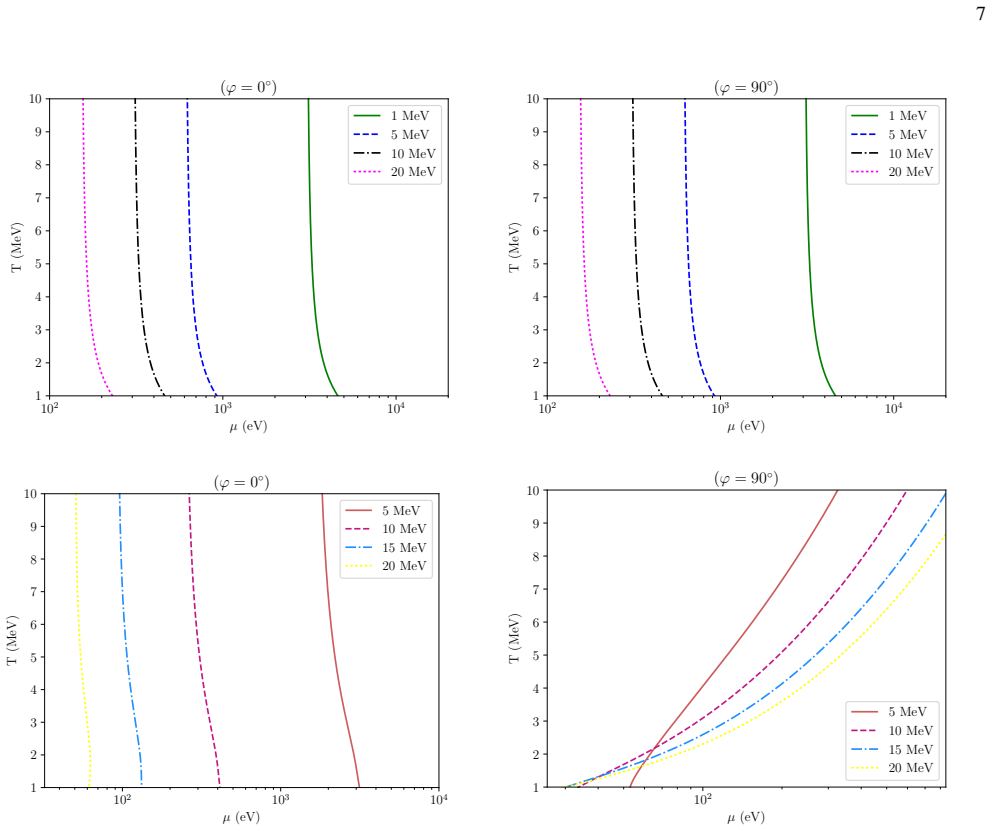
- [Fig. 2 caption] The caption lists neutrino energies as {1, 5, 10, 15} MeV for the upper panels and {5, 10, 15, 20} MeV for the lower panels; the text should be harmonized with the actual plotted energies.
- [References] Reference [65] (Babaev) appears unrelated to the neutrino self-energy calculation it is cited for; please verify that citation.
- [Abstract and Section VI] The term 'flavor ratio' is used both for ratios such as (nu_e : nu_mu : nu_tau) and for normalized flavor fractions; defining this quantity explicitly at first use would improve clarity.
Circularity Check
No significant circularity: flavor ratios and opacity boundaries are computed from externally motivated field and wind inputs, with the self-cited potential formulas rederived in the appendix rather than assumed.
full rationale
The derivation chain is self-contained in the relevant sense. The two scenario inputs, B ~ 10^16 G for NS-NS and B ~ 10^12 G for BH-NS, are adopted from external MHD-simulation literature, and the wind density profiles are taken from Murguia-Berthier et al. (2017, ref [90]). The paper then evaluates the standard three-flavor MSW probabilities (Eqs. 20-23) using those potentials and computes the opacity with Eq. (28) and a cited cross-section. No parameter is fitted to the claimed outputs: the energy-dependent versus constant flavor ratios and the 62-degree opacity boundary are calculated, not tuned. The main self-citation, Fraija (2014, ref [64]), supplies the neutrino effective potential in a magnetized medium, but the strong- and weak-field formulas are rederived in the appendix (Eqs. 33-38), so the paper does not rely on an unverified self-citation chain. The assumed B-field difference is an input from external simulations; using it to separate the two progenitor scenarios is a conditional prediction, not a definitional equivalence. The BH-NS ratio in Fig. 3 equals the assumed initial 4:3:3 ratio only because the weak-field potential is negligible, which is a derived no-oscillation limit rather than a fitted result. The decoherence concern raised in the skeptic note is a physics-correctness issue about evaluating coherent phase factors after asserting incoherence, not a circularity; correcting it would change the calculation, but it would not reveal that an output was secretly an input. No circular step is therefore identified.
Assumptions & free parameters
free parameters (7)
- Magnetic field in NS-NS merger =
1e16 G
- Magnetic field in BH-NS merger =
1e12 G
- Fireball radius r =
1e7 cm
- Temperature T =
1 MeV
- Chemical potential mu =
1 keV
- Initial neutrino flavor ratio =
4:3:3
- Electron fraction Ye =
0.5
assumptions (4)
- domain assumption Finite-temperature and magnetic-field corrected neutrino self-energy from Fraija (2014) is correct.
- domain assumption Neutrinos are produced as an incoherent mixture of mass eigenstates immediately after leaving the high-density fireball, so vacuum oscillations are suppressed.
- ad hoc to paper The fireball medium is homogeneous and the density is constant over r=1e7 cm.
- domain assumption The magnetic field amplification profiles and wind density profiles from Murguia-Berthier et al. 2017 [90] are representative and the only relevant difference between NS-NS and BH-NS scenarios.
Cite this review
Pith. "Pith review of Differentiating short gamma-ray bursts progenitors through multi-MeV neutrinos." pith.science (2026). https://pith.science/paper/MVEQAOHE
@misc{pith2026190804747,
  author       = {Pith},
  title        = {Pith review of: Differentiating short gamma-ray bursts progenitors through multi-MeV neutrinos},
  year         = {2026},
  howpublished = {\url{https://pith.science/paper/MVEQAOHE}},
  note         = {Machine review of arXiv:1908.04747}
}
abstract
With the most recent multi-messenger detection, a new branch in modern astronomy has arisen. The GW170817 event together with the short gamma-ray burst GRB 170817A was the first-ever detection of the gravitational waves and an electromagnetic counterpart. These detections encourage us to think that in the following years we will detect a single event through three different channels: including the mentioned above plus neutrinos from multiple astrophysical sources, like those detected from SN1987A. It is believed that short GRBs are originated in the merger of a black-hole (BH) with a neutron star (NS) or NS-NS scenario. Particularly only in the latter case, several simulations suggest that the magnetic field can be amplified up to $10^{16}$ G. Considering this effect over created thermal neutrinos during the initial stage, we could differentiate short GRB progenitors through the neutrino expected flavor ratio and the opacity created by the baryon-loaded winds ejected in each scenario. Moreover, We find that it is more feasible to detect neutrinos from BH-NS than NS-NS systems. Finally, we also estimate the number of neutrino events expected on ground-based detectors, finding that it is possible to detect neutrinos from an energetic enough source located within a nearby vicinity with Hyper-Kamiokande detector.
Figures
Figures from the paper (3 more)
Reference graph
Works this paper leans on
-
[1]
Strong ⃗B limit From Equation 6, the neutrino effective potential in the strong magnetic field regime becomes Veff,s = √ 2GFm3 eB π2Bc [ ∞∑ l=0 (−1)l sinhαl [Fs−Gs cosϕ] −4 m2 e m2 W Eν me ∞∑ l=0 (−1)l coshαl [Js−Hs cosϕ] ] , (7) whereme is the electron mass, αl = (l + 1)µ/T withµ and T the chemical potential and temperature, respectively,Bc = m2 e/e = 4.14...
-
[2]
Weak ⃗B limit Likewise, we found that the neutrino effective potential in the weak magnetic field limit is Veff,w = √ 2GFm3 eB π2Bc [ ∞∑ l=0 (−1)l sinhαl [Fw−Gw cosϕ] −4 m2 e m2 W Eν me ∞∑ l=0 (−1)l coshαl [Jw−Hw cosϕ] . (8) B. Neutrino Oscillation Neutrino oscillation is a phenomenon widely studied since the second half of the last century. It even nowaday...
-
[3]
In con- trast, the second one will be built within the SURF facil- ities in South Dakota (long-baseline program)
Deep Underground Neutrino Experiment The DUNE (Deep Underground Neutrino Experiment) ex- periment will consist of two neutrino experiments, the first one placed near to Fermi National Laboratory Acceleration Facility in Illinois, USA (short-baseline program). In con- trast, the second one will be built within the SURF facil- ities in South Dakota (long-bas...
2017
-
[4]
In the last expression ∆m2 kj rep- resents the mass squared differences∆m2 kj≡m2 k−m2 j, such that P (να→νβ(t)) = ∑ k>j U∗ αkUβkU∗ αjUβk e−i( ∆m2 kj 2E )t
Vacuum Neutrinos propagating in the vacuum are not affected by ex- ternal surrounding particles, and hence their amplitude proba- bility could be easily expressed as [72] P (να→νβ(t)) = ∑ k>j U∗ αkUβkU∗ αjUβk e−i(Ek−Ej)t, (9) where Ek is the neutrino dispersion relation, which can be approximated as Ek≈E + (m2 k/2E), with E = |⃗ p| and Ek−Ej ≈ ∆m2 kj/2E. ...
-
[5]
The Lorentz scalars for the strong and weak magnetic field limit are computing in the appendix
ReΣ(k) =R [a⊥/k⊥ + b/u + c/b]L as a function of the Lorentz scalars (a⊥, b and c), the dispersion relation (Equa- tion 3) is in the form Veff = b− c cosϕ− a⊥|˜k| sin2ϕ, (6) whereϕ is the angle between the neutrino momentum and the direction of magnetic field. The Lorentz scalars for the strong and weak magnetic field limit are computing in the appendix
-
[6]
Later, Mikheyev and Smirnov [75] showed that the neutrino oscil- lation parameters are modified when they propagate within a material medium; currently, this is known asMSW effect
Matter Wolfenstein demonstrated that neutrinos propagating in a non-vacuum medium are affected by an effective potential, equivalent to the refractive index of that medium [74]. Later, Mikheyev and Smirnov [75] showed that the neutrino oscil- lation parameters are modified when they propagate within a material medium; currently, this is known asMSW effect....
-
[7]
• The best-fit oscillation parameters based on solar exper- iments areδm2 = (5.6+1.9 −1.4)× 10−5 eV2 and tan2θ = 0.427+0.033 −0.029[77]
Two-Neutrino mixing Based on appearance and disappearance neutrino oscilla- tion experiments, fluxes of solar, atmospheric, and accelerator neutrinos have provided values of the squared-mass difference and mixing angles. • The best-fit oscillation parameters based on solar exper- iments areδm2 = (5.6+1.9 −1.4)× 10−5 eV2 and tan2θ = 0.427+0.033 −0.029[77]. •...
-
[8]
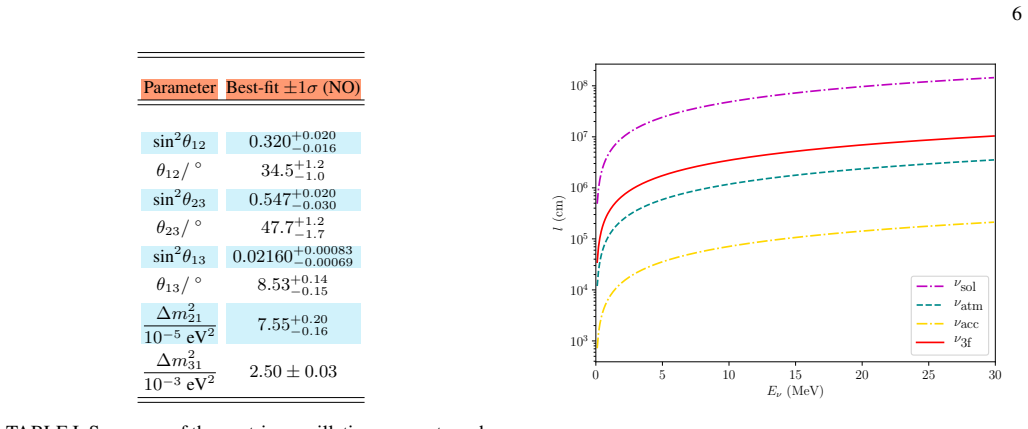
Three-Neutrino Mixing We show in Table I a summary of the most current status of neutrino oscillation parameters in a three-flavor mixing sce- nario performed by global–fit analysis from [83]. 6 Parameter Best-fit±1σ (NO) sin2θ12 0.320+0.020 −0.016 θ12/◦ 34.5+1.2 −1.0 sin2θ23 0.547+0.020 −0.030 θ23/◦ 47.7+1.2 −1.7 sin2θ13 0.02160+0.00083 −0.00069 θ13/◦ 8.53+...
Show all 115 references
-
[9]
At present, SK is a giant water ˇCerenkov detector with a base of 39 m in diameter and a height of 42 m, having the capacity to contain 50 kton of ultra-pure water
Super-Kamiokande Super-Kamiokande (SK) is an underground neutrino obser- vatory built 1000 m below the surface in a Japanese mine. At present, SK is a giant water ˇCerenkov detector with a base of 39 m in diameter and a height of 42 m, having the capacity to contain 50 kton of...
-
[10]
It is expected to start operating somehow in the middle of this decade
Hyper-Kamiokande Hyper-Kamiokande (HK) will be a third-generation ˇCerenkov detector (replacing the current SK detector) also located in a Japanese mine near to its predecessor SK. It is expected to start operating somehow in the middle of this decade. The original design [98,...
-
[11]
Hirata, T
K. Hirata, T. Kajita, M. Koshiba, et al. Observation of a neutrino burst from the supernova sn1987a. Phys. Rev. Lett., 58:1490–1493, Apr 1987
1987
-
[12]
B. P. Abbott, R. Abbott, T. D. Abbott, et al. Binary Black Hole Mergers in the First Advanced LIGO Observing Run.Physical Review X, 6(4):041015, October 2016
2016
-
[13]
Gw170817: observation of gravitational waves from a binary neutron star inspiral
Benjamin P Abbott, R Abbott, TD Abbott, et al. Gw170817: observation of gravitational waves from a binary neutron star inspiral. Physical Review Letters, 119(16):161101, 2017
2017
-
[14]
Albert, M
A. Albert, M. Andr ´e, M. Anghinolfi, et al. Search for high- energy neutrinos from binary neutron star merger GW170817 with ANTARES, IceCube, and the pierre auger observatory. The Astrophysical Journal, 850(2):L35, nov 2017
2017
-
[15]
Atteia, V
J.-L. Atteia, V . Heussaff, J.-P. Dezalay, et al. The maximum isotropic energy of gamma-ray bursts.The Astrophysical Jour- nal, 837(2):119, mar 2017
2017
-
[16]
R. W. Klebesadel, I. B. Strong, and R. A. Olson. Observations of Gamma-Ray Bursts of Cosmic Origin.ApJL, 182:L85, June 1973
1973
-
[17]
Short-duration gamma-ray bursts
Edo Berger. Short-duration gamma-ray bursts. Annual Review of Astronomy and Astrophysics, 52:43–105, 2014
2014
-
[18]
Zhang and P
B. Zhang and P. M ´esz´aros. Gamma-Ray Bursts: progress, problems and prospects. International Journal of Modern Physics A, 19:2385–2472, 2004
2004
-
[19]
Kumar and B
P. Kumar and B. Zhang. The physics of gamma-ray bursts and relativistic jets. Phys. Rep., 561:1–109, February 2015
2015
-
[20]
Hjorth and et al
J. Hjorth and et al. A very energetic supernova associated with theγ-ray burst of 29 March 2003. Nature, 423:847–850, June 2003
2003
-
[21]
S. E. Woosley and J. S. Bloom. The Supernova Gamma-Ray Burst Connection. ARA&A, 44:507–556, September 2006
2006
-
[22]
Hjorth and J
J. Hjorth and J. S. Bloom. The Gamma-Ray Burst - Supernova Connection, pages 169–190. November 2012
2012
-
[23]
Nucleosynthesis, neutrino bursts and γ-rays from coalescing neutron stars
David Eichler, Mario Livio, Tsvi Piran, and David N Schramm. Nucleosynthesis, neutrino bursts and γ-rays from coalescing neutron stars. Nature, 340(6229):126, 1989
1989
-
[25]
W. H. Lee, E. Ramirez-Ruiz, and J. Granot. A Compact Bi- nary Merger Model for the Short, Hard GRB 050509b. ApJL, 630:L165–L168, September 2005
2005
-
[26]
The progenitors of short gamma-ray bursts
William H Lee and Enrico Ramirez-Ruiz. The progenitors of short gamma-ray bursts. New Journal of Physics, 9(1):17, 2007
2007
-
[27]
E. Nakar. Short-hard gamma-ray bursts. Phys. Rep., 442:166– 236, April 2007
2007
-
[28]
Zrake and A
J. Zrake and A. I. MacFadyen. Magnetic Energy Production by Turbulence in Binary Neutron Star Mergers. ApJL, 769:L29, June 2013
2013
-
[29]
D. J. Price and S. Rosswog. Producing ultrastrong magnetic fields in neutron star mergers. Science, 312(5774):719–722, 2006
2006
-
[30]
Giacomazzo, L
B. Giacomazzo, L. Rezzolla, and L. Baiotti. Can magnetic fields be detected during the inspiral of binary neutron stars? MNRAS, 399:L164–L168, October 2009
2009
-
[31]
Obergaulinger, M
M. Obergaulinger, M. A. Aloy, and E. M ¨uller. Local sim- ulations of the magnetized Kelvin-Helmholtz instability in neutron-star mergers. A&A, 515:A30, June 2010
2010
-
[32]
High resolution numerical rela- tivity simulations for the merger of binary magnetized neutron stars
Kenta Kiuchi, Koutarou Kyutoku, Yuichiro Sekiguchi, Masaru Shibata, and Tomohide Wada. High resolution numerical rela- tivity simulations for the merger of binary magnetized neutron stars. Phys. Rev. D, 90:041502, Aug 2014
2014
-
[33]
Kiuchi, P
K. Kiuchi, P. Cerd ´a-Dur´an, K. Kyutoku, Y . Sekiguchi, and M. Shibata. Efficient magnetic-field amplification due to the 13 Kelvin-Helmholtz instability in binary neutron star mergers. Phys. Rev. D, 92(12):124034, December 2015
2015
-
[34]
P. B. Demorest, T. Pennucci, S. M. Ransom, M. S. E. Roberts, and J. W. T. Hessels. A two-solar-mass neutron star measured using Shapiro delay. Nature, 467:1081–1083, October 2010
2010
-
[35]
Antoniadis, P
J. Antoniadis, P. C. C. Freire, N. Wex, et al. A Massive Pul- sar in a Compact Relativistic Binary. Science, 340:448, April 2013
2013
-
[36]
R. C. Duncan and C. Thompson. Formation of very strongly magnetized neutron stars - Implications for gamma-ray bursts. ApJL, 392:L9–L13, June 1992
1992
-
[37]
B. D. Metzger, E. Quataert, and T. A. Thompson. Short- duration gamma-ray bursts with extended emission from pro- tomagnetar spin-down. MNRAS, 385:1455–1460, April 2008
2008
-
[38]
R. D. Blandford and R. L. Znajek. Electromagnetic extraction of energy from Kerr black holes. MNRAS, 179:433–456, May 1977
1977
-
[39]
Murguia-Berthier, E
A. Murguia-Berthier, E. Ramirez-Ruiz, C. D. Kilpatrick, et al. A Neutron Star Binary Merger Model for GW170817/GRB 170817A/SSS17a. ApJL, 848:L34, October 2017
2017
-
[40]
Rosswog and E
S. Rosswog and E. Ramirez-Ruiz. On the diversity of short gamma-ray bursts. MNRAS, 343:L36–L40, August 2003
2003
-
[41]
Rosswog and E
S. Rosswog and E. Ramirez-Ruiz. Jets, winds and bursts from coalescing neutron stars. MNRAS, 336:L7–L11, Octo- ber 2002
2002
-
[42]
Nagakura, K
H. Nagakura, K. Hotokezaka, Y . Sekiguchi, M. Shibata, and K. Ioka. Jet Collimation in the Ejecta of Double Neutron Star Mergers: A New Canonical Picture of Short Gamma-Ray Bursts. ApJL, 784:L28, April 2014
2014
-
[43]
Ramirez-Ruiz, J
E. Ramirez-Ruiz, J. Granot, C. Kouveliotou, et al. An Off- Axis Model of GRB 031203. ApJL, 625:L91–L94, June 2005
2005
-
[44]
Murguia-Berthier, G
A. Murguia-Berthier, G. Montes, E. Ramirez-Ruiz, F. De Colle, and W. H. Lee. Necessary Conditions for Short Gamma-Ray Burst Production in Binary Neutron Star Merg- ers. ApJL, 788:L8, June 2014
2014
-
[45]
Fraija, W
N. Fraija, W. H. Lee, P. Veres, and R. Barniol Duran. Modeling the Early Afterglow in the Short and Hard GRB 090510. ApJ, 831:22, November 2016
2016
-
[46]
Popham, S
R. Popham, S. E. Woosley, and C. Fryer. Hyperaccreting Black Holes and Gamma-Ray Bursts.ApJ, 518:356–374, June 1999
1999
-
[47]
Narayan, T
R. Narayan, T. Piran, and P. Kumar. Accretion Models of Gamma-Ray Bursts. ApJ, 557:949–957, August 2001
2001
-
[48]
Stephan Rosswog, Enrico Ramirez-Ruiz, and Melvyn B. Davies. High-resolution calculations of merging neutron stars - III. Gamma-ray bursts. MNRAS, 345(4):1077–1090, Nov 2003
2003
-
[49]
Neutrino signatures and the neutrino-driven wind in binary neutron star mergers
Luc Dessart, CD Ott, Adam Burrows, Stefan Rosswog, and Eli Livne. Neutrino signatures and the neutrino-driven wind in binary neutron star mergers. The Astrophysical Journal , 690(2):1681, 2008
2008
-
[50]
Neutrino-driven winds from neutron star merger rem- nants
Albino Perego, Stephan Rosswog, Ruben M Cabez ´on, et al. Neutrino-driven winds from neutron star merger rem- nants. Monthly Notices of the Royal Astronomical Society , 443(4):3134–3156, 2014
2014
-
[51]
Mag- netically driven winds from differentially rotating neutron stars and x-ray afterglows of short gamma-ray bursts
Daniel M Siegel, Riccardo Ciolfi, and Luciano Rezzolla. Mag- netically driven winds from differentially rotating neutron stars and x-ray afterglows of short gamma-ray bursts. The As- trophysical Journal Letters, 785(1):L6, 2014
2014
-
[52]
Afterglow observations shed new light on the nature of x-ray flashes
Jonathan Granot, Enrico Ramirez-Ruiz, and Rosalba Perna. Afterglow observations shed new light on the nature of x-ray flashes. The Astrophysical Journal, 630(2):1003, 2005
2005
-
[53]
An off-axis model of grb 031203
Enrico Ramirez-Ruiz, Jonathan Granot, Chryssa Kouveliotou, et al. An off-axis model of grb 031203. The Astrophysical Journal Letters, 625(2):L91, 2005
2005
-
[54]
Fraija, F
N. Fraija, F. De Colle, P. Veres, et al. The Short GRB 170817A: Modeling the Off-axis Emission and Implications on the Ejecta Magnetization. ApJ, 871:123, January 2019
2019
-
[55]
Fraija, A
N. Fraija, A. C. C. d. E. S. Pedreira, and P. Veres. Light Curves of a Shock-breakout Material and a Relativistic Off-axis Jet from a Binary Neutron Star System. ApJ, 871:200, February 2019
2019
-
[56]
Fraija, D
N. Fraija, D. Lopez-Camara, A. C. Caligula do E. S. Pe- dreira, et al. Signatures from a Cocoon and an off-axis ma- terial ejected in a merger of compact objects: An analytical approach. arXiv e-prints, page arXiv:1904.07732, Apr 2019
1904 arXiv
-
[57]
Cavallo and M
G. Cavallo and M. J. Rees. A qualitative study of cosmic fireballs and gamma-ray bursts. MNRAS, 183:359–365, May 1978
1978
-
[58]
Gamma-ray bursts and the fireball model
Tsvi Piran. Gamma-ray bursts and the fireball model. Physics Reports, 314(6):575 – 667, 1999
1999
-
[59]
W. H. Lee, E. Ramirez-Ruiz, and D. Page. Opaque or Trans- parent? A Link between Neutrino Optical Depths and the Characteristic Duration of Short Gamma-Ray Bursts. ApJL, 608:L5–L8, June 2004
2004
-
[60]
M. J. Rees and P. Meszaros. Unsteady outflow models for cosmological gamma-ray bursts. ApJL, 430:L93–L96, August 1994
1994
-
[61]
Fraija, P
N. Fraija, P. Veres, B. B. Zhang, et al. Theoretical Description of GRB 160625B with Wind-to-ISM Transition and Implica- tions for a Magnetized Outflow. ApJ, 848:15, October 2017
2017
-
[62]
M´esz´aros and M
P. M´esz´aros and M. J. Rees. Optical and Long-Wavelength Af- terglow from Gamma-Ray Bursts. ApJ, 476:232–237, Febru- ary 1997
1997
-
[63]
N. Fraija. GRB 110731A: Early Afterglow in Stellar Wind Powered By a Magnetized Outflow. ApJ, 804:105, May 2015
2015
-
[64]
Fraija, W
N. Fraija, W. Lee, and P. Veres. Modeling the Early Multi- wavelength Emission in GRB130427A. ApJ, 818:190, Febru- ary 2016
2016
-
[65]
Fraija, W
N. Fraija, W. H. Lee, M. Araya, et al. Modeling the High- energy Emission in GRB 110721A and Implications on the Early Multiwavelength and Polarimetric Observations. ApJ, 848:94, October 2017
2017
-
[66]
Fraija, S
N. Fraija, S. Dichiara, A. C. Caligula do E. S. Pedreira, et al. Modeling the Observations of GRB 180720B: from Radio to Sub-TeV Gamma-Rays. ApJ, 885(1):29, November 2019
2019
-
[67]
Fraija, R
N. Fraija, R. Barniol Duran, S. Dichiara, and P. Beniamini. Synchrotron Self-Compton as a Likely Mechanism of Pho- tons beyond the Synchrotron Limit in GRB 190114C. ApJ, 883(2):162, October 2019
2019
-
[68]
Fraija, S
N. Fraija, S. Dichiara, A. C. Caligula do E. S. Pedreira, et al. Analysis and Modeling of the Multi-wavelength Observations of the Luminous GRB 190114C. ApJL, 879(2):L26, July 2019
2019
-
[70]
H. B. J. Koers and R. A. M. J. Wijers. The effect of neutrinos on the initial fireballs in gamma-ray bursts.MNRAS, 364:934– 942, December 2005
2005
-
[71]
N ¨otzold and G
D. N ¨otzold and G. Raffelt. Neutrino dispersion at finite tem- perature and density. Nuclear Physics B, 307:924–936, Octo- ber 1988
1988
-
[72]
Enqvist, K
K. Enqvist, K. Kainulainen, and J. Maalampi. Refraction and oscillations of neutrinos in the early universe.Nuclear Physics B, 349:754–790, February 1991
1991
-
[73]
Schwinger
J. Schwinger. On Gauge Invariance and Vacuum Polarization. Physical Review, 82:664–679, June 1951
1951
-
[74]
N. Fraija. Propagation and Neutrino Oscillations in the Base of 14 a Highly Magnetized Gamma-Ray Burst Fireball Flow. ApJ, 787:140, June 2014
2014
-
[75]
E. Babaev. Andreev-Bashkin effect and knot solitons in an interacting mixture of a charged and a neutral superfluid with possible relevance for neutron stars. Phys. Rev. D , 70(4):043001, August 2004
2004
-
[76]
Erdas, C
A. Erdas, C. W. Kim, and T. H. Lee. Neutrino self-energy and dispersion in a medium with a magnetic field. Phys. Rev. D, 58(8):085016, October 1998
1998
-
[77]
S. Sahu, N. Fraija, and Y .-Y . Keum. Neutrino oscillation in a magnetized gamma-ray burst fireball. Phys. Rev. D , 80(3):033009, August 2009
2009
-
[78]
S. Sahu, N. Fraija, and Y .-Y . Keum. Propagation of neutrinos through magnetized gamma-ray burst fireball. J. Cosmology Astropart. Phys., 11:24, November 2009
2009
-
[79]
J. C. D’olivo, J. F. Nieves, and M. Torres. Finite-temperature corrections to the effective potential of neutrinos in a medium. Phys. Rev. D, 46:1172–1179, August 1992
1992
-
[80]
N. Fraija. GeV-PeV neutrino production and oscillation in hid- den jets from gamma-ray bursts. MNRAS, 437:2187–2200, January 2014
2014
-
[81]
N. Fraija. Resonant oscillations of GeV-TeV neutrinos in in- ternal shocks from gamma-ray burst jets inside stars. MNRAS, 450:2784–2798, July 2015
2015
-
[82]
M. C. Gonzalez-Garcia and Y . Nir. Neutrino masses and mix- ing: evidence and implications. Reviews of Modern Physics , 75:345–402, March 2003
2003
-
[83]
C Jarlskog. C. jarlskog, phys. rev. lett. 55, 1039 (1985). Phys. Rev. Lett., 55:1039, 1985
1985
-
[84]
Wolfenstein
L. Wolfenstein. Neutrino oscillations in matter. Phys. Rev. D, 17:2369–2374, May 1978
1978
-
[85]
SP Mikheyev. Yad. fiz, 42 (1985) 1441; sp mikheyev, a. smirnov. Sov. J. Nucl. Phys, 42:913, 1986
1985
-
[86]
M. C. Gonzalez-Garcia and Yosef Nir. Neutrino masses and mixing: evidence and implications. Rev. Mod. Phys., 75:345– 402, Mar 2003
2003
-
[87]
Aharmim and et al
B. Aharmim and et al. Combined Analysis of all Three Phases of Solar Neutrino Data from the Sudbury Neutrino Observa- tory. ArXiv e-prints, September 2011
2011
-
[88]
Abe and et al
K. Abe and et al. Search for Differences in Oscillation Param- eters for Atmospheric Neutrinos and Antineutrinos at Super- Kamiokande. Physical Review Letters, 107(24):241801, De- cember 2011
2011
-
[89]
E. D. Church, K. Eitel, G. B. Mills, and M. Steidl. Statis- tical analysis of different ν− µ -¿ ν− e searches. Phys. Rev. D, 66(1):013001, June 2002
2002
-
[90]
Athanassopoulos and et al
C. Athanassopoulos and et al. Results on νµ -¿νe Neutrino Oscillations from the LSND Experiment. Physical Review Letters, 81:1774–1777, August 1998
1998
-
[91]
Athanassopoulos and et al
C. Athanassopoulos and et al. Evidence for ν− µ -¿ν− e Oscil- lations from the LSND Experiment at the Los Alamos Meson Physics Facility. Physical Review Letters, 77:3082–3085, Oc- tober 1996
1996
-
[92]
Wendell and et al
R. Wendell and et al. Atmospheric neutrino oscillation analy- sis with subleading effects in Super-Kamiokande I, II, and III. Phys. Rev. D, 81(9):092004, May 2010
2010
-
[93]
Status of neutrino oscillations 2018: 3σ hint for normal mass ordering and improved cp sensitivity
PF de Salas, DV Forero, CA Ternes, M T ´ortola, and JWF Valle. Status of neutrino oscillations 2018: 3σ hint for normal mass ordering and improved cp sensitivity. Physics Letters B, 2018
2018
-
[94]
D. A. Dicus. Stellar Energy-Loss Rates in a Convergent The- ory of Weak and Electromagnetic Interactions. Phys. Rev. D, 6:941–949, August 1972
1972
-
[95]
J. M. Lattimer, C. J. Pethick, M. Prakash, and P. Haensel. Di- rect URCA process in neutron stars. Physical Review Letters, 66:2701–2704, May 1991
1991
-
[96]
Supernova neutrinos: Earth matter effects and neutrino mass spectrum
Cecilia Lunardini and A Yu Smirnov. Supernova neutrinos: Earth matter effects and neutrino mass spectrum. Nuclear Physics B, 616(1-2):307–348, 2001
2001
-
[97]
Neutrinos in high energy and astroparticle physics, 62,
Jorge Romao et al. Neutrinos in high energy and astroparticle physics, 62,. John Wiley & Sons, 2015
2015
-
[98]
The msw effect and matter effects in neutrino oscillations
A Yu Smirnov. The msw effect and matter effects in neutrino oscillations. Physica Scripta, 2005(T121):57, 2005
2005
-
[99]
Kneller, Gail C
James P. Kneller, Gail C. McLaughlin, and Justin Brockman. Oscillation effects and time variation of the supernova neu- trino signal. Phys. Rev. D, 77:045023, Feb 2008
2008
-
[100]
Murguia-Berthier, E
A. Murguia-Berthier, E. Ramirez-Ruiz, G. Montes, et al. The Properties of Short Gamma-Ray Burst Jets Triggered by Neu- tron Star Mergers. ApJL, 835:L34, February 2017
2017
-
[101]
M. J. Rees and P. M ´esz´aros. Refreshed Shocks and After- glow Longevity in Gamma-Ray Bursts. ApJL, 496(1):L1–L4, March 1998
1998
-
[102]
Impulsive and Varying In- jection in Gamma-Ray Burst Afterglows
Re’em Sari and Peter M ´esz´aros. Impulsive and Varying In- jection in Gamma-Ray Burst Afterglows. ApJL, 535(1):L33– L37, May 2000
2000
-
[103]
Gamma-ray bursts with con- tinuous energy injection and their afterglow signature
Bing Zhang and Peter Meszaros. Gamma-ray bursts with con- tinuous energy injection and their afterglow signature. The Astrophysical Journal, 566(2):712, 2002
2002
-
[104]
Relativistic wind bubbles and afterglow signatures
ZG Dai. Relativistic wind bubbles and afterglow signatures. The Astrophysical Journal, 606(2):1000, 2004
2004
-
[105]
High-resolution calculations of merging neutron stars—ii
Stephan Rosswog and M Liebend ¨orfer. High-resolution calculations of merging neutron stars—ii. neutrino emis- sion. Monthly Notices of the Royal Astronomical Society , 342(3):673–689, 2003
2003
-
[106]
D. L. Tubbs and D. N. Schramm. Neutrino Opacities at High Temperatures and Densities. ApJ, 201:467–488, Octo- ber 1975
1975
-
[107]
The super- kamiokande detector
S Fukuda, Y Fukuda, T Hayakawa, et al. The super- kamiokande detector. Nuclear Instruments and Methods in Physics Research Section A: Accelerators, Spectrometers, De- tectors and Associated Equipment, 501(2-3):418–462, 2003
2003
-
[108]
Abe and et al
K. Abe and et al. Letter of Intent: The Hyper-Kamiokande Ex- periment — Detector Design and Physics Potential —. ArXiv e-prints, September 2011
2011
-
[109]
Abe, et al
Hyper-Kamiokande Working Group, :, K. Abe, et al. A Long Baseline Neutrino Oscillation Experiment Using J- PARC Neutrino Beam and Hyper-Kamiokande. ArXiv e- prints, December 2014
2014
-
[110]
Hyper-kamiokande design report
Ke Abe, Ke Abe, H Aihara, et al. Hyper-kamiokande design report. arXiv preprint arXiv:1805.04163, 2018
2018 arXiv
-
[111]
Long-baseline neutrino facility (lbnf) and deep underground neutrino experi- ment (dune) conceptual design report, volume 4 the dune de- tectors at lbnf
R Acciarri, MA Acero, M Adamowski, et al. Long-baseline neutrino facility (lbnf) and deep underground neutrino experi- ment (dune) conceptual design report, volume 4 the dune de- tectors at lbnf. arXiv preprint arXiv:1601.02984, 2016
2016
-
[112]
J. N. Bahcall. Neutrino astrophysics. 1989
1989
-
[113]
R. N. Mohapatra and P. B. Pal. Massive neutrinos in physics and astrophysics. 2004
2004
-
[114]
Fraija, C
N. Fraija, C. G. Bernal, and A. M. Hidalgo-Gam ´ez. Signa- tures of neutrino cooling in the SN1987A scenario. MNRAS, 442:239–250, July 2014
2014
-
[115]
A complete sample of bright swift short gamma-ray bursts
P D’Avanzo, R Salvaterra, MG Bernardini, et al. A complete sample of bright swift short gamma-ray bursts. Monthly No- tices of the Royal Astronomical Society , 442(3):2342–2356, 2014
2014
-
[116]
Short GRBs: Opening angles, local neutron star merger rate, and off-axis events for GRB/GW association
Zhi-Ping Jin, Xiang Li, Hao Wang, et al. Short GRBs: Opening angles, local neutron star merger rate, and off-axis events for GRB/GW association. The Astrophysical Journal, 857(2):128, apr 2018. 15
2018
-
[117]
Review of particle physics
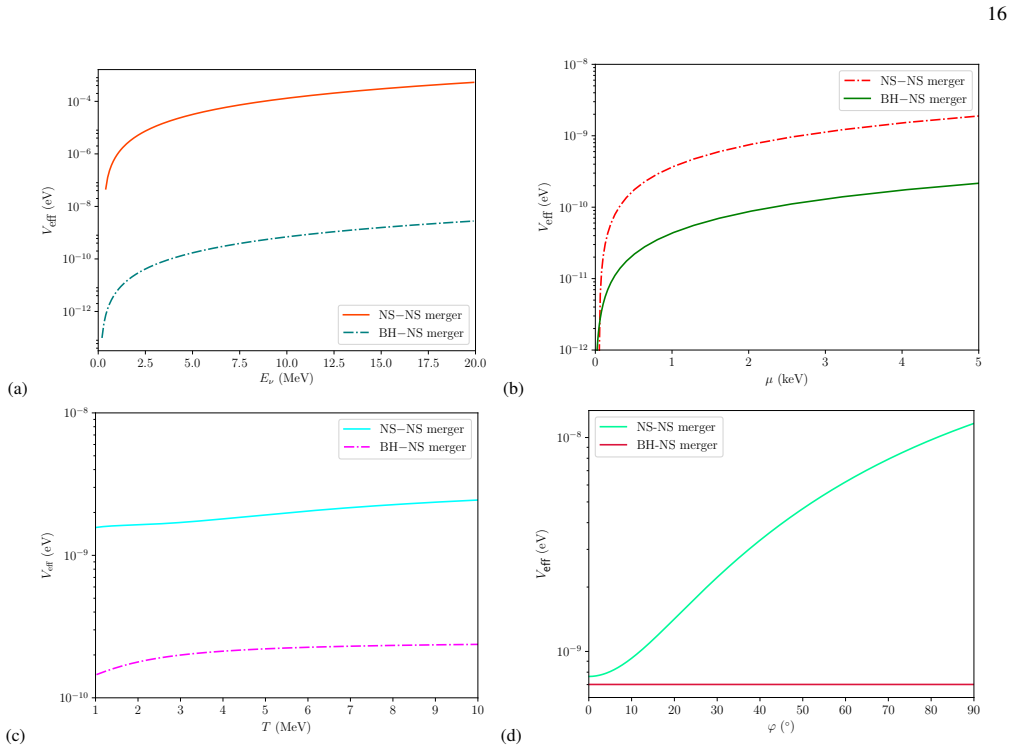
C Patrignani, Particle Data Group, et al. Review of particle physics. Chinese physics C, 40(10):100001, 2016. . 16 (a) 0.0 2.5 5.0 7.5 10.0 12.5 15.0 17.5 20.0 Eν (MeV) 10□12 10□10 10□8 10□6 10□4 Veff (eV) NS−NS merger BH−NS merger (b) 0 1 2 3 4 5 µ (keV) 10□12 10□11 10□10 10□9...
2016
Reviewed August 14, 2026 · model on record in the stance chip above.
Discussion (0). Continue with ORCID to comment.