REVIEW 3 major objections 4 minor 26 references
Sommerfeld--type integrals for discrete diffraction problems
T0 review · 3 major / 4 minor · reviewed 2026-08-14 · deepseek-v4-flash
Pith's one-line read A torus of plane waves carries explicit solutions for three discrete diffraction problems.
desk verdict Solid half-line and Green's function results, but the right-angle solution is asserted with a residue normalization error that as written breaks the incident-wave amplitude. read the letter →
The pith
A machine-rendered reading of the paper's core claim, the machinery that carries it, and where it could break.
The reading
What carries the argument
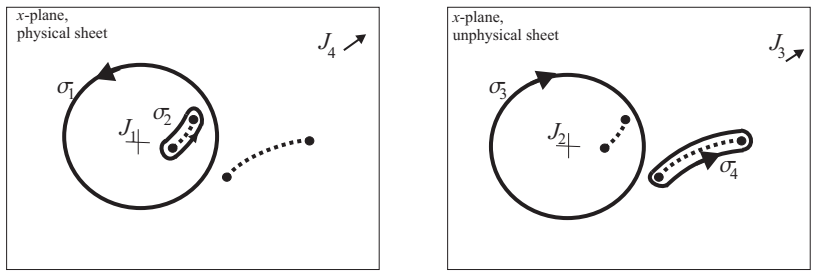
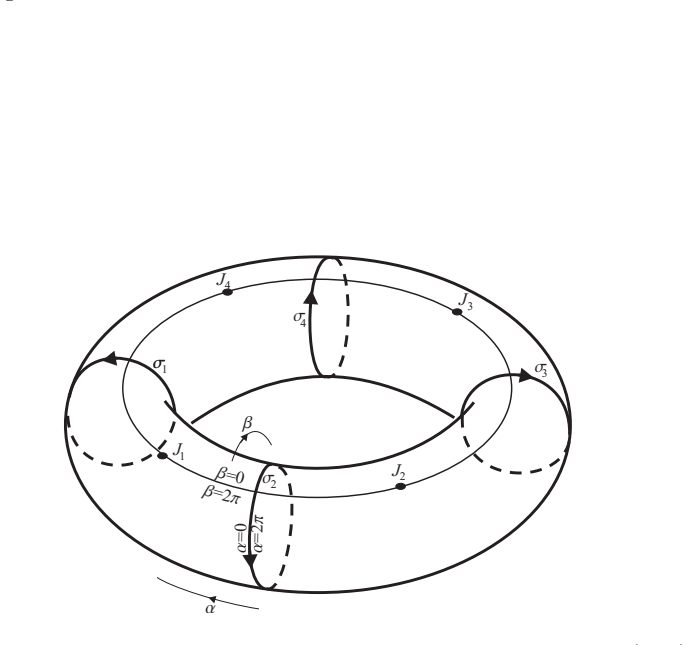
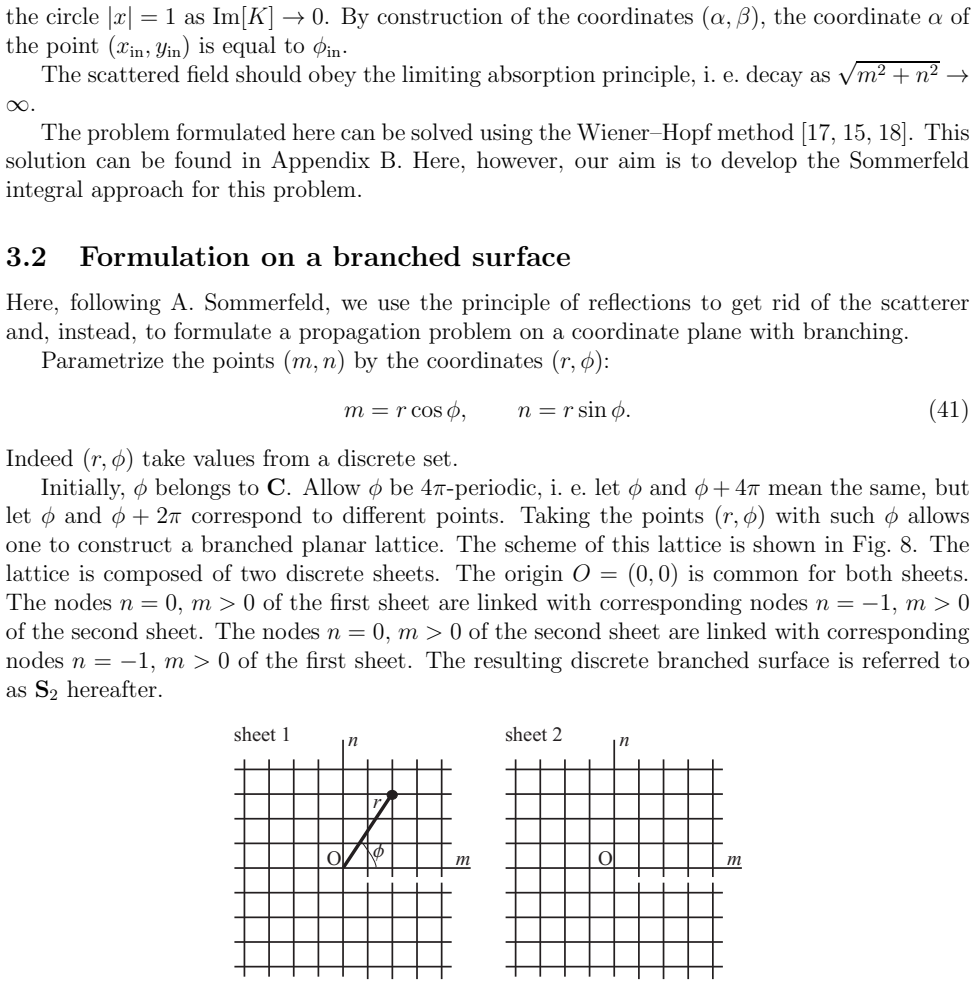
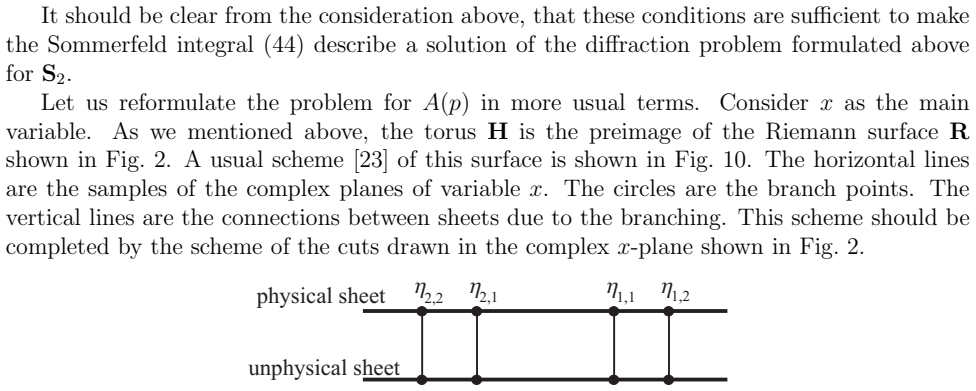
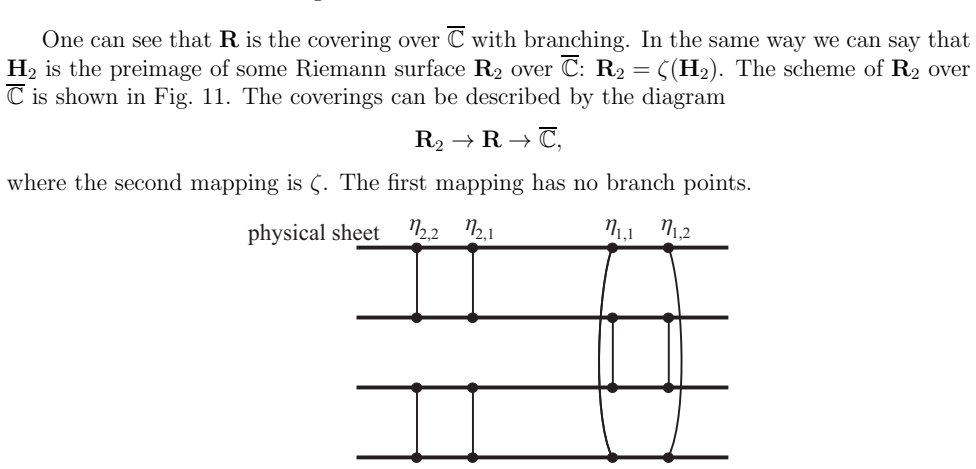
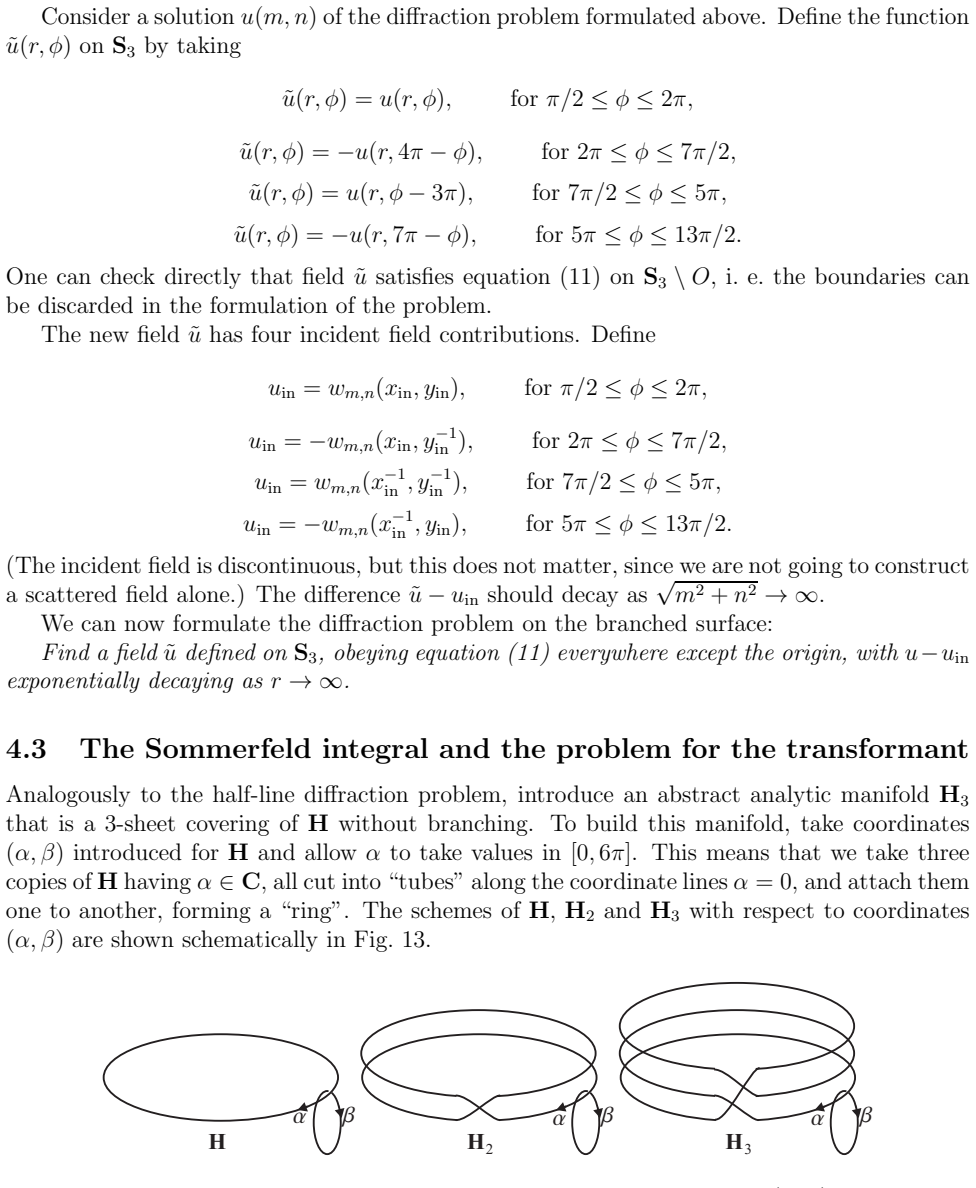
The central object is the dispersion torus $H$ together with the analytic one-form $\Psi=dx/(x(y-y^{-1}))$; plane waves $x^m y^n$ restricted to $H$ form the integrand. The mechanism is contour deformation on $H$ and on its coverings $H_2$ and $H_3$, where the observation angle $\varphi$ has period $4\pi$ and $6\pi$, respectively; this enforces the reflection principle that converts Dirichlet boundaries into branched sheets. The only unknown is the Sommerfeld transformant $A(p)$: for the half-line it is an algebraic function with prescribed residues at two poles, and for the right angle it is assembled from the elliptic function $E(t,\omega_1,3\omega_2)$ at four pole locations.
What would settle it
Evaluate the integral (44) with the transformant (70) at the nodes $(m,0)$ for $m>0$ and $(0,n)$ for $n>0$, using the residue-at-infinity procedure applied to the half-line problem; if any of these values is nonzero, or if the homogeneous equation (11) fails at a node adjacent to the corner, the claimed right-angle solution is incorrect.
Extended reading notes
Core claim
For the discrete Helmholtz equation $u(m+1,n)+u(m-1,n)+u(m,n+1)+u(m,n-1)+(K^2-4)u(m,n)=0$, the paper identifies the set of all plane waves, the dispersion surface $H$ cut out by $x+x^{-1}+y+y^{-1}+K^2-4=0$, as a torus, and shows that the one-form $\Psi=dx/(x(y-y^{-1}))$ is analytic on it. The Green's function is a period of an elliptic integral of $\Psi$ over four homotopic contours on $H$, and the same contour-integral representation, after passage to the two- and three-sheet coverings $H_2$ and $H_3$, gives the half-line and right-angle diffraction fields. The half-line Sommerfeld transformant is found in closed algebraic form, while the right-angle transformant is built from the elliptic function (68), and the paper states that the integral (44) with (70) provides the solution of the right-angled wedge problem.
Load-bearing premise
For the right-angle problem, the load-bearing premise is that the elliptic-function transformant (70) enforces the Dirichlet boundary conditions (65) and the radiation condition; the paper asserts the solution property without checking these conditions, so if the poles and periods of $A$ fail to make the integral vanish on the two half-lines, the right-angle result would not stand.
Editorial extensions
If this is right
- The lattice Green's function can be computed from $u(0,0)$ and $u(2,0)$ alone, with all other values generated by the recurrence (77), so repeated numerical integration is unnecessary.
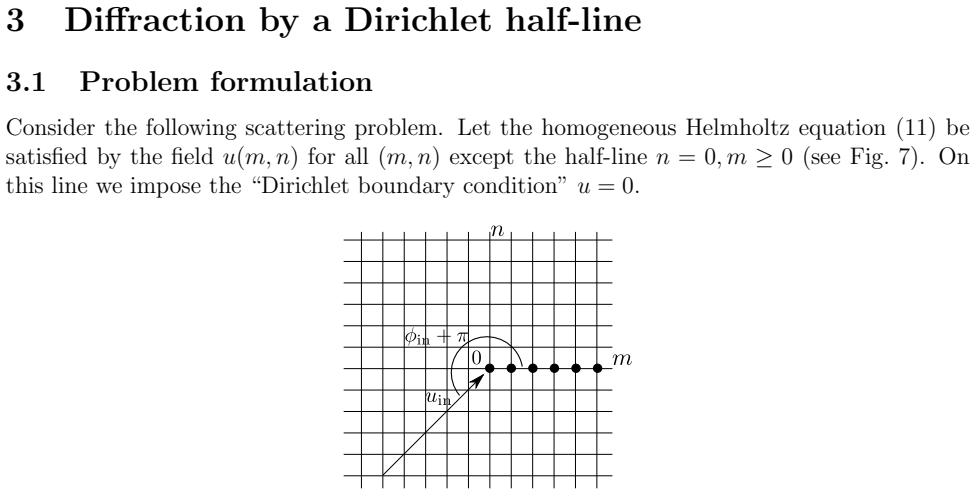
- For the half-line problem, explicit formulae (59) and (60) express every node value as an algebraic function of $K$ and the incidence data, and the Dirichlet condition on the half-line is verified by residue evaluation.
- The same contour formalism applies to the right-angle problem, where the field integral can be evaluated by residues at the twelve infinity points of $H_3$ once the elliptic transformant is computed numerically.
- The continuous Sommerfeld construction is thereby transferred to discrete lattices, with the dispersion torus replacing the tube of propagation angles and the coverings $H_2$, $H_3$ replacing multi-sheeted angle strips.
Reading between the lines
- A direct check not performed in the paper is to substitute the elliptic transformant (70) into the integral (44) and compute residues at the infinity points on the half-lines $n=0, m>0$ and $m=0, n>0$; vanishing of those residues would confirm the Dirichlet boundary conditions (65).
- The construction suggests a natural family: a Dirichlet wedge of aperture $\pi/2$ corresponds to the three-sheeted covering $H_3$, so a wedge of aperture $p\pi/2$ would plausibly correspond to a $p$-sheeted covering with a transformant built from elliptic functions of period $p\omega_2$.
- The linear recurrence (77) for the Green's function has coefficients depending on $K$, so its numerical stability as $|m|+|n|$ grows is not automatic; a stability analysis would determine the practical range of the recursion.
Signed reviews
Editorial analysis
A structured set of objections, weighed in public.
Referee Report
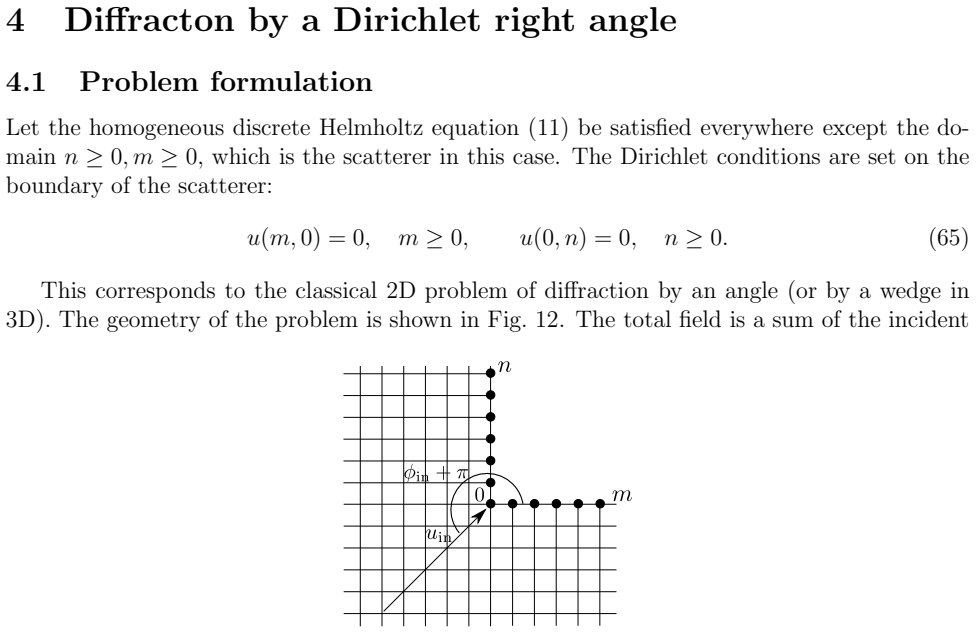
Summary. The paper develops Sommerfeld-type integral representations for three discrete Helmholtz problems on a square lattice: the Green's function for a point source, diffraction by a Dirichlet half-line, and diffraction by a Dirichlet right angle. The authors introduce the dispersion surface H, which is a torus, and rewrite single-integral Green's function representations as contour integrals of a meromorphic 1-form over contours on H. For the half-line problem, they construct a two-sheeted covering H2 and solve a functional problem for the Sommerfeld transformant in terms of algebraic functions, verifying the Dirichlet condition and comparing the result with the Wiener-Hopf solution. For the right-angle problem, they introduce a three-sheeted covering H3 and propose a transformant built from elliptic functions, asserting that the resulting Sommerfeld integral solves the problem.
Significance. If the claims are correct, the paper gives a unified analytic framework for discrete diffraction, with the half-line solution independently checked against the Wiener-Hopf method and the right-angle solution being a new result in terms of elliptic functions. The derivation of recursive relations for the Green's function from the torus representation is elegant and potentially useful computationally. The paper contains no fitted parameters; the transformants are fixed by prescribed residue conditions, and the half-line result is cross-validated by an independent method, which are strengths. However, the right-angle construction, which is the paper's main advertised novelty, is asserted rather than demonstrated, and the transformant in equation (70) has a residue-normalization error. These issues bear directly on the central claim of Section 4.
major comments (3)
- [Section 4.4, Eq. (70)] The prefactor in equation (70) gives the wrong residues for the form AΨ. Since t(p) is defined by t = ∫Ψ in equation (66), we have dt = Ψ in the t-coordinate, and the function E in equation (68) has principal part 1/(t − a) at its pole. Therefore, at the pole t = t0 + ω2, the function (70) has principal part −2πi/(t − t0 − ω2), so Res[AΨ] = −2πi. The functional problem in Section 4.3 requires Res[AΨ] = −(2πi)^{-1} at this pole, with analogous requirements at the other three poles. The same factor 2πi appears at all four poles, so the polar contributions in the integral (44) are amplified by (2πi)^2 relative to the prescribed incident waves. As written, (44) with (70) does not solve the right-angle problem. The prefactor 2πi in (70) should presumably be 1/(2πi), and the residue normalization must be verified after this correction.
- [Section 4.4, final paragraph] The claim that 'the integral (44) with (70) provides the solution for the right-angled wedge problem' is asserted, not demonstrated. For the half-line problem the authors explicitly verify the Dirichlet condition in equation (58) and compare with the Wiener-Hopf solution in Section 3.6. For the right-angle problem, no analogous verification of the boundary conditions (65) on the two rays is given, no check of the radiation condition is provided, and no uniqueness argument is made. The transformant (70) is constructed as an ansatz satisfying a set of residue conditions; satisfying those conditions is not shown to be sufficient for the integral to satisfy the Dirichlet conditions. This gap is load-bearing because the right-angle solution is the main new result of the paper.
- [Section 4.4, pole placement before Eq. (70)] The correspondence between the four physical pole locations and the t-plane offsets (t0 + ω2, 2ω2 − t0, t0 + 5ω2/2, ω2/2 − t0) is stated without proof. The construction only works if, for all admissible φin and K, these four points are pairwise incongruent modulo the period lattice of (ω1, 3ω2) and produce exactly the four required simple poles in one fundamental parallelogram. If two of the offsets coincide modulo the lattice for some parameter values, the residue conditions in Section 4.3 cannot be satisfied simultaneously by (70). The authors should either prove this non-coincidence for the stated parameter range or make explicit the generic restriction under which (70) is valid.
minor comments (4)
- [Section 4.4, text after Eq. (70)] The phrase 'triple periodic' should be 'doubly periodic', since the function is periodic with periods ω1 and 3ω2.
- [Section 4 title] The word 'Diffracton' in the section heading is a typo; it should be 'Diffraction'.
- [Reference [2]] The title of reference [2] contains typos: 'Theoretical about the difraction of x-rays' should likely read 'The theory of diffraction of X-rays' or similar.
- [Section 4.4, paragraph on algebraic functions] The statement that 'A(x) should be an algebraic function that can be expressed explicitly and should contain only square and cubic radicals' is not proved in the paper, and the final representation (70) is left in terms of elliptic functions. This claim should either be demonstrated or softened to avoid presenting an unproved structural assertion.
Circularity Check
No significant circularity: the derivations are self-contained, parameter-free, and independently checked where claimed.
full rationale
The paper fits no data and invokes no load-bearing self-citations. The Green's function is derived from the double Fourier integral by residue calculus; the recursive relations follow from Legendre's reduction of elliptic integrals, not from the target field values. The half-line Sommerfeld transformant is fixed by an explicit functional problem (simple poles with prescribed residues (48)-(49)), solved algebraically as (54), and then checked against the independent Wiener-Hopf solution (95) and against the Dirichlet condition (58). The right-angle transformant (70) is constructed from the standard elliptic function E(t, omega_1, 3*omega_2) with the residues required by the four incident-wave images; this construction is an ansatz with prescribed singularities, not a fit to the field. The claim in Section 4.4 that (44) with (70) solves the wedge problem is asserted rather than verified: the paper does not demonstrate that the resulting field satisfies the Dirichlet conditions (65) and the radiation condition, and a residue-normalization issue may affect the prefactor. That is a correctness or completeness gap, not circularity, because the assertion does not define the solution into existence by the same equations used as inputs. No step reduces to its own inputs.
Assumptions & free parameters
assumptions (4)
- domain assumption The physical solution is selected by the limiting absorption principle: with Im K > 0, the field decays exponentially as sqrt(m^2+n^2) increases without bound.
- ad hoc to paper Real waves are defined by the condition Im[(x - x^{-1})/(y - y^{-1})] = 0 (Eq. 15), and this branch is used to parameterize incident waves and saddle points.
- ad hoc to paper For the right-angle problem, the transformant A(p) constructed in Eq. (70) from elliptic functions is single-valued meromorphic on H3 with exactly the four prescribed poles and residues, and the Sommerfeld integral (44) with this A solves the boundary value problem.
- standard math Legendre's theorem on elliptic integrals, that a general elliptic integral is a linear combination of four basic elliptic integrals with rational coefficients, applies to the Green's function representation.
Cite this review
Pith. "Pith review of Sommerfeld--type integrals for discrete diffraction problems." pith.science (2026). https://pith.science/paper/DIIXFJYN
@misc{pith2026190804764,
  author       = {Pith},
  title        = {Pith review of: Sommerfeld--type integrals for discrete diffraction problems},
  year         = {2026},
  howpublished = {\url{https://pith.science/paper/DIIXFJYN}},
  note         = {Machine review of arXiv:1908.04764}
}
read the original abstract
Three problems for a discrete analogue of the Helmholtz equation are studied analytically using the plane wave decomposition and the Sommerfeld integral approach. They are: 1) the problem with a point source on an entire plane; 2) the problem of diffraction by a Dirichlet half-line; 3) the problem of diffraction by a Dirichlet right angle. It is shown that total field can be represented as an integral of an algebraic function over a contour drawn on some manifold. The latter is a torus. As the result, the explicit solutions are obtained in terms of recursive relations (for the Green's function), algebraic functions (for the half-line problem), or elliptic functions (for the right angle problem).
Figures
Figures from the paper (11 more)

Reference graph
Works this paper leans on
-
[1]
A. Sommerfeld. Optics. Lectures on theoretical physics. Academic Press, 1954
work page 1954
-
[2]
A. Sommerfeld. Theoretical about the difraction of x-rays. Zeitschrift fur Math. und Phys. , 46:11–97, 1901
work page 1901
-
[3]
H. M. Macdonald. Electric Waves . University Press, 1902
work page 1902
-
[4]
V.M. Babich, M.A Lyalinov, and V.E. Grikurov. Diffraction Theory. The Sommerfeld- Malyuzhinets Technique. Alpha Science Int., United Kingdom, 2008
work page 2008
-
[5]
Proceedings of the Sommerfeld’96 Workshop Freudenstadt 30 September – 4 october 1996, 1997
The Sommerfeld problem: methods, generalizations and frus trations. Proceedings of the Sommerfeld’96 Workshop Freudenstadt 30 September – 4 october 1996, 1997
work page 1996
-
[6]
J. H. Hannay and A. Thain. Exact scattering theory for any str aight reflectors in two dimensions. J. Phys. A. , 36:4063–4080, 2003
work page 2003
-
[7]
R. J. Duffin. Discrete potential theory. Duke Math. J. , 20:233–251, 1953
work page 1953
- [8]
Show all 26 references
-
[9]
A. H. Zemanian. Infinite electrical networks: a reprise. IEEE Transactions on circuits and systems, 35(11):1346–1358, 1988
1988
-
[10]
Atkinson and F
D. Atkinson and F. J. Steenwijk. Infinite resistive lattices. American Journal of Physics , 67:486–492, 1999
1999
-
[11]
K. Pearson. The problem of random walk. Nature. London, 72:294–342, 1905
1905
-
[12]
W. H. McCrea and F. J. W. Whipple. Random paths in two and three dimensions. Proc. Roy. Soc. Edinburgh , 60:281–298, 1940
1940
-
[13]
F. Spitzer. Principles of random walks . New York : Van Nostrand, 1964
1964
-
[14]
Ito and H
K. Ito and H. P. Jr. McKean. Potentials and the random walk. Illinois J. of Math. , 4:119–132, 1960
1960
-
[15]
L. I. Slepyan. Antiplane problem of a crack in a lattice. Mech. Solids , 17:101–114, 1982
1982
-
[16]
L. I. Slepyan. Models and phenomena in fracture mechanics . Springer, New York, 2002
2002
-
[17]
G. P. Eatwell and J. R. Willis. The excitation of a fluid-loaded plate s tiffened by a semi- infinite array of beams. IMA J. Appl. Mech. , 29:247–270, 1982
1982
-
[18]
B. L. Sharma. Diffraction of waves on square lattice by semi-infin ite rigid constraint. Wave Motion, 59:52–68, 2015. 30
2015
-
[19]
Hurvitz and R
A. Hurvitz and R. Courant. Vorlesungen ¨ uber Allgemeine Funktionentheorie und Elliptis- che Funktionen. Springer, 1925
1925
-
[20]
B. V. Shabat. Introduction to complex analysis . American Mathematical Society, 1992
1992
-
[21]
H. Bateman. Higher transcedental functions , volume II. McGraw-Hill, 1955
1955
-
[22]
P. A. Martin. Discrete scattering theory: Green’s function fo r a square lattice. Wave motion, 2006
2006
-
[23]
V. B. Alekseev. Abel’s Theorem in Problems and Solutions . Springer Netherlands, 2010
2010
-
[24]
S. K. Lando. Lectures on Generating Functions . American Mathematical Society, 2003
2003
-
[25]
N. I. Akhiezer. Elements of the theory of elliptic functions . American Mathematical Society, 1980
1980
-
[26]
real waves
H. Bremmer Balth Van Der Pol. Operational Calculus. Cambridge University Press, 2008. Appenidx A. Computation of the Green’s function using the recursive relations We study here the problem for the Green’s function (1). Our aim is to find a way to tabulate function u(m,n ) for ...
2008
Reviewed August 14, 2026 · model on record in the stance chip above.
Discussion (0). Continue with ORCID to comment.