REVIEW 2 major objections 4 minor 2 cited by
Quasi-simultaneous radio and X-ray observations of Aql X-1: probing low luminosities
T0 review · 2 major / 4 minor · reviewed 2026-08-14 · deepseek-v4-flash
Pith's one-line read Aql X-1's radio jet fades faster than assumed at low X-ray luminosity, implying a steep radio-X-ray relation or a sharp cutoff.
desk verdict A careful, reproducible observational paper that pushes Aql X-1's radio/X-ray correlation an order of magnitude fainter and shows a steeper fade, with the main caveat honestly stated by the authors. read the letter →
The pith
A machine-rendered reading of the paper's core claim, the machinery that carries it, and where it could break.
The reading
What carries the argument
The argument runs on a Bayesian linear-regression fit to the logarithmic radio--X-ray relation, $L_R/L_{R,c} = \xi (L_X/L_{X,c})^{\beta}$, that treats radio non-detections as censored upper limits rather than discarding them. This is what converts three empty radio pointings into constraints on the slope. The second essential ingredient is the assumption that the $L_R$--$L_X$ correlation behaves similarly between outbursts, which licenses pooling the 2016 upper limits with detections from seven earlier outbursts to span roughly two decades in luminosity.
What would settle it
A radio detection of Aql X-1 at $L_X \lesssim 3\times 10^{35}$ erg s$^{-1}$ with a 5 GHz luminosity above the new upper limits (roughly $1.5\times 10^{27}$ erg s$^{-1}$ or brighter) would directly contradict both the steep power law and the sharp cutoff. Alternatively, a dedicated campaign observing the decay through $10^{35}$--$10^{36}$ erg s$^{-1}$ with daily cadence would reveal whether the radio flux falls smoothly along $\beta \sim 1.2$ or drops abruptly, settling which of the two models describes the source.
Extended reading notes
Core claim
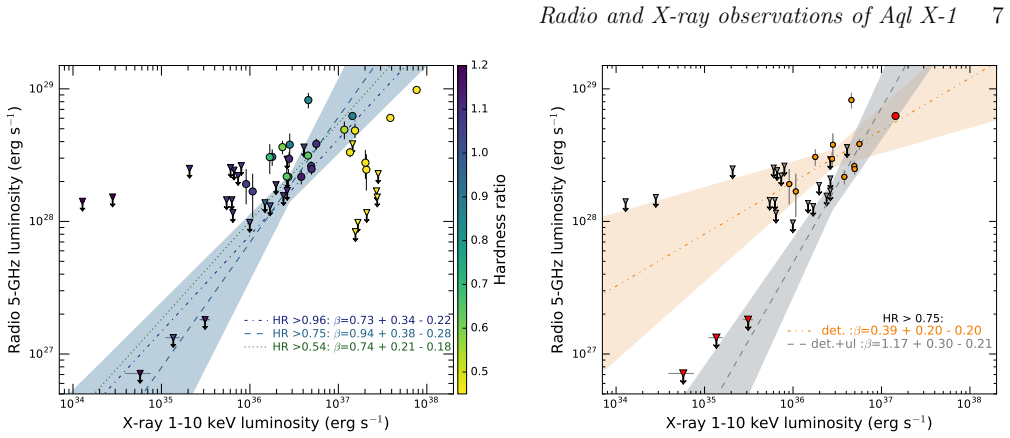
The central discovery is that Aql X-1's radio emission decays more rapidly at low X-ray luminosities than previously assumed, at least during the 2016 outburst. Three radio non-detections with 3-$\sigma$ upper limits of 15, 11 and 6 $\mu$Jy at X-ray luminosities of $3\times 10^{35}$, $1.2\times 10^{35}$ and $6\times 10^{34}$ erg s$^{-1}$ bracket a factor-of-14 drop in $L_X$ against a factor-of-24 drop in radio luminosity relative to the last detection. Combining all available hard-state data (HR > 0.75) with these upper limits yields a power-law slope $\beta = 1.17^{+0.30}_{-0.21}$, steeper than the $\beta \approx 0.4$--$0.9$ values from earlier studies that ignored upper limits. The data are equally compatible with a sudden radio cutoff at $L_X \lesssim 5\times 10^{35}$ erg s$^{-1}$, which would indicate a minimal accretion rate needed to sustain a steady jet. Notably, including upper limits from pre-2016 data alone already steepens the archival slope to $\beta = 0.94^{+0.38}_{-0.28}$, so the steepening is not driven by the 2016 points alone.
Load-bearing premise
The conclusion rests on assuming Aql X-1 behaves the same way in every outburst, so that radio non-detections from the 2016 decay can be combined with detections from seven earlier outbursts; if the jet's behaviour varies from outburst to outburst, the steep slope or cutoff could be an artifact of comparing different epochs rather than a true luminosity dependence.
Editorial extensions
If this is right
- If the steep slope $\beta \approx 1.17$ is real, Aql X-1's accretion inflow is more radiatively efficient at low luminosities than the shallow slopes found for the bulk of neutron star binaries, in line with a jet that carries a roughly constant fraction of the accretion power.
- If the sharp cutoff is real, there is a critical X-ray luminosity around $5\times 10^{35}$ erg s$^{-1}$ below which the steady jet cannot be sustained, giving an empirical threshold for jet launching in atoll-type neutron star binaries.
- Previous studies that fitted only detections underestimated the slope; even without the 2016 data, including archival upper limits steepens the best-fit slope from $\beta \sim 0.4$ to $\beta = 0.94^{+0.38}_{-0.28}$.
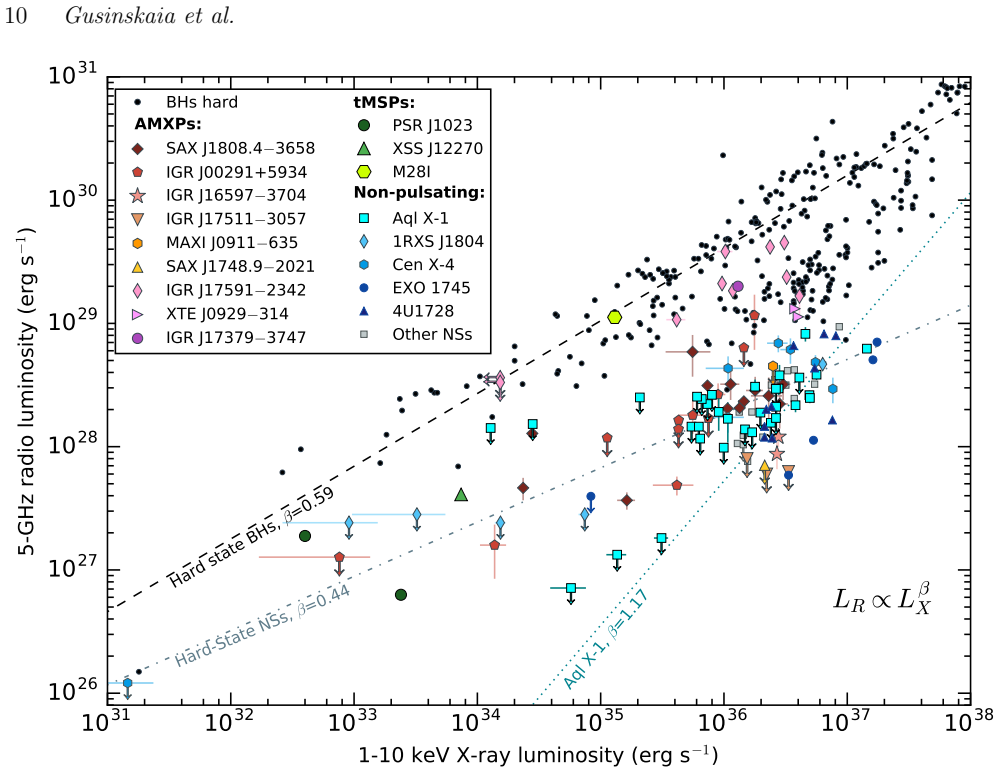
- A previously published coupled accretion-jet model that predicts $L_R \sim 1$--$4\times 10^{28}$ erg s$^{-1}$ at these low $L_X$ values is ruled out, because the new upper limits are about an order of magnitude fainter.
Reading between the lines
- A denser radio campaign sampling the decay from $10^{36}$ down to $10^{34}$ erg s$^{-1}$ in a single outburst would discriminate between a smooth steep power law and a sharp step, a distinction the current sparse data cannot make.
- If the cutoff is real, it implies a physical switch in the accretion flow, possibly related to the propeller effect or a change to a radiatively inefficient regime; this could be tested by looking for correlated X-ray spectral or timing changes at the same luminosity.
- The cross-outburst assumption could be checked by measuring the $L_R$--$L_X$ relation in a future high-luminosity outburst similar to 2016; if the 2016 jet was unusually bright at high $L_X$ (it did not quench like previous outbursts), the steep decay could reflect an unusually powerful jet rather than a universal low-luminosity behaviour.
Signed reviews
Editorial analysis
A structured set of objections, weighed in public.
Referee Report
Summary. The paper reports three VLA 10 GHz observations of Aql X-1 during the decay of its 2016 outburst, yielding radio non-detections with 3 sigma limits of 6-15 microJy at X-ray luminosities of 6e34-3e35 erg/s, together with quasi-simultaneous Swift-XRT spectral fits. Combining these with ATCA detections from the same outburst and re-analysed RXTE/PCA data from seven earlier outbursts, the authors fit L_R-L_X power laws with the LINMIX censored regression of Kelly (2007). Their preferred selection (hardness ratio >0.75, radio upper limits included, 2016 data included) gives beta=1.17(+0.30/-0.21), considerably steeper than earlier estimates (beta about 0.4-0.9), and they discuss a sharp cutoff near L_X about 5e35 erg/s as an alternative. They also show that the new upper limits lie about an order of magnitude below the prediction of Qiao & Liu (2019).
Significance. The paper has clear strengths: a careful re-analysis of all archival RXTE spectra with a uniform column density and model selection; a systematic exploration of hardness-ratio thresholds and of including/excluding the 2016 outburst; a full table of derived luminosities; explicit statement of the inter-outburst similarity assumption; and a genuinely falsifiable result in that the Qiao & Liu model is excluded by the new upper limits. If the 2016 behaviour is representative, beta=1.17 implies a radiatively efficient accretion flow for Aql X-1, in contrast with most NS-LMXB population fits, and the deep upper limits open a new observational regime. The main caveat is that the combined slope, not the 2016 non-detections themselves, is model-dependent; the paper is transparent about this in the abstract and Section 3.2.2, but the Conclusions present the combined steep slope without re-stating the assumption.
major comments (2)
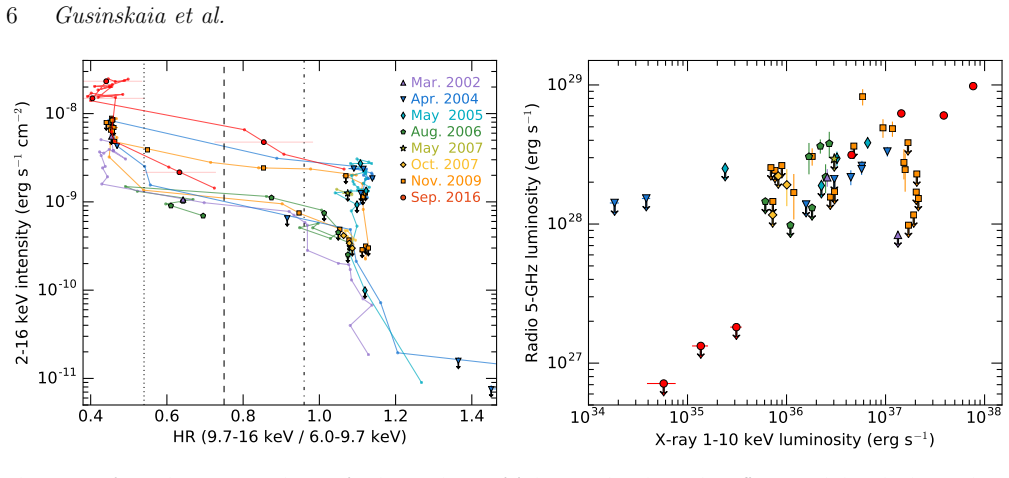
- [Section 3.2.2] The headline combined slope beta=1.17(+0.30/-0.21) rests on the assumption that the L_R-L_X correlation behaves similarly between outbursts, but the stated justification is circular for the 2016 points: these points are exactly the ones that define the new steep regime, and Section 4.1 notes that the 2016 outburst's jet behaviour may have been 'somewhat unusual' and that it is the only high-luminosity outburst in the sample. The archival-only fit (HR>0.75, upper limits included, 2016 excluded) already gives beta=0.94(+0.38/-0.28), so the 2016 data are not solely responsible for the steepening, but the paper does not provide a quantitative test of whether the 2016 upper limits are consistent with the archival-only fit. I recommend adding such a test (e.g., computing the predicted archival L_R distribution at the 2016 X-ray luminosities and stating how many of the 3 sigma radio upper limits fall below the 1 sigma band), or alternatively demoting the combined beta to an explicitly illustrative value and making 'at least during the 2016 outburst' the primary result throughout, including the Conclusions. Without this, the reader cannot distinguish a luminosity-dependent steepening from an outburst-dependent jet behaviour.
- [Section 3.2.2] The statement that the 2016-only least-squares fit, in which the 3 sigma upper limits are treated as detections, gives beta=0.82 and is 'roughly speaking a 3-sigma lower-limit on the steepness of the slope' needs statistical support. Treating an upper limit as a measured value places the true radio luminosity at the boundary of the allowed region, so the resulting slope estimate is not a conventional confidence bound, and no uncertainty or derivation is provided. Because this is the only direct evidence that the 2016 decay is steep when considered alone, please specify the statistical treatment explicitly (e.g., a censored-data fit at the 3 sigma values, or a Monte Carlo realisation that draws upper-limit values from the allowed range) and report the uncertainty on beta=0.82. This would let the reader assess how much of the combined steep slope is driven by the LINMIX upper-limit likelihood rather than by the raw 2016 measurements.
minor comments (4)
- [Table 2] The header row describing the 2016 inclusion has malformed parentheses ('(+ sign' and '(- sign'); please correct these to '+ sign' and '- sign' for clarity.
- [Section 2.1.1] The reference to 'CASA 2; McMullin et al. 2007' reads as if CASA has version '2'; the '2' appears to be a stray character or footnote marker and should be removed or converted to a proper citation.
- [Section 4.1.2] The quoted lowest archival data point '(L_X approximately 5.5e35 erg/s, L_R <= 1.4e28 erg/s)' does not exactly match any row of Table A1; the nearest rows have L_X around 6e35 erg/s and upper limits of 1.2-1.5e28 erg/s. Please verify the quoted values or indicate which row is being referenced.
- [Section 3.2.2] The sentence 'The inclusion of the 2016 outburst also leads to a consistent steep power-law index, that is consistent with the strong VLA radio upper limits' is redundant; consider rewording to 'The 2016 data are consistent with this steep power law'.
Circularity Check
No significant circularity: the steep-slope result is an observational fit, externally benchmarked against Qiao & Liu (2019), and is not forced by construction or by self-citation.
full rationale
The paper's central quantitative claim (β = 1.17^{+0.30}_{-0.21}, Table 2 and Section 3.2.2) is a fit to observational data, not a fitted input renamed as a prediction. The 2016 VLA radio upper limits are raw measurements, and the LINMIX_ERR procedure incorporates them through the published Kelly (2007) censored-regression method using the explicitly stated model in Eqs. (1) and (2). The 'similar behaviour between outbursts' assumption in Section 3.2.2 is explicitly labelled as an assumption and is checked by the absence of obvious systematic offsets in Figure 2; it does not mathematically force the slope. The comparison to Qiao & Liu (2019) is an external, parameter-free theoretical prediction based on archival data, and the new upper limits lie roughly an order of magnitude below it, which is a genuine falsification rather than circular reasoning. Self-citations (e.g., Gusinskaia et al. 2017, 2019; Gallo et al. 2018 includes a co-author) are used for source context and fitting conventions, not as the load-bearing justification for the steep slope. The steep-slope conclusion is driven by where upper limits sit relative to the assumed power law, but this is an inference from the data, and the paper transparently reports the detections-only slope (β = 0.39 ± 0.20) and the 2016-only least-squares lower limit (β = 0.82), showing that the result is not hidden inside the fitting machinery. No step reduces by construction to its own inputs; the honest limitation in Section 4.1.2 that comparing separate outbursts is questionable is a caveat about astrophysical interpretation, not circularity.
Assumptions & free parameters
free parameters (5)
- beta =
1.17 (+0.30/-0.21) for preferred fit
- xi =
-0.26 (+0.09/-0.13) in log10 units
- sigma0 =
0.13 (+0.12/-0.06) dex
- interpolation error coefficients =
0.2 per day and 0.005 offset
- cutoff luminosity (alternative model) =
LX about 5e35 erg/s
assumptions (5)
- domain assumption The LR-LX correlation behaves similarly between different outbursts of Aql X-1.
- domain assumption Distance to Aql X-1 is 4.5 kpc.
- domain assumption Radio spectrum is flat between 4 and 12 GHz.
- domain assumption Hardness ratio threshold HR > 0.75 selects the hard X-ray state.
- domain assumption X-ray flux at radio epochs can be obtained by log-interpolating between bracketing Swift-XRT or RXTE observations.
Cite this review
Pith. "Pith review of Quasi-simultaneous radio and X-ray observations of Aql X-1: probing low luminosities." pith.science (2026). https://pith.science/paper/A5D652HO
@misc{pith2026190804778,
  author       = {Pith},
  title        = {Pith review of: Quasi-simultaneous radio and X-ray observations of Aql X-1: probing low luminosities},
  year         = {2026},
  howpublished = {\url{https://pith.science/paper/A5D652HO}},
  note         = {Machine review of arXiv:1908.04778}
}
abstract
Aql X-1 is one of the best-studied neutron star low-mass X-ray binaries. It was previously targeted using quasi-simultaneous radio and X-ray observations during at least 7 different accretion outbursts. Such observations allow us to probe the interplay between accretion inflow (X-ray) and jet outflow (radio). Thus far, these combined observations have only covered one order of magnitude in radio and X-ray luminosity range; this means that any potential radio - X-ray luminosity correlation, $L_R \propto L_X^{\beta}$, is not well constrained ($\beta \approx$ 0.4-0.9, based on various studies) or understood. Here we present quasi-simultaneous Very Large Array and Swift-XRT observations of Aql X-1's 2016 outburst, with which we probe one order of magnitude fainter in radio and X-ray luminosity compared to previous studies ($6 \times 10^{34} < L_X < 3 \times 10^{35}$ erg s$^{-1}$, i.e., the intermediate to low-luminosity regime between outburst peak and quiescence). The resulting radio non-detections indicate that Aql X-1's radio emission decays more rapidly at low X-ray luminosities than previously assumed - at least during the 2016 outburst. Assuming similar behaviour between outbursts, and combining all available data, this can be modelled as a steep $\beta=1.17^{+0.30}_{-0.21}$ power-law index or as a sharp radio cut-off at $L_X \lesssim 5 \times 10^{35}$ erg s$^{-1}$ (given our deep radio upper limits at X-ray luminosities below this value). We discuss these results in the context of other similar studies.
Figures

Figures from the paper (1 more)
Forward citations
Cited by 2 Pith papers
-
Why do massive stars form bow shocks? Bulk ISM motion as the main driver of bow shock formation and geometry
Bulk interstellar gas motion, not stellar motion, dominates most massive star bow shocks; only about 21% are classical aligned bow shocks.
-
Radio and X-ray monitoring of the accreting millisecond X-ray pulsar IGR J17591-2342 in outburst
The accreting millisecond pulsar IGR J17591-2342 was radio-bright compared with other neutron star binaries in outburst, with a poorly constrained radio-X-ray slope of 0.37 and factor-of-four radio variability.
Reference graph
Works this paper leans on
-
[1]
Altamirano D., Casella P., Patruno A., Wijnands R., van der Klis M., 2008, @doi [ ] 10.1086/528983 , http://adsabs.harvard.edu/abs/2008ApJ...674L..45A 674, L45
doi:10.1086/528983 2008
-
[2]
Bahramian A., et al., 2018, Radio/X-ray correlation database for X-ray binaries , @doi 10.5281/zenodo.1252036 , https://doi.org/10.5281/zenodo.1252036
-
[3]
Blandford R. D., Payne D. G., 1982, @doi [ ] 10.1093/mnras/199.4.883 , http://adsabs.harvard.edu/abs/1982MNRAS.199..883B 199, 883
-
[4]
Blandford R. D., Znajek R. L., 1977, @doi [ ] 10.1093/mnras/179.3.433 , http://adsabs.harvard.edu/abs/1977MNRAS.179..433B 179, 433
-
[5]
Bogdanov S., et al., 2018, @doi [ ] 10.3847/1538-4357/aaaeb9 , http://adsabs.harvard.edu/abs/2018ApJ...856...54B 856, 54
-
[6]
Campana S., Coti Zelati F., D'Avanzo P., 2013, @doi [ ] 10.1093/mnras/stt604 , https://ui.adsabs.harvard.edu/abs/2013MNRAS.432.1695C 432, 1695
-
[7]
Campana S., Brivio F., Degenaar N., Mereghetti S., Wijnands R., D'Avanzo P., Israel G. L., Stella L., 2014, @doi [ ] 10.1093/mnras/stu709 , https://ui.adsabs.harvard.edu/abs/2014MNRAS.441.1984C 441, 1984
-
[8]
Casella P., Altamirano D., Patruno A., Wijnands R., van der Klis M., 2008, @doi [ ] 10.1086/528982 , http://adsabs.harvard.edu/abs/2008ApJ...674L..41C 674, L41
doi:10.1086/528982 2008
Show all 65 references
-
[9]
A., Leisy P., Patat F., 1999, , http://adsabs.harvard.edu/abs/1999A
Chevalier C., Ilovaisky S. A., Leisy P., Patat F., 1999, , http://adsabs.harvard.edu/abs/1999A
1999
-
[10]
P., Tzioumis A
Corbel S., Fender R. P., Tzioumis A. K., Tomsick J. A., Orosz J. A., Miller J. M., Wijnands R., Kaaret P., 2002, @doi [Science] 10.1126/science.1075857 , http://adsabs.harvard.edu/abs/2002Sci...298..196C 298, 196
2002 doi
-
[11]
K., Fender R
Corbel S., Coriat M., Brocksopp C., Tzioumis A. K., Fender R. P., Tomsick J. A., Buxton M. M., Bailyn C. D., 2013, @doi [ ] 10.1093/mnras/sts215 , https://ui.adsabs.harvard.edu/abs/2013MNRAS.428.2500C 428, 2500
2013 doi
-
[13]
Czerny M., Czerny B., Grindlay J., 1985, in Bulletin of the American Astronomical Society. p. 554
1985
-
[14]
R., Fridriksson J
D'Angelo C. R., Fridriksson J. K., Messenger C., Patruno A., 2015, @doi [ ] 10.1093/mnras/stv465 , https://ui.adsabs.harvard.edu/abs/2015MNRAS.449.2803D 449, 2803
2015 doi
-
[15]
T., et al., 2015, @doi [ ] 10.1088/0004-637X/809/1/13 , http://adsabs.harvard.edu/abs/2015ApJ...809...13D 809, 13
Deller A. T., et al., 2015, @doi [ ] 10.1088/0004-637X/809/1/13 , http://adsabs.harvard.edu/abs/2015ApJ...809...13D 809, 13
2015 doi
-
[16]
D \' az Trigo M., et al., 2018, @doi [ ] 10.1051/0004-6361/201832693 , http://adsabs.harvard.edu/abs/2018A
2018 doi
-
[17]
Done C., Gierli \'n ski M., Kubota A., 2007, @doi [ ] 10.1007/s00159-007-0006-1 , https://ui.adsabs.harvard.edu/abs/2007A
2007 doi
-
[18]
P., Kuulkers E., 2001, @doi [ ] 10.1046/j.1365-8711.2001.04345.x , http://adsabs.harvard.edu/abs/2001MNRAS.324..923F 324, 923
Fender R. P., Kuulkers E., 2001, @doi [ ] 10.1046/j.1365-8711.2001.04345.x , http://adsabs.harvard.edu/abs/2001MNRAS.324..923F 324, 923
2001
-
[19]
T., Chubb T
Friedman H., Byram E. T., Chubb T. A., 1967, @doi [Science] 10.1126/science.156.3773.374 , http://adsabs.harvard.edu/abs/1967Sci...156..374F 156, 374
1967 doi
-
[20]
Gallo E., et al., 2014, @doi [ ] 10.1093/mnras/stu1599 , http://adsabs.harvard.edu/abs/2014MNRAS.445..290G 445, 290
2014 doi
-
[21]
Gallo E., Degenaar N., van den Eijnden J., 2018, @doi [ ] 10.1093/mnrasl/sly083 , http://adsabs.harvard.edu/abs/2018MNRAS.478L.132G 478, L132
2018 doi
-
[22]
K., Morgan E
Galloway D. K., Morgan E. H., Krauss M. I., Kaaret P., Chakrabarty D., 2007, @doi [ ] 10.1086/510741 , http://adsabs.harvard.edu/abs/2007ApJ...654L..73G 654, L73
2007 doi
-
[23]
K., Muno M
Galloway D. K., Muno M. P., Hartman J. M., Psaltis D., Chakrabarty D., 2008, @doi [ ] 10.1086/592044 , https://ui.adsabs.harvard.edu/abs/2008ApJS..179..360G 179, 360
2008 doi
-
[24]
u ng \"o r C., G \
G \"u ng \"o r C., G \"u ver T., Ek s i K. Y., 2014, @doi [ ] 10.1093/mnras/stu128 , http://adsabs.harvard.edu/abs/2014MNRAS.439.2717G 439, 2717
2014 doi
-
[25]
u ng \"o r C., Ek s i K. Y., G \
G \"u ng \"o r C., Ek s i K. Y., G \"o g \"u s E., G \"u ver T., 2017, @doi [ ] 10.3847/1538-4357/aa8b76 , https://ui.adsabs.harvard.edu/abs/2017ApJ...848...13G 848, 13
2017 doi
-
[26]
V., et al., 2017, @doi [ ] 10.1093/mnras/stx1235 , http://adsabs.harvard.edu/abs/2017MNRAS.470.1871G 470, 1871
Gusinskaia N. V., et al., 2017, @doi [ ] 10.1093/mnras/stx1235 , http://adsabs.harvard.edu/abs/2017MNRAS.470.1871G 470, 1871
2017 doi
-
[27]
V., et al., 2019, arXiv e-prints, https://ui.adsabs.harvard.edu/abs/2019arXiv190902323G p
Gusinskaia N. V., et al., 2019, arXiv e-prints, https://ui.adsabs.harvard.edu/abs/2019arXiv190902323G p. arXiv:1909.02323
2019 arXiv
-
[29]
B., Radeva Y., Rots A
Jahoda K., Markwardt C. B., Radeva Y., Rots A. H., Stark M. J., Swank J. H., Strohmayer T. E., Zhang W., 2006, @doi [ ] 10.1086/500659 , https://ui.adsabs.harvard.edu/abs/2006ApJS..163..401J 163, 401
2006 doi
-
[30]
Jaodand A., Hessels J. W. T., Archibald A., 2018, in Weltevrede P., Perera B. B. P., Preston L. L., Sanidas S., eds, IAU Symposium Vol. 337, Pulsar Astrophysics the Next Fifty Years. pp 47--51 ( @eprint arXiv 1711.10565 ), @doi 10.1017/S1743921317010407
2018 arXiv
-
[31]
C., 2007, @doi [ ] 10.1086/519947 , http://adsabs.harvard.edu/abs/2007ApJ...665.1489K 665, 1489
Kelly B. C., 2007, @doi [ ] 10.1086/519947 , http://adsabs.harvard.edu/abs/2007ApJ...665.1489K 665, 1489
2007 doi
-
[32]
K., Durgaprasad N., Gokhale G
Kunte P. K., Durgaprasad N., Gokhale G. S., Iyengar V. S., Manchanda R. K., Sreekantan B. V., 1973, @doi [Nature Physical Science] 10.1038/physci245037a0 , http://adsabs.harvard.edu/abs/1973NPhS..245...37K 245, 37
1973 doi
-
[33]
Lewin W. H. G., van Paradijs J., van den Heuvel E. P. J., 1997, X-ray Binaries
1997
-
[34]
J., 2012, preprint, http://adsabs.harvard.edu/abs/2012arXiv1204.3154M ( @eprint arXiv 1204.3154 )
Maccarone T. J., 2012, preprint, http://adsabs.harvard.edu/abs/2012arXiv1204.3154M ( @eprint arXiv 1204.3154 )
2012 arXiv
-
[35]
Markoff S., Nowak M., Corbel S., Fender R., Falcke H., 2003, @doi [ ] 10.1051/0004-6361:20021497 , https://ui.adsabs.harvard.edu/abs/2003A&A...397..645M 397, 645
2003 doi
-
[36]
P., Waters B., Schiebel D., Young W., Golap K., 2007, in Shaw R
McMullin J. P., Waters B., Schiebel D., Young W., Golap K., 2007, in Shaw R. A., Hill F., Bell D. J., eds, Astronomical Society of the Pacific Conference Series Vol. 376, Astronomical Data Analysis Software and Systems XVI. p. 127
2007
-
[37]
P., 2006, @doi [ ] 10.1111/j.1365-2966.2005.09777.x , http://adsabs.harvard.edu/abs/2006MNRAS.366...79M 366, 79
Migliari S., Fender R. P., 2006, @doi [ ] 10.1111/j.1365-2966.2005.09777.x , http://adsabs.harvard.edu/abs/2006MNRAS.366...79M 366, 79
2006
-
[38]
P., Rupen M., Jonker P
Migliari S., Fender R. P., Rupen M., Jonker P. G., Klein-Wolt M., Hjellming R. M., van der Klis M., 2003, @doi [ ] 10.1046/j.1365-8711.2003.06795.x , http://adsabs.harvard.edu/abs/2003MNRAS.342L..67M 342, L67
2003
-
[40]
Miller-Jones J. C. A., et al., 2010a, @doi [ ] 10.1088/2041-8205/716/2/L109 , http://adsabs.harvard.edu/abs/2010ApJ...716L.109M 716, L109
-
[41]
Miller-Jones J. C. A., Heinke C. O., Sivakoff G. R., Pooley D., Homan J., Altamirano D., 2010b, The Astronomer's Telegram, https://ui.adsabs.harvard.edu/abs/2010ATel.2377....1M 2377, 1
-
[42]
P., Motta S
Mu \ n oz-Darias T., Fender R. P., Motta S. E., Belloni T. M., 2014, @doi [ ] 10.1093/mnras/stu1334 , http://adsabs.harvard.edu/abs/2014MNRAS.443.3270M 443, 3270
2014 doi
-
[43]
Narayan R., Yi I., 1995, @doi [ ] 10.1086/176343 , http://adsabs.harvard.edu/abs/1995ApJ...452..710N 452, 710
1995 doi
-
[44]
A., et al., 2011, @doi [ ] 10.1088/0004-637X/728/1/13 , https://ui.adsabs.harvard.edu/abs/2011ApJ...728...13N 728, 13
Nowak M. A., et al., 2011, @doi [ ] 10.1088/0004-637X/728/1/13 , https://ui.adsabs.harvard.edu/abs/2011ApJ...728...13N 728, 13
2011 doi
-
[45]
Papitto A., et al., 2013, @doi [ ] 10.1038/nature12470 , http://adsabs.harvard.edu/abs/2013Natur.501..517P 501, 517
2013 doi
-
[46]
M., 2016, @doi [ ] 10.3847/0004-637X/822/1/33 , https://ui.adsabs.harvard.edu/abs/2016ApJ...822...33P 822, 33
Parfrey K., Spitkovsky A., Beloborodov A. M., 2016, @doi [ ] 10.3847/0004-637X/822/1/33 , https://ui.adsabs.harvard.edu/abs/2016ApJ...822...33P 822, 33
2016 doi
-
[47]
Patruno A., 2012, @doi [ ] 10.1088/2041-8205/753/1/L12 , http://adsabs.harvard.edu/abs/2012ApJ...753L..12P 753, L12
2012 doi
-
[48]
L., 2012, preprint, http://adsabs.harvard.edu/abs/2012arXiv1206.2727P ( @eprint arXiv 1206.2727 )
Patruno A., Watts A. L., 2012, preprint, http://adsabs.harvard.edu/abs/2012arXiv1206.2727P ( @eprint arXiv 1206.2727 )
2012 arXiv
-
[49]
A., Chandler C
Perley R. A., Chandler C. J., Butler B. J., Wrobel J. M., 2011, @doi [ ] 10.1088/2041-8205/739/1/L1 , http://adsabs.harvard.edu/abs/2011ApJ...739L...1P 739, L1
2011 doi
-
[50]
M., Markoff S., Kelly B
Plotkin R. M., Markoff S., Kelly B. C., K \"o rding E., Anderson S. F., 2012, @doi [ ] 10.1111/j.1365-2966.2011.19689.x , http://adsabs.harvard.edu/abs/2012MNRAS.419..267P 419, 267
2012
-
[51]
F., 2019, @doi [ ] 10.1093/mnras/stz1365 , https://ui.adsabs.harvard.edu/abs/2019MNRAS.487.1626Q 487, 1626
Qiao E., Liu B. F., 2019, @doi [ ] 10.1093/mnras/stz1365 , https://ui.adsabs.harvard.edu/abs/2019MNRAS.487.1626Q 487, 1626
2019 doi
-
[52]
Romano P., et al., 2006, @doi [ ] 10.1051/0004-6361:20065071 , http://ukads.nottingham.ac.uk/abs/2006A
2006 doi
-
[53]
D., Degenaar N., Wijnands R., van den Eijnden J., Gusinskaia N
Russell T. D., Degenaar N., Wijnands R., van den Eijnden J., Gusinskaia N. V., Hessels J. W. T., Miller-Jones J. C. A., 2018, @doi [ ] 10.3847/2041-8213/aaf4f9 , https://ui.adsabs.harvard.edu/abs/2018ApJ...869L..16R 869, L16
2018 doi
-
[54]
E., Bildsten L., Brown E
Rutledge R. E., Bildsten L., Brown E. F., Pavlov G. G., Zavlin V. E., 2001, @doi [ ] 10.1086/322361 , http://adsabs.harvard.edu/abs/2001ApJ...559.1054R 559, 1054
2001 doi
-
[55]
Sanna A., Riggio A., Pintore F., Altamirano D., Burderi L., Di Salvo T., 2016, The Astronomer's Telegram, https://ui.adsabs.harvard.edu/abs/2016ATel.9292....1S 9292, 1
2016
-
[56]
I., Sunyaev R
Shakura N. I., Sunyaev R. A., 1973, , http://adsabs.harvard.edu/abs/1973A
1973
-
[57]
J., et al., 2016, @doi [ ] 10.1093/mnras/stw1013 , http://adsabs.harvard.edu/abs/2016MNRAS.460..345T 460, 345
Tetarenko A. J., et al., 2016, @doi [ ] 10.1093/mnras/stw1013 , http://adsabs.harvard.edu/abs/2016MNRAS.460..345T 460, 345
2016 doi
-
[58]
J., et al., 2017, The Astronomer's Telegram, https://ui.adsabs.harvard.edu/abs/2017ATel10843....1T 10843, 1
Tetarenko A. J., et al., 2017, The Astronomer's Telegram, https://ui.adsabs.harvard.edu/abs/2017ATel10843....1T 10843, 1
2017
-
[59]
J., et al., 2018, @doi [ ] 10.3847/1538-4357/aaa95a , https://ui.adsabs.harvard.edu/abs/2018ApJ...854..125T 854, 125
Tetarenko A. J., et al., 2018, @doi [ ] 10.3847/1538-4357/aaa95a , https://ui.adsabs.harvard.edu/abs/2018ApJ...854..125T 854, 125
2018 doi
-
[60]
Tudor V., et al., 2016, The Astronomer's Telegram, https://ui.adsabs.harvard.edu/abs/2016ATel.8914....1T 8914, 1
2016
-
[61]
Tudor V., et al., 2017, @doi [ ] 10.1093/mnras/stx1168 , http://adsabs.harvard.edu/abs/2017MNRAS.470..324T 470, 324
2017 doi
-
[62]
P., Linares M., Maitra D., van der Klis M., 2009, @doi [ ] 10.1111/j.1365-2966.2009.15604.x , http://adsabs.harvard.edu/abs/2009MNRAS.400.2111T 400, 2111
Tudose V., Fender R. P., Linares M., Maitra D., van der Klis M., 2009, @doi [ ] 10.1111/j.1365-2966.2009.15604.x , http://adsabs.harvard.edu/abs/2009MNRAS.400.2111T 400, 2111
2009
-
[63]
Wijnands R., van der Klis M., 1998, @doi [ ] 10.1038/28557 , https://ui.adsabs.harvard.edu/abs/1998Natur.394..344W 394, 344
1998 doi
-
[64]
Yuan F., Cui W., 2005, @doi [ ] 10.1086/431453 , https://ui.adsabs.harvard.edu/abs/2005ApJ...629..408Y 629, 408
2005 doi
-
[65]
van den Eijnden J., et al., 2018, The Astronomer's Telegram, https://ui.adsabs.harvard.edu/abs/2018ATel11487....1V 11487
2018
-
[66]
van der Klis M., 1994, , http://adsabs.harvard.edu/abs/1994A
1994
-
[67]
write newline
" write newline "" before.all 'output.state := FUNCTION fin.entry write newline FUNCTION new.block output.state before.all = 'skip after.block 'output.state := if FUNCTION new.sentence output.state after.block = 'skip output.state before.all = 'skip after.sentence 'output.stat...
-
[68]
write newline
" write newline "" before.all 'output.state := FUNCTION fin.entry write newline FUNCTION new.block output.state before.all = 'skip after.block 'output.state := if FUNCTION new.sentence output.state after.block = 'skip output.state before.all = 'skip after.sentence 'output.stat...
Reviewed August 14, 2026 · model on record in the stance chip above.
Discussion (0). Continue with ORCID to comment.