REVIEW 4 major objections 5 minor 38 references
Distributed Estimation in the Presence of Strategic Data Sources
T0 review · 4 major / 5 minor · reviewed 2026-08-14 · deepseek-v4-flash
Pith's one-line read A quadratic payment rule can make self-interested data sources report truthfully at minimum cost.
desk verdict A worthwhile mechanism-design paper for crowdsourced estimation whose main theorem survives the reader's objection, but whose fallback mechanism has a sign error that must be fixed. read the letter →
The pith
A machine-rendered reading of the paper's core claim, the machinery that carries it, and where it could break.
The reading
What carries the argument
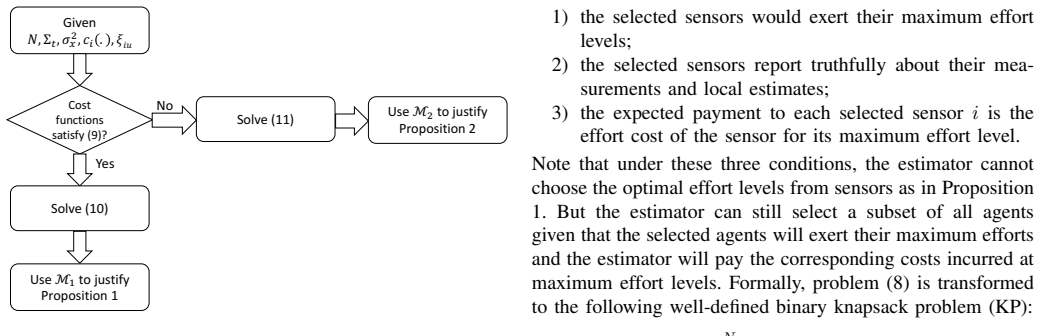
The load-bearing object is the pairwise quadratic scoring rule $p_i = \gamma_i - \beta_i(\hat{x}_{ri} - y_{rj})^2$. Its role is to make agent $i$'s payment depend on how well its reported local estimate predicts another agent's raw measurement, which the agent cannot control. Since $\min_{\hat{x}_{ri}} E[(\hat{x}_{ri} - y_j)^2 \mid \hat{x}_i]$ is achieved at $\hat{x}_{ri} = E[y_j \mid \hat{x}_i]$, truthful reporting is the optimal message whenever the effort cost does not enter the message choice. The expected squared error $E[(\hat{x}_i - y_j)^2] = (\xi_i + \xi_x)^{-1} + \xi_j^{-1}$ makes the payment's sensitivity to effort explicit; $\beta_i$ is calibrated from the target effort by the first-order condition (23), and $\gamma_i$ by the individual-rationality condition (24). The same machinery, with $\beta_i$ chosen large enough, converts the mechanism into a max-effort elicitor. At the estimator level, the mechanism justifies replacing the game-theoretic problem (8) with the deterministic resource-allocation problem (13), or the knapsack problem (11) in the fallback case.
What would settle it
Choose a cost function $c_i$ that satisfies (9) but has a region of negative curvature, fix a target $\tilde{\xi}_i$, set $\beta_i$ by (23), and evaluate $U_i(\xi_i) = \gamma_i - \beta_i((\xi_i + \xi_x)^{-1} + \tilde{\xi}_j^{-1}) - c_i(\xi_i)$ on $[0, \xi_{iu}]$. If the maximum over $\xi_i$ is attained away from $\tilde{\xi}_i$, Theorem 1's stated profile is not a Nash equilibrium, and the central claim fails for that cost function.
Extended reading notes
Core claim
In the static Gaussian estimation model, the paper claims that the payment $p_i(\hat{x}_{ri}, y_{rj}) = \gamma_i - \beta_i(\hat{x}_{ri} - y_{rj})^2$ can simultaneously solve both incentive problems that plague crowdsourced estimation: agents choose measurement accuracy (effort) and choose what to report. Because the squared loss makes the conditional expectation $E[y_j \mid \hat{x}_i]$ the optimal report, an agent's own accuracy directly improves its expected payment, so effort can be incentivized without observing it. Setting $\beta_i = c_i'(\tilde{\xi}_i)(\xi_x + \tilde{\xi}_i)^2$ makes the estimator-chosen effort $\tilde{\xi}_i$ the unique best response when others play their prescribed strategies, and setting $\gamma_i = \beta_i((\xi_x + \tilde{\xi}_i)^{-1} + \tilde{\xi}_j^{-1}) + c_i(\tilde{\xi}_i)$ makes the expected payment exactly the effort cost and keeps participation rational. Thus, under condition (9), the truthful-effort profile is a Nash equilibrium and the estimator's problem collapses to minimizing total cost subject to the precision constraint (13). If (9) fails, the same payment form with a larger $\beta_i$ pushes agents to their maximum effort, and the estimator solves the binary knapsack problem (11); expected payments equal the maximum-effort costs. The fusion of reports uses the standard inverse-variance weighting, so the global accuracy target is met by construction.
Load-bearing premise
The main proof assumes that condition (9), checked pointwise at every effort level, guarantees that each agent's expected utility is globally concave in effort; in fact the relevant second derivative uses the fixed calibrated constant $\beta_i$ rather than the moving derivative $c_i'(\xi_i)$, so non-convex cost functions could admit another, better response away from the desired effort.
Editorial extensions
If this is right
- Under condition (9), the estimator can guarantee a target global MSE at the minimum possible expected total payment, with each selected agent paid exactly its effort cost in equilibrium.
- For convex effort costs, condition (9) holds automatically, covering the two worked examples: quadratic continuous costs lead to equal efforts across agents, and discrete per-measurement costs lead to a bounded knapsack problem.
- The quadratic cost example gives the closed-form minimum payment $l(\Sigma_t^{-1} - \xi_x)^2 / N$ when all $N$ agents are hired.
- If one honest agent is available to serve as a reference, the truth-telling profile is a unique equilibrium in strictly dominant strategies, removing the need to worry about equilibrium selection.
- When condition (9) fails, the fallback mechanism is still feasible and truthful, but no longer payment-optimal; it solves a binary knapsack selection problem in pseudo-polynomial time.
Reading between the lines
- The proof's concavity step suggests a practical design check that is stricter than (9): verify $-2\beta_i / (\xi_i + \xi_x)^3 - c_i''(\xi_i) < 0$ on the whole interval $[0, \xi_{iu}]$ before deploying M1, or choose $\beta_i$ to enforce it.
- The pairwise scoring structure is a continuous-signal peer-prediction scheme, so the mechanism could be combined with robust Bayesian truth serum ideas to handle agents with correlated private signals rather than conditionally independent Gaussian noise.
- In repeated deployments, the estimator could estimate cost functions from observed agent behavior and adapt $\beta_i$ and $\gamma_i$ over time, extending the static design to dynamic settings.
- The expected-payment guarantee is not a worst-case payment guarantee; a risk-averse estimator or one with a hard budget cap would need an additional payment bound or an ex-ante budget constraint.
Signed reviews
Editorial analysis
A structured set of objections, weighed in public.
Referee Report
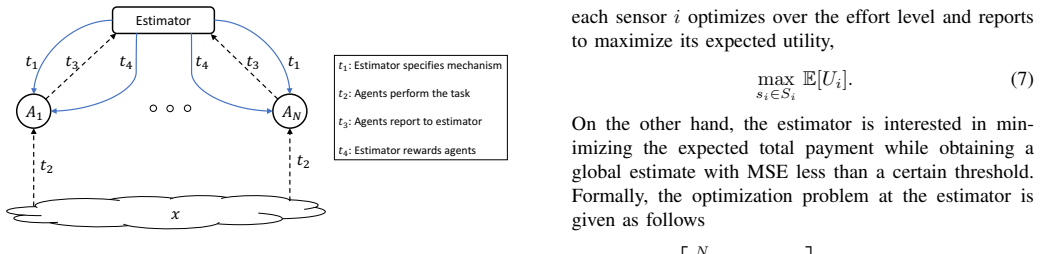
Summary. The paper studies a static distributed estimation problem in which N self-interested agents choose an effort level (equivalently, a precision ξ_i), observe a noisy measurement of a Gaussian unknown, and report both a measurement and a local estimate to an estimator. The estimator designs payment mechanisms to implement desired effort and truthful reporting in Nash equilibrium while minimizing expected total payment subject to a global MSE constraint and individual rationality. For cost functions satisfying condition (9), the authors propose mechanism M1 (Theorem 1) that implements the optimal effort profile from problem (13) with expected payment equal to each agent's effort cost. For general cost functions, they propose a fallback mechanism M2 (Theorem 2) that elicits maximum effort from selected agents and reduces the estimator's problem to a binary knapsack problem. Two special cases (quadratic and discrete linear costs) and simulations are provided.
Significance. The paper addresses a timely problem and contains several attractive elements: the formulation in Section II is clean, the reduction of the estimator's optimization to (13) and (11) is useful, and condition (9) is a genuine structural insight, namely a single-crossing condition on (ξ_x+ξ)^2 c_i'(ξ) rather than a concavity condition. If established rigorously, the results would be a valuable contribution to mechanism design for crowdsourced estimation, going beyond the binary-effort models in the prior literature. However, the current manuscript contains a sign error that makes Theorem 2 and Proposition 2 false as stated, a gap in the proof of Theorem 1, and unaddressed issues about the availability of a reference agent and the incentive for truthful measurement reports. These issues are load-bearing but appear fixable in revision.
major comments (4)
- [Section V, Theorem 2, Eq. (29)] The sign before c_i(ξ_iu) in (29) is wrong. Substituting the equilibrium strategy (30) into the payment (27) gives E[p_i] = γ_i − β_i(1/(ξ_x+ξ_iu)+1/ξ_ju) = −c_i(ξ_iu), which contradicts the asserted E[p_i] = c_i(ξ_iu) and violates the individual-rationality constraint (8). The intended mechanism requires γ_i = β_i(1/(ξ_x+ξ_iu)+1/ξ_ju) + c_i(ξ_iu). As written, Theorem 2 and Proposition 2 are false.
- [Appendix A, proof of Theorem 1, Eq. (41)] The proof claims that condition (9) guarantees the concavity of E[U_i(ξ_i)] via the negativity of (41). This is incorrect: (41) is −2β_i/(ξ_x+ξ_i)^3 − c_i''(ξ_i) with β_i fixed at c_i'(ξ̃_i)(ξ_x+ξ̃_i)^2, whereas (9) is a pointwise condition on c_i'(ξ_i), so (9) does not imply (41)<0 for all ξ_i. The conclusion of Theorem 1 can nevertheless be recovered because (9) makes q(ξ)=(ξ_x+ξ)^2 c_i'(ξ) strictly increasing, so U_i'(ξ)=(q(ξ̃_i)−q(ξ))/(ξ_x+ξ)^2, which changes sign once at ξ̃_i. The proof should be rewritten along these lines.
- [Section IV-B, Eqs. (23)-(24)] Mechanism M1 requires a reference agent j with positive desired effort, since γ_i contains ξ̃_j^{-1}. The paper does not assume that the optimal solution of (13) has at least two positive components; if exactly one agent is selected, the term ξ̃_j^{-1} is undefined or infinite and the mechanism cannot be implemented. Please add an explicit assumption that at least two selected agents have positive effort, or extend the mechanism to handle the single-selected-agent case.
- [Section IV-B, Corollary 1 and Section V, Corollary 2] The payment rules (21) and (27) do not depend on the agent's own reported measurement y_ri, so every value of y_ri gives the same utility. Hence the truthful report y_ri=y_i is only weakly optimal, and the claims that the strategy profile is the 'unique equilibrium in strictly dominant strategies' are false as stated. The authors should either make y_ri incentive-relevant in the payment or explicitly restrict the claims to weak implementation and discuss the resulting equilibrium-selection issue for the fusion rule (4).
minor comments (5)
- [Eqs. (10), (11), (20)] The notation φ_i∈(0,1) should be φ_i∈{0,1}, and η_i∈(0,1,...,η_i^m) should be η_i∈{0,1,...,η_i^m}.
- [Section VI] 'Without loss of generosity' should read 'without loss of generality'.
- [Corollary 2] In the sentence describing the parameter replacement, the reference to '˜ξ_j' should be ξ_h, since Eq. (29) contains ξ_ju and the honest-agent version should replace that quantity with ξ_h.
- [Assumption 1] The assumption should explicitly state the smoothness required for the derivatives in condition (9) and in the proofs, since Assumption 1 as written only asserts positivity and boundedness.
- [Appendix A] The phrase 'if the constraint (9) is satisfied at ξ̃_i' is imprecise because (9) is stated for all ξ_i; the surrounding text should be adjusted to reflect that (9) is a global condition on the cost function.
Circularity Check
No significant circularity: M1 and M2 are constructive mechanism designs whose parameters are set from the stated cost functions, and the Nash-equilibrium claims are proven rather than assumed from their own conclusions.
full rationale
This paper is a mechanism-design construction, not an empirical prediction exercise, and I find no step in which a claimed result reduces to its own inputs by definition or by self-citation. In Theorem 1, the estimator chooses desired effort levels (tilde xi_i) by solving the optimization problem (13), and then sets the payment parameters beta_i and gamma_i in (23)-(24) using the agent's cost function c_i and the desired effort. The proof in Appendix A derives the best response by differentiating the expected utility (37)-(39) and shows that, with beta_i fixed as in (40), the desired effort is a stationary point; condition (9) is invoked to support the global maximum claim. This is the standard inverse-optimality construction of mechanism design: the payment is engineered so that the agent's first-order condition matches the planner's target. The resulting statement that s* is a Nash equilibrium is a theorem with a proof, not a quantity fitted to data and then relabeled as a prediction. No parameter is calibrated to a subset of outcomes and then 'predicts' a closely related outcome; the only inputs are the cost functions, the prior variance, the accuracy target, and the assumed noise model. The self-citations present are not load-bearing: reference [33] is cited only to contrast the present general cost model with a prior specific one, and reference [34] supplies the standard distributed-estimation fusion formula (4)-(5); neither is used to justify the central mechanism or to forbid alternative designs. There is no invoked uniqueness theorem from the authors' prior work, and no ansatz is smuggled in via citation. The substantive weaknesses of the paper are correctness issues rather than circularity: the proof's claim that condition (9) implies the global concavity condition (41) is not valid in general (though a single-crossing argument can rescue Theorem 1), and Theorem 2's gamma_i in (29) appears to have a sign error that would make E[p_i] = -c_i(xi_iu) rather than +c_i(xi_iu), violating individual rationality. These are mathematical defects in the derivation, not instances of the derivation being equivalent to its inputs. Accordingly, the appropriate circularity score is 0.
Assumptions & free parameters
assumptions (6)
- domain assumption Cost functions satisfy Assumption 1: non-negative, increasing, bounded, c_i(0)=0.
- domain assumption Estimator knows each c_i(·) and its derivative exactly.
- domain assumption Condition (9) holds for the optimal mechanism.
- domain assumption Agents maximize expected utility; solution concept is Nash equilibrium.
- standard math Gaussian prior and noise; MMSE fusion formula (2)-(5) from prior literature.
- ad hoc to paper Condition (9) implies concavity of agent utility.
Cite this review
Pith. "Pith review of Distributed Estimation in the Presence of Strategic Data Sources." pith.science (2026). https://pith.science/paper/GDPHFAIN
@misc{pith2026190804780,
  author       = {Pith},
  title        = {Pith review of: Distributed Estimation in the Presence of Strategic Data Sources},
  year         = {2026},
  howpublished = {\url{https://pith.science/paper/GDPHFAIN}},
  note         = {Machine review of arXiv:1908.04780}
}
read the original abstract
Distributed estimation that recruits potentially large groups of humans to collect data about a phenomenon of interest has emerged as a paradigm applicable to a broad range of detection and estimation tasks. However, it also presents a number of challenges especially with regard to user participation and data quality, since the data resources may be strategic human agents instead of physical sensors. We consider a static estimation problem in which an estimator collects data from self-interested agents. Since it incurs cost to participate, mechanisms to incentivize the agents to collect and transmit data of desired quality are needed. Agents are strategic in the sense that they can take measurement with different levels of accuracy by expending different levels of effort. They may also misreport their information in order to obtain greater compensation, if possible. With both the measurements from the agents and their accuracy unknown to the estimator, we design incentive mechanisms that encourage desired behavior from strategic agents. Specifically, we solve an optimization problem at the estimator which minimizes the expected total compensation to the agents while guaranteeing a specified quality of the global estimate.
Figures
Figures from the paper (1 more)
Reference graph
Works this paper leans on
-
[1]
From participatory sensing to mobile crowd sensing,
B. Guo, Z. Yu, X. Zhou, and D. Zhang, “From participatory sensing to mobile crowd sensing,” in Pervasive Computing and Communications Workshops (PERCOM Workshops), 2014 IEEE International Conference on. IEEE, 2014, pp. 593–598
work page 2014
-
[2]
Opportunities in mobile crowd sensing,
H. Ma, D. Zhao, and P. Yuan, “Opportunities in mobile crowd sensing,” IEEE Communications Magazine , vol. 52, no. 8, pp. 29–35, 2014
work page 2014
-
[3]
M. N. K. Boulos, B. Resch, D. N. Crowley, J. G. Breslin, G. Sohn, R. Burtner, W. A. Pike, E. Jezierski, and K.-Y . S. Chuang, “Crowd- sourcing, citizen sensing and sensor web technologies for public and environmental health surveillance and crisis management: trends, ogc standards and application examples,” International Journal of Health Geographics, vol...
work page 2011
-
[4]
Mobile crowd sensing in clinical and psychological trials – a case study,
R. Pryss, M. Reichert, J. Herrmann, B. Langguth, and W. Schlee, “Mobile crowd sensing in clinical and psychological trials – a case study,” in Computer-Based Medical Systems (CBMS), 2015 IEEE 28th International Symposium on . IEEE, 2015, pp. 23–24
work page 2015
-
[5]
Crowd sensing of traffic anomalies based on human mobility and social media,
B. Pan, Y . Zheng, D. Wilkie, and C. Shahabi, “Crowd sensing of traffic anomalies based on human mobility and social media,” in Proceedings of the 21st ACM SIGSPATIAL International Conference on Advances in Geographic Information Systems . ACM, 2013, pp. 344–353
work page 2013
-
[6]
Resource allocation for statistical estimation,
Q. Berthet and V . Chandrasekaran, “Resource allocation for statistical estimation,” Proceedings of the IEEE , vol. 104, no. 1, pp. 111–125, 2016
work page 2016
-
[7]
Diffusion LMS strategies for dis- tributed estimation,
F. S. Cattivelli and A. H. Sayed, “Diffusion LMS strategies for dis- tributed estimation,” IEEE Transactions on Signal Processing , vol. 58, no. 3, pp. 1035–1048, 2010
work page 2010
-
[8]
P. K. Varshney, Distributed Detection and Data Fusion. Springer, 1997
work page 1997
Show all 38 references
-
[9]
Quality control in crowdsourcing systems: Issues and directions,
M. Allahbakhsh, B. Benatallah, A. Ignjatovic, H. R. Motahari-Nezhad, E. Bertino, and S. Dustdar, “Quality control in crowdsourcing systems: Issues and directions,” IEEE Internet Computing , vol. 17, no. 2, pp. 76–81, 2013
2013
-
[10]
A survey of incentive mechanisms for participatory sensing,
H. Gao, C. H. Liu, W. Wang, J. Zhao, Z. Song, X. Su, J. Crowcroft, and K. K. Leung, “A survey of incentive mechanisms for participatory sensing,” IEEE Communications Surveys & Tutorials, vol. 17, no. 2, pp. 918–943, 2015
2015
-
[11]
Optimal task recommendation for mobile crowdsourcing with privacy control,
Y . Gong, L. Wei, Y . Guo, C. Zhang, and Y . Fang, “Optimal task recommendation for mobile crowdsourcing with privacy control,” IEEE Internet of Things Journal , vol. 3, no. 5, pp. 745–756, 2016
2016
-
[12]
Nericell: rich mon- itoring of road and traffic conditions using mobile smartphones,
P. Mohan, V . N. Padmanabhan, and R. Ramjee, “Nericell: rich mon- itoring of road and traffic conditions using mobile smartphones,” in Proceedings of the 6th ACM Conference on Embedded Network Sensor Systems. ACM, 2008, pp. 323–336
2008
-
[13]
Vtrack: accurate, energy-aware road traffic delay estimation using mobile phones,
A. Thiagarajan, L. Ravindranath, K. LaCurts, S. Madden, H. Balakrish- nan, S. Toledo, and J. Eriksson, “Vtrack: accurate, energy-aware road traffic delay estimation using mobile phones,” in Proceedings of the 7th ACM Conference on Embedded Networked Sensor Systems . ACM, 2009, ...
2009
-
[14]
Ear-phone: an end-to-end participatory urban noise mapping system,
R. K. Rana, C. T. Chou, S. S. Kanhere, N. Bulusu, and W. Hu, “Ear-phone: an end-to-end participatory urban noise mapping system,” in Proceedings of the 9th ACM/IEEE International Conference on Information Processing in Sensor Networks . ACM, 2010, pp. 105– 116
2010
-
[15]
Can online reviews reveal a product’s true quality?: empirical findings and analytical modeling of online word- of-mouth communication,
N. Hu, P. A. Pavlou, and J. Zhang, “Can online reviews reveal a product’s true quality?: empirical findings and analytical modeling of online word- of-mouth communication,” in Proceedings of the 7th ACM Conference on Electronic Commerce. ACM, 2006, pp. 324–330
2006
-
[16]
A survey of incentive techniques for mobile crowd sensing,
L. G. Jaimes, I. J. Vergara-Laurens, and A. Raij, “A survey of incentive techniques for mobile crowd sensing,” IEEE Internet of Things Journal , vol. 2, no. 5, pp. 370–380, 2015
2015
-
[17]
Incentive mechanisms for par- ticipatory sensing: Survey and research challenges,
F. Restuccia, S. K. Das, and J. Payton, “Incentive mechanisms for par- ticipatory sensing: Survey and research challenges,” ACM Transactions on Sensor Networks (TOSN) , vol. 12, no. 2, p. 13, 2016
2016
-
[18]
Optimum statistical estimation with strategic data sources,
Y . Cai, C. Daskalakis, and C. Papadimitriou, “Optimum statistical estimation with strategic data sources,” in Conference on Learning Theory, 2015, pp. 280–296
2015
-
[19]
Budget-constrained contract design for effort-averse sensors in averaging based estimation,
F. Farokhi, I. Shames, and M. Cantoni, “Budget-constrained contract design for effort-averse sensors in averaging based estimation,” arXiv preprint arXiv:1509.08193, 2015
2015 arXiv
-
[20]
Dwelling on the negative: Incentivizing effort in peer prediction,
J. Witkowski, Y . Bachrach, P. Key, and D. C. Parkes, “Dwelling on the negative: Incentivizing effort in peer prediction,” in1st AAAI Conference on Human Computation and Crowdsourcing , 2013
2013
-
[21]
Incentives for effort in crowd- sourcing using the peer truth serum,
G. Radanovic, B. Faltings, and R. Jurca, “Incentives for effort in crowd- sourcing using the peer truth serum,” ACM Transactions on Intelligent Systems and Technology (TIST) , vol. 7, no. 4, p. 48, 2016
2016
-
[22]
Sell your experiences: a market mechanism based incentive for participatory sensing,
J.-S. Lee and B. Hoh, “Sell your experiences: a market mechanism based incentive for participatory sensing,” in Pervasive Computing and Communications (PerCom), 2010 IEEE International Conference on . IEEE, 2010, pp. 60–68
2010
-
[23]
Target tracking via crowd- sourcing: A mechanism design approach
N. Cao, S. Brahma, and P. K. Varshney, “Target tracking via crowd- sourcing: A mechanism design approach.” IEEE Transactions on Signal Processing, vol. 63, no. 6, pp. 1464–1476, 2015
2015
-
[24]
On auction design for crowd sensing,
K. Chen, V . Gupta, and Y .-F. Huang, “On auction design for crowd sensing,” in 19th International Conference on Information Fusion (FU- SION). IEEE, 2016, pp. 334–339
2016
-
[25]
A Bayesian truth serum for subjective data,
D. Prelec, “A Bayesian truth serum for subjective data,” Science, vol. 306, no. 5695, pp. 462–466, 2004
2004
-
[26]
Eliciting informative feed- back: The peer-prediction method,
N. Miller, P. Resnick, and R. Zeckhauser, “Eliciting informative feed- back: The peer-prediction method,” Management Science, vol. 51, no. 9, pp. 1359–1373, 2005
2005
-
[27]
Mechanisms for making crowds truthful,
R. Jurca, B. Faltings et al., “Mechanisms for making crowds truthful,” Journal of Artificial Intelligence Research , vol. 34, no. 1, p. 209, 2009
2009
-
[28]
A robust Bayesian truth serum for small populations
J. Witkowski and D. C. Parkes, “A robust Bayesian truth serum for small populations.” in Proceedings of the 26th AAAI Conference on Artificial Intelligence, 2012, pp. 1492–1498
2012
-
[29]
A robust Bayesian truth serum for non- binary signals,
G. Radanovic and B. Faltings, “A robust Bayesian truth serum for non- binary signals,” inProceedings of the 27th AAAI Conference on Artificial Intelligence, 2013, pp. 833–839
2013
-
[30]
Parametric prediction from parametric agents,
Y . Luo, N. B. Shah, J. Huang, and J. Walrand, “Parametric prediction from parametric agents,” Operations Research, vol. 66, no. 2, pp. 313– 326, 2018
2018
-
[31]
Learning to incentivize: Eliciting effort via output agreement,
Y . Liu and Y . Chen, “Learning to incentivize: Eliciting effort via output agreement,” in Proceedings of the 25th International Joint Conference on Artificial Intelligence , 2016, pp. 3782–3788
2016
-
[32]
Sequential peer prediction: Learning to elicit effort using posted prices,
Y . Liu and Y . Chen, “Sequential peer prediction: Learning to elicit effort using posted prices,” in Proceedings of the 31st AAAI Conference on Artificial Intelligence, 2017, pp. 607–613
2017
-
[33]
An incentive-based approach to distributed estimation with strategic sensors,
D. G. Dobakhshari, N. Li, and V . Gupta, “An incentive-based approach to distributed estimation with strategic sensors,” in 2016 IEEE 55th Conference on Decision and Control (CDC) . IEEE, 2016, pp. 6141– 6146
2016
-
[34]
Distributed estimation,
Y . Xu, V . Gupta, and C. Fischione, “Distributed estimation,” inAcademic Press Library in Signal Processing. Elsevier, 2014, vol. 4, pp. 675–706
2014
-
[35]
Kellerer, U
H. Kellerer, U. Pferschy, and D. Pisinger, Knapsack Problems. Springer, 2004
2004
-
[36]
A generalized knapsack problem with variable coefficients,
H. Suzuki, “A generalized knapsack problem with variable coefficients,” Mathematical Programming, vol. 15, no. 1, pp. 162–176, 1978
1978
-
[37]
Solving the generalized knapsack problem with variable coefficients,
K. Holmberg and K. J ¨ornsten, “Solving the generalized knapsack problem with variable coefficients,” Naval Research Logistics (NRL) , vol. 43, no. 5, pp. 673–689, 1996
1996
-
[38]
A minimal algorithm for the bounded knapsack problem,
D. Pisinger, “A minimal algorithm for the bounded knapsack problem,” INFORMS Journal on Computing , vol. 12, no. 1, pp. 75–82, 2000
2000
Reviewed August 14, 2026 · model on record in the stance chip above.
Discussion (0). Continue with ORCID to comment.