REVIEW 2 major objections 4 minor 65 references
Jets, Bubbles, and Heat Pumps in Galaxy Clusters
T0 review · 2 major / 4 minor · reviewed 2026-08-14 · deepseek-v4-flash
Pith's one-line read AGN jets can act as a heat pump, heating galaxy clusters at over 100 percent efficiency.
desk verdict Genuinely new heat-pump mechanism for AGN feedback, with a clean analytic efficiency bound; the thermalization claim remains post-hoc and needs self-consistent follow-up. read the letter →
The pith
A machine-rendered reading of the paper's core claim, the machinery that carries it, and where it could break.
The reading
What carries the argument
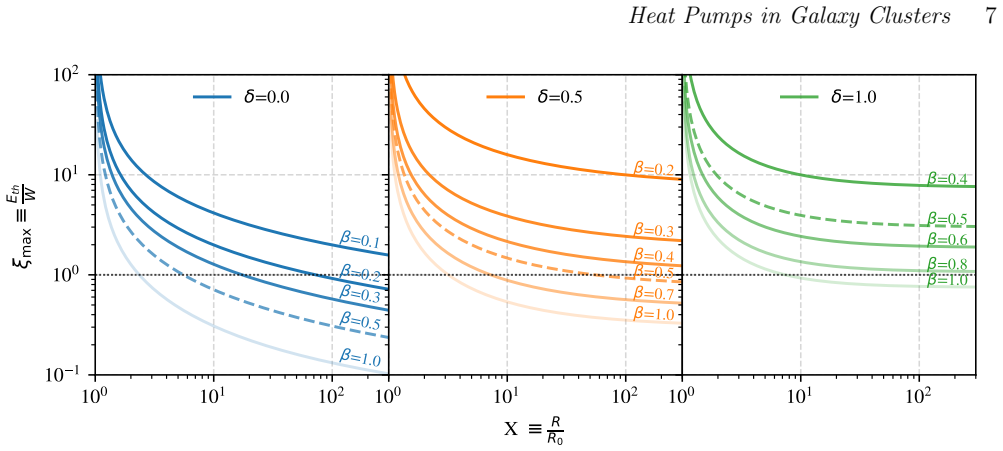
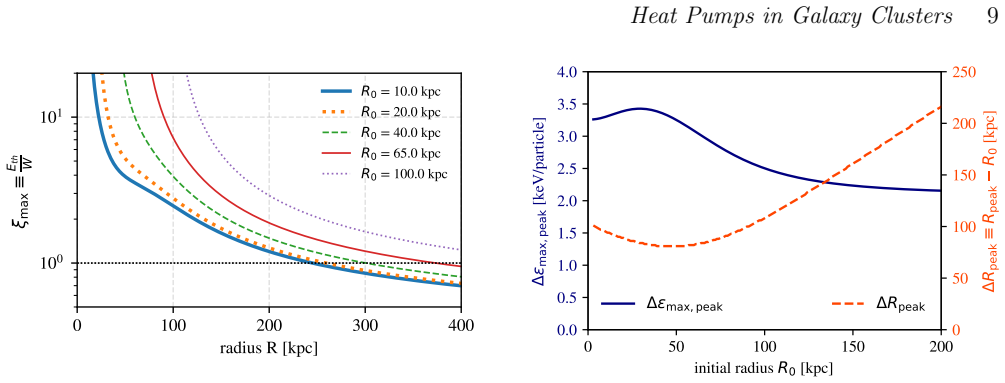
The central object is the heat-pump efficiency $\xi_{\mathrm{max}} \equiv E_{\mathrm{th}}/W$ for a blob of gas lifted adiabatically in a power-law atmosphere ($T \propto r^{\delta}$, $\rho \propto r^{-3\beta}$), with $E_{\mathrm{th}}$ the thermal energy needed to thermalize the lifted gas to the surrounding temperature and $W$ the net work against gravity. The identity $\xi_{\mathrm{max}} = \frac{1}{(3\beta-\delta)(\gamma-1)} \frac{X\,F(X)}{\int_1^X F(x)\,dx}$, with $F(x) = x^{\delta-1}\left(1 - x^{-3\beta + (3\beta-\delta)/\gamma}\right)$, is what carries the argument; for $\gamma = 5/3$ it gives $\xi_{\mathrm{max}} > 1$ asymptotically when $\beta < (5/6)\delta$. In the simulation, the physical mechanism is the bubble wake transporting low-entropy gas into contact with hot gas, which the authors quantify with Lagrangian tracer particles and a Spitzer-conduction heating-rate estimate.
What would settle it
Run the same jet-bubble setup with explicit anisotropic thermal conduction and a magnetized intracluster medium: if the heating timescale for most uplifted gas exceeds the local free-fall time, the heat pump fails. Observationally, measure the temperature of gas in the wakes of X-ray cavities at large radii; if that gas is still near its adiabatic temperature, much cooler than the surrounding gas, it has not been thermalized before sinking, contradicting the mechanism.
Extended reading notes
Core claim
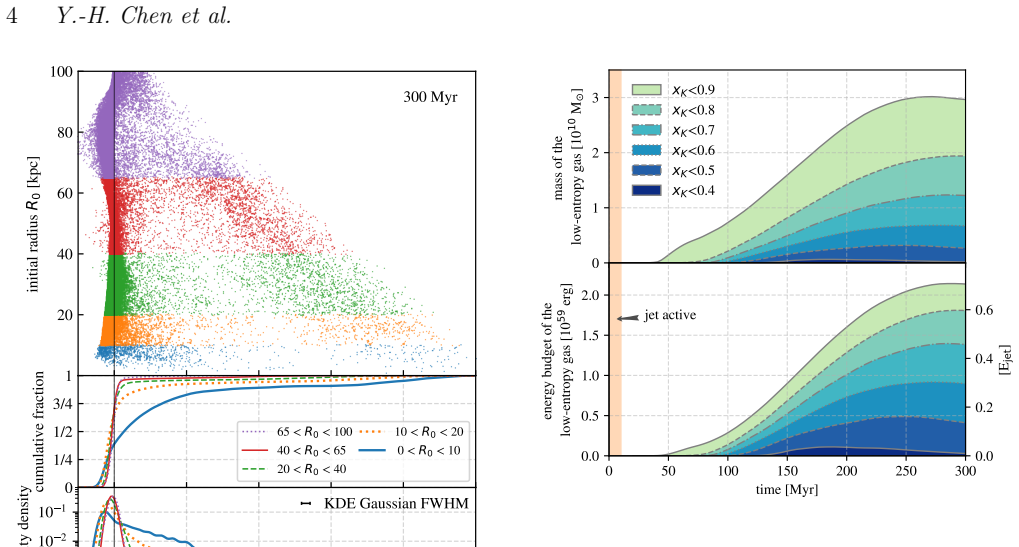
Jet-inflated bubbles carry a significant mass of low-entropy gas out of the cluster core in their wakes; once this gas reaches the hot outer atmosphere, Spitzer thermal conduction across the corrugated interface can thermalize it before it sinks back. The authors estimate the associated conductive energy budget and find it comparable to the total jet energy, about $3.16\times10^{59}$ erg, peaking around 300 Myr after a 10-Myr jet episode. They derive an analytic expression for the maximum efficiency $\xi_{\mathrm{max}} = E_{\mathrm{th}}/W$, the ratio of conductive thermal energy to the work of lifting, and show that $\xi_{\mathrm{max}}$ can exceed 100 percent for a wide range of cluster profiles, especially when the temperature gradient is steep or the density gradient shallow. The conclusion is that the AGN need not supply the heat directly; it only creates the pipeline that lets the hot atmosphere heat the core gas, with efficiency above unity possible because the work of lifting in a sub-adiabatic, convectively stable atmosphere is small relative to the heat drawn from the reservoir.
Load-bearing premise
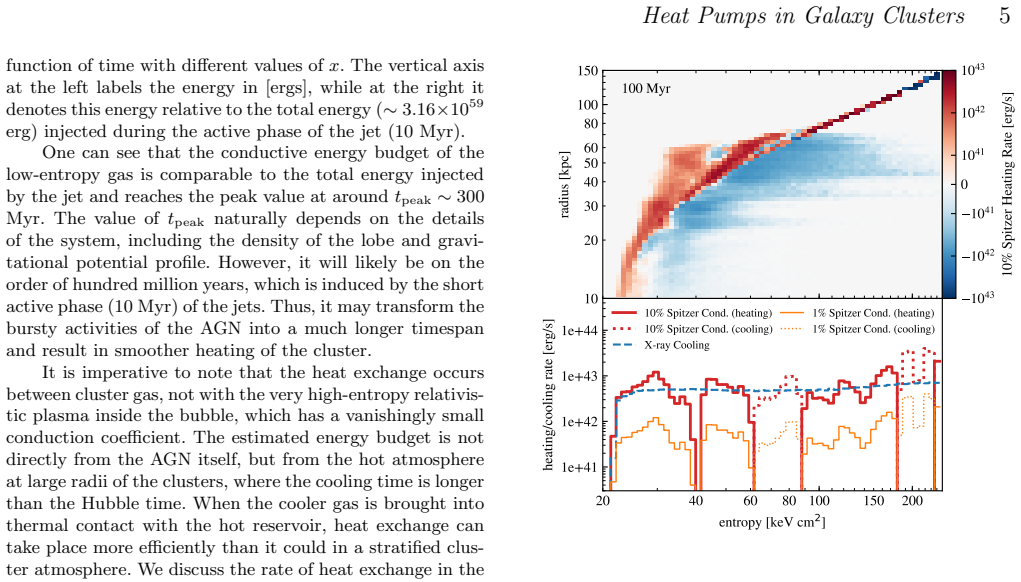
The load-bearing premise is that thermal conduction actually thermalizes the uplifted gas before it sinks back; the simulation has no explicit conduction, no radiative cooling, and no magnetic field in the intracluster medium, so the paper must assume that real magnetic suppression of conduction still leaves the heating timescale shorter than the free-fall time.
Editorial extensions
If this is right
- AGN feedback efficiency can exceed 100 percent: the energy that ends up heating the core can be larger than the total mechanical energy of the jet.
- A short, 10-Myr jet outburst can keep influencing the cluster thermal state for hundreds of millions of years, converting bursty AGN activity into a smoother, longer-lasting heating process.
- The jet power need not instantaneously balance the cooling luminosity, because the cluster's hot atmosphere acts as the heat reservoir; this may explain the observed scatter between jet power and cluster cooling power.
- Repeated AGN cycles can drive a large-scale circulation that removes cooled gas from the core and replenishes it with higher-entropy gas, heating regions off the jet axis.
- The heat pump adds a conductive heating channel on top of direct jet heating, so the total heat available to offset catastrophic cooling is the jet energy plus the heat drawn from the reservoir.
Reading between the lines
- The efficiency formula implies an observational ranking: clusters with steep temperature gradients and shallow density gradients (large $\delta$, small $\beta$) should show the strongest heat-pump signatures, and their lifted wakes should appear hottest relative to adiabatic expectations.
- If magnetic suppression makes conduction too slow in real clusters, the heat pump fails; this assumption could be tested by comparing X-ray temperatures of uplifted gas in well-observed clusters like Perseus with the adiabatic prediction.
- The same mechanism may operate at smaller scales in galaxy groups or in the circumgalactic medium of massive galaxies, wherever buoyant bubbles lift cool gas into hotter surroundings, and it could help regulate cooling there.
- Cold H$\alpha$ filaments observed in cluster cores might trace gas that was lifted but not yet thermalized; mapping filament temperatures could empirically bound the conductive suppression factor.
Signed reviews
Editorial analysis
A structured set of objections, weighed in public.
Referee Report
Summary. The paper proposes a 'heat pump' mechanism for AGN feedback in cool-core clusters. Using a 3D ideal MHD simulation of a Perseus-like cluster with a 10-Myr jet, the authors show that buoyantly rising bubbles lift low-entropy gas from the core to larger radii. They compute the thermal energy that would be needed to bring this uplifted gas to the local ambient temperature and find it comparable to the total jet energy (about 3.16e59 erg). They then apply a post-hoc Spitzer conduction model with suppression factors fSp=0.1 and 0.01 to estimate heating timescales, and derive an analytic maximum efficiency xi_max = Eth/W for a simplified cluster profile, finding that it can exceed 100 percent under some conditions. They conclude that the AGN can act as a heat pump, drawing heat from the outer atmosphere and potentially heating the core more efficiently than direct jet energy transfer alone.
Significance. If the heat-pump mechanism operates as proposed, it would provide a new channel for AGN feedback that is gentler and longer-lived than direct jet heating, and it would help explain how bursty AGN activity can regulate cooling over hundreds of Myr. The analytic derivation in Section 4 is transparent and parameter-free in the sense that it follows from the assumed power-law profiles, and the paper's energy-budget diagnostic (Fig. 3) is a useful, clearly explained measure of the potential heat content in the uplifted gas. The authors also include explicit caveats about the missing physics, and the paper is written as an exploratory study rather than a definitive measurement. The main weakness is that the central timescale claim relies on a post-hoc conduction estimate rather than a self-consistent simulation, which limits what can be concluded about the mechanism's viability.
major comments (2)
- [Section 3.4 and 5.1(a), Figs. 4-6] The claim that uplifted low-entropy gas is thermalized before it sinks back (conclusion (iii)) rests on a post-hoc Spitzer conduction estimate applied to a simulation without explicit thermal conduction, radiative cooling, or an initial ICM magnetic field. As the authors acknowledge in Section 5.1(a), active conduction would smooth the sharp temperature gradients that drive the computed heat flux, so the flux would decline roughly as t^{-1/2}; the estimate is therefore not self-consistent. Figure 6 shows that even at fSp=0.01 the thermalization timescale is comparable to the free-fall time (~150 Myr at 300 Myr), so a modest overestimate of the flux or additional suppression by magnetic geometry and microinstabilities (which cannot be assessed because the ICM is unmagnetized) breaks the required inequality tau_heat < tau_ff. Since the energy budget in Fig. 3 is only accessible if thermalization occurs before fallback, the present simulations do not establish the central premise. A revision should either add an explicit-conduction run or a time-dependent flux model that includes the back-reaction on the gradients, or substantially soften the abstract and conclusion (iii).
- [Section 3.3 and Fig. 3] The energy budget of the 'low-entropy gas' is computed from a purely adiabatic simulation. The quantity and radial distribution of that gas would change if conduction and radiative cooling were active: conductive heating would lower the density contrast and alter the buoyancy of the uplifted gas, while cooling could cause some gas to condense and sink earlier. The paper does not quantify these back-reactions, so the late-time energy budget in Fig. 3 is not a reliable predictor of the energy actually available for the heat-pump mechanism in a real cluster. This is a second, independent reason why the quantitative claim that the conductive energy budget is 'comparable to the total energy injected by the jets' is not established by the current simulation setup, even though it is a useful upper-limit diagnostic.
minor comments (4)
- [Section 4, Eq. (12)] In Eq. (12), the exponent of the second term appears to contain (3β-1)/γ; consistency with Eqs. (14)-(17) requires (3β-δ)/γ. Please correct this typo so that the force expression matches the subsequent derivation.
- [Section 5.1(a)] The text states that the heat flux 'will drop roughly as t1/2'; this should read t^{-1/2}.
- [Section 2] The maximum refinement level is reduced from 30 pc to 120 pc shortly after the jet is turned off; the authors should comment on the potential effect of this resolution change on the development of the instabilities that shape the bubble wake and control the amount of uplifted gas.
- [Section 3.4, Figs. 4 and 5] The binning and the meaning of the dashed and dotted lines in the marginal histograms are not fully described in either the text or the captions; please specify the entropy and radius bin widths and the normalization used, so that the heating and cooling rates can be reproduced from the description.
Circularity Check
No significant circularity: the efficiency bound is an analytic consequence of assumed cluster profiles, and the simulation diagnostics are independent measurements.
full rationale
The paper's central derivation chain is self-contained. The heat-pump efficiency xi_max = Eth/W (Eq. 17) is derived analytically from assumed power-law temperature and density profiles (Eq. 5), hydrostatic equilibrium (Eq. 7), and adiabatic lifting; it is not calibrated to or inferred from the simulation output, and the greater-than-100-per-cent result follows directly from the inequality beta < 5 delta/6 for monatomic gas (Eq. 19). The energy budget Eth,xi in Eq. 2 is computed from tracer-particle and entropy-threshold diagnostics of the MHD simulation, so it is an independent measurement of the simulation state, not a fitted parameter. The conduction-rate estimate (Section 3.4) is an intentionally idealized post hoc calculation using Spitzer conductivity with fSp = 0.1 and 0.01; the paper explicitly flags this as an overestimate in Section 5.1, noting that the sharp gradients would smooth once conduction is active and that magnetic fields are absent, so anisotropic suppression cannot be estimated. That is a stated limitation rather than circular reasoning. Self-citations such as Heinz et al. 2006, Ensslin et al. 2011, and Ruszkowski et al. 2007 are contextual and do not carry the load-bearing argument; there is no imported uniqueness theorem or ansatz smuggled in via citation. The claimed result is a proposed mechanism with acknowledged open questions, not a prediction that reduces to its inputs by construction.
Assumptions & free parameters
free parameters (3)
- Conduction suppression factor fSp =
0.1 and 0.01
- Entropy ratio threshold xK =
0.4 to 0.9
- Cluster and jet setup parameters =
Perseus-like: beta=0.53, rc=26 kpc; jet power 1e45 erg/s, v=0.1c, 10 Myr
assumptions (5)
- domain assumption Ideal MHD without explicit thermal conduction or radiative cooling.
- domain assumption Spherically symmetric, static gravitational potential in hydrostatic equilibrium.
- domain assumption Spitzer conductivity with constant suppression fSp = 0.1 or 0.01 applies at the hot-cold interface.
- domain assumption Power-law temperature and density profiles with hydrostatic equilibrium and slow, pressure-equilibrated adiabatic lifting.
- standard math Entropy ratio xK identifies gas origin because entropy is conserved for adiabatic motion.
Cite this review
Pith. "Pith review of Jets, Bubbles, and Heat Pumps in Galaxy Clusters." pith.science (2026). https://pith.science/paper/DYJGII6C
@misc{pith2026190804796,
  author       = {Pith},
  title        = {Pith review of: Jets, Bubbles, and Heat Pumps in Galaxy Clusters},
  year         = {2026},
  howpublished = {\url{https://pith.science/paper/DYJGII6C}},
  note         = {Machine review of arXiv:1908.04796}
}
abstract
Feedback from AGN jets has been proposed to counteract the catastrophic cooling in many galaxy clusters. However, it is still unclear which physical processes are acting to couple the energy from the bi-directional jets to the ICM. We study the long-term evolution of rising bubbles that were inflated by AGN jets using MHD simulations. In the wake of the rising bubbles, a significant amount of low-entropy gas is brought into contact with the hot cluster gas. We assess the energy budget of the uplifted gas and find it comparable to the total energy injected by the jets. Although our simulation does not include explicit thermal conduction, we find that, for reasonable assumptions about the conduction coefficient, the rate is fast enough that much of the uplifted gas may be thermalized before it sinks back to the core. Thus, we propose that the AGN can act like a heat pump to move low-entropy gas from the cluster core to the heat reservoir and will be able to heat the inner cluster more efficiently than would be possible by direct energy transfer from jets alone. We show that the maximum efficiency of this mechanism, i.e. the ratio between the conductive thermal energy and the work needed to lift the gas, $\xi_{\mathrm{max}}$ can exceed 100 per cent. While $\xi$ < $\xi_{\mathrm{max}}$ in realistic scenarios, AGN-induced thermal conduction has the potential to significantly increase the efficiency with which AGN can heat cool-core clusters and transform the bursty AGN activities into a smoother and enduring heating process.
Figures

Figures from the paper (5 more)



Reference graph
Works this paper leans on
-
[2]
B \^ i rzan L., Rafferty D. A., McNamara B. R., Wise M. W., Nulsen P. E. J., 2004, @doi [ApJ] 10.1086/383519 , 607, 800
doi:10.1086/383519 2004
-
[3]
Churazov E., Forman W., Jones C., 2000, A & A, 356, 788
work page 2000
-
[4]
R., Bohringer H., Forman W., 2001, @doi [ApJ] 10.1086/321357 , 554, 261
Churazov E., Bruggen M., Kaiser C. R., Bohringer H., Forman W., 2001, @doi [ApJ] 10.1086/321357 , 554, 261
doi:10.1086/321357 2001
-
[5]
Diehl S., Li H., Fryer C., Rafferty D., 2008, @doi [ApJ] 10.1086/591310 , 687, 173
doi:10.1086/591310 2008
-
[6]
Dolag K., Jubelgas M., Springel V., Borgani S., Rasia E., 2004, @doi [ApJ] 10.1086/420966 , 606, L97
doi:10.1086/420966 2004
-
[7]
S., 2010, @doi [ApJ] 10.1088/0004-637X/712/2/883 , 712, 883
Dong R., Rasmussen J., Mulchaey J. S., 2010, @doi [ApJ] 10.1088/0004-637X/712/2/883 , 712, 883
-
[8]
Duan X., Guo F., 2018, @doi [ApJ] 10.3847/1538-4357/aac9ba , 861, 106
-
[9]
Dubey A., Antypas K., Ganapathy M. K., Reid L. B., Riley K., Sheeler D., Siegel A., Weide K., 2009, @doi [Parallel Computing] 10.1016/J.PARCO.2009.08.001 , 35, 512
Show all 65 references
-
[10]
M., Weide K., Graziani C., 2012, @doi [ApJS] 10.1088/0067-0049/201/2/27 , 201, 27
Dubey A., Daley C., Zuhone J., Ricker P. M., Weide K., Graziani C., 2012, @doi [ApJS] 10.1088/0067-0049/201/2/27 , 201, 27
2012 doi
-
[11]
J., Pfrommer C., 2008, @doi [ApJ] 10.1086/529371 , 677, 993
Dursi L. J., Pfrommer C., 2008, @doi [ApJ] 10.1086/529371 , 677, 993
2008 doi
-
[12]
Ehlert K., Weinberger R., Pfrommer C., Pakmor R., Springel V., 2018, @doi [MNRAS] 10.1093/mnras/sty2397 , 481, 2878
2018 doi
-
[13]
A., Pfrommer C., Miniati F., Subramanian K., 2011, @doi [A & A] 10.1051/0004-6361/201015652 , 527, A99
En lin T. A., Pfrommer C., Miniati F., Subramanian K., 2011, @doi [A & A] 10.1051/0004-6361/201015652 , 527, A99
2011 doi
-
[14]
C., 1994, @doi [ARAA] 10.1146/annurev.aa.32.090194.001425 , 32, 277
Fabian A. C., 1994, @doi [ARAA] 10.1146/annurev.aa.32.090194.001425 , 32, 277
1994
-
[15]
C., 2012, @doi [ARAA] 10.1146/annurev-astro-081811-125521 , 50, 455
Fabian A. C., 2012, @doi [ARAA] 10.1146/annurev-astro-081811-125521 , 50, 455
2012 doi
-
[16]
C., Sanders J
Fabian A. C., Sanders J. S., Crawford C. S., Conselice C. J., Gallagher J. S., Wyse R. F. G., 2003, @doi [MNRAS] 10.1046/j.1365-8711.2003.06856.x , 344, L48
2003
-
[17]
C., Sanders J
Fabian A. C., Sanders J. S., Taylor G. B., Allen S. W., Crawford C. S., Johnstone R. M., Iwasawa K., 2006, @doi [MNRAS] 10.1111/j.1365-2966.2005.09896.x , 366, 417
2006
-
[18]
C., et al., 2011, @doi [MNRAS] 10.1111/j.1365-2966.2011.19402.x , 418, 2154
Fabian A. C., et al., 2011, @doi [MNRAS] 10.1111/j.1365-2966.2011.19402.x , 418, 2154
2011
-
[19]
C., Walker S
Fabian A. C., Walker S. A., Russell H. R., Pinto C., Sanders J. S., Reynolds C. S., 2017, @doi [MNRAS] 10.1093/mnrasl/slw170 , 464, L1
2017 doi
-
[20]
Forman W., et al., 2007, @doi [ApJ] 10.1086/519480 , 665, 1057
2007 doi
-
[21]
Fryxell B., et al., 2000, @doi [ApJS] 10.1086/317361 , 131, 273
2000 doi
-
[22]
Gendron-Marsolais M., et al., 2017, @doi [ApJ] 10.3847/1538-4357/aa8a6f , 848, 26
2017 doi
-
[23]
J., et al., 2019, @doi [A & A] 10.1051/0004-6361/201833893 , 622, A12
Hardcastle M. J., et al., 2019, @doi [A & A] 10.1051/0004-6361/201833893 , 622, A12
2019 doi
-
[24]
Heinz S., Briiggen M., Young A., Levesque E., 2006, @doi [MNRAS] 10.1111/j.1745-3933.2006.00243.x , 373, L65
2006
-
[25]
Hillel S., Soker N., 2016, @doi [MNRAS] 10.1093/mnras/stv2483 , 455, 2139
2016 doi
-
[26]
Hillel S., Soker N., 2018, @doi [Research in Astronomy and Astrophysics] 10.1088/1674-4527/18/7/81 , 18, 081
2018 doi
-
[27]
Kannan R., Vogelsberger M., Pfrommer C., Weinberger R., Springel V., Hernquist L., Puchwein E., Pakmor R., 2017, @doi [ApJ] 10.3847/2041-8213/aa624b , 837, L18
2017 doi
-
[28]
Lee D., 2013, @doi [Journal of Computational Physics] 10.1016/j.jcp.2013.02.049 , 243, 269
2013 doi
-
[29]
L., 2014, @doi [ApJ] 10.1088/0004-637X/789/2/153 , 789, 153
Li Y., Bryan G. L., 2014, @doi [ApJ] 10.1088/0004-637X/789/2/153 , 789, 153
2014 doi
-
[30]
L., 2017, @doi [ApJ] 10.3847/1538-4357/aa88c1 , 847, 106
Li Y., Ruszkowski M., Bryan G. L., 2017, @doi [ApJ] 10.3847/1538-4357/aa88c1 , 847, 106
2017 doi
-
[31]
Lim J., Ohyama Y., Chi-Hung Y., Dinh-V-Trung Shiang-Yu W., 2012, @doi [ApJ] 10.1088/0004-637X/744/2/112 , 744, 112
2012 doi
-
[32]
G., Balogh M
McCarthy I. G., Balogh M. L., Babul A., Poole G. B., Horner D. J., 2004, @doi [ApJ] 10.1086/423267 , 613, 811
2004 doi
-
[33]
McNamara B., Nulsen P., 2007, @doi [ARAA] 10.1146/annurev.astro.45.051806.110625 , 45, 117
2007 arXiv
-
[34]
R., Nulsen P
McNamara B. R., Nulsen P. E. J., 2012, @doi [New Journal of Physics] 10.1088/1367-2630/14/5/055023 , 14, 055023
2012 doi
-
[35]
R., et al., 2014, @doi [ApJ] 10.1088/0004-637X/785/1/44 , 785, 44
McNamara B. R., et al., 2014, @doi [ApJ] 10.1088/0004-637X/785/1/44 , 785, 44
2014 doi
-
[36]
R., Russell H
McNamara B. R., Russell H. R., Nulsen P. E. J., Hogan M. T., Fabian A. C., Pulido F., Edge A. C., 2016, @doi [ApJ] 10.3847/0004-637X/830/2/79 , 830, 79
2016 doi
-
[38]
S., Davis D
Mulchaey J. S., Davis D. S., Mushotzky R. F., Burstein D., 2003, @doi [ApJS] 10.1086/345736 , 145, 39
2003 doi
-
[39]
V., 2001, @doi [ApJ] 10.1086/338325 , 562, L129
Narayan R., Medvedev M. V., 2001, @doi [ApJ] 10.1086/338325 , 562, L129
2001 doi
-
[40]
M., Jones T
O'Neill S. M., Jones T. W., 2010, @doi [ApJ] 10.1088/0004-637X/710/1/180 , 710, 180
2010 doi
-
[41]
O'Sullivan E., et al., 2017, @doi [MNRAS] 10.1093/mnras/stx2078 , 472, 1482
2017 doi
-
[42]
R., Fabian A
Peterson J. R., Fabian A. C., 2006, @doi [Physics Reports] 10.1016/j.physrep.2005.12.007 , 427, 1
2006 doi
-
[43]
R., Kahn S
Peterson J. R., Kahn S. M., Paerels F. B. S., Kaastra J. S., Tamura T., Bleeker J. A. M., Ferrigno C., Jernigan J. G., 2003, @doi [ApJ] 10.1086/374830 , 590, 207
2003 doi
-
[44]
Pope E. C. D., Babul A., Pavlovski G., Bower R. G., Dotter A., 2010, @doi [MNRAS] 10.1111/j.1365-2966.2010.16816.x , 406, 2023
2010
-
[45]
A., McNamara B
Rafferty D. A., McNamara B. R., Nulsen P. E. J., Wise M. W., 2006, @doi [ApJ] 10.1086/507672 , 652, 216
2006 doi
-
[46]
Revaz Y., Combes F., Salom \' e P., 2007, @doi [A & A] 10.1051/0004-6361:20078915 , 477, L33
2007 doi
-
[47]
T., Drake J
Roberg-Clark G. T., Drake J. F., Reynolds C. S., Swisdak M., 2016, @doi [ApJ] 10.3847/2041-8205/830/1/L9 , 830, L9
2016 doi
-
[48]
T., Drake J
Roberg-Clark G. T., Drake J. F., Reynolds C. S., Swisdak M., 2018a, @doi [Physical Review Letters] 10.1103/PhysRevLett.120.035101 , 120, 035101
-
[49]
T., Drake J
Roberg-Clark G. T., Drake J. F., Swisdak M., Reynolds C. S., 2018b, @doi [ApJ] 10.3847/1538-4357/aae393 , 867, 154
-
[50]
R., et al., 2016, @doi [MNRAS] 10.1093/mnras/stw409 , 458, 3134
Russell H. R., et al., 2016, @doi [MNRAS] 10.1093/mnras/stw409 , 458, 3134
2016 doi
-
[51]
A., Br \" u ggen M., Heinz S., Pfrommer C., 2007, @doi [MNRAS] 10.1111/j.1365-2966.2007.11801.x , 378, 662
Ruszkowski M., En lin T. A., Br \" u ggen M., Heinz S., Pfrommer C., 2007, @doi [MNRAS] 10.1111/j.1365-2966.2007.11801.x , 378, 662
2007
-
[52]
Scheuer P. A. G., 1982, In: Extragalactic radio sources; Proceedings of the Symposium, pp 163--165
1982
-
[53]
S., 2016, @doi [ApJS] 10.3847/1538-4365/227/2/31 , 227, 31
Shin J., Woo J.-H., Mulchaey J. S., 2016, @doi [ApJS] 10.3847/1538-4365/227/2/31 , 227, 31
2016 doi
-
[54]
Interscience
Spitzer L., 1962, Physics of Fully Ionized Gases , 2nd editio edn. Interscience
1962
-
[55]
Su Y., Nulsen P. E. J., Kraft R. P., Forman W. R., Jones C., Irwin J. A., Randall S. W., Churazov E., 2017, @doi [ApJ] 10.3847/1538-4357/aa8954 , 847, 94
2017 doi
-
[56]
J., Smith B
Turk M. J., Smith B. D., Oishi J. S., Skory S., Skillman S. W., Abel T., Norman M. L., 2010, @doi [MNRAS] 10.1088/0067-0049/192/1/9 , 423, 3018
2010 doi
-
[57]
N., et al., 2016, @doi [ApJ] 10.3847/0004-637X/832/2/148 , 832, 148
Vantyghem A. N., et al., 2016, @doi [ApJ] 10.3847/0004-637X/832/2/148 , 832, 148
2016 doi
-
[58]
N., et al., 2018, @doi [ApJ] 10.3847/1538-4357/aad2e0 , 863, 193
Vantyghem A. N., et al., 2018, @doi [ApJ] 10.3847/1538-4357/aad2e0 , 863, 193
2018 doi
-
[59]
M., Fabian A
Voigt L. M., Fabian A. C., 2004, @doi [MNRAS] 10.1111/j.1365-2966.2004.07285.x , 347, 1130
2004
-
[60]
Weinberger R., Ehlert K., Pfrommer C., Pakmor R., Springel V., 2017, @doi [MNRAS] 10.1093/mnras/stx1409 , 470, 4530
2017 doi
-
[61]
W., McNamara B
Wise M. W., McNamara B. R., Nulsen P. E. J., Houck J. C., David L. P., 2007, @doi [ApJ] 10.1086/512767 , 659, 1153
2007 doi
-
[62]
Yang H. Y. K., Reynolds C. S., 2015, @doi [ApJ] 10.3847/0004-637X/818/2/181 , 818, 181
2015 doi
-
[63]
Yang H. Y. K., Reynolds C. S., 2016, @doi [ApJ] 10.3847/0004-637X/829/2/90 , 829
2016 doi
-
[64]
A., 2018, @doi [MNRAS] 10.1093/mnras/sty1269 , 478, 4785
Zhang C., Churazov E., Schekochihin A. A., 2018, @doi [MNRAS] 10.1093/mnras/sty1269 , 478, 4785
2018 doi
-
[65]
Zhuravleva I., et al., 2014, @doi [Nature] 10.1038/nature13830 , 515, 85
2014 doi
-
[66]
Zhuravleva I., et al., 2015, @doi [MNRAS] 10.1093/mnras/stv900 , 450, 4184
2015 doi
-
[67]
write newline
" write newline "" before.all 'output.state := FUNCTION fin.entry write newline FUNCTION new.block output.state before.all = 'skip after.block 'output.state := if FUNCTION new.sentence output.state after.block = 'skip output.state before.all = 'skip after.sentence 'output.stat...
Reviewed August 14, 2026 · model on record in the stance chip above.
Discussion (0). Continue with ORCID to comment.