REVIEW 3 major objections 5 minor 18 references
Collective modes near a Pomeranchuk instability
T0 review · 3 major / 5 minor · reviewed 2026-08-14 · deepseek-v4-flash
Pith's one-line read Every angular-momentum channel of a two-dimensional Fermi liquid has a critical zero-sound mode that freezes at the Pomeranchuk instability and then crosses into the unstable half-plane; for l=1 current-type order, the static…
desk verdict A solid, honest map of zero-sound poles near Pomeranchuk instabilities; the l=1 current-order resolution is the real news, and the stated single-harmonic scope is a caveat, not a fatal flaw. read the letter →
The pith
A machine-rendered reading of the paper's core claim, the machinery that carries it, and where it could break.
The reading
What carries the argument
The load-bearing object is the single-harmonic quasiparticle susceptibility $\chi_{qp,l}^{c(s)}(s)=\nu_F\,\chi_{free,l}(s)\big/\big(1+F_l^{c(s)}\chi_{free,l}(s)\big)$, whose free-fermion bubble $\chi_{free,l}(s)$ is evaluated on the Fermi surface with $\sqrt{2}\cos l\theta$ or $\sqrt{2}\sin l\theta$ form factors depending on the longitudinal or transverse channel. Zero-sound collective modes are the poles of this function, and the critical mode is the pole whose velocity $s v_F^*$ tends to zero as $F_l^{c(s)}\to -1$. The square-root branch cuts of the two-dimensional Lindhard function make the pole locations sheet-dependent, which explains the existence of silent modes; the Ward identity $\Lambda_1^{c(s)}\propto 1+F_1^{c(s)}$ for current-type order parameters supplies the extra vertex factor that keeps the static response finite while leaving the dynamical pole intact.
What would settle it
A microscopic calculation of the retarded current-order susceptibility at second order in the interaction, with vertex corrections included beyond the one-harmonic kernel, would settle whether the $l=1$ pole really moves to the upper half-plane below $F_1^{c(s)}=-1$; a pump-probe measurement of the same channel across a clean two-dimensional nematic transition would provide an experimental check.
Extended reading notes
Core claim
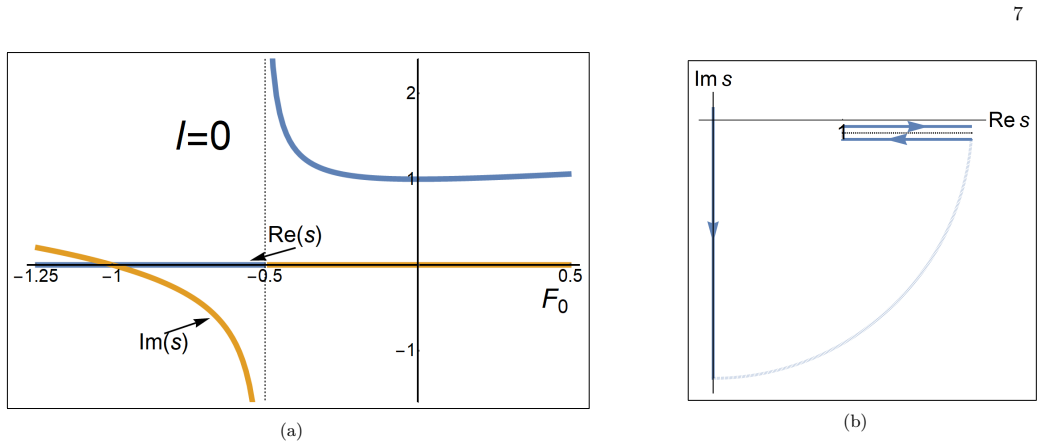
The central claim is that the retarded quasiparticle susceptibility $\chi_{qp,l}^{c(s)}(s)$, with $s=\omega/(v_F^* q)$, has a pole at $s=0$ exactly when $F_l^{c(s)}=-1$, and that for $F_l^{c(s)}<-1$ this pole lies in the upper half-plane, making the symmetric Fermi liquid unstable. The pole trajectories have a parity structure: for even $l$ in the longitudinal channel and odd $l$ in the transverse channel the critical pole is purely imaginary, $s\approx -i(1+F_l^{c(s)})/2$, whereas for odd $l$ longitudinal and even $l$ transverse channels it is almost real, $s\approx \pm\big((1+F_l^{c(s)})/2l\big)^{1/2}-i(1+F_l^{c(s)})/4$. Away from the critical point the poles move on a two-sheet Riemann surface, and some sink below the branch cut, so they are present mathematically but silent spectroscopically. For $l=1$ current-type order parameters, the Ward identity $\Lambda_1^{c(s)}\propto 1+F_1^{c(s)}$ keeps the static susceptibility finite at the transition, yet the same dynamical pole survives in the full susceptibility because its residue scales as $(1+F_1^{c(s)})^2$; the paper concludes that current-type Pomeranchuk order does develop, but its time evolution is slower.
Load-bearing premise
The assumption that the full low-energy dynamics is captured by the single-harmonic quasiparticle form $\chi_{qp,l} = \nu_F\chi_{free,l}/(1+F_l\chi_{free,l})$ with one Landau parameter dominating is load-bearing; if other harmonics are not negligible near the instability, or if non-Fermi-liquid corrections alter the kernel, the specific pole trajectories and parity classification could fail.
Editorial extensions
If this is right
- At every Pomeranchuk transition the collective-mode velocity vanishes, so long-wavelength order-parameter fluctuations become soft and slow as $F_l^{c(s)}$ approaches $-1$ from above.
- The parity rule predicts distinct time-domain signatures: in even-$l$ longitudinal and odd-$l$ transverse channels the order parameter relaxes monotonically near the transition, while in the complementary channels it oscillates with decaying amplitude and a period that diverges at the transition.
- For $l=1$ current-type order a static measurement of the susceptibility will not show a divergence at $F_1^{c(s)}=-1$, but the system still becomes unstable below this value; the growth of order after an instantaneous perturbation is real but delayed by the $(1+F_1^{c(s)})^2$ residue.
- For positive $F_l^{c(s)}$ with $l>0$, zero-sound poles can move to an unphysical Riemann sheet beyond a threshold, so the spectral peak in the imaginary part of the susceptibility may be absent or anomalously broad even though a collective mode exists; the long-time response is then governed by the branch-cut endpoint.
- Impurity scattering overdamps the critical modes and destroys the clean threshold behavior, so the clean parity classification applies only to sufficiently clean Fermi liquids.
Reading between the lines
- The single-harmonic pole analysis suggests a general rule for weakly coupled channels: as long as no other Landau parameter is itself close to $-1$, the critical mode of the dominant harmonic survives with only its velocity renormalized by the other harmonics, by analogy with the paper's explicit two-parameter result.
- The silent modes imply a sharp operational distinction between equilibrium spectroscopy and pump-probe response: a mode sitting below the branch cut will be invisible in the frequency-dependent loss but should still dominate the time-domain decay, so time-resolved experiments are a direct way to search for it.
- A concrete testable extension is to apply an ultrafast perturbation with the symmetry of the $l=1$ current order in a clean two-dimensional electron system tuned across a nematic transition: the predicted response changes from decaying oscillations to $t\sinh(\sqrt{|1+F_1|/2}\,t)$-type growth, with an amplitude suppressed by $(1+F_1)^2$.
- The same pole-trajectory logic may carry over to other Fermi-surface instabilities whose low-energy response has the same free-fermion-bubble structure, in which case the parity classification of critical dynamics is not specific to Pomeranchuk transitions.
Signed reviews
Editorial analysis
A structured set of objections, weighed in public.
Referee Report
Summary. The paper analyzes collective zero-sound modes associated with Pomeranchuk instabilities in a two-dimensional Fermi liquid. Starting from the single-harmonic RPA-like form of the quasiparticle susceptibility, Eq. (7), the authors derive explicit pole trajectories for l=0, 1, and 2 in both longitudinal and transverse channels, and for both charge and spin sectors, and then present a general classification for arbitrary l in Sec. II E. The central claim is that for each l there is a critical zero-sound mode whose frequency vanishes at the Pomeranchuk instability F_l^{c(s)}=-1 and which moves into the upper frequency half-plane for F_l^{c(s)}<-1. The paper also includes a treatment of finite disorder, a time-domain analysis of the response, and a special analysis of the l=1 charge-current and spin-current order parameters, where the Ward identity forces the static vertex to vanish as 1+F_1 so that the static susceptibility remains finite at F_1=-1 even though the dynamical susceptibility still has a pole that crosses into the upper half-plane. The l=1 claim is supported by a separate second-order perturbation calculation and by a Ginzburg-Landau functional argument.
Significance. If the central claims hold, the paper provides a useful and largely self-contained classification of collective modes near Pomeranchuk instabilities. The explicit l=0,1,2 pole equations, the detailed Riemann-sheet analysis, and the treatment of the l=1 current channel are valuable, and the paper contains no fitted parameters. The separate Ward-identity and O(U^2) perturbation-theory checks for the l=1 current case are a distinct strength, as they address an apparent paradox in the existing literature. The main limitation is that the 'for every l' universality is established only under the single-harmonic assumption of Eq. (7); if several Landau harmonics are comparable, the pole condition becomes a determinant condition that mixes harmonics, and the critical value is not generically F_l=-1. The paper's own Sec. II F shows this explicitly for the F_0/F_1 pair, and no analogous check is provided for general l.
major comments (3)
- [Sec. II A, Eq. (7); Sec. II E; Sec. II F] The universal classification for arbitrary l in Sec. II E is derived entirely from the single-harmonic RPA expression Eq. (7), which the authors themselves state is valid only when all Landau parameters except one are small. In a rotationally invariant Fermi liquid, the collective-mode pole is governed by the full Landau matrix, and when two or more harmonics are comparable the denominator of the susceptibility is a determinant that mixes them, as demonstrated for F_0 and F_1 in Eq. (67). The manuscript gives a two-parameter check only for the F_0/F_1 pair and provides no analogous result for arbitrary l or for two distant harmonics. To sustain the 'for every l' claim in the abstract and conclusions, the authors should either prove that the F_l=-1 crossing is robust to generic multi-harmonic perturbations (for example, by a two-harmonic calculation for l and l+2) or explicitly restate the entire classification as conditional on single-harmonic dominance.
- [Sec. VI, Conclusions] The concluding paragraph states, without qualification, that 'Right at the transition, the mode is located at omega=0, i.e. the static susceptibility diverges.' This contradicts the main result of Sec. V for the l=1 charge- and spin-current order parameters: there, the Ward identity makes the static vertex proportional to 1+F_1^{c(s)}, so the full static susceptibility in Eq. (118) remains finite at F_1^{c(s)}=-1 even though a dynamical pole crosses the real axis. The conclusion needs to be qualified to generic (non-current) order parameters, or the l=1 current case must be explicitly separated out.
- [End of Sec. I] The disclaimer that the Fermi-liquid range shrinks near the Pomeranchuk instability is not quantified. Since the critical mode has s=omega/(v_F^* q) -> 0 exactly at F_l=-1, the poles of interest lie precisely in the regime where quasiparticle self-energy corrections are most singular, and the free-fermion bubble in Eq. (7) may receive non-Fermi-liquid corrections. The authors assume that at any fixed distance from the critical point one can choose omega and q small enough to remain in the Fermi-liquid regime, but no smallness parameter or estimate is provided. A quantitative statement, or a restriction of the universal pole-crossing claim to the regime where such corrections are controlled, would remove a correctness risk at the central point of the paper.
minor comments (5)
- [Abstract] The abstract contains a typographical error: 'susceptiblities' should be 'susceptibilities'.
- [Sec. II D.2] In the paragraph beginning 'For F_1 > 1/3' in the l=2 transverse channel subsection, the Landau parameter should be F_2^{c(s)}, not F_1^{c(s)}.
- [Sec. III C.2] The sentence 'At F_0 -> 0, s_{i,1} approx ...' appears in the l=1 transverse subsection and should refer to F_1, not F_0.
- [Eq. (103)] The integrand 'cos x t^*' should be written as cos(x t^*), and the parentheses around the branch-cut discontinuity are missing; this makes the equation unnecessarily hard to read.
- [Caption of Fig. 2] The word 'susceptibiliies' in the figure caption is a typo for 'susceptibilities'.
Circularity Check
No significant circularity: the paper's pole classifications are derived explicitly from the stated single-harmonic quasiparticle-RPA assumption, with no fitted inputs and no load-bearing self-citation chain.
full rationale
The derivation chain is self-contained in the relevant sense. The central engine, Eq. (7), is an explicitly stated quasiparticle-RPA ansatz for the case where one Landau parameter dominates; it is an assumption with stated validity conditions, not a quantity fitted to the predicted poles, and the paper acknowledges its restriction ("The dynamical quasiparticle susceptibility cannot, in general, be expressed in terms of a single Landau parameter, unless all Landau parameters except for a single F_l^{c(s)} are small"). All subsequent pole locations, Riemann-sheet assignments, and even/odd parity classifications are obtained by direct algebraic solution of the pole equations derived from the free-fermion bubbles (Eqs. (8), (24), (40), (46), (51), (57)-(61)), so the outputs are not equivalent to the inputs by construction. The special l=1 current-order case uses the Ward identity (m*/m)Z Lambda_1 = 1 + F_1, which is cited to Refs. [28,54]; although some of the cited references share authors with this paper, the present work re-derives the key consequence directly in Secs. V.A-V.D, including an explicit O(U^2) perturbative check of the s-independence of the vertex, so the self-citation is not load-bearing. No fitted parameters are renamed as predictions, no uniqueness theorem from the authors' prior work is invoked to forbid alternatives, and no known result is merely relabeled. The main vulnerability of the paper is that the universal 'for every l' classification rests on the single-harmonic restriction of Eq. (7); but that is a limitation of scope or robustness, not circularity, and the paper partially addresses multi-parameter cases in Sec. II.F and Sec. V.C. Accordingly, the appropriate circularity score is 0.
Assumptions & free parameters
assumptions (6)
- domain assumption Fermi liquid quasiparticle description: low-energy response is governed by quasiparticles with renormalized mass m*, residue Z, and Landau parameters F_l; self-energy damping is subleading.
- domain assumption The dynamical quasiparticle susceptibility is given by the RPA-like one-channel bubble, Eq. (7), with all Landau parameters except one negligible.
- standard math The free-fermion bubble in 2D has only square-root branch cuts, forming a two-sheet Riemann surface, and the physical sheet is defined by analyticity in the upper half-plane.
- domain assumption Impurity scattering can be modeled by a diffusion-ladder vertex correction with rate gamma, preserving charge and spin conservation for l=0.
- domain assumption Conservation of total charge and spin imply the Ward identity (m*/m) Z Lambda_1^{c(s)} = 1 + F_1^{c(s)}, and high-energy vertex renormalizations do not introduce singular s dependence.
- domain assumption The incoherent high-energy fermion contribution chi_inc is regular in q and omega and does not alter the pole structure.
Cite this review
Pith. "Pith review of Collective modes near a Pomeranchuk instability." pith.science (2026). https://pith.science/paper/GB3Y5ELW
@misc{pith2026190804800,
  author       = {Pith},
  title        = {Pith review of: Collective modes near a Pomeranchuk instability},
  year         = {2026},
  howpublished = {\url{https://pith.science/paper/GB3Y5ELW}},
  note         = {Machine review of arXiv:1908.04800}
}
abstract
We consider collective excitations of a Fermi liquid. For each value of the angular momentum $l$, we study the evolution of longitudinal and transverse collective modes in the charge (c) and spin (s) channels with the Landau parameter $F_l^{c(s)}$, starting from positive $F_l^{c(s)}$ and all the way to the Pomeranchuk transition at $F_l^{c(s)} = -1$. In each case, we identify a critical zero-sound mode, whose velocity vanishes at the Pomeranchuk instability. For $F_l^{c(s)} < -1$, this mode is located in the upper frequency half-plane, which signals an instability of the ground state. In a clean Fermi liquid the critical mode may be either purely relaxational or almost propagating, depending on the parity of $l$ and on whether the response function is longitudinal or transverse. These differences lead to qualitatively different types of time evolution of the order parameter following an initial perturbation. A special situation occurs for the $l = 1$ order parameter that coincides with the spin or charge current. In this case the residue of the critical mode vanishes at the Pomeranchuk transition. However, the critical mode can be identified at any distance from the transition, and is still located in the upper frequency half-plane for $F_1^{c(s)} < -1$. The only peculiarity of the charge/spin current order parameter is that its time evolution occurs on longer scales than for other order parameters. We also analyze collective modes away from the critical point, and find that the modes evolve with $F_l^{c(s)}$ on a multi-sheet Riemann surface. For certain intervals of $F_l^{c(s)}$, the modes either move to an unphysical Riemann sheet or stay on the physical sheet but away from the real frequency axis. In that case, the modes do not give rise to peaks in the imaginary parts of the corresponding susceptiblities.
Figures

Figures from the paper (13 more)







Reference graph
Works this paper leans on
-
[1]
Comparing the results for for the l = 0, 1, 2 modes, we see a difference between even and odd l
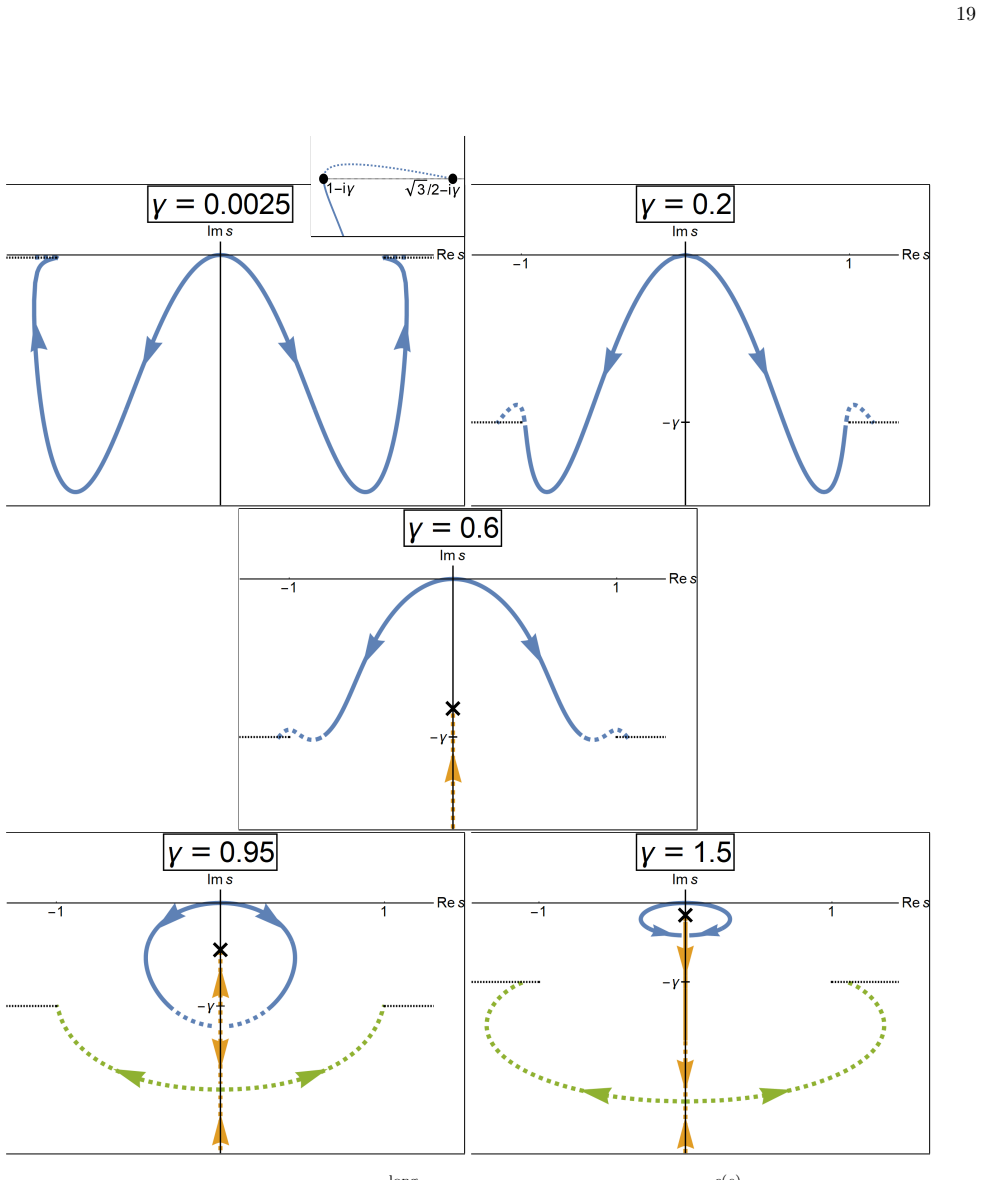
Equations for the poles We now focus in more detail on negative Fc(s) l and, in particular, on the behavior of collective modes near a Pomeranchuk instability. Comparing the results for for the l = 0, 1, 2 modes, we see a difference between even and odd l. Namely, near a Pomeranchuk instability the critical mode in the longitudinal channel is purely imagin...
-
[2]
even l, longitudinal channel For Fc(s) l ≈ −1, we first search for a solution with small|s|. Expanding Eq. (61) in s, we find a pole on the imaginary axis s =si≈−i1 +Fc(s) l 2 . (62) There exist additional non-critical solutions for which s remains finite at Fc(s) l =−1. To obtain these solutions, we choose the plus sign in Eq. (61), set Fc(s) l =−1, and sol...
-
[3]
For the transverse channel [for which we have to choose the minus sign in Eq
even l, transverse channel We start again withFc(s) l ≈− 1 and consider the solu- tion with vanishingly smalls. For the transverse channel [for which we have to choose the minus sign in Eq. (61)], the leading, linear-in- s term on the right-hand side of Eq. (61) is absent, and one needs to include the sublead- ing terms. A straightforward analysis then sh...
-
[4]
We do not present the details of calculations and just state the results
odd l, longitudinal channel The analysis for odd l proceeds along the same lines. We do not present the details of calculations and just state the results. For Fc(s) l ≈ −1, there are l + 1 so- lutions, which form ( l + 1)/2 pairs s1,2;p =±ap−ibp, 0≤p< (l+1)/2. One pair is the same as in Eq. (64), the other solutions tend to finitesm = arccos(π(1+2m)/(2l),...
-
[5]
(62), and l− 1 solutions sn = arccos(πn/l), 0 < n < l
odd l, transverse channel For Fc(s) l ≈− 1, there is one purely imaginary solu- tion with vanishing s, as in Eq. (62), and l− 1 solutions sn = arccos(πn/l), 0 < n < l. For 0 <−Fc(s) l ≪ 1, there arel solutionssm =e−iπ(1+2m)/(2l)/2|Fe l|1/2l, with 0 ≤ m < l. One solution, with m = ( l− 1)/2, is purely imaginary, while the other solutions form (l−1)/2 pairs...
-
[6]
In the pre- vious sections, we saw that a critical zero-sound mode corresponds to small s
(67) Suppose that Fc(s) 1 is negative and close to −1 while 1 +Fc(s) 0 > 0 (Fc(s) 0 can be of either sign). In the pre- vious sections, we saw that a critical zero-sound mode corresponds to small s. Substituting the forms of Kn into Eq. (67) and assuming that s is small, we obtain (1 +Fc(s) 0 )(1 +Fc(s) 1 ) = 2s2 + 2is3 +iFc(s) 0 (1 +Fc(s) 1 )s. (68) Iter...
-
[7]
l = 0 Zero-sound modes in the l = 0 channel were analyzed in Refs. 30 and 46. The free-fermion susceptibility with the form factor fc(s) 0 (kF ) = 1 is χfree,0(s) = 1− s 2 lns +iδ + 1 s +iδ− 1. (72) The equation for the pole reads 1 |Fc(s) 0 | − 1 =−s 2 [ −iπ + ln 1 +s +iδ 1−s−iδ ] . (73) The pole is completely imaginary: s =−ib (hence, iδ in (73) is irre...
-
[8]
We normalize Ym 1 as Y 0 1 (θ) = √ 3 cosθ and Y±1 1 (θ,φ ) = ∓ √ 3/2 sinθe±iφ
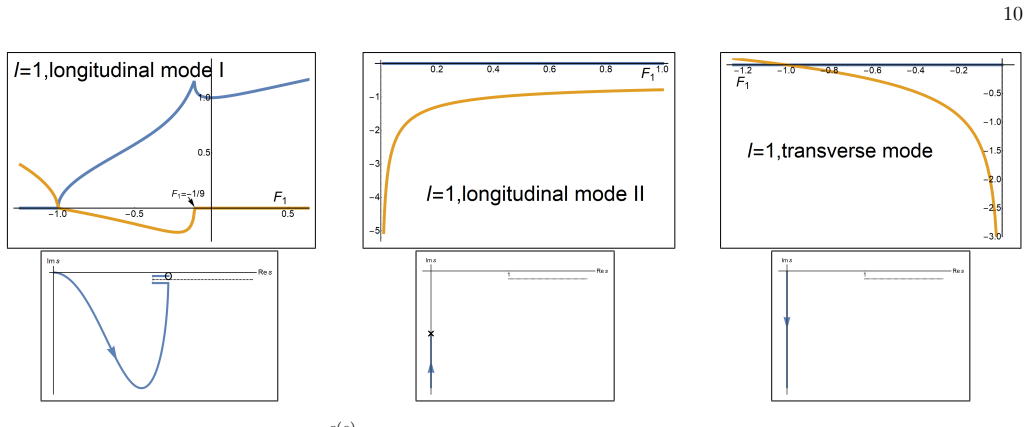
l = 1 The eigenfunctions of angular momentum l = 1 are spherical harmonics Ym 1 (θ,φ ). We normalize Ym 1 as Y 0 1 (θ) = √ 3 cosθ and Y±1 1 (θ,φ ) = ∓ √ 3/2 sinθe±iφ. Then the critical value of Fc(s) 1 for a Pomeranchuk in- stability is Fc(s) 1 =−1. In the longitudinal channel, the form-factor is fc(s) 1 (kF ) =Y 0 1 (θ). The free-fermion susceptibility i...
Show all 18 references
-
[9]
For −1 < Fc(s) 1 < 0, the poles of χlong qp,1(s) are at s1,2 =±a1−ib1, where a1 and b1 are given by Eq
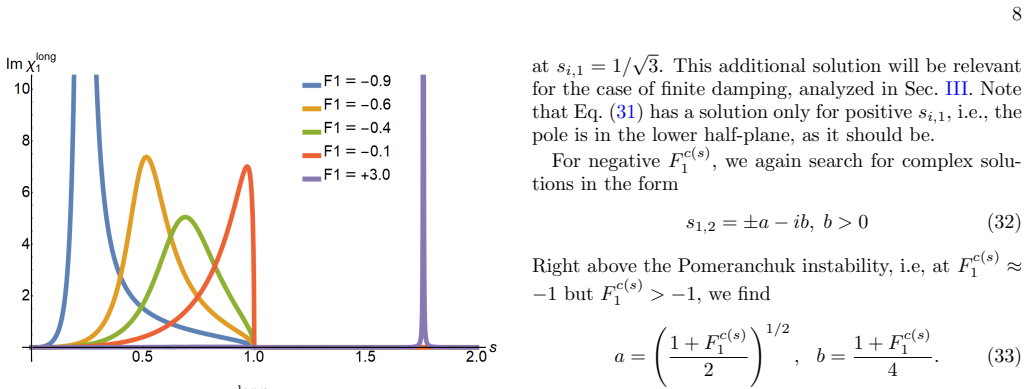
l = 1, longitudinal We start with recalling the situation at vanishingly small damping. For −1 < Fc(s) 1 < 0, the poles of χlong qp,1(s) are at s1,2 =±a1−ib1, where a1 and b1 are given by Eq. (35). For Fc(s) 1 just above −1, a1 ≈ ((1−|Fc(s) 1 |)/2)1/2 and b1≈ (1−|Fc(s) 1 |)/4,...
-
[10]
At Fc(s) 1 = 0+, si 21 tends to infinity
l = 1, transverse channel For vanishingly weak damping (γ→ 0), the pole moves along the imaginary axis (s =−isi) for−1<F c(s) 1 < 0, towards largersi, as|Fc(s) 1 | decreases. At Fc(s) 1 = 0+, si 21 tends to infinity. For positive Fc(s) 1 , there is no pole on our Riemann sheet....
-
[11]
For small negative Fc(s) 2 , the latter pole is at the lower edge of the branch cut
l = 2, longitudinal channel For vanishingly weak damping (γ→ 0) and Fc(s) 2 < 0, one of the poles is on the imaginary axis while the other one is in the complex plane. For small negative Fc(s) 2 , the latter pole is at the lower edge of the branch cut. WhenFc(s) 2 crosses zero...
-
[12]
l = 2, transverse channel For vanishingly weak damping (γ→ 0), the poles s = ±a2−ib2 are in the complex plane ofs for negativeFc(s) 2 . As Fc(s) 2 increases from −1 towards 0, the poles move from the vicinity of the real axis at Fc(s) 1 ≈− 1 (a2∼ (1−|Fc(s) 2 |)1/2≫b2 ) towards...
-
[13]
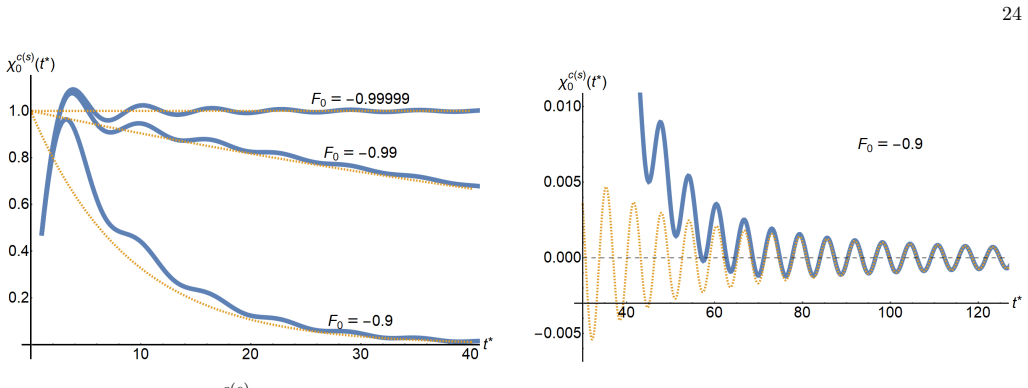
l = 1, longitudinal channel For small positive 1 + Fc(s) 1 , the poles of χlong 1 (s) are given by Eq. (33). Near the poles, χlong 1 (s)∝ 1 (s−s1)(s−s2) +... (110) where ... stands for non-singular terms. Evaluating the residues, we obtain the pole contribution to χlong 1 (t∗)...
-
[14]
We also see that the pole contribution contains two relevant scales t∗ a = [ 2/(1−|Fc(s) 1 |) ]1/2 andt∗ b = 4/(1−|Fc(s) 1 |)
We see that the pole contribution remains dominant up to t∗∼| ln(1−|Fc(s) 1 )|/(1−|Fc(s) 1 |), which becomes progressively larger as |Fc(s) 1 | approaches one. We also see that the pole contribution contains two relevant scales t∗ a = [ 2/(1−|Fc(s) 1 |) ]1/2 andt∗ b = 4/(1−|Fc...
-
[15]
The behavior of χ tr 1 (t∗) is then the same as for the l = 0 case
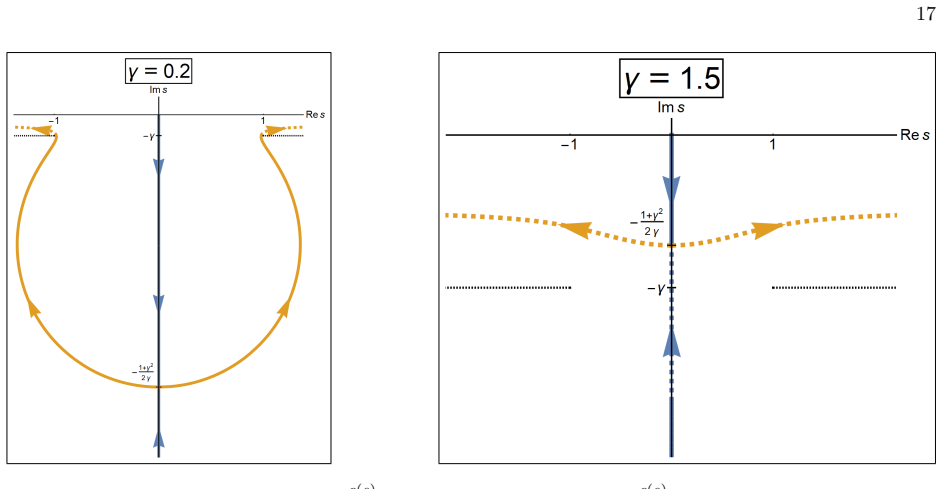
l = 1, transverse channel For small 1 +Fc(s) 1 , the pole in the transverse suscep- tibility for l = 1 is on the imaginary axis. The behavior of χ tr 1 (t∗) is then the same as for the l = 0 case. C. Response in the time domain in the presence of disorder Near Pomeranchuk inst...
-
[16]
What was said above does not apply to the special case of a Galilean-invariant system
= (Λ c(s) 1 )2χc(s) qp,1(q,ω = 0) + χc(s) inc,1 does not diverge at Fc(s) 1 = −1, despite the fact that the quasiparticle susceptibilityχc(s) qp,1(q,ω = 0) diverges as 1/(1 +Fc(s) 1 ). What was said above does not apply to the special case of a Galilean-invariant system. In th...
-
[17]
With this definition, the full longitudinal susceptibility in the l = 1 channel can be written as χc(s),long 1 (s) = −νF ∫ dθ π ∑ l al ¯Λc(s) l (s) coslθ cos2θ s− cosθ +iδ Λc(s) 1 . (119) The vertex ¯Λc(s) l (q,ω ) is given by a series of diagrams which contain momentum and fre...
-
[18]
lecture notes,
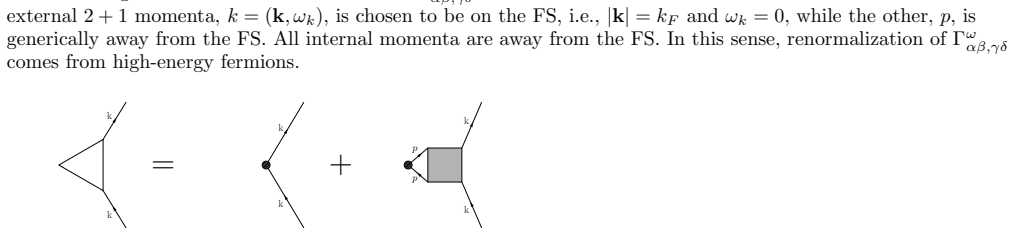
The shaded box is Γ ω αβ,γδ . Γω αβ,γδ (k,p ) = 1 2δαγδβδ [ U +iU2 ∫ d3k′ (2π)3 (2Gk′Gp−k+k′ +Gk′Gp+k−k′) ] − 1 2 σαγ· σβδ [ U +iU2 ∫ d3k′ (2π)3Gk′Gp+k−k′ ] ≡δαγδβδΓc(k,p ) + σαγ· σβδΓs(k,p ), (126) where at the last step we defined the charge and spin parts of the four-fermion...
1959 arXiv
Reviewed August 14, 2026 · model on record in the stance chip above.
Discussion (0). Continue with ORCID to comment.