REVIEW 4 major objections 4 minor 1 cited by
Ultrafast spin dynamics in the proximate quantum spin liquid {\alpha}-RuCl3
T0 review · 4 major / 4 minor · reviewed 2026-08-14 · deepseek-v4-flash
Pith's one-line read Ultrafast pump-probe measurements on α-RuCl3 reveal two picosecond-scale lifetimes in the Kitaev paramagnetic regime, assigned to Majorana fermions and Z2 fluxes.
desk verdict Useful and new in method (complex transient-grating ΔR/R on α-RuCl3) and in reporting two lifetimes in the Kitaev paramagnetic window, but the central claim rests on an unshown optical-phase subtraction in a missing Supplemental Material and an abstract magnetic-field statement that the body never delivers. read the letter →
The pith
A machine-rendered reading of the paper's core claim, the machinery that carries it, and where it could break.
The reading
What carries the argument
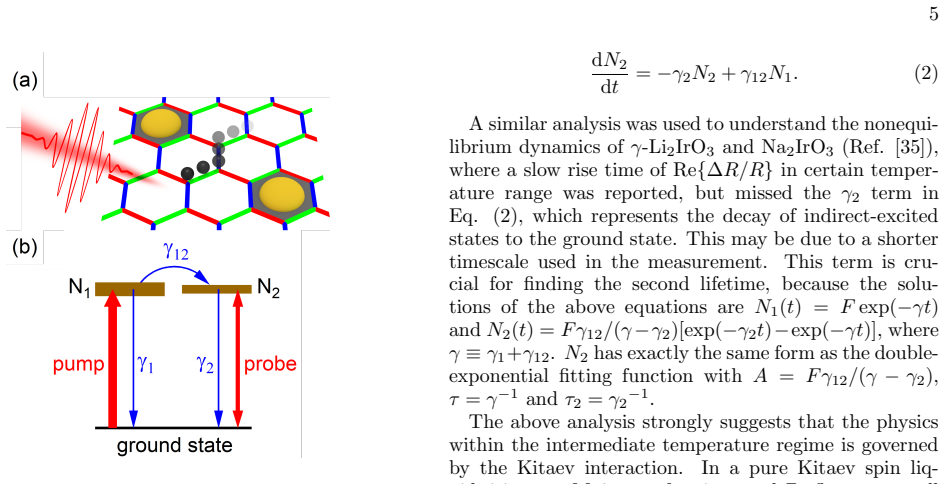
The central object is the complex transient reflectance $\Delta R/R$ measured by heterodyne transient grating spectroscopy, which separates the in-phase part $\mathrm{Re}\{\Delta R/R\}$ and the out-of-phase part $\mathrm{Im}\{\Delta R/R\}$ of the response to a 200 fs pump pulse. The fractional-particle component lives only in $\mathrm{Im}\{\Delta R/R\}$, which is what distinguishes it from ordinary carrier and magnetic dynamics. The analysis is carried by a two-level kinetic model: directly photoexcited states $N_1$ decay with rate $\gamma = \gamma_1 + \gamma_{12}$ either to the ground state or to indirect-excited states $N_2$, which then decay with rate $\gamma_2$; the solution for $N_2$ has exactly the form $A[\exp(-t/\tau_2)-\exp(-t/\tau)]$, with $\tau = \gamma^{-1}$ and $\tau_2 = \gamma_2^{-1}$. This machinery turns the measured double-exponential shape into a physical picture in which direct spin-continuum excitations feed a longer-lived localized population, identified respectively with itinerant Majorana fermions and localized Z2 fluxes of the Kitaev honeycomb model.
What would settle it
A direct check is to measure $\mathrm{Im}\{\Delta R/R\}$ at a fixed temperature in the Kitaev regime while varying pump fluence and polarization, and to let the optical phases of the conventional and magnetic components be free parameters in the fit: if the double-exponential component does not survive as a stable residual, the two-lifetime assignment is an artifact. A complementary check is to compare the extracted temperature dependence of the short lifetime with the Majorana lifetimes computed from quench-dynamics calculations on the Kitaev model over the same temperature range.
Extended reading notes
Core claim
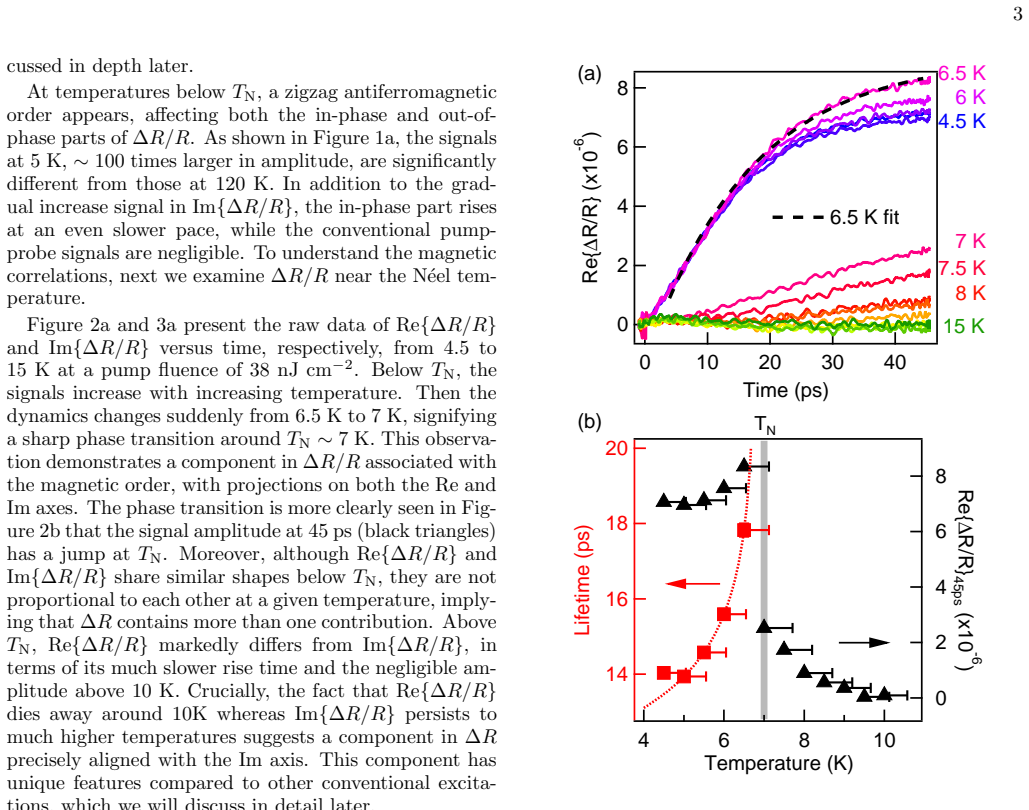
Within the temperature window from the Néel temperature $T_N \approx 7$ K to the Kitaev interaction scale $T_H \approx 100$ K, the imaginary part of the transient reflectance change $\mathrm{Im}\{\Delta R/R\}$ contains a component absent above $T_H$. After subtracting the conventional hot-carrier and magnetic contributions, this component is fit by $A[\exp(-t/\tau_2)-\exp(-t/\tau)]$, with $\tau$ between 1 and 20 ps following a $T^{-1.40}$ power law and $\tau_2 \approx 50$ ps almost independent of temperature; its amplitude follows $T^{-2.45}$. The paper interprets this signal as photoexcited fractional particles: the pump creates spin-continuum excitations that convert into Majorana fermions and Z2 fluxes, with the shorter lifetime set by Majorana decay, limited by spin-phonon scattering, and the longer one by localized flux decay. Below $T_N$, a separate component tied to zigzag antiferromagnetic order shows divergent lifetime and amplitude at the phase transition.
Load-bearing premise
The load-bearing premise is that the conventional hot-carrier and magnetic contributions can be cleanly removed from $\mathrm{Im}\{\Delta R/R\}$ by subtracting them using optical phases fixed at reference temperatures, leaving a genuine fractional-particle component; the subtraction itself is not shown in the main text but deferred to the Supplemental Material.
Editorial extensions
If this is right
- The two measured lifetimes give concrete timescales for fractional-particle dynamics in α-RuCl3, tens of picoseconds or shorter, which any scheme for braiding these excitations would have to respect.
- Because the shorter lifetime and the amplitude fall as power laws in temperature, heating quickly suppresses the fractional-particle signal, so low-temperature operation is essential.
- The disappearance of the component near 100 K tracks the crossover out of the Kitaev paramagnet, making transient reflectance a possible probe of the Kitaev interaction scale.
- The two-level solution implies the direct photoexcitation population is converted into the longer-lived state rather than simply decaying, so the observed rise time of the indirect component is set by the same physics as the short lifetime.
Reading between the lines
- Inference beyond the paper: applying an in-plane magnetic field toward the field-induced spin-liquid phase should reshape the two lifetimes if they are truly Majorana and flux dynamics, since the paper's experiment is zero-field.
- Inference beyond the paper: if the temperature dependence of the short lifetime is set by spin-phonon scattering, then isotope substitution or pressure, which alter the phonon spectrum, should change the observed power-law exponent and the 50 ps plateau.
- Inference beyond the paper: the phase-subtraction step could be tested by repeating the analysis with the optical phase of the background contributions left as a free fit parameter; a stable double-exponential residual would strongly support the paper's interpretation.
Signed reviews
Editorial analysis
A structured set of objections, weighed in public.
Referee Report
Summary. The paper reports time-resolved heterodyne transient grating measurements of the complex transient reflectance ΔR/R of α-RuCl3 between 4.5 K and 120 K. Below TN≈7 K, Re{ΔR/R} shows a divergent component attributed to critical spin fluctuations. In the intermediate 'Kitaev paramagnetic' regime (7–100 K), the authors identify an out-of-phase component that, after subtracting conventional hot-carrier and magnetic contributions, is fit by A[exp(−t/τ2)−exp(−t/τ)]. The extracted short lifetime τ ranges from 1 to 20 ps and follows a fitted power law T^{−1.40}; the long lifetime τ2≈50 ps is nearly temperature independent. The amplitude follows T^{−2.45}. The authors propose a coupled two-level model, Eqs. (1)–(2), whose solution reproduces the fitting form, and interpret τ as the Majorana fermion lifetime and τ2 as the Z2 flux lifetime, with the fractional-particle identification carried from prior literature.
Significance. If the central extraction is valid, this would be a rare time-domain measurement of fractionalized-excitation lifetimes in a proximate Kitaev spin liquid, and the use of the imaginary part of ΔR/R to isolate a new channel is an interesting methodological step. The critical-fluctuation behavior near TN is a useful confirmation of earlier pump-probe work. However, the central claim currently rests on a subtraction procedure that is not shown in the manuscript and is deferred to a Supplemental Material that is absent from the posted version. The abstract also advertises in-plane magnetic-field sensitivity that is never presented in the body. The paper's strengths are its novel technique and the clear presentation of raw complex reflectance data at representative temperatures, but the load-bearing evidence for the two-lifetime fractional-particle component is not independently verifiable as submitted.
major comments (4)
- [Main text near Fig. 3 and Fig. 3 caption] The isolation of the claimed fractional-particle component is the central empirical result, yet the only description is: 'we first determine their optical phases and then subtract their contributions from Im{ΔR/R} correspondingly (see Supplemental Material)', and the caption states that the extraction method is in the Supplemental Material. The posted v1 contains no Supplemental Material. Because conventional and magnetic contributions have projections on both Re and Im axes, the residual Im{ΔR/R} is defined only after subtracting two large decaying components; if either phase is misestimated, the residual can acquire a rise-and-decay shape that mimics A[exp(−t/τ2)−exp(−t/τ)]. The main text must show representative raw traces, the phase determination, the subtracted components, the resulting residual, and the fits, so that the two-lifetime claim can be checked.
- [Abstract and 'Photoinduced spin liquids' section] The abstract states that the photoexcitation component is 'sensitive to the in-plane magnetic field', but no magnetic-field measurement appears anywhere in the body or figures. This is a claim advertised in the abstract without supporting data. Either the field-dependent data should be added and analyzed, or the claim should be removed from the abstract.
- [Eqs. (1)-(2) and the paragraph following Fig. 4] The coupled differential equations are solved exactly into the same double-exponential function used for fitting, with τ=γ^{-1} and τ2=γ2^{-1}. Consequently the agreement of the model with the data is not a test of the fractional-particle interpretation; it is a restatement of the fit. The text should explicitly characterize the two-level model as a minimal phenomenological parametrization of the extracted two-time signal, and the assignment of τ to Majorana fermions and τ2 to Z2 fluxes as a hypothesis supported by prior literature (Refs. 18–22, 34, 50–54) rather than by a derived prediction from the model.
- [Fig. 3(c,d) and text discussing T^{-1.40} and T^{-2.45}] The power laws τ∝T^{-1.40} and A∝T^{-2.45} are fitted to the extracted values between 10 and 60 K; they are not derived from the Kitaev model or from any microscopic calculation. The text should distinguish these empirical fits from predicted behavior, especially because the abstract and introduction imply that the measurements 'reveal' a specific temperature dependence. This distinction matters for the reader's assessment of what is measured versus what is assumed.
minor comments (4)
- [Title and abstract] The title 'Ultrafast dynamics of fractional particles in α-RuCl3' is stronger than the evidence presented; a more cautious title such as 'Ultrafast spin dynamics in the proximate quantum spin liquid α-RuCl3' (as used in the arXiv metadata) would better match the tentative nature of the fractional-particle assignment.
- [Fig. 1 caption] The caption uses many undefined abbreviations (hot-c, e-h, e-ph) that are only explained in a long parenthetical at the end; defining them at first use would improve readability.
- [Paragraph beginning 'In the intermediate temperature regime'] The text says the signal 'can be fit with a double-exponential function' but does not state the fitting range, the number of free parameters, or whether an offset is included. Adding these details, even briefly, would help the reader judge the fit quality.
- [Fig. 3(c,d)] The two pump fluences are claimed to give overlapping amplitudes and lifetimes, but the figure does not clearly distinguish the two data sets by symbol shape; separate symbols or a legend entry would make this assertion verifiable.
Circularity Check
No circularity: the coupled-ODE model is an acknowledged post-hoc parametrization of the measured two-lifetime signal, not an independent derivation; the physical assignment rests on external prior work rather than on self-citation.
full rationale
The paper's chain is: (i) measure complex ΔR/R; (ii) in the Kitaev paramagnetic window subtract conventional and magnetic contributions from Im{ΔR/R} using optical phases (deferred to the Supplemental Material) to isolate a residual; (iii) fit that residual to A[exp(-t/τ2)-exp(-t/τ)]; (iv) write coupled rate equations (1)-(2) whose exact solution for N2 is the same double-exponential; (v) interpret τ and τ2 as Majorana and flux lifetimes. Step (iv) is an explicit post-hoc parametrization, not a first-principles derivation: the paper states 'N2 has exactly the same form as the double-exponential fitting function' and calls the model 'minimal.' It does not claim to predict the lifetimes from the Kitaev Hamiltonian, nor does it present a fitted parameter as an independent prediction. The physical assignment draws on external neutron, Raman and thermal-Hall results (Refs. 18-22, 50-54) rather than on a self-citation chain that forbids alternatives. The missing Supplemental Material is an evidentiary gap, not a circular step. Hence no circularity is identified.
Assumptions & free parameters
free parameters (5)
- Short lifetime τ(T) =
1-20 ps over 10-60 K, τ ∝ T^{-1.40 ± 0.05}
- Long lifetime τ2(T) =
≈ 55 ps, nearly T-independent
- Amplitude A(T) =
A ∝ T^{-2.45 ± 0.21}
- Power-law exponent for τ =
-1.40 ± 0.05
- Optical phases of conventional and magnetic contributions =
not given (Supplemental Material)
assumptions (3)
- standard math The solution of the linear coupled ODEs (Eqs. 1-2) describes the photoinduced dynamics.
- domain assumption α-RuCl3 between TN≈7 K and TH≈100 K is a proximate Kitaev paramagnet in which fractional particles can be photoexcited.
- domain assumption The residual Im{ΔR/R} after subtraction of conventional and magnetic components is a single new photoexcitation component.
invented entities (1)
-
Photoinduced fractional-particle component in Im{ΔR/R}
Cite this review
Pith. "Pith review of Ultrafast spin dynamics in the proximate quantum spin liquid {\alpha}-RuCl3." pith.science (2026). https://pith.science/paper/LCXALZE5
@misc{pith2026190804807,
  author       = {Pith},
  title        = {Pith review of: Ultrafast spin dynamics in the proximate quantum spin liquid \alpha-RuCl3},
  year         = {2026},
  howpublished = {\url{https://pith.science/paper/LCXALZE5}},
  note         = {Machine review of arXiv:1908.04807}
}
read the original abstract
{\alpha}-RuCl3 is a Kitaev material suggested to be a proximate quantum spin liquid in a certain temperature and magnetic field range. Nonequilibrium measurements of transient dynamics have been proposed to detect fractionalized particles that emerge in the spin liquid and to possibly drive the system into novel photoinduced magnetic states that cannot be accessed by conventional equilibrium probes. Here we study ultrafast spin dynamics of photoinduced excitations in {\alpha}-RuCl3 using pump-probe transient grating spectroscopy. In the real part of the complex transient reflectance change {\Delta}R/R, we observe the long-range antiferromagnetic correlation near the N\'eel temperature. Most intriguingly, above the N\'eel temperature in the Kitaev paramagnetic phase, we reveal a photoexcitation component sensitive to the in-plane magnetic field in the imaginary part of {\Delta}R/R. This component exhibits two distinct lifetimes of about tens of picoseconds. This photoexcitation component may be connected to novel photoexcited states in the Kitaev quantum spin liquid, and its lifetimes likely reflect the dynamics of unconventional spin excitations in the Kitaev model.
Figures


Figures from the paper (1 more)
Forward citations
Cited by 1 Pith paper
-
Hunting Majorana Fermions in Kitaev Magnets
A review of theoretical and experimental evidence that Kitaev magnets exhibit thermal fractionalization into Majorana fermions and Z2 fluxes, with the half-quantized thermal Hall effect as the strongest proposed signature.
Reference graph
Works this paper leans on
-
[1]
Kitaev, Annals of Physics January Special Issue, 321, 2 (2006)
A. Kitaev, Annals of Physics January Special Issue, 321, 2 (2006)
work page 2006
-
[2]
G. Baskaran, S. Mandal, and R. Shankar, Phys. Rev. Lett. 98, 247201 (2007)
work page 2007
-
[3]
Savary and L
L. Savary and L. Balents, Rep. Prog. Phys. 80, 016502 (2016)
2016
-
[4]
Balents, Nature 464, 199 (2010)
L. Balents, Nature 464, 199 (2010)
2010
-
[5]
Witczak-Krempa, G
W. Witczak-Krempa, G. Chen, Y. B. Kim, and L. Ba- lents, Annual Review of Condensed Matter Physics 5, 57 (2014)
2014
-
[6]
S. M. Winter, A. A. Tsirlin, M. Daghofer, J. van den Brink, Y. Singh, P. Gegenwart, and R. Valent´ ı, J. Phys.: Condens. Matter 29, 493002 (2017)
work page 2017
-
[7]
J. G. Rau, E. K.-H. Lee, and H.-Y. Kee, Annual Review of Condensed Matter Physics 7, 195 (2016)
2016
-
[8]
Y. Zhou, K. Kanoda, and T.-K. Ng, Rev. Mod. Phys. 89, 025003 (2017)
2017
Show all 55 references
-
[9]
Takagi, T
H. Takagi, T. Takayama, G. Jackeli, G. Khaliullin, and S. E. Nagler, Nature Reviews Physics 1, 264 (2019)
2019
-
[10]
Jackeli and G
G. Jackeli and G. Khaliullin, Phys. Rev. Lett. 102, 017205 (2009)
2009
-
[11]
H.-S. Kim, V. S. V., A. Catuneanu, and H.-Y. Kee, Phys. Rev. B 91, 241110 (2015)
2015
-
[12]
K. W. Plumb, J. P. Clancy, L. J. Sandilands, V. V. Shankar, Y. F. Hu, K. S. Burch, H.-Y. Kee, and Y.- J. Kim, Phys. Rev. B 90, 041112 (2014)
2014
-
[13]
Chaloupka, G
J. Chaloupka, G. Jackeli, and G. Khaliullin, Phys. Rev. Lett. 105, 027204 (2010)
2010
-
[14]
Singh, S
Y. Singh, S. Manni, J. Reuther, T. Berlijn, R. Thomale, W. Ku, S. Trebst, and P. Gegenwart, Phys. Rev. Lett. 108, 127203 (2012)
2012
-
[15]
X. Liu, T. Berlijn, W.-G. Yin, W. Ku, A. Tsvelik, Y.-J. Kim, H. Gretarsson, Y. Singh, P. Gegenwart, and J. P. Hill, Phys. Rev. B 83, 220403 (2011)
2011
-
[16]
J. A. Sears, M. Songvilay, K. W. Plumb, J. P. Clancy, Y. Qiu, Y. Zhao, D. Parshall, and Y.-J. Kim, Phys. Rev. B 91, 144420 (2015)
2015
-
[17]
J. G. Rau, E. K.-H. Lee, and H.-Y. Kee, Phys. Rev. Lett. 112, 077204 (2014)
2014
-
[18]
L. J. Sandilands, Y. Tian, K. W. Plumb, Y.-J. Kim, and K. S. Burch, Phys. Rev. Lett. 114, 147201 (2015)
2015
-
[19]
Banerjee, C
A. Banerjee, C. A. Bridges, J.-Q. Yan, A. A. Aczel, L. Li, M. B. Stone, G. E. Granroth, M. D. Lumsden, Y. Yiu, J. Knolle, S. Bhattacharjee, D. L. Kovrizhin, R. Moess- ner, D. A. Tennant, D. G. Mandrus, and S. E. Nagler, Nature Materials 15, 733 (2016)
2016
-
[20]
Banerjee, J
A. Banerjee, J. Yan, J. Knolle, C. A. Bridges, M. B. Stone, M. D. Lumsden, D. G. Mandrus, D. A. Tennant, R. Moessner, and S. E. Nagler, Science 356, 1055 (2017)
2017
-
[21]
Do, S.-Y
S.-H. Do, S.-Y. Park, J. Yoshitake, J. Nasu, Y. Motome, Y. S. Kwon, D. T. Adroja, D. J. Voneshen, K. Kim, T.-H. Jang, J.-H. Park, K.-Y. Choi, and S. Ji, Nature Physics 13, 1079 (2017)
2017
-
[22]
Kasahara, T
Y. Kasahara, T. Ohnishi, Y. Mizukami, O. Tanaka, S. Ma, K. Sugii, N. Kurita, H. Tanaka, J. Nasu, Y. Mo- tome, T. Shibauchi, and Y. Matsuda, Nature 559, 227 (2018)
2018
-
[23]
K. Ran, J. Wang, W. Wang, Z.-Y. Dong, X. Ren, S. Bao, S. Li, Z. Ma, Y. Gan, Y. Zhang, J. T. Park, G. Deng, S. Danilkin, S.-L. Yu, J.-X. Li, and J. Wen, Phys. Rev. Lett. 118, 107203 (2017)
2017
-
[24]
S. K. Choi, R. Coldea, A. N. Kolmogorov, T. Lancaster, I. I. Mazin, S. J. Blundell, P. G. Radaelli, Y. Singh, P. Gegenwart, K. R. Choi, S.-W. Cheong, P. J. Baker, C. Stock, and J. Taylor, Phys. Rev. Lett. 108, 127204 (2012)
2012
-
[25]
Glamazda, P
A. Glamazda, P. Lemmens, S.-H. Do, Y. S. Choi, and K.-Y. Choi, Nature Communications 7, 12286 (2016)
2016
-
[26]
A. N. Ponomaryov, E. Schulze, J. Wosnitza, P. Lampen- Kelley, A. Banerjee, J.-Q. Yan, C. A. Bridges, D. G. Mandrus, S. E. Nagler, A. K. Kolezhuk, and S. A. Zvya- gin, Phys. Rev. B 96, 241107 (2017)
2017
-
[27]
Baek, S.-H
S.-H. Baek, S.-H. Do, K.-Y. Choi, Y. S. Kwon, A. U. B. Wolter, S. Nishimoto, J. van den Brink, and B. B¨ uchner, Phys. Rev. Lett. 119, 037201 (2017)
2017
-
[28]
Zheng, K
J. Zheng, K. Ran, T. Li, J. Wang, P. Wang, B. Liu, Z.-X. Liu, B. Normand, J. Wen, and W. Yu, Phys. Rev. Lett. 119, 227208 (2017)
2017
-
[29]
Janˇ sa, A
N. Janˇ sa, A. Zorko, M. Gomilˇ sek, M. Pregelj, K. W. Kr¨ amer, D. Biner, A. Biffin, C. R¨ uegg, and M. Klanjˇ sek, Nature Physics 14, 786 (2018)
2018
-
[30]
Z. Wang, S. Reschke, D. H¨ uvonen, S.-H. Do, K.-Y. Choi, M. Gensch, U. Nagel, T. R˜ o˜ om, and A. Loidl, Phys. Rev. Lett. 119, 227202 (2017)
2017
-
[31]
Little, L
A. Little, L. Wu, P. Lampen-Kelley, A. Banerjee, S. Patankar, D. Rees, C. A. Bridges, J.-Q. Yan, D. Man- drus, S. E. Nagler, and J. Orenstein, Phys. Rev. Lett. 119, 227201 (2017)
2017
-
[32]
L. Wu, A. Little, E. E. Aldape, D. Rees, E. Thewalt, P. Lampen-Kelley, A. Banerjee, C. A. Bridges, J.-Q. Yan, D. Boone, S. Patankar, D. Goldhaber-Gordon, D. Man- drus, S. E. Nagler, E. Altman, and J. Orenstein, Phys. Rev. B 98, 094425 (2018)
2018
-
[33]
L. Y. Shi, Y. Q. Liu, T. Lin, M. Y. Zhang, S. J. Zhang, 7 L. Wang, Y. G. Shi, T. Dong, and N. L. Wang, Phys. Rev. B 98, 094414 (2018)
2018
-
[34]
Nonequilibrium Majorana Dy- namics by Quenching a Magnetic Field in Kitaev Spin Liquids,
J. Nasu and Y. Motome, “Nonequilibrium Majorana Dy- namics by Quenching a Magnetic Field in Kitaev Spin Liquids,” (2019), arXiv:1905.10984
2019 arXiv
-
[35]
J. P. Hinton, S. Patankar, E. Thewalt, A. Ruiz, G. Lopez, N. Breznay, A. Vishwanath, J. Analytis, J. Orenstein, J. D. Koralek, and I. Kimchi, Phys. Rev. B 92, 115154 (2015)
2015
-
[36]
Nembrini, S
N. Nembrini, S. Peli, F. Banfi, G. Ferrini, Y. Singh, P. Gegenwart, R. Comin, K. Foyevtsova, A. Damascelli, A. Avella, and C. Giannetti, Phys. Rev. B 94, 201119 (2016)
2016
-
[37]
Alpichshev, F
Z. Alpichshev, F. Mahmood, G. Cao, and N. Gedik, Phys. Rev. Lett. 114, 017203 (2015)
2015
-
[38]
Alpichshev, E
Z. Alpichshev, E. J. Sie, F. Mahmood, G. Cao, and N. Gedik, Phys. Rev. B 96, 235141 (2017)
2017
-
[39]
Gedik, J
N. Gedik, J. Orenstein, R. Liang, D. A. Bonn, and W. N. Hardy, Science 300, 1410 (2003)
2003
-
[40]
D. H. Torchinsky, F. Mahmood, A. T. Bollinger, I. Boˇ zovi´ c, and N. Gedik, Nature Materials 12, 387 (2013)
2013
-
[41]
J. P. Hinton, Quasiparticle Coherence, Collective Modes, and Competing Order in Cuprate Superconductors , Ph.D. thesis (2014)
2014
-
[42]
R. P. Prasankumar and A. J. Taylor, Optical Techniques for Solid-State Materials Characterization (CRC Press, Boca Raton, 2012) oCLC: 755911638
2012
-
[43]
Y. Xu, R. Wang, S. Ma, L. Zhou, Y. R. Shen, and C. Tian, Journal of Applied Physics 123, 025301 (2018)
2018
-
[44]
Hentrich, A
R. Hentrich, A. U. B. Wolter, X. Zotos, W. Brenig, D. Nowak, A. Isaeva, T. Doert, A. Banerjee, P. Lampen- Kelley, D. G. Mandrus, S. E. Nagler, J. Sears, Y.-J. Kim, B. B¨ uchner, and C. Hess, Phys. Rev. Lett. 120, 117204 (2018)
2018
-
[45]
Widmann, V
S. Widmann, V. Tsurkan, D. A. Prishchenko, V. G. Mazurenko, A. A. Tsirlin, and A. Loidl, Phys. Rev. B 99, 094415 (2019)
2019
-
[46]
Koopmans, J
B. Koopmans, J. J. M. Ruigrok, F. D. Longa, and W. J. M. de Jonge, Phys. Rev. Lett. 95, 267207 (2005)
2005
-
[47]
Ogasawara, K
T. Ogasawara, K. Ohgushi, Y. Tomioka, K. S. Takahashi, H. Okamoto, M. Kawasaki, and Y. Tokura, Phys. Rev. Lett. 94, 087202 (2005)
2005
-
[48]
T. Kise, T. Ogasawara, M. Ashida, Y. Tomioka, Y. Tokura, and M. Kuwata-Gonokami, Phys. Rev. Lett. 85, 1986 (2000)
2000
-
[49]
C. L. S. Kantner, M. C. Langner, W. Siemons, J. L. Blok, G. Koster, A. J. H. M. Rijnders, R. Ramesh, and J. Orenstein, Phys. Rev. B 83, 134432 (2011)
2011
-
[50]
J. S. Gordon, A. Catuneanu, E. S. Sørensen, and H.-Y. Kee, Nature Communications 10, 2470 (2019)
2019
-
[51]
Knolle, D
J. Knolle, D. L. Kovrizhin, J. T. Chalker, and R. Moess- ner, Phys. Rev. Lett. 112, 207203 (2014)
2014
-
[52]
Song, Y.-Z
X.-Y. Song, Y.-Z. You, and L. Balents, Phys. Rev. Lett. 117, 037209 (2016)
2016
-
[53]
Knolle, G.-W
J. Knolle, G.-W. Chern, D. L. Kovrizhin, R. Moessner, and N. B. Perkins, Phys. Rev. Lett. 113, 187201 (2014)
2014
-
[54]
Perreault, J
B. Perreault, J. Knolle, N. B. Perkins, and F. J. Burnell, Phys. Rev. B 92, 094439 (2015)
2015
-
[55]
I. A. Leahy, C. A. Pocs, P. E. Siegfried, D. Graf, S.-H. Do, K.-Y. Choi, B. Normand, and M. Lee, Phys. Rev. Lett. 118, 187203 (2017)
2017
Reviewed August 14, 2026 · model on record in the stance chip above.
Discussion (0). Continue with ORCID to comment.